← Original paper

Leaving Cert Ordinary Maths 2022 · Paper 1

Teacher worked solutions. Explanations are in blue.

Question 1

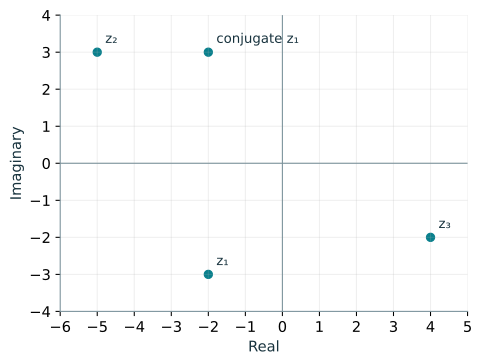
a–b) Values and plots

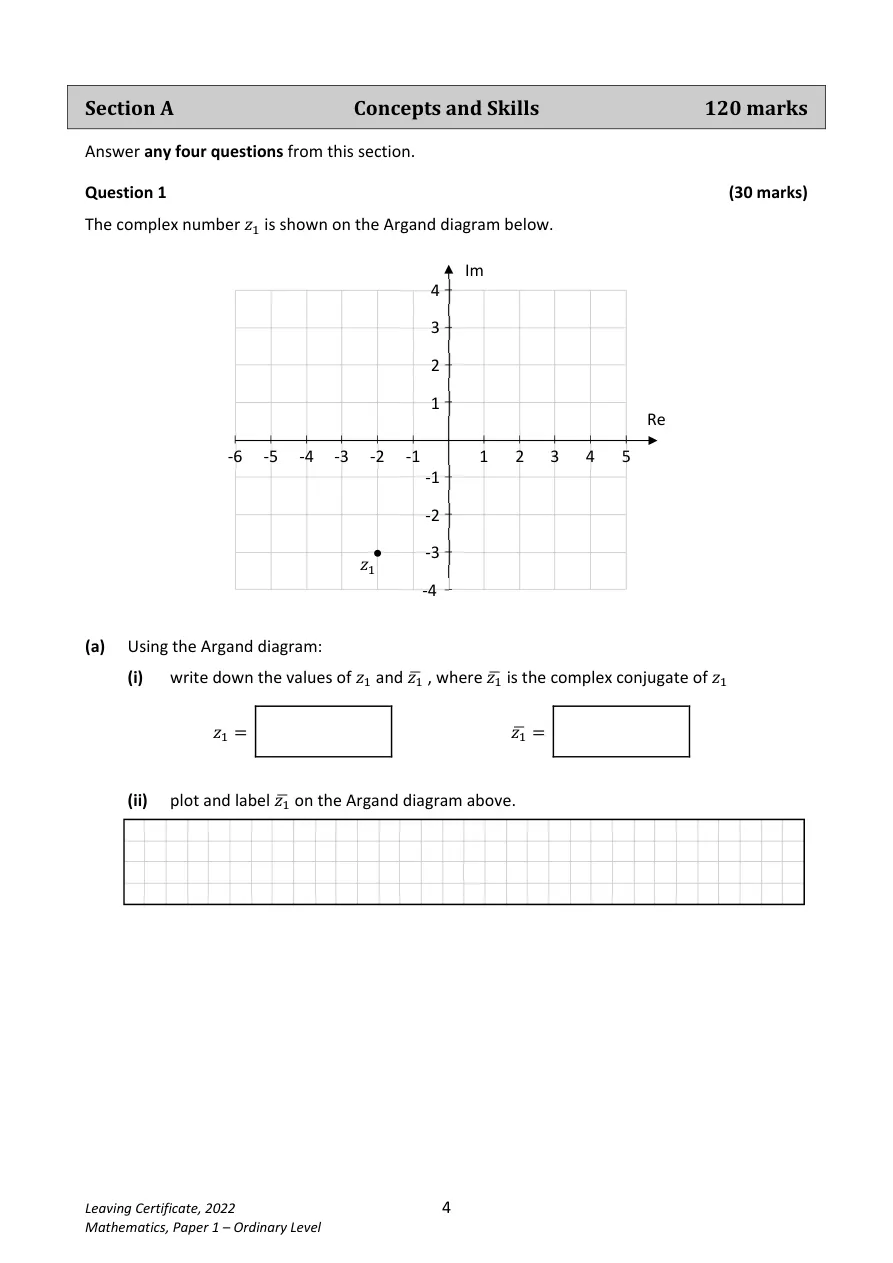
  1. z_1=-2-3i
  2. \overline{z_1}=-2+3i
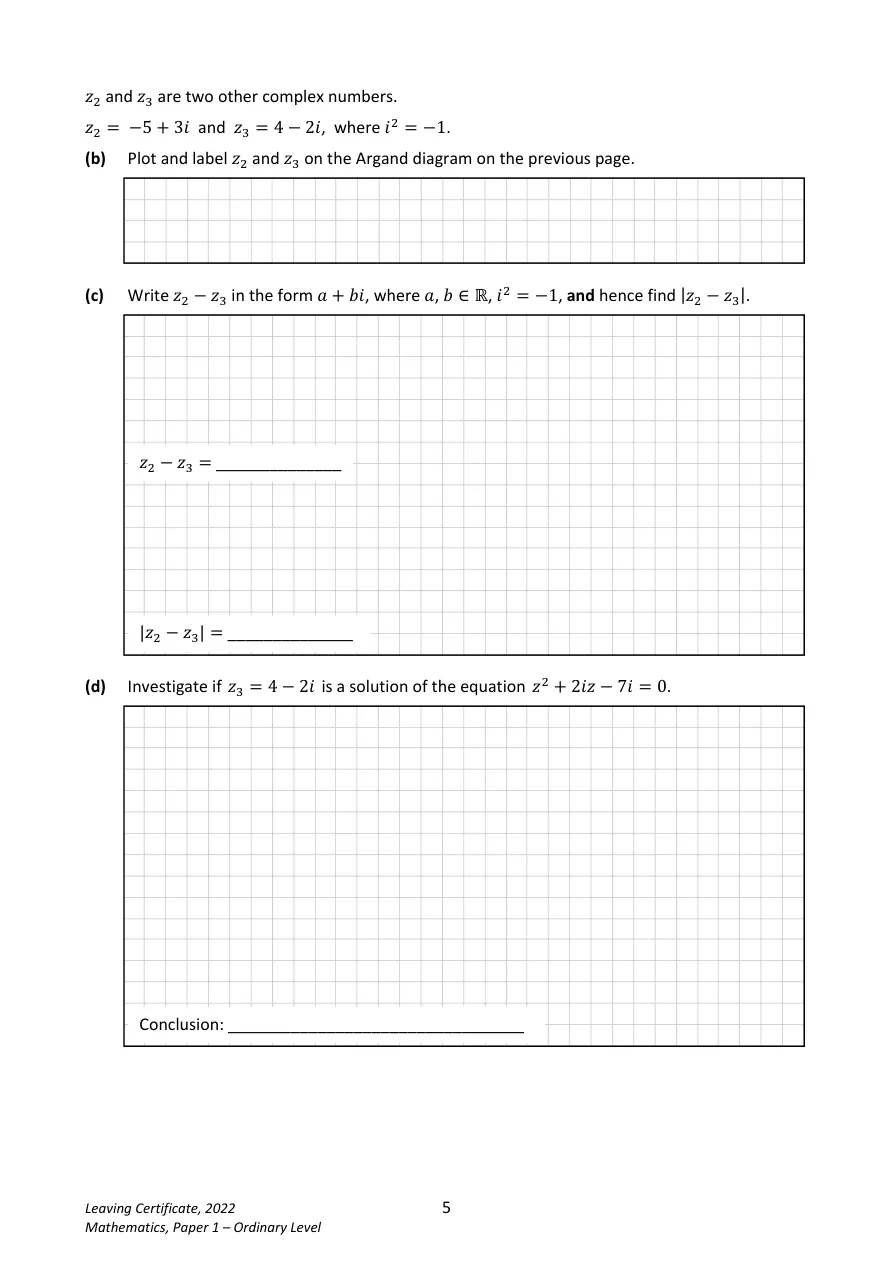
  3. z_2=-5+3i,\quad z_3=4-2i
  4. 2022-1-1-argand

c) Subtract and find modulus

  1. z_2-z_3=(-5+3i)-(4-2i)
  2. z_2-z_3=-9+5i
  3. |z_2-z_3|=\sqrt{(-9)^2+5^2}
  4. |z_2-z_3|=\sqrt{106}

d) Test a possible root

  1. z^2+2iz-7i=(4-2i)^2+2i(4-2i)-7i
  2. =16-16i-4+8i+4-7i
  3. =16-15i
  4. 16-15i\neq0
  5. z₃ is not a solution of the equation.
Question 2

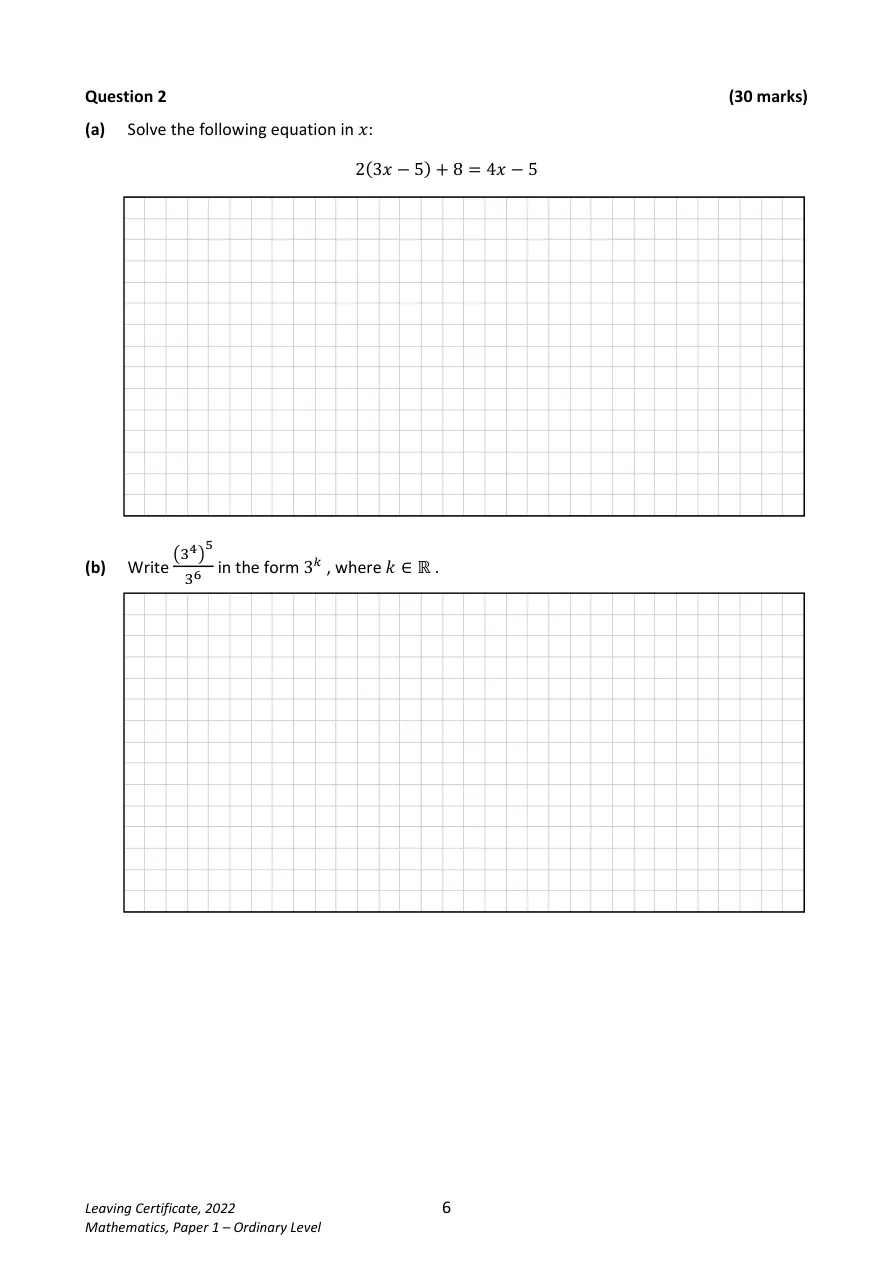
a) Solve

  1. 6x-10+8=4x-5
  2. 2x=-3
  3. x=-\dfrac{3}{2}

b) Index laws

  1. \dfrac{(3^4)^5}{3^6}=3^{20-6}
  2. =3^{14}

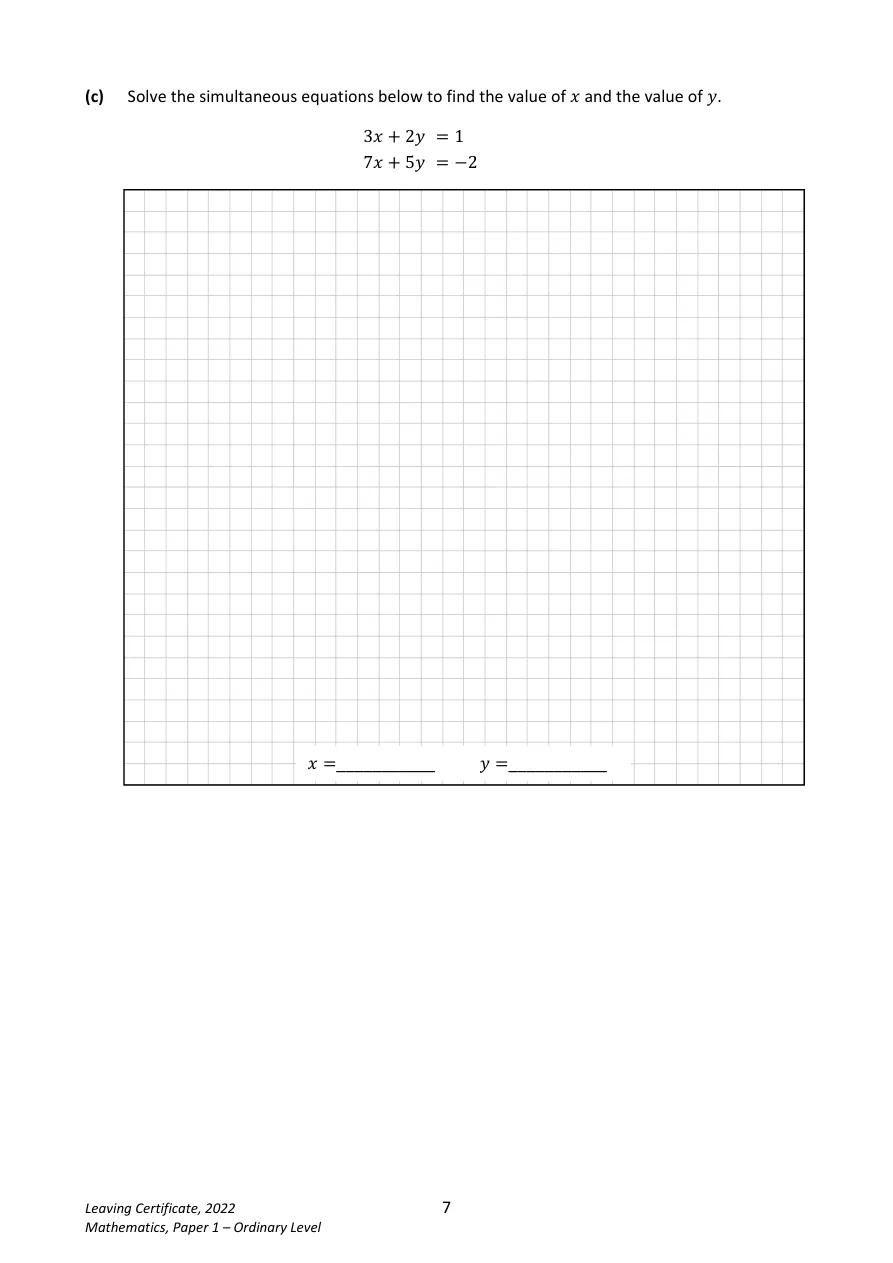
c) Simultaneous equations

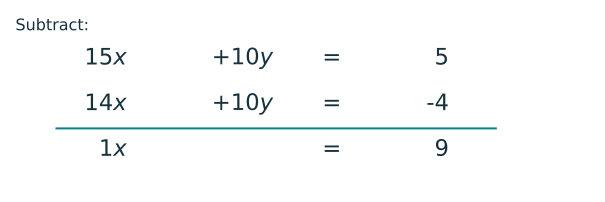
  1. 15x+10y=5

    Multiply the first equation by five.

  2. 14x+10y=-4

    Multiply the second equation by two.

  3. x=9

    Subtract the second equation from the first. The two 10y terms cancel, and 5 − (−4) = 9.

  4. 2022-1-2-elimination
  5. 3(9)+2y=1
  6. 2y=-26
  7. y=-13

Question 3

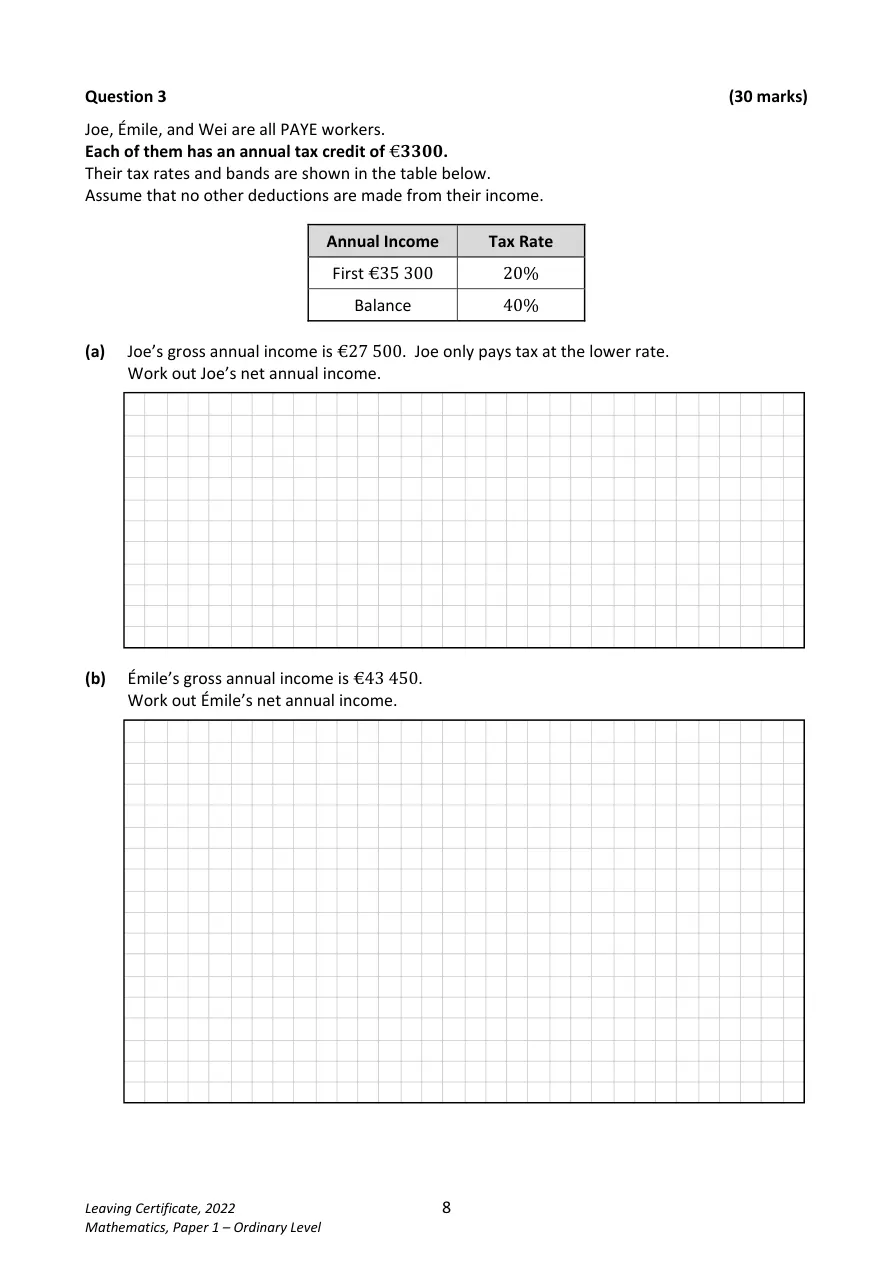
a) Joe

  1. Use the tax bands and credits supplied in the question, rather than current tax rules.
  2. T=27500(0.2)-3300
  3. T=2200\ \mathrm{euro}
  4. N=27500-2200
  5. N=25300\ \mathrm{euro}

b) Émile

  1. T=35300(0.2)+(43450-35300)(0.4)-3300
  2. T=7060+3260-3300
  3. T=7020\ \mathrm{euro}
  4. N=43450-7020
  5. N=36430\ \mathrm{euro}

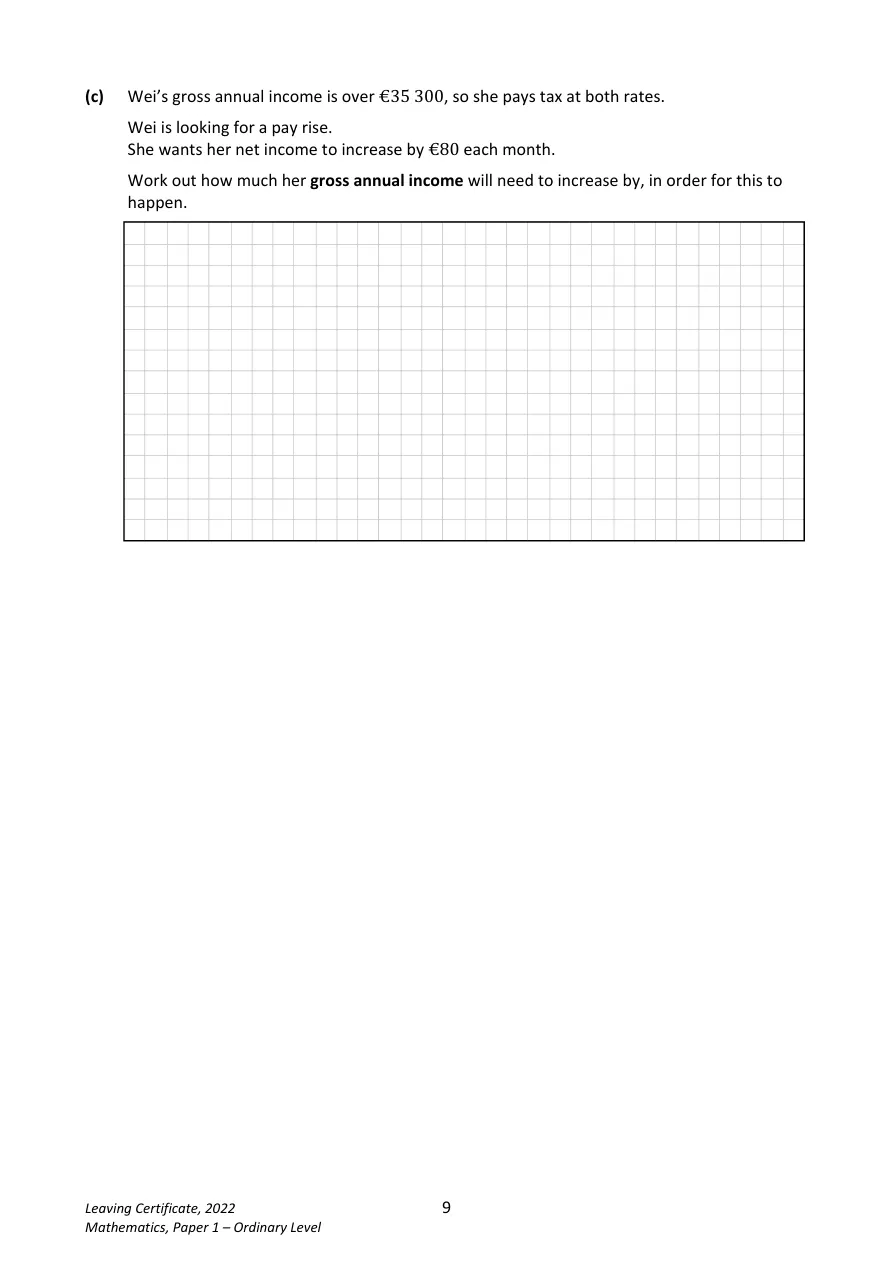
c) Wei's pay rise

  1. \Delta N=12(80)=960\ \mathrm{euro}
  2. 0.6\Delta G=960

    Wei keeps 60% of the extra gross pay after 40% tax.

  3. \Delta G=\dfrac{960}{0.6}
  4. \Delta G=1600\ \mathrm{euro}

Question 4

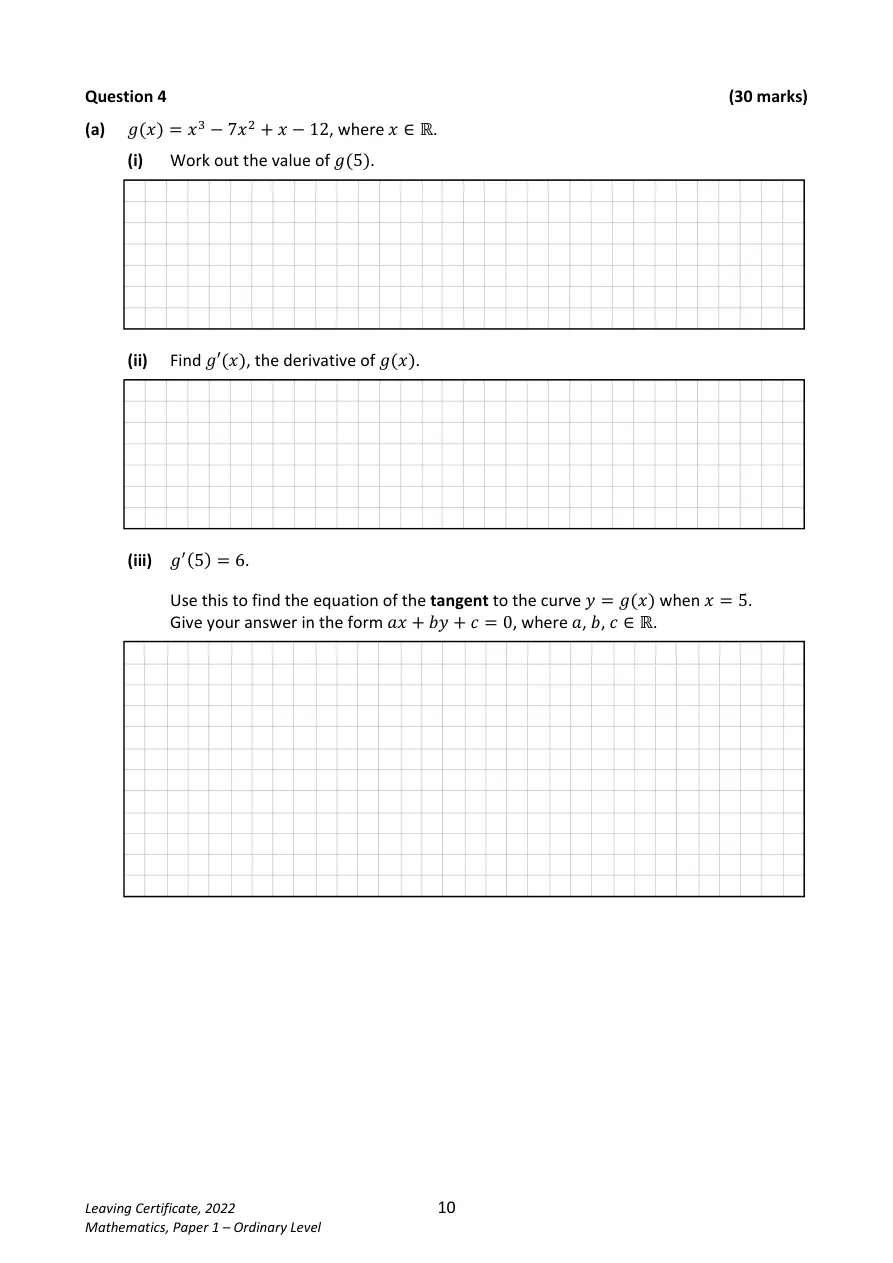
a) Polynomial g

  1. g(5)=5^3-7(5)^2+5-12
  2. g(5)=-57
  3. g'(x)=3x^2-14x+1
  4. y+57=6(x-5)
  5. y=6x-87
  6. 6x-y-87=0

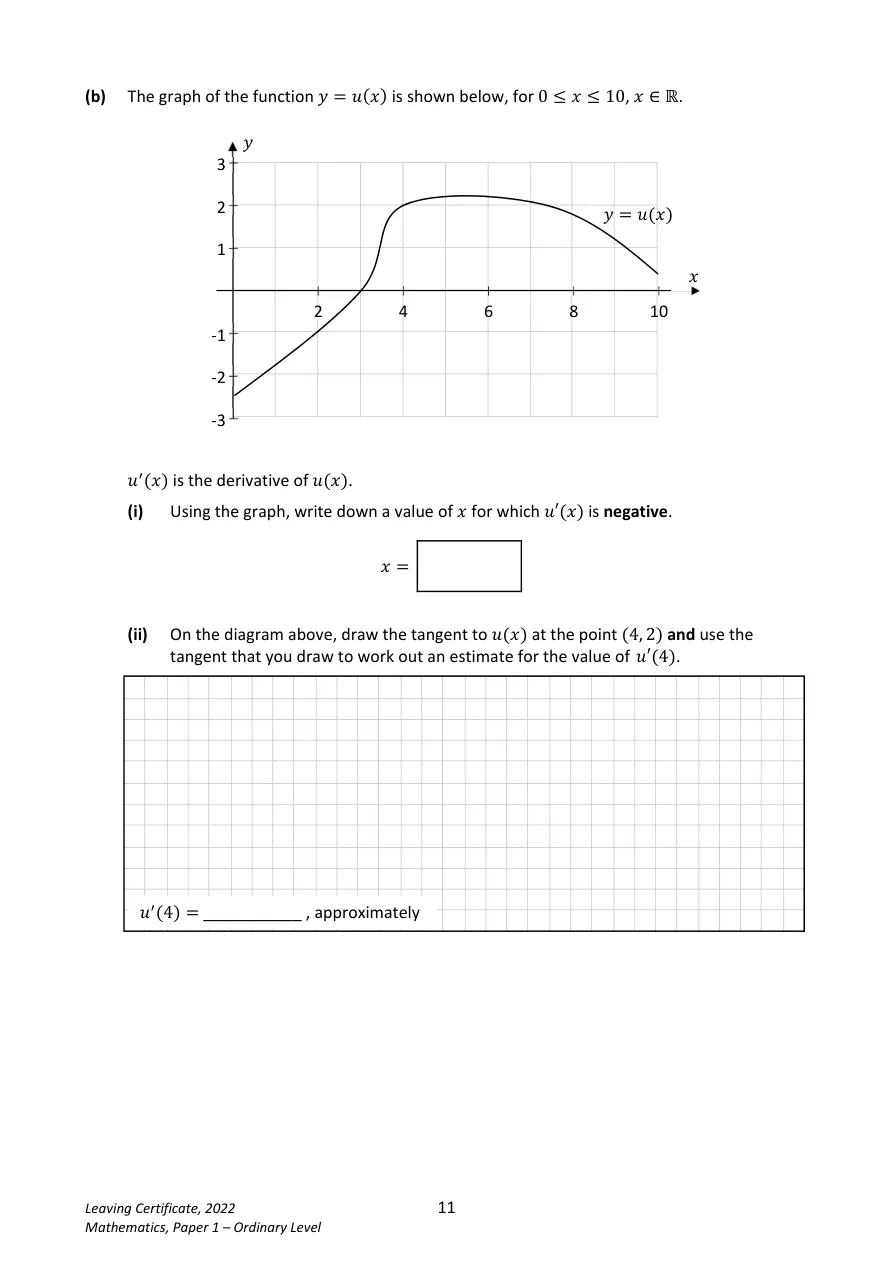
b) Tangent to u

  1. For example x = 8 gives a negative derivative because the curve is decreasing there. Draw a straight tangent touching the curve at (4, 2), with the same local direction as the curve.
  2. u'(4)\approx\dfrac{2}{4}
  3. u'(4)\approx0.5

    Estimate rise over run using two well-separated points on your tangent.

  4. A suitable tangent is approximately y − 2 = 0.5(x − 4). The answer depends slightly on the tangent drawn.

Question 5

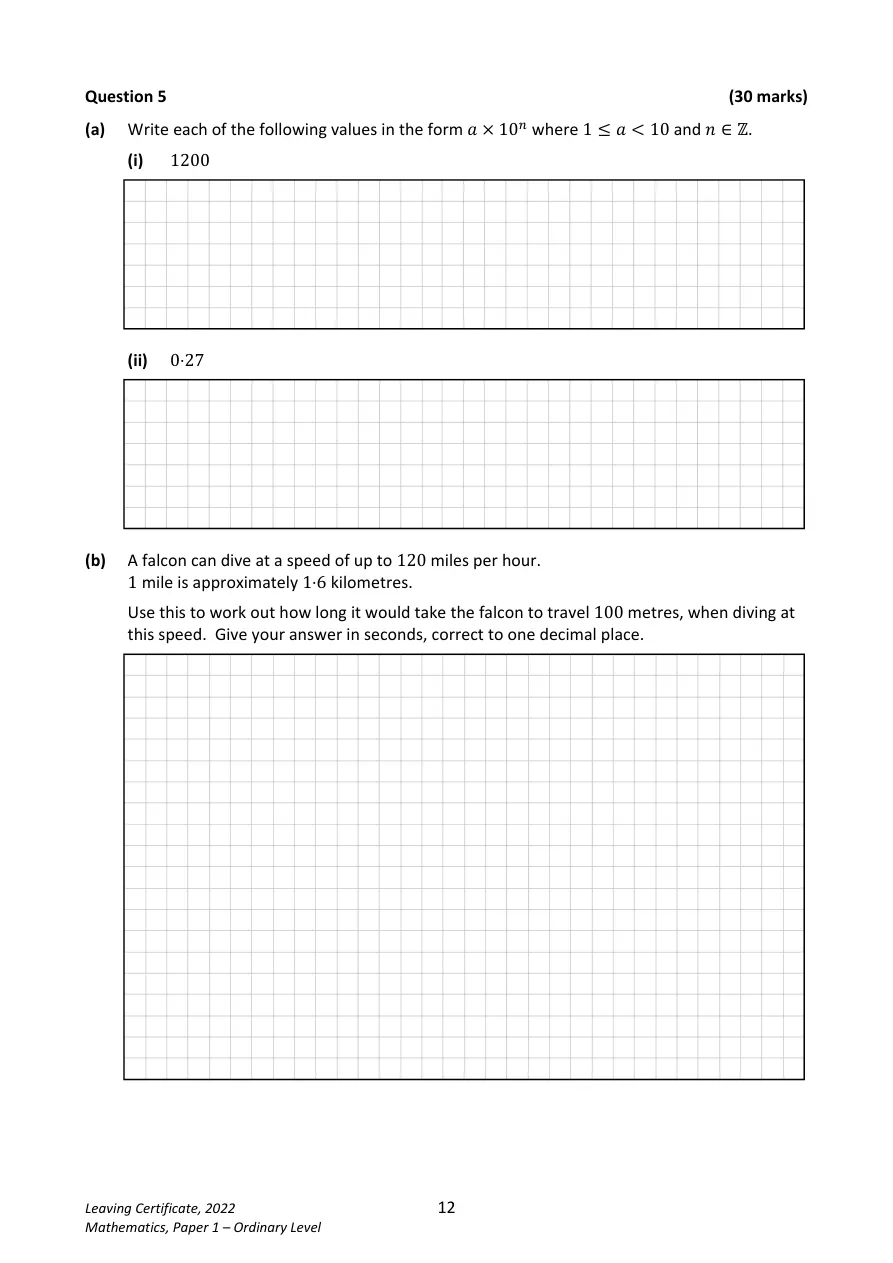
a) Standard form

  1. 1200=1.2\times10^3
  2. 0.27=2.7\times10^{-1}

b) Falcon dive

  1. v=120(1.6)=192\ \mathrm{km/h}
  2. v=\dfrac{192000}{3600}\ \mathrm{m/s}
  3. t=\dfrac{100}{\frac{192000}{3600}}
  4. t=1.875\ \mathrm{s}
  5. t\approx1.9\ \mathrm{s}

c) Read graphs

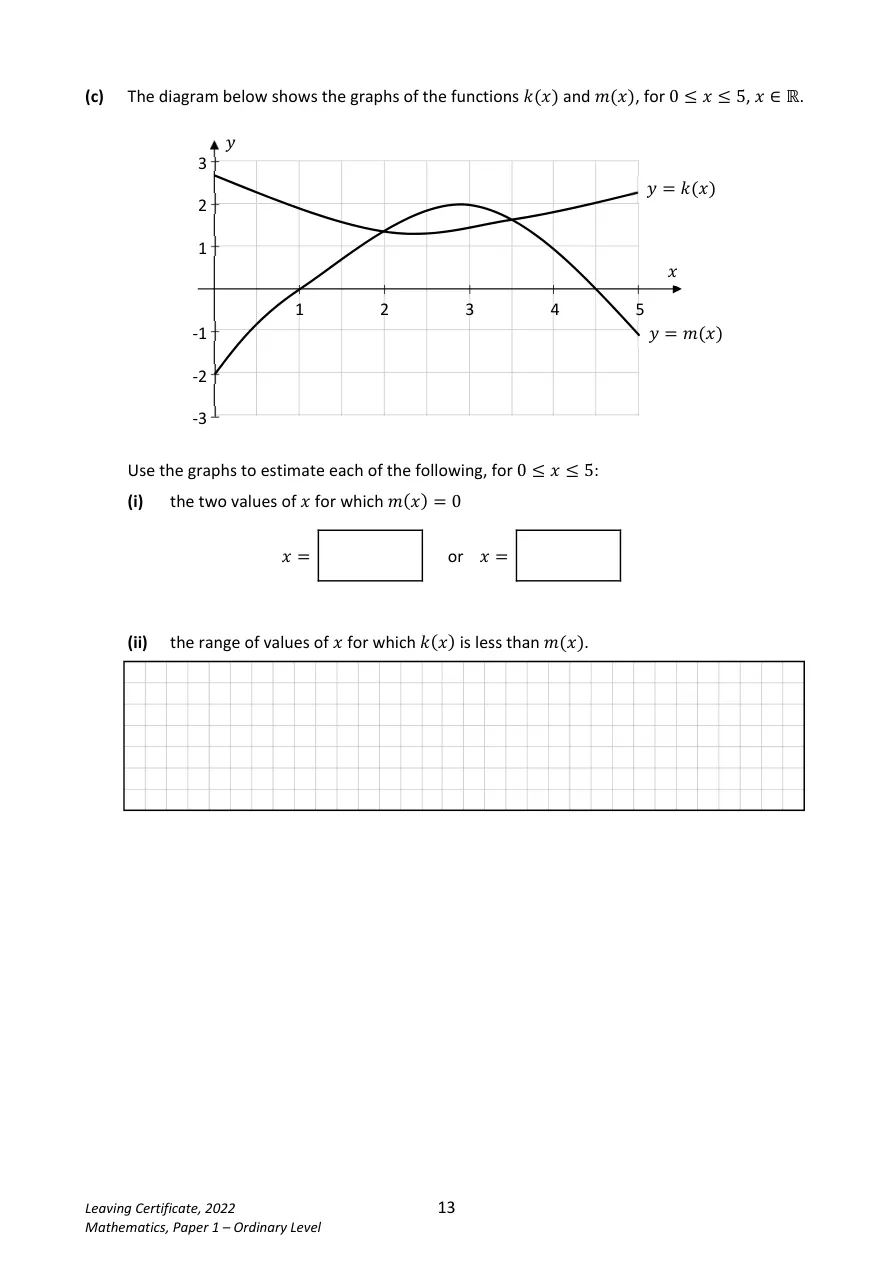
  1. m(x)=0\quad\mathrm{at}\quad x\approx1\ \mathrm{and}\ x\approx4.5
  2. 2<x<3.5

    k lies below m between the intersection points; endpoints are excluded for a strict inequality.

Question 6

a) First term and difference

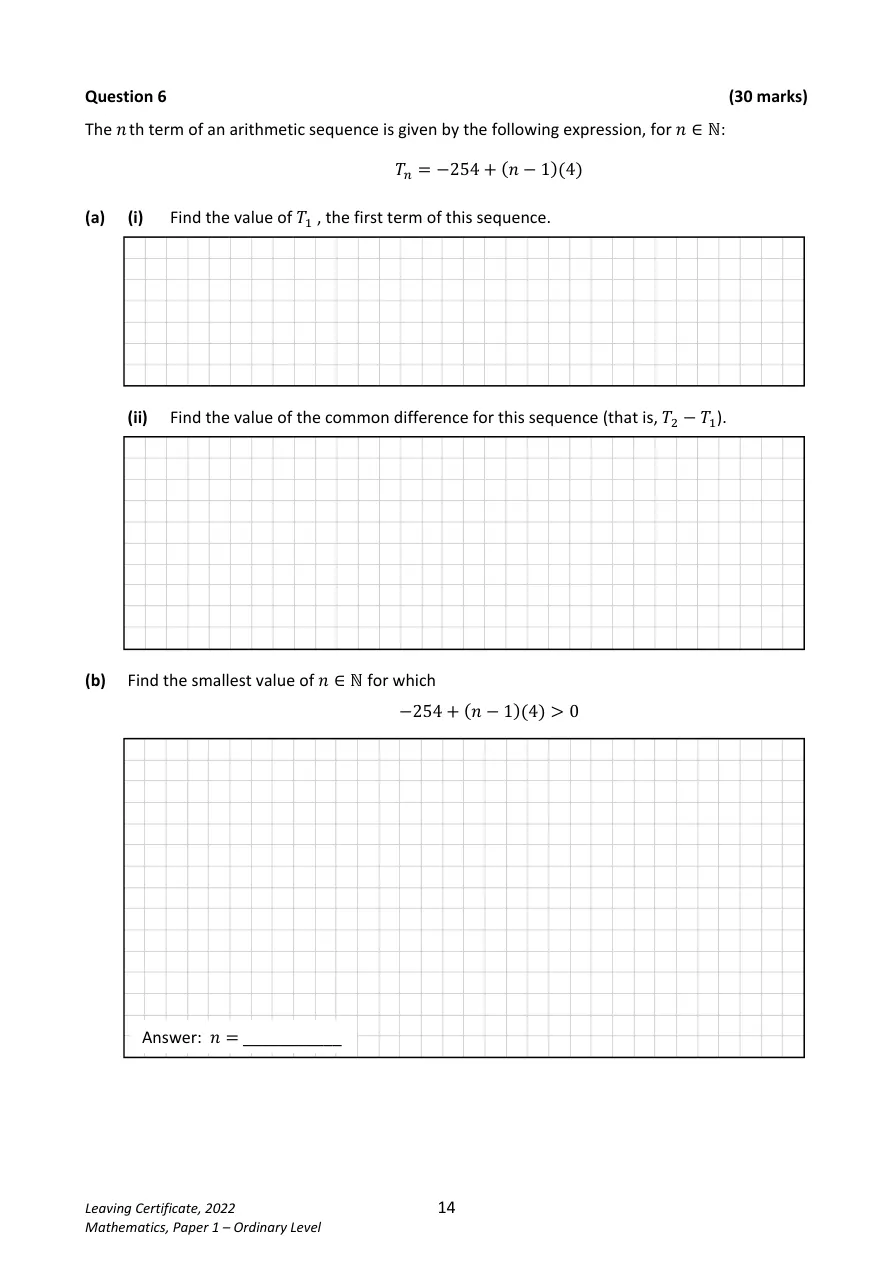
  1. T_1=-254
  2. T_2=-254+4=-250
  3. d=T_2-T_1=4

b) First positive term

  1. -254+4(n-1)>0
  2. 4n>258
  3. n>64.5
  4. n_{\min}=65

c) Zero sum

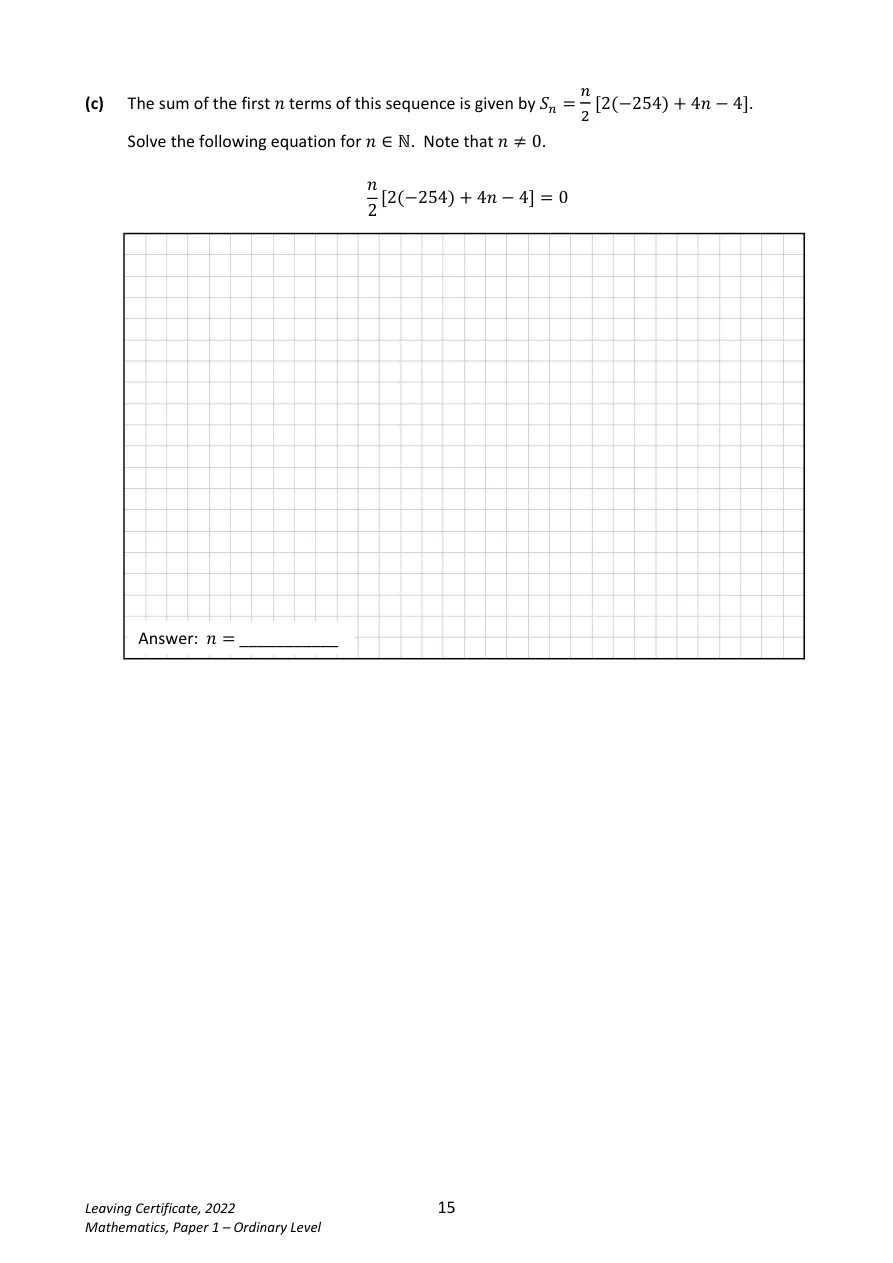
  1. \dfrac{n}{2}[-508+4n-4]=0
  2. -512+4n=0

    n is nonzero, so divide by n/2.

  3. 4n=512
  4. n=128

Question 7

a) Heart-rate model

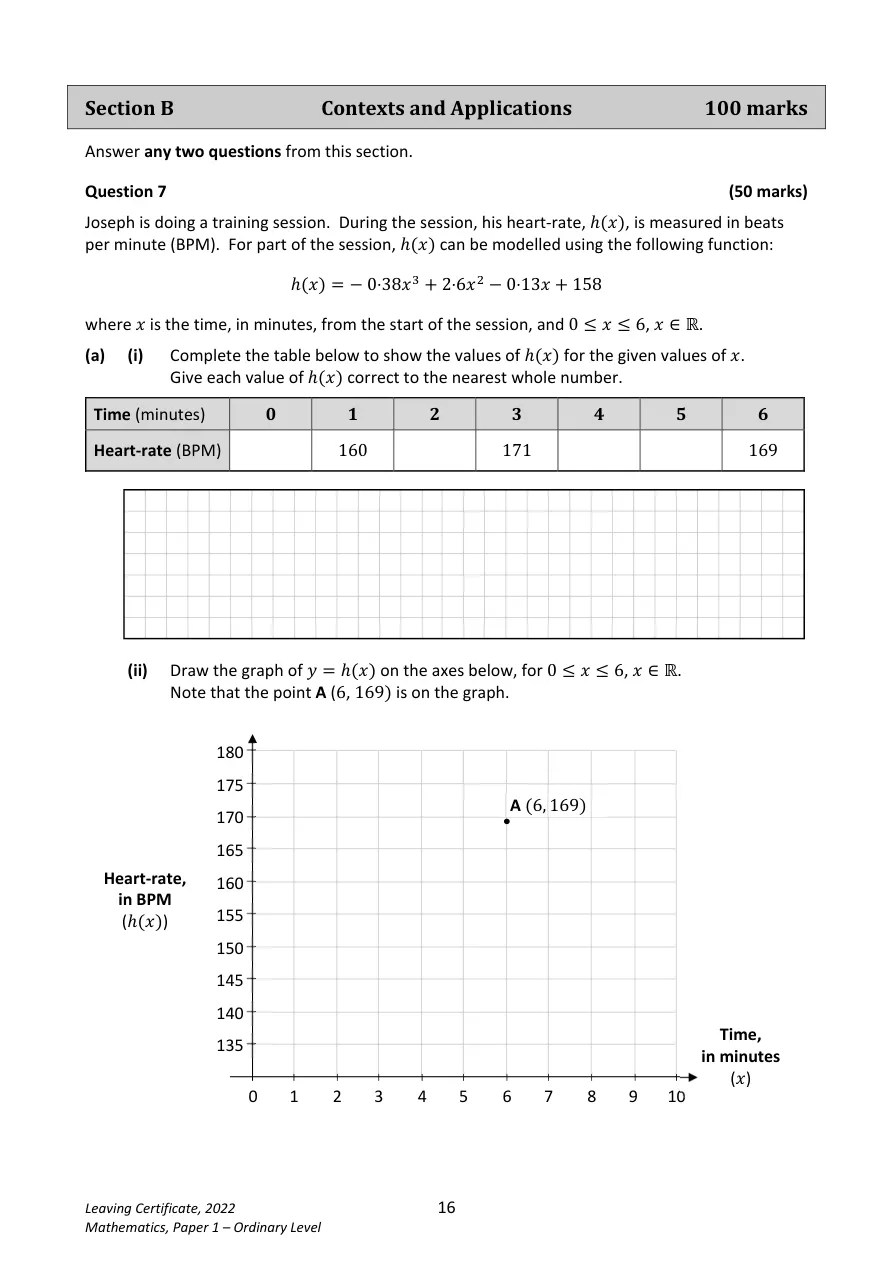
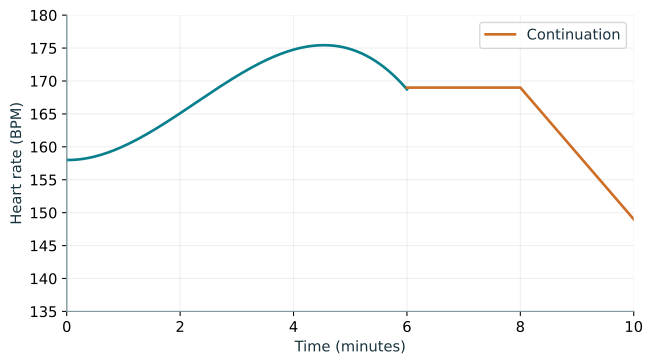
  1. h(0)=158,\ h(1)=160,\ h(2)=165
  2. h(3)=171,\ h(4)=175,\ h(5)=175,\ h(6)=169
  3. 2022-1-7-graph

b–c) Interpret and continue

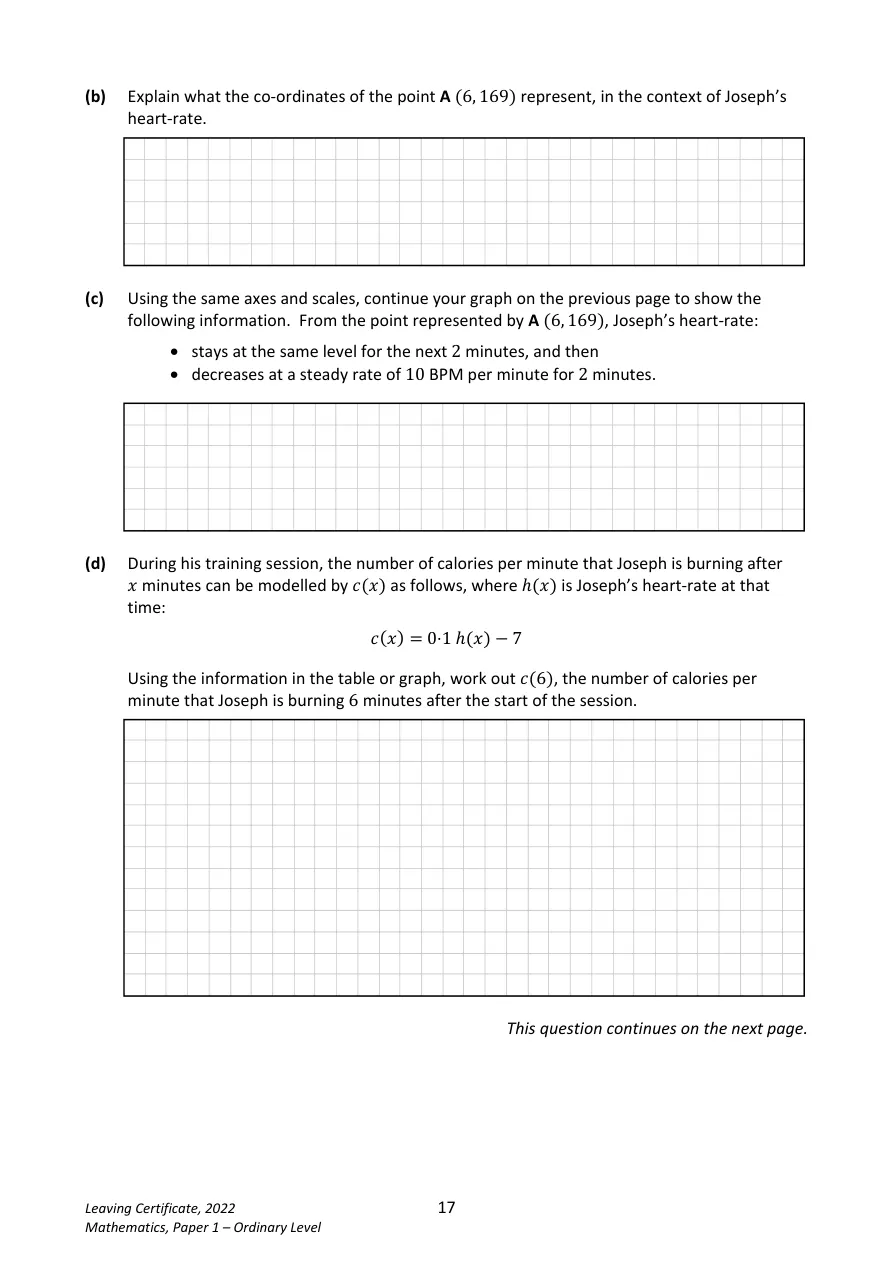
  1. A(6, 169) means Joseph's heart rate is 169 BPM six minutes after the start. Continue horizontally from (6, 169) to (8, 169), then with a straight line to (10, 149).

d) Calories

  1. c(6)=0.1(169)-7
  2. c(6)=9.9\ \mathrm{calories/min}

e) Watch beeps

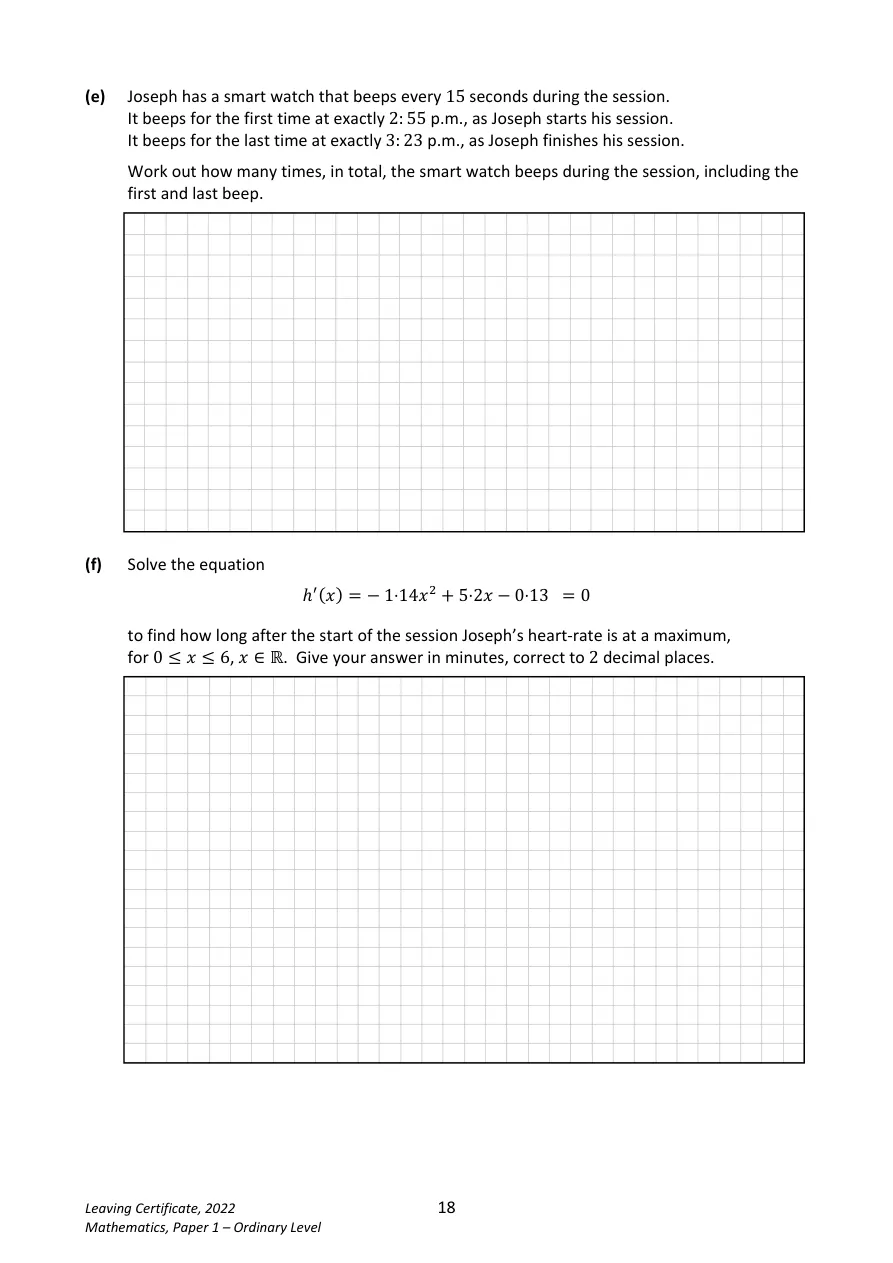
  1. \Delta t=28(60)=1680\ \mathrm{s}
  2. N=\dfrac{1680}{15}+1
  3. N=113

    Include the beep at the start as well as the end.

f) Maximum heart rate

  1. -1.14x^2+5.2x-0.13=0
  2. a=-1.14,\quad b=5.2,\quad c=-0.13

    Match ax² + bx + c = 0. Include the signs of the coefficients.

  3. x=\dfrac{-b\pm\sqrt{b^2-4ac}}{2a}

    Write the formula before substituting. The ± gives two calculations, one with + and one with −.

  4. x=\dfrac{-5.2\pm\sqrt{5.2^2-4(-1.14)(-0.13)}}{-2.28}

    Use brackets when substituting negative numbers, especially when squaring b.

  5. x\approx0.025\quad\mathrm{or}\quad x\approx4.536
  6. h''(x)=-2.28x+5.2
  7. h''(4.536)<0

    The larger root is the maximum; the smaller gives a minimum.

  8. x\approx4.54\ \mathrm{minutes}

Question 8

a) Acid mixtures

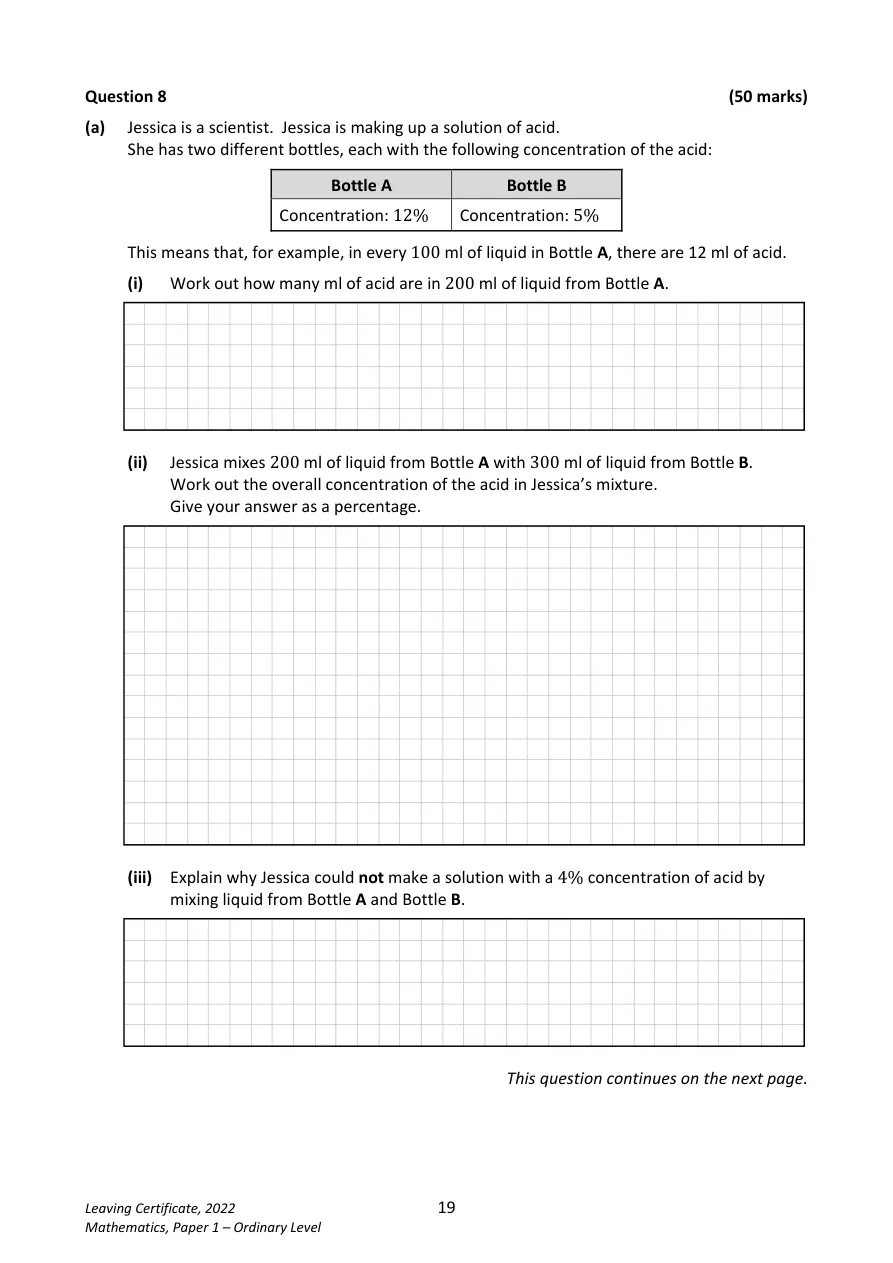
  1. V_A=0.12(200)=24\ \mathrm{ml}
  2. V_{\mathrm{acid}}=24+0.05(300)
  3. V_{\mathrm{acid}}=39\ \mathrm{ml}
  4. c=\dfrac{39}{200+300}\times100
  5. c=7.8\%
  6. A mixture of the 5% and 12% liquids must have a concentration between 5% and 12%, inclusive. It cannot be 4% without adding another substance.
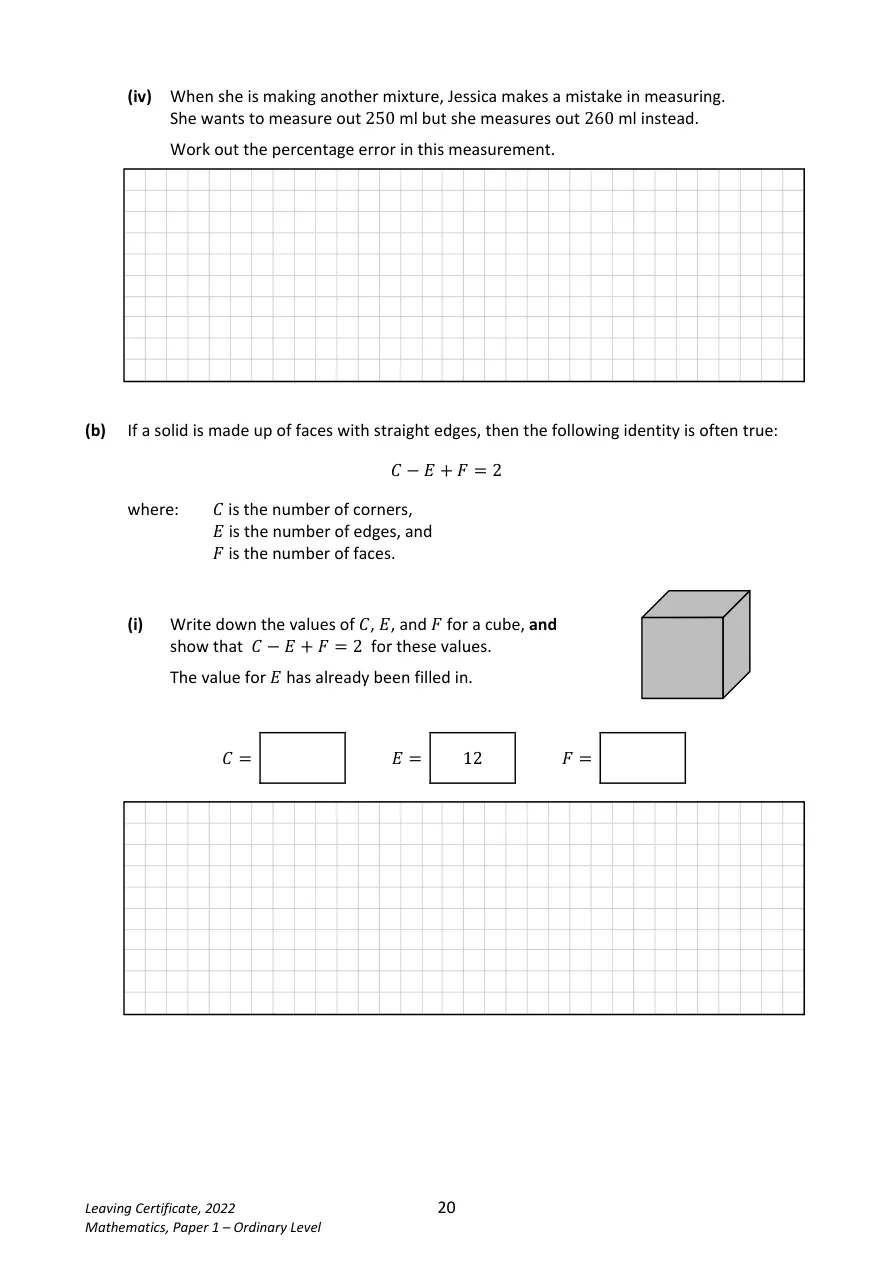
  7. \mathrm{error}=\dfrac{260-250}{250}\times100
  8. \mathrm{error}=4\%

b) Euler's formula

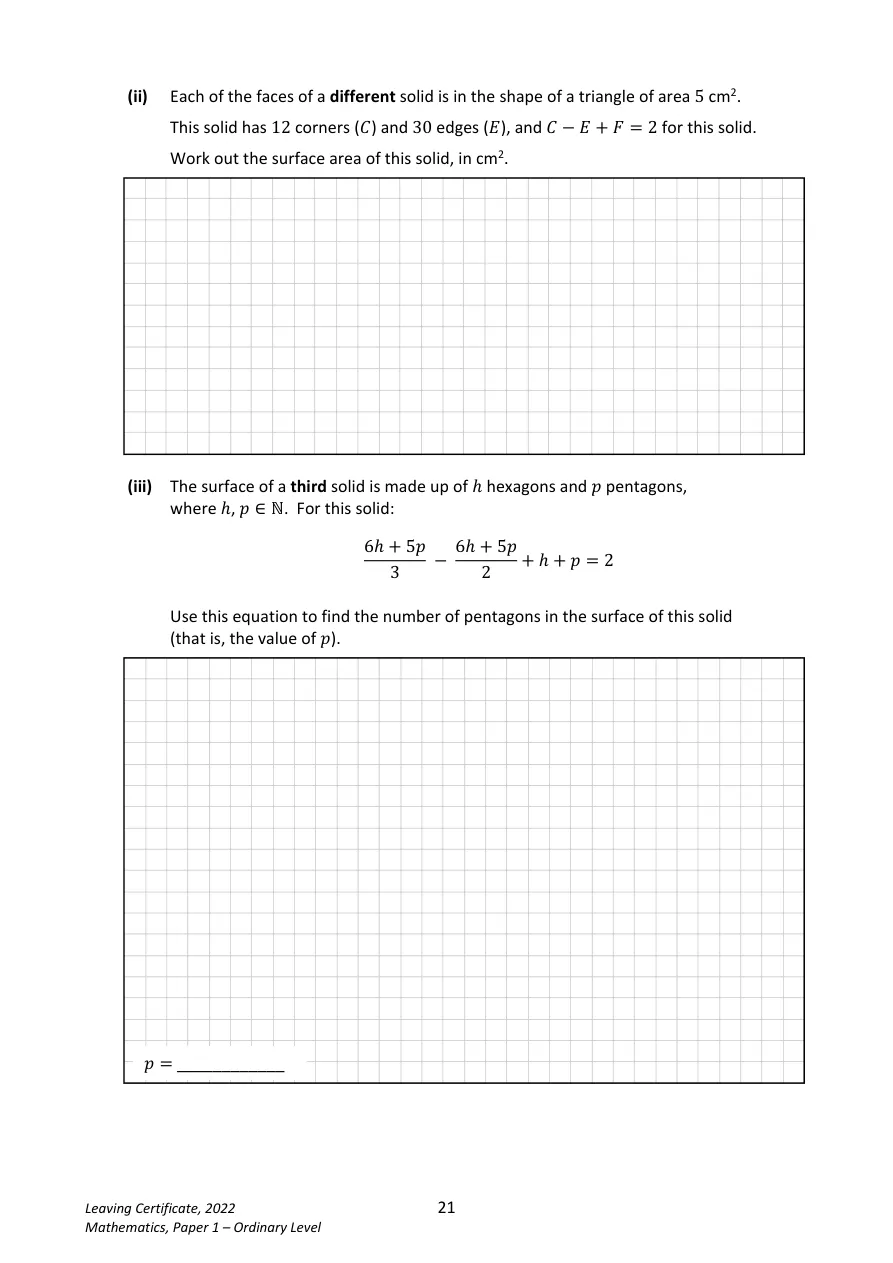
  1. C=8,\quad E=12,\quad F=6
  2. 8-12+6=2
  3. 12-30+F=2
  4. F=20
  5. A=20(5)=100\ \mathrm{cm}^2
  6. 2(6h+5p)-3(6h+5p)+6h+6p=12

    Multiply the given equation by six.

  7. 12h+10p-18h-15p+6h+6p=12
  8. p=12

Question 9

a) Read values and percentage

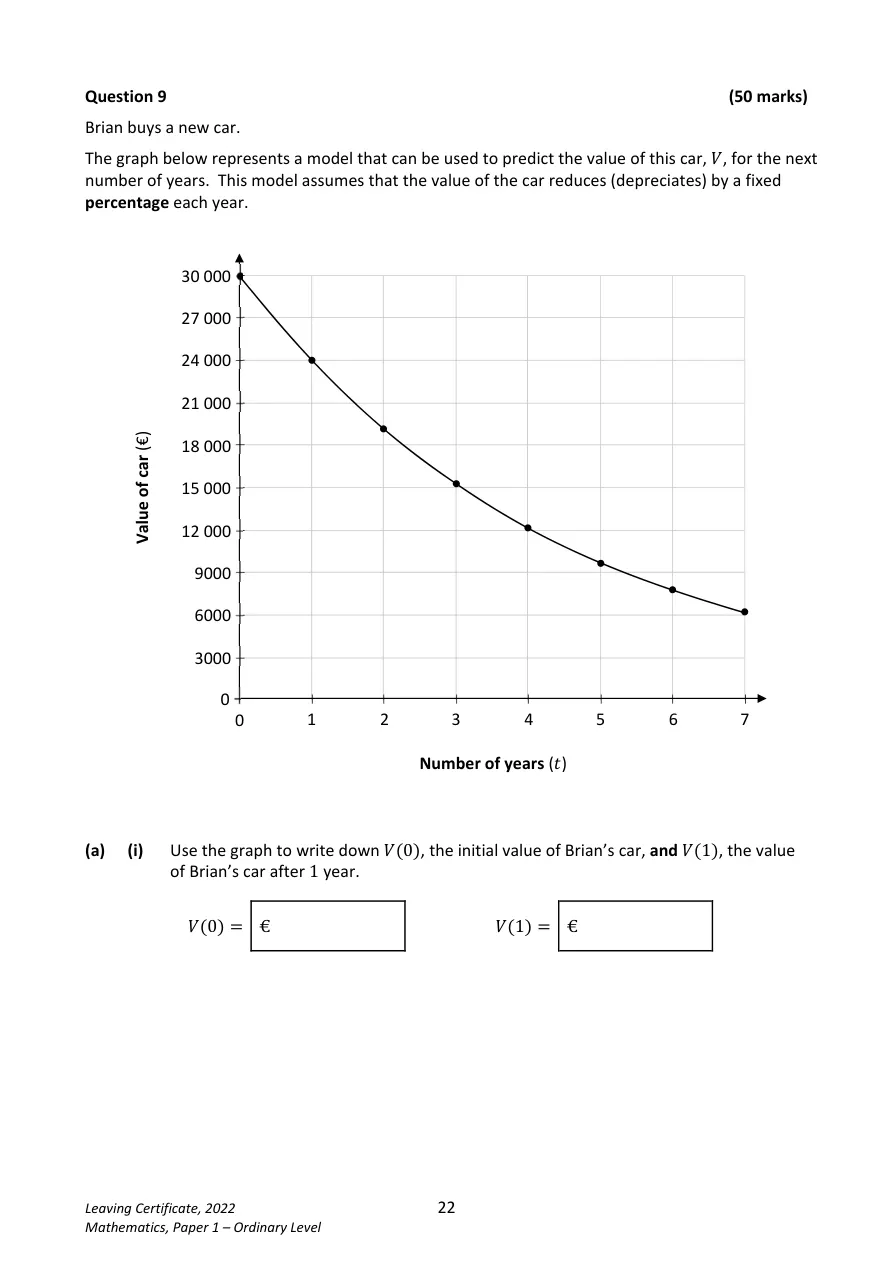
  1. V(0)=30000,\quad V(1)=24000
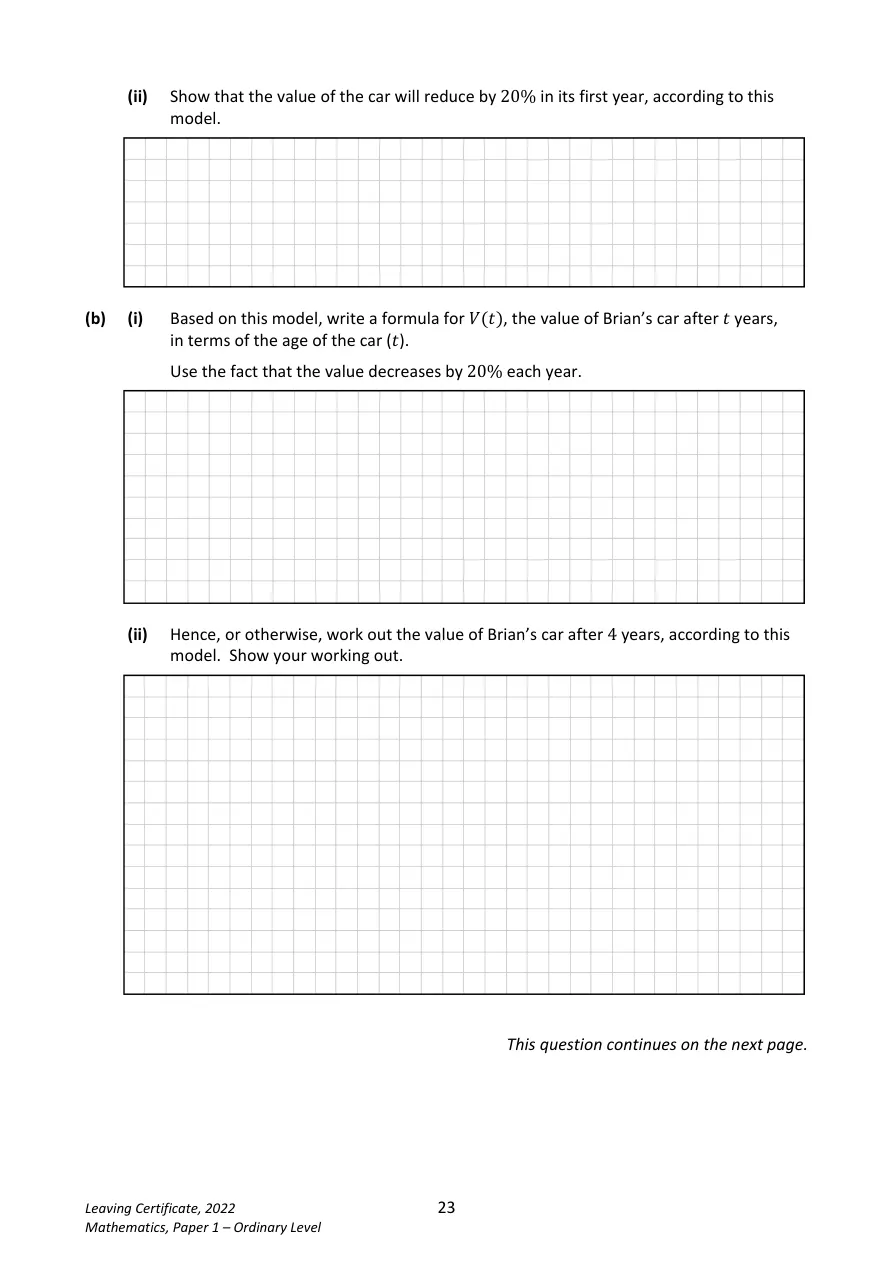
  2. r=\dfrac{30000-24000}{30000}\times100
  3. r=20\%

b) Percentage depreciation model

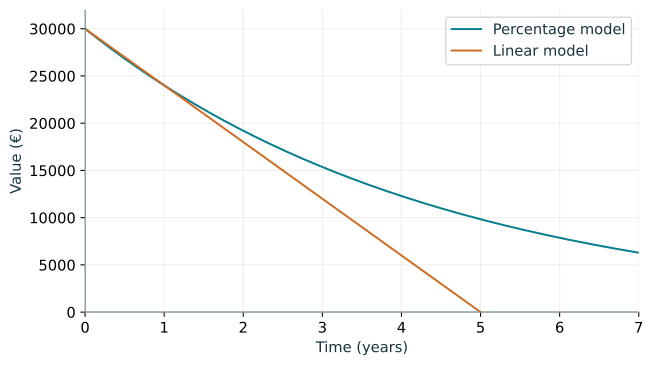
  1. V(t)=30000(0.8)^t
  2. V(4)=30000(0.8)^4
  3. V(4)=12288\ \mathrm{euro}

c) Linear model

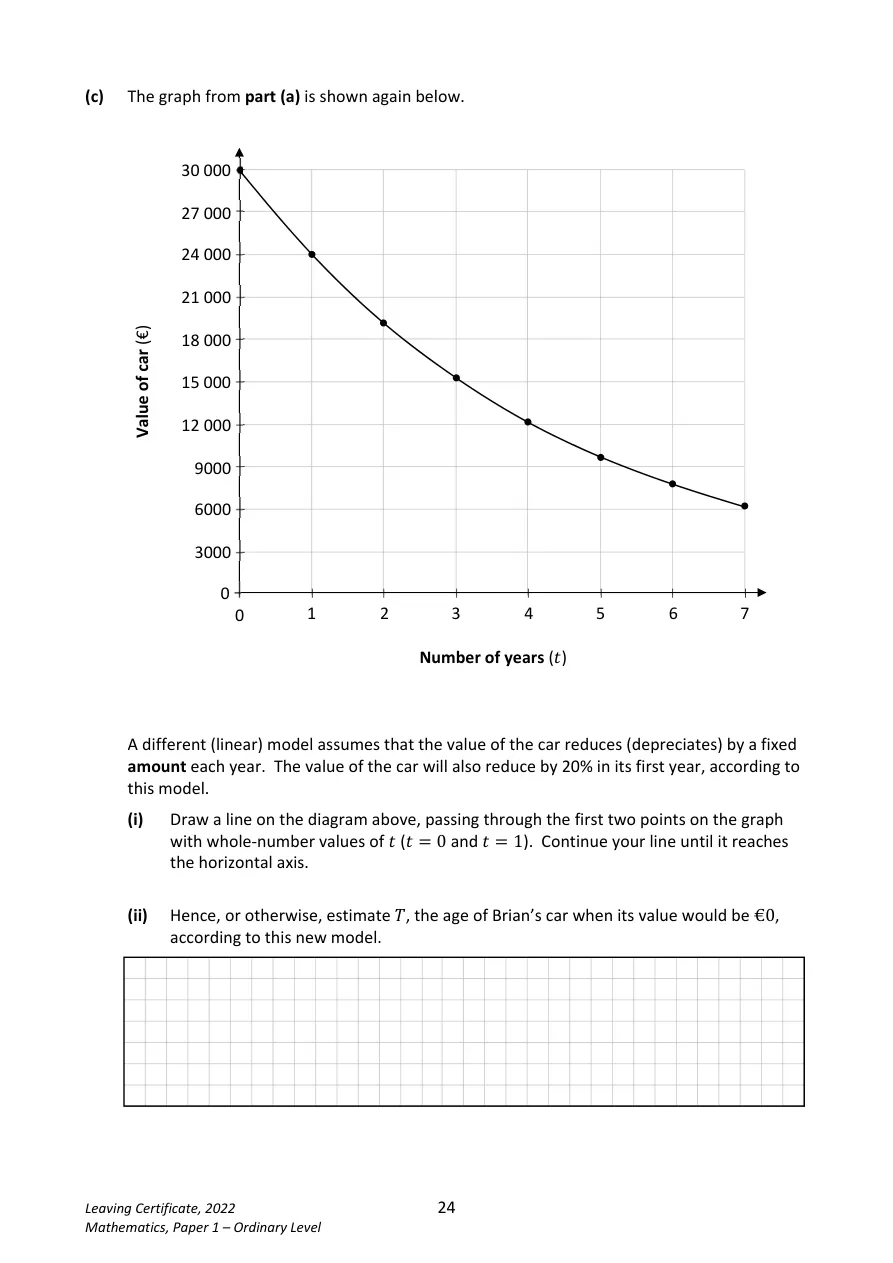
  1. L(t)=30000-6000t
  2. 30000-6000T=0
  3. T=5\ \mathrm{years}
  4. 2022-1-9-graph

d) Finance cost

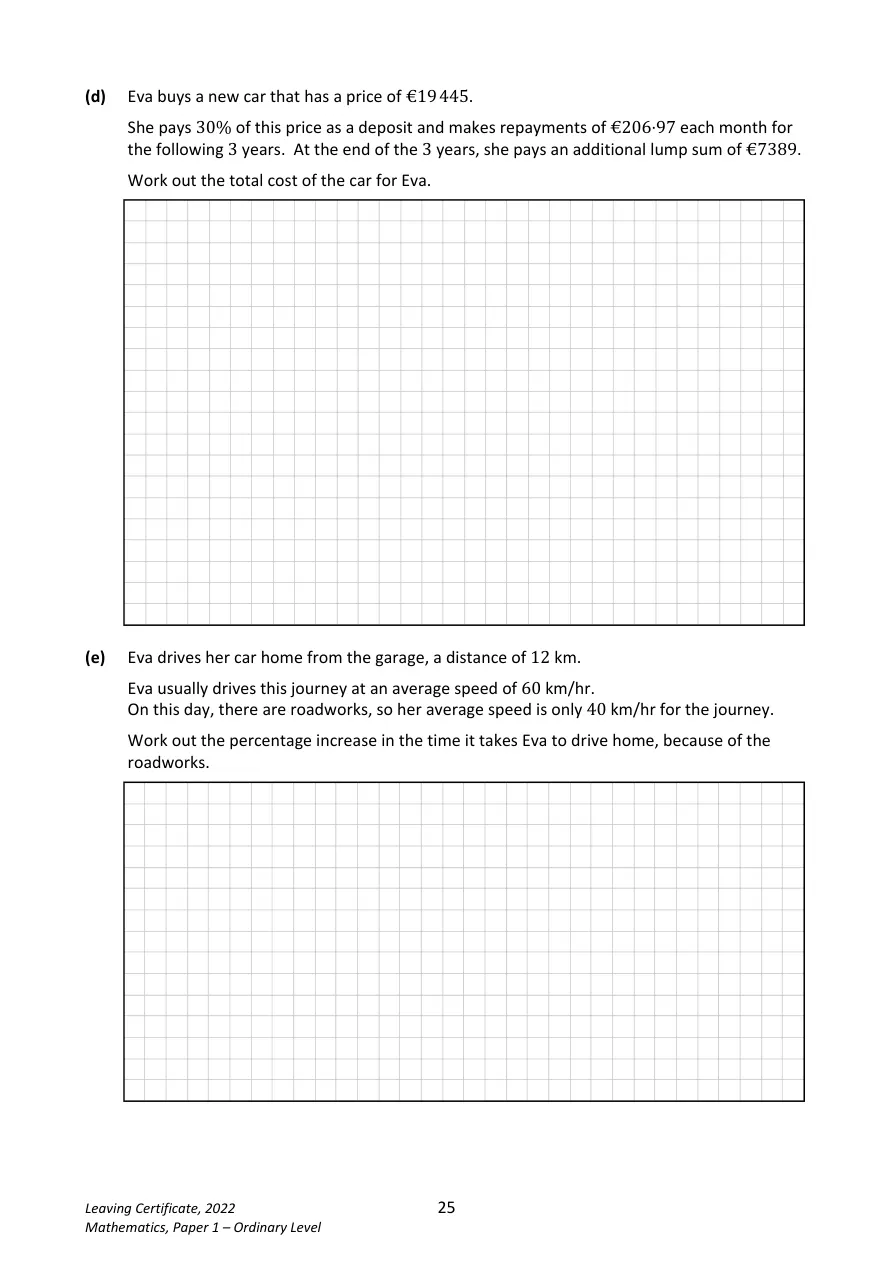
  1. C=19445(0.30)+36(206.97)+7389
  2. C=20673.42\ \mathrm{euro}

e) Longer journey time

  1. t_1=\dfrac{12}{60}=0.2\ \mathrm{h}
  2. t_2=\dfrac{12}{40}=0.3\ \mathrm{h}
  3. p=\dfrac{0.3-0.2}{0.2}\times100
  4. p=50\%

Question 10

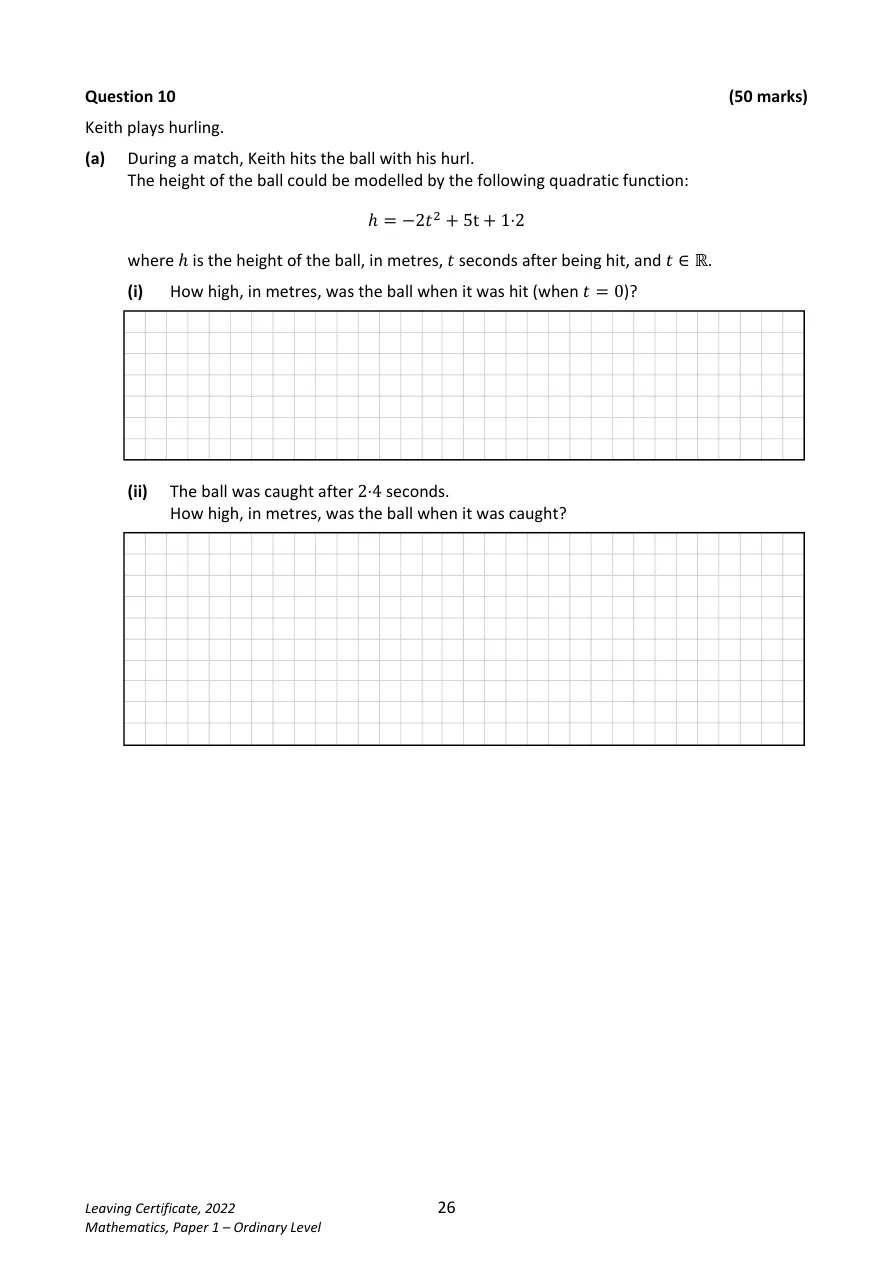
a) Height model

  1. h(0)=1.2\ \mathrm{m}
  2. h(2.4)=-2(2.4)^2+5(2.4)+1.2
  3. h(2.4)=1.68\ \mathrm{m}
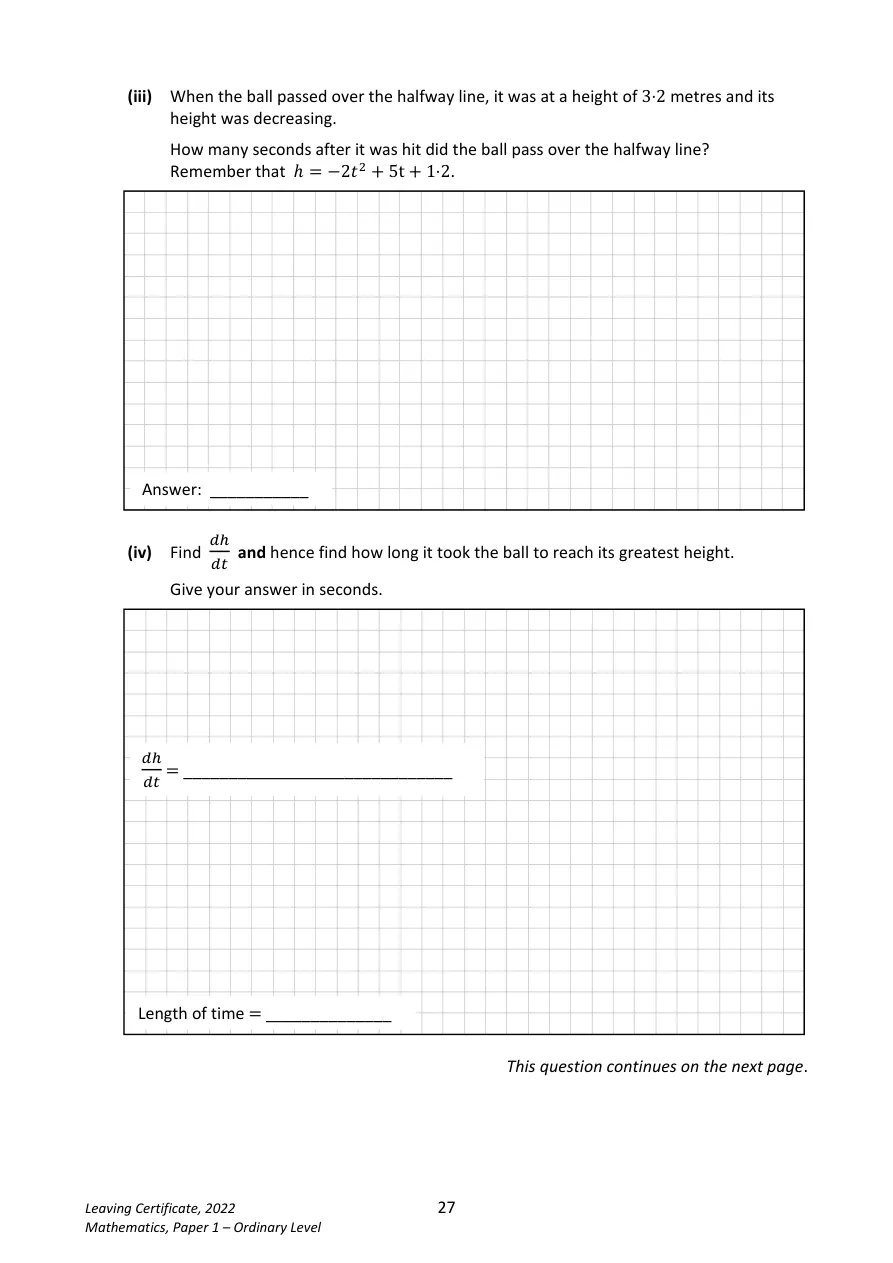
  4. -2t^2+5t+1.2=3.2
  5. 2t^2-5t+2=0
  6. (2t-1)(t-2)=0

    The product is zero, so at least one of the factors must be zero. Set each factor equal to zero in turn.

  7. t=0.5\quad\mathrm{or}\quad t=2
  8. Choose t = 2 seconds because the height is decreasing then.
  9. \dfrac{dh}{dt}=-4t+5
  10. -4t+5=0
  11. t=1.25\ \mathrm{s}

    Negative quadratic coefficient confirms maximum height.

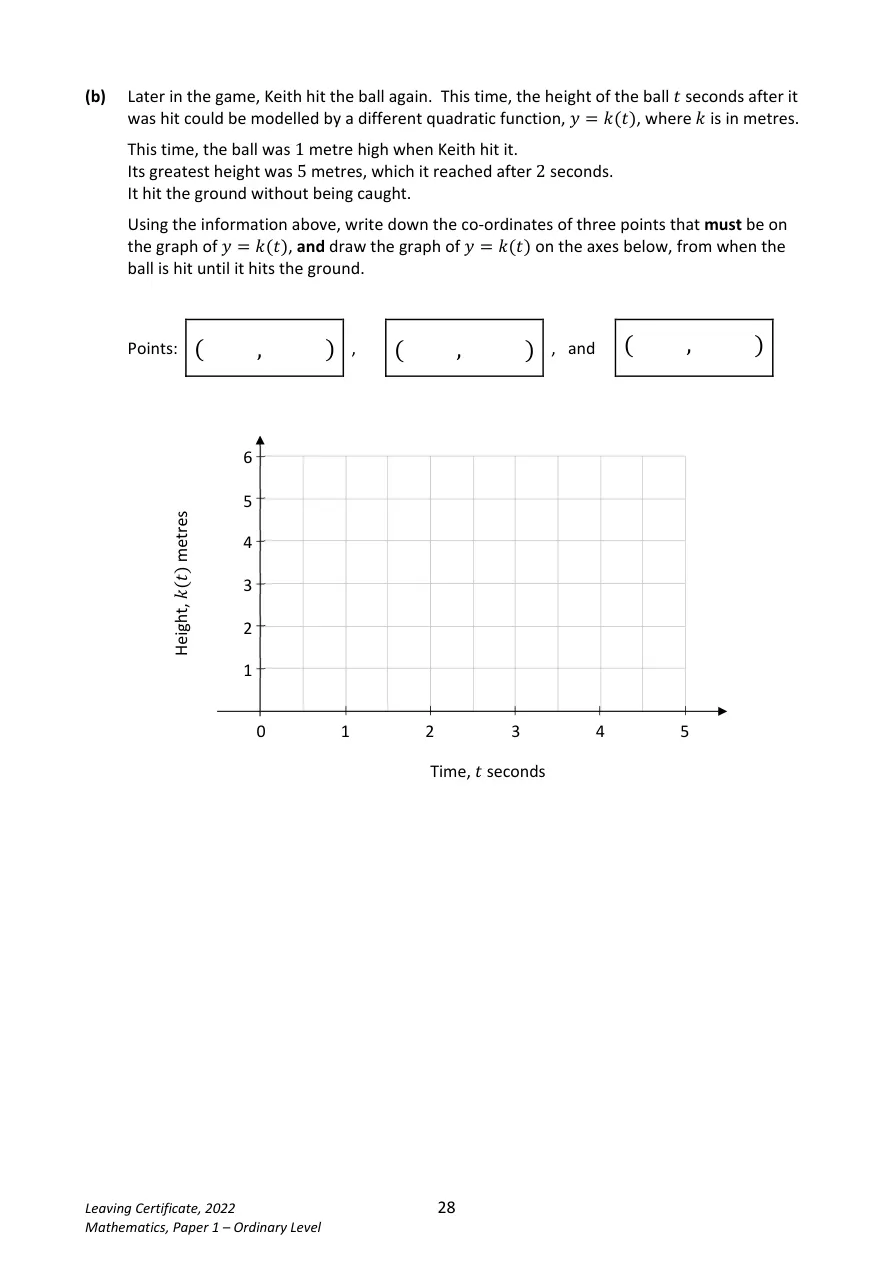
b) Second flight

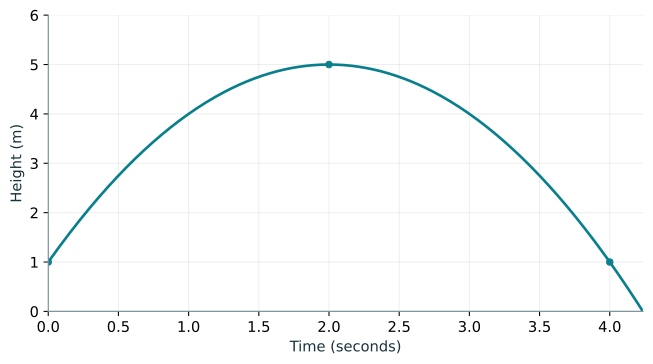
  1. The points (0, 1), (2, 5) and (4, 1) must be on the parabola, by symmetry about t = 2. A matching equation is k(t) = −(t − 2)² + 5. Draw the curve from t = 0 to its positive ground intercept, approximately 4.24 seconds.
  2. 2022-1-10-graph

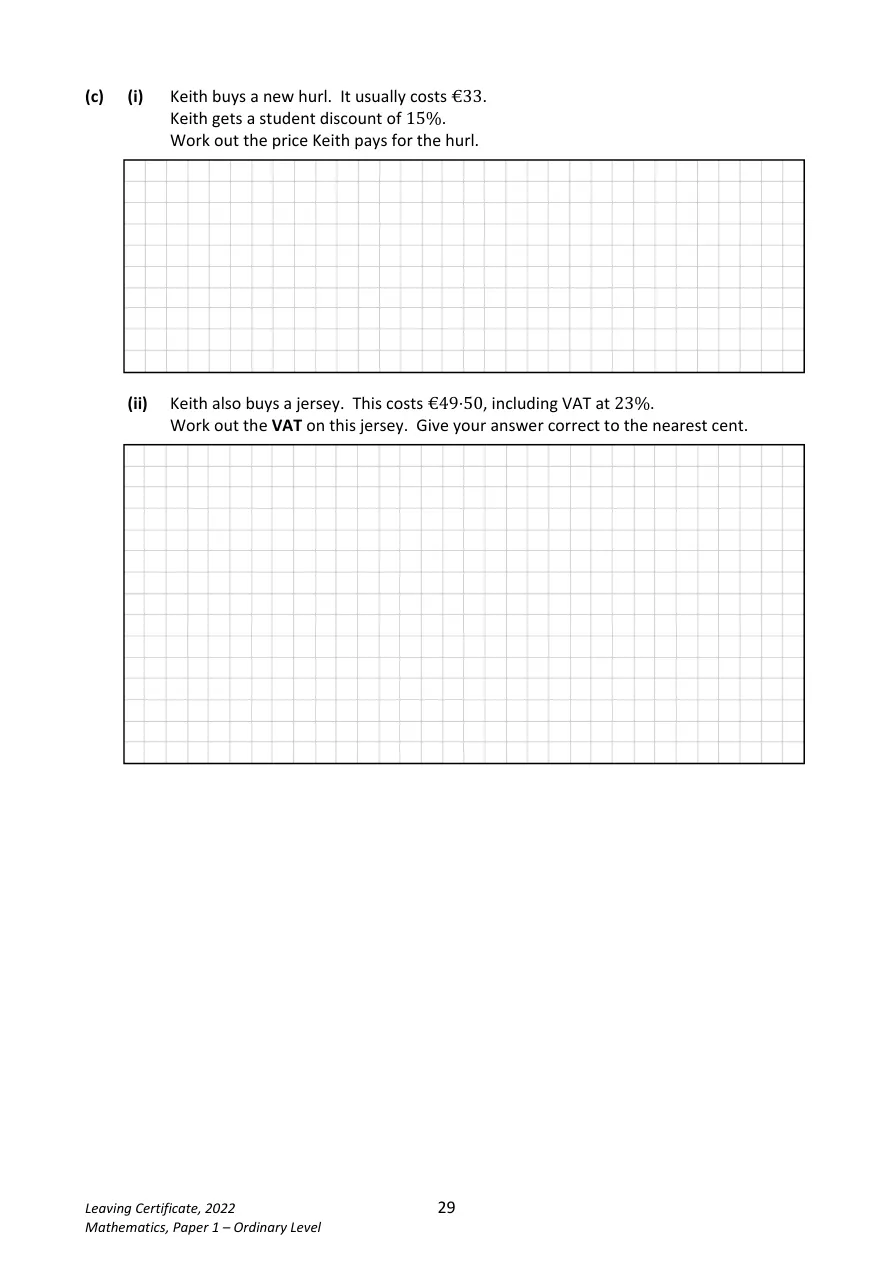
c) Equipment

  1. C=33(0.85)=28.05\ \mathrm{euro}
  2. \mathrm{VAT}=49.50\dfrac{23}{123}
  3. \mathrm{VAT}\approx9.26\ \mathrm{euro}

    The VAT-inclusive price represents 123%, not 100%.

See working and diagrams on the original paper
Original exam paper page 4
z_1=-2-3i
\overline{z_1}=-2+3i
conjugatez2z3
Original exam paper page 5
z_2=-5+3i,\quad z_3=4-2i
z_2-z_3=(-5+3i)-(4-2i)
z_2-z_3=-9+5i
|z_2-z_3|=\sqrt{(-9)^2+5^2}
|z_2-z_3|=\sqrt{106}
z^2+2iz-7i=(4-2i)^2+2i(4-2i)-7i
=16-16i-4+8i+4-7i
=16-15i
16-15i\neq0
z₃ is not a solution of the equation.
Original exam paper page 6
6x-10+8=4x-5
2x=-3
x=-\dfrac{3}{2}
\dfrac{(3^4)^5}{3^6}=3^{20-6}
=3^{14}
Original exam paper page 7
15x+10y=5
[Multiply the first equation by five.]
14x+10y=-4
[Multiply the second equation by two.]
x=9
[Subtract the second new equation from the first.]
2022-1-2-elimination
3(9)+2y=1
2y=-26
y=-13
Original exam paper page 8
Use the tax bands and credits supplied in the question, rather than current tax rules.
T=27500(0.2)-3300
T=2200\ \mathrm{euro}
N=27500-2200
N=25300\ \mathrm{euro}
T=35300(0.2)+(43450-35300)(0.4)-3300
T=7060+3260-3300
T=7020\ \mathrm{euro}
N=43450-7020
N=36430\ \mathrm{euro}
Original exam paper page 9
\Delta N=12(80)=960\ \mathrm{euro}
0.6\Delta G=960
[Wei keeps 60% of the extra gross pay after 40% tax.]
\Delta G=\dfrac{960}{0.6}
\Delta G=1600\ \mathrm{euro}
Original exam paper page 10
g(5)=5^3-7(5)^2+5-12
g(5)=-57
g'(x)=3x^2-14x+1
y+57=6(x-5)
y=6x-87
6x-y-87=0
Original exam paper page 11
For example x = 8 gives a negative derivative because the curve is decreasing there. Draw a straight tangent touching the curve at (4, 2), with the same local direction as the curve.
u'(4)\approx\dfrac{2}{4}
u'(4)\approx0.5
[Estimate rise over run using two well-separated points on your tangent.]
A suitable tangent is approximately y − 2 = 0.5(x − 4). The answer depends slightly on the tangent drawn.
8
Original exam paper page 12
1200=1.2\times10^3
0.27=2.7\times10^{-1}
v=120(1.6)=192\ \mathrm{km/h}
v=\dfrac{192000}{3600}\ \mathrm{m/s}
t=\dfrac{100}{\frac{192000}{3600}}
t=1.875\ \mathrm{s}
t\approx1.9\ \mathrm{s}
Original exam paper page 13
2<x<3.5
[k lies below m between the intersection points; endpoints are excluded for a strict inequality.]
1
4.5
Original exam paper page 14
T_1=-254
T_2=-254+4=-250
d=T_2-T_1=4
-254+4(n-1)>0
4n>258
n>64.5
n_{\min}=65
Original exam paper page 15
\dfrac{n}{2}[-508+4n-4]=0
-512+4n=0
[n is nonzero, so divide by n/2.]
4n=512
n=128
Original exam paper page 16
h(0)=158,\ h(1)=160,\ h(2)=165
h(3)=171,\ h(4)=175,\ h(5)=175,\ h(6)=169
158165175175
Original exam paper page 17
A(6, 169): 6 minutes after starting, his heart rate is 169 BPM.
From (6,169), continue horizontally to (8,169), then draw a straight line to (10,149).
c(6)=0.1(169)-7
c(6)=9.9\ \mathrm{calories/min}
Original exam paper page 18
\Delta t=28(60)=1680\ \mathrm{s}
N=\dfrac{1680}{15}+1
N=113
[Include the beep at the start as well as the end.]
-1.14x^2+5.2x-0.13=0
x=\dfrac{-5.2\pm\sqrt{5.2^2-4(-1.14)(-0.13)}}{-2.28}
x\approx0.025\quad\mathrm{or}\quad x\approx4.536
h''(x)=-2.28x+5.2
h''(4.536)<0
[The larger root is the maximum; the smaller gives a minimum.]
x\approx4.54\ \mathrm{minutes}
Original exam paper page 19
V_A=0.12(200)=24\ \mathrm{ml}
V_{\mathrm{acid}}=24+0.05(300)
V_{\mathrm{acid}}=39\ \mathrm{ml}
c=\dfrac{39}{200+300}\times100
c=7.8\%
A mixture of the 5% and 12% liquids must have a concentration between 5% and 12%, inclusive. It cannot be 4% without adding another substance.
Original exam paper page 20
\mathrm{error}=\dfrac{260-250}{250}\times100
\mathrm{error}=4\%
C=8,\quad E=12,\quad F=6
8-12+6=2
86
Original exam paper page 21
12-30+F=2
F=20
A=20(5)=100\ \mathrm{cm}^2
2(6h+5p)-3(6h+5p)+6h+6p=12
[Multiply the given equation by six.]
12h+10p-18h-15p+6h+6p=12
p=12
Original exam paper page 22
30000
24000
Original exam paper page 23
r=\dfrac{30000-24000}{30000}\times100
r=20\%
V(t)=30000(0.8)^t
V(4)=30000(0.8)^4
V(4)=12288\ \mathrm{euro}
Original exam paper page 24
L(t)=30000-6000t
30000-6000T=0
T=5\ \mathrm{years}
Original exam paper page 25
C=19445(0.30)+36(206.97)+7389
C=20673.42\ \mathrm{euro}
t_1=\dfrac{12}{60}=0.2\ \mathrm{h}
t_2=\dfrac{12}{40}=0.3\ \mathrm{h}
p=\dfrac{0.3-0.2}{0.2}\times100
p=50\%
Original exam paper page 26
h(0)=1.2\ \mathrm{m}
h(2.4)=-2(2.4)^2+5(2.4)+1.2
h(2.4)=1.68\ \mathrm{m}
Original exam paper page 27
-2t^2+5t+1.2=3.2
2t^2-5t+2=0
(2t-1)(t-2)=0
t=0.5\quad\mathrm{or}\quad t=2
Choose t = 2 seconds because the height is decreasing then.
\dfrac{dh}{dt}=-4t+5
-4t+5=0
t=1.25\ \mathrm{s}
[Negative quadratic coefficient confirms maximum height.]
Original exam paper page 28
The points (0, 1), (2, 5) and (4, 1) must be on the parabola, by symmetry about t = 2. A matching equation is k(t) = −(t − 2)² + 5. Draw the curve from t = 0 to its positive ground intercept, approximately 4.24 seconds.
0, 12, 54, 1
Original exam paper page 29
C=33(0.85)=28.05\ \mathrm{euro}
\mathrm{VAT}=49.50\dfrac{23}{123}
\mathrm{VAT}\approx9.26\ \mathrm{euro}
[The VAT-inclusive price represents 123%, not 100%.]