← Original paper

Leaving Cert Ordinary Maths 2022 · Paper 2

Teacher worked solutions. Explanations are in blue.

Question 1

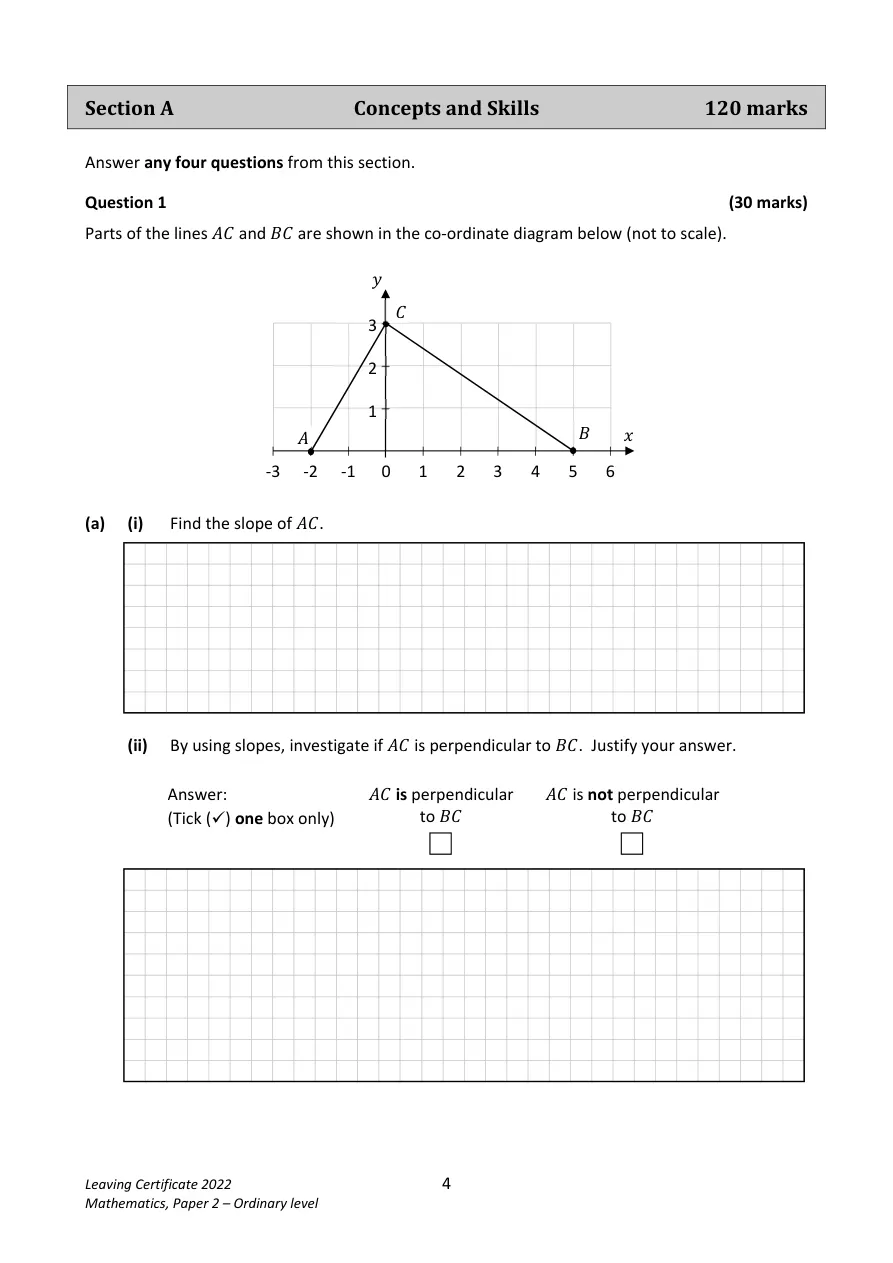
a) Slopes

  1. m_{AC}=\dfrac{3-0}{0-(-2)}=\dfrac{3}{2}
  2. m_{BC}=\dfrac{3-0}{0-5}=-\dfrac{3}{5}
  3. m_{AC}m_{BC}=-\dfrac{9}{10}\neq-1
  4. AC and BC are not perpendicular.

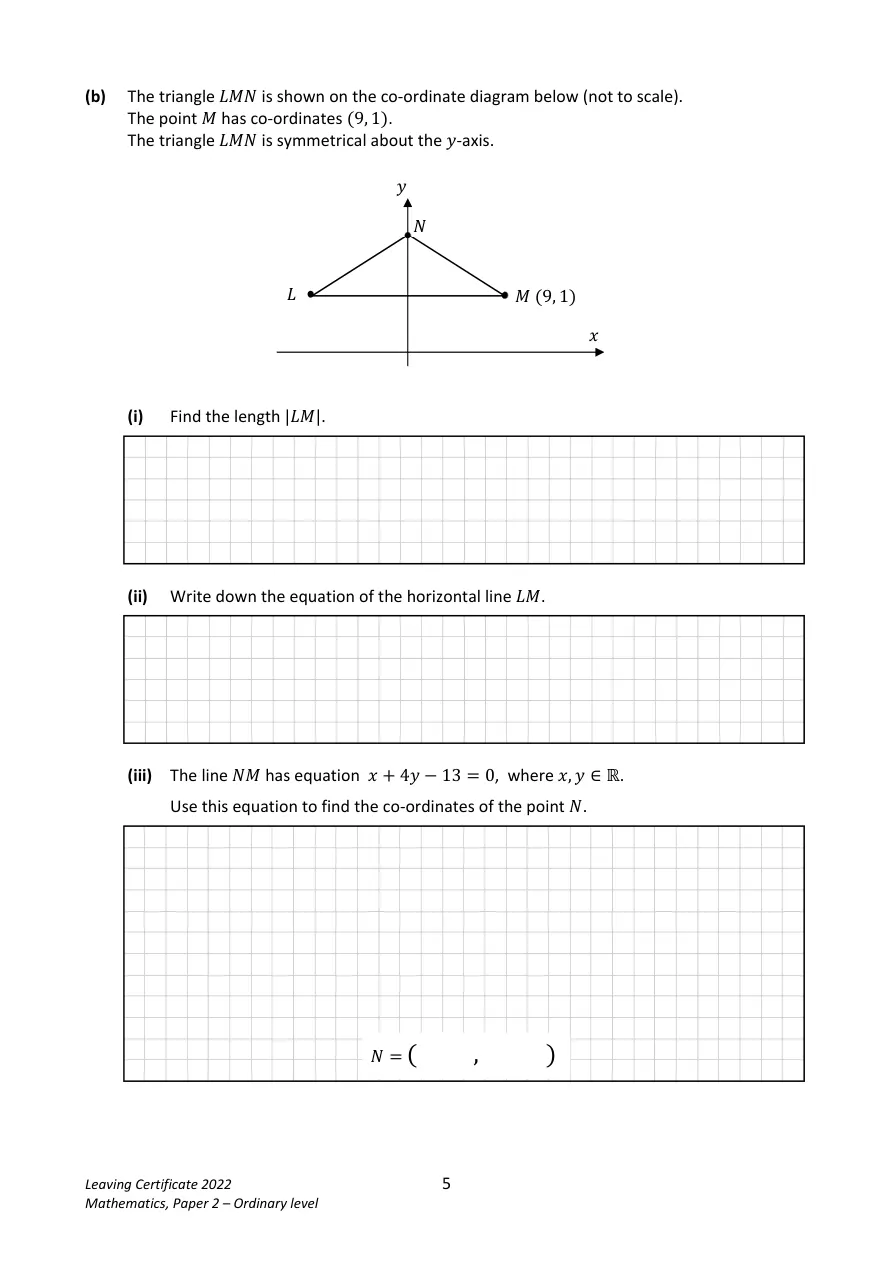
b) Symmetrical triangle

  1. L=(-9,1),\quad M=(9,1)
  2. LM=9-(-9)=18
  3. LM:\ y=1
  4. x=0

    N lies on the axis of symmetry.

  5. 4y-13=0
  6. y=\dfrac{13}{4}
  7. N=\left(0,\dfrac{13}{4}\right)
Question 2

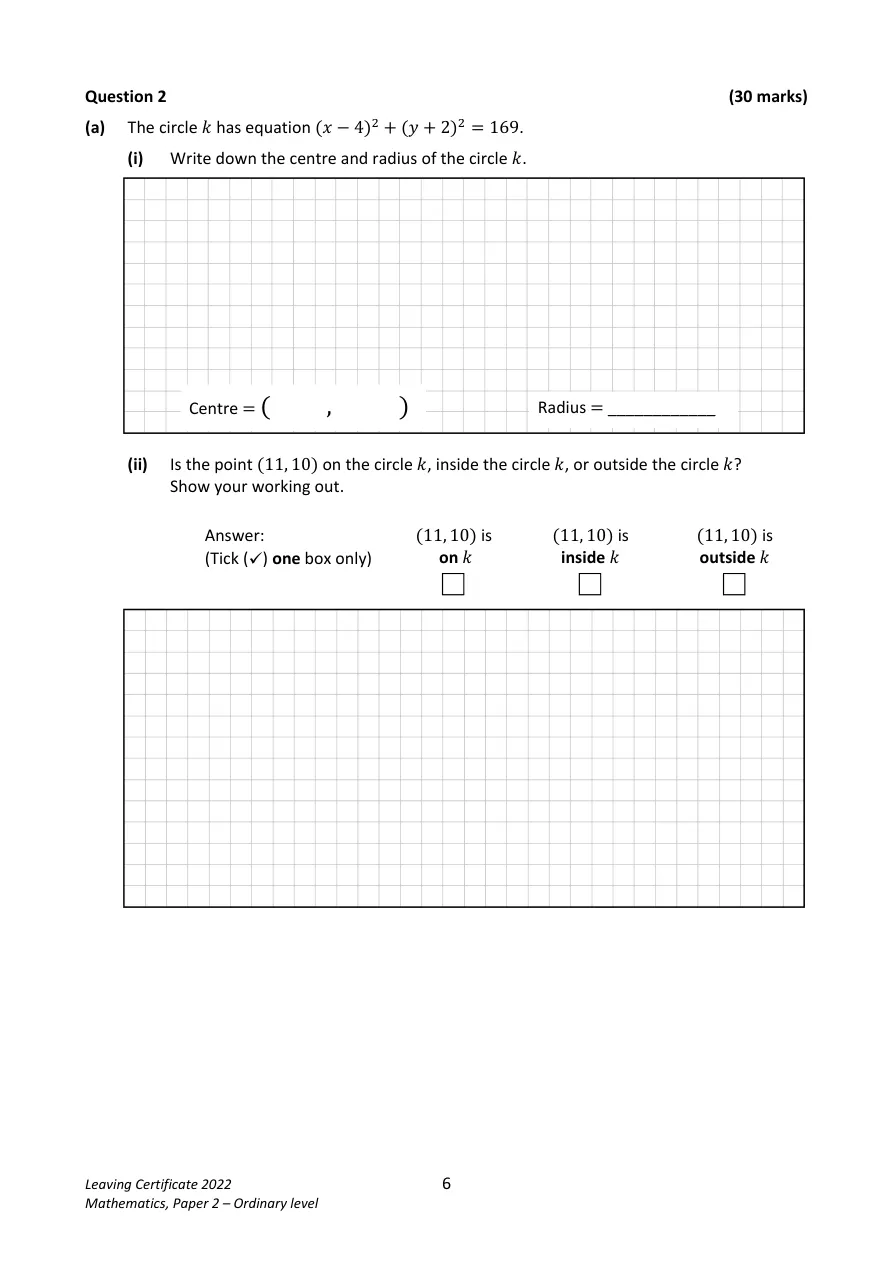
a) Circle k

  1. C=(4,-2),\quad r=13
  2. (11-4)^2+(10+2)^2=193
  3. 193>169
  4. The point (11, 10) is outside the circle.

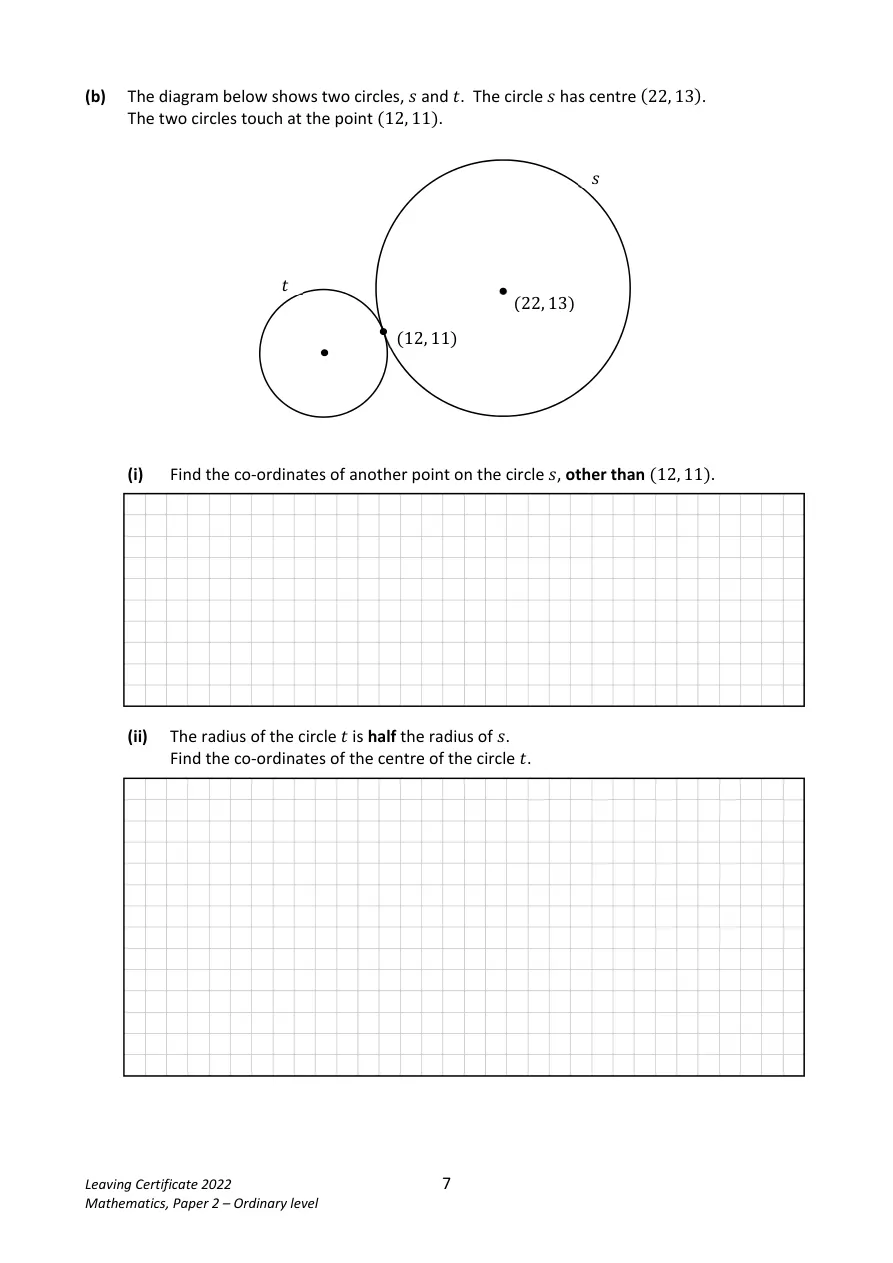
b) Touching circles

  1. \vec v=(22-12,13-11)=(10,2)
  2. P=(22,13)+(10,2)
  3. P=(32,15)

    Reflect the contact point across the centre to get another point on s.

  4. C_t=(12,11)-\dfrac{1}{2}(10,2)
  5. C_t=(7,10)

    The smaller circle's centre is on the opposite side of the contact point.

Question 3

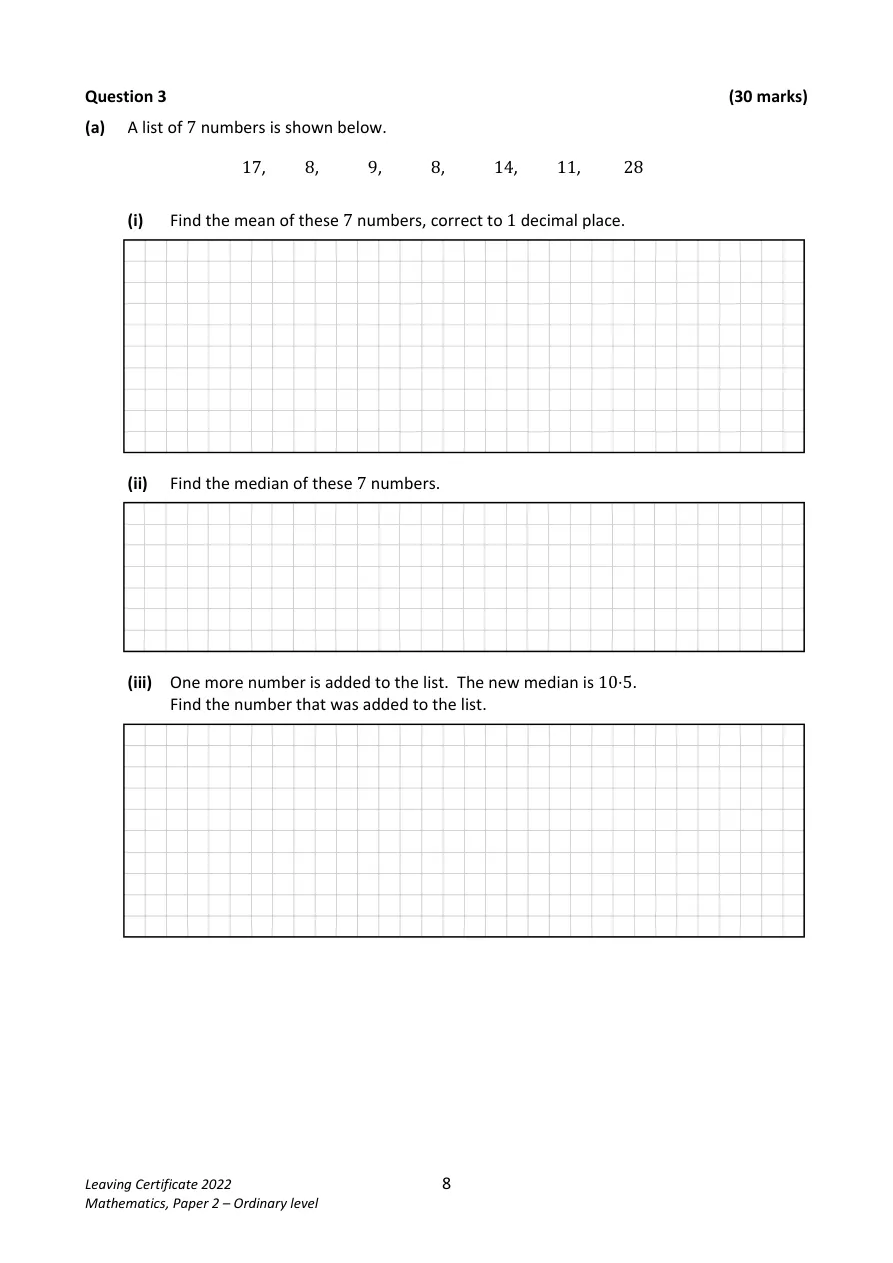
a) Numbers

  1. \mu=\dfrac{17+8+9+8+14+11+28}{7}
  2. \mu\approx13.6
  3. Ordered list: 8, 8, 9, 11, 14, 17, 28. The median is 11.
  4. \dfrac{x+11}{2}=10.5
  5. x=10

    Adding 10 puts 10 and 11 in the two middle positions.

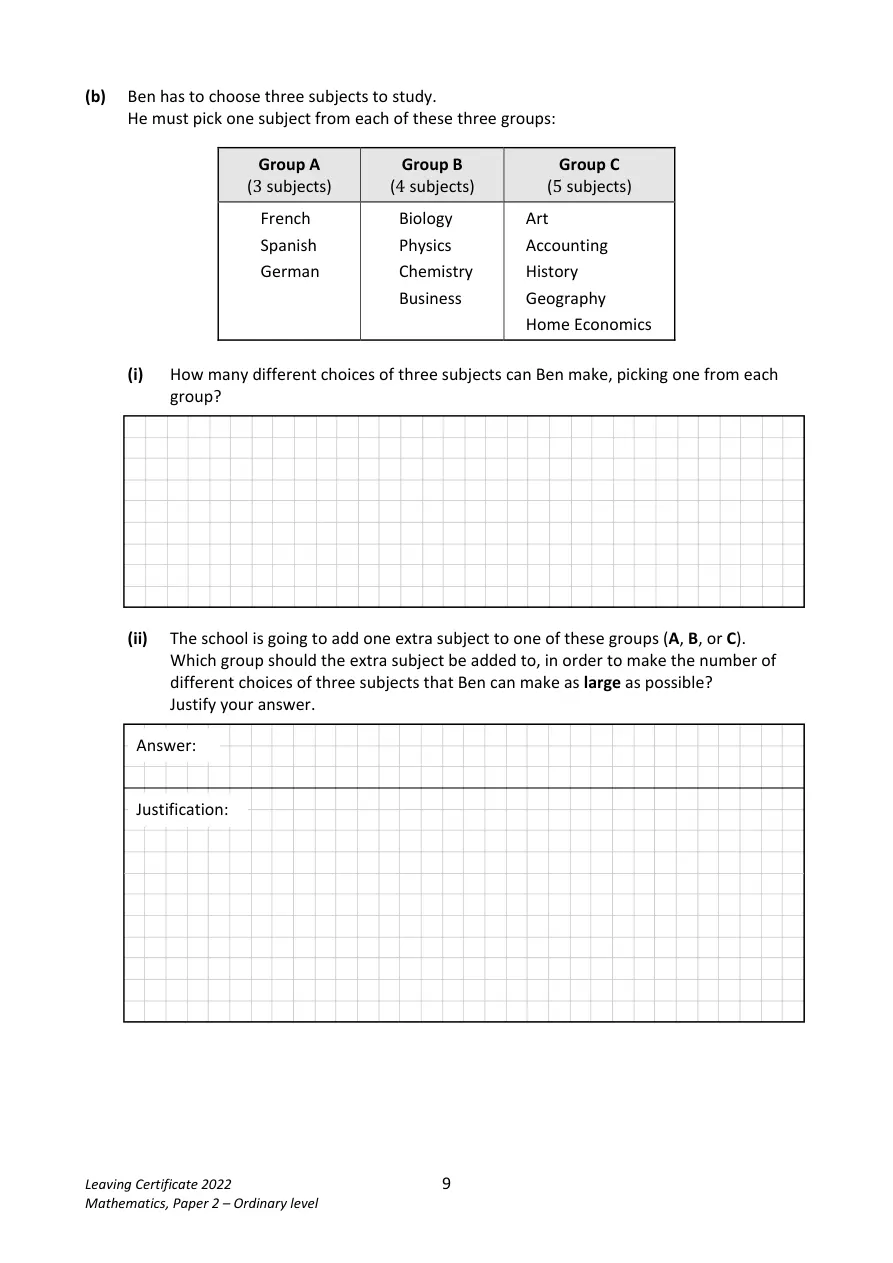
b) Subject choices

  1. N=3(4)(5)=60
  2. N_A=4(4)(5)=80
  3. N_B=3(5)(5)=75
  4. N_C=3(4)(6)=72
  5. Add the new subject to Group A, which gives the largest number of choices.

Question 4

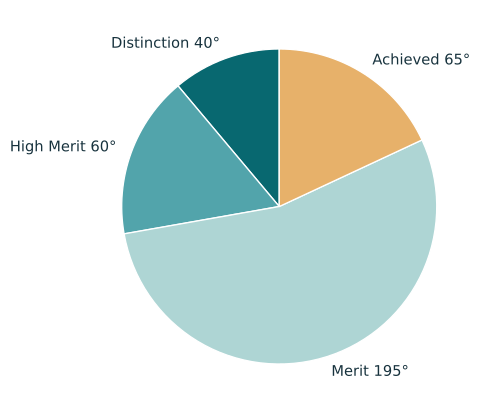
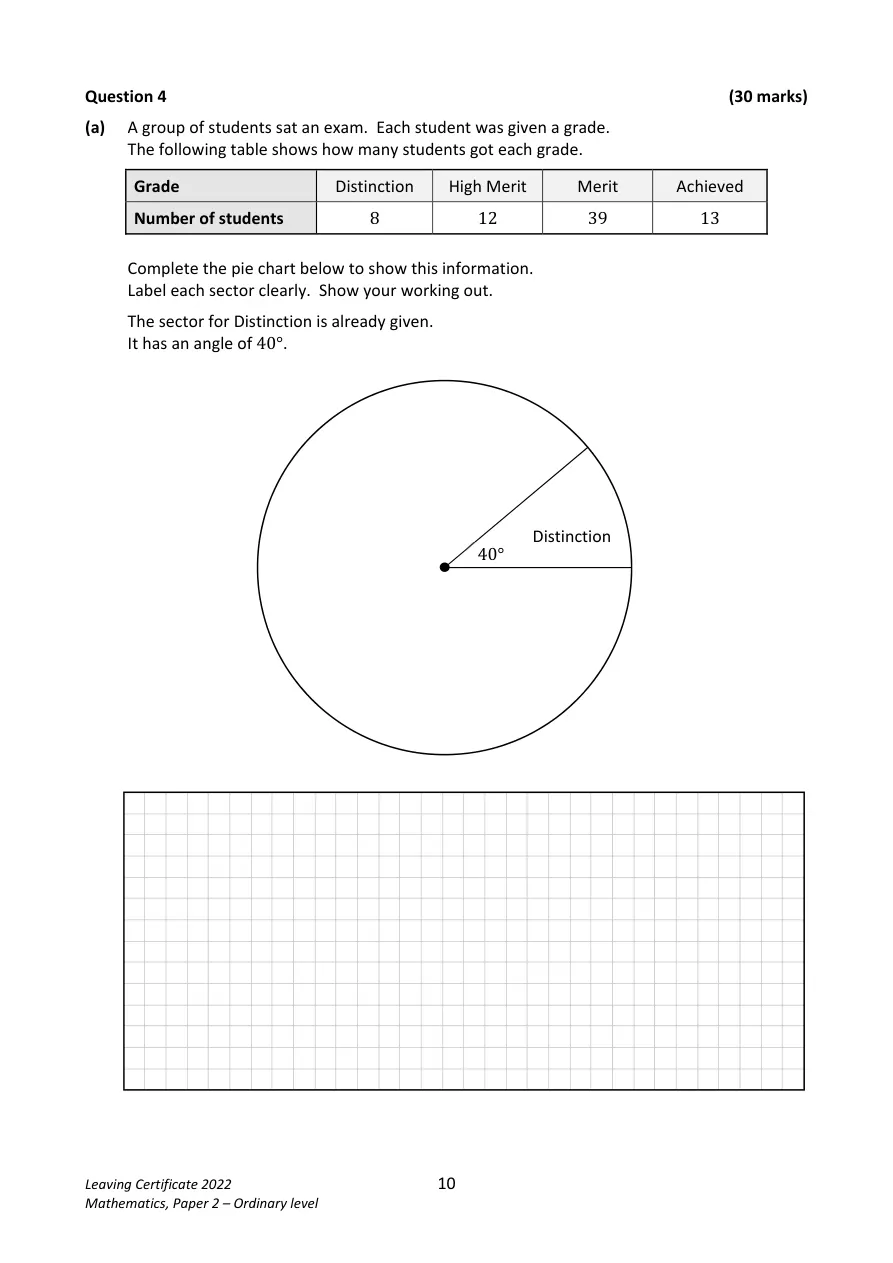
a) Pie chart

  1. N=8+12+39+13=72
  2. \mathrm{angle\ per\ student}=\dfrac{360^\circ}{72}=5^\circ
  3. \theta_D=8(5^\circ)=40^\circ
  4. \theta_H=12(5^\circ)=60^\circ
  5. \theta_M=39(5^\circ)=195^\circ
  6. \theta_A=13(5^\circ)=65^\circ
  7. 2022-2-4-pie

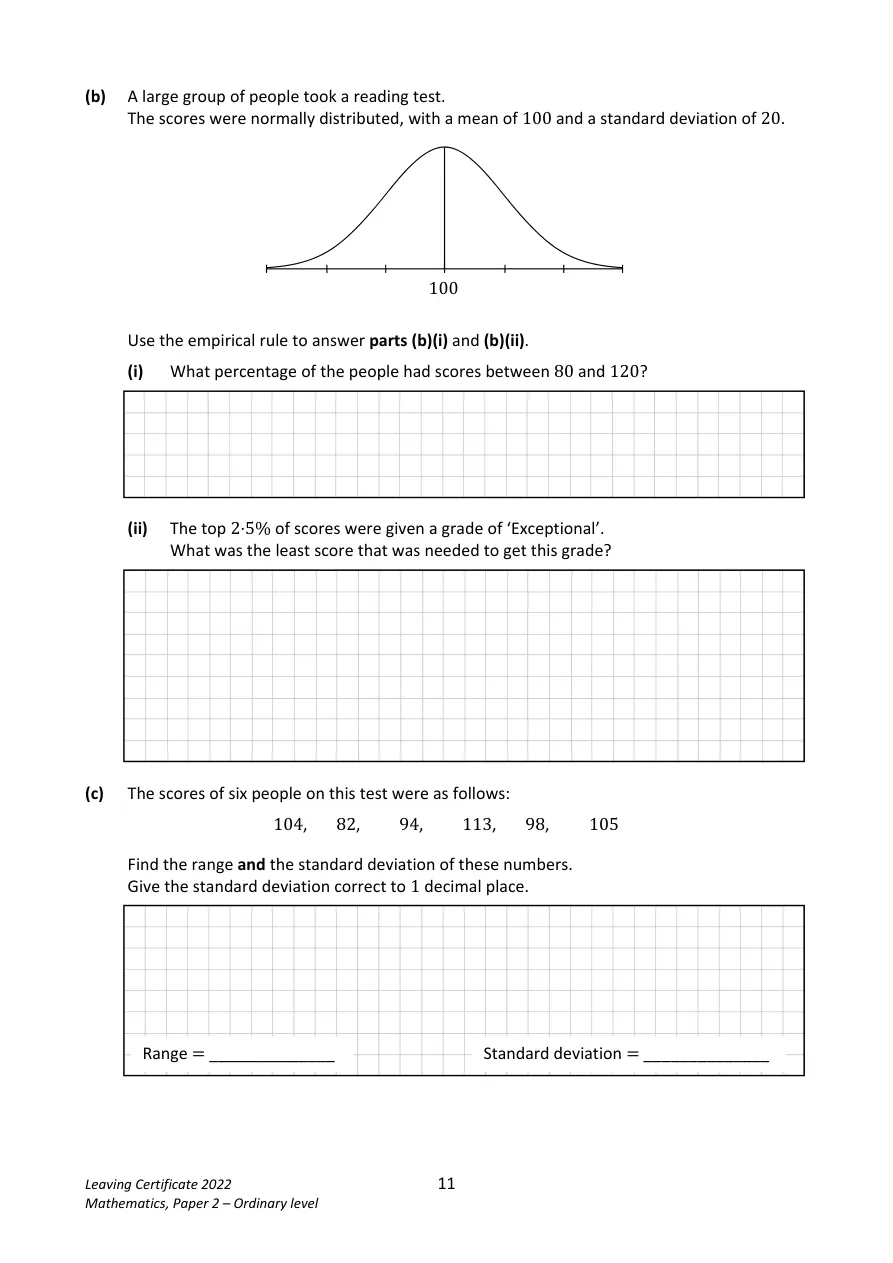
b) Normal distribution

  1. P(80\leq X\leq120)\approx68\%
  2. X_{\mathrm{exceptional}}=100+2(20)
  3. X_{\mathrm{exceptional}}=140

c) Range and spread

  1. R=113-82=31
  2. \mu=\dfrac{596}{6}
  3. \sigma=\sqrt{\dfrac{\sum(x-\mu)^2}{6}}
  4. \sigma\approx9.8

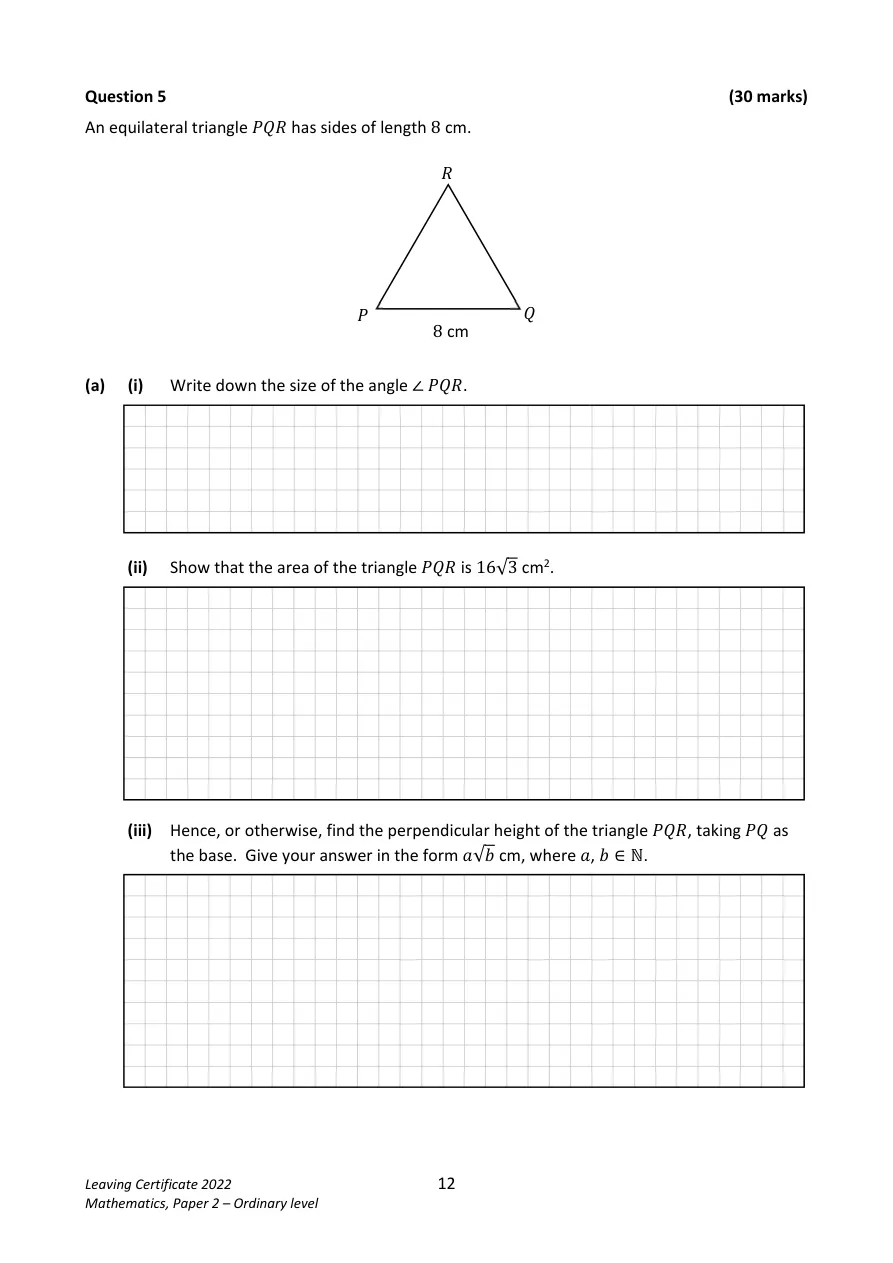
Question 5

a) Equilateral triangle

  1. \angle PQR=60^\circ
  2. A=\dfrac{1}{2}(8)(8)\sin60^\circ
  3. A=32\dfrac{\sqrt{3}}{2}
  4. A=16\sqrt{3}\ \mathrm{cm}^2
  5. h=\sqrt{8^2-4^2}
  6. h=\sqrt{48}=4\sqrt{3}\ \mathrm{cm}

b) Right triangle

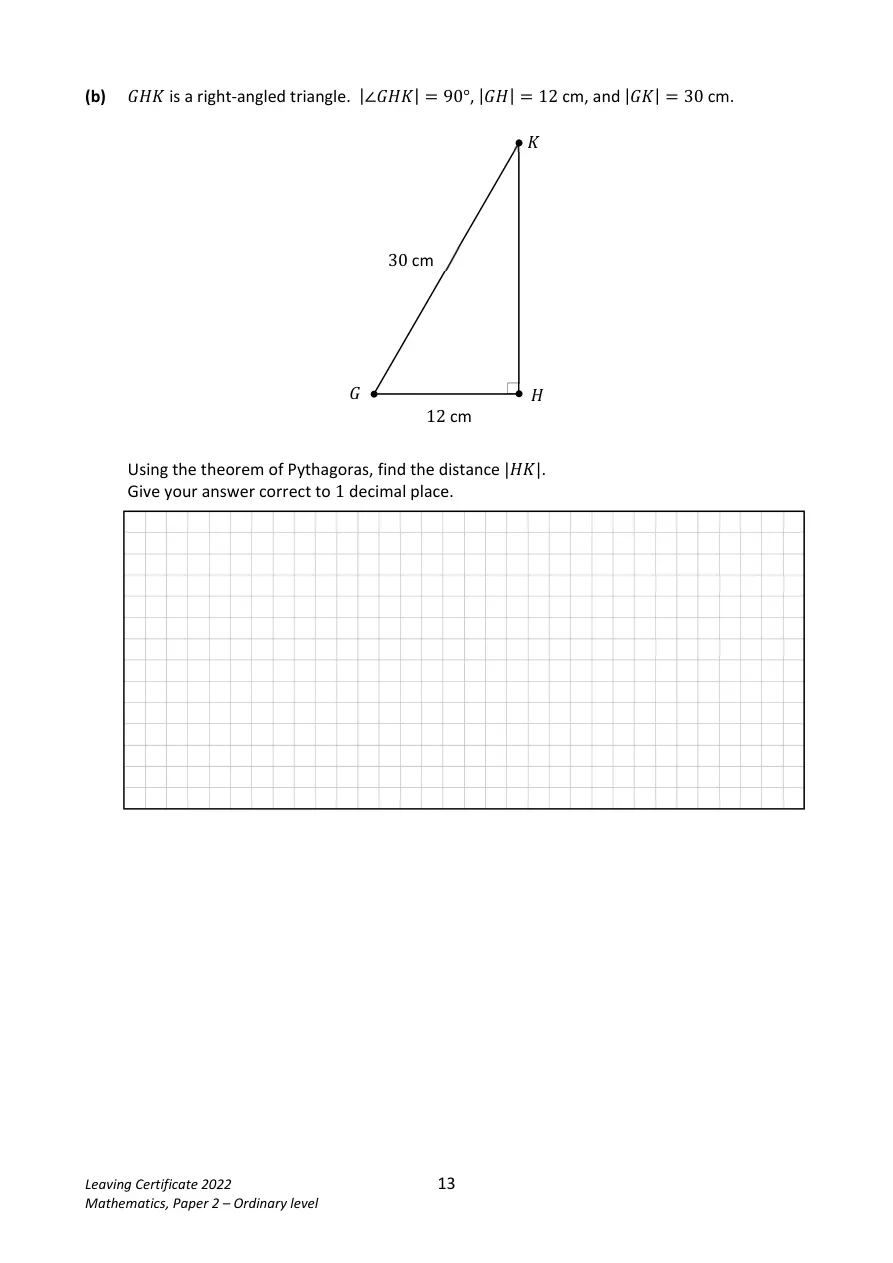
  1. HK^2=30^2-12^2
  2. HK^2=756
  3. HK=\sqrt{756}
  4. HK\approx27.5\ \mathrm{cm}

Question 6

a) Circle c

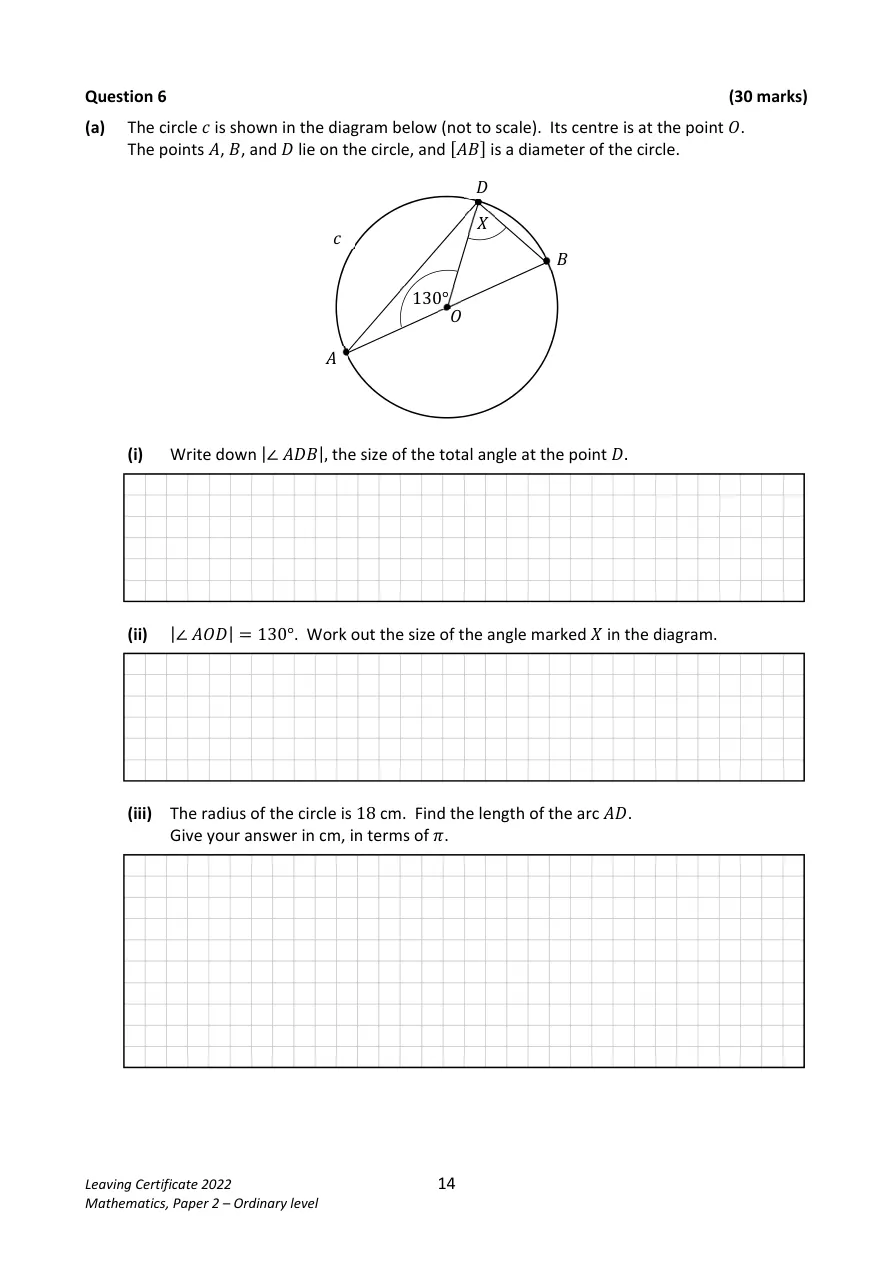
  1. \angle ADB=90^\circ

    An angle in a semicircle is a right angle.

  2. X=\dfrac{130^\circ}{2}
  3. X=65^\circ

    The angle at the circumference is half the central angle standing on the same arc.

  4. s=\dfrac{130}{360}(2\pi)(18)
  5. s=13\pi\ \mathrm{cm}

    This is the minor arc AD. The major arc would be 23π cm.

b) Statements

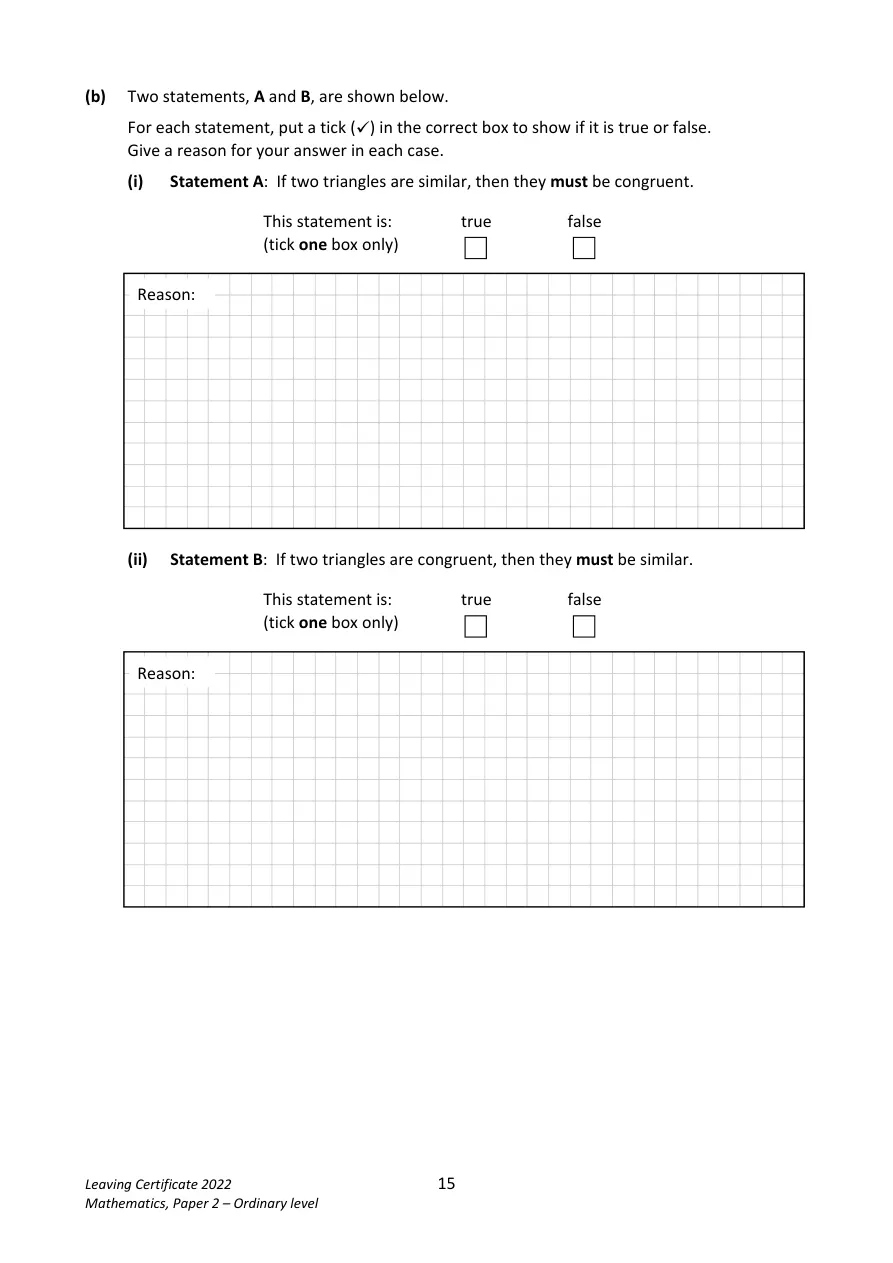
  1. A is false: similar triangles can have different sizes; for example, equilateral triangles with sides 2 cm and 4 cm are similar but not congruent. B is true: congruent triangles have equal corresponding angles and sides, so in particular they are similar.

Question 7

a) Dog weights

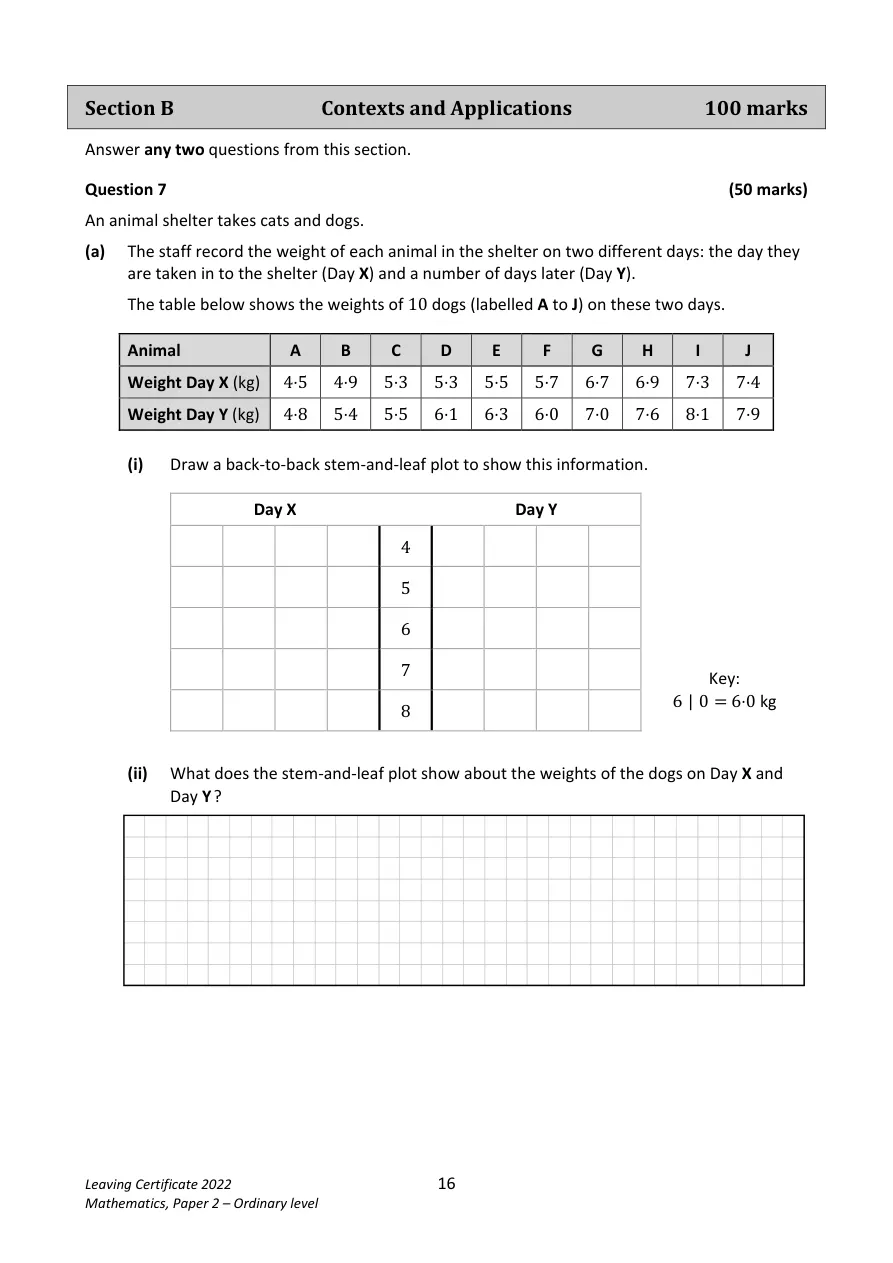
  1. Day X leaves (descending) for stems 4, 5, 6, 7, 8: 9 5; 7 5 3 3; 9 7; 4 3; none. Day Y leaves (ascending): 8; 4 5; 0 1 3; 0 6 9; 1. Place the shared stems between the lists. Key: stem 6, leaf 0 means 6.0 kg.
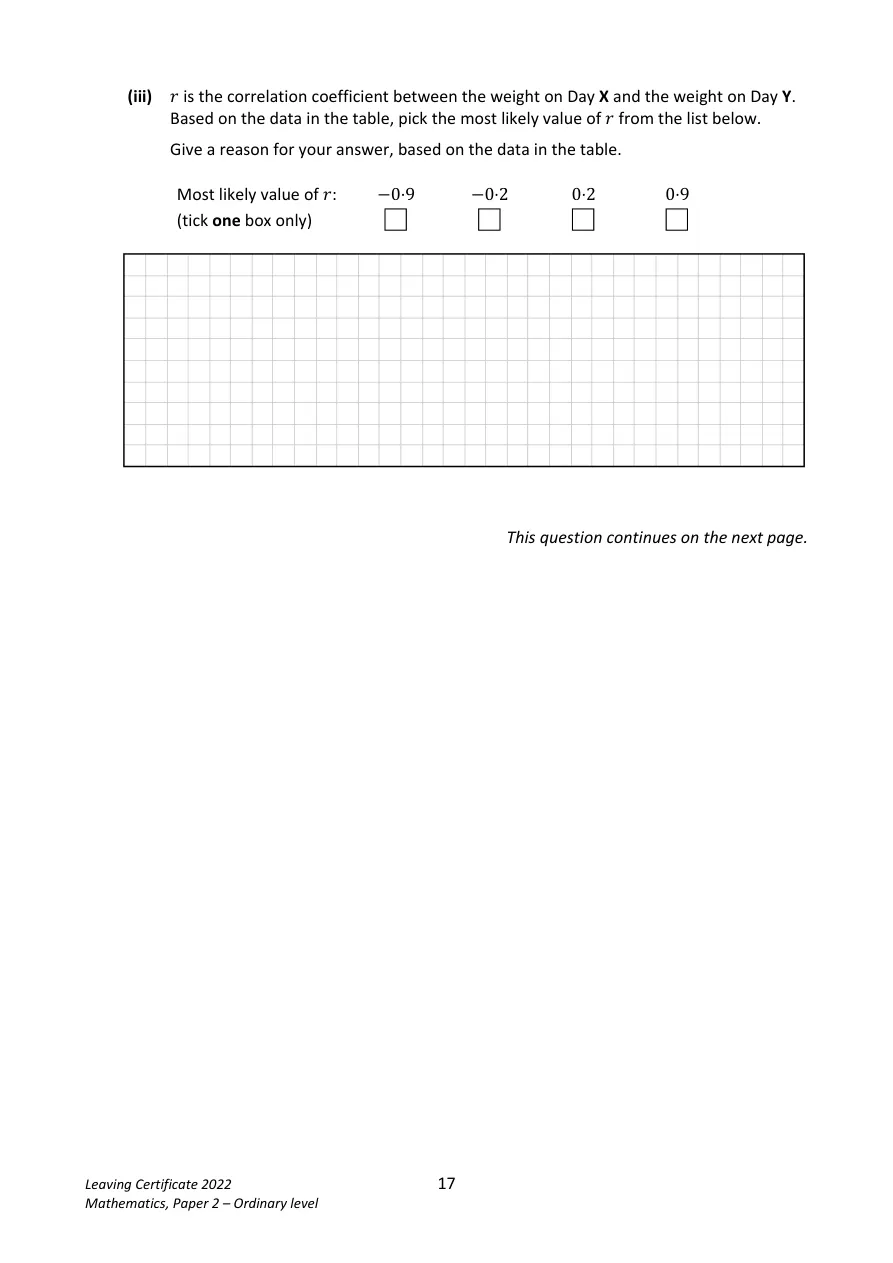
  2. The dog weights increased overall from Day X to Day Y. Choose r = 0.9: the two weights have a strong positive relationship.

b) Complete the table

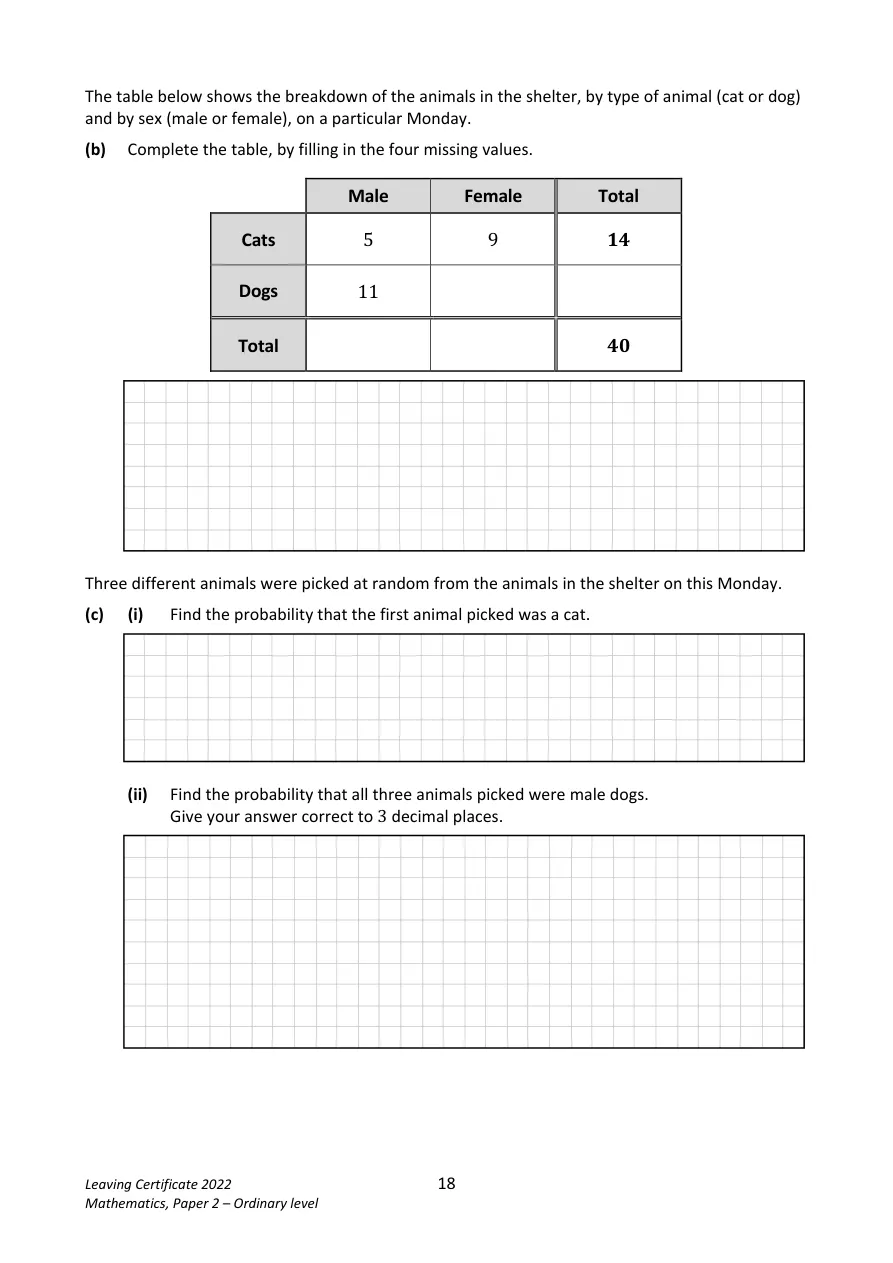
  1. Cats: 5 male, 9 female, total 14. Dogs: 11 male, 15 female, total 26. Totals: 16 male, 24 female, overall 40.

c) Pick animals

  1. P(\mathrm{cat})=\dfrac{14}{40}=\dfrac{7}{20}
  2. P(\mathrm{three\ male\ dogs})=\dfrac{11}{40}\dfrac{10}{39}\dfrac{9}{38}
  3. P(\mathrm{three\ male\ dogs})\approx0.017

    Sampling different animals means no replacement.

d) Pens

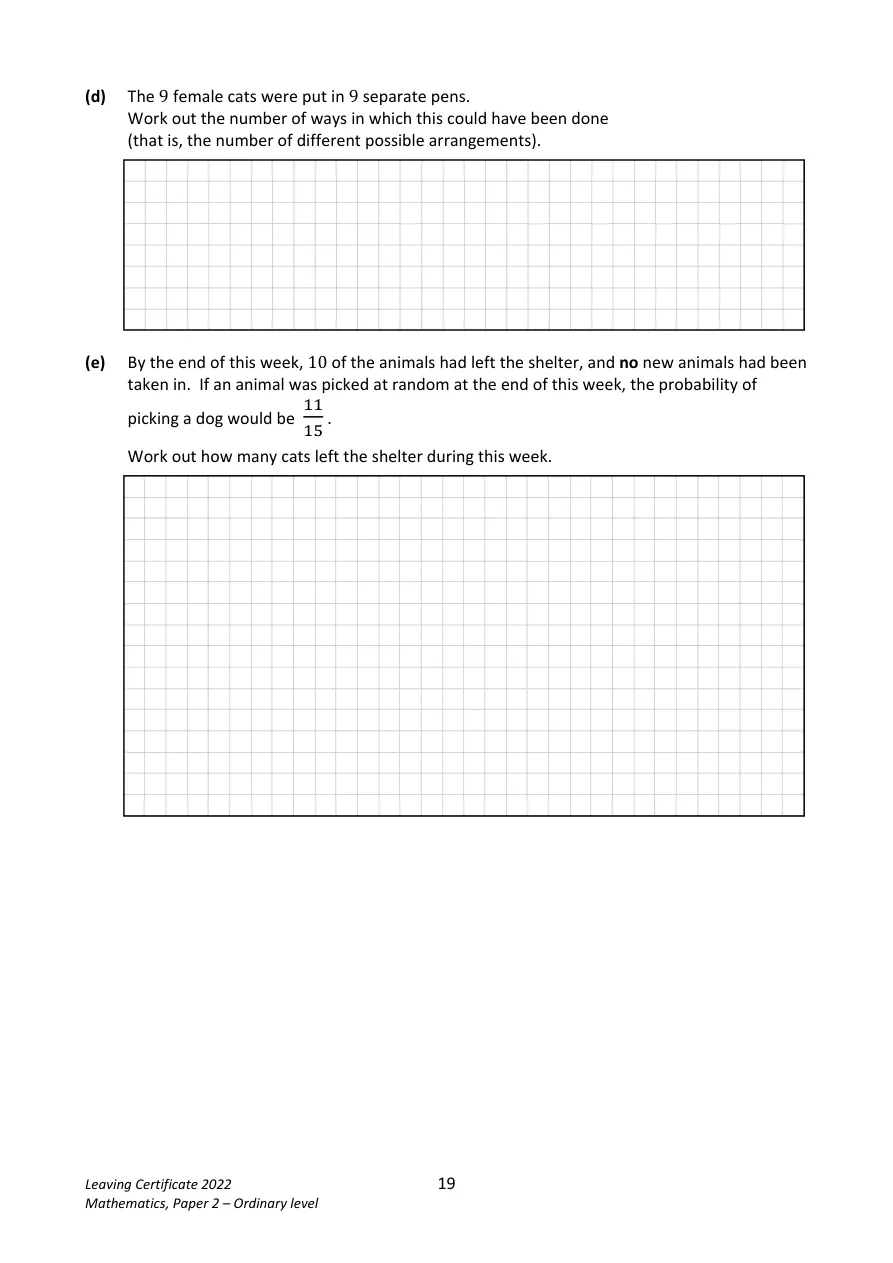
  1. N=9!=362880

e) Cats leaving

  1. N_{\mathrm{remaining}}=40-10=30
  2. D_{\mathrm{remaining}}=30\dfrac{11}{15}=22
  3. C_{\mathrm{remaining}}=30-22=8
  4. C_{\mathrm{left}}=14-8=6

Question 8

a) Top of lighthouse

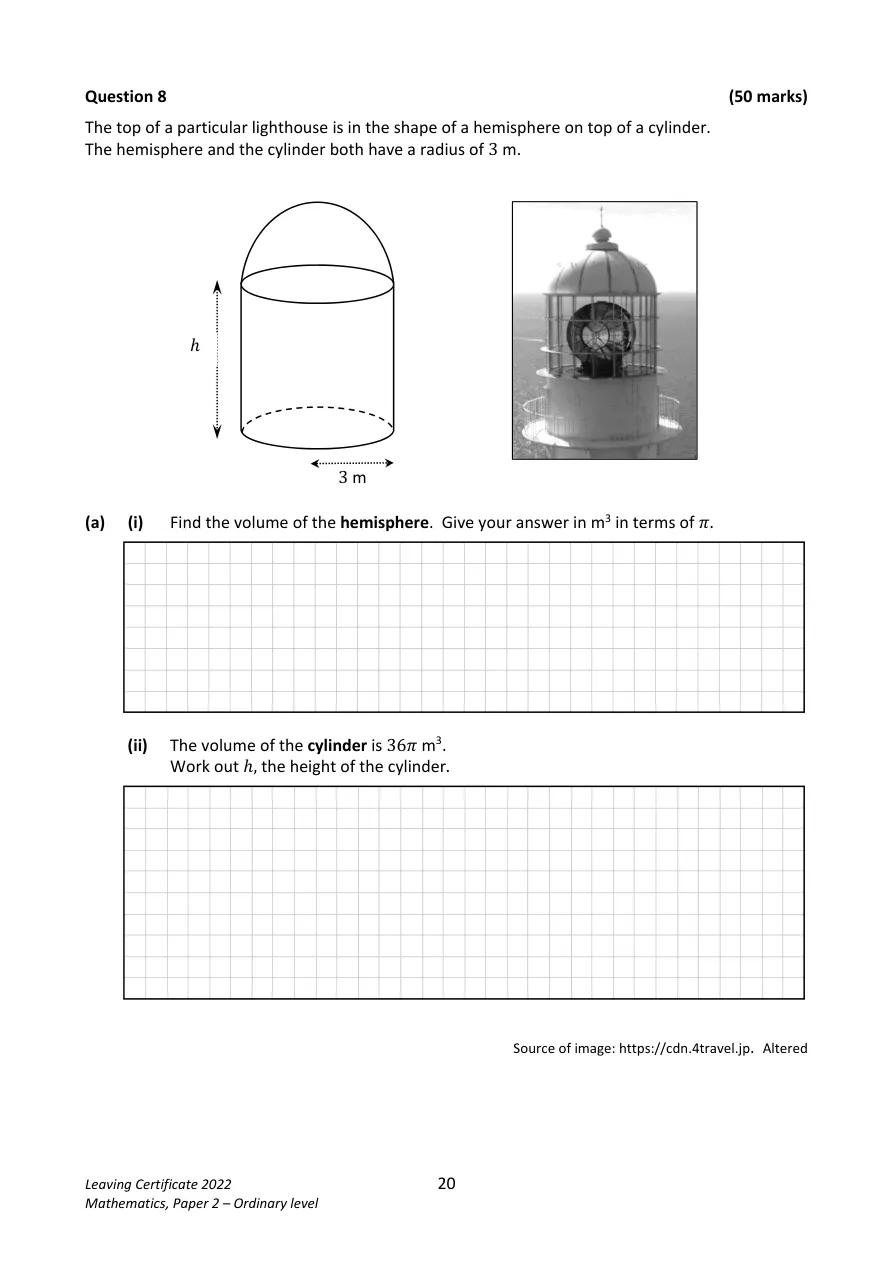
  1. V=\dfrac{2}{3}\pi(3)^3
  2. V=18\pi\ \mathrm{m}^3
  3. \pi(3)^2h=36\pi
  4. h=4\ \mathrm{m}

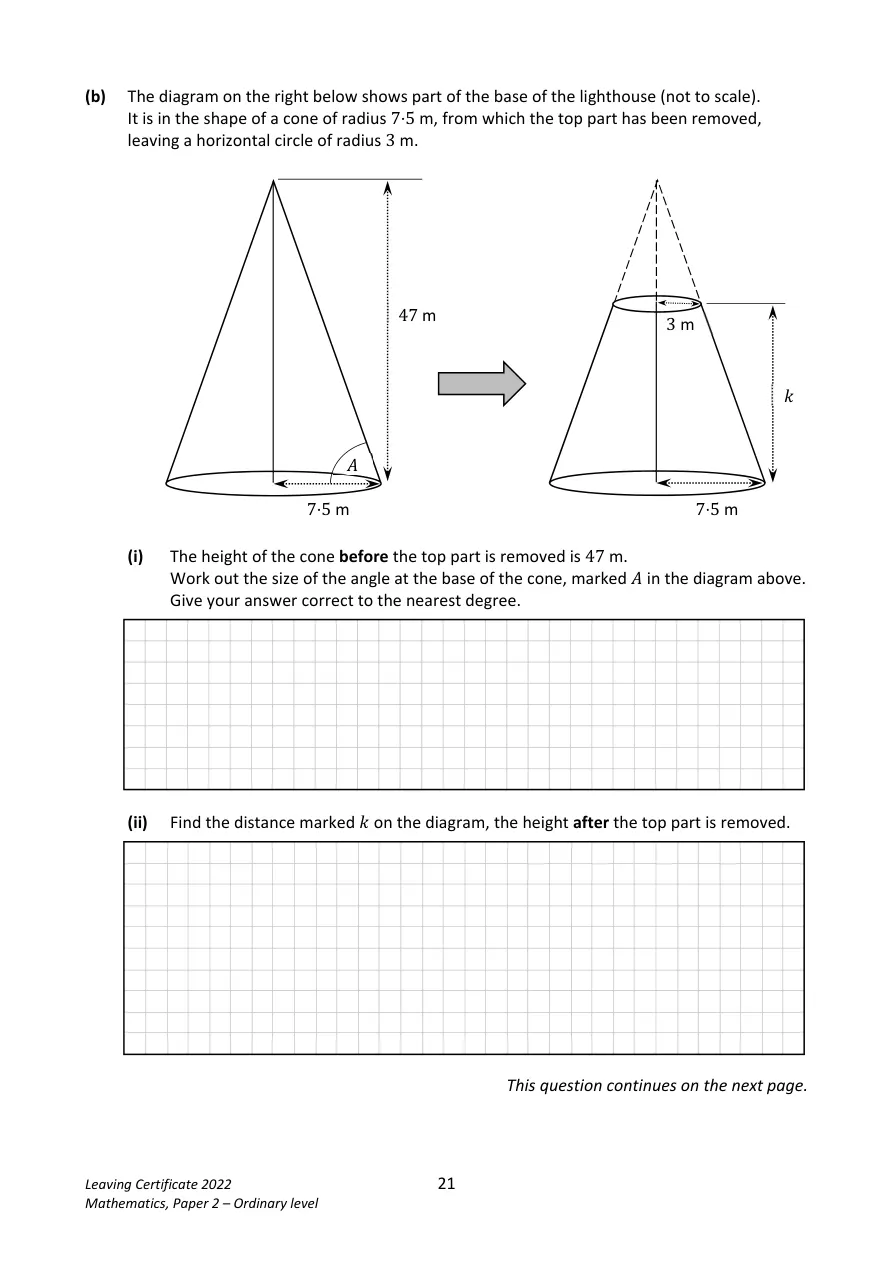
b) Truncated cone

  1. A=\tan^{-1}\left(\dfrac{47}{7.5}\right)
  2. A\approx81^\circ
  3. \dfrac{x}{47}=\dfrac{3}{7.5}

    Similar cross-section triangles give the removed height x.

  4. x=18.8\ \mathrm{m}
  5. k=47-18.8
  6. k=28.2\ \mathrm{m}

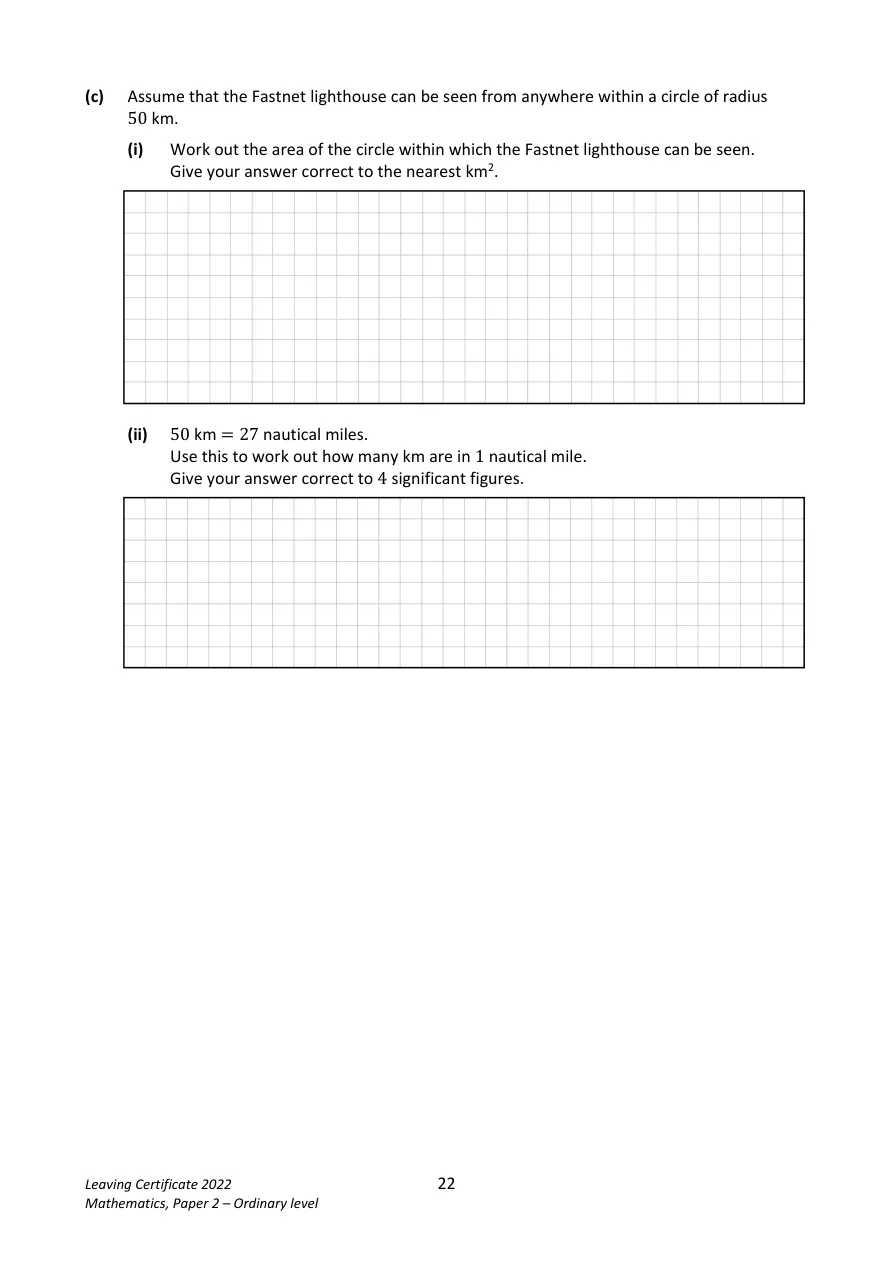
c) Visibility

  1. A=\pi(50)^2
  2. A\approx7854\ \mathrm{km}^2
  3. 1\ \mathrm{nautical\ mile}=\dfrac{50}{27}\ \mathrm{km}
  4. 1\ \mathrm{nautical\ mile}\approx1.852\ \mathrm{km}

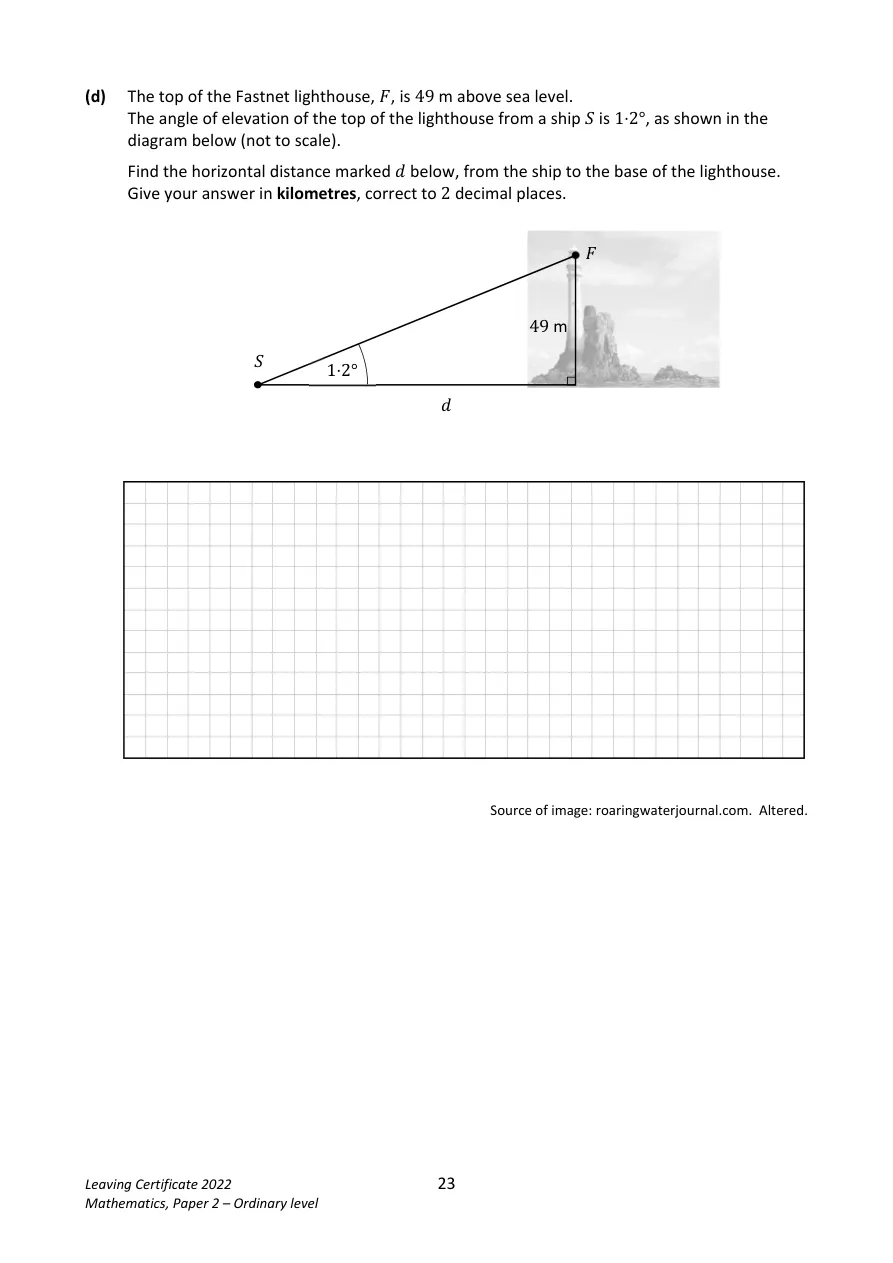
d) Ship distance

  1. d=\dfrac{49}{\tan1.2^\circ}\ \mathrm{m}
  2. d\approx2339.2\ \mathrm{m}
  3. d\approx2.34\ \mathrm{km}

Question 9

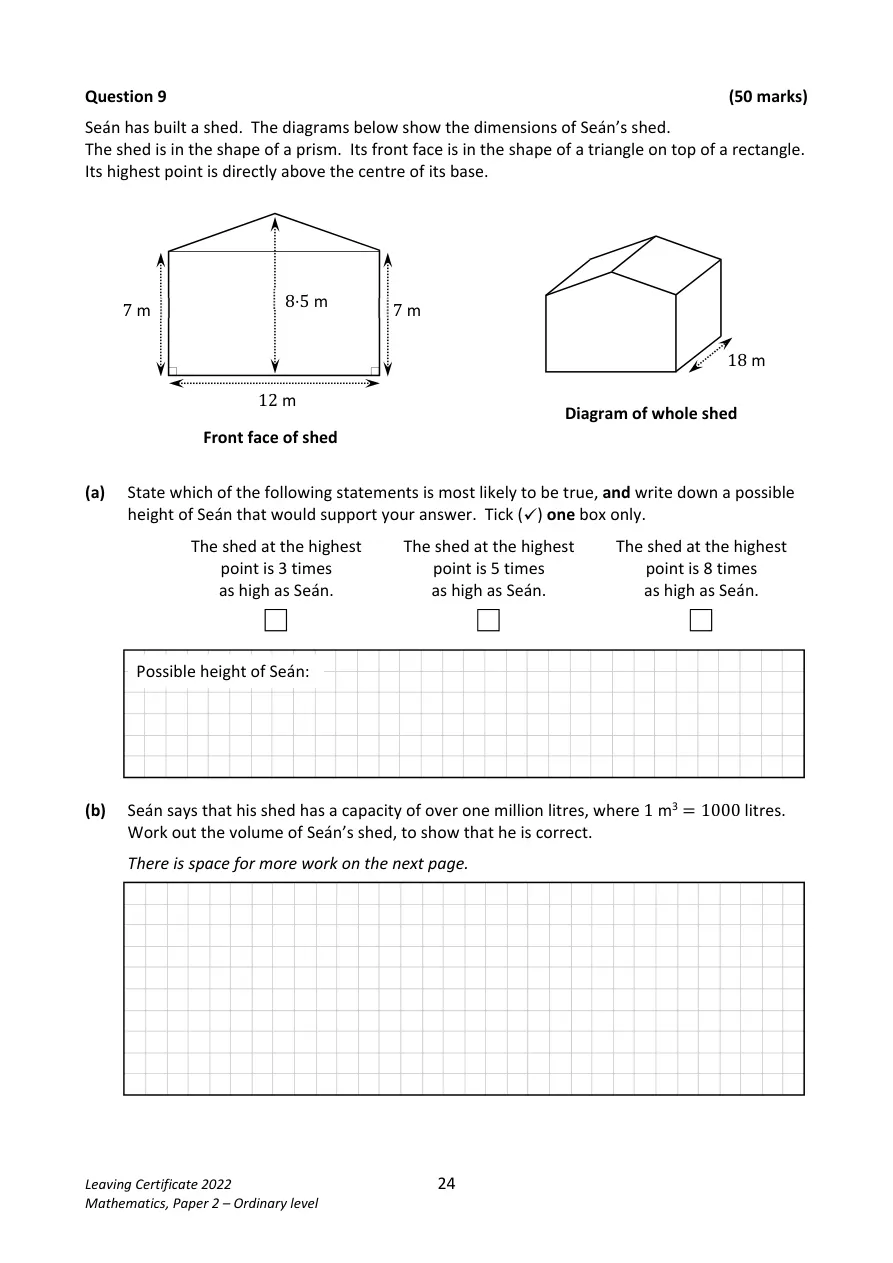
a) Estimate Seán's height

  1. H=\dfrac{8.5}{5}=1.7\ \mathrm{m}
  2. Five times as high as Seán is plausible if Seán is about 1.7 m tall.

b) Shed capacity

  1. A_{\mathrm{front}}=7(12)+\dfrac{1}{2}(12)(1.5)
  2. A_{\mathrm{front}}=93\ \mathrm{m}^2
  3. V=93(18)=1674\ \mathrm{m}^3
  4. V=1674000\ \mathrm{litres}
  5. The capacity is greater than one million litres.

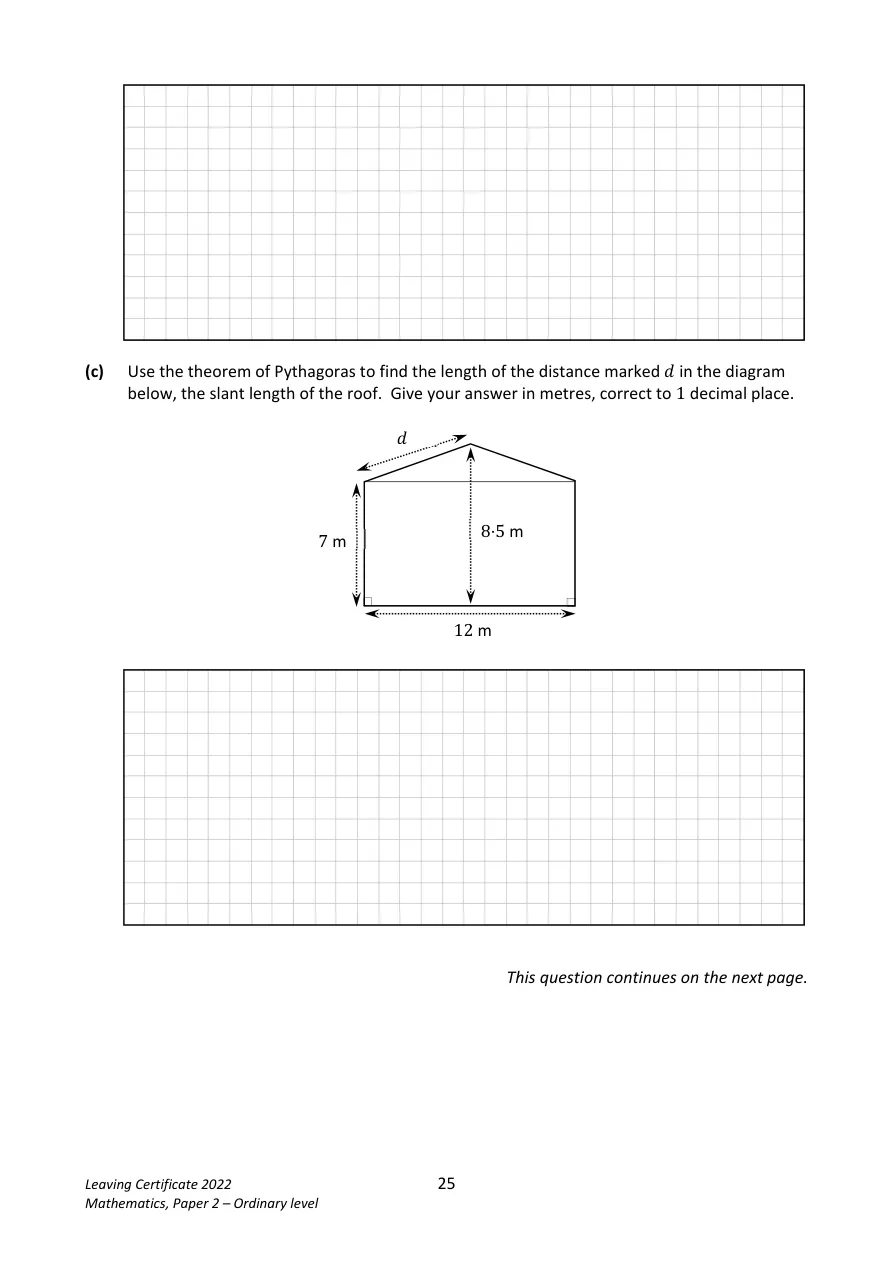
c) Roof slant

  1. d=\sqrt{6^2+1.5^2}
  2. d\approx6.2\ \mathrm{m}

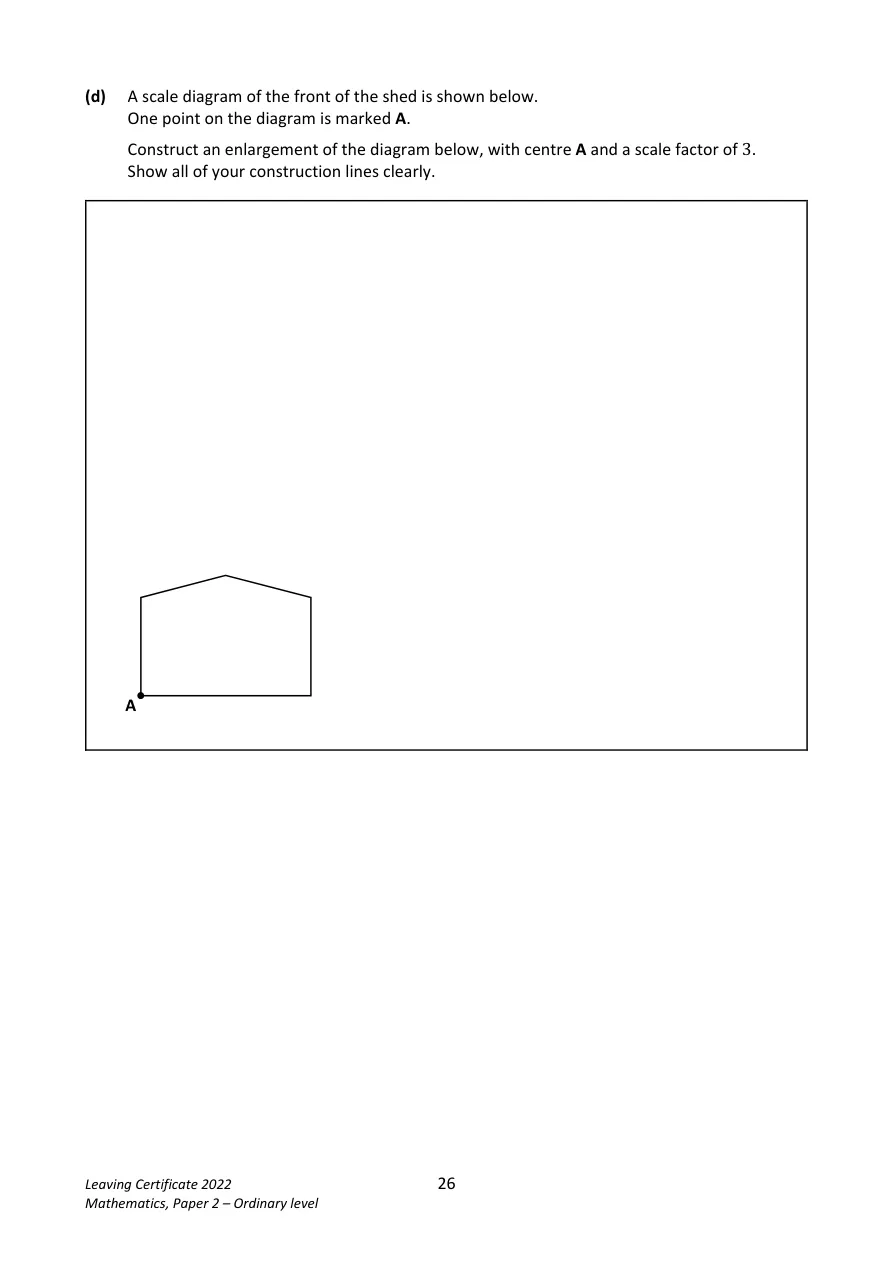
d) Enlargement

  1. Keep A fixed. Draw rays from A through every other vertex. Mark each new vertex on its ray at three times its original distance from A, then join the new vertices in the original order. Keep the construction rays visible. The source model's approximate new distances are AB′ = 4.0 cm, AC′ = 4.6 cm, AD′ = 3.5 cm and AE′ = 2.4 cm; measure from the original diagram printed at 100%.

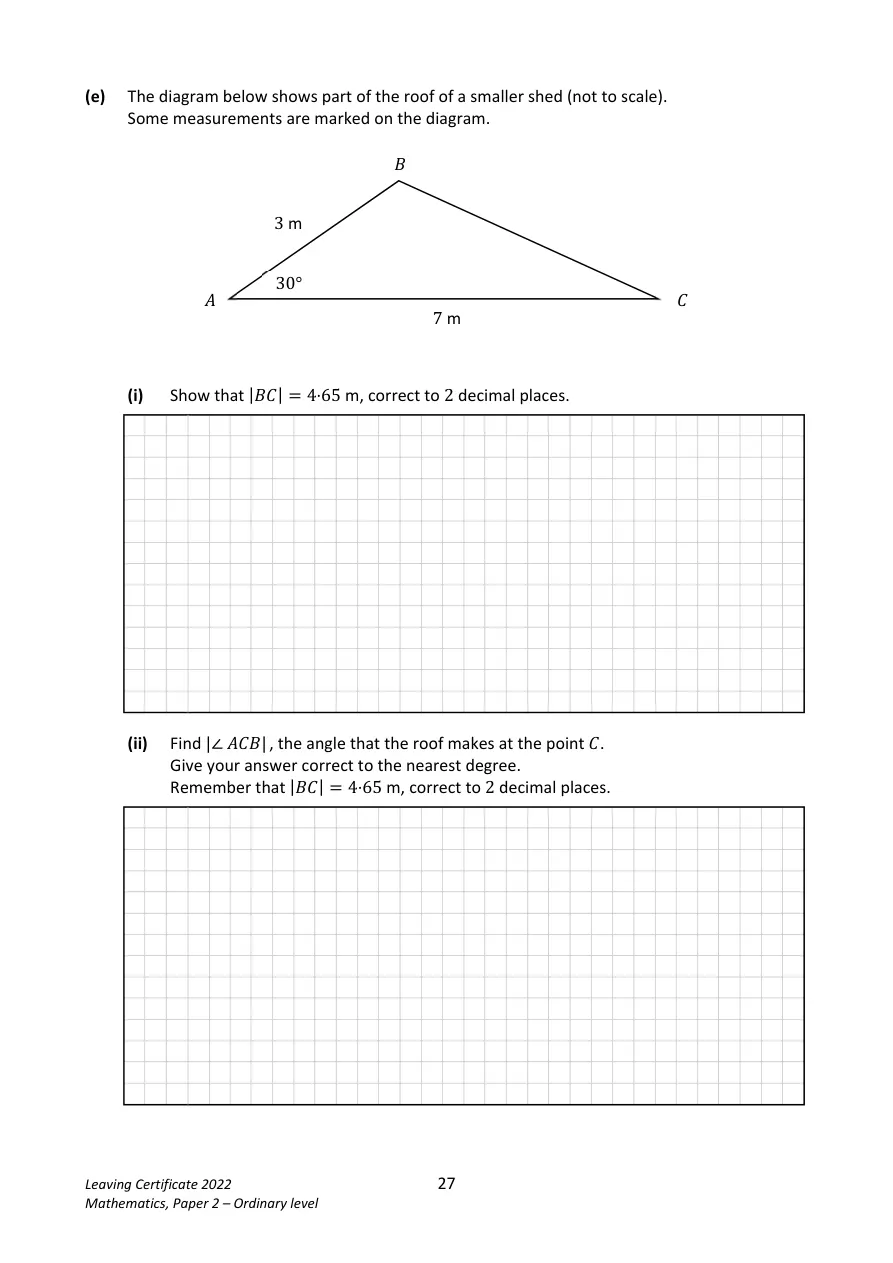
e) Smaller shed

  1. BC=\sqrt{3^2+7^2-2(3)(7)\cos30^\circ}
  2. BC\approx4.65\ \mathrm{m}
  3. \dfrac{\sin C}{3}=\dfrac{\sin30^\circ}{4.65}
  4. C=\sin^{-1}\left(\dfrac{3\sin30^\circ}{4.65}\right)
  5. C\approx19^\circ

Question 10

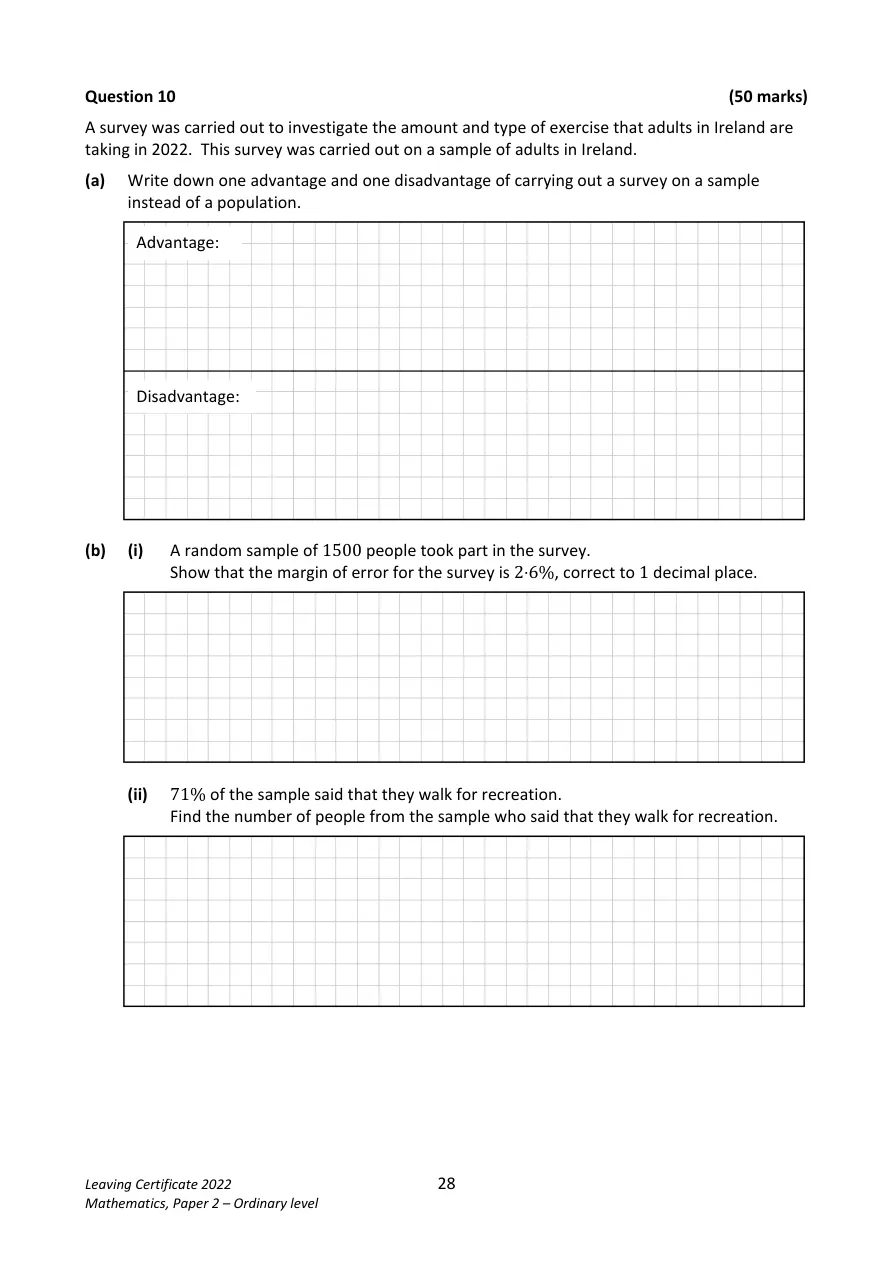
a) Sample versus population

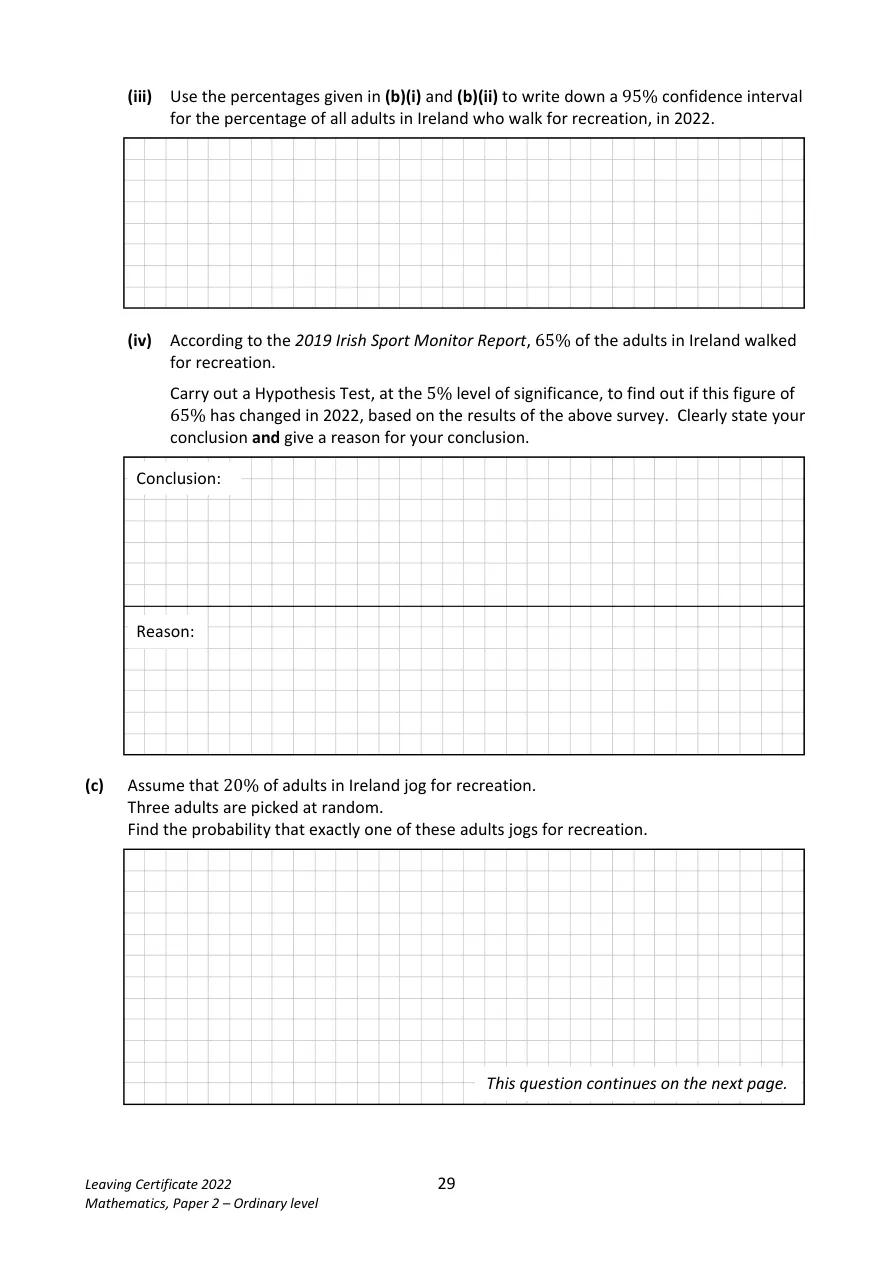
  1. Advantage: surveying a sample is quicker and cheaper. Disadvantage: sampling variation or an unrepresentative sample can make the estimate inaccurate.

b) Walking survey

  1. E=\dfrac{1}{\sqrt{1500}}\times100\%
  2. E\approx2.6\%
  3. N=1500(0.71)=1065
  4. \mathrm{CI}=[71-2.6,71+2.6]\%
  5. \mathrm{CI}=[68.4,73.6]\%
  6. The historical proportion 65% is outside this interval. Reject the null hypothesis at the 5% significance level: there is evidence that the percentage has changed (increased).

c) Exactly one jogger

  1. P=3(0.2)(0.8)^2
  2. P=0.384

    There are three possible positions for the one jogger.

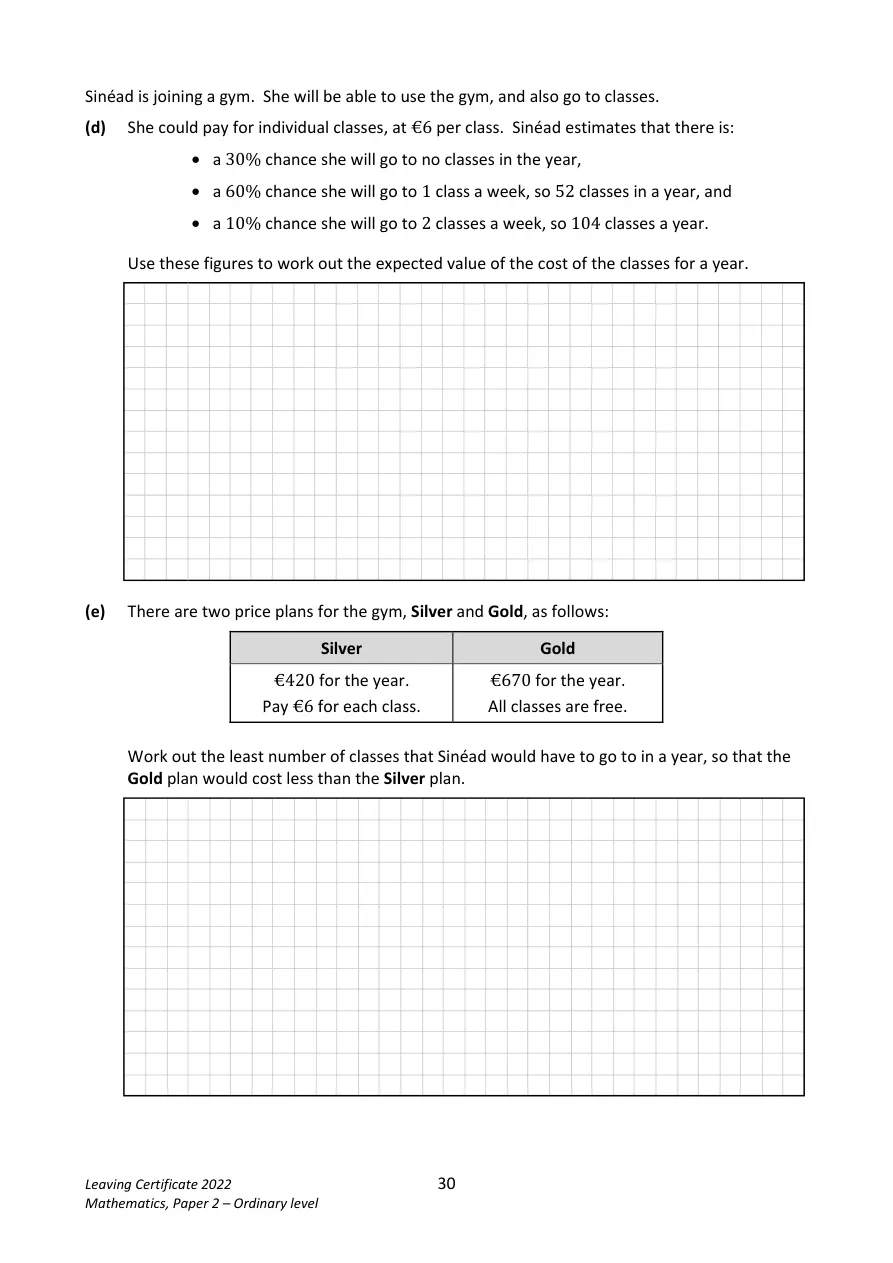
d) Expected class cost

  1. E=0(0.3)+52(6)(0.6)+104(6)(0.1)
  2. E=249.60\ \mathrm{euro}

e) Gold cheaper than Silver

  1. 670<420+6n
  2. 250<6n
  3. n>41.66\ldots
  4. n_{\min}=42\ \mathrm{classes}
See working and diagrams on the original paper
Original exam paper page 4
m_{AC}=\dfrac{3-0}{0-(-2)}=\dfrac{3}{2}
m_{BC}=\dfrac{3-0}{0-5}=-\dfrac{3}{5}
m_{AC}m_{BC}=-\dfrac{9}{10}\neq-1
AC and BC are not perpendicular.
Original exam paper page 5
L=(-9,1),\quad M=(9,1)
LM=9-(-9)=18
LM:\ y=1
x=0
[N lies on the axis of symmetry.]
4y-13=0
y=\dfrac{13}{4}
N=\left(0,\dfrac{13}{4}\right)
Original exam paper page 6
C=(4,-2),\quad r=13
(11-4)^2+(10+2)^2=193
193>169
The point (11, 10) is outside the circle.
Original exam paper page 7
\vec v=(22-12,13-11)=(10,2)
P=(22,13)+(10,2)
P=(32,15)
[Reflect the contact point across the centre to get another point on s.]
C_t=(12,11)-\dfrac{1}{2}(10,2)
C_t=(7,10)
[The smaller circle's centre is on the opposite side of the contact point.]
Original exam paper page 8
\mu=\dfrac{17+8+9+8+14+11+28}{7}
\mu\approx13.6
Ordered list: 8, 8, 9, 11, 14, 17, 28. The median is 11.
\dfrac{x+11}{2}=10.5
x=10
[Adding 10 puts 10 and 11 in the two middle positions.]
Original exam paper page 9
N=3(4)(5)=60
N_A=4(4)(5)=80
N_B=3(5)(5)=75
N_C=3(4)(6)=72
Group A gives the most choices.
Original exam paper page 10
N=8+12+39+13=72
\mathrm{angle\ per\ student}=\dfrac{360^\circ}{72}=5^\circ
\theta_D=8(5^\circ)=40^\circ
\theta_H=12(5^\circ)=60^\circ
\theta_M=39(5^\circ)=195^\circ
\theta_A=13(5^\circ)=65^\circ
DHigher MeritMeritAchieved
Original exam paper page 11
P(80\leq X\leq120)\approx68\%
X_{\mathrm{exceptional}}=100+2(20)
X_{\mathrm{exceptional}}=140
R=113-82=31
\mu=\dfrac{596}{6}
\sigma=\sqrt{\dfrac{\sum(x-\mu)^2}{6}}
\sigma\approx9.8
Original exam paper page 12
\angle PQR=60^\circ
A=\dfrac{1}{2}(8)(8)\sin60^\circ
A=32\dfrac{\sqrt{3}}{2}
A=16\sqrt{3}\ \mathrm{cm}^2
h=\sqrt{8^2-4^2}
h=\sqrt{48}=4\sqrt{3}\ \mathrm{cm}
Original exam paper page 13
HK^2=30^2-12^2
HK^2=756
HK=\sqrt{756}
HK\approx27.5\ \mathrm{cm}
Original exam paper page 14
\angle ADB=90^\circ
[An angle in a semicircle is a right angle.]
X=\dfrac{130^\circ}{2}
X=65^\circ
[The angle at the circumference is half the central angle standing on the same arc.]
s=\dfrac{130}{360}(2\pi)(18)
s=13\pi\ \mathrm{cm}
[This is the minor arc AD. The major arc would be 23π cm.]
Original exam paper page 15
False. Similar triangles may have different sizes. Equilateral triangles with sides 2 cm and 4 cm are similar, but not congruent.
True. Congruent triangles have equal corresponding angles and equal corresponding sides, so they are also similar.
Original exam paper page 16
Weights increased overall from Day X to Day Y.
9 587 5 3 34 59 70 1 34 30 6 91
Original exam paper page 17
r = 0.9: there is a strong positive relationship between the two weights.
Original exam paper page 18
Cats: 5 male, 9 female, total 14. Dogs: 11 male, 15 female, total 26. Totals: 16 male, 24 female, overall 40.
P(\mathrm{cat})=\dfrac{14}{40}=\dfrac{7}{20}
P(\mathrm{three\ male\ dogs})=\dfrac{11}{40}\dfrac{10}{39}\dfrac{9}{38}
P(\mathrm{three\ male\ dogs})\approx0.017
[Sampling different animals means no replacement.]
15261624
Original exam paper page 19
N=9!=362880
N_{\mathrm{remaining}}=40-10=30
D_{\mathrm{remaining}}=30\dfrac{11}{15}=22
C_{\mathrm{remaining}}=30-22=8
C_{\mathrm{left}}=14-8=6
Original exam paper page 20
V=\dfrac{2}{3}\pi(3)^3
V=18\pi\ \mathrm{m}^3
\pi(3)^2h=36\pi
h=4\ \mathrm{m}
Original exam paper page 21
A=\tan^{-1}\left(\dfrac{47}{7.5}\right)
A\approx81^\circ
\dfrac{x}{47}=\dfrac{3}{7.5}
[Similar cross-section triangles give the removed height x.]
x=18.8\ \mathrm{m}
k=47-18.8
k=28.2\ \mathrm{m}
Original exam paper page 22
A=\pi(50)^2
A\approx7854\ \mathrm{km}^2
1\ \mathrm{nautical\ mile}=\dfrac{50}{27}\ \mathrm{km}
1\ \mathrm{nautical\ mile}\approx1.852\ \mathrm{km}
Original exam paper page 23
d=\dfrac{49}{\tan1.2^\circ}\ \mathrm{m}
d\approx2339.2\ \mathrm{m}
d\approx2.34\ \mathrm{km}
Original exam paper page 24
H=\dfrac{8.5}{5}=1.7\ \mathrm{m}
Five times as high as Seán is plausible if Seán is about 1.7 m tall.
A_{\mathrm{front}}=7(12)+\dfrac{1}{2}(12)(1.5)
A_{\mathrm{front}}=93\ \mathrm{m}^2
V=93(18)=1674\ \mathrm{m}^3
V=1674000\ \mathrm{litres}
The capacity is greater than one million litres.
Original exam paper page 25
d=\sqrt{6^2+1.5^2}
d\approx6.2\ \mathrm{m}
Original exam paper page 26
Original exam paper page 27
BC=\sqrt{3^2+7^2-2(3)(7)\cos30^\circ}
BC\approx4.65\ \mathrm{m}
\dfrac{\sin C}{3}=\dfrac{\sin30^\circ}{4.65}
C=\sin^{-1}\left(\dfrac{3\sin30^\circ}{4.65}\right)
C\approx19^\circ
Original exam paper page 28
Quicker and cheaper than surveying everyone.
Sampling variation or an unrepresentative sample may make the estimate inaccurate.
E=\dfrac{1}{\sqrt{1500}}\times100\%
E\approx2.6\%
N=1500(0.71)=1065
Original exam paper page 29
\mathrm{CI}=[71-2.6,71+2.6]\%
\mathrm{CI}=[68.4,73.6]\%
P=3(0.2)(0.8)^2
P=0.384
[There are three possible positions for the one jogger.]
Reject the null hypothesis at the 5% significance level.
65% lies outside [68.4%, 73.6%]. There is evidence that the proportion has increased.
Original exam paper page 30
E=0(0.3)+52(6)(0.6)+104(6)(0.1)
E=249.60\ \mathrm{euro}
670<420+6n
250<6n
n>41.66\ldots
n_{\min}=42\ \mathrm{classes}