← Original paper

Leaving Cert Ordinary Maths 2023 · Paper 2

Teacher worked solutions. Explanations are in blue.

Question 1

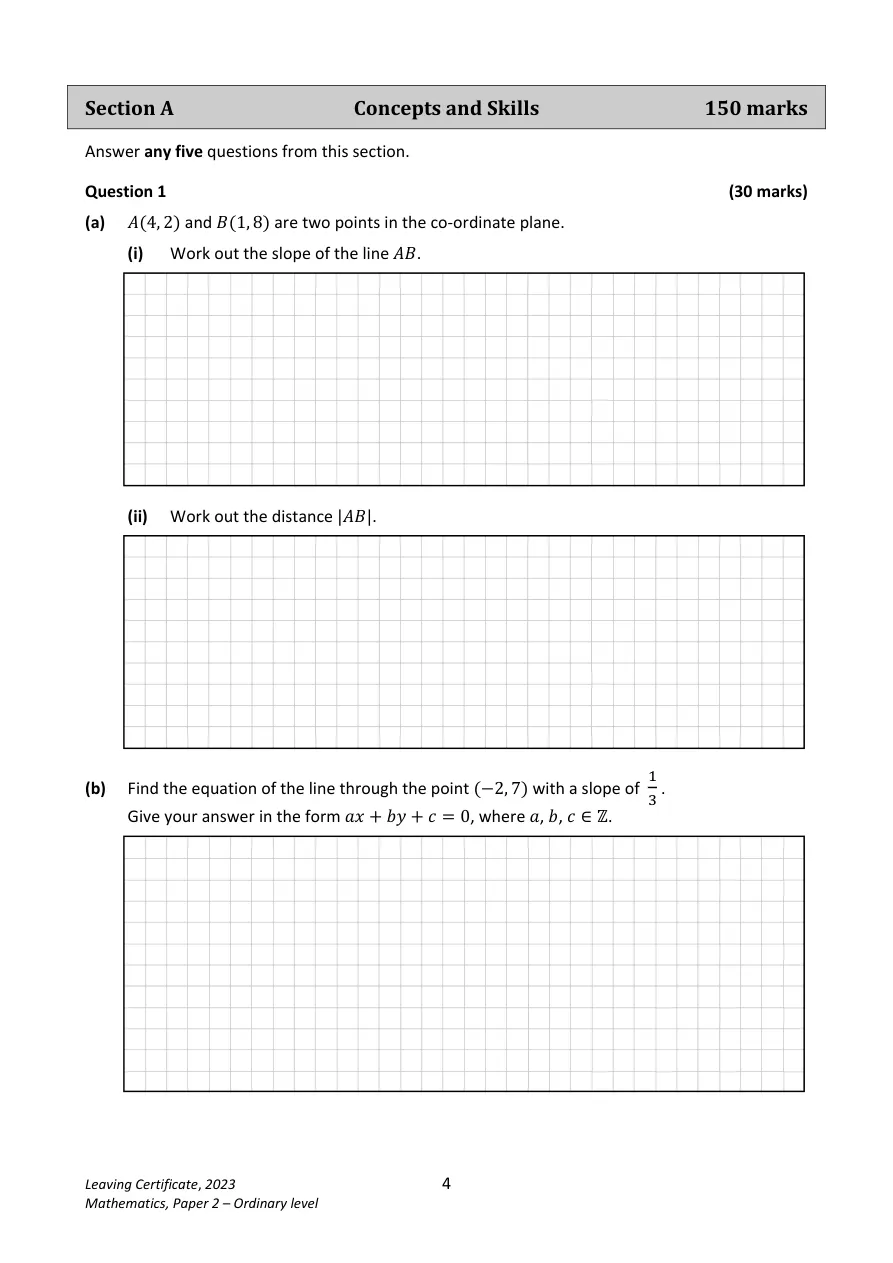
a) A and B

  1. m=\dfrac{8-2}{1-4}=-2

    Subtract the y-coordinates for the top and the x-coordinates for the bottom. Use the same point first in both subtractions.

  2. AB=\sqrt{(1-4)^2+(8-2)^2}

    Subtract the x-coordinates and the y-coordinates separately. Square each difference, add the squares, then take the square root.

  3. AB=\sqrt{45}=3\sqrt{5}

b) Equation of a line

  1. y-7=\dfrac{1}{3}(x+2)
  2. 3y-21=x+2
  3. x-3y+23=0

c) Draw line segments

  1. y-2=2(x-4)
  2. y=2x-6
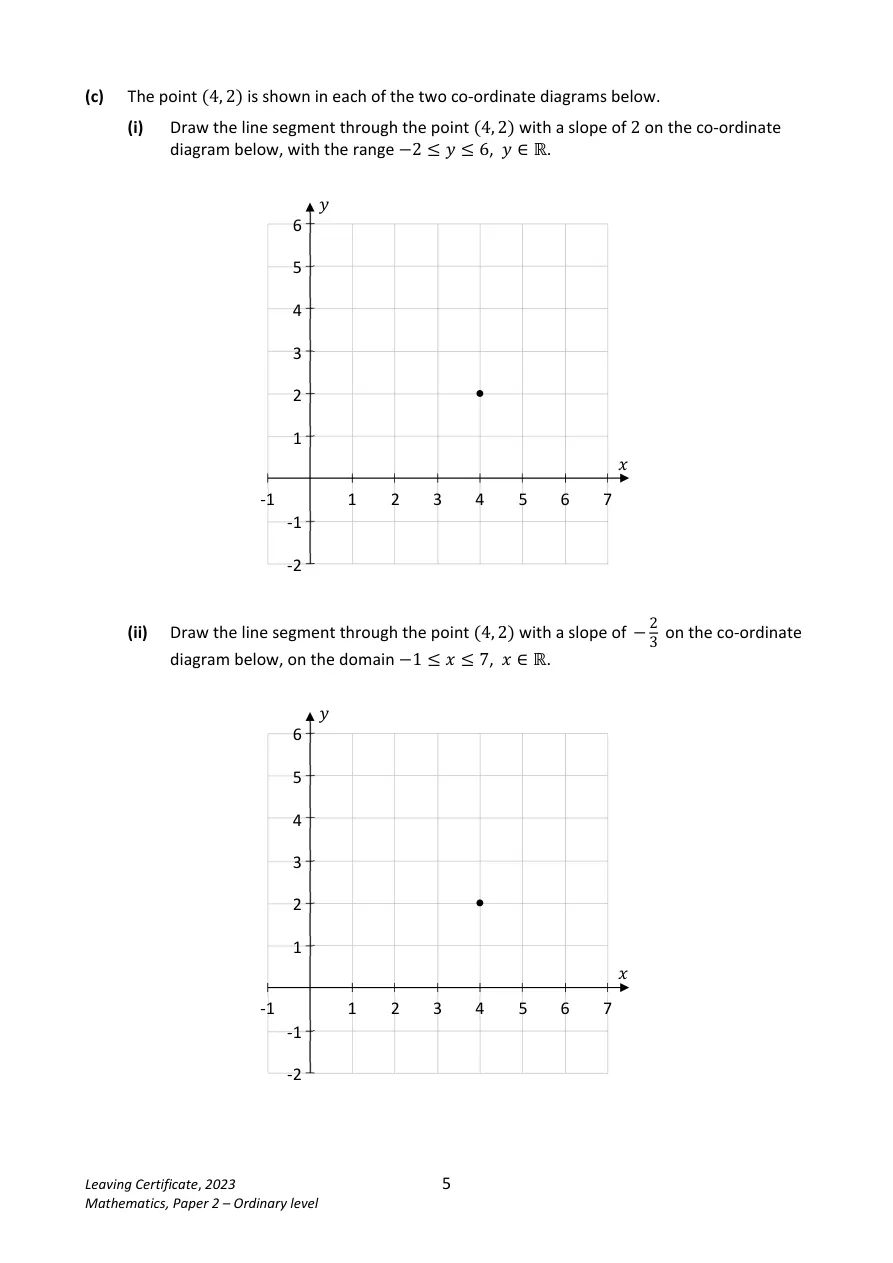
  3. For (i), draw the segment from (2, −2) to (6, 6), because the specified range is −2 ≤ y ≤ 6.
  4. y-2=-\dfrac{2}{3}(x-4)
  5. y=-\dfrac{2}{3}x+\dfrac{14}{3}
  6. For (ii), draw the segment from (−1, 16/3) to (7, 0), using the specified domain −1 ≤ x ≤ 7.
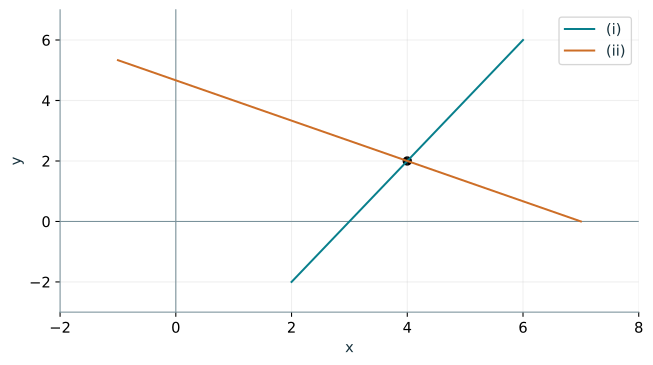
  7. 2023-2-1-lines

Question 2

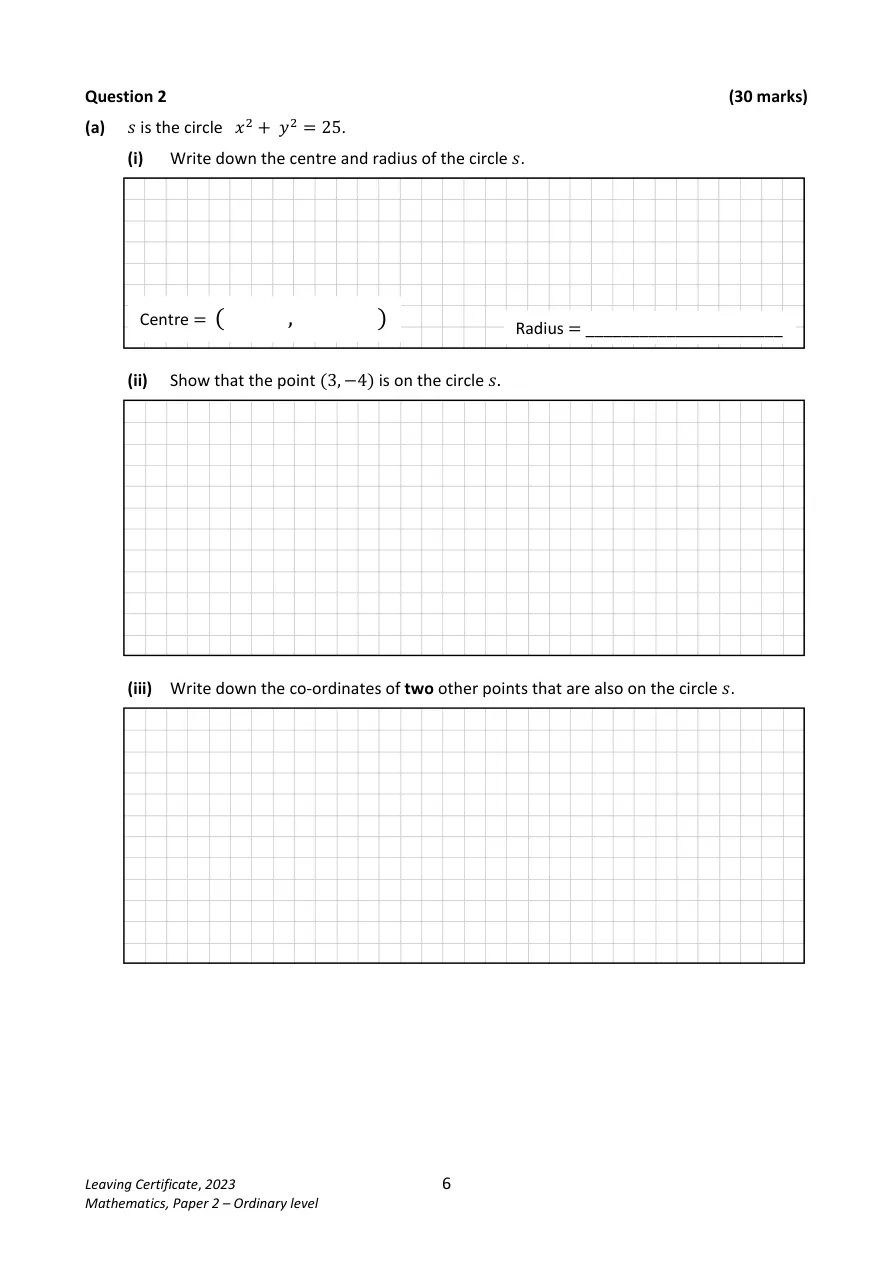
a) Circle s

  1. C=(0,0),\quad r=5
  2. 3^2+(-4)^2=25

    The point satisfies x² + y² = 25, so it is on the circle.

  3. Two other possible points are (0, 5) and (5, 0).

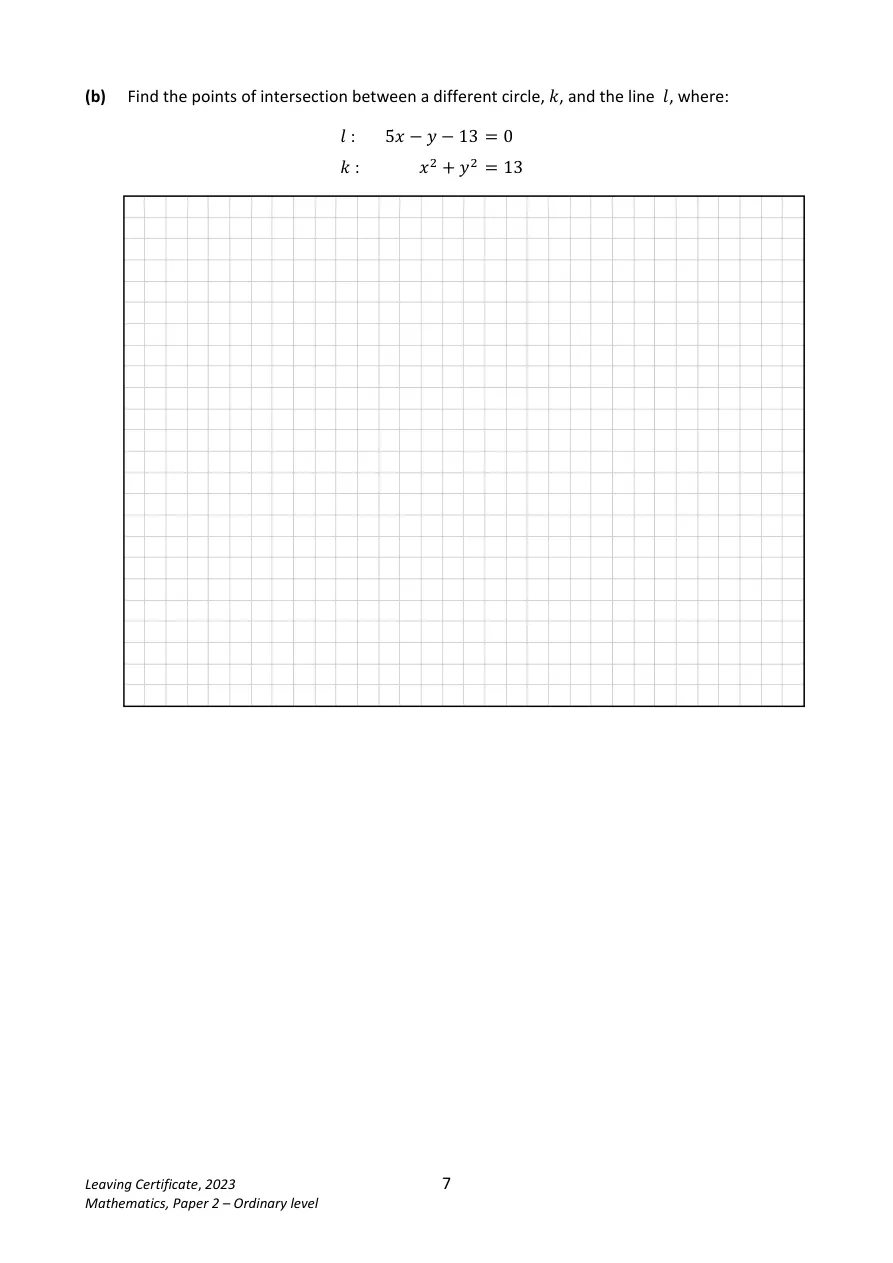
b) Intersections

  1. y=5x-13
  2. x^2+(5x-13)^2=13
  3. 26x^2-130x+156=0
  4. x^2-5x+6=0
  5. (x-2)(x-3)=0

    The product is zero, so at least one of the factors must be zero. Set each factor equal to zero in turn.

  6. x=2\quad\mathrm{or}\quad x=3
  7. Substituting into y = 5x − 13 gives the points (2, −3) and (3, 2).

Question 3

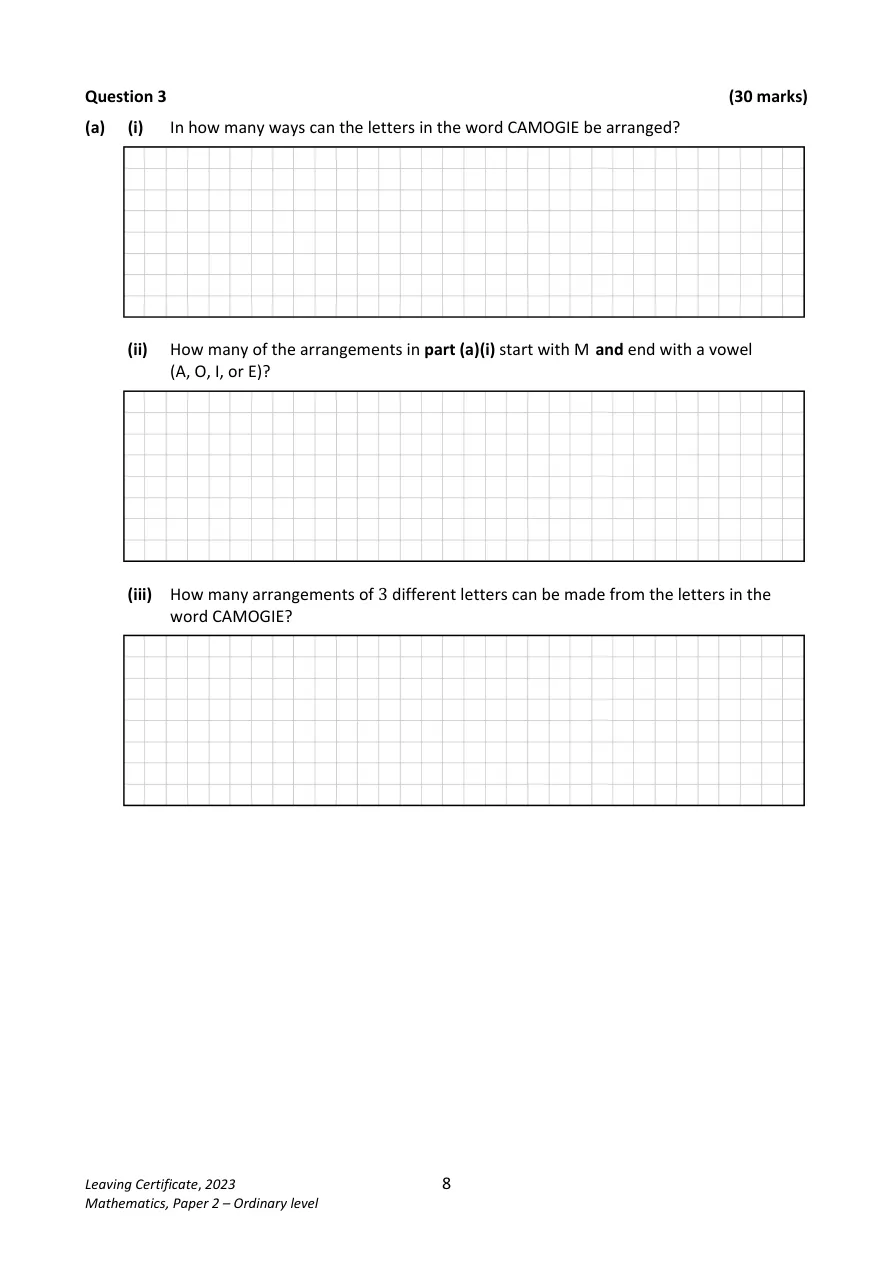
a) CAMOGIE

  1. N=7!=5040
  2. N_{\mathrm{M\ first,\ vowel\ last}}=1(4)(5!)
  3. N_{\mathrm{M\ first,\ vowel\ last}}=480
  4. N_3=7(6)(5)=210

    Order matters; do not repeat letters.

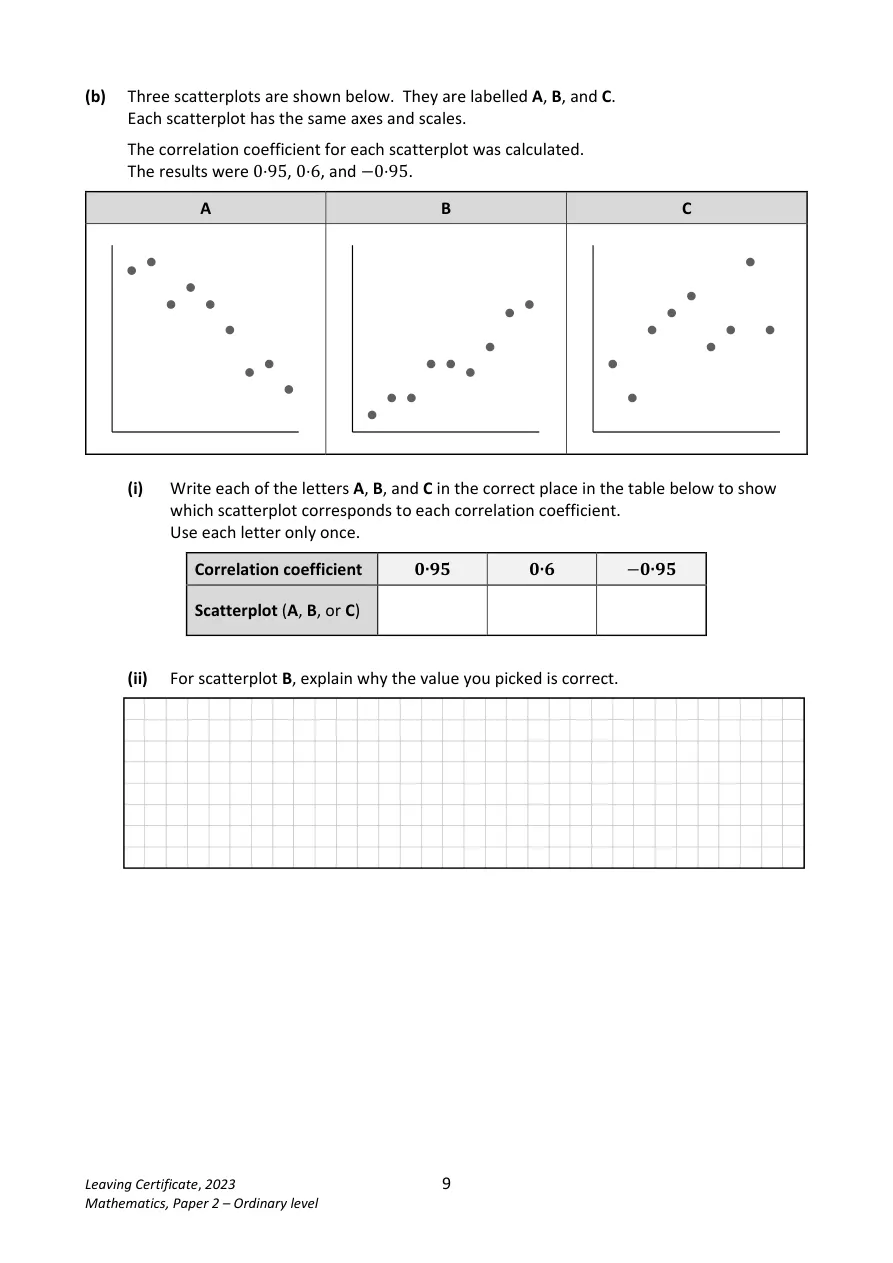
b) Scatterplots

  1. 0.95 → B; 0.6 → C; −0.95 → A. B is strongly positively correlated: the points cluster near a line with positive slope.

Question 4

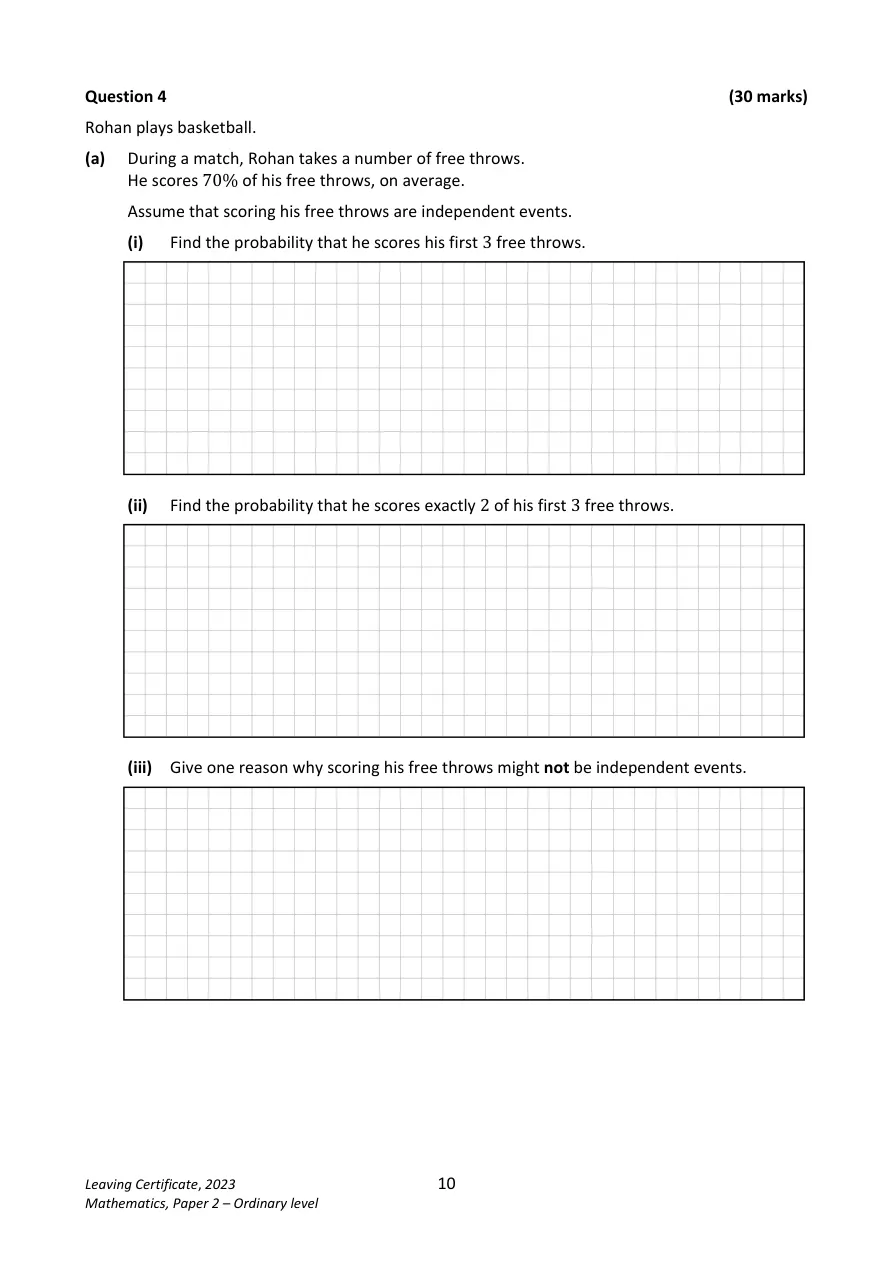
a) Free throws

  1. P(SSS)=0.7^3=0.343
  2. P(\mathrm{exactly\ two})=3(0.7)^2(0.3)
  3. P(\mathrm{exactly\ two})=0.441

    The missed throw can be first, second or third.

  4. Outcomes may not be independent: confidence or fatigue from earlier throws can affect later performance.

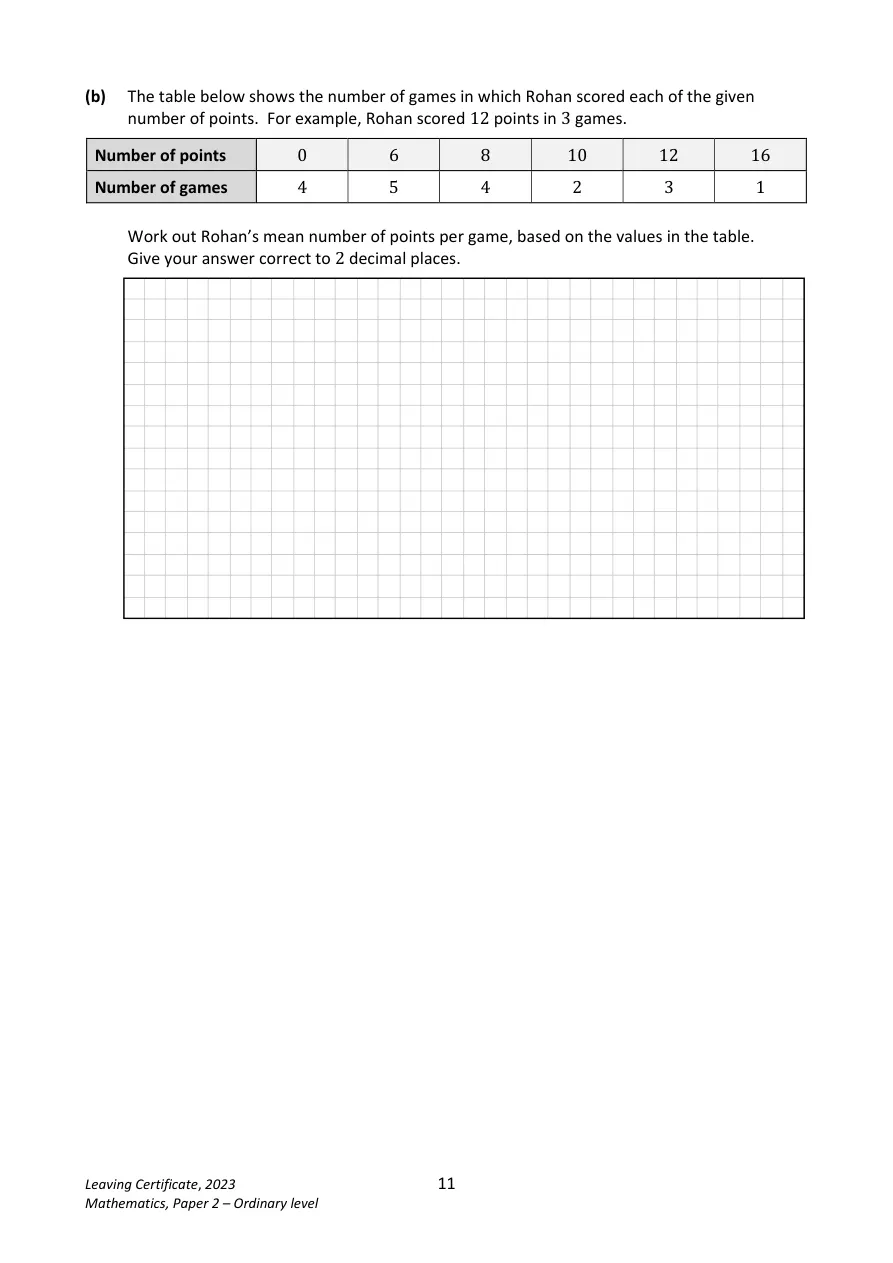
b) Mean points

  1. \mu=\dfrac{4(0)+5(6)+4(8)+2(10)+3(12)+1(16)}{4+5+4+2+3+1}
  2. \mu=\dfrac{134}{19}
  3. \mu\approx7.05

Question 5

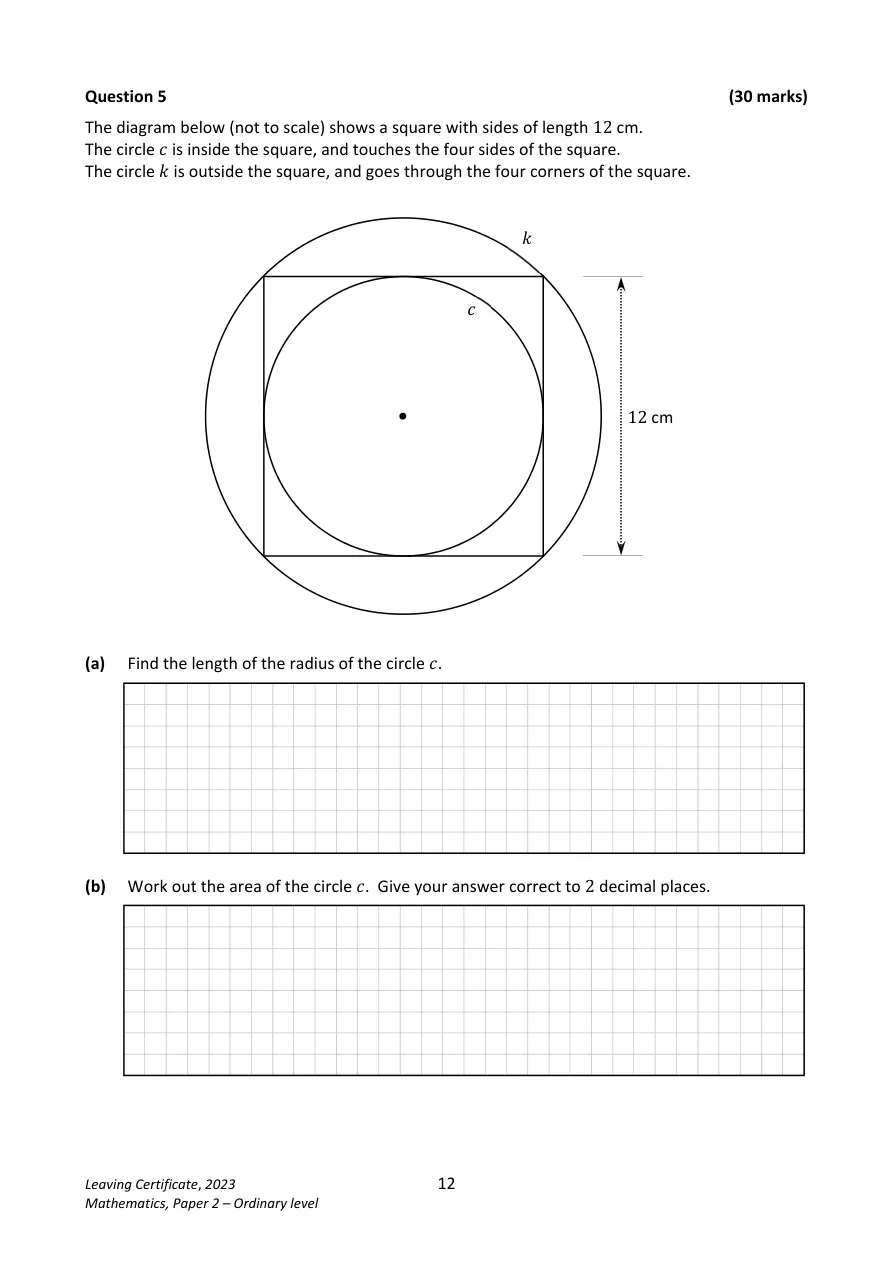
a) Inner radius

  1. r=\dfrac{12}{2}=6\ \mathrm{cm}

b) Inner area

  1. A=\pi(6)^2
  2. A\approx113.10\ \mathrm{cm}^2

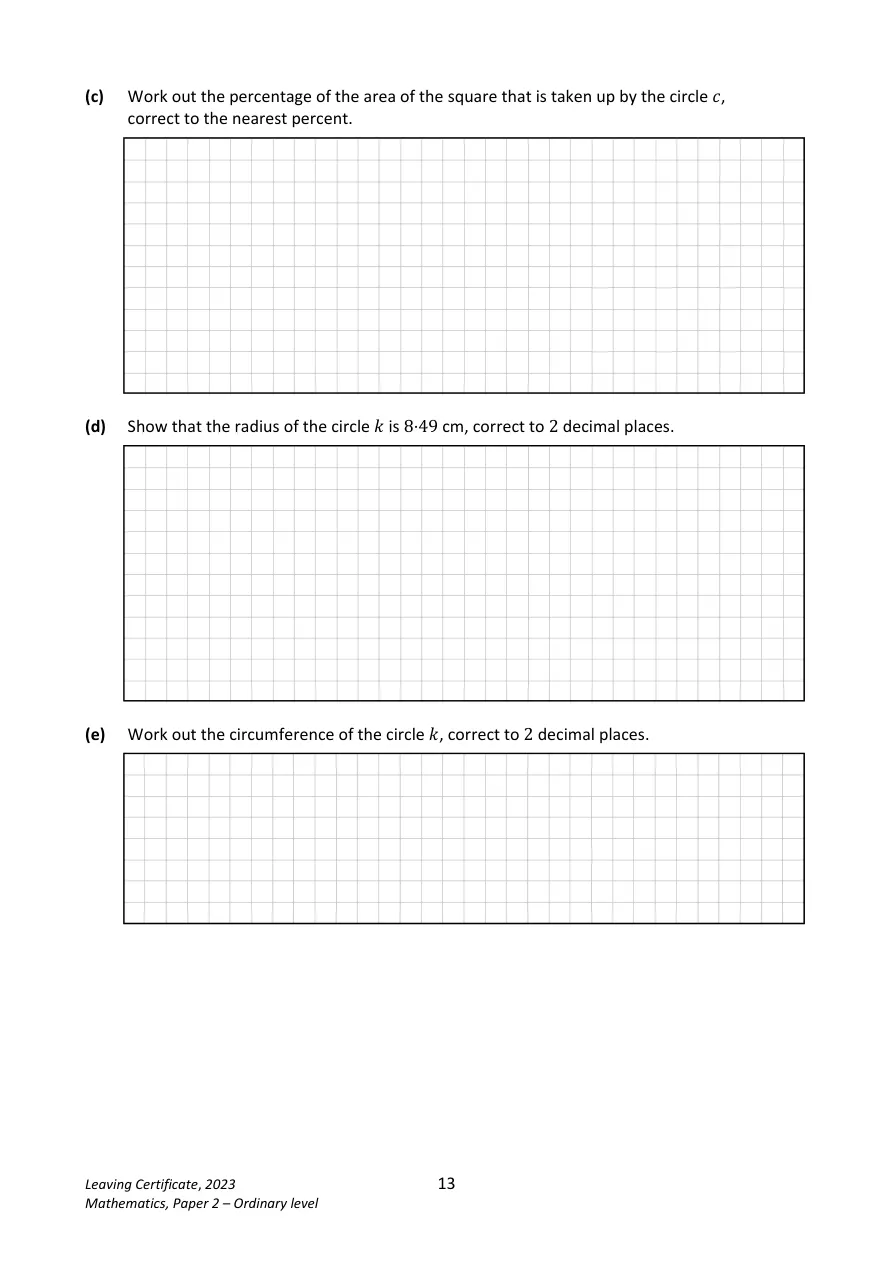
c) Percentage of square

  1. p=\dfrac{36\pi}{12^2}\times100
  2. p\approx79\%

d) Outer radius

  1. R=\sqrt{6^2+6^2}
  2. R\approx8.49\ \mathrm{cm}

e) Outer circumference

  1. C=2\pi(8.49)
  2. C\approx53.34\ \mathrm{cm}
  3. This uses the radius rounded to 8.49 cm from (d), as in the SEC model. Keeping the exact radius gives 53.31 cm; this is the small difference caused by intermediate rounding.

Question 6

a) Construct ABCD

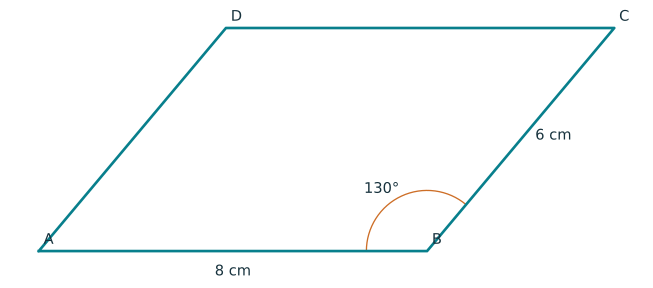
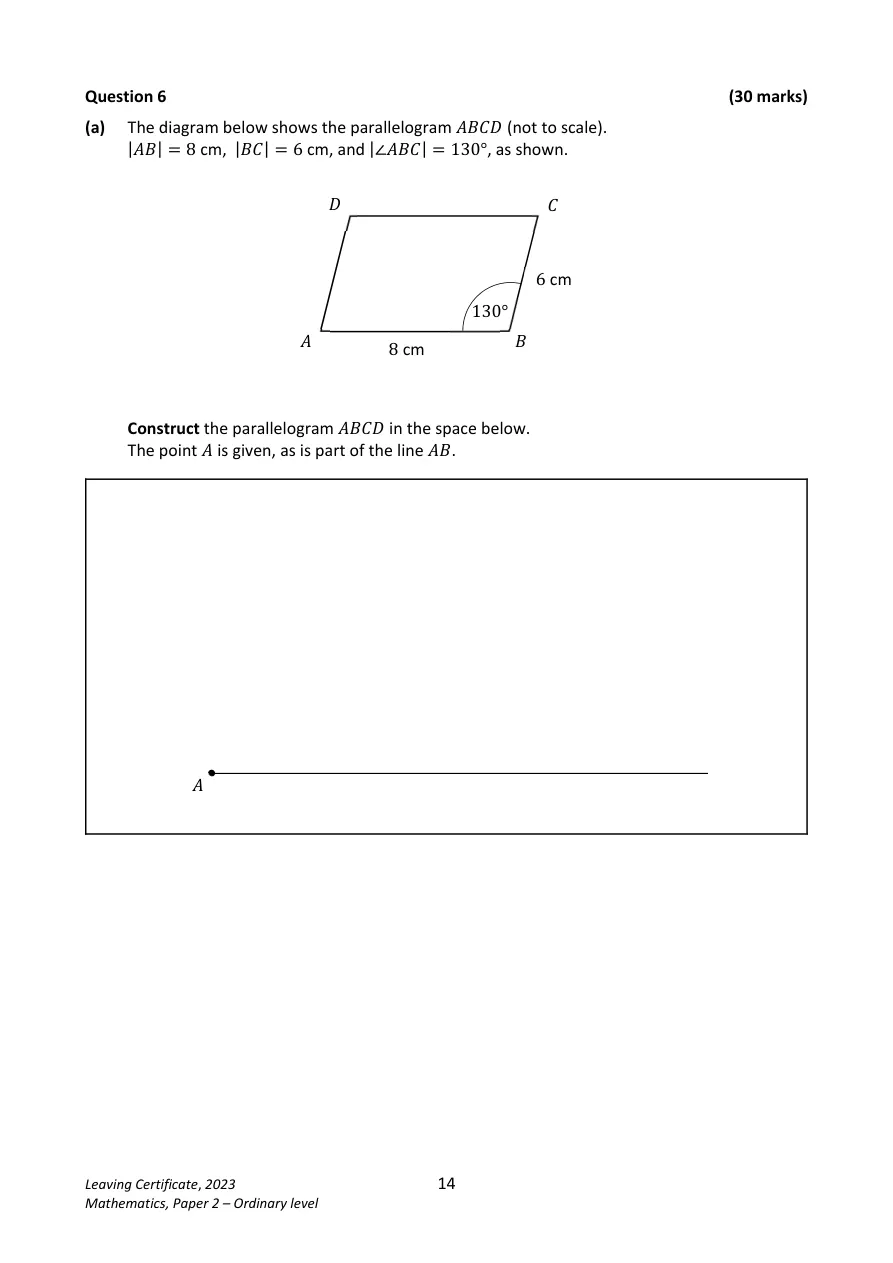
  1. Mark AB = 8 cm along the given ray. At B construct an internal angle of 130° with BA, then mark C 6 cm from B on that ray. Through A draw a line parallel to BC; through C draw a line parallel to AB. Their intersection is D. Show the lengths and angle clearly.
  2. 2023-2-6-parallelogram

b) Find x and y

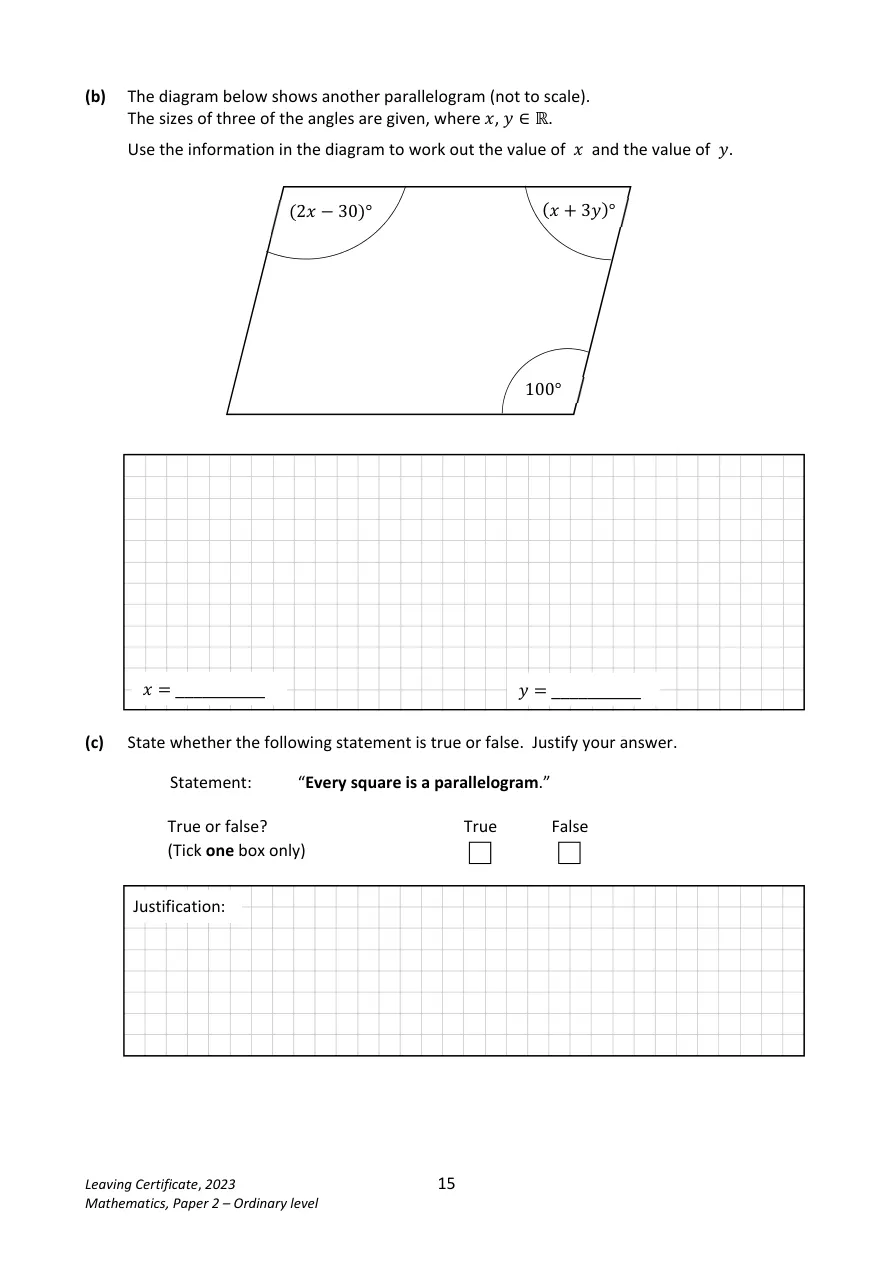
  1. 2x-30=100

    Opposite angles of a parallelogram are equal.

  2. 2x=130
  3. x=65
  4. x+3y=80

    Adjacent angles add to 180°.

  5. 65+3y=80
  6. y=5

c) Squares

  1. True. Both pairs of opposite sides of a square are parallel, so a square satisfies the definition of a parallelogram.

Question 7

a) Road gradients

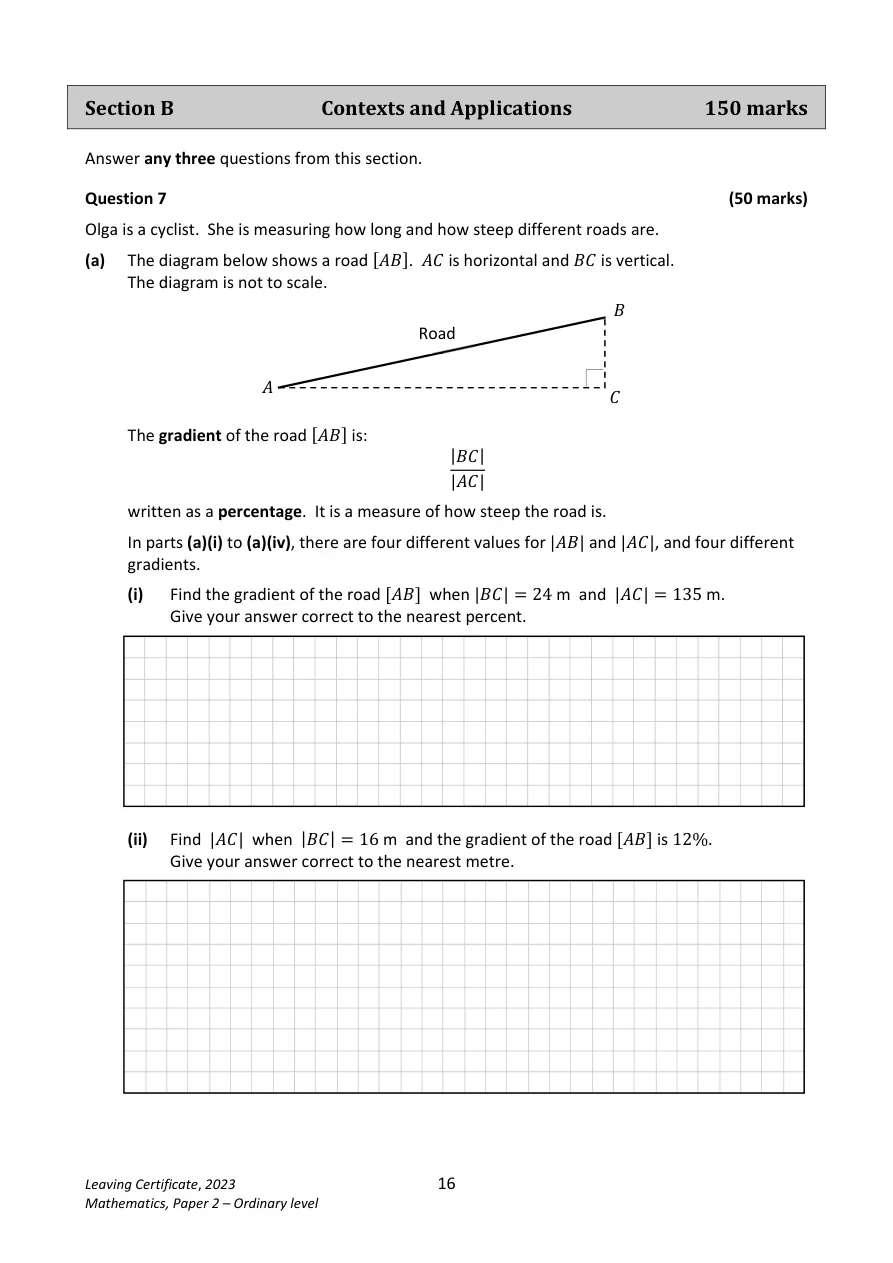
  1. g=\dfrac{24}{135}\times100
  2. g\approx18\%
  3. \dfrac{16}{AC}=\dfrac{12}{100}
  4. AC=\dfrac{1600}{12}\approx133\ \mathrm{m}
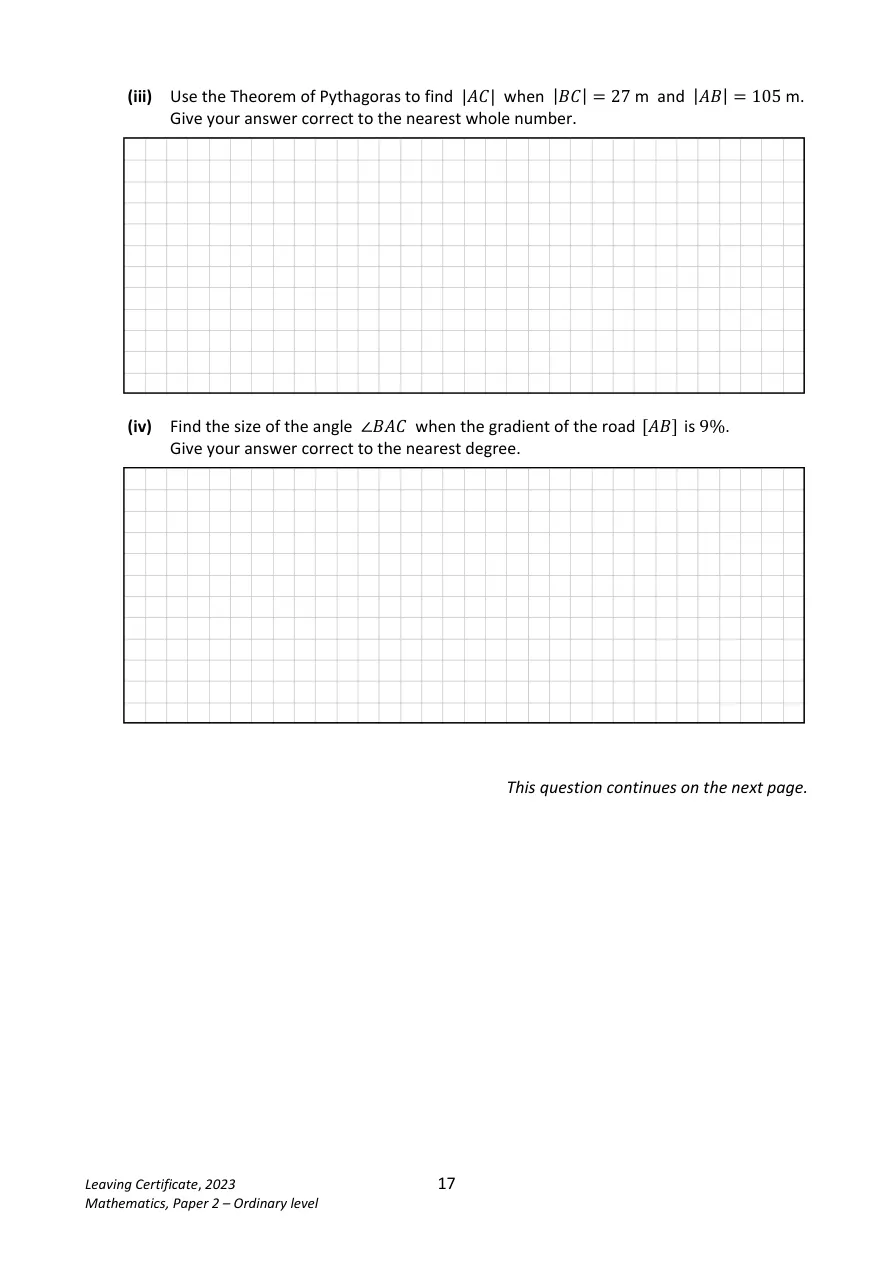
  5. AC=\sqrt{105^2-27^2}
  6. AC\approx101\ \mathrm{m}
  7. \theta=\tan^{-1}\left(\dfrac{9}{100}\right)
  8. \theta\approx5^\circ

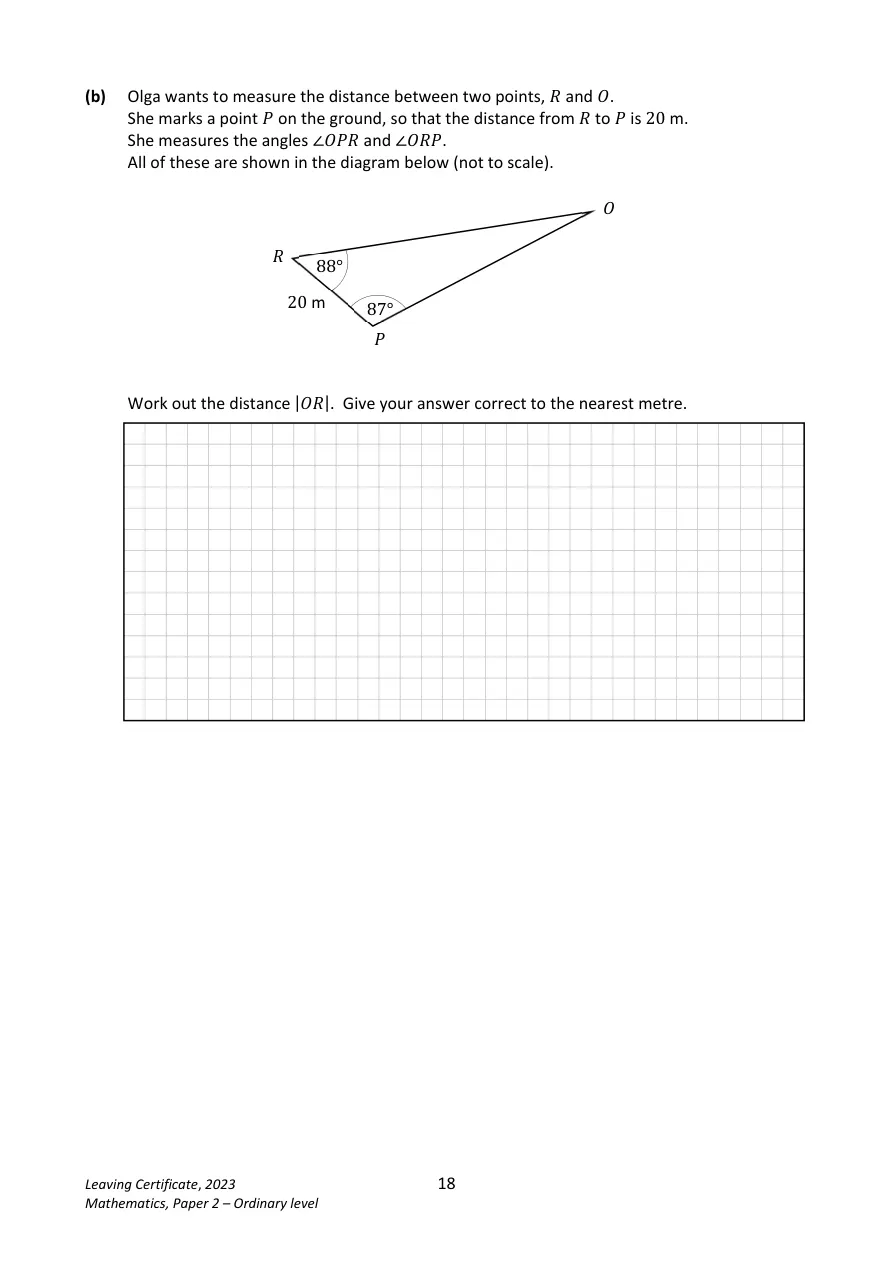
b) Distance OR

  1. \angle O=180^\circ-88^\circ-87^\circ=5^\circ
  2. \dfrac{OR}{\sin87^\circ}=\dfrac{20}{\sin5^\circ}
  3. OR=\dfrac{20\sin87^\circ}{\sin5^\circ}
  4. OR\approx229\ \mathrm{m}

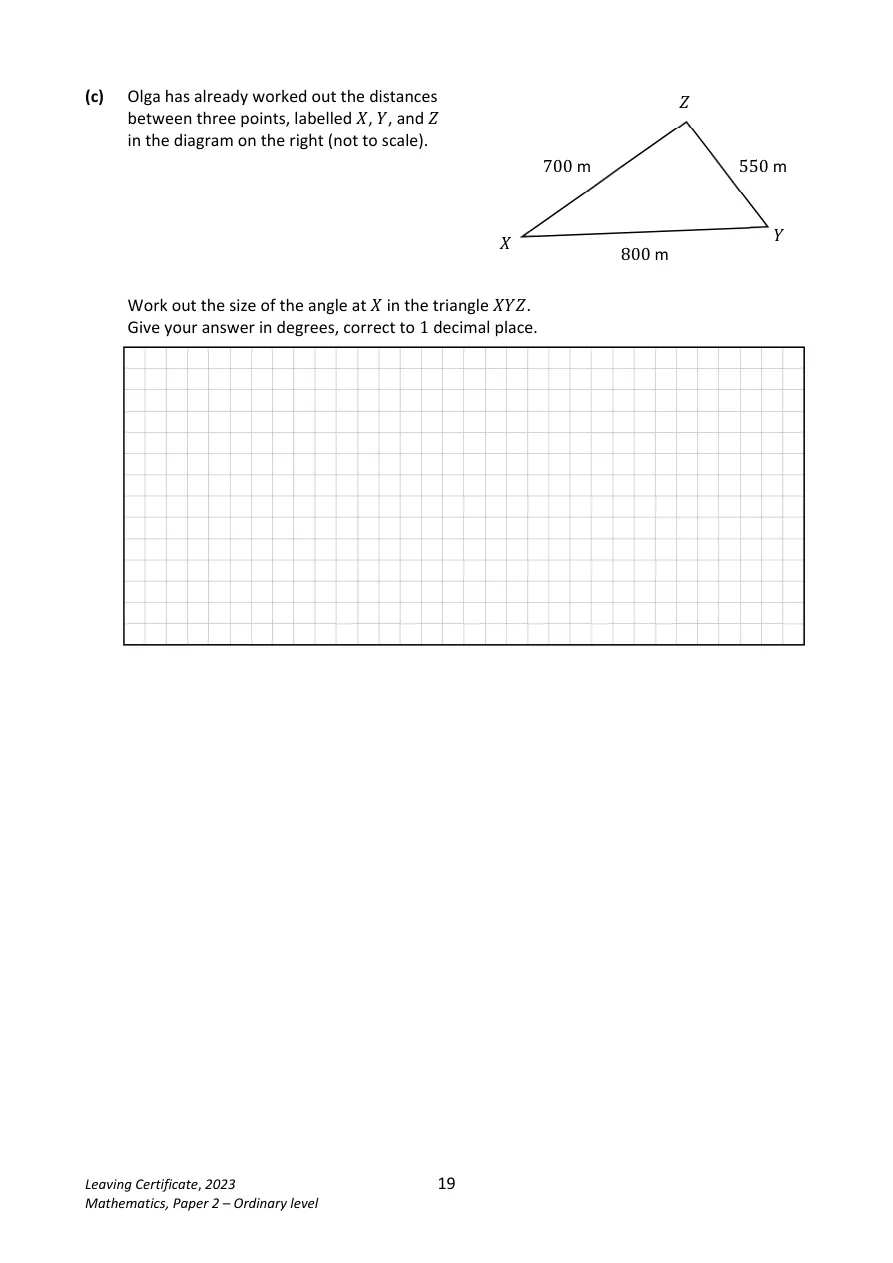
c) Angle X

  1. \cos X=\dfrac{700^2+800^2-550^2}{2(700)(800)}
  2. X\approx42.4^\circ

Question 8

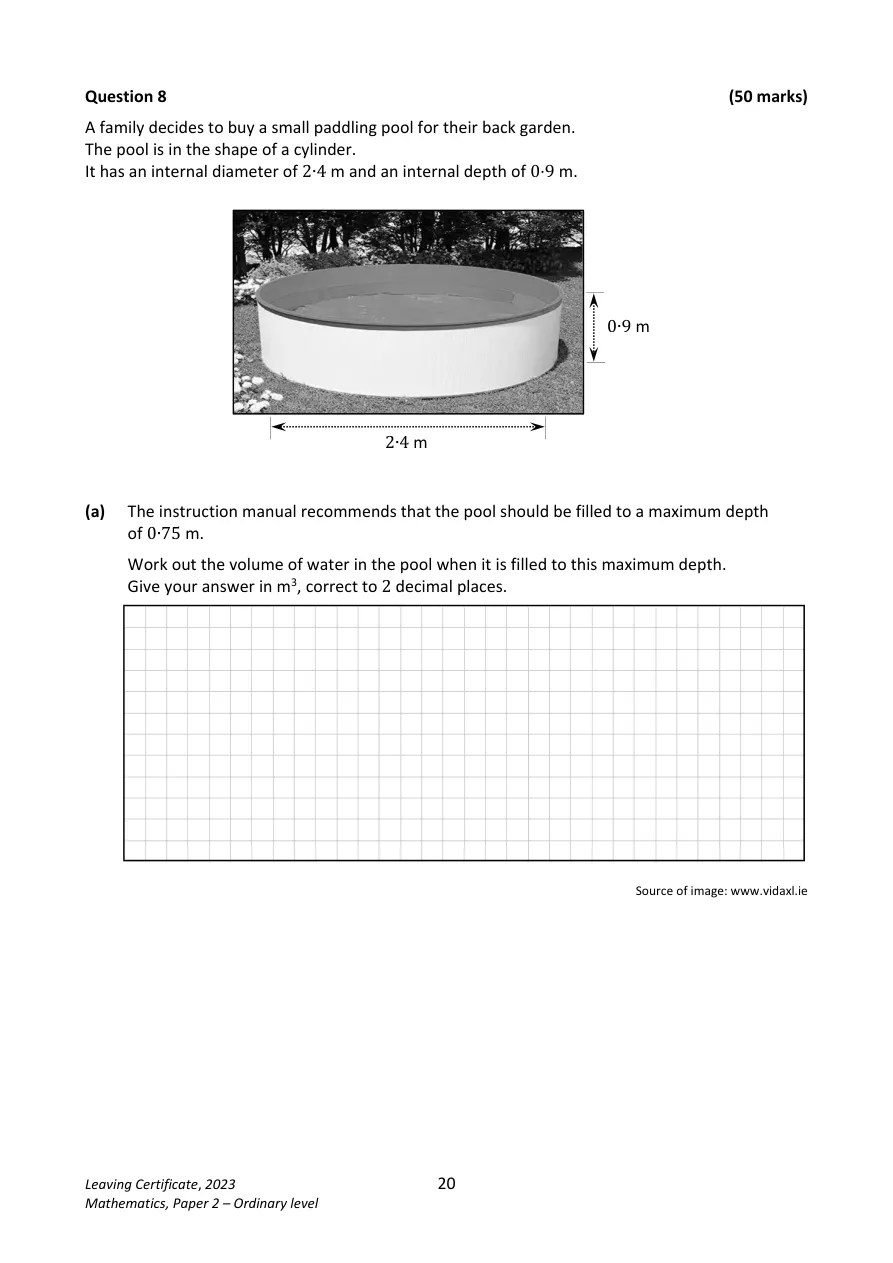
a) Water volume

  1. V=\pi(1.2)^2(0.75)
  2. V\approx3.39\ \mathrm{m}^3

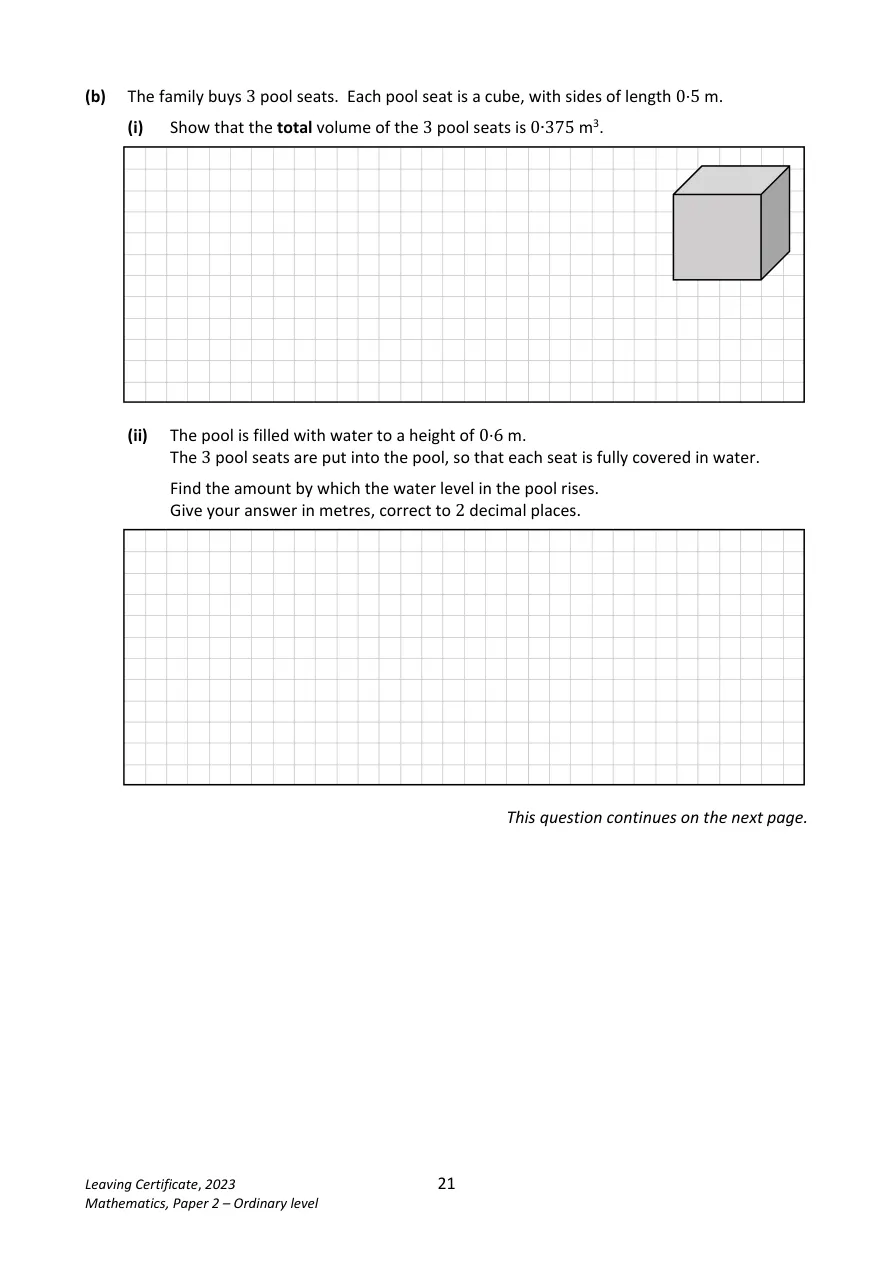
b) Pool seats

  1. V_{\mathrm{seats}}=3(0.5)^3
  2. V_{\mathrm{seats}}=0.375\ \mathrm{m}^3
  3. h=\dfrac{0.375}{\pi(1.2)^2}
  4. h\approx0.08\ \mathrm{m}

    Displaced volume equals base area times rise in water level.

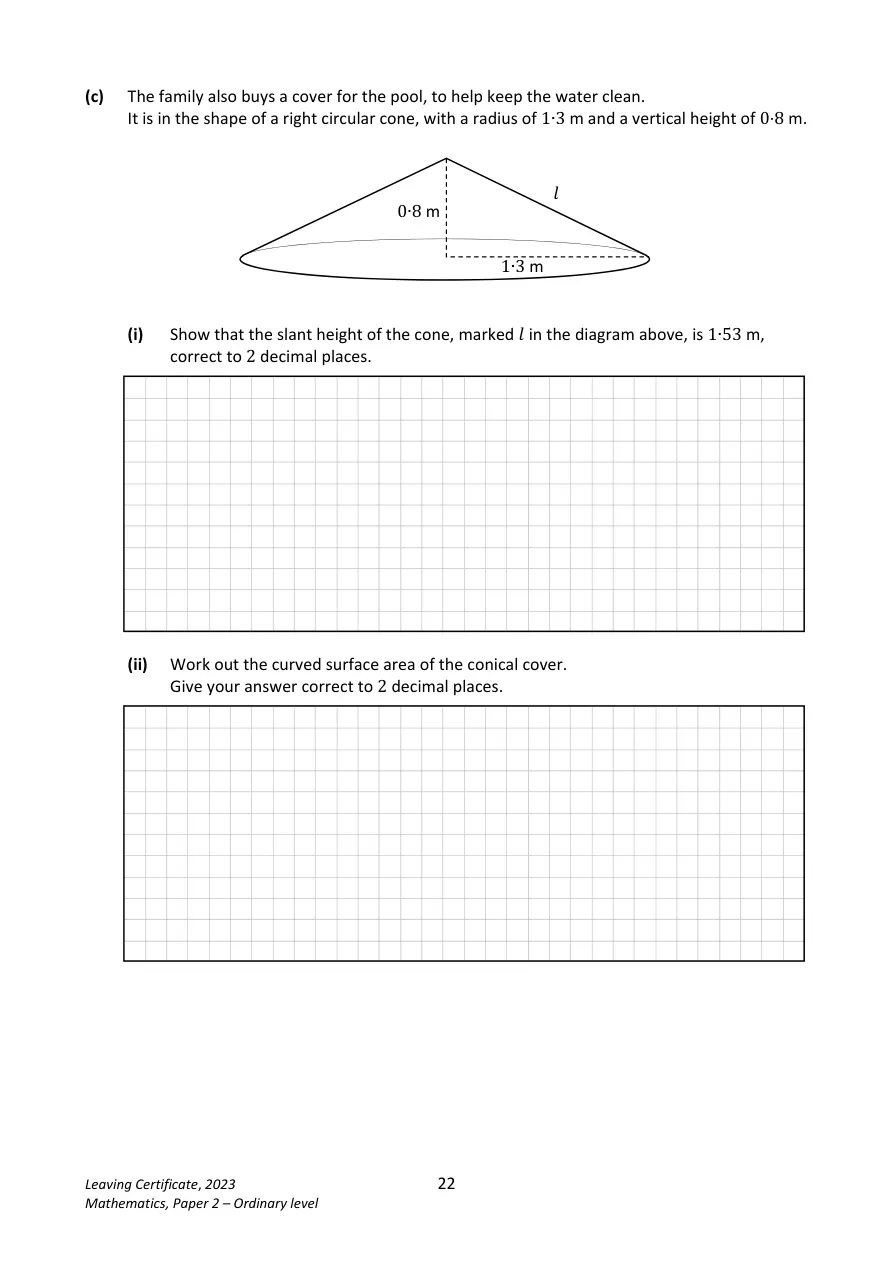
c) Conical cover

  1. l=\sqrt{0.8^2+1.3^2}
  2. l\approx1.53\ \mathrm{m}
  3. A=\pi(1.3)(1.53)
  4. A\approx6.25\ \mathrm{m}^2
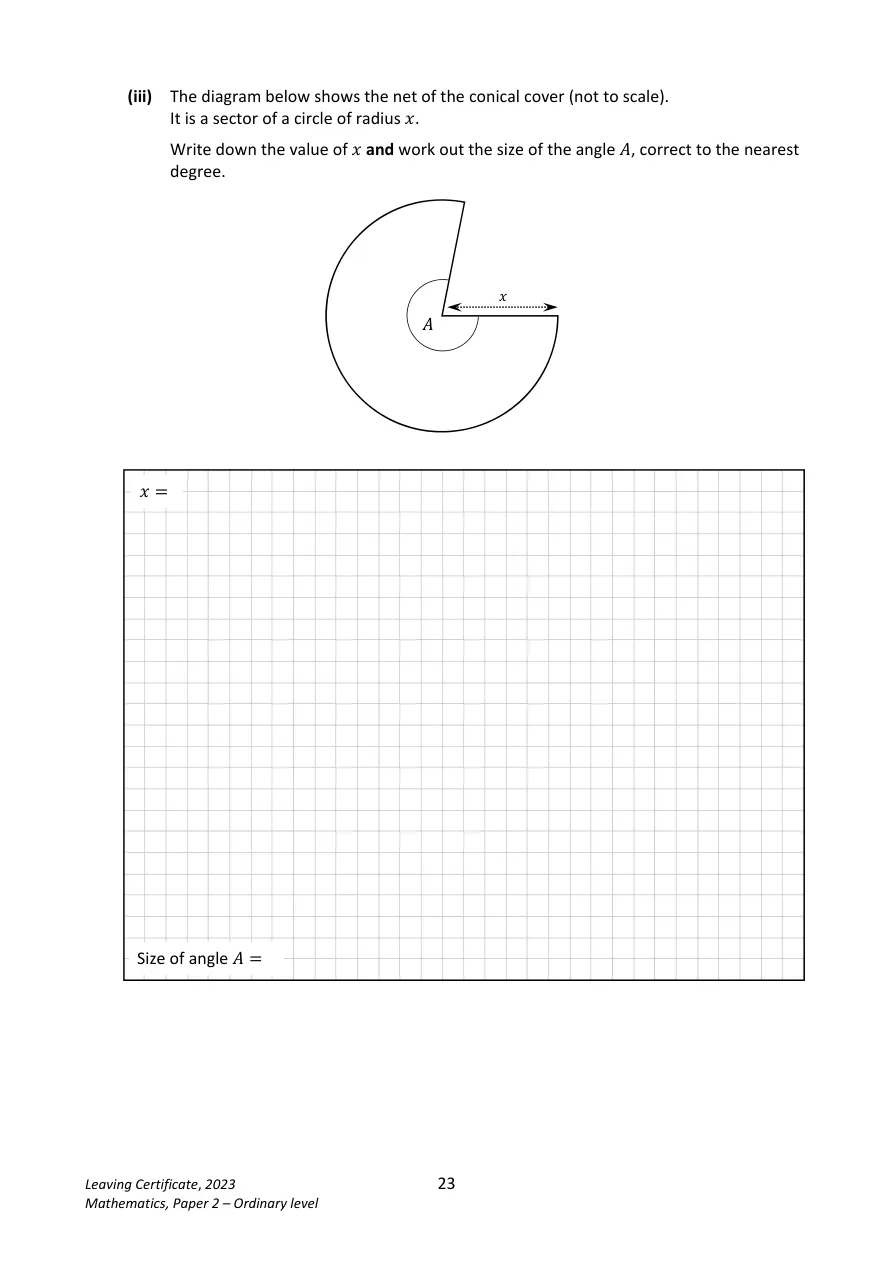
  5. x=1.53\ \mathrm{m}

    The sector radius is the cone's slant height.

  6. \dfrac{\theta}{360}(2\pi)(1.53)=2\pi(1.3)
  7. \theta=\dfrac{360(1.3)}{1.53}
  8. \theta\approx306^\circ
  9. The area and angle calculations use the rounded slant height requested in (i), matching the examination model.

Question 9

a) Reading survey

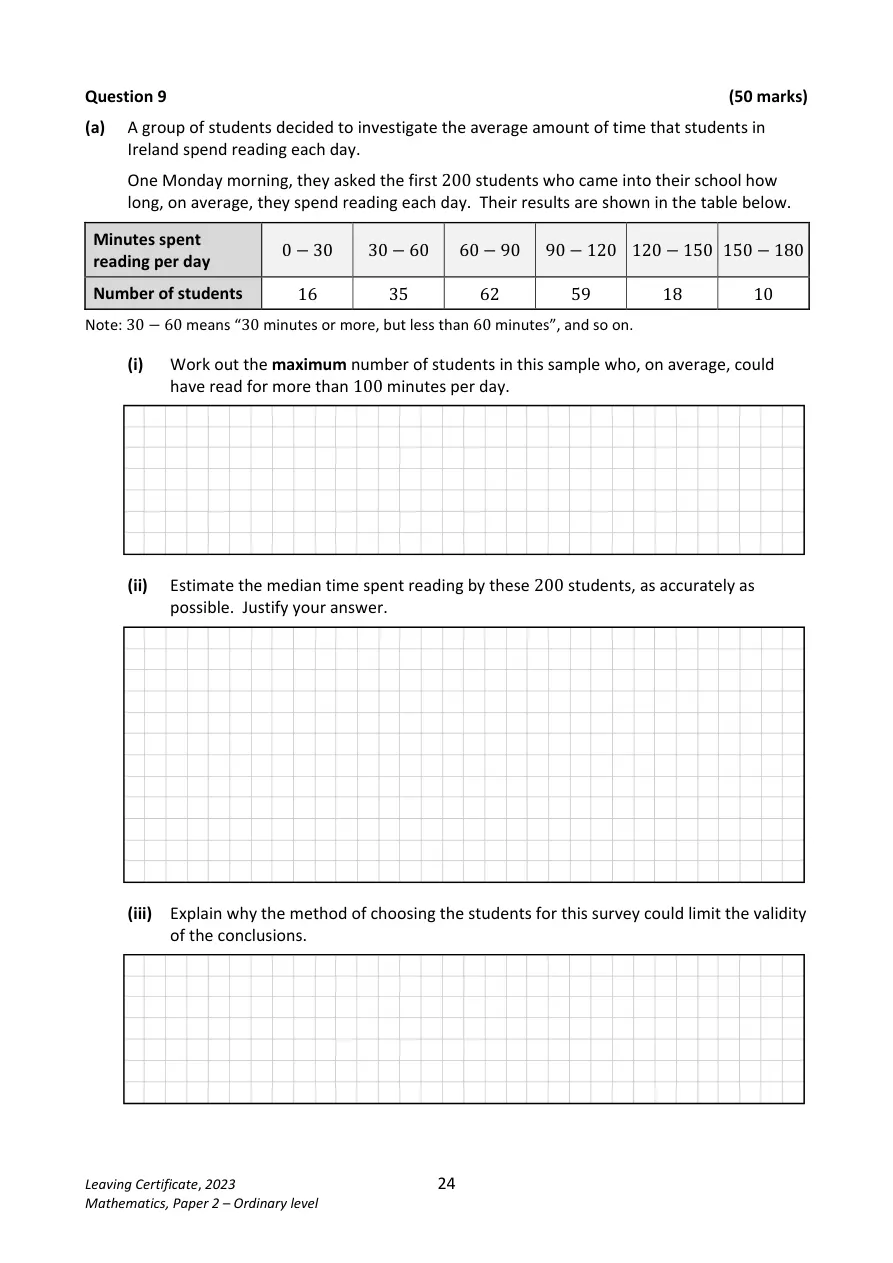
  1. N_{\max}=59+18+10=87
  2. The 100th and 101st values fall in the 60–90 minute class: cumulative frequencies are 16, 51, 113, 172, 190, 200. An estimate of 75 minutes (the class midpoint) is reasonable; the exact median is unknown from grouped data.
  3. The first 200 arrivals at one school may not represent all students in Ireland. Arrival patterns and the choice of just one school can bias the sample.
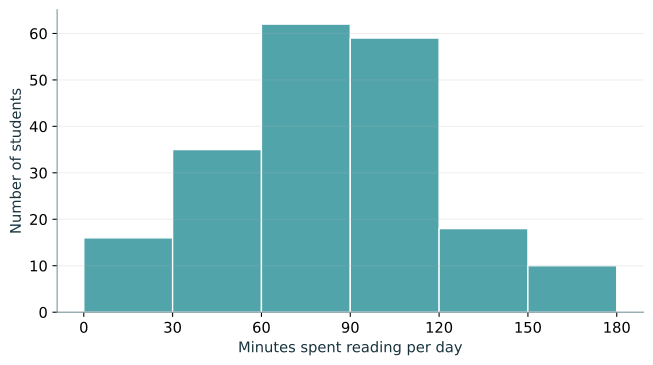
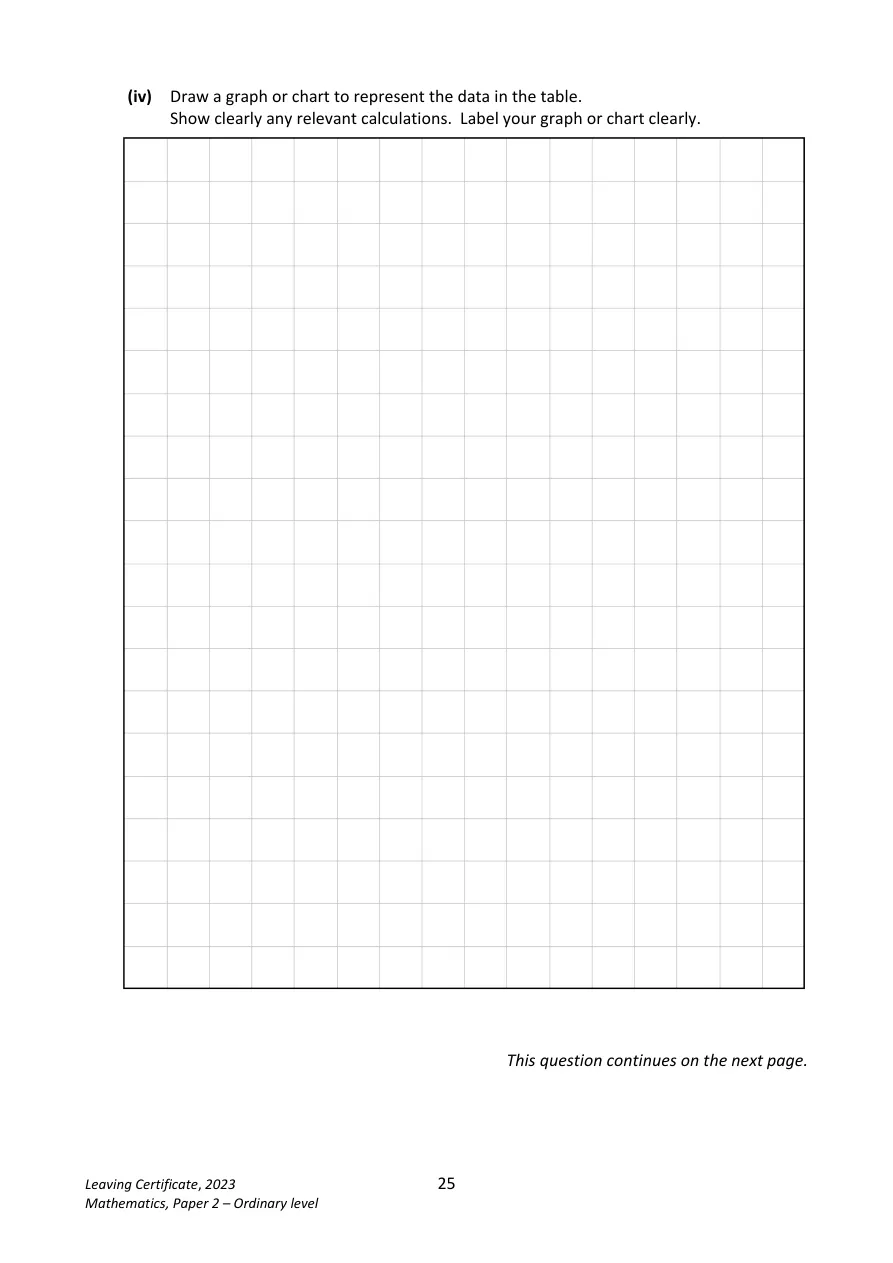
  4. 2023-2-9-histogram
  5. All classes have equal width, so the histogram heights can be their frequencies: 16, 35, 62, 59, 18, 10.

b) Test results

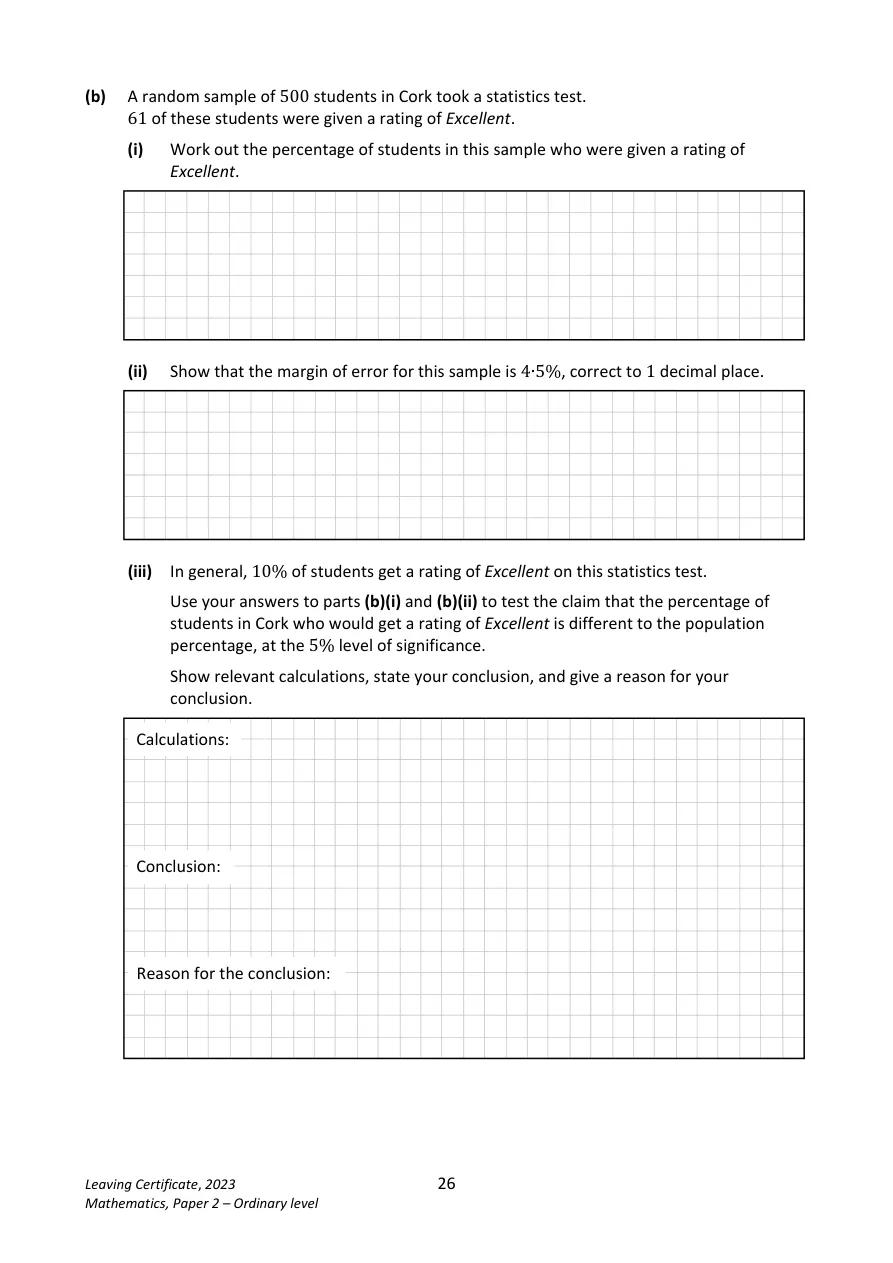
  1. \hat p=\dfrac{61}{500}\times100=12.2\%
  2. E=\dfrac{1}{\sqrt{500}}\times100\%
  3. E\approx4.5\%
  4. \mathrm{CI}=[12.2-4.5,12.2+4.5]\%
  5. \mathrm{CI}=[7.7,16.7]\%
  6. 10% lies inside the interval. There is insufficient evidence at the 5% significance level that the Cork population proportion differs from 10%.

Question 10

a) Pentagon angle

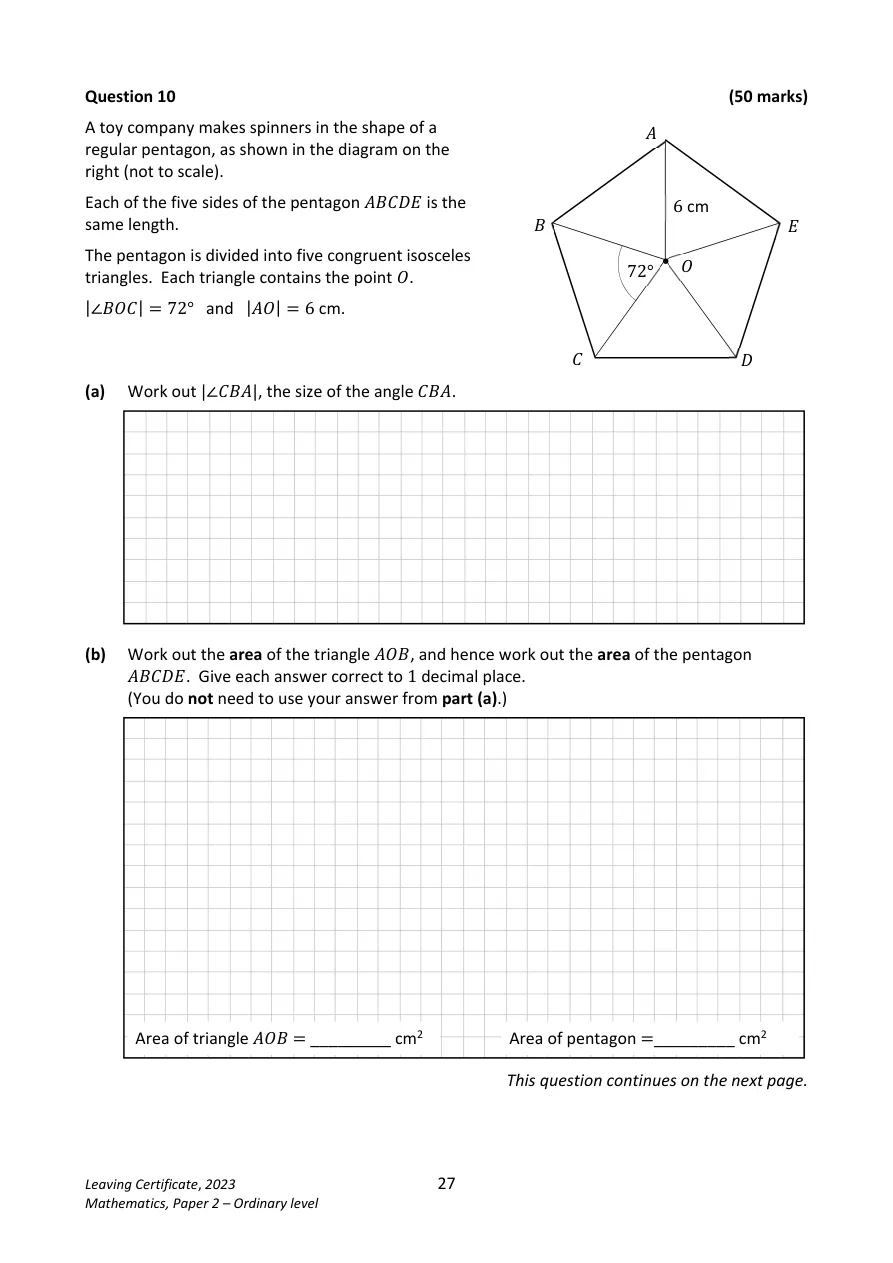
  1. \alpha=\dfrac{180^\circ-72^\circ}{2}=54^\circ
  2. \angle CBA=2(54^\circ)=108^\circ

b) Areas

  1. A_{\triangle}=\dfrac{1}{2}(6)(6)\sin72^\circ
  2. A_{\triangle}\approx17.1\ \mathrm{cm}^2
  3. A_{\mathrm{pentagon}}=5\left[\dfrac{1}{2}(6)(6)\sin72^\circ\right]
  4. A_{\mathrm{pentagon}}\approx85.6\ \mathrm{cm}^2

    Keep the unrounded triangle area until the final answer.

c) Two spins

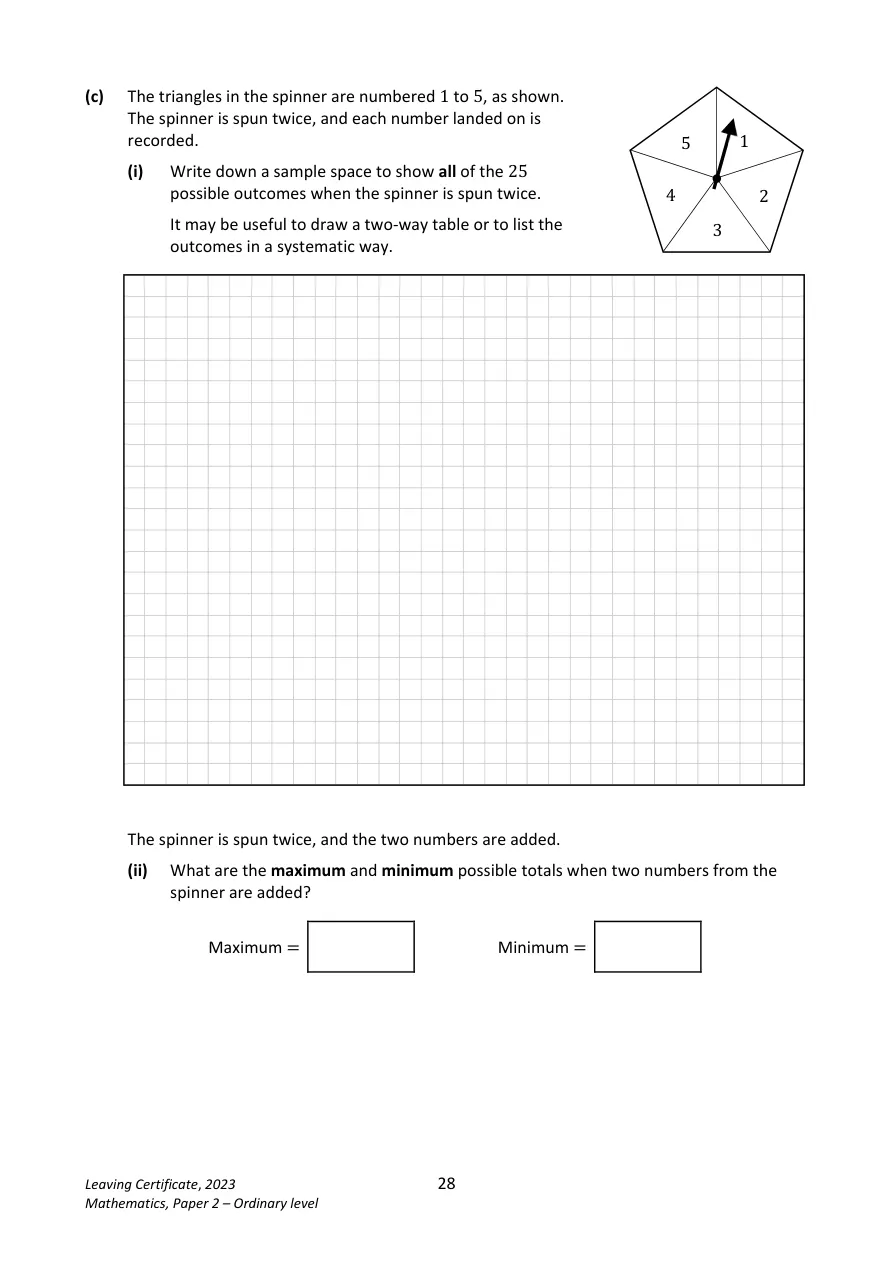
  1. Sample space: (1,1), (1,2), (1,3), (1,4), (1,5); (2,1), (2,2), (2,3), (2,4), (2,5); (3,1), (3,2), (3,3), (3,4), (3,5); (4,1), (4,2), (4,3), (4,4), (4,5); (5,1), (5,2), (5,3), (5,4), (5,5).
  2. \mathrm{maximum}=10,\quad\mathrm{minimum}=2
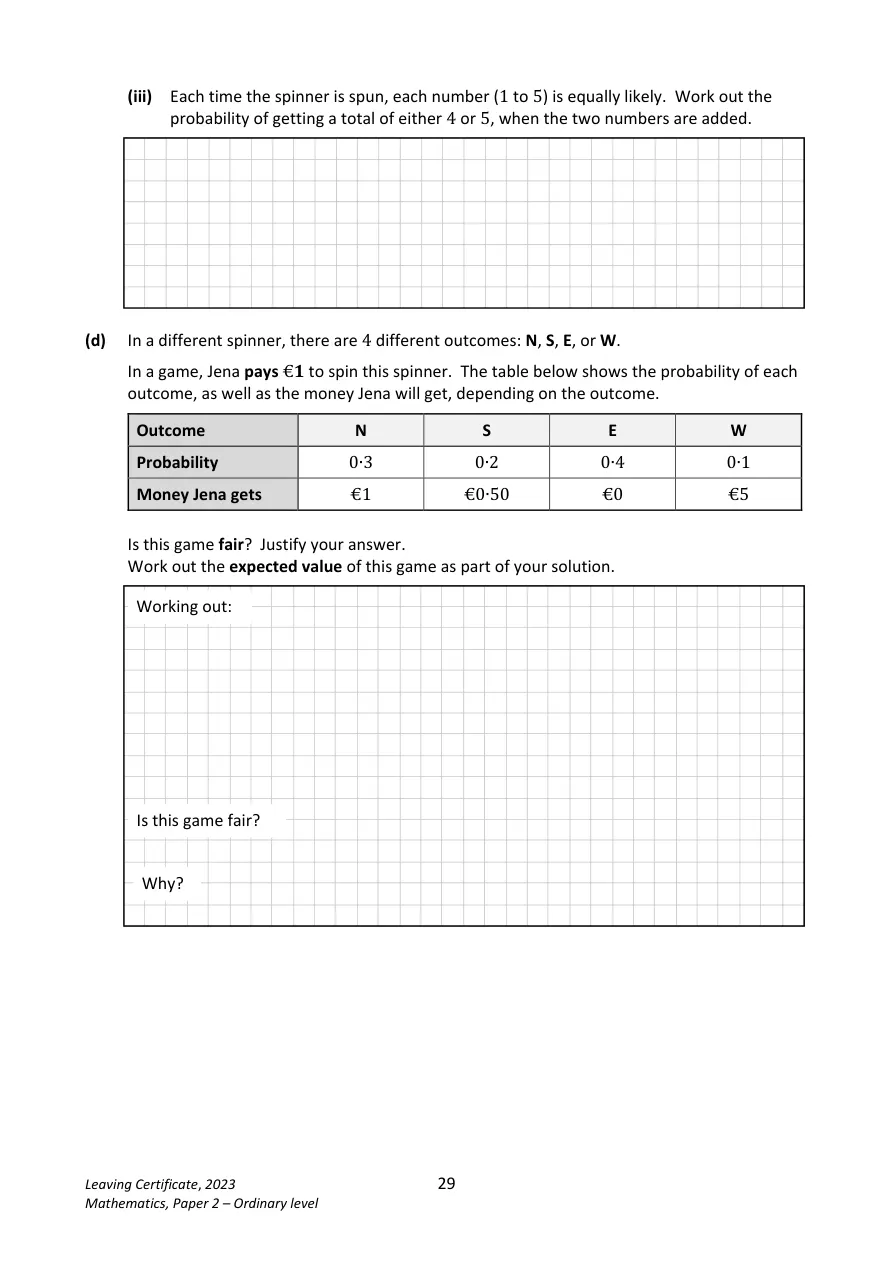
  3. Total 4: (1,3), (2,2), (3,1). Total 5: (1,4), (2,3), (3,2), (4,1).
  4. P(4\ \mathrm{or}\ 5)=\dfrac{3+4}{25}=\dfrac{7}{25}

d) Fair game

  1. E(\mathrm{payout})=1(0.3)+0.5(0.2)+0(0.4)+5(0.1)
  2. E(\mathrm{payout})=0.90\ \mathrm{euro}
  3. E(\mathrm{net})=0.90-1=-0.10\ \mathrm{euro}
  4. The game is not fair: the expected payout is less than the €1 entry fee. The expected loss is 10 cent per play.
See working and diagrams on the original paper
Original exam paper page 4
m=\dfrac{8-2}{1-4}=-2
AB=\sqrt{(1-4)^2+(8-2)^2}
AB=\sqrt{45}=3\sqrt{5}
y-7=\dfrac{1}{3}(x+2)
3y-21=x+2
x-3y+23=0
Original exam paper page 5
y − 2 = 2(x − 4) y = 2x − 6 Endpoints: (2, −2), (6, 6)
y − 2 = −⅔(x − 4) y = −⅔x + 14/3 Endpoints: (−1, 16/3), (7, 0)
Original exam paper page 6
C=(0,0),\quad r=5
3^2+(-4)^2=25
[The point satisfies x² + y² = 25, so it is on the circle.]
Two other possible points are (0, 5) and (5, 0).
0, 0
5
Original exam paper page 7
y=5x-13
x^2+(5x-13)^2=13
26x^2-130x+156=0
x^2-5x+6=0
(x-2)(x-3)=0
x=2\quad\mathrm{or}\quad x=3
Substituting into y = 5x − 13 gives the points (2, −3) and (3, 2).
Original exam paper page 8
N=7!=5040
N_{\mathrm{M\ first,\ vowel\ last}}=1(4)(5!)
N_{\mathrm{M\ first,\ vowel\ last}}=480
N_3=7(6)(5)=210
[Order matters; do not repeat letters.]
Original exam paper page 9
BCA
B has a strong positive correlation: its points cluster closely around a line with positive slope.
Original exam paper page 10
P(SSS)=0.7^3=0.343
P(\mathrm{exactly\ two})=3(0.7)^2(0.3)
P(\mathrm{exactly\ two})=0.441
[The missed throw can be first, second or third.]
Outcomes may not be independent: confidence or fatigue from earlier throws can affect later performance.
Original exam paper page 11
\mu=\dfrac{4(0)+5(6)+4(8)+2(10)+3(12)+1(16)}{4+5+4+2+3+1}
\mu=\dfrac{134}{19}
\mu\approx7.05
Original exam paper page 12
r=\dfrac{12}{2}=6\ \mathrm{cm}
A=\pi(6)^2
A\approx113.10\ \mathrm{cm}^2
Original exam paper page 13
p=\dfrac{36\pi}{12^2}\times100
p\approx79\%
R=\sqrt{6^2+6^2}
R\approx8.49\ \mathrm{cm}
C=2\pi(8.49)
C\approx53.34\ \mathrm{cm}
This uses the radius rounded to 8.49 cm from (d), as in the SEC model. Keeping the exact radius gives 53.31 cm; this is the small difference caused by intermediate rounding.
Original exam paper page 14
BCD8 cm6 cm130°
AB = 8 cm. At B construct 130° to BA, then mark BC = 6 cm. Draw AD parallel to BC and DC parallel to AB; their intersection is D.
Original exam paper page 15
2x-30=100
[Opposite angles of a parallelogram are equal.]
2x=130
x=65
x+3y=80
[Adjacent angles add to 180°.]
65+3y=80
y=5
True. Both pairs of opposite sides of a square are parallel, so a square satisfies the definition of a parallelogram.
65
5
Original exam paper page 16
g=\dfrac{24}{135}\times100
g\approx18\%
\dfrac{16}{AC}=\dfrac{12}{100}
AC=\dfrac{1600}{12}\approx133\ \mathrm{m}
Original exam paper page 17
AC=\sqrt{105^2-27^2}
AC\approx101\ \mathrm{m}
\theta=\tan^{-1}\left(\dfrac{9}{100}\right)
\theta\approx5^\circ
Original exam paper page 18
\angle O=180^\circ-88^\circ-87^\circ=5^\circ
\dfrac{OR}{\sin87^\circ}=\dfrac{20}{\sin5^\circ}
OR=\dfrac{20\sin87^\circ}{\sin5^\circ}
OR\approx229\ \mathrm{m}
Original exam paper page 19
\cos X=\dfrac{700^2+800^2-550^2}{2(700)(800)}
X\approx42.4^\circ
Original exam paper page 20
V=\pi(1.2)^2(0.75)
V\approx3.39\ \mathrm{m}^3
Original exam paper page 21
V_{\mathrm{seats}}=3(0.5)^3
V_{\mathrm{seats}}=0.375\ \mathrm{m}^3
h=\dfrac{0.375}{\pi(1.2)^2}
h\approx0.08\ \mathrm{m}
[Displaced volume equals base area times rise in water level.]
Original exam paper page 22
l=\sqrt{0.8^2+1.3^2}
l\approx1.53\ \mathrm{m}
A=\pi(1.3)(1.53)
A\approx6.25\ \mathrm{m}^2
Original exam paper page 23
x=1.53\ \mathrm{m}
[The sector radius is the cone's slant height.]
\dfrac{\theta}{360}(2\pi)(1.53)=2\pi(1.3)
\theta=\dfrac{360(1.3)}{1.53}
\theta\approx306^\circ
The area and angle calculations use the rounded slant height requested in (i), matching the examination model.
1.53 m
306°
Original exam paper page 24
N_{\max}=59+18+10=87
The 100th and 101st values fall in the 60–90 minute class: cumulative frequencies are 16, 51, 113, 172, 190, 200. An estimate of 75 minutes (the class midpoint) is reasonable; the exact median is unknown from grouped data.
The first 200 arrivals at one school may not represent all students in Ireland. Arrival patterns and the choice of just one school can bias the sample.
Original exam paper page 25
2023-2-9-histogram
All classes have equal width, so the histogram heights can be their frequencies: 16, 35, 62, 59, 18, 10.
Original exam paper page 26
\hat p=\dfrac{61}{500}\times100=12.2\%
E=\dfrac{1}{\sqrt{500}}\times100\%
E\approx4.5\%
\mathrm{CI}=[12.2-4.5,12.2+4.5]\%
\mathrm{CI}=[7.7,16.7]\%
Insufficient evidence of a difference from 10%.
10% lies inside the 95% confidence interval [7.7%, 16.7%].
Original exam paper page 27
\alpha=\dfrac{180^\circ-72^\circ}{2}=54^\circ
\angle CBA=2(54^\circ)=108^\circ
A_{\triangle}=\dfrac{1}{2}(6)(6)\sin72^\circ
A_{\triangle}\approx17.1\ \mathrm{cm}^2
A_{\mathrm{pentagon}}=5\left[\dfrac{1}{2}(6)(6)\sin72^\circ\right]
A_{\mathrm{pentagon}}\approx85.6\ \mathrm{cm}^2
[Keep the unrounded triangle area until the final answer.]
17.1
85.6
Original exam paper page 28
(1, 1) (1, 2) (1, 3) (1, 4) (1, 5) (2, 1) (2, 2) (2, 3) (2, 4) (2, 5) (3, 1) (3, 2) (3, 3) (3, 4) (3, 5) (4, 1) (4, 2) (4, 3) (4, 4) (4, 5) (5, 1) (5, 2) (5, 3) (5, 4) (5, 5)
10
2
Original exam paper page 29
Total 4: (1,3), (2,2), (3,1). Total 5: (1,4), (2,3), (3,2), (4,1).
P(4\ \mathrm{or}\ 5)=\dfrac{3+4}{25}=\dfrac{7}{25}
E(\mathrm{payout})=1(0.3)+0.5(0.2)+0(0.4)+5(0.1)
E(\mathrm{payout})=0.90\ \mathrm{euro}
E(\mathrm{net})=0.90-1=-0.10\ \mathrm{euro}
The game is not fair: the expected payout is less than the €1 entry fee. The expected loss is 10 cent per play.