← Original paper

Leaving Cert Ordinary Maths 2024 · Paper 1

Teacher worked solutions. Explanations are in blue.

Question 1

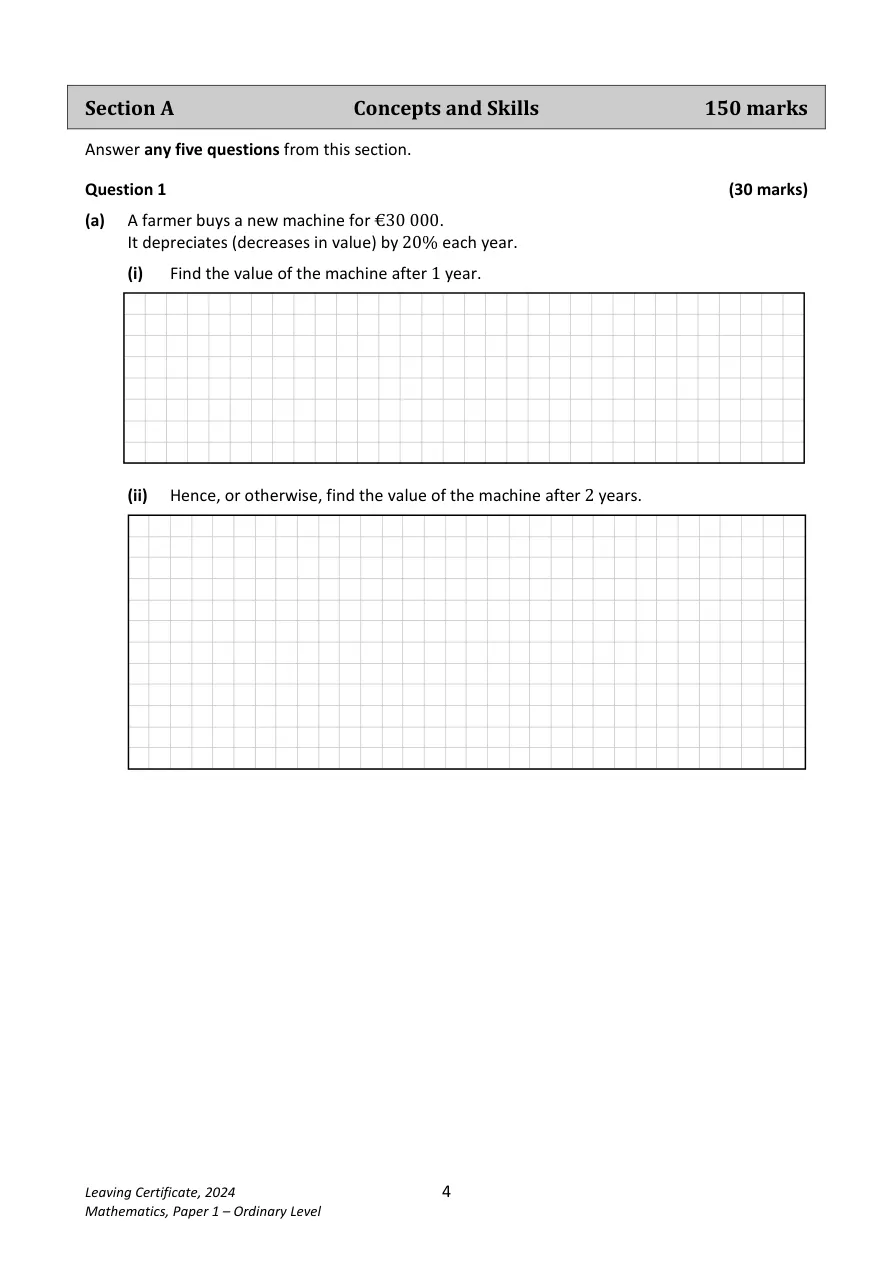
a) Machine

  1. V_1=30000(0.8)
  2. V_1=24000

    Value after one year, in euro.

  3. V_2=24000(0.8)
  4. V_2=19200

    Apply the depreciation again to the reduced value.

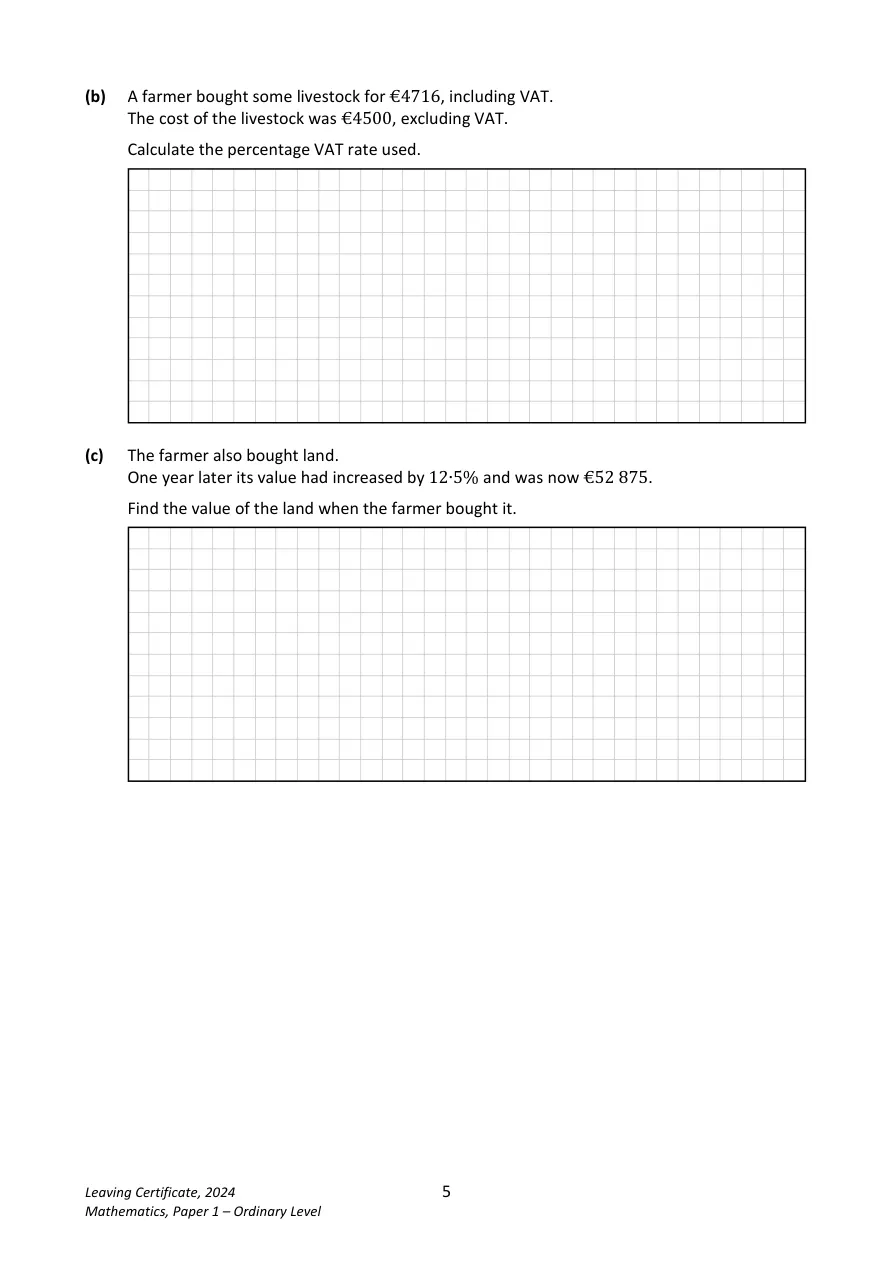
b) VAT

  1. \mathrm{VAT}=4716-4500
  2. \mathrm{VAT}=216
  3. r=\dfrac{216}{4500}\times100
  4. r=4.8\%

c) Original land value

  1. 1.125P=52875
  2. P=\dfrac{52875}{1.125}
  3. P=47000

Question 2

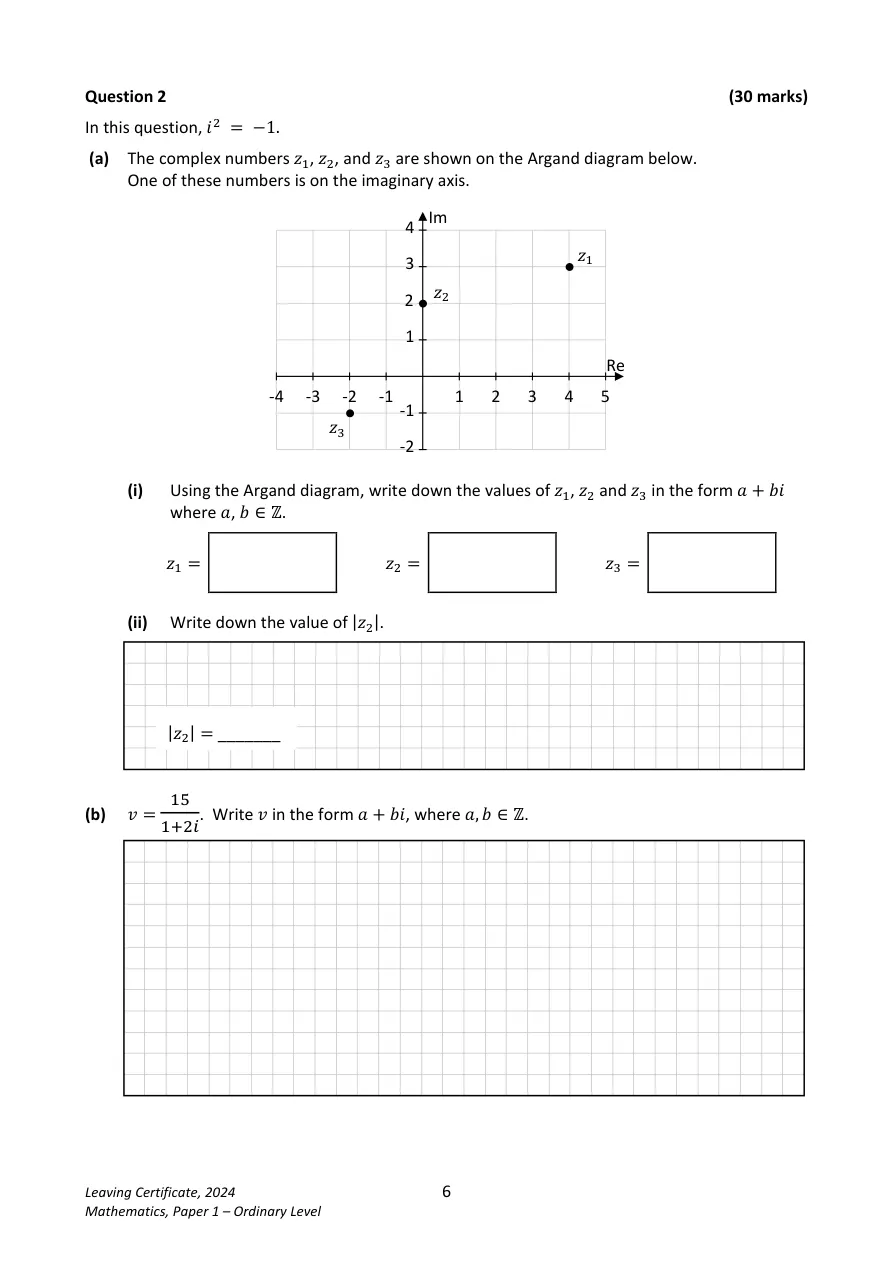
a) Read the diagram

  1. z_1=4+3i
  2. z_2=2i
  3. z_3=-2-i
  4. |z_2|=2

b) Divide by a complex number

  1. v=\dfrac{15}{1+2i}
  2. v=\dfrac{15(1-2i)}{(1+2i)(1-2i)}

    Multiply top and bottom by the conjugate.

  3. v=\dfrac{15-30i}{1+4}
  4. v=3-6i

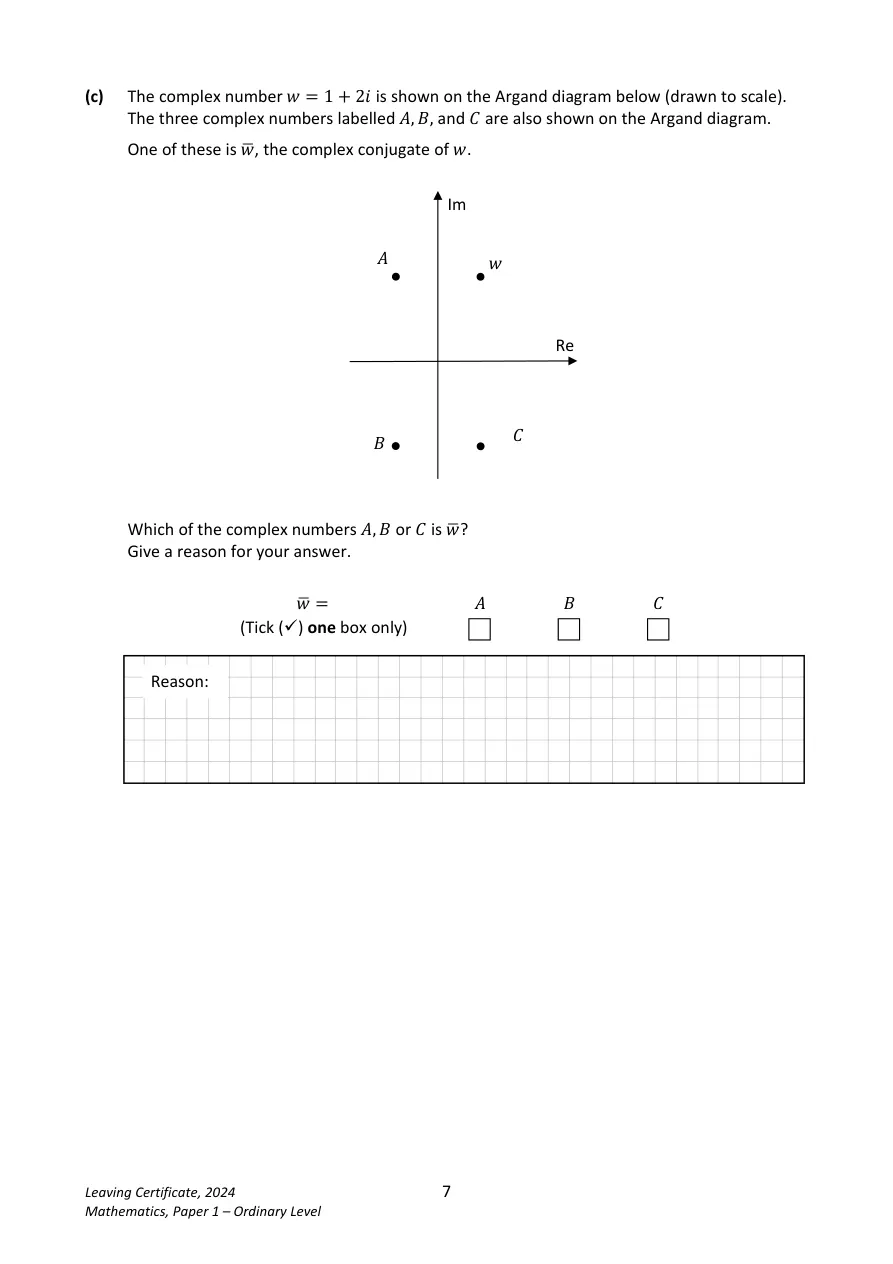
c) Conjugate

  1. \overline{w}=1-2i
  2. Choose C. Reflection in the real axis preserves the real part and reverses the imaginary part.

Question 3

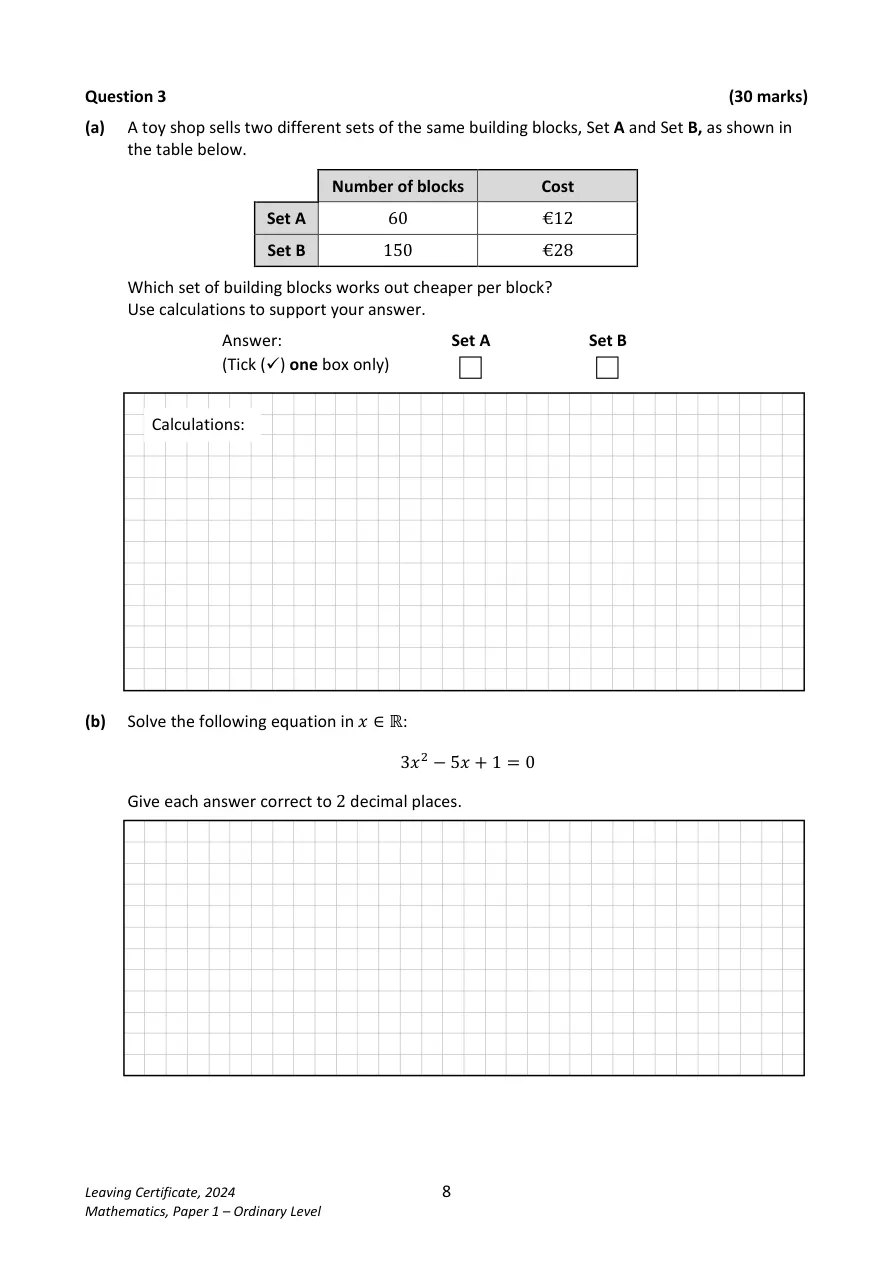
a) Price per block

  1. A=\dfrac{12}{60}=0.20
  2. B=\dfrac{28}{150}\approx0.1867
  3. Set B is cheaper per block.

b) Quadratic

  1. a=3,\quad b=-5,\quad c=1

    Match ax² + bx + c = 0. Include the signs of the coefficients.

  2. x=\dfrac{-b\pm\sqrt{b^2-4ac}}{2a}

    Write the formula before substituting. The ± gives two calculations, one with + and one with −.

  3. x=\dfrac{5\pm\sqrt{(-5)^2-4(3)(1)}}{2(3)}

    Use brackets when substituting negative numbers, especially when squaring b.

  4. x=\dfrac{5\pm\sqrt{13}}{6}
  5. x\approx0.23\quad\mathrm{or}\quad x\approx1.43

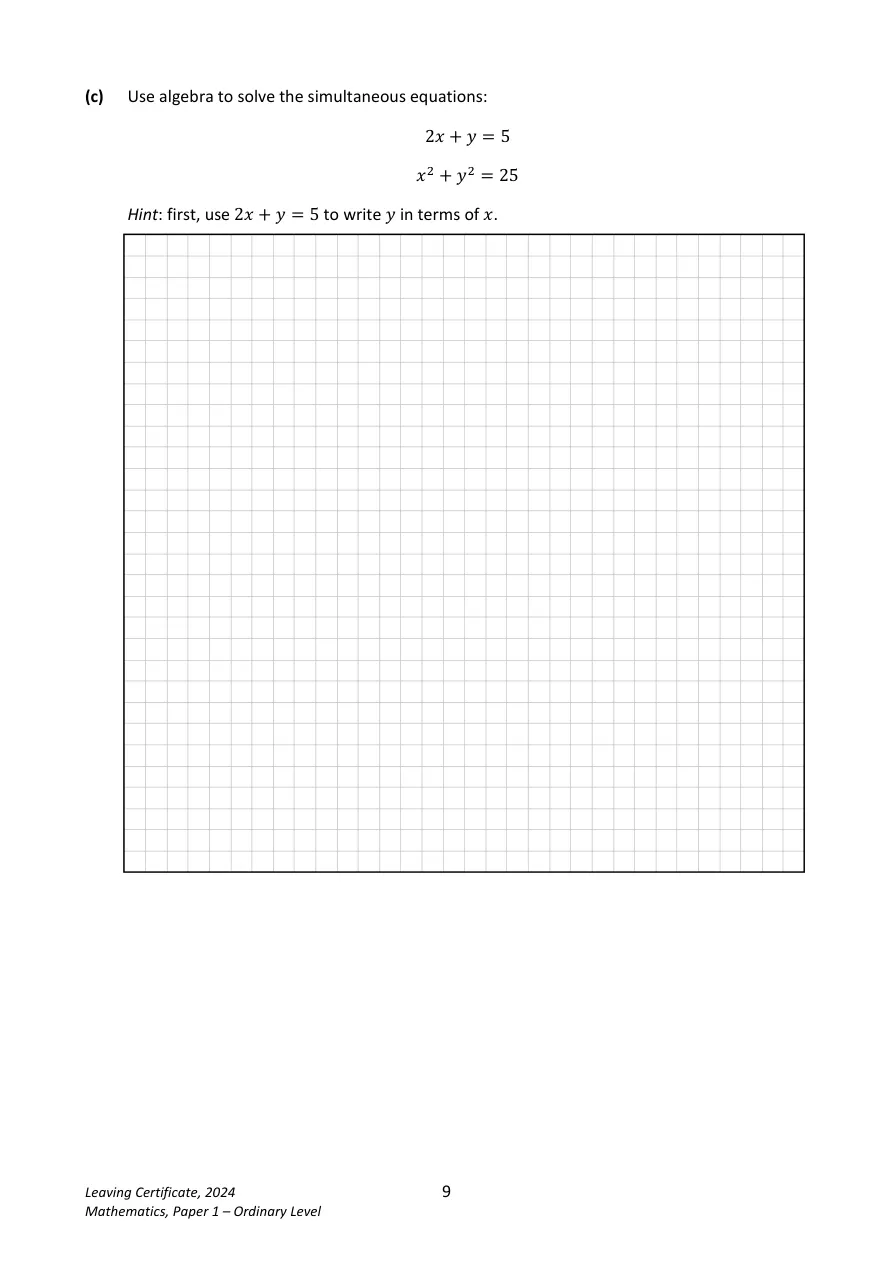
c) Simultaneous equations

  1. y=5-2x
  2. x^2+(5-2x)^2=25

    Replace y in the circle equation with 5 − 2x.

  3. 5x^2-20x=0

    Expand the square as (5 − 2x)(5 − 2x), collect terms and subtract 25 from both sides.

  4. 5x(x-4)=0

    Both terms contain 5x. Take it outside the bracket.

  5. x=0\quad\mathrm{or}\quad x=4

    Either 5x = 0 or x − 4 = 0.

  6. (x,y)=(0,5)\quad\mathrm{or}\quad(4,-3)

    Substitute each x into y = 5 − 2x to get the matching y.

Question 4

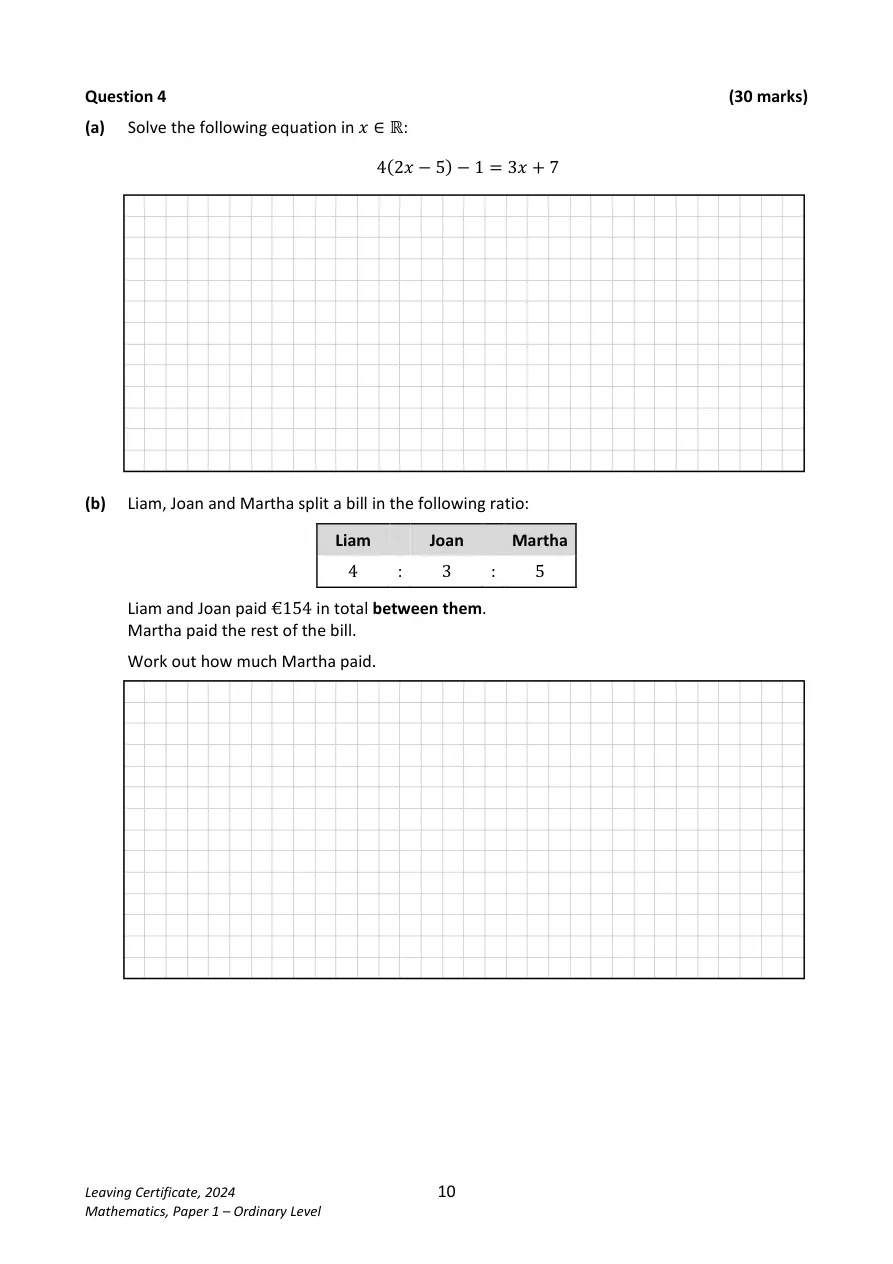
a) Linear equation

  1. 8x-20-1=3x+7
  2. 5x=28
  3. x=\dfrac{28}{5}=5.6

b) Martha's share

  1. \mathrm{one\ part}=\dfrac{154}{4+3}=22
  2. M=5(22)
  3. M=110

    Martha pays €110.

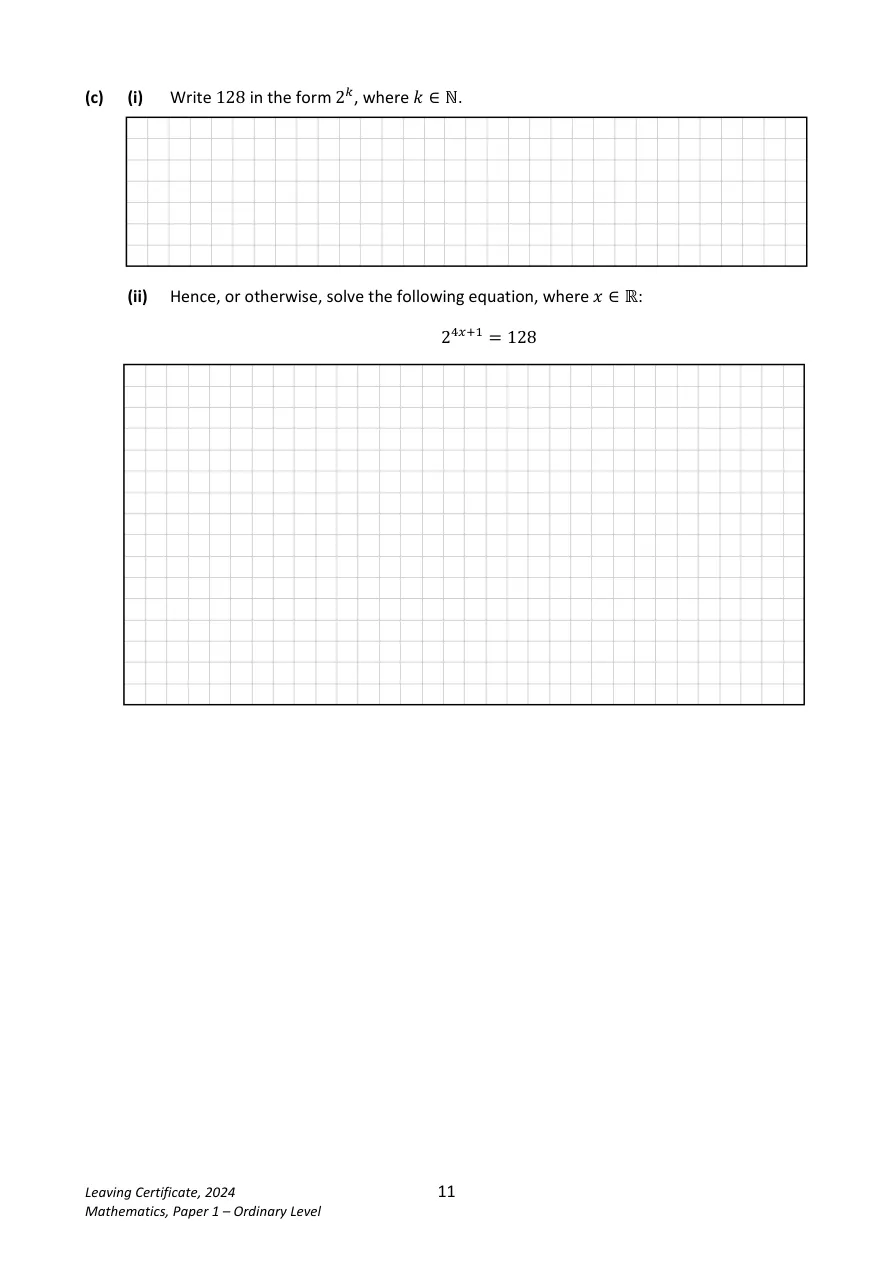
c) Powers of two

  1. 128=2^7
  2. 2^{4x+1}=2^7
  3. 4x+1=7

    Equal bases imply equal exponents.

  4. 4x=6
  5. x=1.5

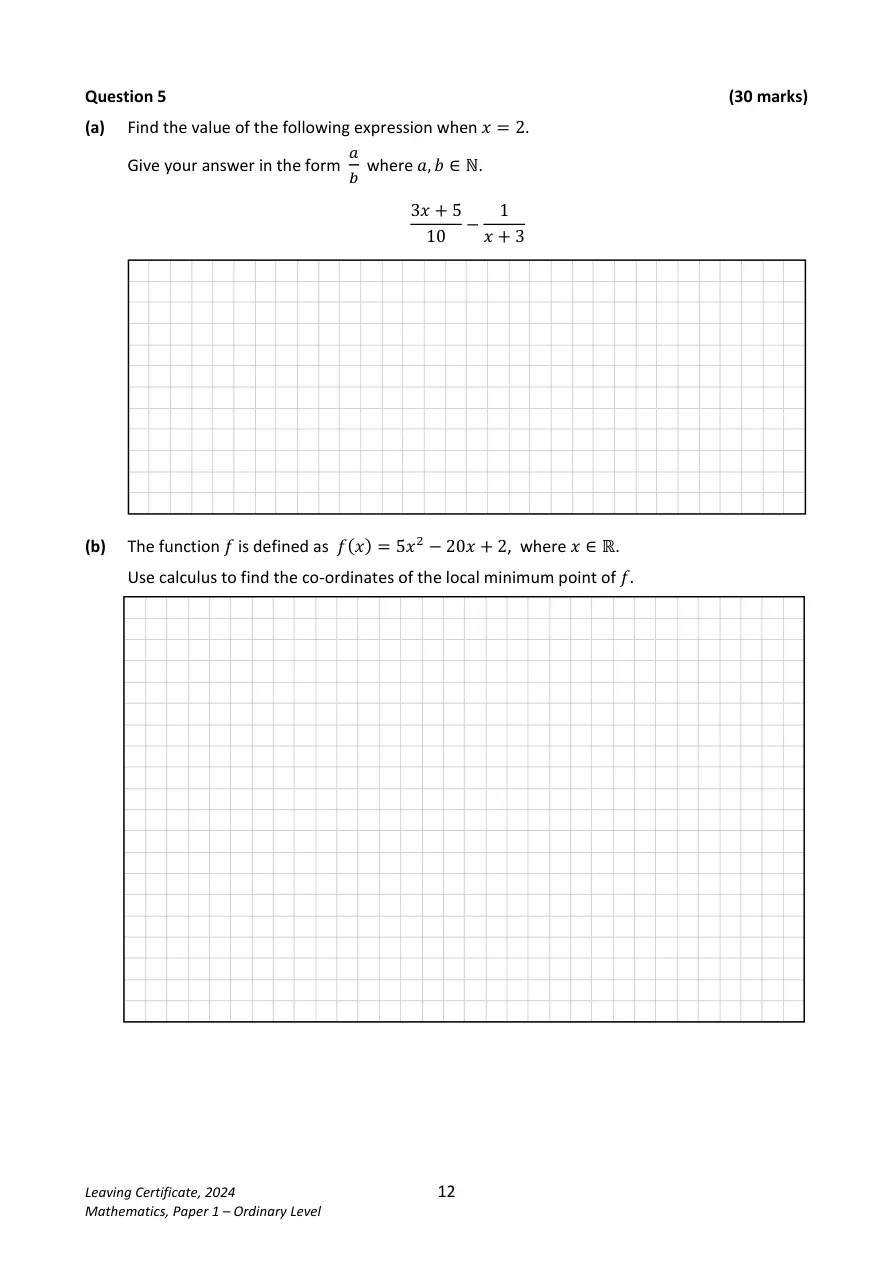
Question 5

a) Substitute x = 2

  1. \dfrac{3(2)+5}{10}-\dfrac{1}{2+3}
  2. =\dfrac{11}{10}-\dfrac{2}{10}
  3. =\dfrac{9}{10}

b) Minimum

  1. f'(x)=10x-20
  2. 10x-20=0
  3. x=2
  4. f(2)=5(2)^2-20(2)+2
  5. f(2)=-18
  6. The minimum point is (2, −18); the positive quadratic coefficient confirms a minimum.

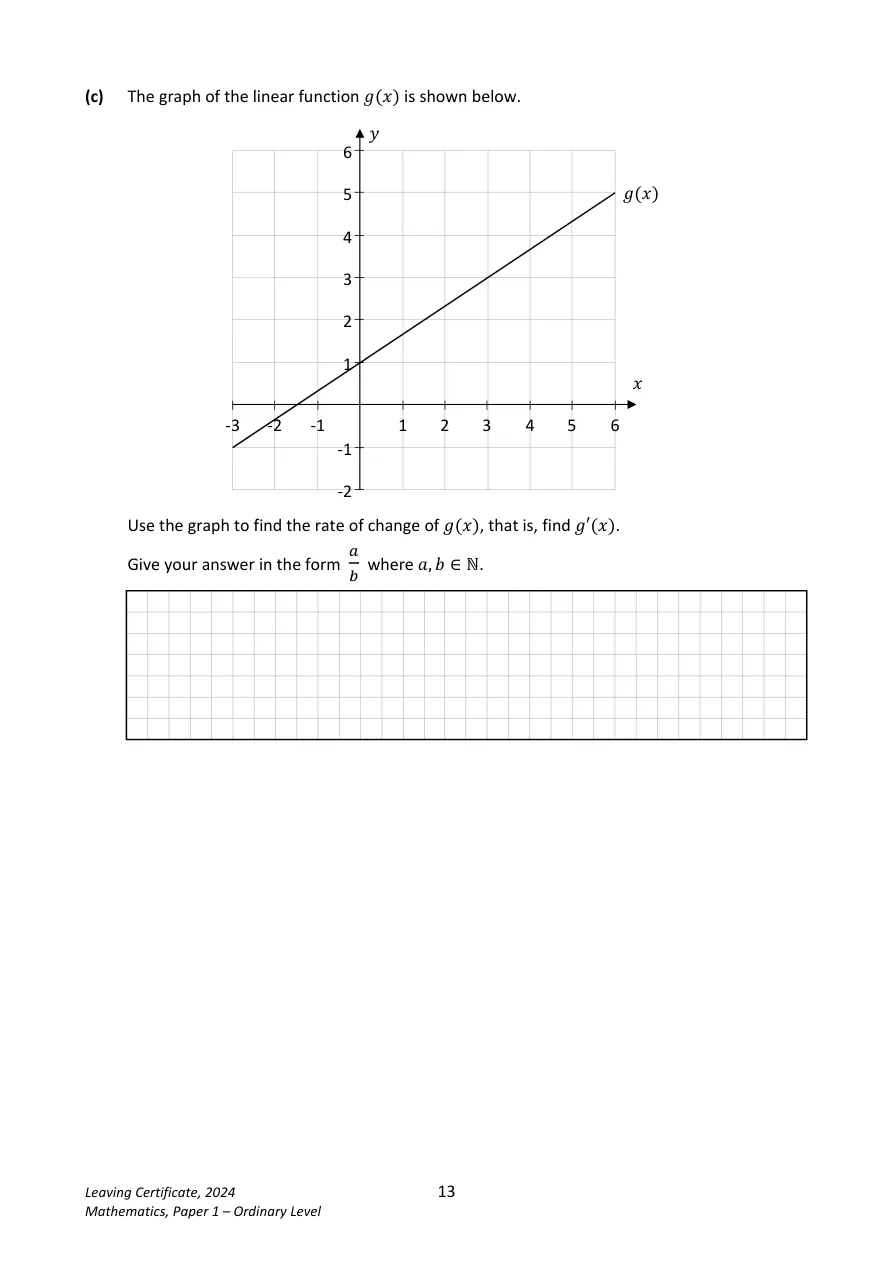
c) Rate of change

  1. g'(x)=\dfrac{2}{3}

    The straight line rises 2 units for every 3 units across.

Question 6

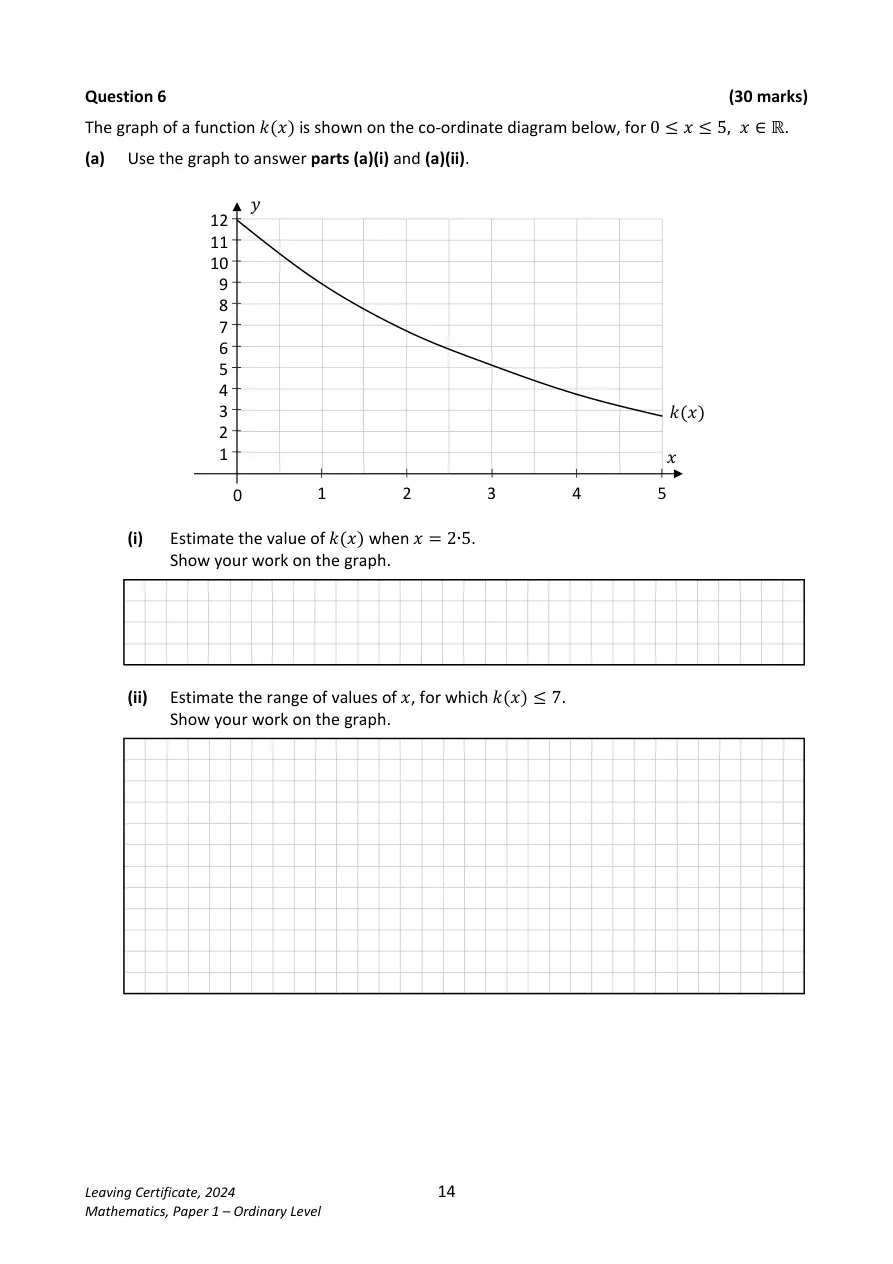
a) Read the graph

  1. k(2.5)\approx5.8
  2. 1.9\lesssim x\leq5

    On the stated domain, the curve is at or below 7 from about x = 1.9 onward.

  3. Draw a vertical from x = 2.5 to the curve and a horizontal to the y-axis. For the inequality, draw y = 7 and read its intersection with the curve.

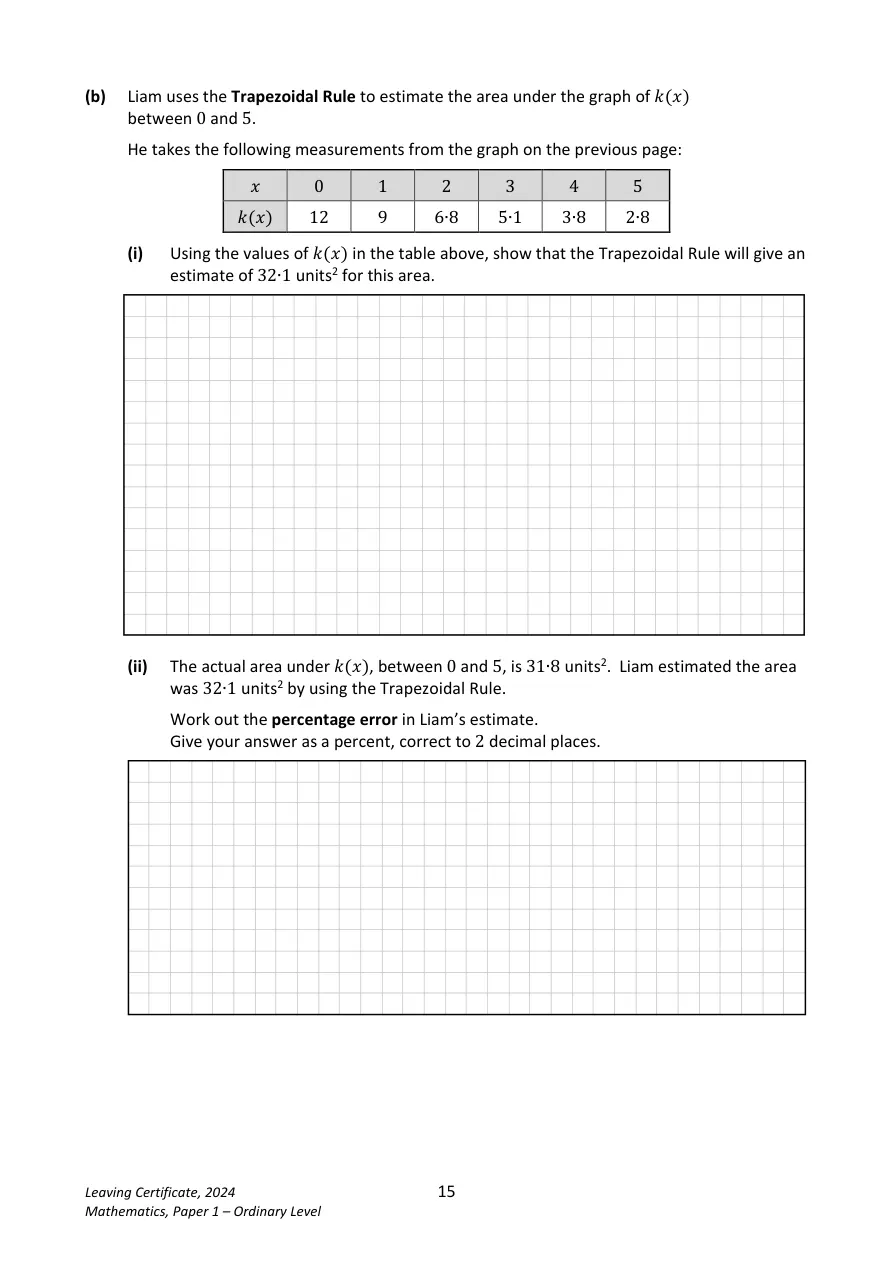
b) Trapezoidal estimate

  1. A\approx\dfrac{1}{2}[12+2.8+2(9+6.8+5.1+3.8)]
  2. A\approx32.1\ \mathrm{units}^2
  3. \mathrm{error}=\dfrac{32.1-31.8}{31.8}\times100
  4. \mathrm{error}\approx0.94\%

Question 7

a) First experiment

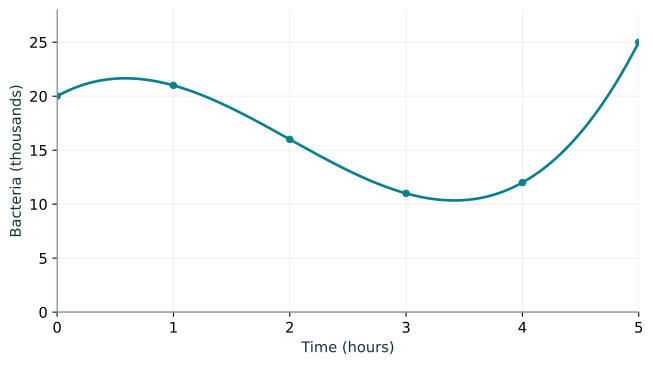
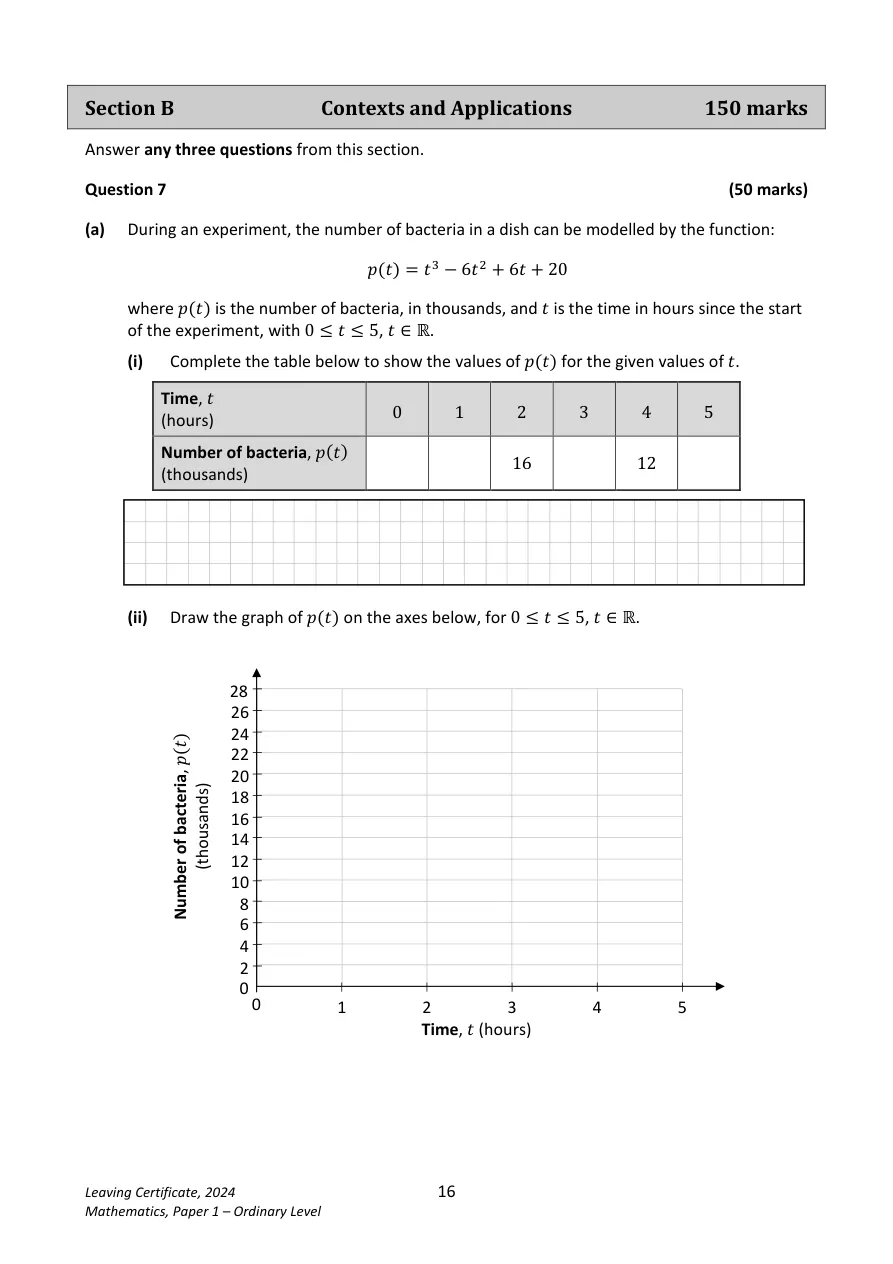
  1. p(0)=20,\quad p(1)=21,\quad p(2)=16
  2. p(3)=11,\quad p(4)=12,\quad p(5)=25
  3. 2024-1-7-graph
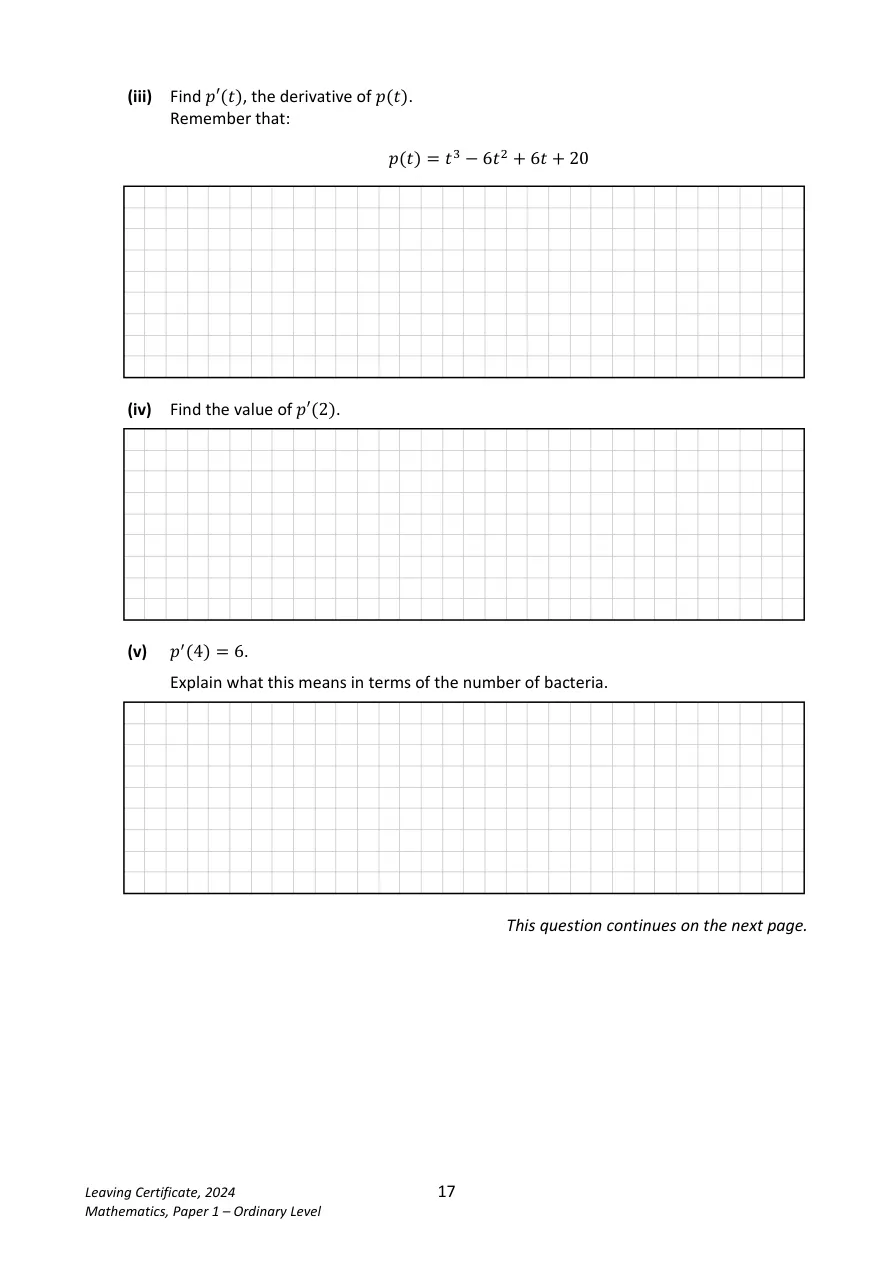
  4. p'(t)=3t^2-12t+6
  5. p'(2)=3(2)^2-12(2)+6
  6. p'(2)=-6

    At two hours the number is decreasing by 6000 bacteria per hour.

  7. p′(4) = 6 means that after four hours the number of bacteria is increasing at 6000 per hour. The model counts bacteria in thousands.

b) Second experiment

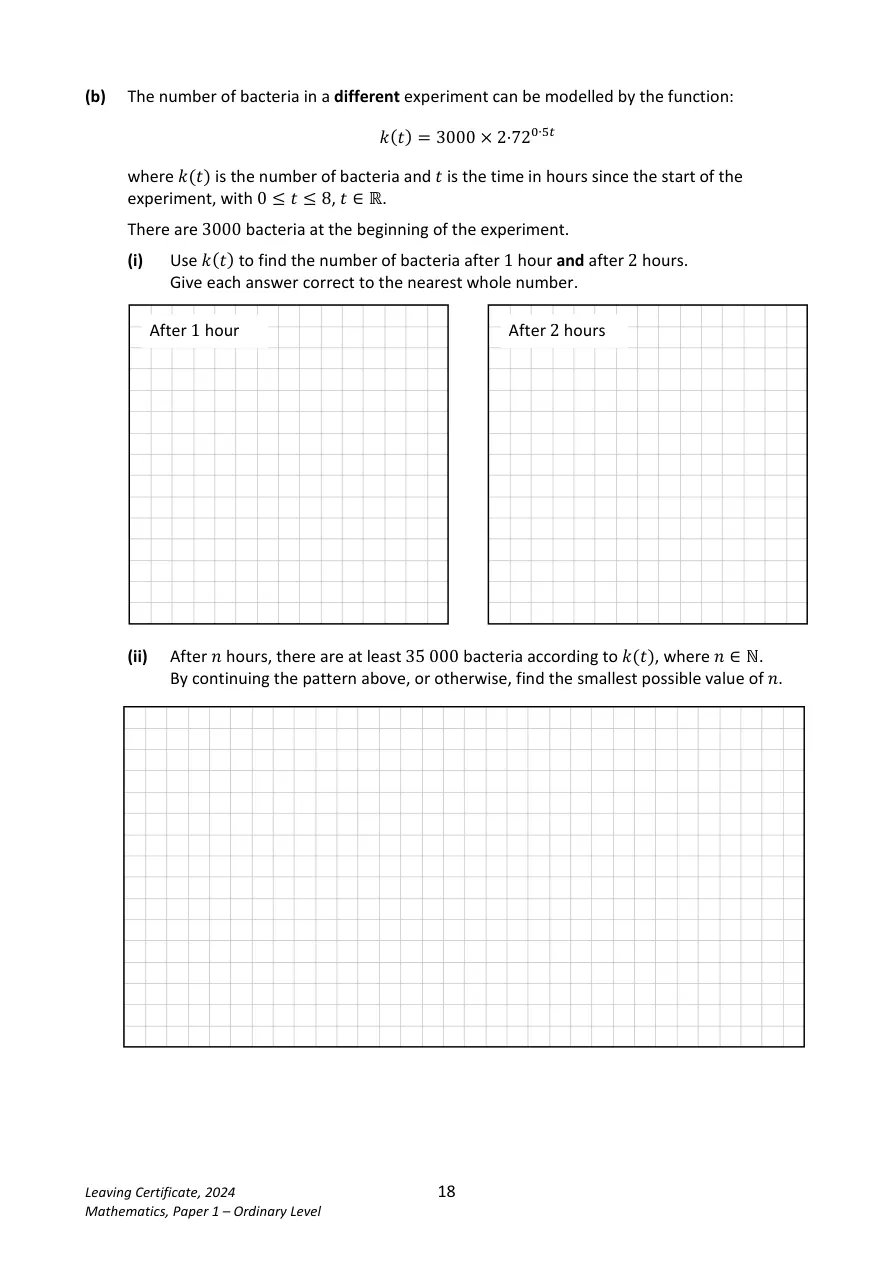
  1. k(1)=3000(2.72)^{0.5}
  2. k(1)\approx4948
  3. k(2)=3000(2.72)^1
  4. k(2)=8160
  5. k(4)\approx22195<35000
  6. k(5)\approx36605>35000
  7. n=5

    The model is increasing; 5 is the first whole number of hours that meets the target.

Question 8

a) Cycle journey

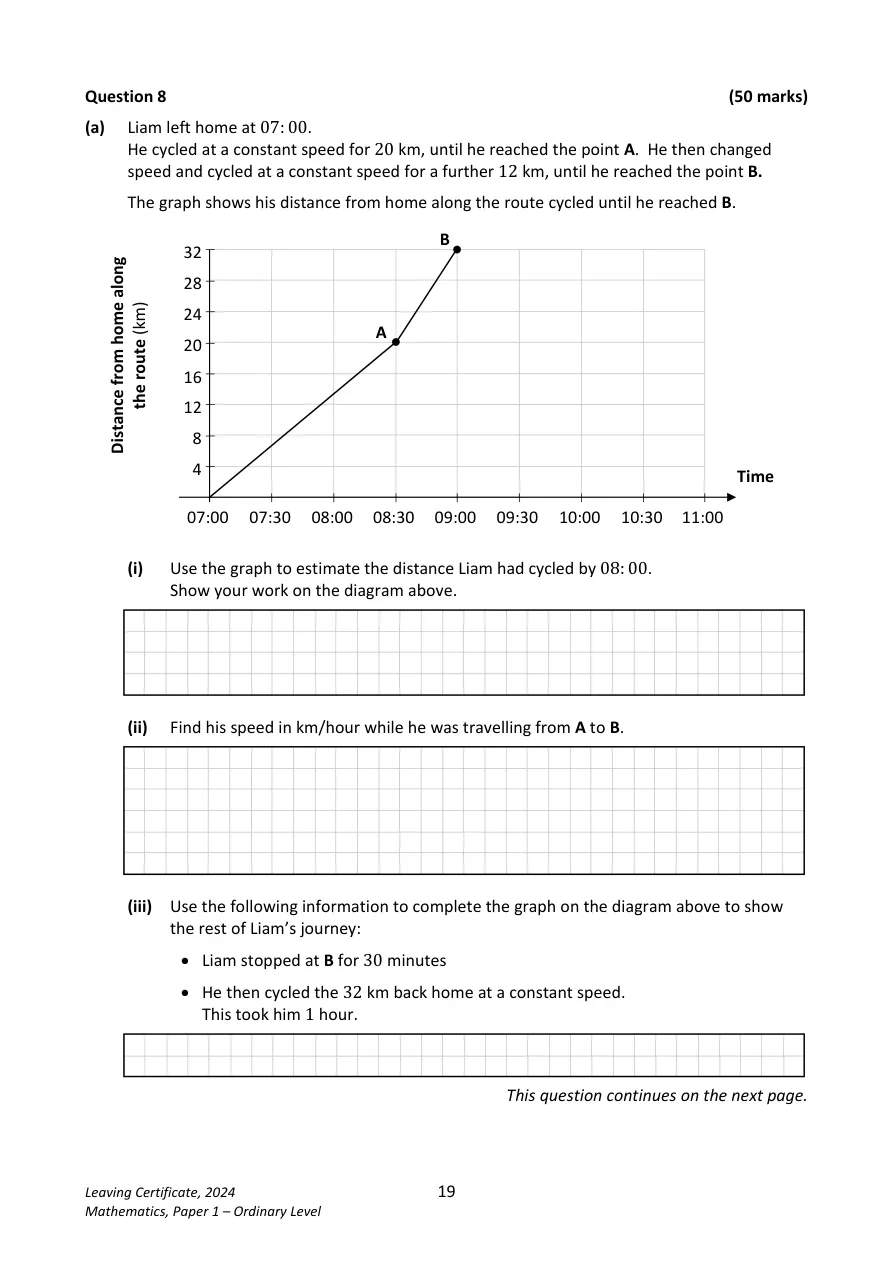
  1. d(08{:}00)\approx13\ \mathrm{km}
  2. v=\dfrac{12}{0.5}
  3. v=24\ \mathrm{km/h}
  4. Complete the graph with a horizontal segment from B at 09:00 to 09:30, at 32 km. Then draw a straight segment down to (10:30, 0) for the return home.

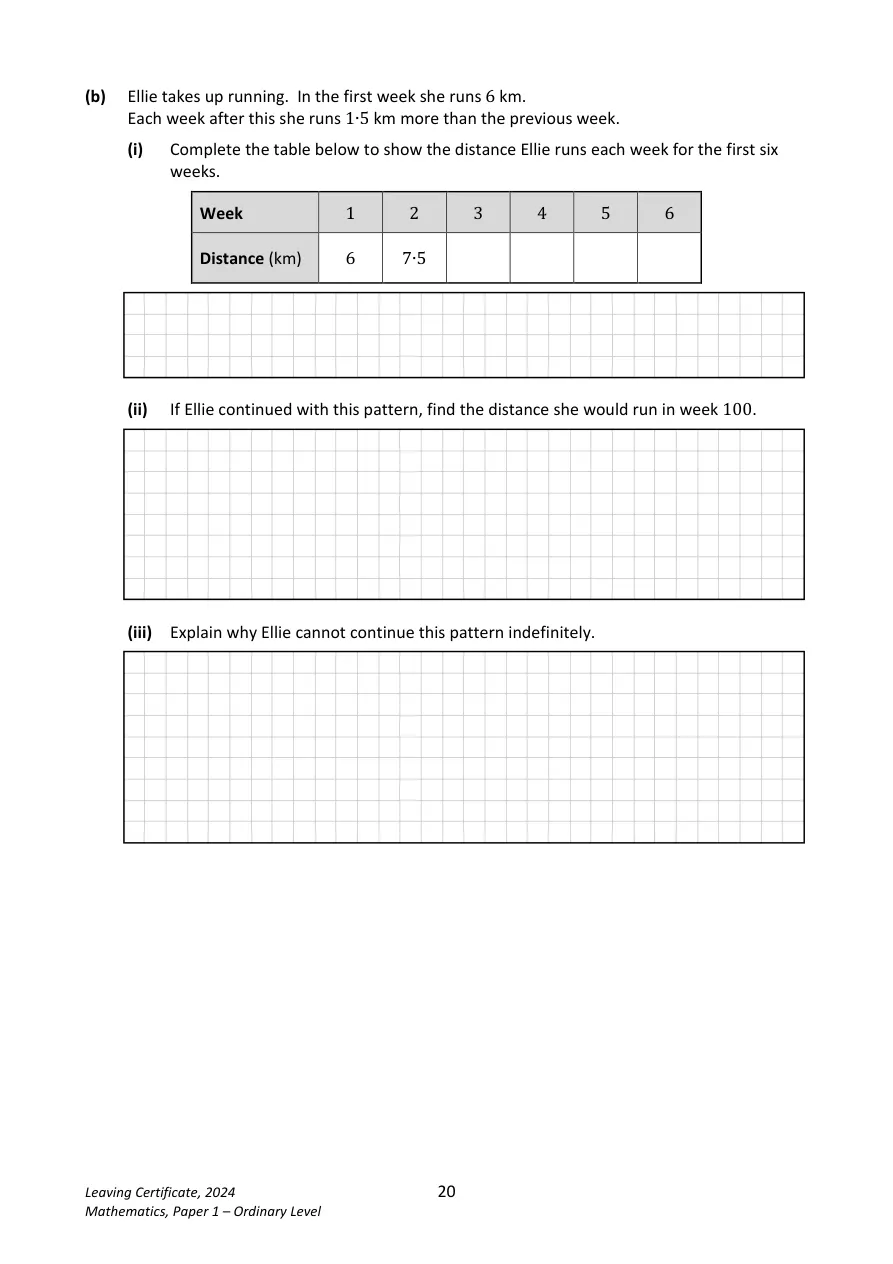
b) Weekly distances

  1. T_1=6,\ T_2=7.5,\ T_3=9
  2. T_4=10.5,\ T_5=12,\ T_6=13.5
  3. T_n=6+(n-1)(1.5)
  4. T_{100}=154.5\ \mathrm{km}
  5. The model cannot continue indefinitely: weekly distances would become too large to run.
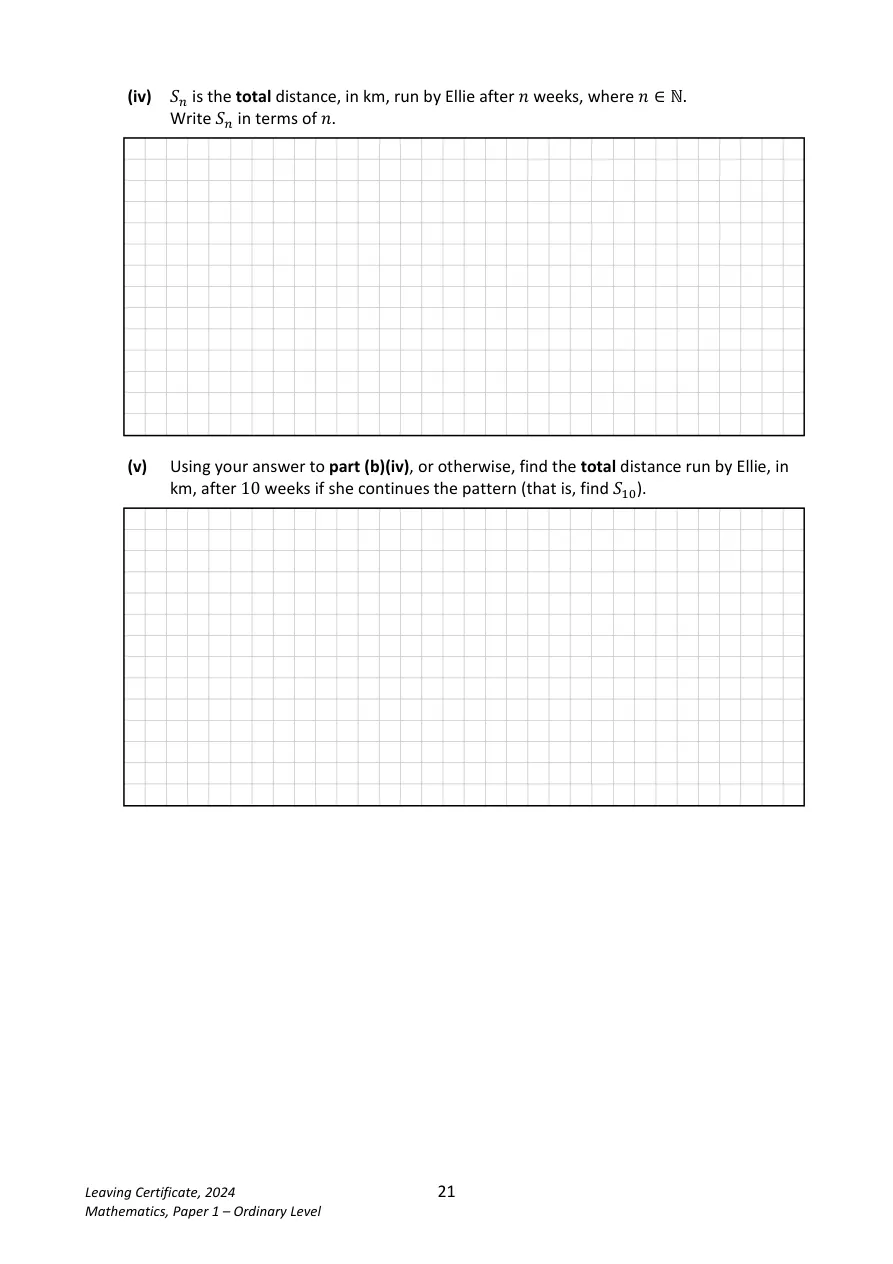
  6. S_n=\dfrac{n}{2}[12+1.5(n-1)]
  7. S_{10}=\dfrac{10}{2}[12+1.5(9)]
  8. S_{10}=127.5\ \mathrm{km}

Question 9

a) Tickets

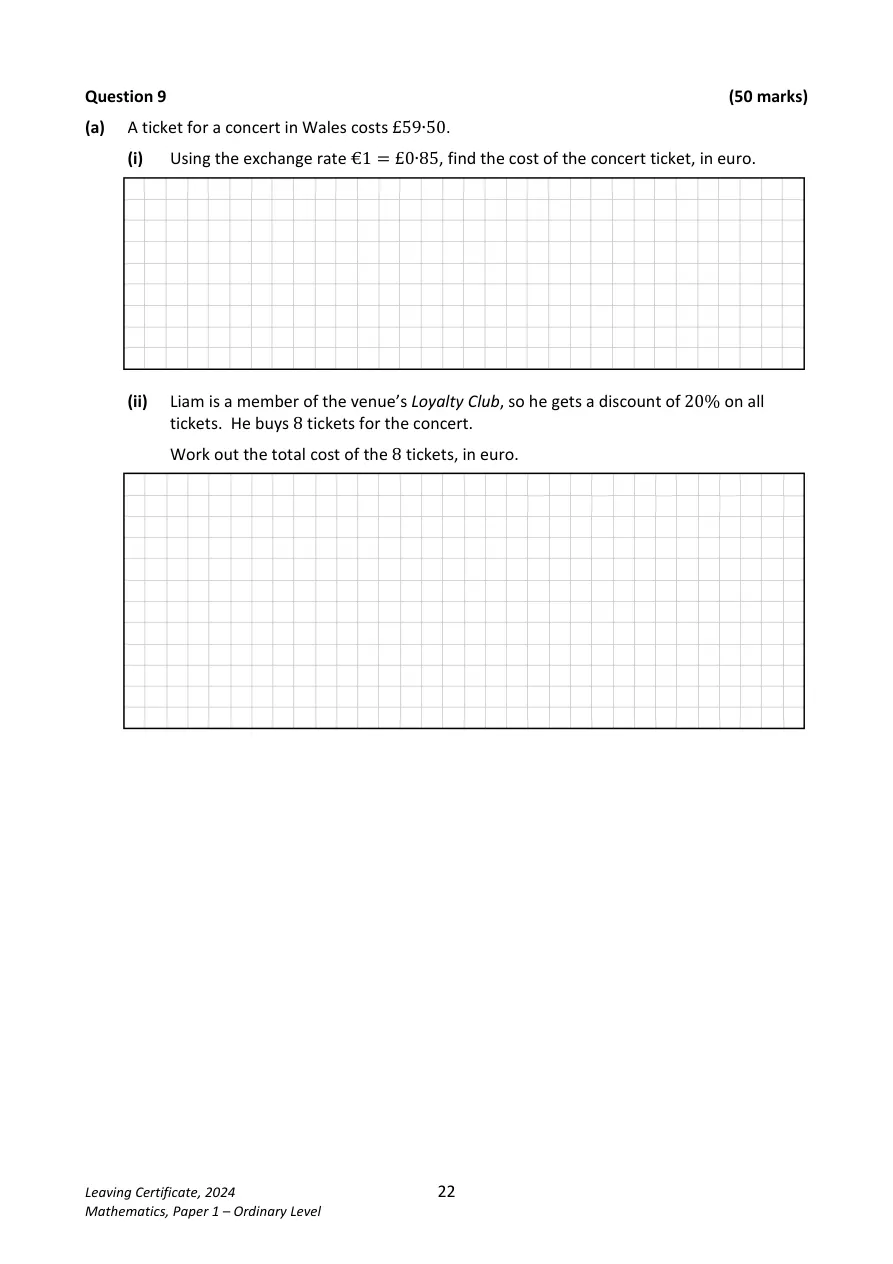
  1. C=\dfrac{59.50}{0.85}
  2. C=70\ \mathrm{euro}
  3. C_8=8(70)(0.8)
  4. C_8=448\ \mathrm{euro}

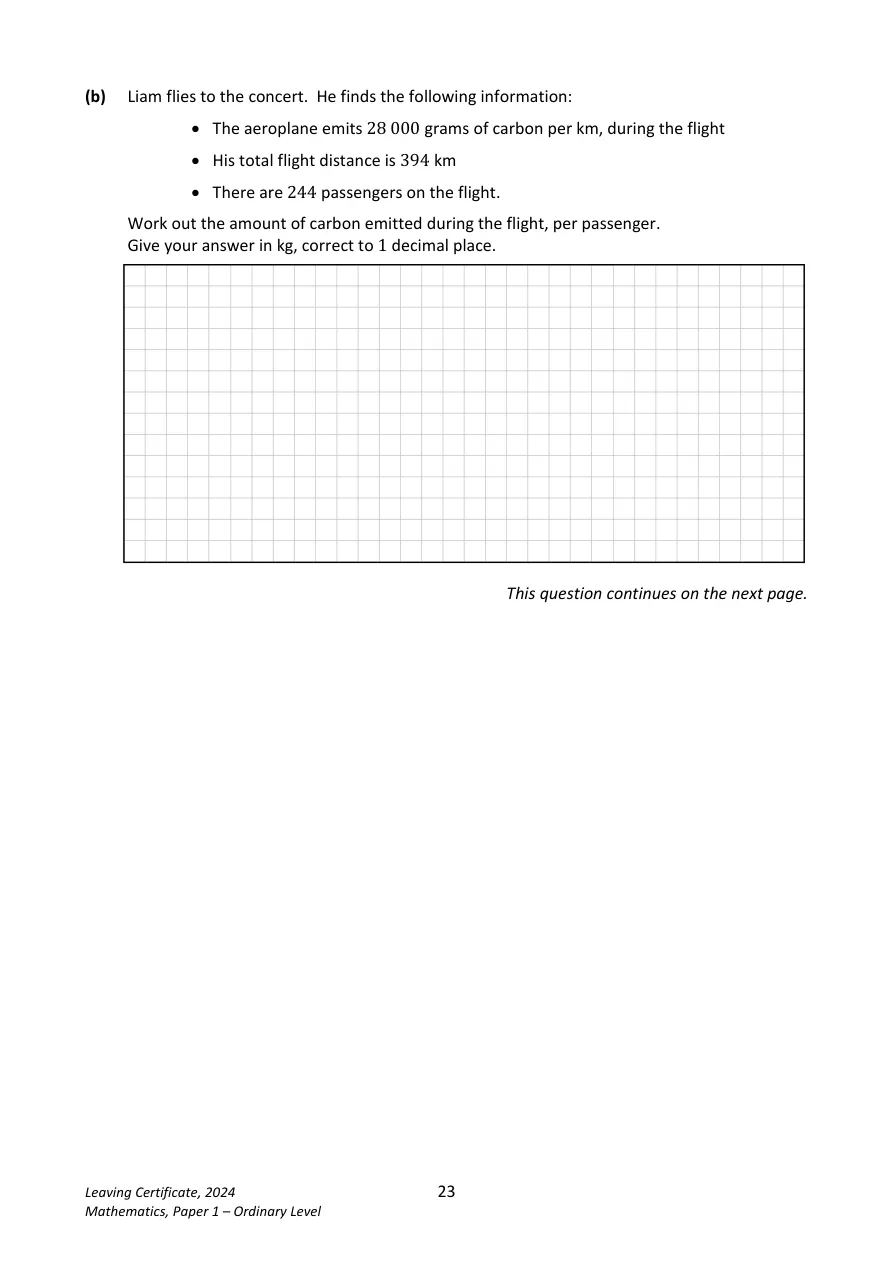
b) Carbon per passenger

  1. m=\dfrac{28000(394)}{244(1000)}

    Divide by passengers and convert grams to kilograms.

  2. m\approx45.2\ \mathrm{kg}

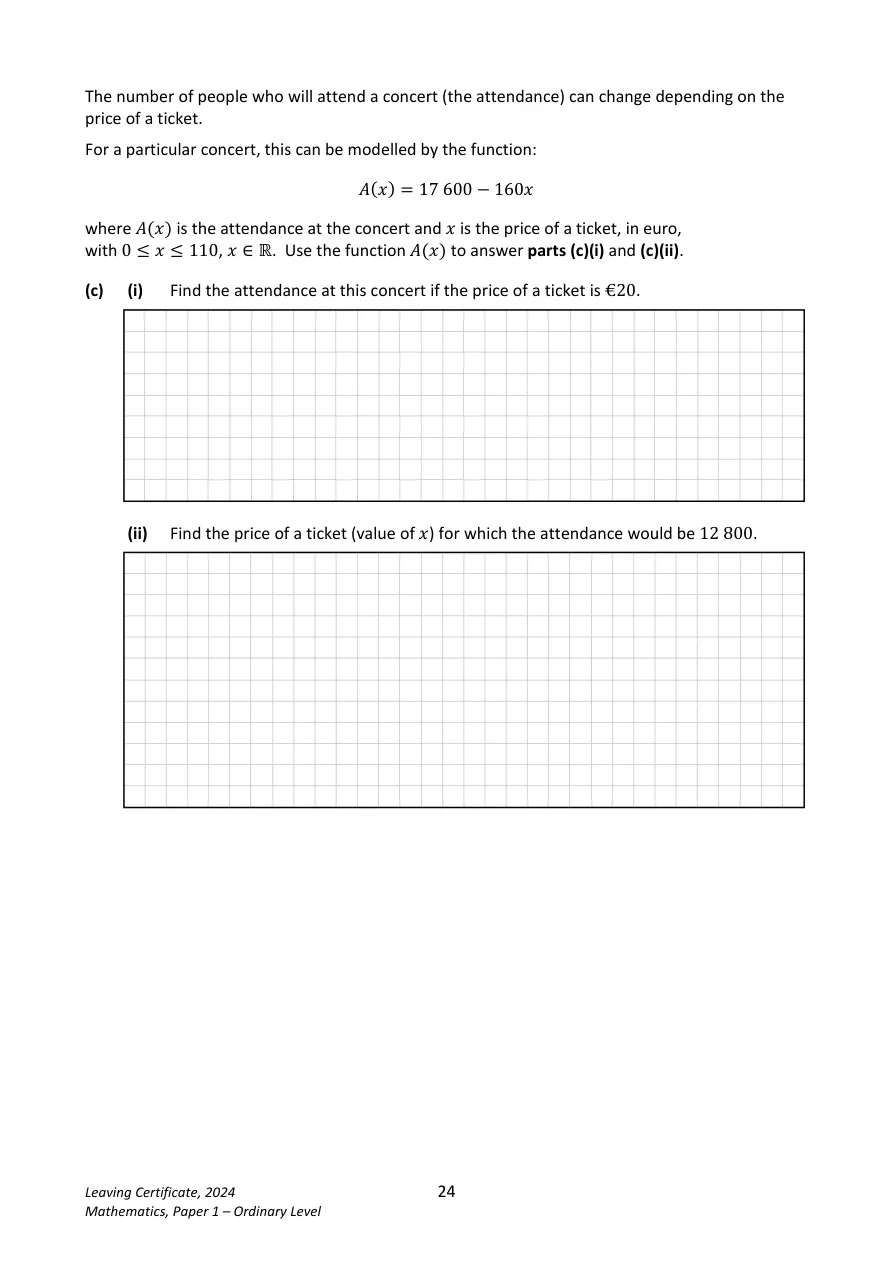
c) Attendance

  1. A(20)=17600-160(20)
  2. A(20)=14400
  3. 17600-160x=12800
  4. 160x=4800
  5. x=30\ \mathrm{euro}

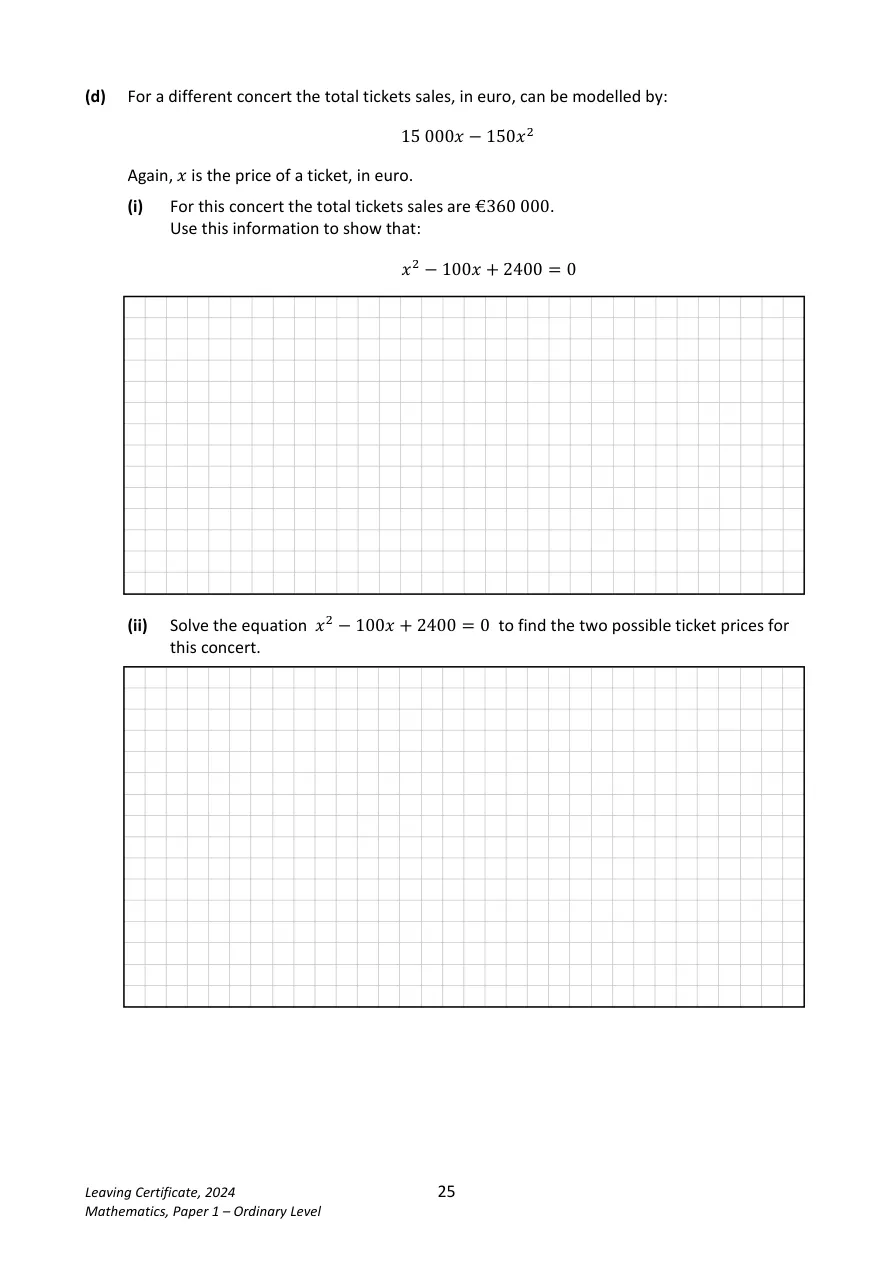
d) Ticket sales

  1. 15000x-150x^2=360000
  2. 150x^2-15000x+360000=0
  3. x^2-100x+2400=0

    Divide every term by 150.

  4. (x-40)(x-60)=0

    The product is zero, so at least one of the factors must be zero. Set each factor equal to zero in turn.

  5. x=40\quad\mathrm{or}\quad x=60
  6. The two possible ticket prices are €40 and €60.

Question 10

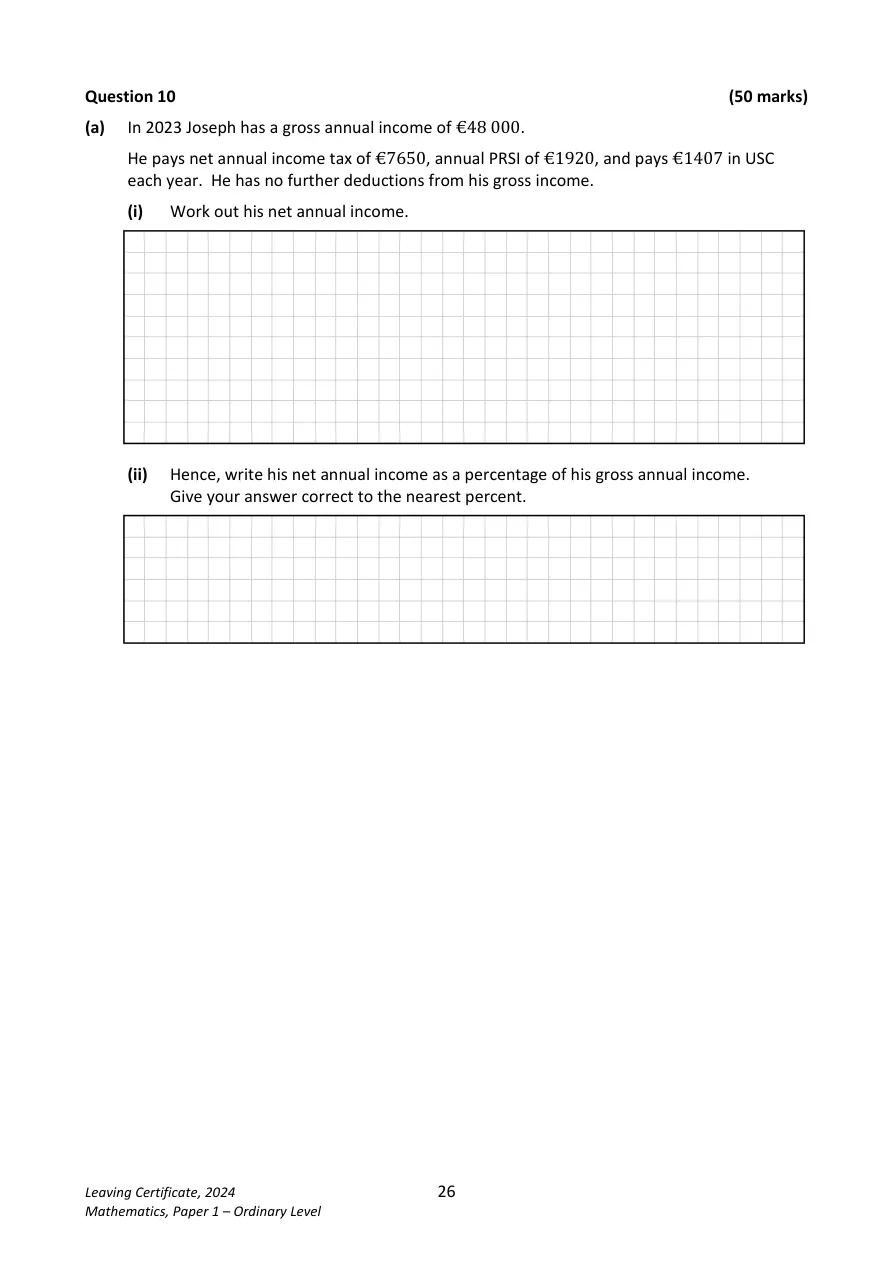
a) Joseph

  1. N=48000-7650-1920-1407
  2. N=37023\ \mathrm{euro}
  3. p=\dfrac{37023}{48000}\times100
  4. p\approx77\%

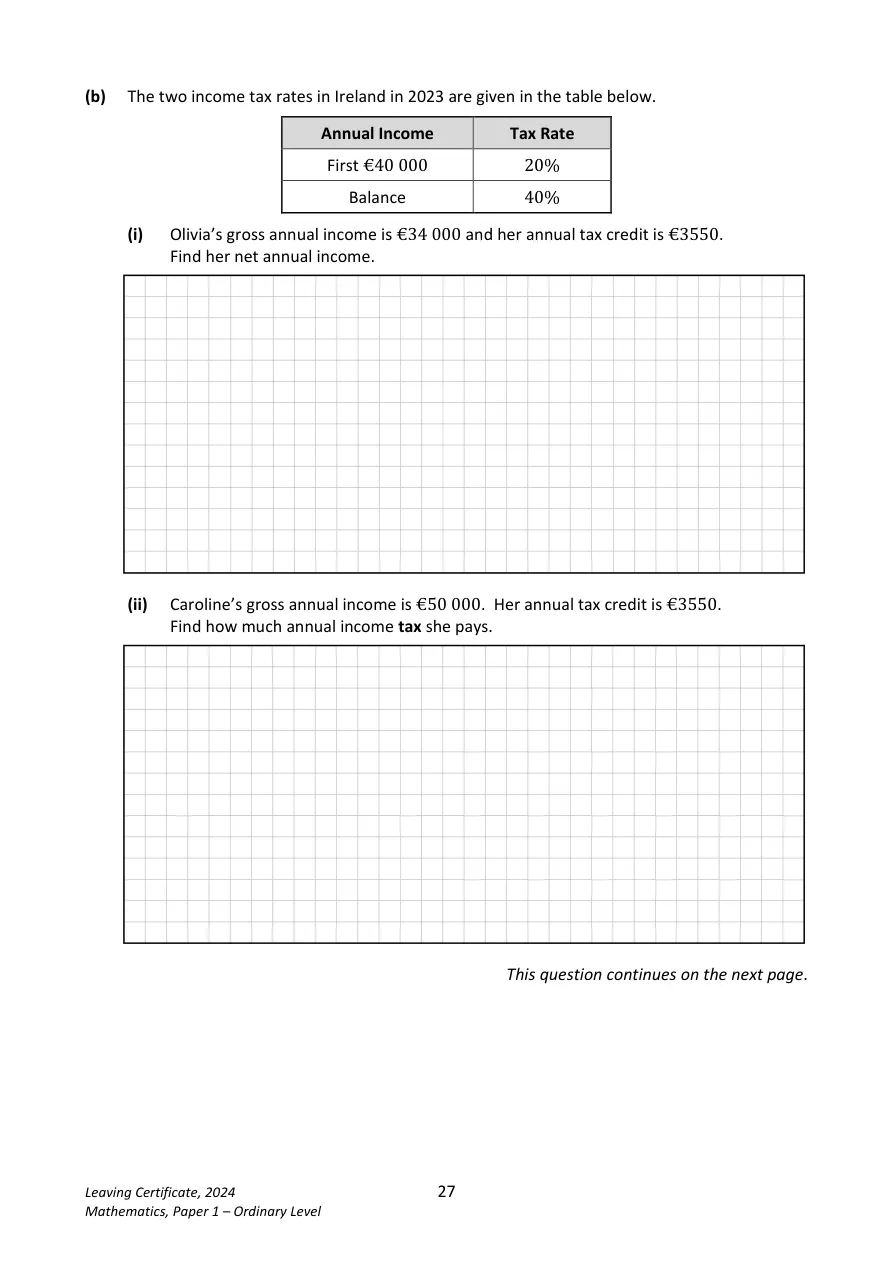
b) Income tax

  1. Use the tax rates and credits stated in this examination question.
  2. T_{\mathrm{Olivia}}=34000(0.2)-3550
  3. T_{\mathrm{Olivia}}=3250
  4. N_{\mathrm{Olivia}}=34000-3250
  5. N_{\mathrm{Olivia}}=30750\ \mathrm{euro}
  6. T_{\mathrm{Caroline}}=40000(0.2)+10000(0.4)-3550
  7. T_{\mathrm{Caroline}}=8450\ \mathrm{euro}
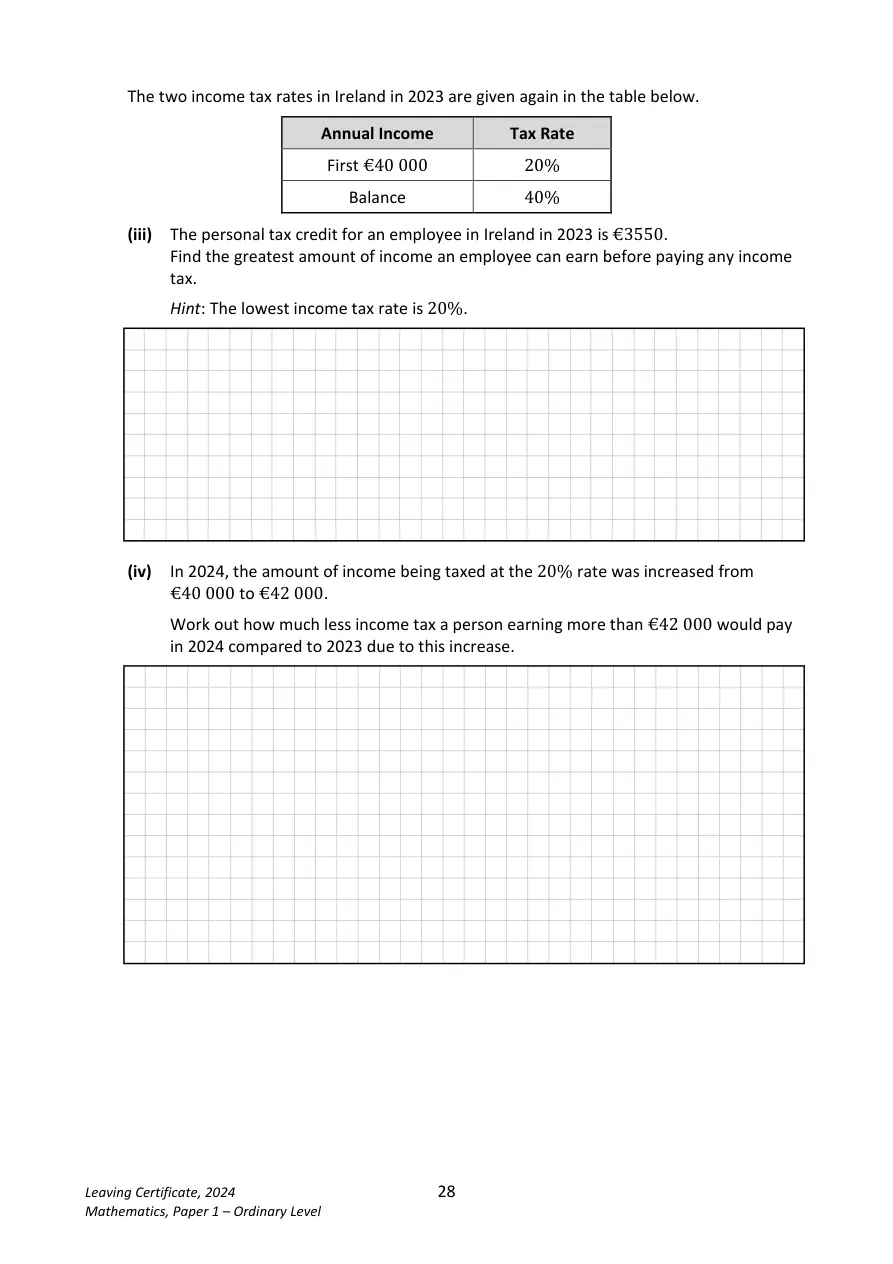
  8. 0.2I=3550
  9. I=17750\ \mathrm{euro}

    This is the greatest income before income tax is due.

  10. \mathrm{saving}=(42000-40000)(0.4-0.2)
  11. \mathrm{saving}=400\ \mathrm{euro}

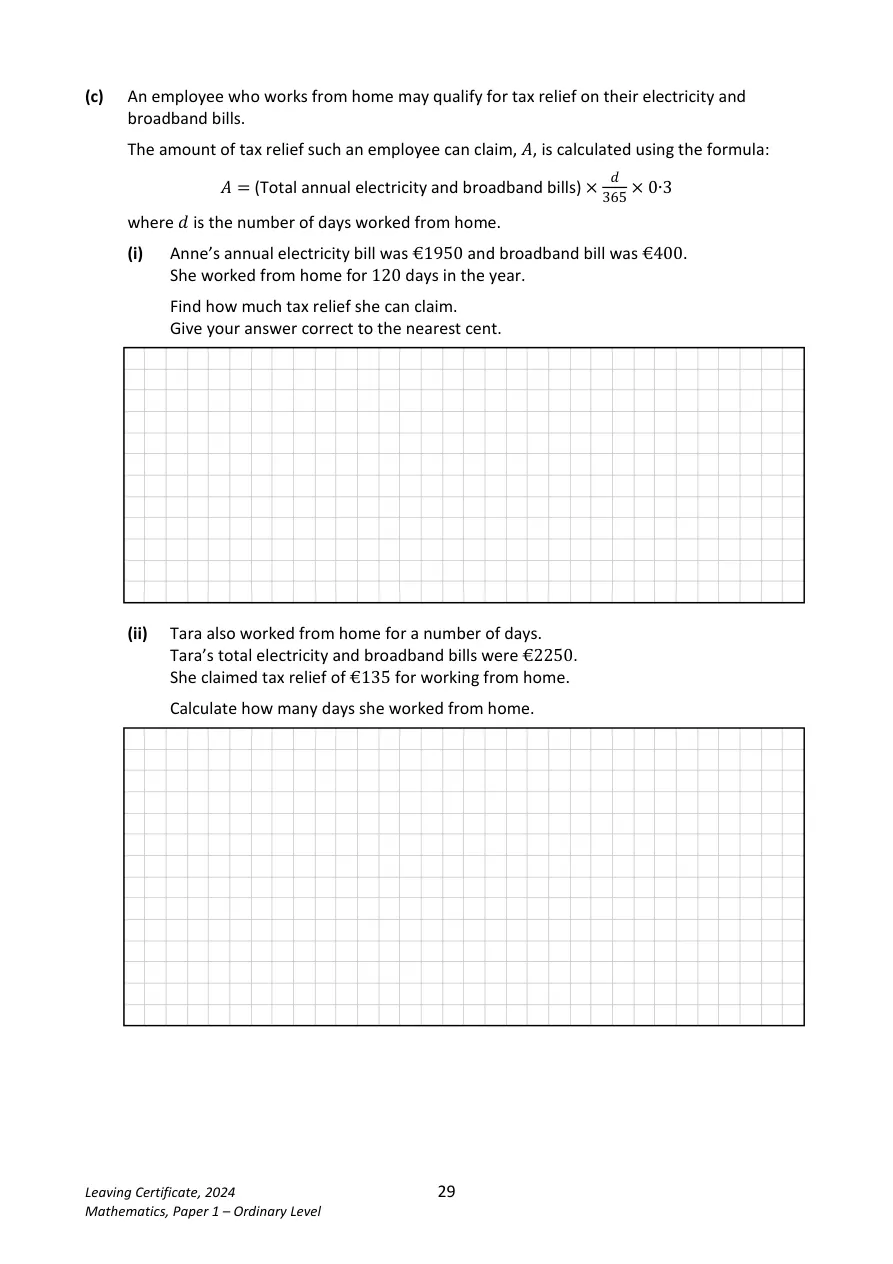
c) Working from home

  1. A=(1950+400)\dfrac{120}{365}(0.3)
  2. A\approx231.78\ \mathrm{euro}
  3. 2250\dfrac{d}{365}(0.3)=135
  4. d=\dfrac{135(365)}{2250(0.3)}
  5. d=73\ \mathrm{days}
See working and diagrams on the original paper
Original exam paper page 4
V_1=30000(0.8)
V_1=24000
[Value after one year, in euro.]
V_2=24000(0.8)
V_2=19200
[Apply the depreciation again to the reduced value.]
Original exam paper page 5
\mathrm{VAT}=4716-4500
\mathrm{VAT}=216
r=\dfrac{216}{4500}\times100
r=4.8\%
1.125P=52875
P=\dfrac{52875}{1.125}
P=47000
Original exam paper page 6
z_1=4+3i
z_2=2i
z_3=-2-i
|z_2|=2
v=\dfrac{15}{1+2i}
v=\dfrac{15(1-2i)}{(1+2i)(1-2i)}
[Multiply top and bottom by the conjugate.]
v=\dfrac{15-30i}{1+4}
v=3-6i
Original exam paper page 7
\overline{w}=1-2i
Choose C. Reflection in the real axis preserves the real part and reverses the imaginary part.
Original exam paper page 8
A=\dfrac{12}{60}=0.20
B=\dfrac{28}{150}\approx0.1867
Set B is cheaper per block.
x=\dfrac{5\pm\sqrt{(-5)^2-4(3)(1)}}{2(3)}
x=\dfrac{5\pm\sqrt{13}}{6}
x\approx0.23\quad\mathrm{or}\quad x\approx1.43
Original exam paper page 9
y=5-2x
x^2+(5-2x)^2=25
[Substitute y = 5 − 2x.]
5x^2-20x=0
5x(x-4)=0
x=0\quad\mathrm{or}\quad x=4
(x,y)=(0,5)\quad\mathrm{or}\quad(4,-3)
Original exam paper page 10
8x-20-1=3x+7
5x=28
x=\dfrac{28}{5}=5.6
\mathrm{one\ part}=\dfrac{154}{4+3}=22
[Liam and Joan account for 4 + 3 parts.]
M=5(22)
M=110
Original exam paper page 11
128=2^7
2^{4x+1}=2^7
4x+1=7
[Equal bases imply equal exponents.]
4x=6
x=1.5
Original exam paper page 12
\dfrac{3(2)+5}{10}-\dfrac{1}{2+3}
=\dfrac{11}{10}-\dfrac{2}{10}
=\dfrac{9}{10}
f'(x)=10x-20
10x-20=0
[At a stationary point, the derivative is zero.]
x=2
f(2)=5(2)^2-20(2)+2
f(2)=-18
The minimum point is (2, −18); the positive quadratic coefficient confirms a minimum.
Original exam paper page 13
g'(x)=\dfrac{2}{3}
[The straight line rises 2 units for every 3 units across.]
Original exam paper page 14
k(2.5)\approx5.8
1.9\lesssim x\leq5
[On the stated domain, the curve is at or below 7 from about x = 1.9 onward.]
Draw a vertical from x = 2.5 to the curve and a horizontal to the y-axis. For the inequality, draw y = 7 and read its intersection with the curve.
Original exam paper page 15
A\approx\dfrac{1}{2}[12+2.8+2(9+6.8+5.1+3.8)]
A\approx32.1\ \mathrm{units}^2
\mathrm{error}=\dfrac{32.1-31.8}{31.8}\times100
\mathrm{error}\approx0.94\%
Original exam paper page 16
p(0)=20,\quad p(1)=21,\quad p(2)=16
p(3)=11,\quad p(4)=12,\quad p(5)=25
20211125
Original exam paper page 17
p'(t)=3t^2-12t+6
p'(2)=3(2)^2-12(2)+6
p'(2)=-6
[At two hours the number is decreasing by 6000 bacteria per hour.]
p′(4) = 6 means that after four hours the number of bacteria is increasing at 6000 per hour. The model counts bacteria in thousands.
Original exam paper page 18
k(1)=3000(2.72)^{0.5}
k(1)\approx4948
k(2)=3000(2.72)^1
k(2)=8160
k(4)\approx22195<35000
k(5)\approx36605>35000
n=5
[The model is increasing; 5 is the first whole number of hours that meets the target.]
Original exam paper page 19
d(08{:}00)\approx13\ \mathrm{km}
v=\dfrac{12}{0.5}
v=24\ \mathrm{km/h}
09:00–09:30: stopped; 09:30–10:30: return home.
Original exam paper page 20
T_1=6,\ T_2=7.5,\ T_3=9
T_4=10.5,\ T_5=12,\ T_6=13.5
T_n=6+(n-1)(1.5)
T_{100}=154.5\ \mathrm{km}
The model cannot continue indefinitely: weekly distances would become too large to run.
910.51213.5
Original exam paper page 21
S_n=\dfrac{n}{2}[12+1.5(n-1)]
S_{10}=\dfrac{10}{2}[12+1.5(9)]
S_{10}=127.5\ \mathrm{km}
Original exam paper page 22
C=\dfrac{59.50}{0.85}
C=70\ \mathrm{euro}
C_8=8(70)(0.8)
C_8=448\ \mathrm{euro}
Original exam paper page 23
m=\dfrac{28000(394)}{244(1000)}
[Divide total emissions by passengers, then by 1000.]
m\approx45.2\ \mathrm{kg}
Original exam paper page 24
A(20)=17600-160(20)
A(20)=14400
17600-160x=12800
160x=4800
x=30\ \mathrm{euro}
Original exam paper page 25
15000x-150x^2=360000
150x^2-15000x+360000=0
x^2-100x+2400=0
[Divide every term by 150.]
(x-40)(x-60)=0
x=40\quad\mathrm{or}\quad x=60
The two possible ticket prices are €40 and €60.
Original exam paper page 26
N=48000-7650-1920-1407
N=37023\ \mathrm{euro}
p=\dfrac{37023}{48000}\times100
p\approx77\%
Original exam paper page 27
Use the tax rates and credits stated in this examination question.
T_{\mathrm{Olivia}}=34000(0.2)-3550
T_{\mathrm{Olivia}}=3250
N_{\mathrm{Olivia}}=34000-3250
N_{\mathrm{Olivia}}=30750\ \mathrm{euro}
T_{\mathrm{Caroline}}=40000(0.2)+10000(0.4)-3550
T_{\mathrm{Caroline}}=8450\ \mathrm{euro}
Original exam paper page 28
0.2I=3550
I=17750\ \mathrm{euro}
[This is the greatest income before income tax is due.]
\mathrm{saving}=(42000-40000)(0.4-0.2)
\mathrm{saving}=400\ \mathrm{euro}
Original exam paper page 29
A=(1950+400)\dfrac{120}{365}(0.3)
A\approx231.78\ \mathrm{euro}
2250\dfrac{d}{365}(0.3)=135
d=\dfrac{135(365)}{2250(0.3)}
d=73\ \mathrm{days}