← Original paper

Leaving Cert Ordinary Maths 2024 · Paper 2

Teacher worked solutions. Explanations are in blue.

Question 1

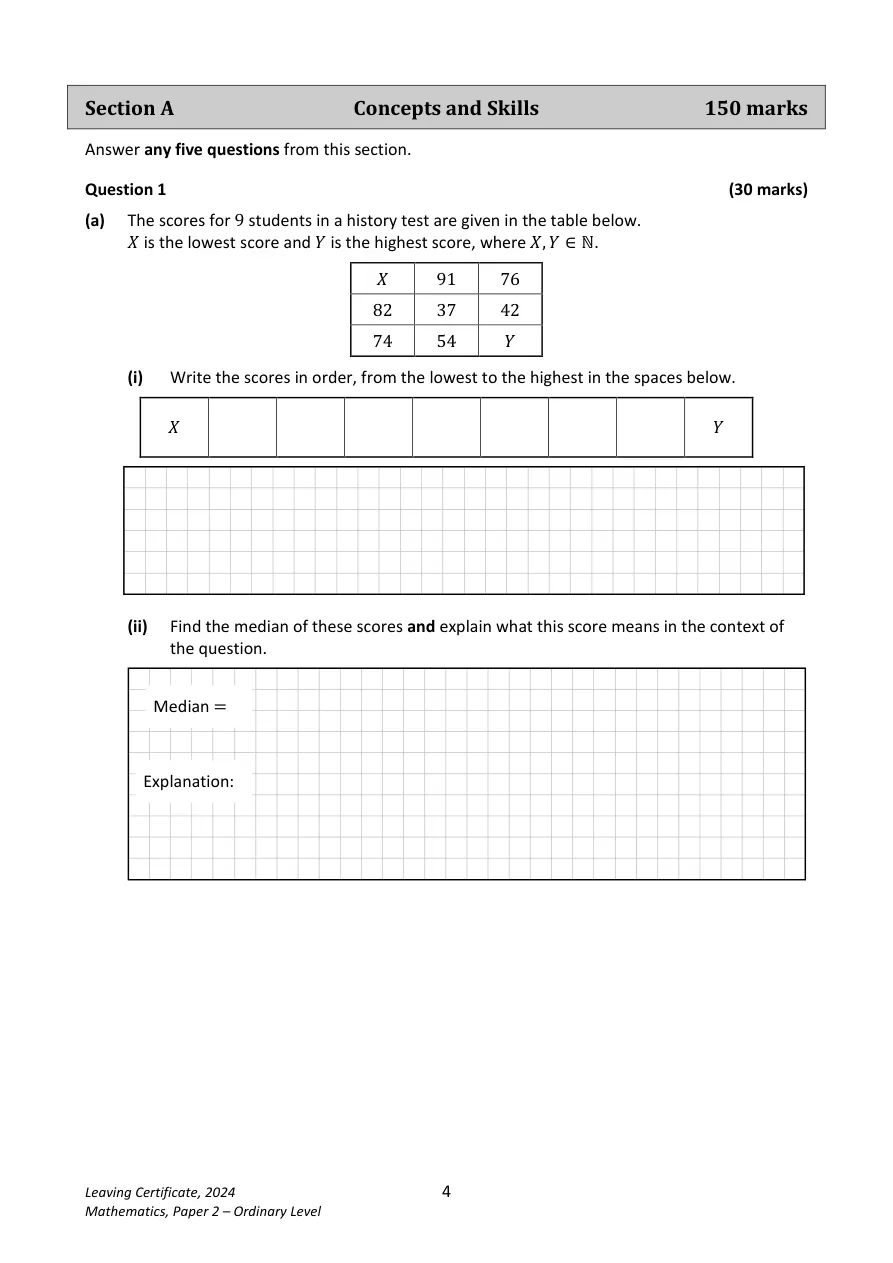
a) Ordered scores

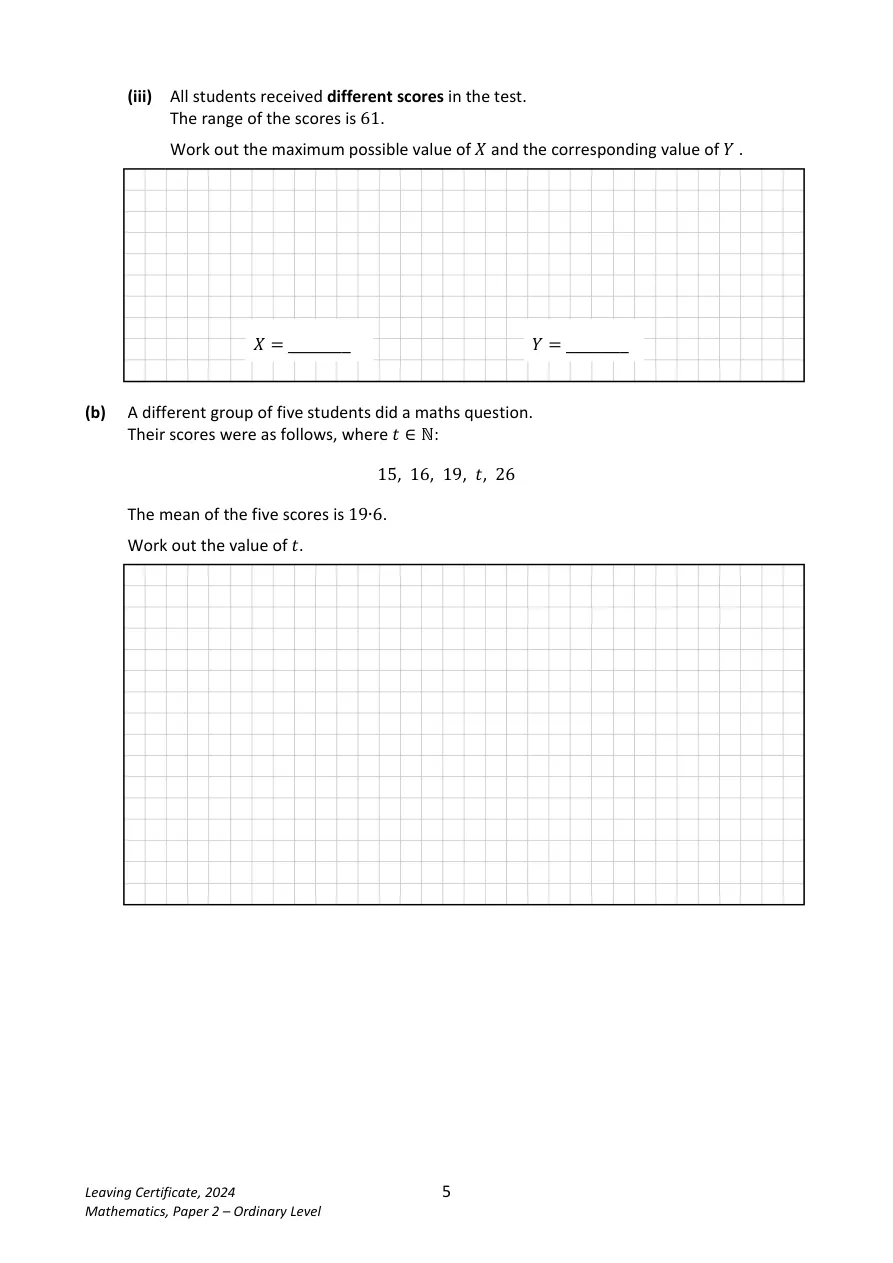
  1. X, 37, 42, 54, 74, 76, 82, 91, Y.
  2. \mathrm{median}=74

    The fifth of nine ordered scores is the middle score.

  3. Four students scored below 74 and four scored above it.
  4. X_{\max}=36

    All scores are different whole numbers and X is below 37.

  5. Y-X=61
  6. Y=36+61=97

b) Missing score

  1. \dfrac{15+16+19+t+26}{5}=19.6
  2. 76+t=98
  3. t=22

Question 2

a) Outcomes

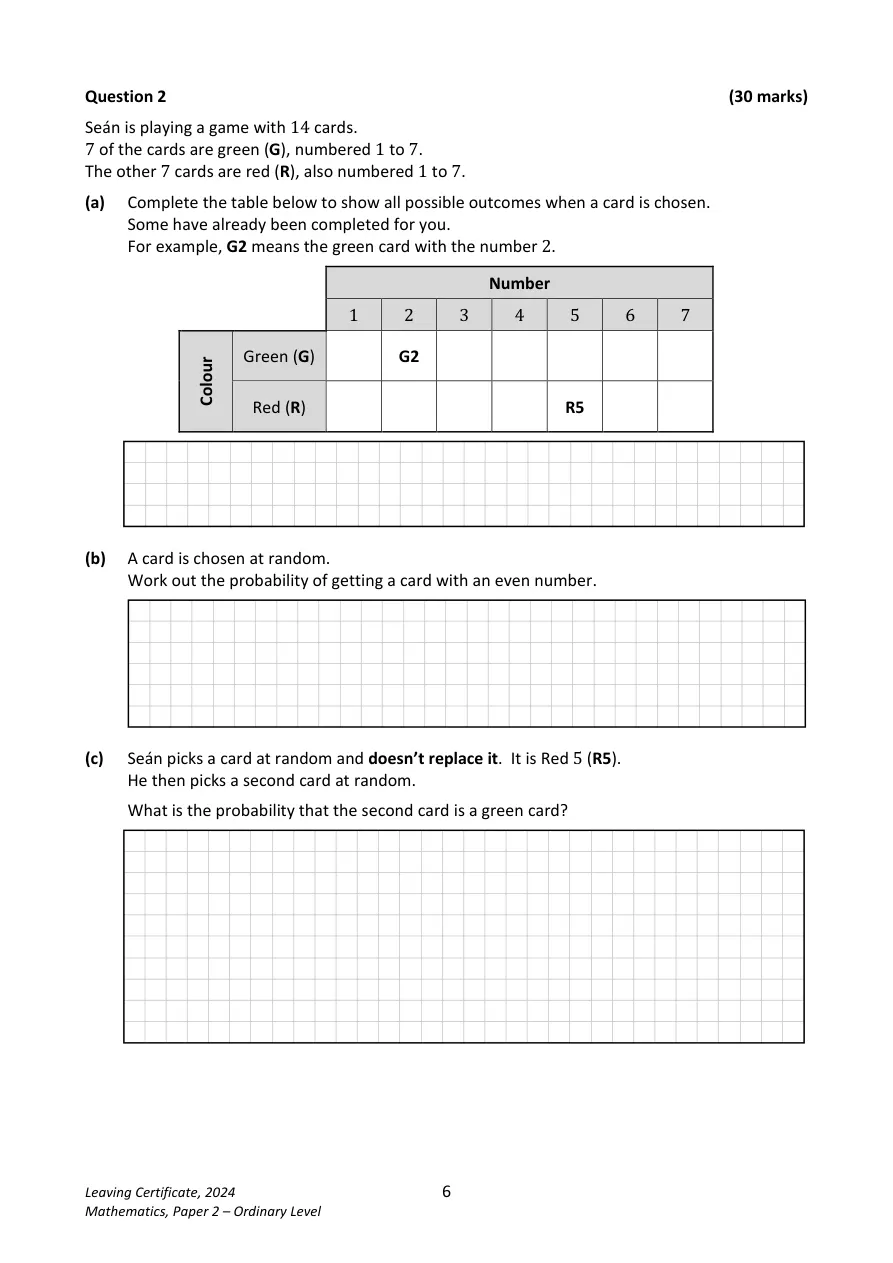
  1. Green: G1, G2, G3, G4, G5, G6, G7. Red: R1, R2, R3, R4, R5, R6, R7.

b) Even number

  1. P=\dfrac{6}{14}=\dfrac{3}{7}

    The even numbers 2, 4 and 6 occur in both colours.

c) Green after R5 removed

  1. P=\dfrac{7}{13}

d) Different colour and number

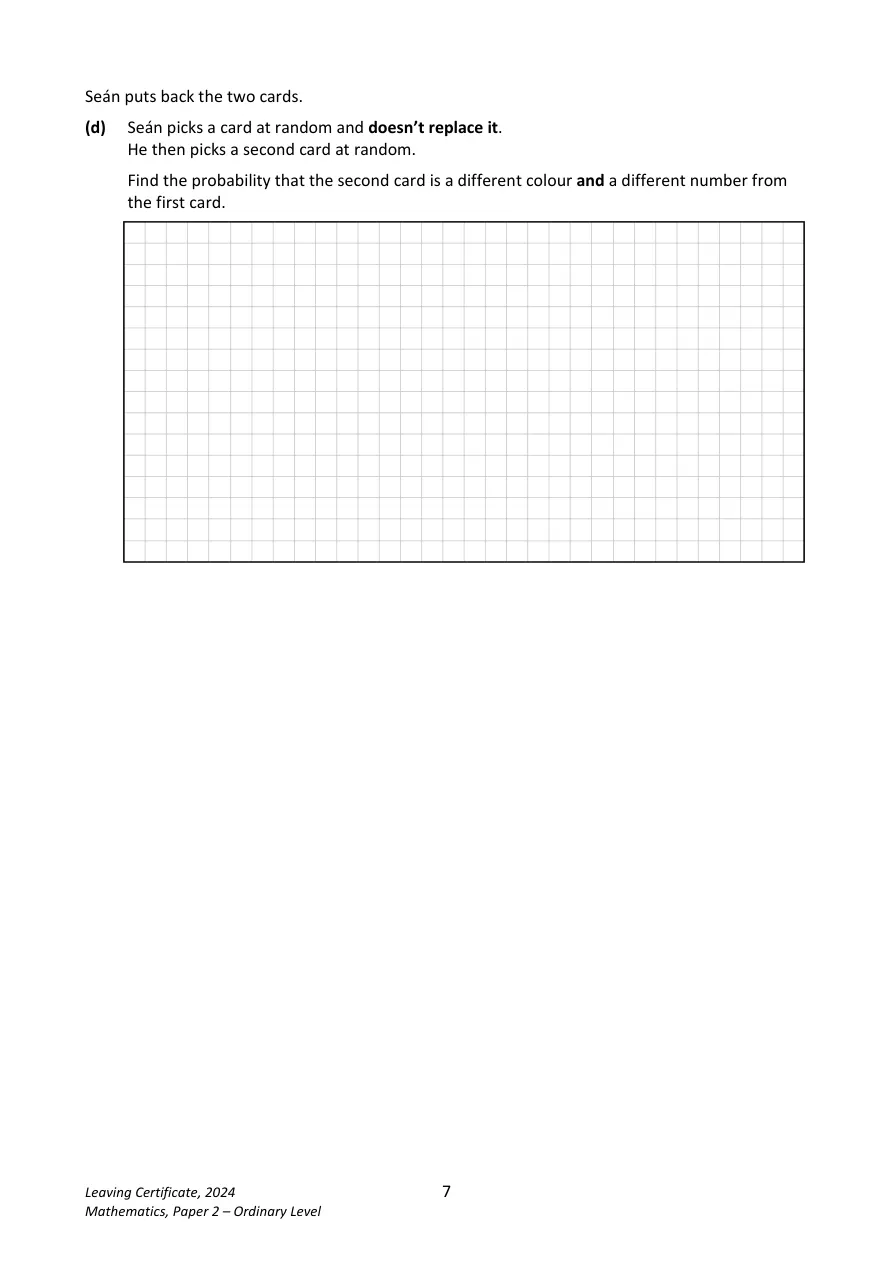
  1. P=\dfrac{6}{13}

    Seven cards of the other colour remain, but one has the same number.

Question 3

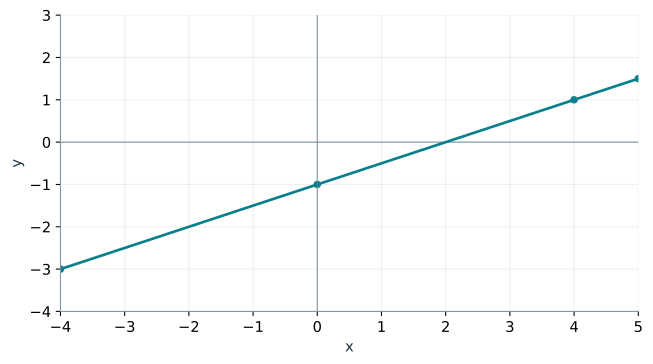
a) Verify and draw

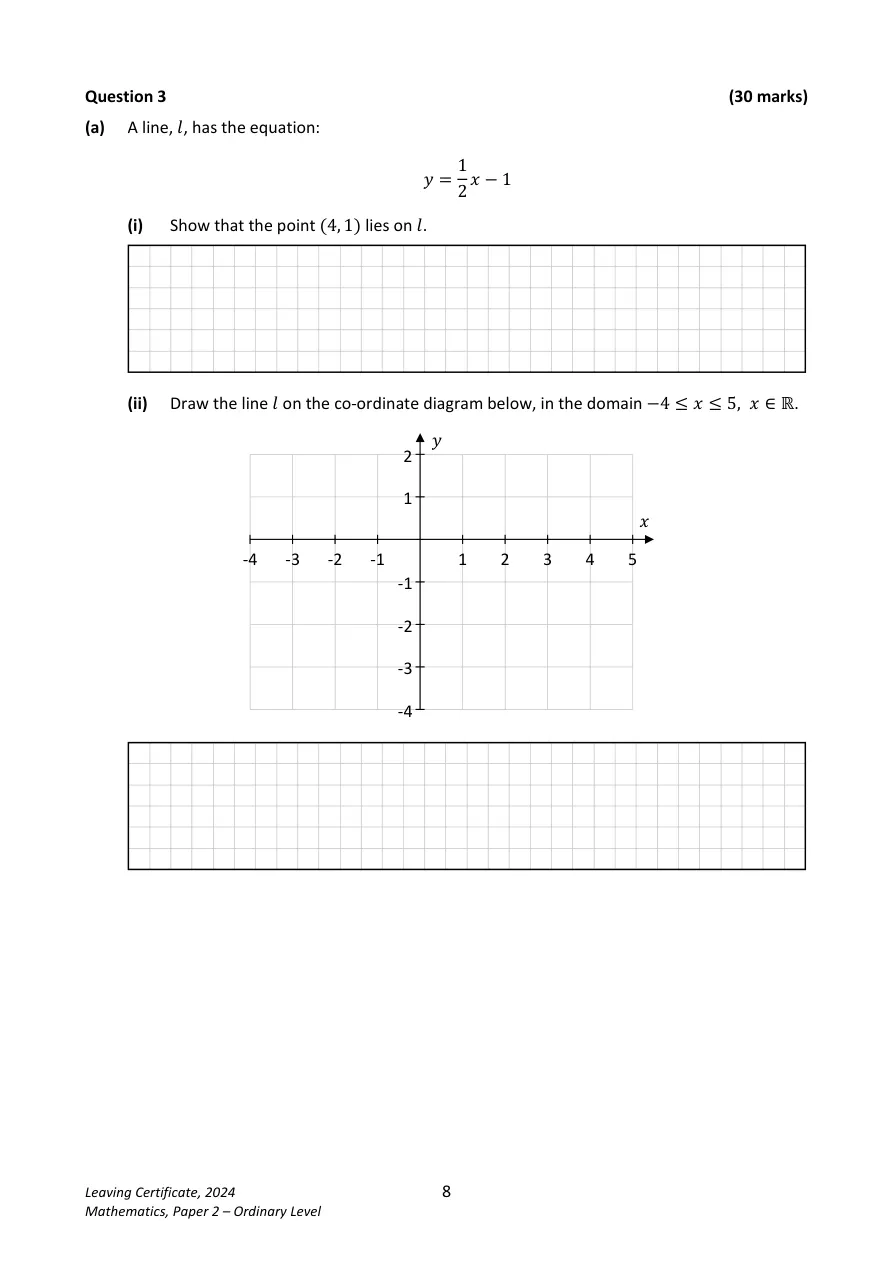
  1. \dfrac{1}{2}(4)-1=1

    The point (4, 1) satisfies the equation.

  2. Plot (−4, −3), (0, −1), (4, 1) and (5, 1.5). Join with a straight line from x = −4 to x = 5.
  3. 2024-2-3-line

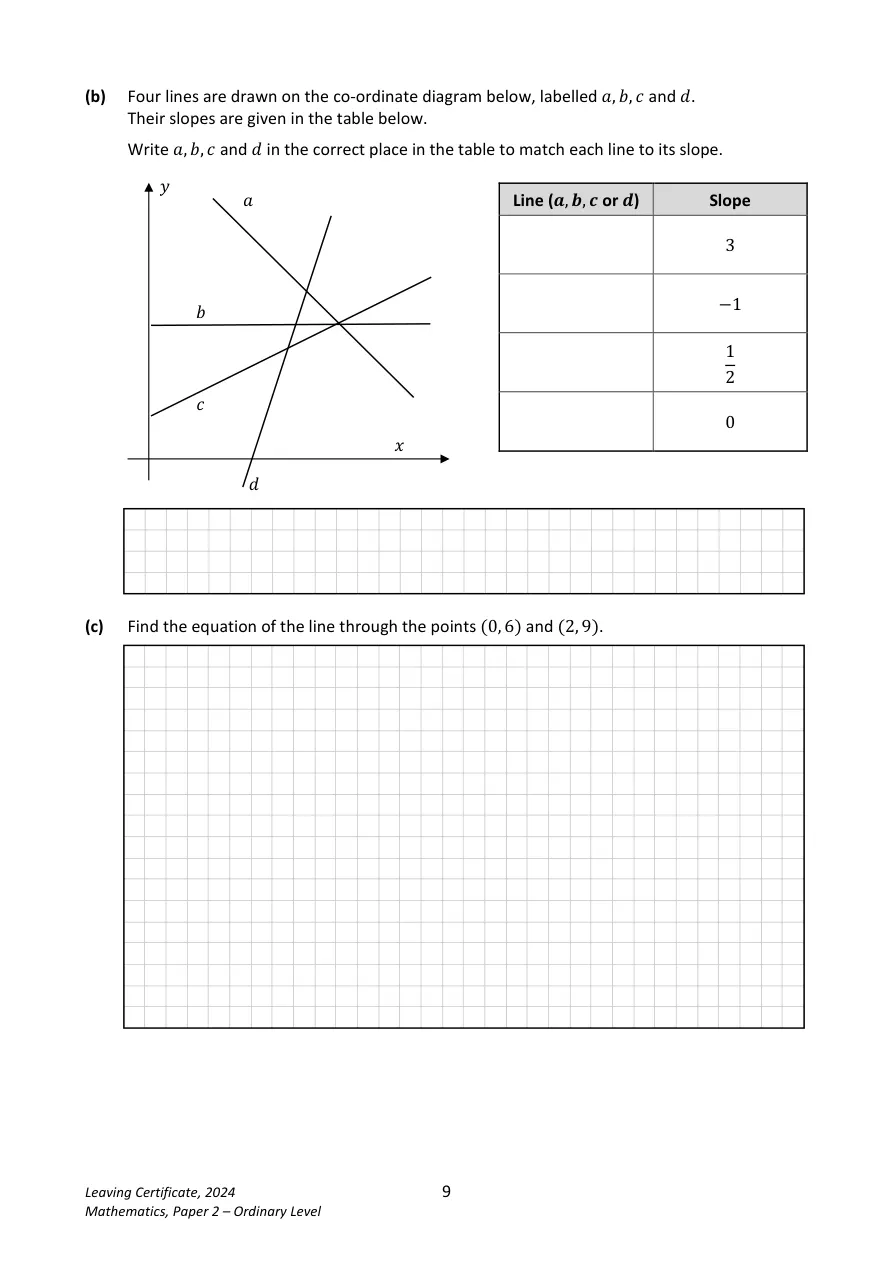
b) Match slopes

  1. Slope 3: d. Slope −1: a. Slope 1/2: c. Slope 0: b.

c) Equation through two points

  1. m=\dfrac{9-6}{2-0}

    Subtract the y-coordinates for the top and the x-coordinates for the bottom. Use the same point first in both subtractions.

  2. m=\dfrac{3}{2}
  3. y-6=\dfrac{3}{2}(x-0)
  4. y=\dfrac{3}{2}x+6

Question 4

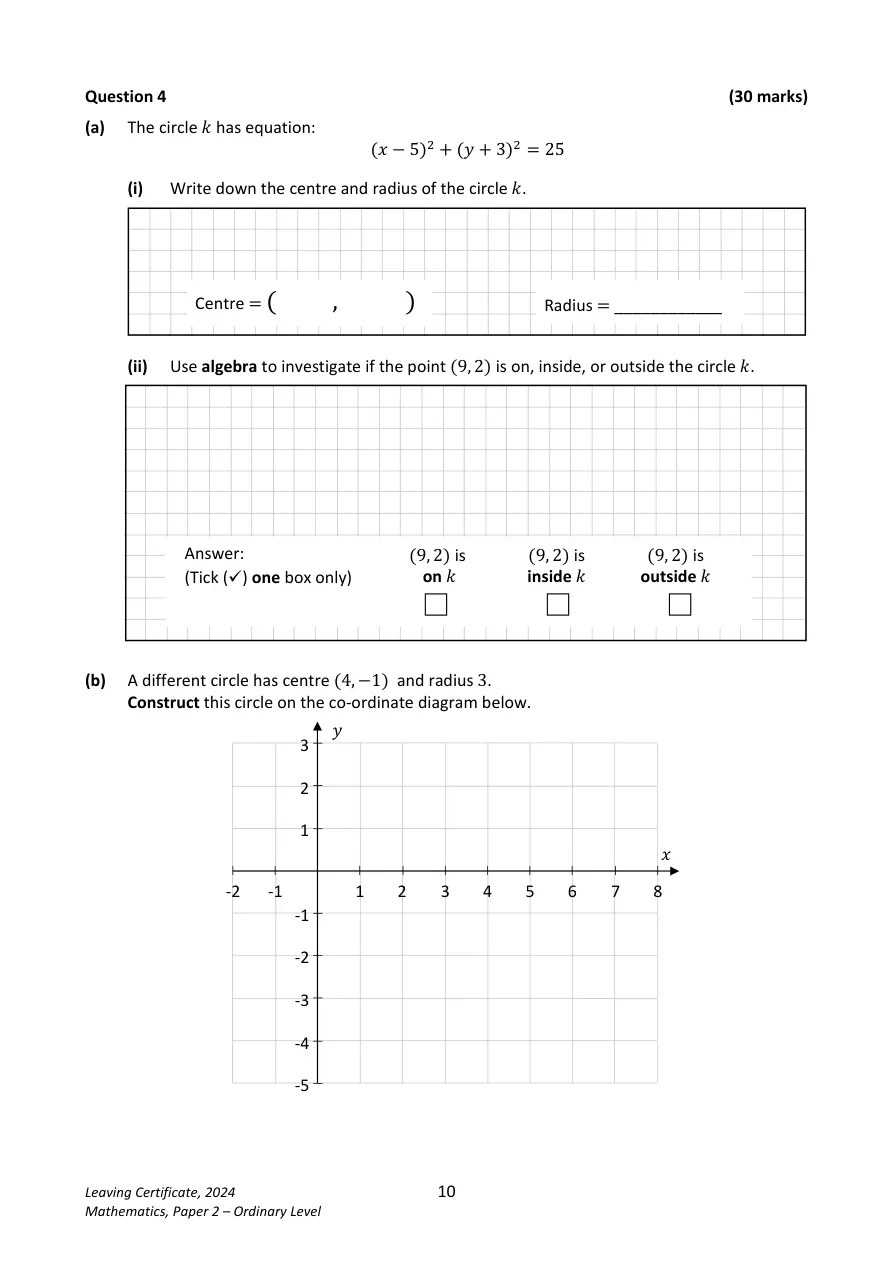
a) Circle k

  1. C=(5,-3),\quad r=5
  2. (9-5)^2+(2+3)^2=41
  3. 41>25

    The point is outside because squared distance exceeds squared radius.

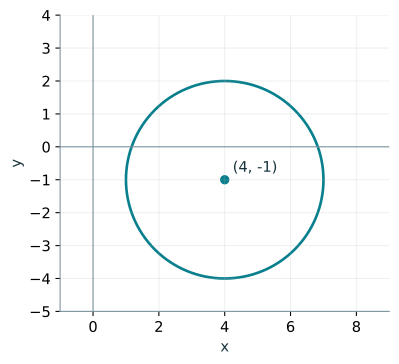
b) Construct the circle

  1. (x-4)^2+(y+1)^2=9
  2. Mark the centre (4, −1), set the compass to 3 coordinate units, and draw the circle. It passes through (1, −1), (7, −1), (4, 2) and (4, −4).
  3. 2024-2-4-circle

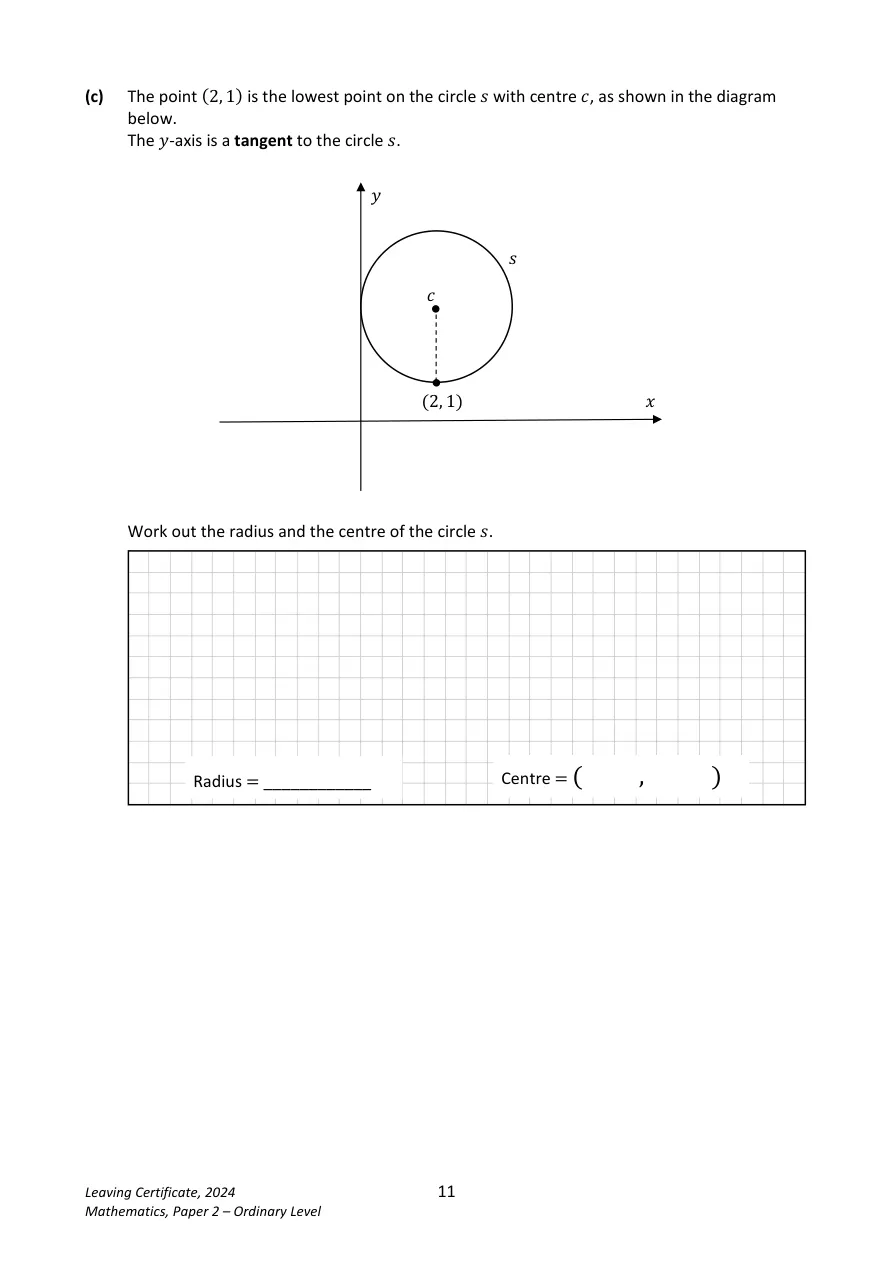
c) Circle s

  1. r=2

    The lowest point has x-coordinate 2, as does the centre. Tangency to the y-axis makes this the radius.

  2. C=(2,1+2)
  3. C=(2,3)

Question 5

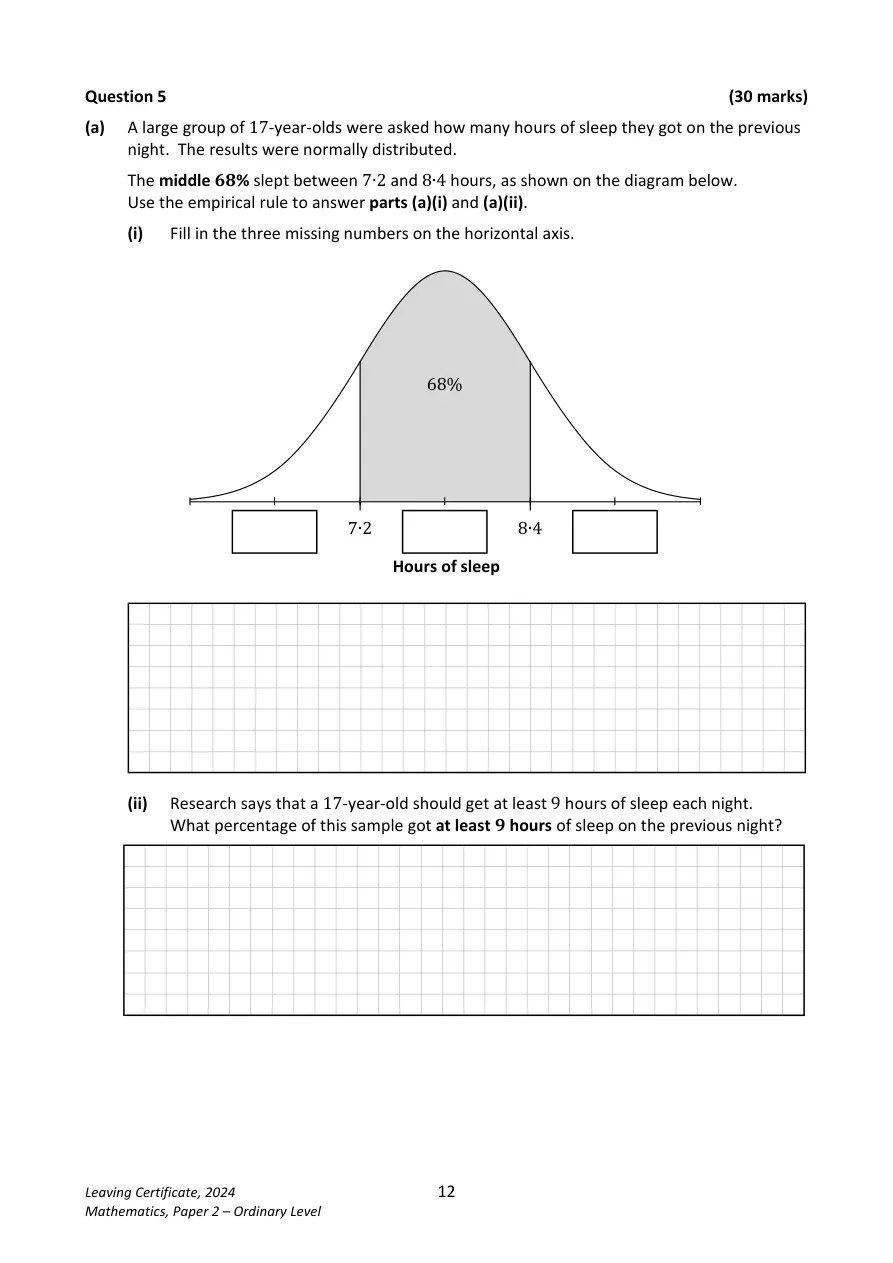
a) Normal distribution

  1. \mu=\dfrac{7.2+8.4}{2}
  2. \mu=7.8
  3. \sigma=8.4-7.8
  4. \sigma=0.6
  5. The missing labels are 6.6, 7.8 and 9.0 hours, from left to right.
  6. 9=7.8+2(0.6)
  7. P(X\geq9)\approx\dfrac{100-95}{2}\%
  8. P(X\geq9)\approx2.5\%

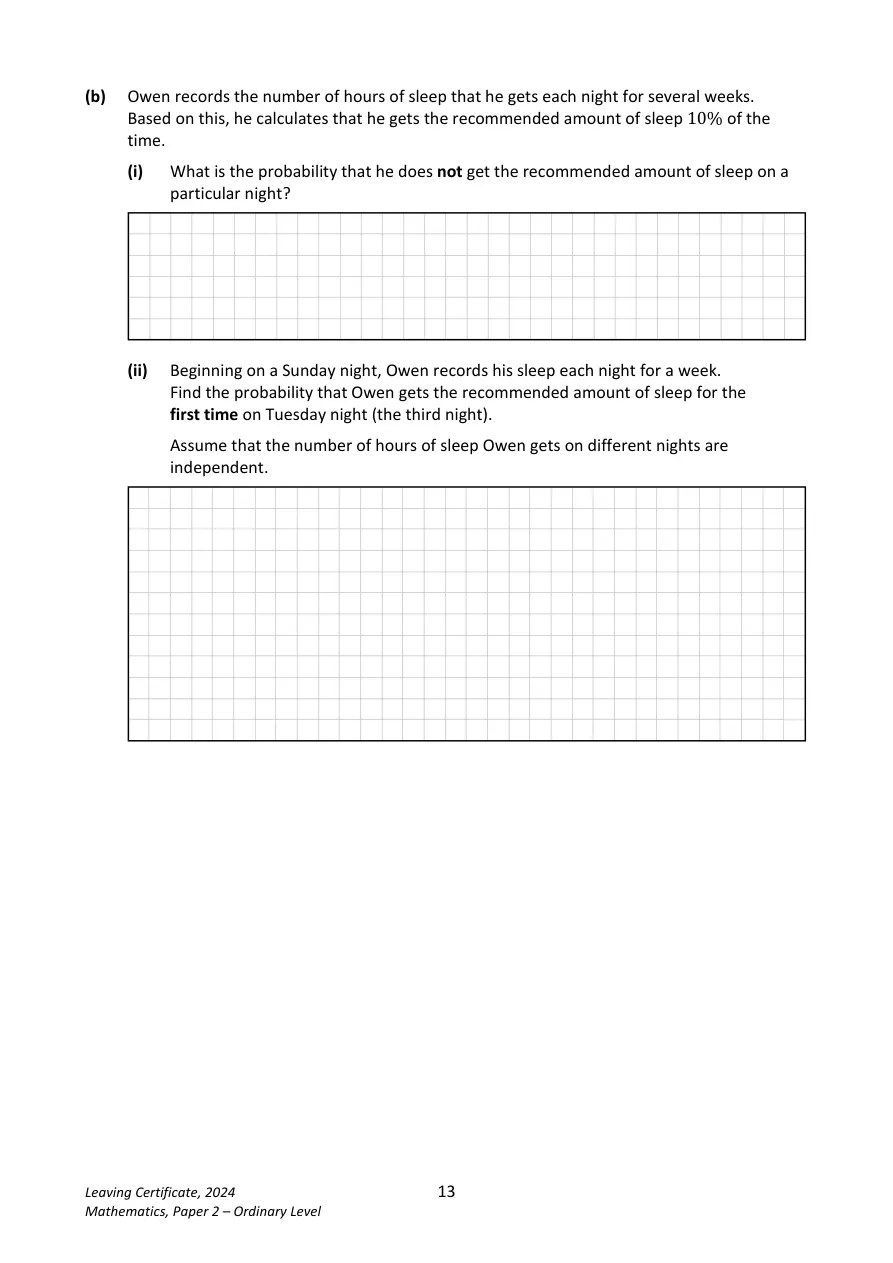
b) First recommended sleep on Tuesday

  1. P(\mathrm{not\ recommended})=1-0.1=0.9
  2. P=0.9(0.9)(0.1)
  3. P=0.081

    Independent nights: fail Sunday, fail Monday, succeed Tuesday.

Question 6

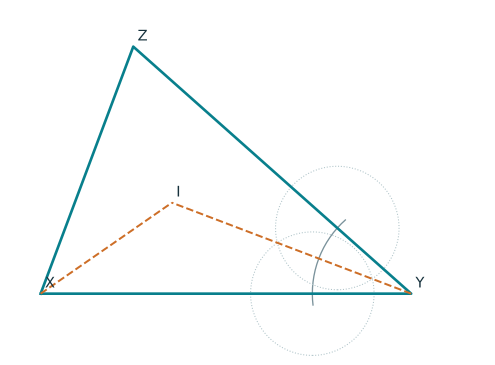
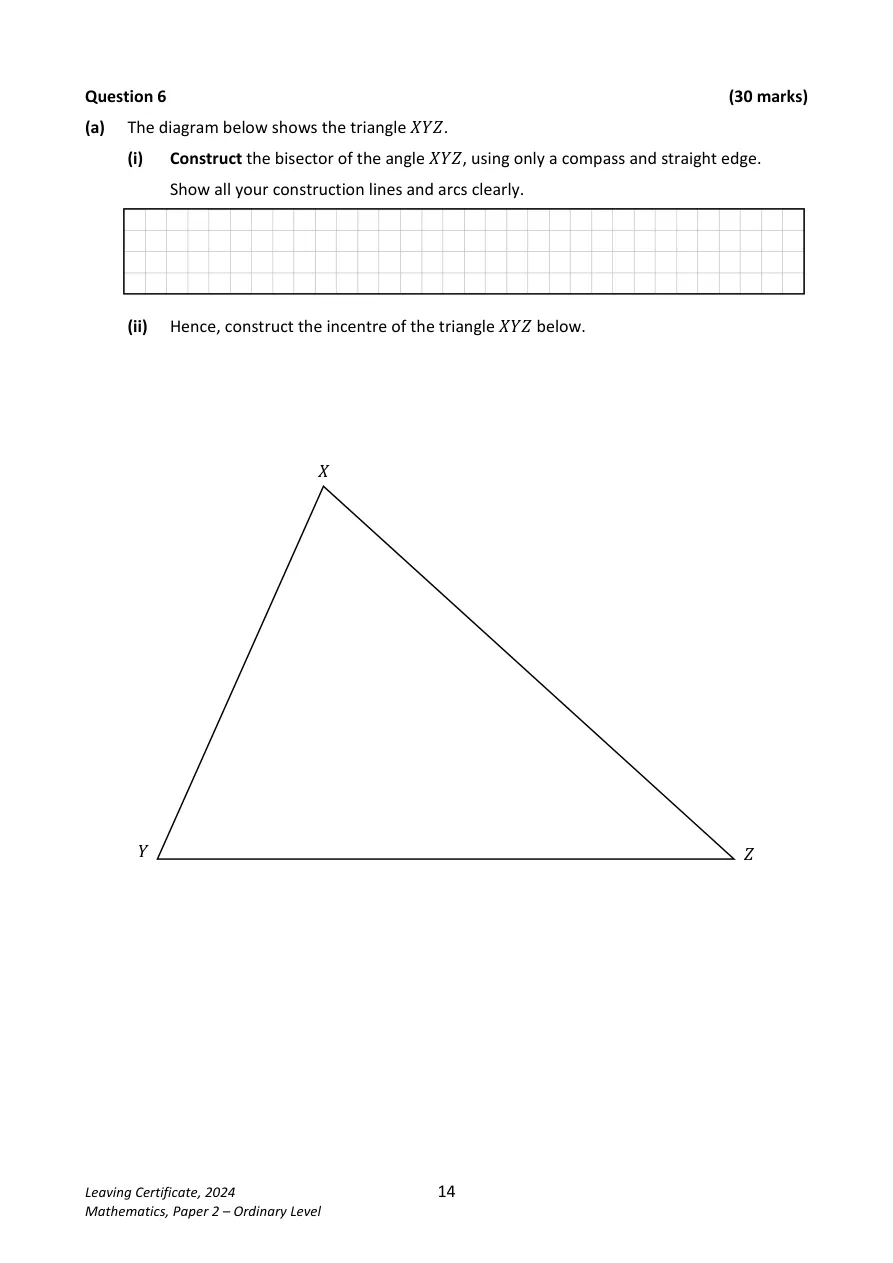
a) Angle bisector and incentre

  1. With centre Y draw an arc crossing YX and YZ at two points. From those points draw equal-radius arcs meeting inside the angle. Join their intersection to Y to bisect angle XYZ. Construct another internal angle bisector in the same way. Their intersection is the incentre. Keep all compass arcs visible.
  2. 2024-2-6-incentre

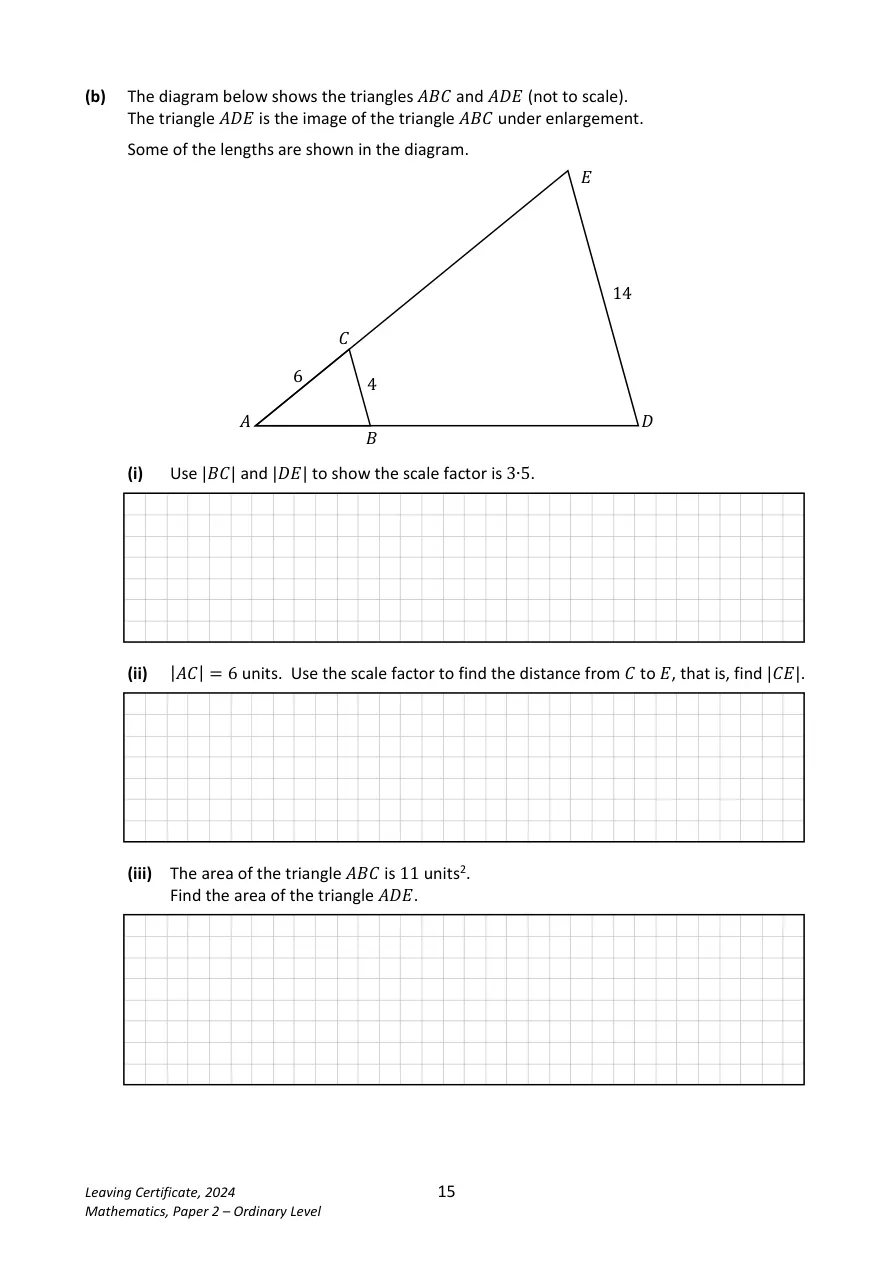
b) Enlargement

  1. k=\dfrac{14}{4}=3.5
  2. AE=6(3.5)=21
  3. CE=21-6=15\ \mathrm{units}
  4. A_{\mathrm{large}}=11(3.5)^2
  5. A_{\mathrm{large}}=134.75\ \mathrm{units}^2

Question 7

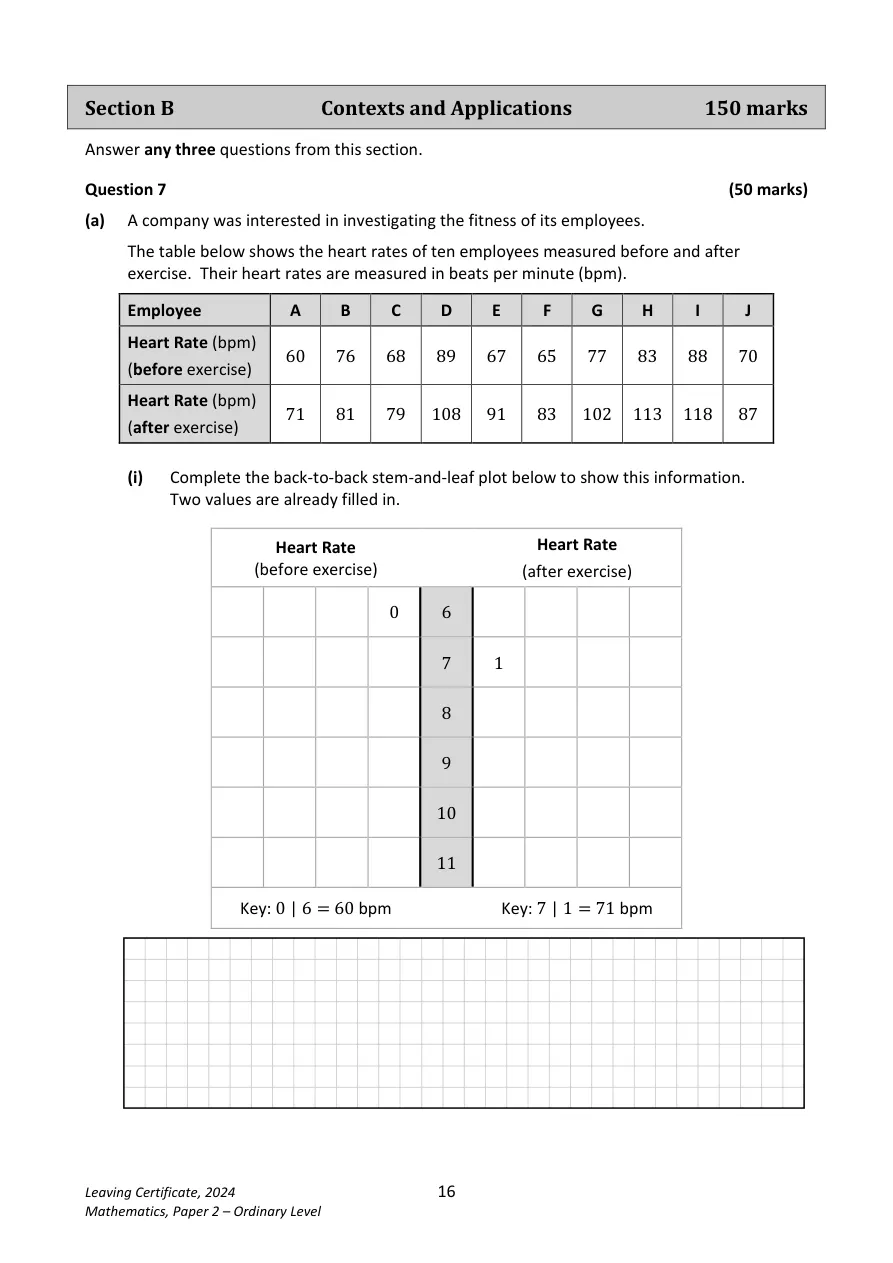
a) Heart rates

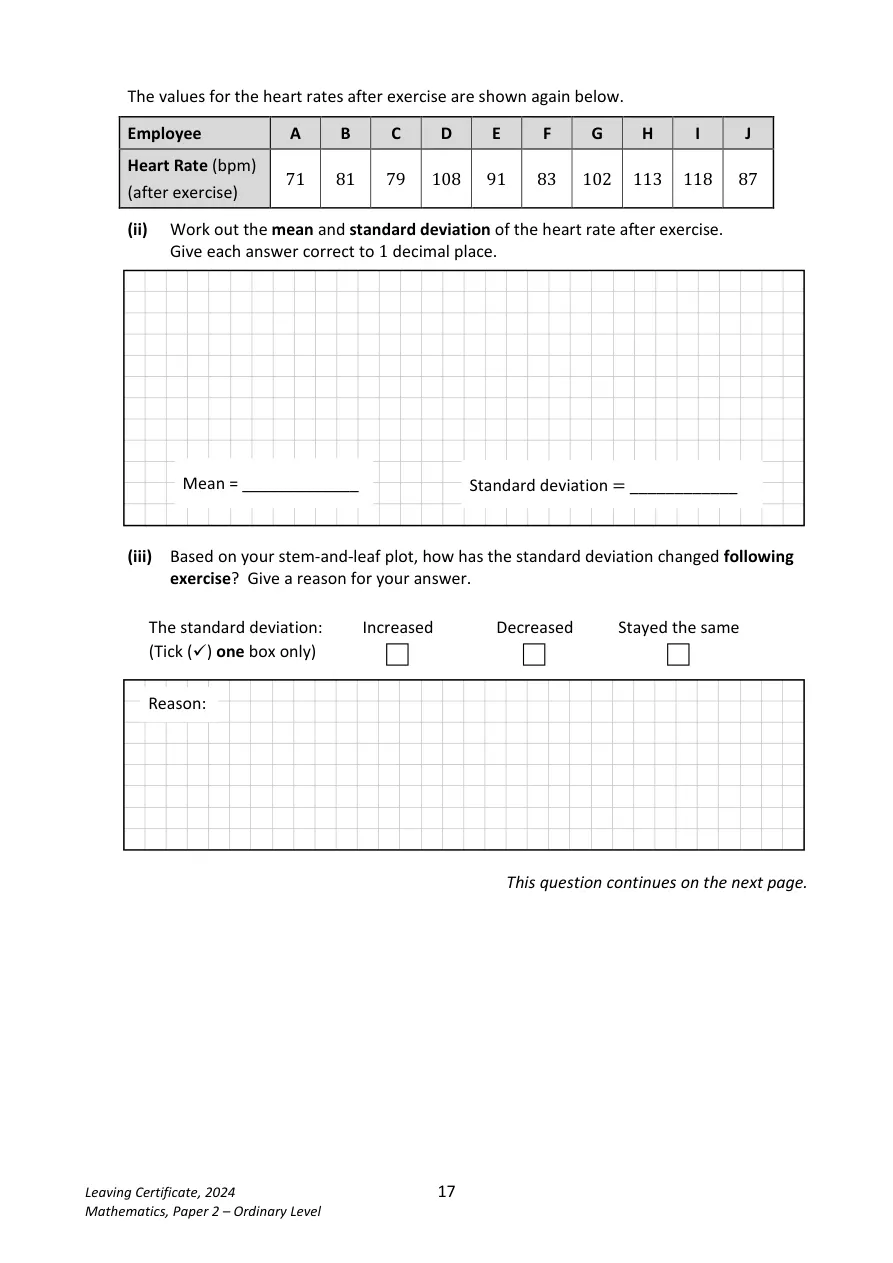
  1. Back-to-back plot, stems 6, 7, 8, 9, 10, 11. Before-exercise leaves in descending order: 8 7 5 0 | 6; 7 6 0 | 7; 9 8 3 | 8; no leaves for 9–11. After-exercise leaves ascending: 7 | 1 9; 8 | 1 3 7; 9 | 1; 10 | 2 8; 11 | 3 8. Key: 6 | 0 = 60 bpm on the left; 7 | 1 = 71 bpm on the right.
  2. \mu=\dfrac{933}{10}=93.3\ \mathrm{bpm}
  3. \sigma=\sqrt{\dfrac{\sum(x-93.3)^2}{10}}
  4. \sigma\approx15.1\ \mathrm{bpm}
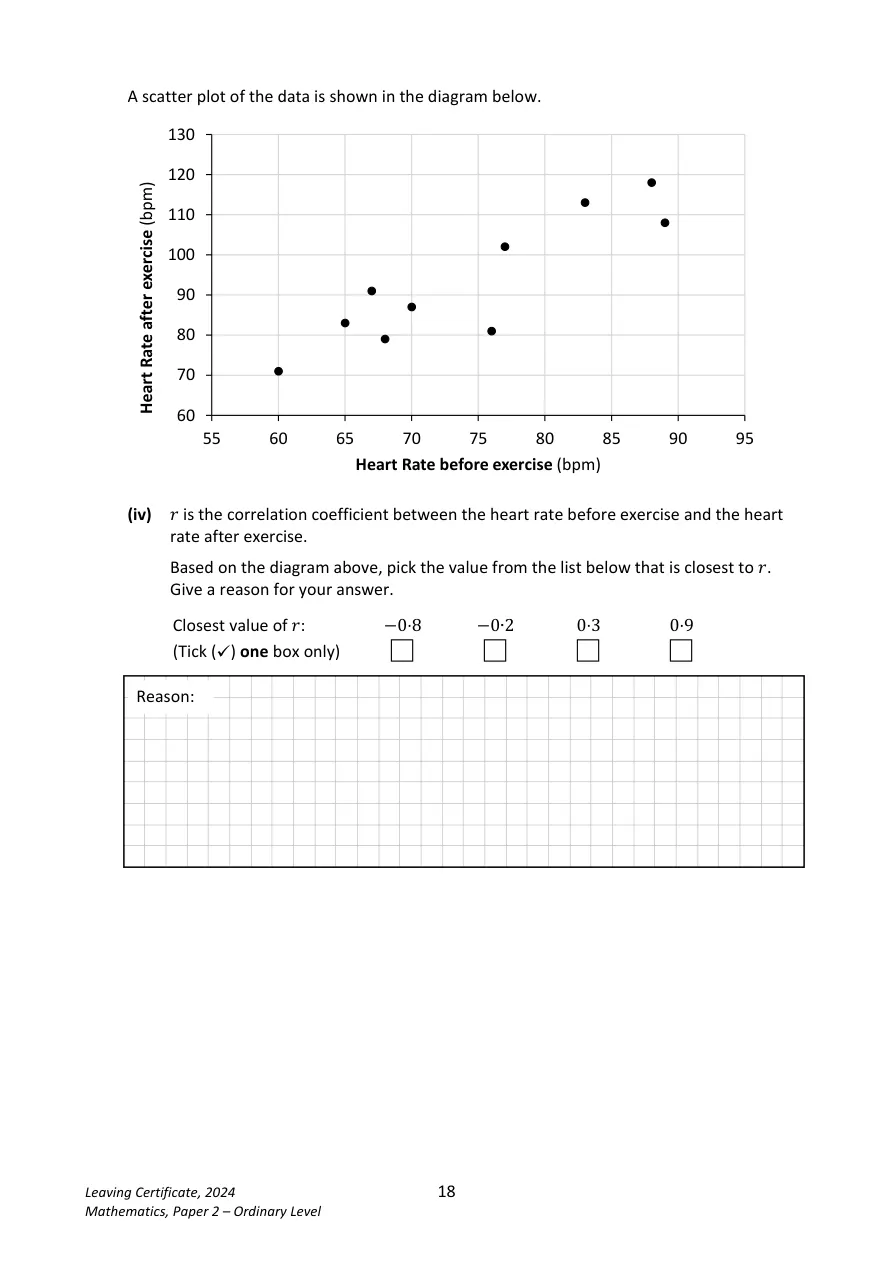
  5. The standard deviation increased: heart rates are more spread out after exercise. Choose r = 0.9; the scatter plot has strong positive correlation.

b) Inference

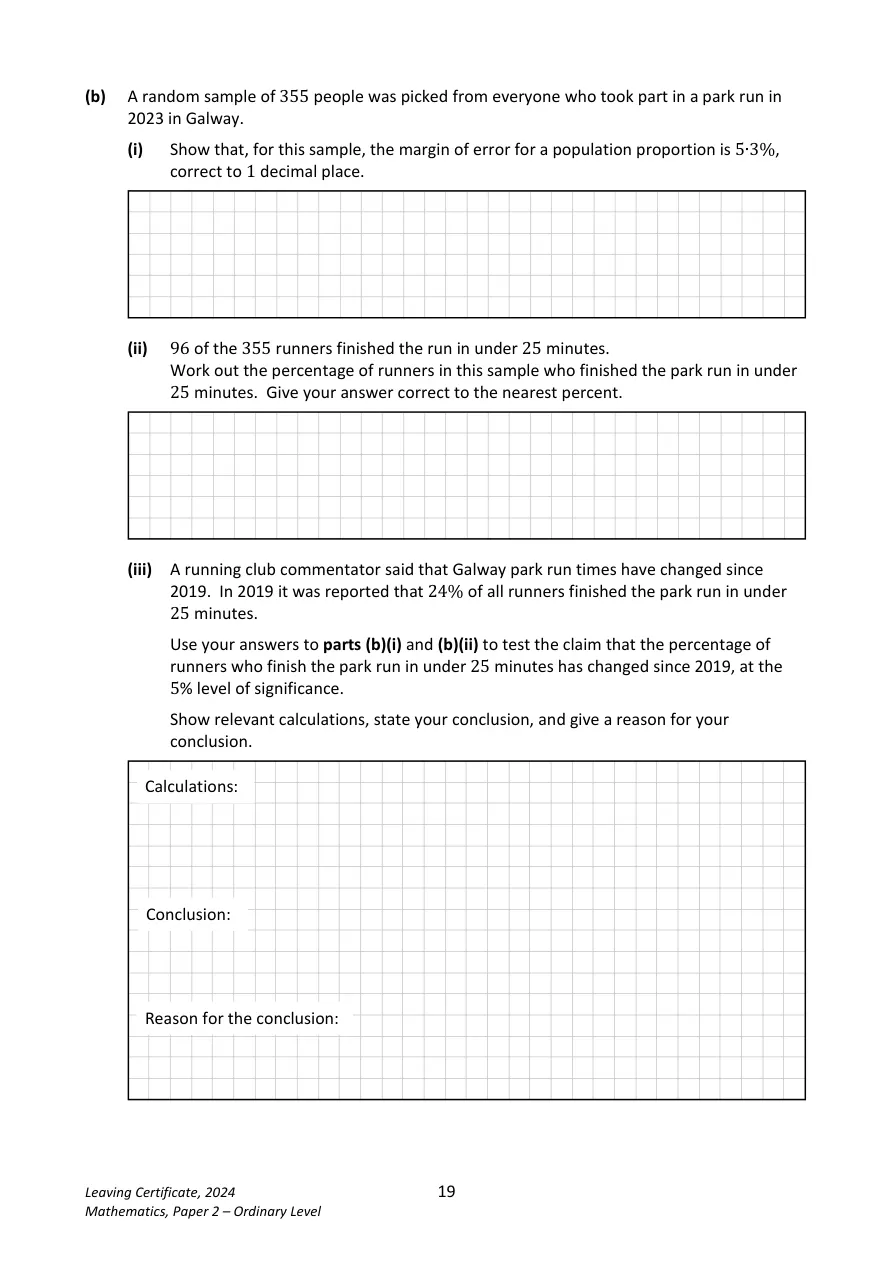
  1. E=\dfrac{1}{\sqrt{355}}\times100\%
  2. E\approx5.3\%
  3. \hat p=\dfrac{96}{355}\times100\%
  4. \hat p\approx27\%
  5. \mathrm{CI}=[27-5.3,27+5.3]\%
  6. \mathrm{CI}=[21.7,32.3]\%
  7. 24% lies in the interval, so there is insufficient evidence at the 5% significance level that the population proportion has changed.

Question 8

a) Sign cables

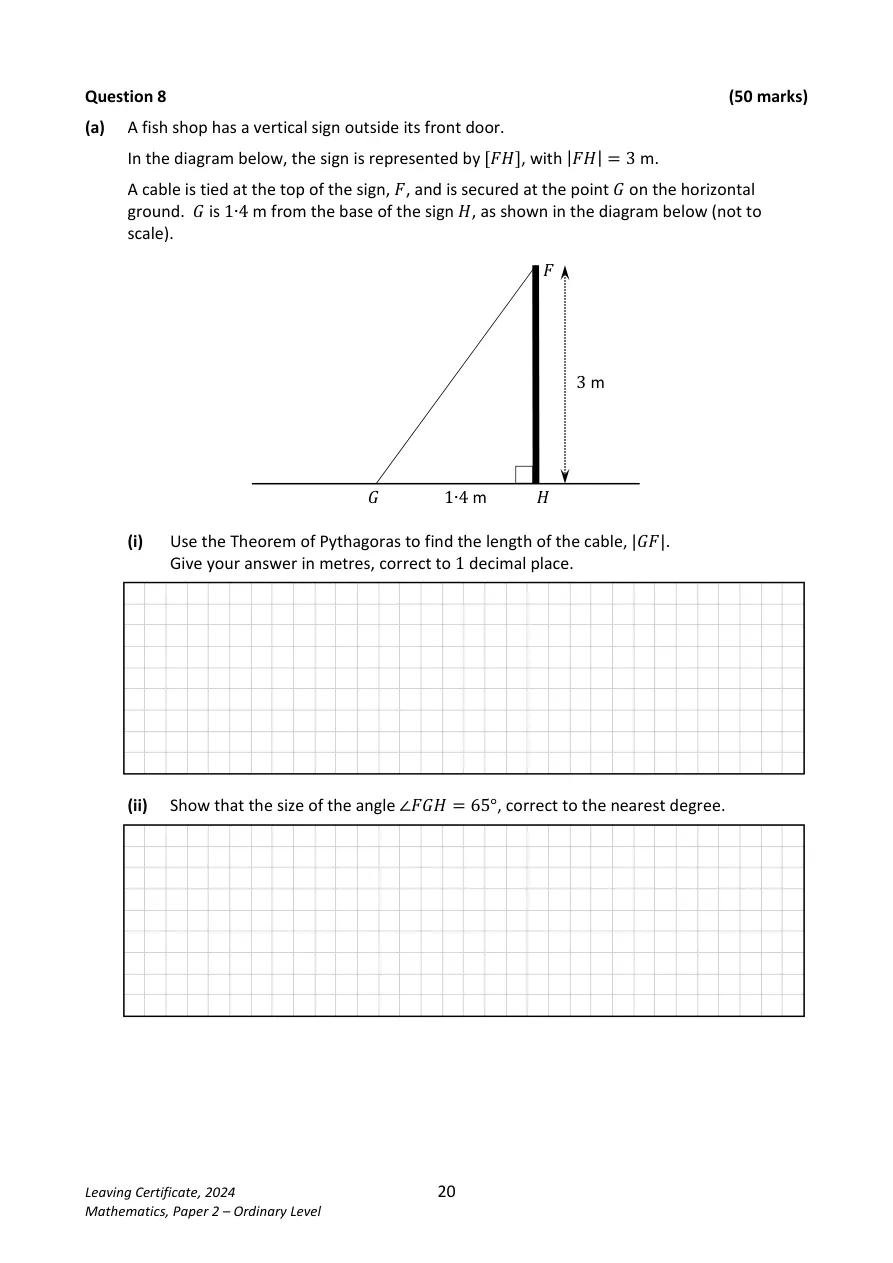
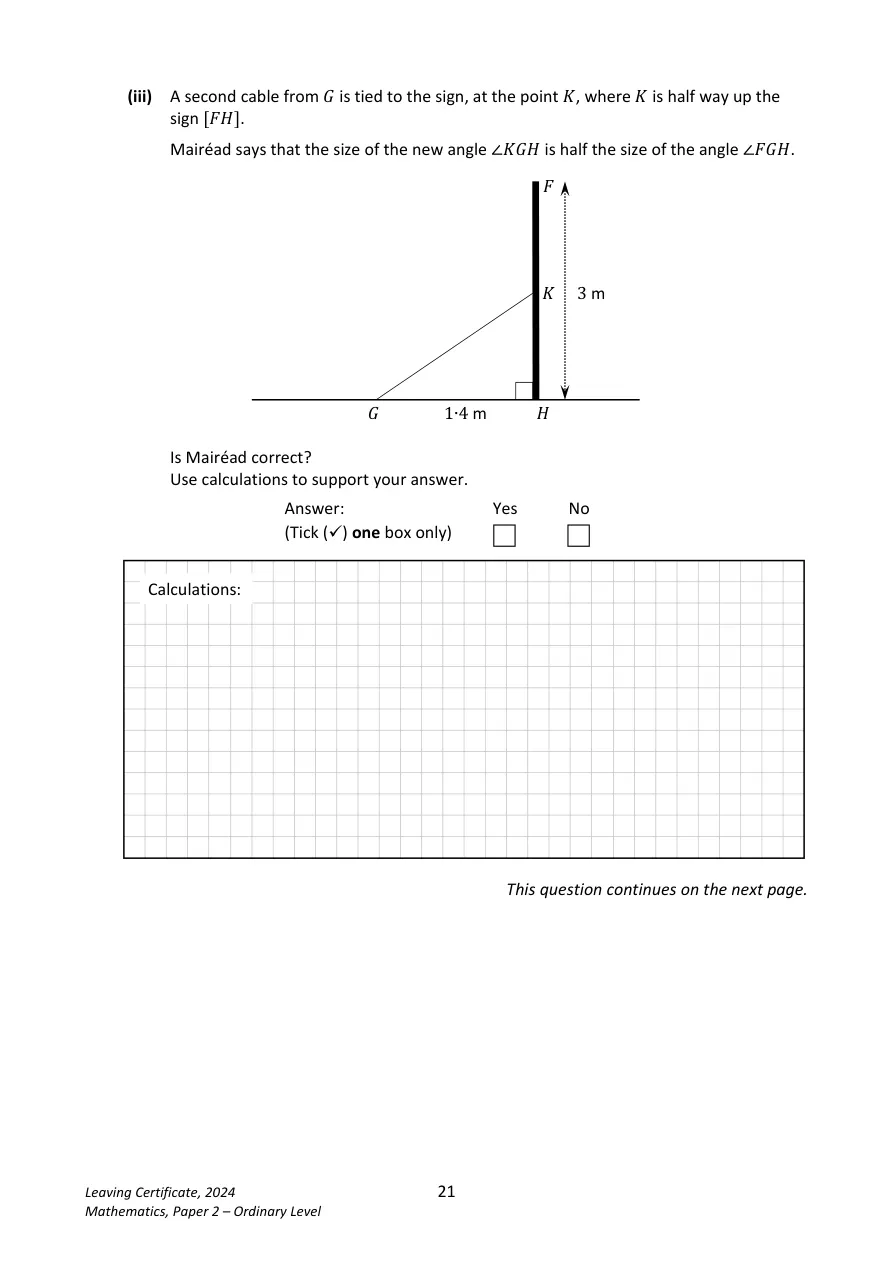
  1. l=\sqrt{1.4^2+3^2}
  2. l\approx3.3\ \mathrm{m}
  3. \theta=\tan^{-1}\left(\dfrac{3}{1.4}\right)
  4. \theta\approx65^\circ
  5. \phi=\tan^{-1}\left(\dfrac{1.5}{1.4}\right)
  6. \phi\approx47^\circ
  7. Mairéad is incorrect: 47° is not half of 65°. Halving the height does not halve the angle.

b) Logo

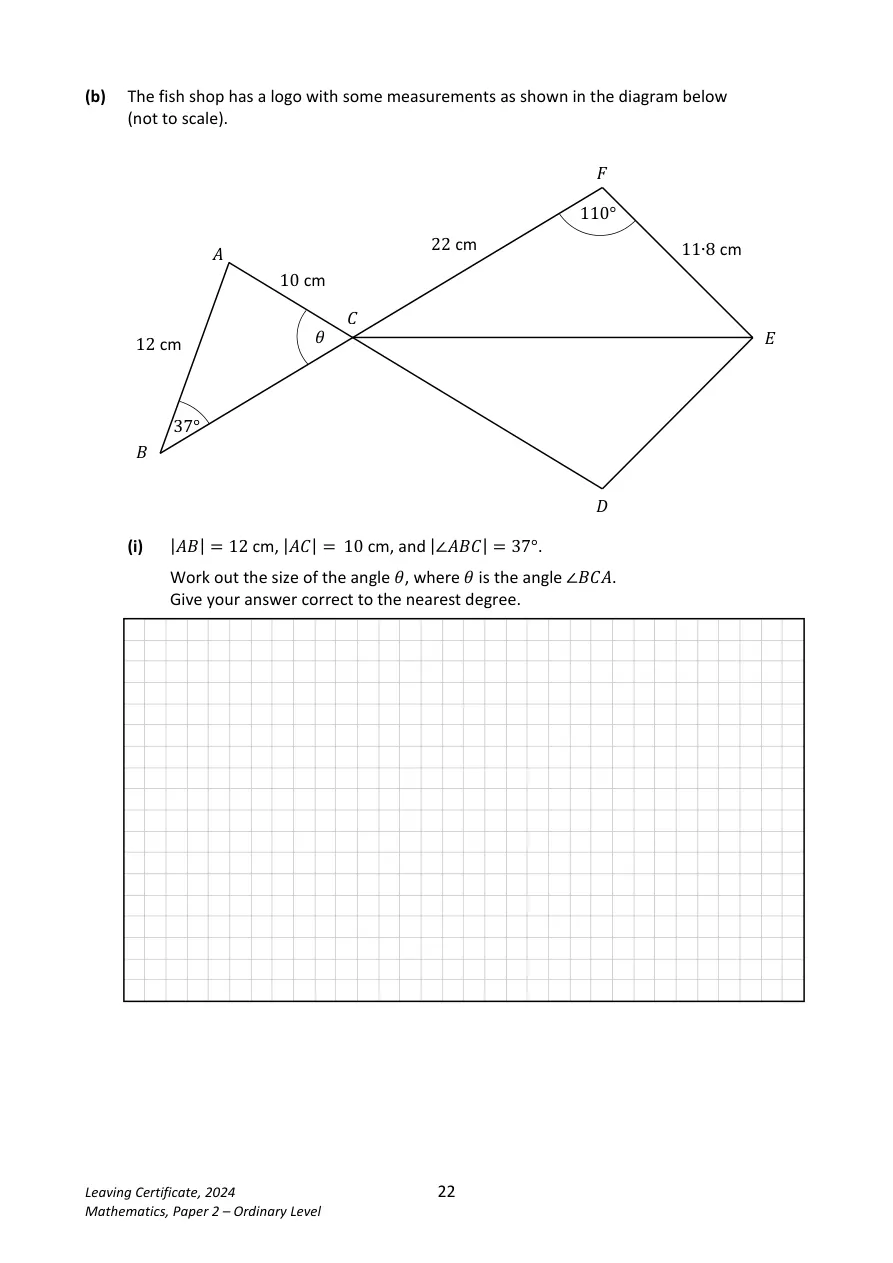
  1. \dfrac{\sin\theta}{12}=\dfrac{\sin37^\circ}{10}
  2. \theta=\sin^{-1}\left(\dfrac{12\sin37^\circ}{10}\right)
  3. \theta\approx46^\circ

    Use the acute angle shown in the diagram.

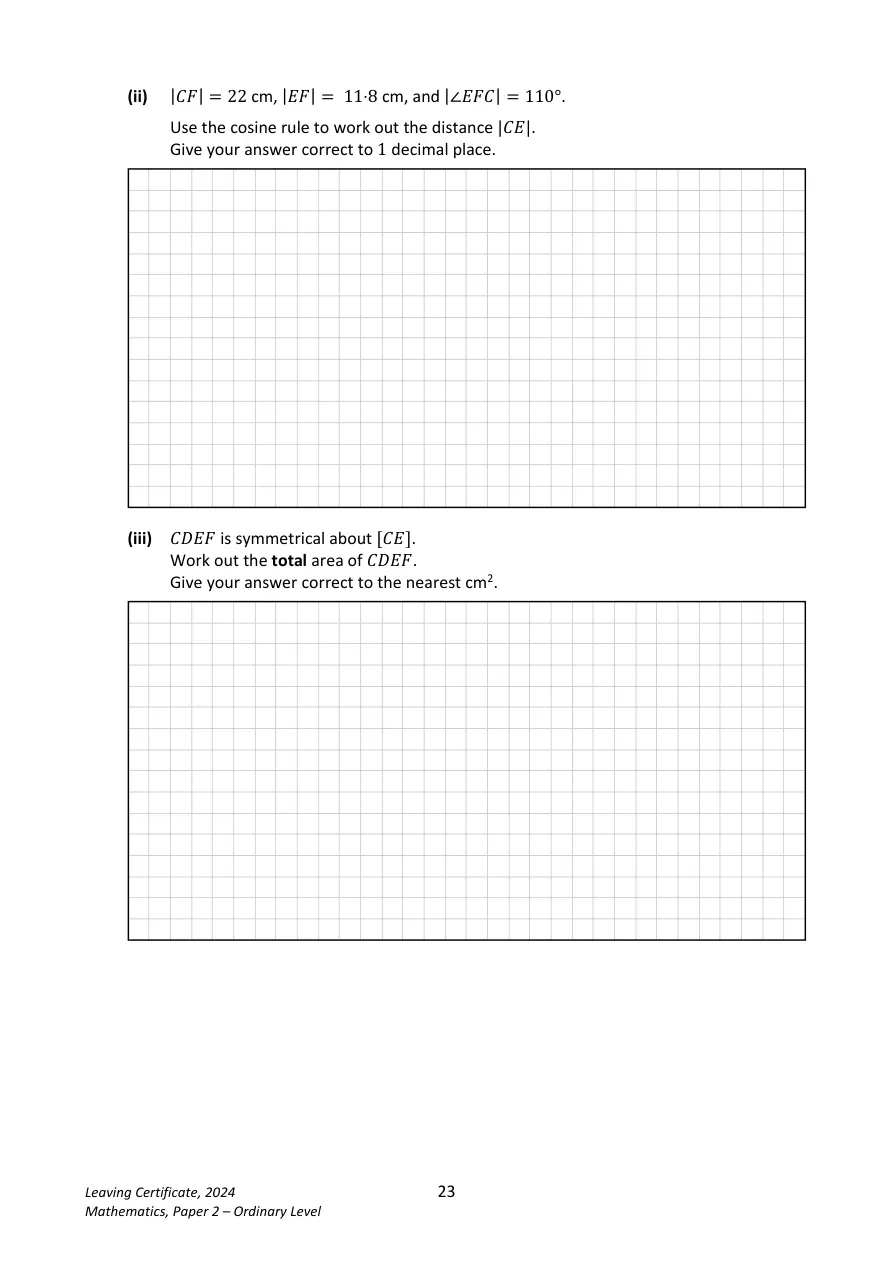
  4. CE=\sqrt{22^2+11.8^2-2(22)(11.8)\cos110^\circ}
  5. CE\approx28.3\ \mathrm{cm}
  6. A=2\left[\dfrac{1}{2}(22)(11.8)\sin110^\circ\right]
  7. A\approx244\ \mathrm{cm}^2

Question 9

a) Choices

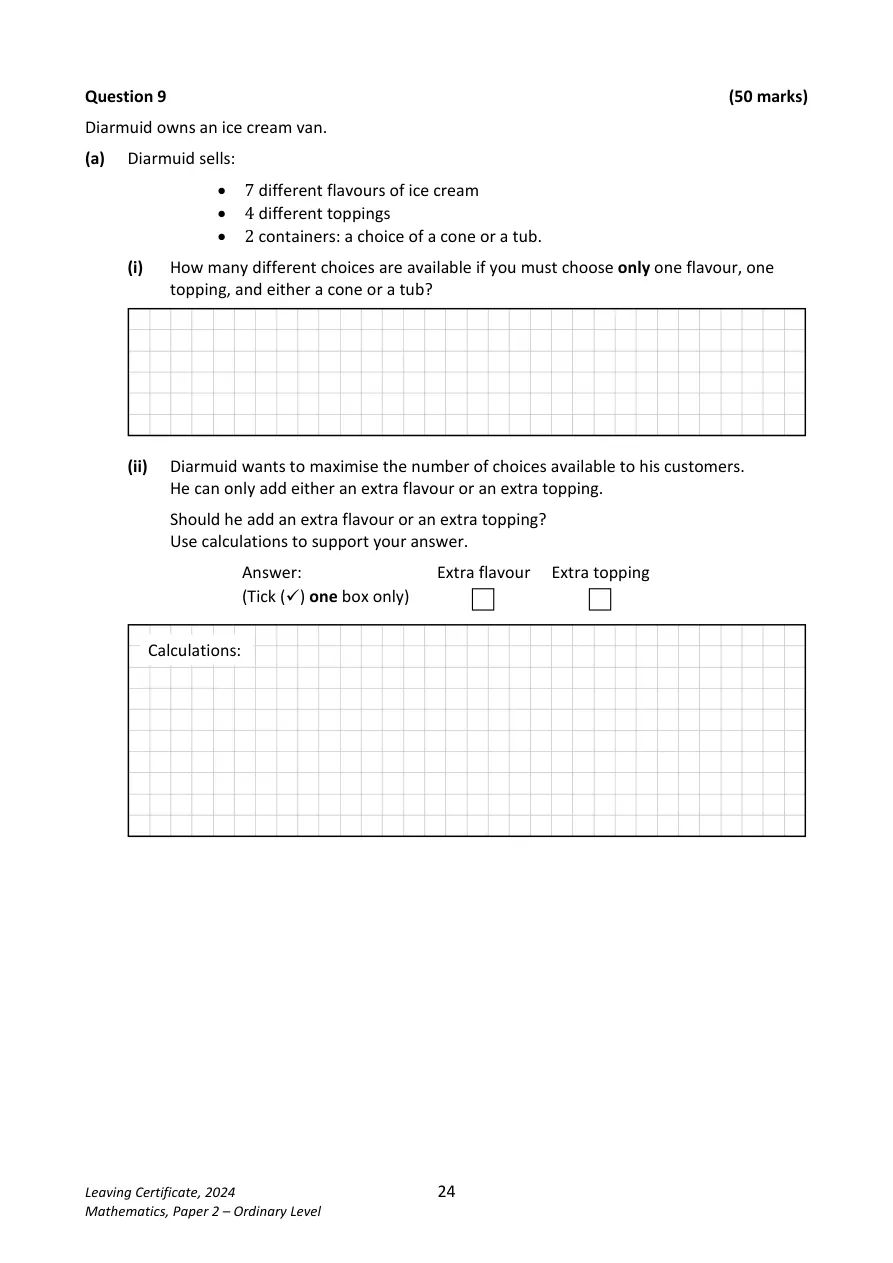
  1. N=7(4)(2)=56
  2. N_{\mathrm{extra\ topping}}=7(5)(2)=70
  3. N_{\mathrm{extra\ flavour}}=8(4)(2)=64
  4. Add an extra topping: it gives more choices.

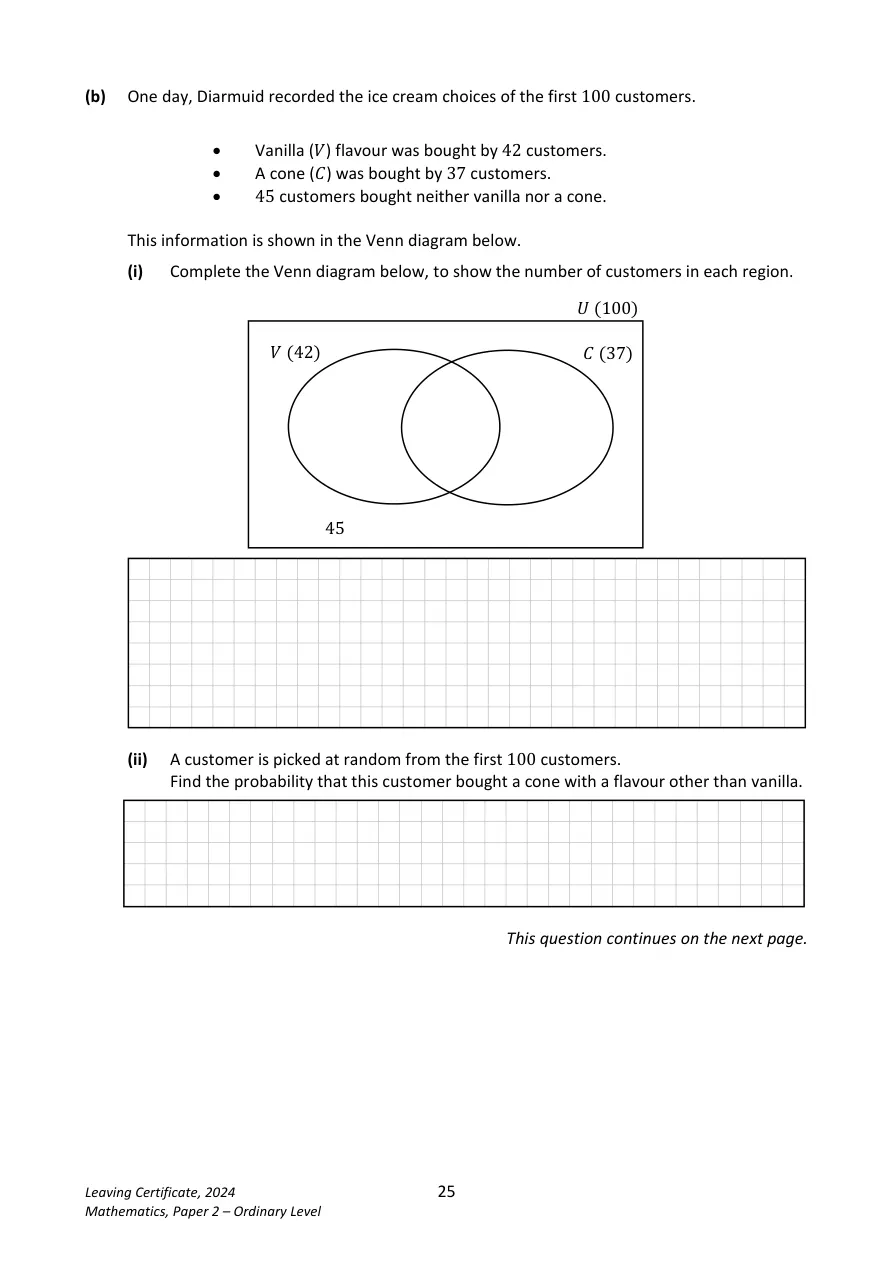
b) Venn diagram

  1. n(V\cup C)=100-45=55
  2. n(V\cap C)=42+37-55=24
  3. n(V\mathrm{\ only})=42-24=18
  4. n(C\mathrm{\ only})=37-24=13
  5. Place 18 in V only, 24 in the overlap, 13 in C only and 45 outside both.
  6. P=\dfrac{13}{100}=0.13

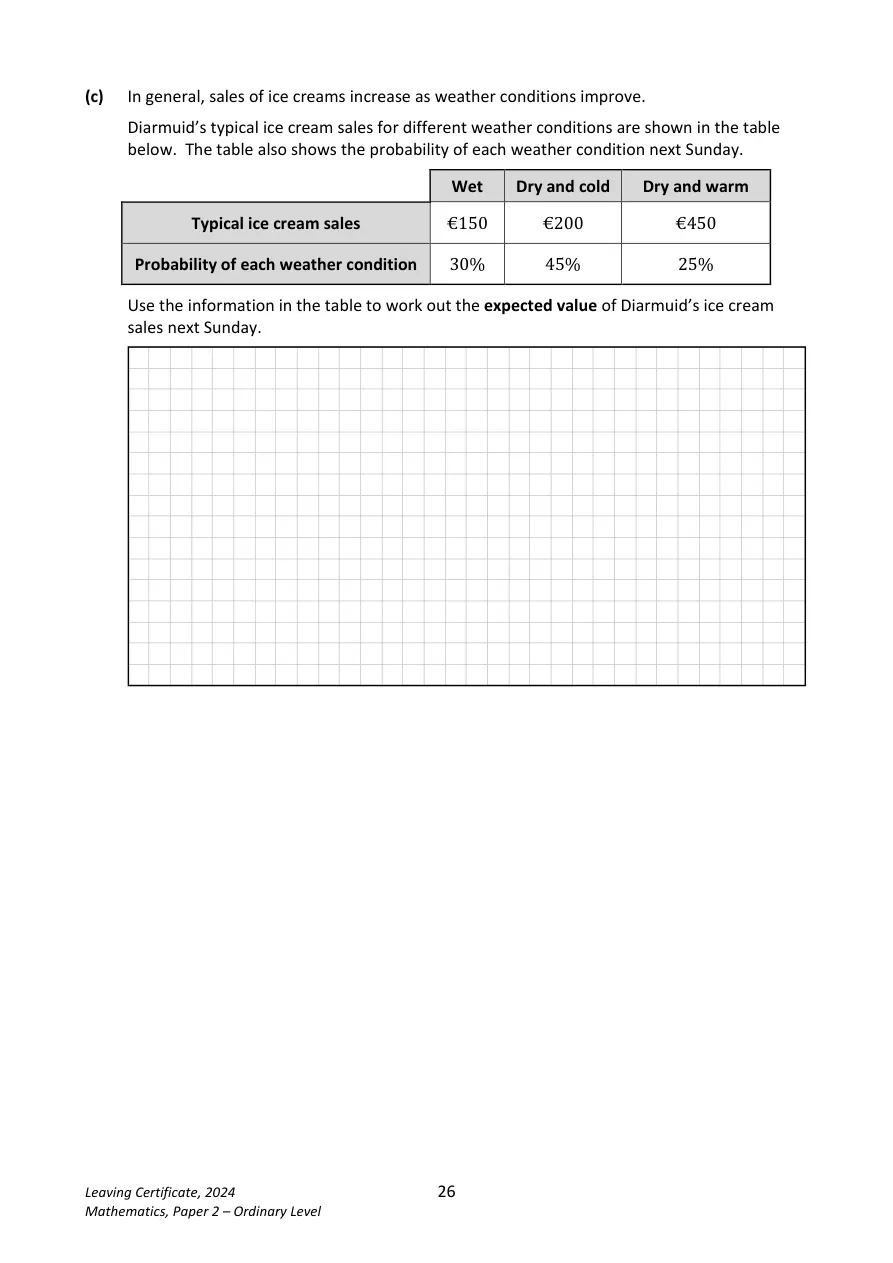
c) Expected sales

  1. E=150(0.30)+200(0.45)+450(0.25)
  2. E=247.50\ \mathrm{euro}

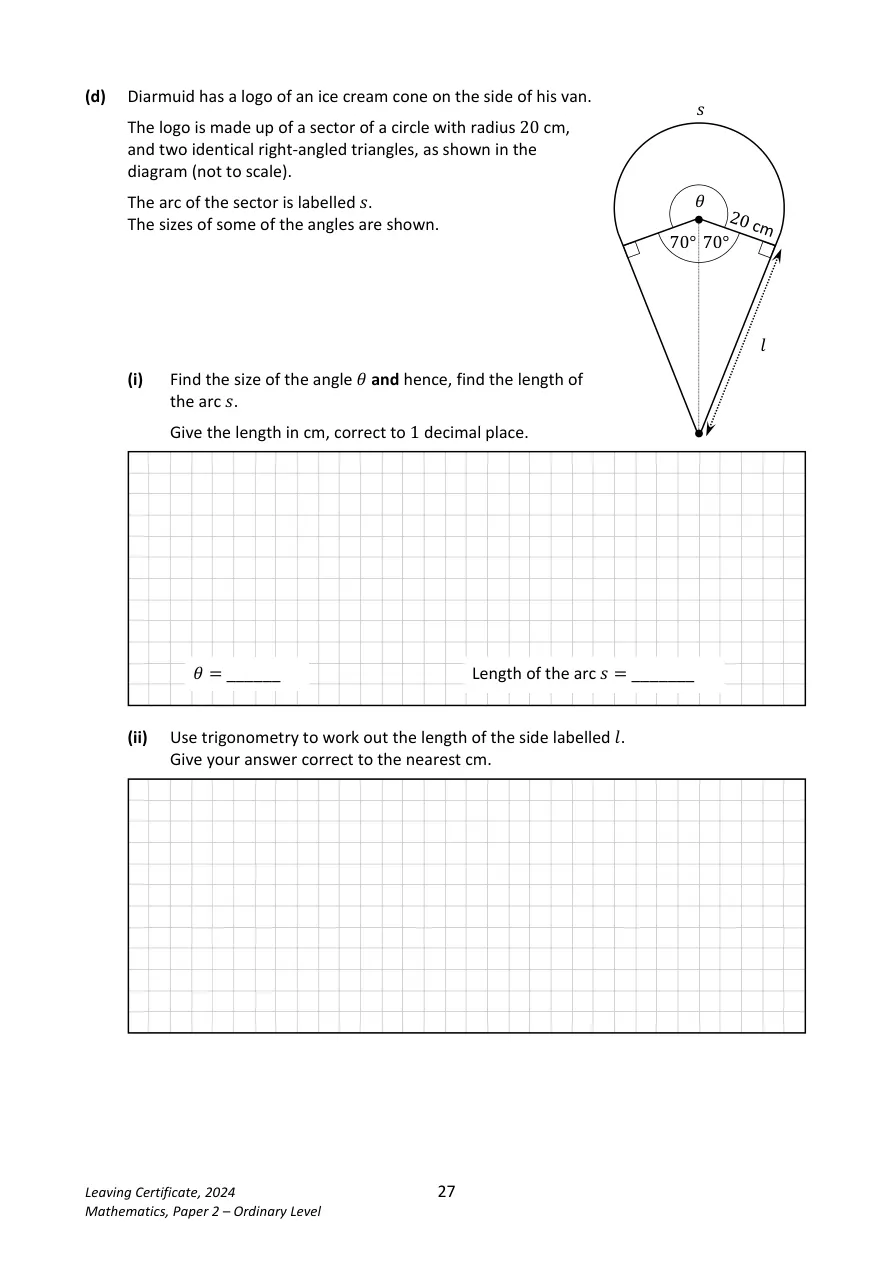
d) Logo

  1. \theta=360^\circ-70^\circ-70^\circ
  2. \theta=220^\circ
  3. s=\dfrac{220}{360}(2\pi)(20)
  4. s\approx76.8\ \mathrm{cm}
  5. l=20\tan70^\circ
  6. l\approx55\ \mathrm{cm}

Question 10

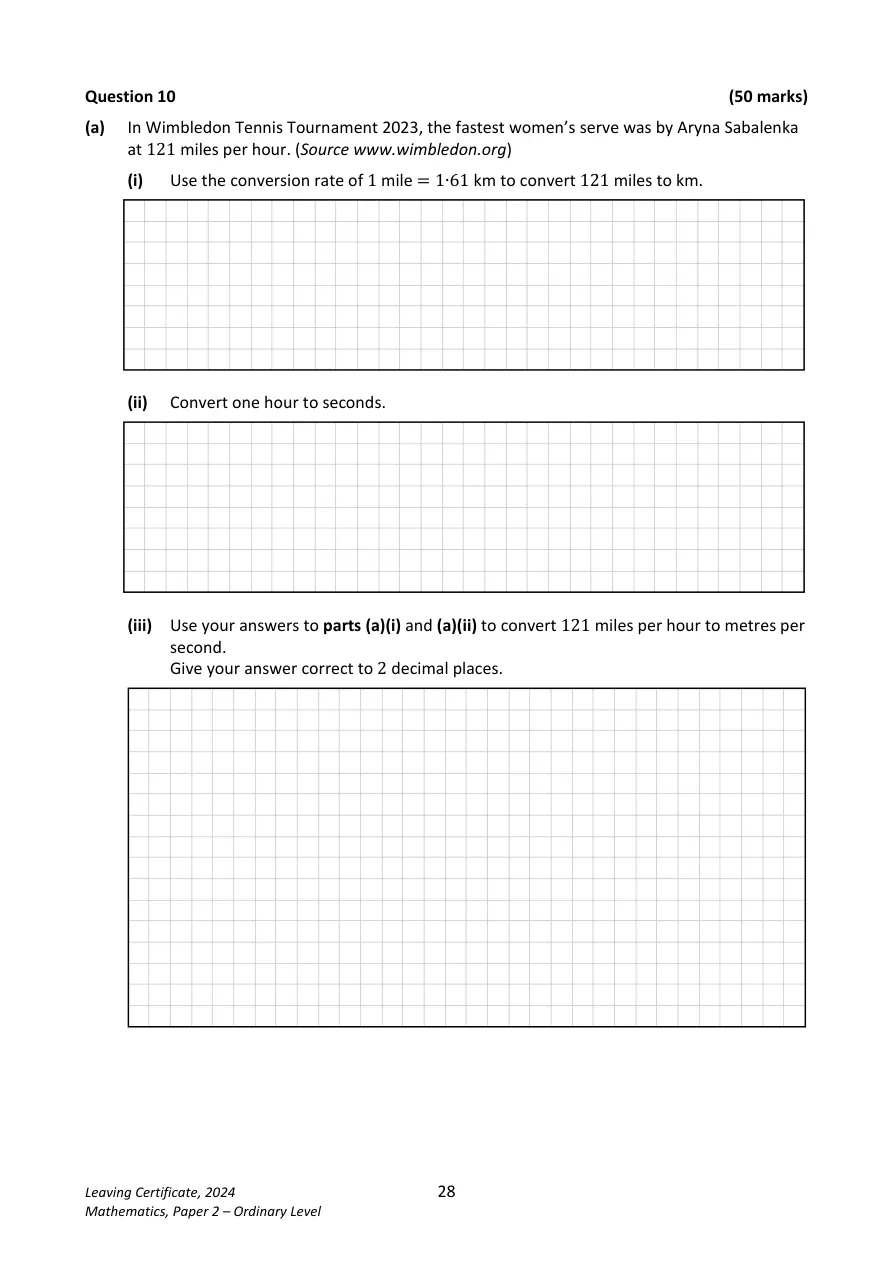
a) Serve speed

  1. d=121(1.61)=194.81\ \mathrm{km}
  2. t=60(60)=3600\ \mathrm{s}
  3. v=\dfrac{194810}{3600}
  4. v\approx54.11\ \mathrm{m/s}

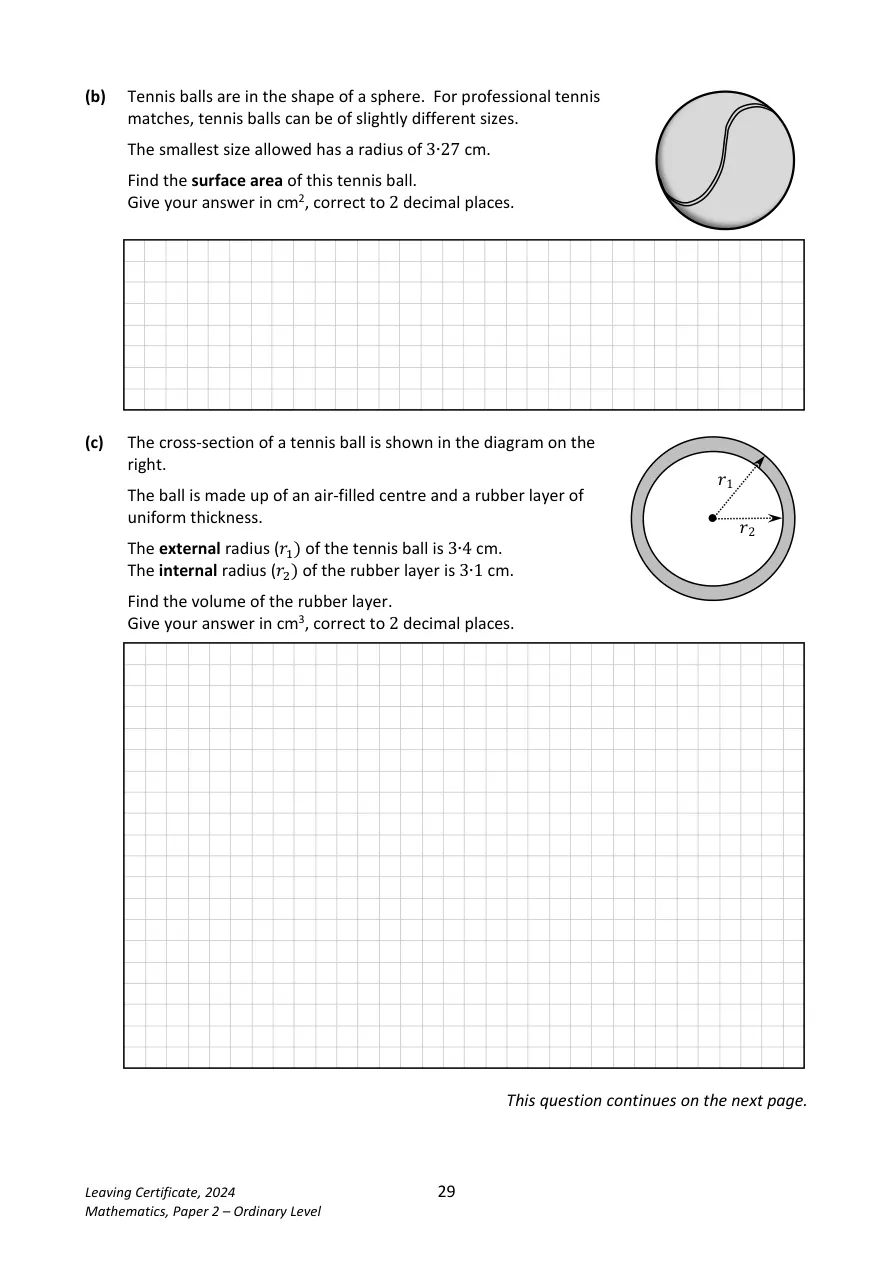
b) Surface area

  1. A=4\pi(3.27)^2
  2. A\approx134.37\ \mathrm{cm}^2

c) Rubber volume

  1. V=\dfrac{4}{3}\pi(3.4^3-3.1^3)
  2. V\approx39.85\ \mathrm{cm}^3

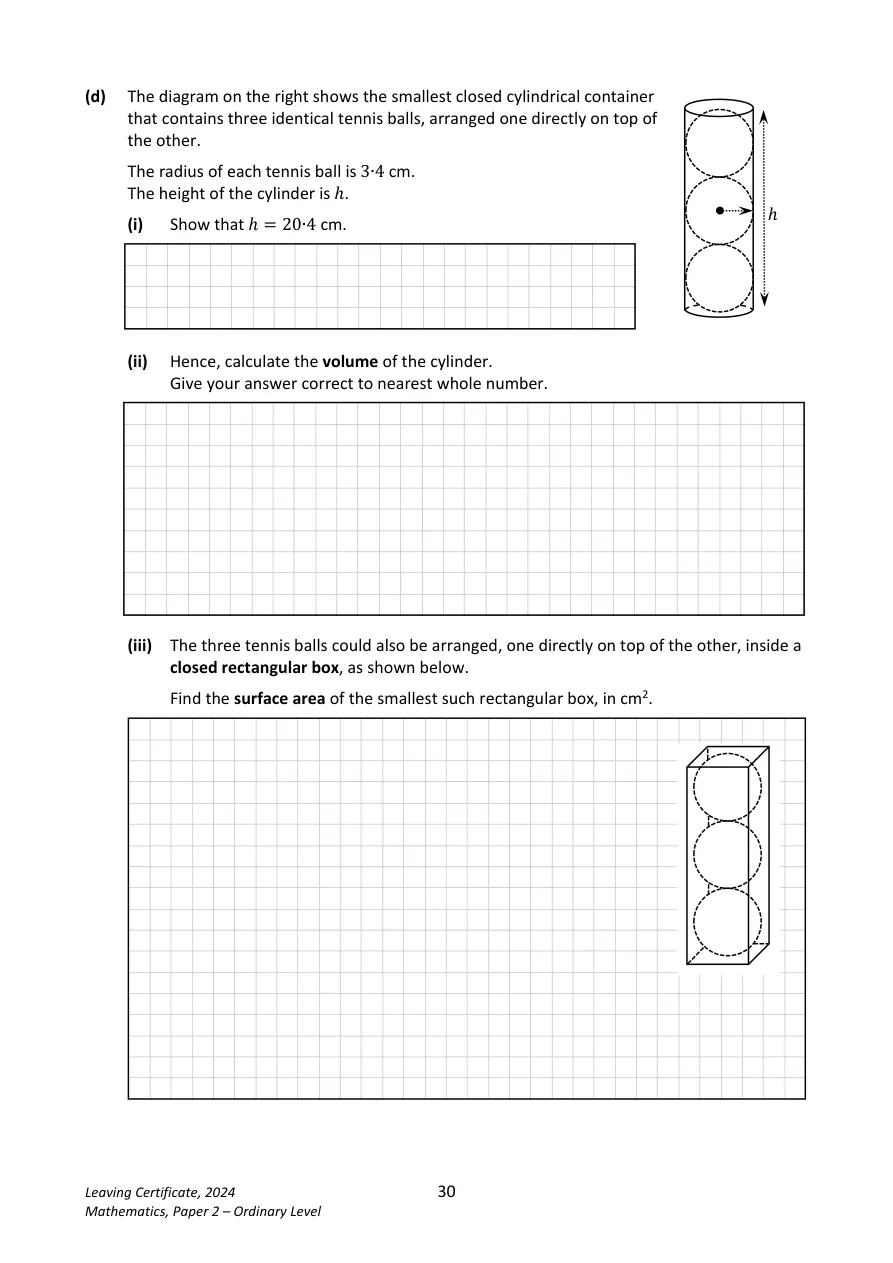
d) Container

  1. h=3(2)(3.4)=20.4\ \mathrm{cm}
  2. V=\pi(3.4)^2(20.4)
  3. V\approx741\ \mathrm{cm}^3
  4. A=2(6.8)(6.8)+4(6.8)(20.4)
  5. A=647.36\ \mathrm{cm}^2
See working and diagrams on the original paper
Original exam paper page 4
37425474768291
\mathrm{median}=74
[The fifth of nine ordered scores is the middle score.]
Four students scored below 74 and four scored above it.
Original exam paper page 5
X_{\max}=36
[All scores are different whole numbers and X is below 37.]
Y-X=61
Y=36+61=97
\dfrac{15+16+19+t+26}{5}=19.6
76+t=98
t=22
Original exam paper page 6
G1G3G4G5G6G7R1R2R3R4R6R7
P=\dfrac{6}{14}=\dfrac{3}{7}
[The even numbers 2, 4 and 6 occur in both colours.]
P=\dfrac{7}{13}
Original exam paper page 7
P=\dfrac{6}{13}
[Seven cards of the other colour remain, but one has the same number.]
Original exam paper page 8
\dfrac{1}{2}(4)-1=1
[The point (4, 1) satisfies the equation.]
Original exam paper page 9
dacb
m=\dfrac{9-6}{2-0}
m=\dfrac{3}{2}
y-6=\dfrac{3}{2}(x-0)
y=\dfrac{3}{2}x+6
Original exam paper page 10
C=(5,-3),\quad r=5
(9-5)^2+(2+3)^2=41
41>25
[The point is outside because squared distance exceeds squared radius.]
C(4, −1)
Original exam paper page 11
r=2
C=(2,1+2)
[The centre is one radius above the lowest point.]
C=(2,3)
Original exam paper page 12
\mu=\dfrac{7.2+8.4}{2}
\mu=7.8
\sigma=8.4-7.8
\sigma=0.6
6.67.89.0
9=7.8+2(0.6)
P(X\geq9)\approx\dfrac{100-95}{2}\%
P(X\geq9)\approx2.5\%
Original exam paper page 13
P(\mathrm{not\ recommended})=1-0.1=0.9
P=0.9(0.9)(0.1)
P=0.081
[Independent nights: fail Sunday, fail Monday, succeed Tuesday.]
Original exam paper page 14
I
Equal compass arcs locate each internal angle bisector. Their intersection I is the incentre.
Original exam paper page 15
k=\dfrac{14}{4}=3.5
AE=6(3.5)=21
CE=21-6=15\ \mathrm{units}
A_{\mathrm{large}}=11(3.5)^2
A_{\mathrm{large}}=134.75\ \mathrm{units}^2
Original exam paper page 16
875760998313712838
Original exam paper page 17
\mu=\dfrac{933}{10}=93.3\ \mathrm{bpm}
\sigma=\sqrt{\dfrac{\sum(x-93.3)^2}{10}}
\sigma\approx15.1\ \mathrm{bpm}
Increased: after exercise, the heart rates are more spread out.
Original exam paper page 18
r = 0.9: the scatter plot shows strong positive correlation.
Original exam paper page 19
E=\dfrac{1}{\sqrt{355}}\times100\%
E\approx5.3\%
\hat p=\dfrac{96}{355}\times100\%
\hat p\approx27\%
\mathrm{CI}=[27-5.3,27+5.3]\%
\mathrm{CI}=[21.7,32.3]\%
Insufficient evidence that the proportion has changed.
24% lies inside the 95% interval [21.7%, 32.3%].
Original exam paper page 20
l=\sqrt{1.4^2+3^2}
l\approx3.3\ \mathrm{m}
\theta=\tan^{-1}\left(\dfrac{3}{1.4}\right)
\theta\approx65^\circ
Original exam paper page 21
\phi=\tan^{-1}\left(\dfrac{1.5}{1.4}\right)
\phi\approx47^\circ
Mairéad is incorrect: 47° is not half of 65°. Halving the height does not halve the angle.
Original exam paper page 22
\dfrac{\sin\theta}{12}=\dfrac{\sin37^\circ}{10}
\theta=\sin^{-1}\left(\dfrac{12\sin37^\circ}{10}\right)
\theta\approx46^\circ
[Use the acute angle shown in the diagram.]
Original exam paper page 23
CE=\sqrt{22^2+11.8^2-2(22)(11.8)\cos110^\circ}
[Cosine rule: the required diagonal is CE.]
A=2\left[\dfrac{1}{2}(22)(11.8)\sin110^\circ\right]
A\approx244\ \mathrm{cm}^2
CE\approx28.3\ \mathrm{cm}
Original exam paper page 24
N=7(4)(2)=56
N_{\mathrm{extra\ topping}}=7(5)(2)=70
N_{\mathrm{extra\ flavour}}=8(4)(2)=64
Add an extra topping: it gives more choices.
Original exam paper page 25
n(V\cup C)=100-45=55
n(V\cap C)=42+37-55=24
n(V\mathrm{\ only})=42-24=18
n(C\mathrm{\ only})=37-24=13
182413
P=\dfrac{13}{100}=0.13
Original exam paper page 26
E=150(0.30)+200(0.45)+450(0.25)
E=247.50\ \mathrm{euro}
Original exam paper page 27
\theta=360^\circ-70^\circ-70^\circ
\theta=220^\circ
s=\dfrac{220}{360}(2\pi)(20)
s\approx76.8\ \mathrm{cm}
l=20\tan70^\circ
l\approx55\ \mathrm{cm}
Original exam paper page 28
d=121(1.61)=194.81\ \mathrm{km}
t=60(60)=3600\ \mathrm{s}
v=\dfrac{194810}{3600}
v\approx54.11\ \mathrm{m/s}
Original exam paper page 29
A=4\pi(3.27)^2
A\approx134.37\ \mathrm{cm}^2
V=\dfrac{4}{3}\pi(3.4^3-3.1^3)
V\approx39.85\ \mathrm{cm}^3
Original exam paper page 30
h=3(2)(3.4)=20.4\ \mathrm{cm}
V=\pi(3.4)^2(20.4)
V\approx741\ \mathrm{cm}^3
A=2(6.8)(6.8)+4(6.8)(20.4)
A=647.36\ \mathrm{cm}^2