← Original paper

Leaving Cert Ordinary Maths 2025 · Paper 1

Teacher worked solutions. Explanations are in blue.

Question 1

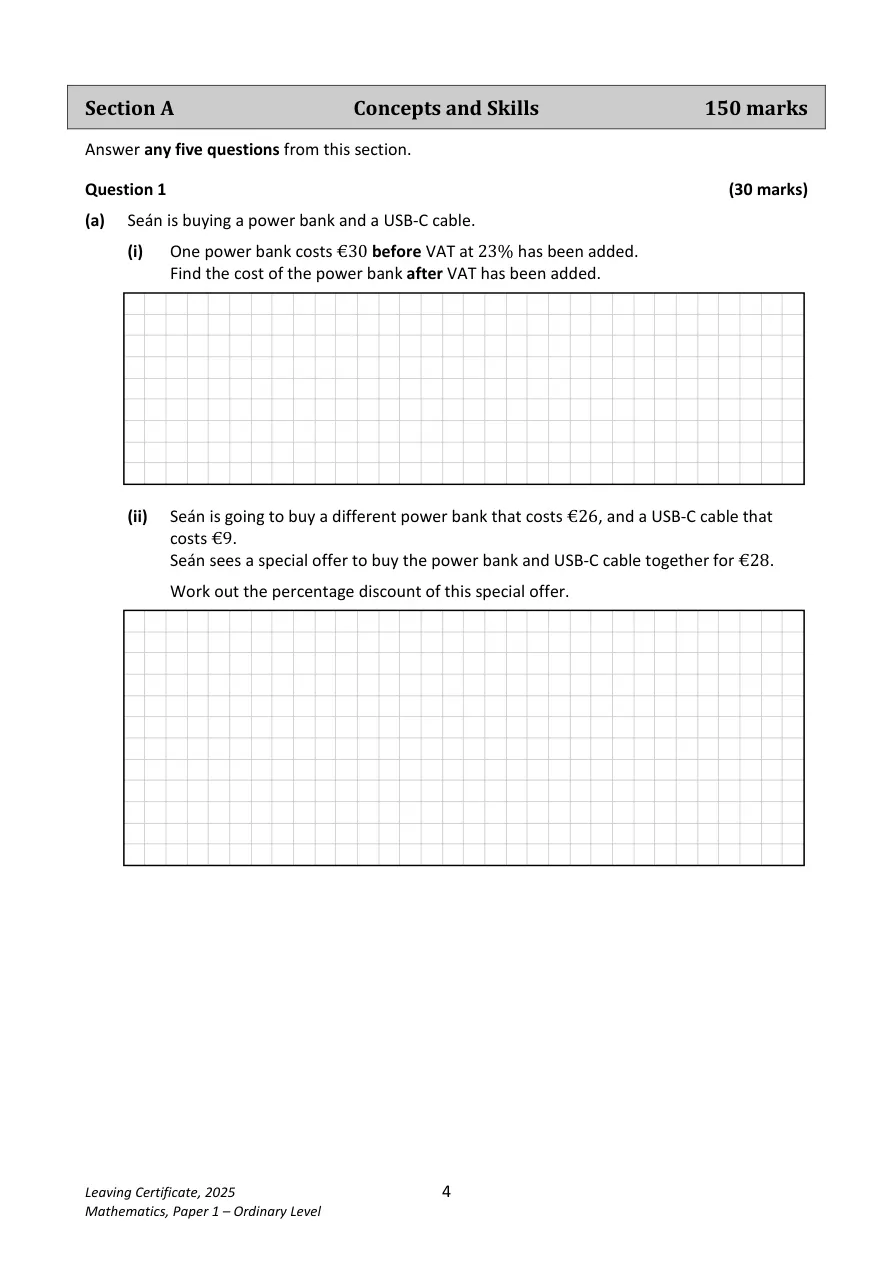
a)(i) VAT

  1. C=30(1.23)
  2. C=\mathrm{€}36.90

a)(ii) Discount

  1. C_{\mathrm{usual}}=26+9=35
  2. D=35-28=7
  3. p=\dfrac{7}{35}\times100
  4. p=20\%

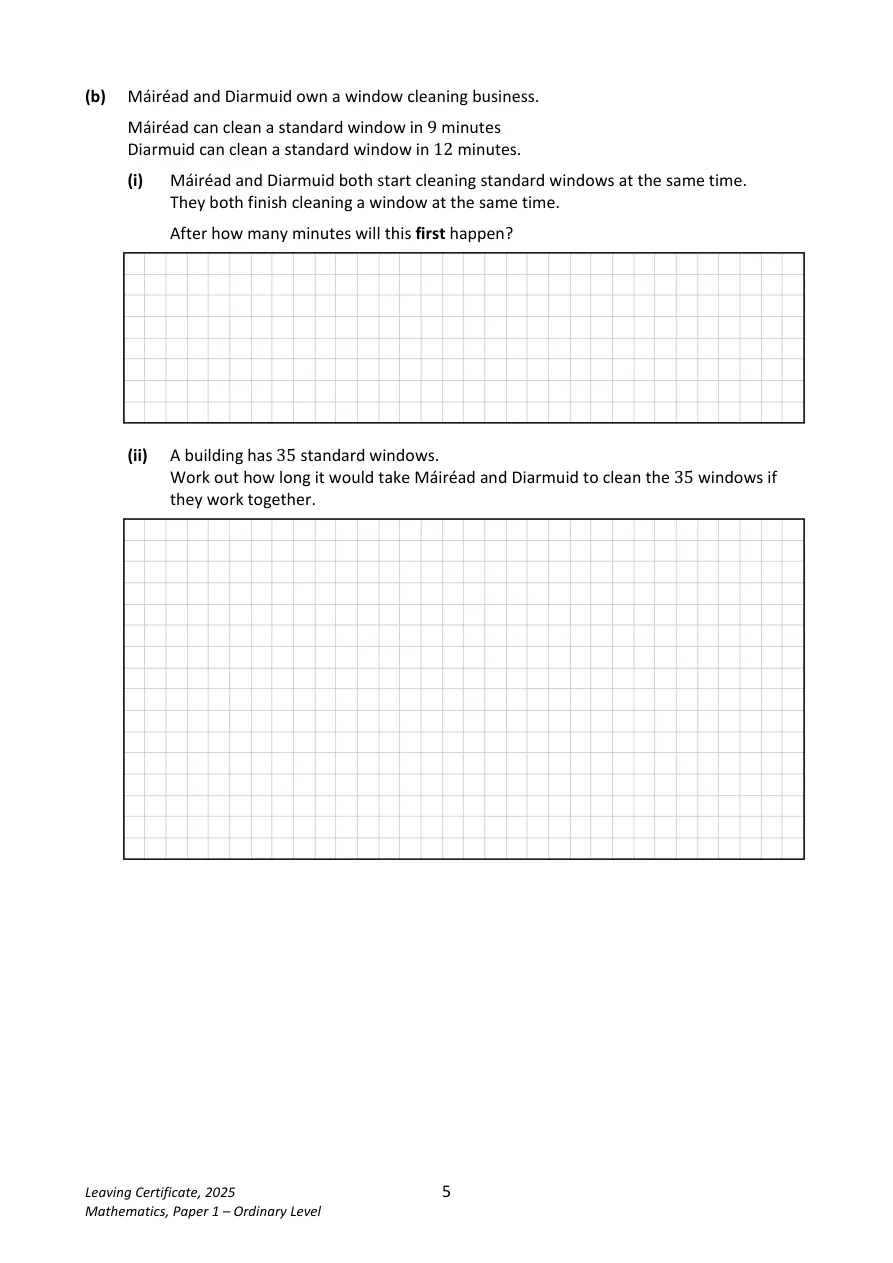
b)(i) Finish together

  1. \mathrm{LCM}(9,12)=36
  2. They first finish windows together after 36 minutes: Máiréad has cleaned 4 and Diarmuid 3.

b)(ii) 35 windows

  1. R=\dfrac{1}{9}+\dfrac{1}{12}
  2. R=\dfrac{7}{36}\ \mathrm{windows\ per\ minute}
  3. t=\dfrac{35}{\dfrac{7}{36}}
  4. t=180\ \mathrm{min}=3\ \mathrm{h}
Question 2

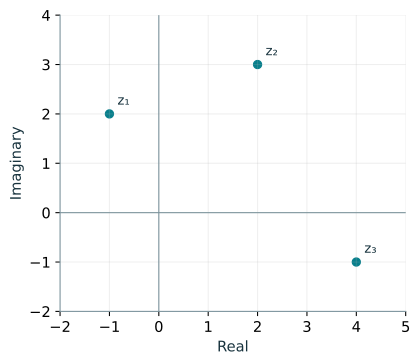
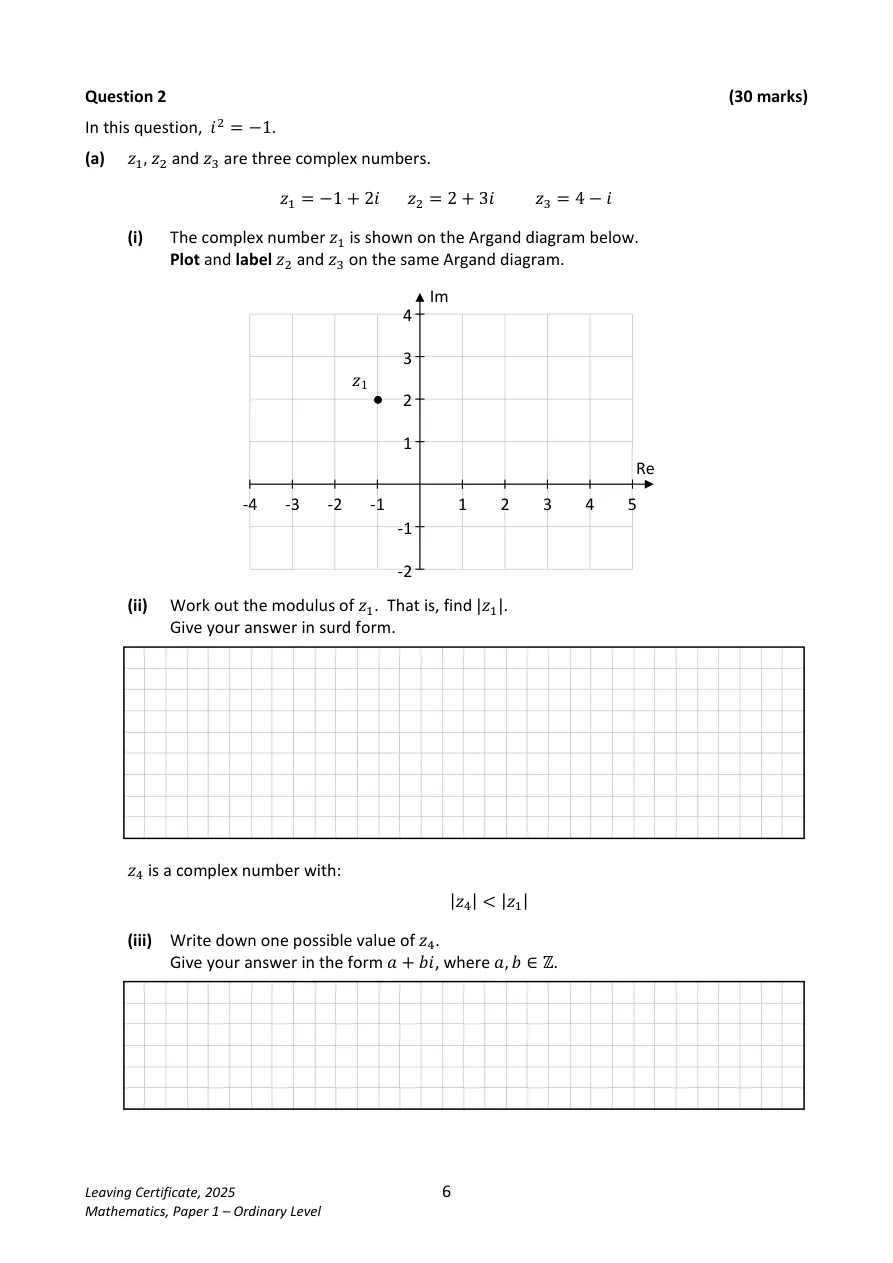
a)(i) Argand points

  1. z_2=2+3i,\quad z_3=4-i
  2. Plot z₂ at (2,3) and z₃ at (4,−1). Horizontal axis is real; vertical axis is imaginary.
  3. 2025-1-2-argand

a)(ii) Modulus

  1. |z_1|=\sqrt{(-1)^2+2^2}
  2. |z_1|=\sqrt{5}

a)(iii) Smaller modulus

  1. z_4=1+i
  2. |z_4|=\sqrt{2}<\sqrt{5}

    One possible answer; many others are valid.

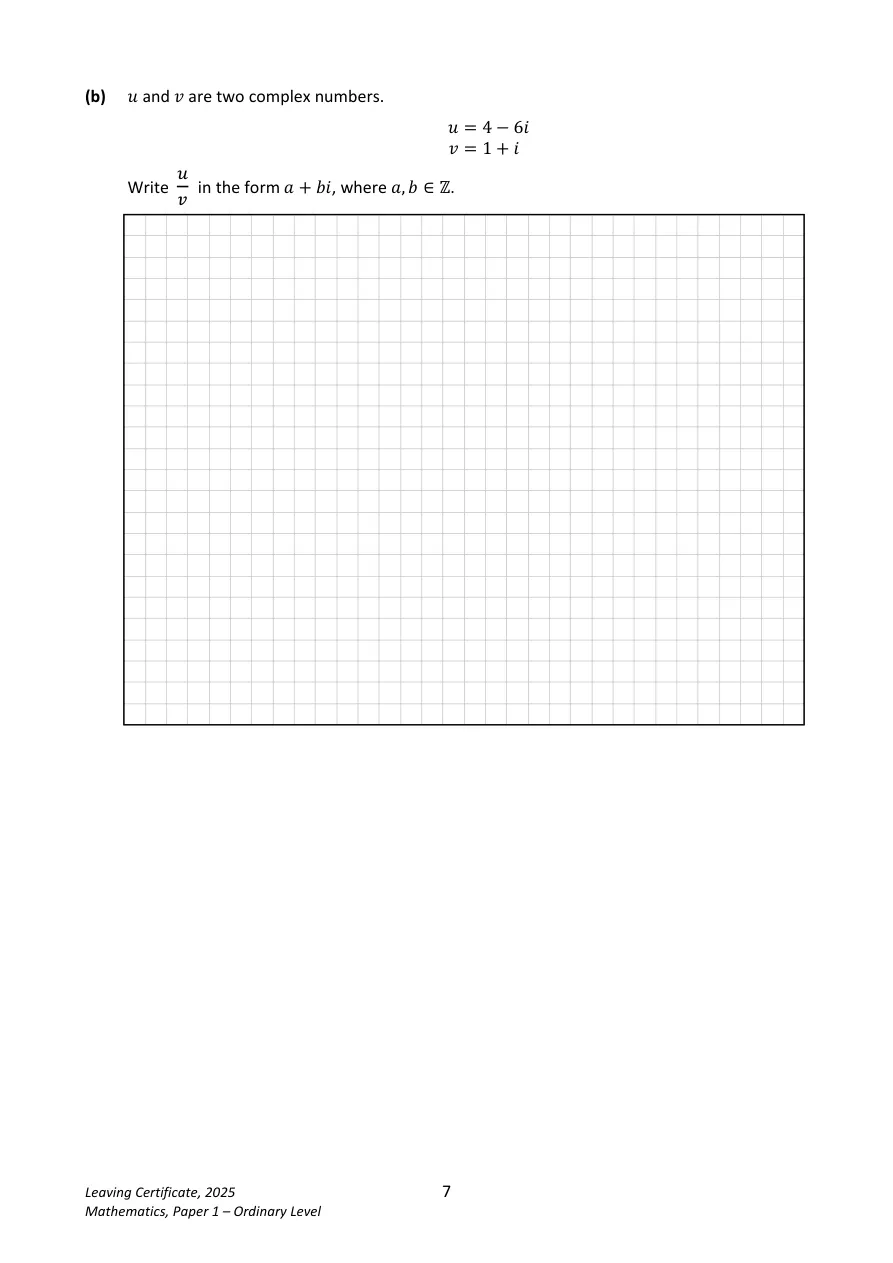
b) Divide complex numbers

  1. \dfrac{4-6i}{1+i}\times\dfrac{1-i}{1-i}
  2. \dfrac{4-4i-6i+6i^2}{1-i^2}
  3. \dfrac{-2-10i}{2}

    Replace i² by −1.

  4. -1-5i

Question 3

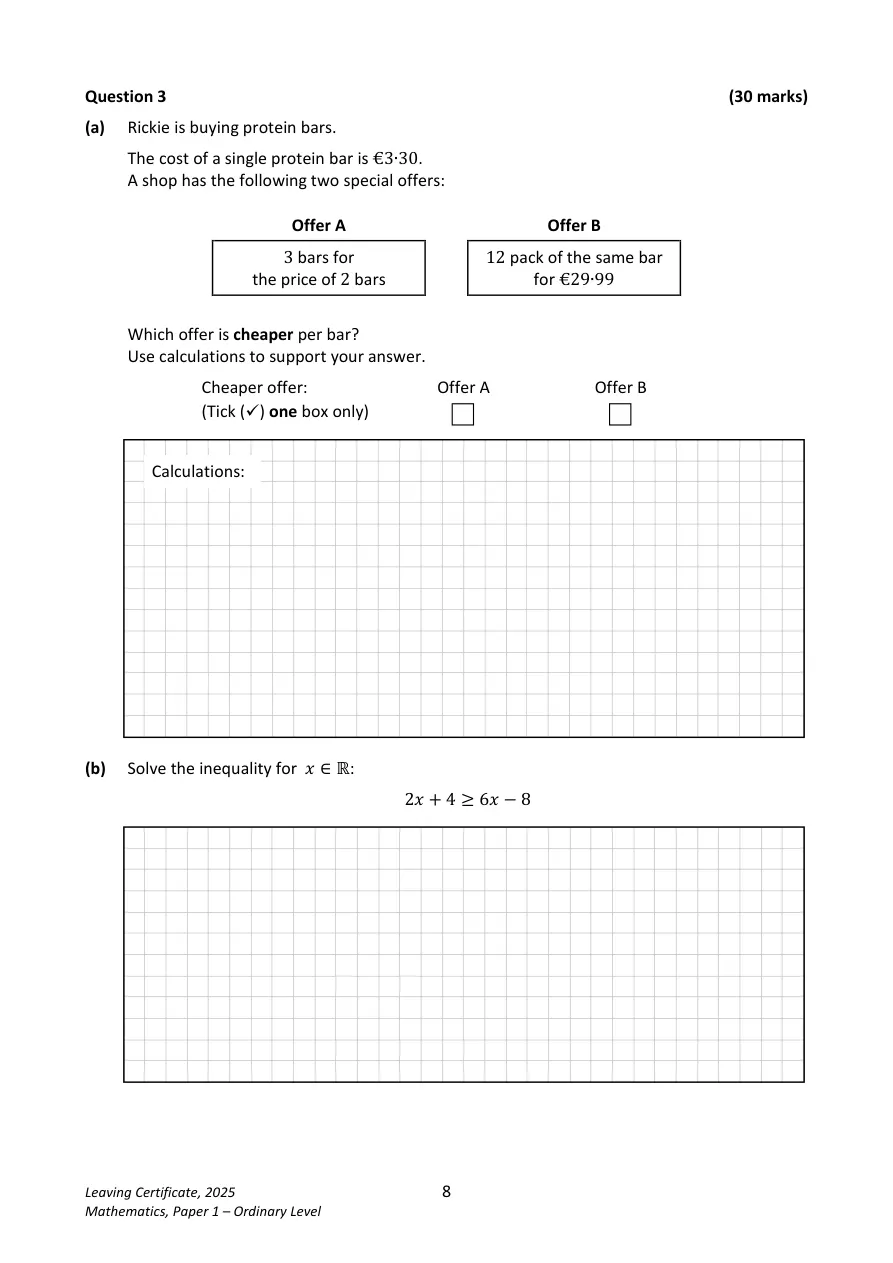
a) Compare offers

  1. A=\dfrac{6.60}{3}=\mathrm{€}2.20
  2. B=\dfrac{29.99}{12}\approx\mathrm{€}2.50
  3. Offer A is cheaper per bar.

b) Inequality

  1. 2x+4\geq6x-8
  2. -4x\geq-12
  3. x\leq3

    Reverse the inequality when dividing by −4.

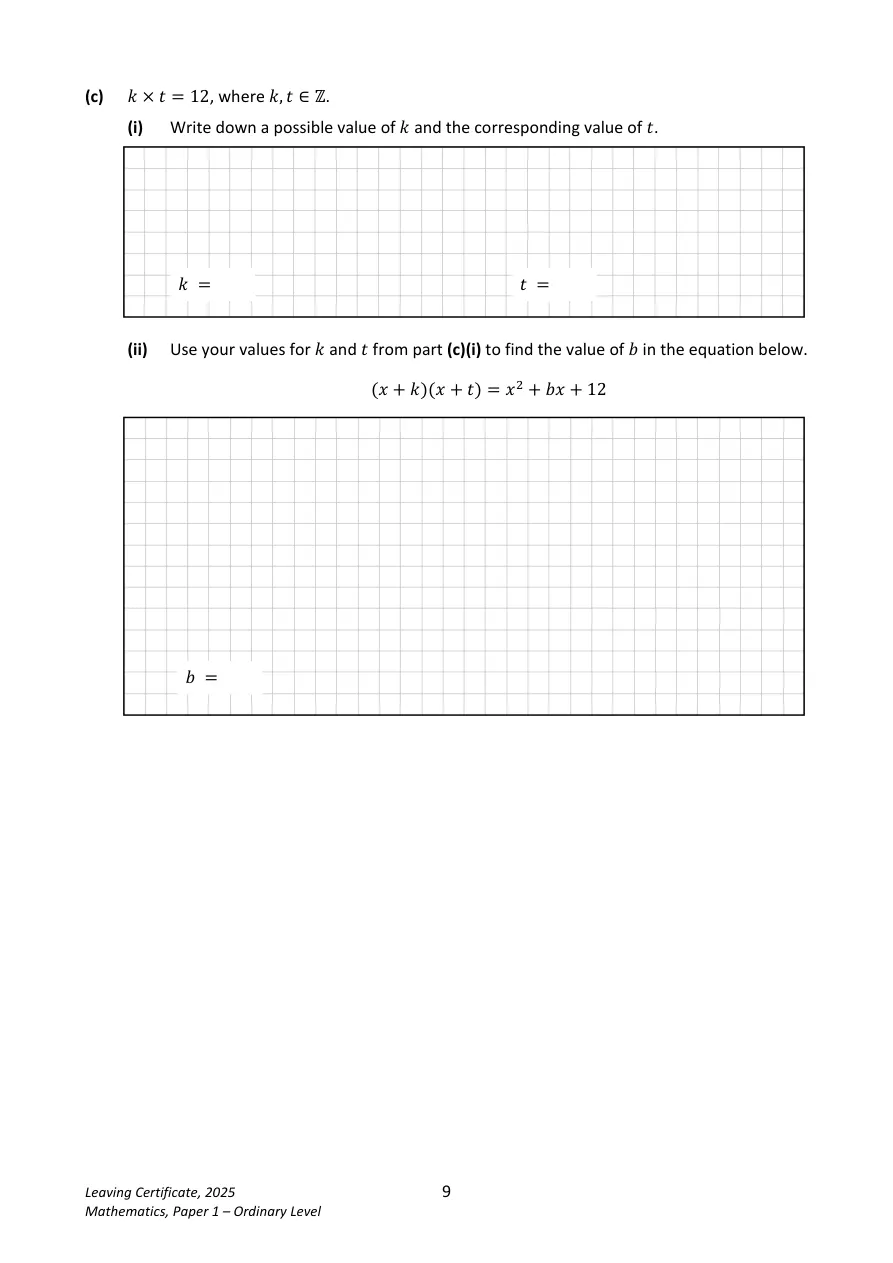
c)(i) Choose factors

  1. k=6,\quad t=2
  2. kt=12

c)(ii) Find b

  1. (x+6)(x+2)=x^2+8x+12
  2. b=8

    This value depends on the valid pair chosen in part (i).

Question 4

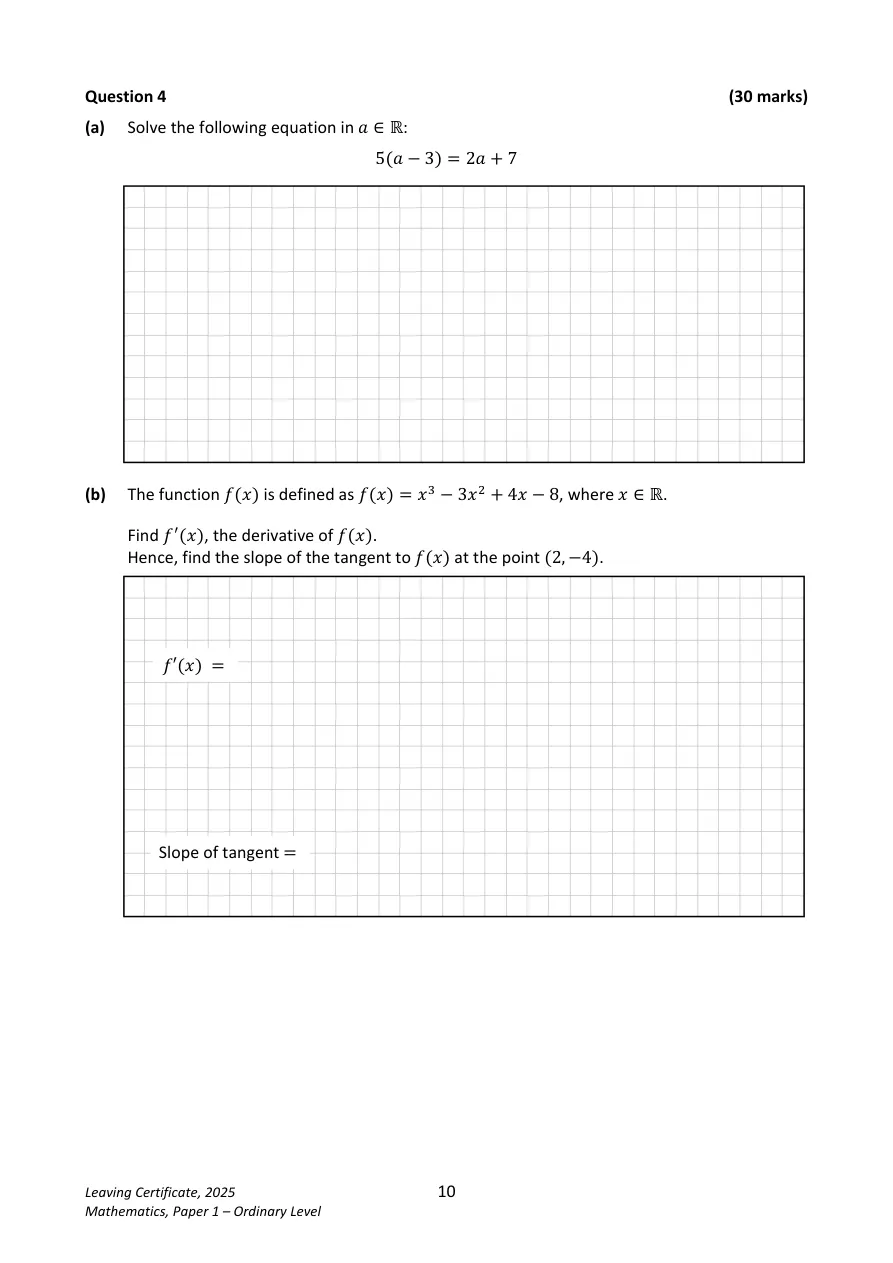
a) Solve

  1. 5(a-3)=2a+7
  2. 5a-15=2a+7
  3. 3a=22
  4. a=\dfrac{22}{3}

b) Tangent slope

  1. f'(x)=3x^2-6x+4

    Differentiate each term using the power rule.

  2. f'(2)=3(2)^2-6(2)+4
  3. f'(2)=4

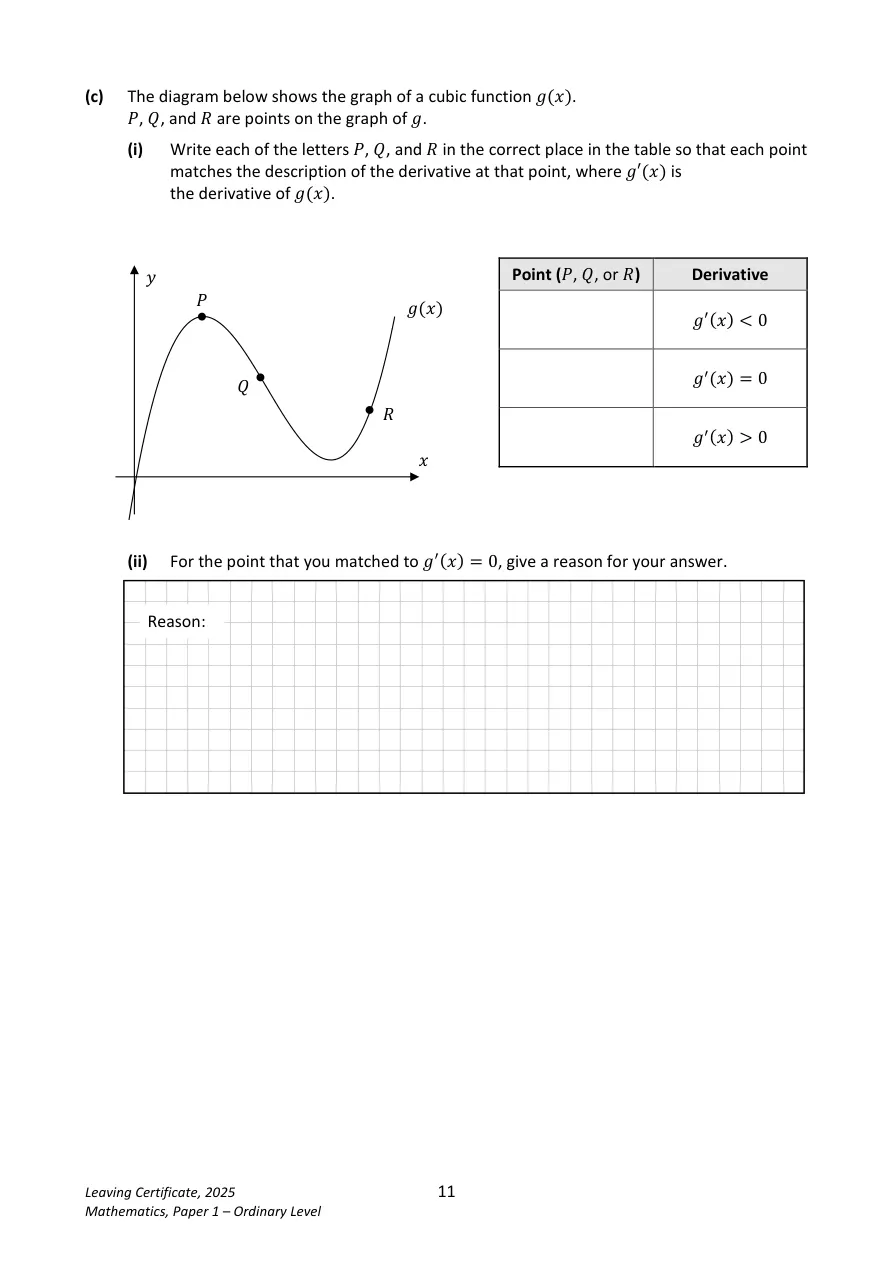
c)(i) Match derivatives

  1. Q:\quad g'(x)<0
  2. P:\quad g'(x)=0
  3. R:\quad g'(x)>0

c)(ii) Reason

  1. P is a turning point with a horizontal tangent, so its derivative is zero.

Question 5

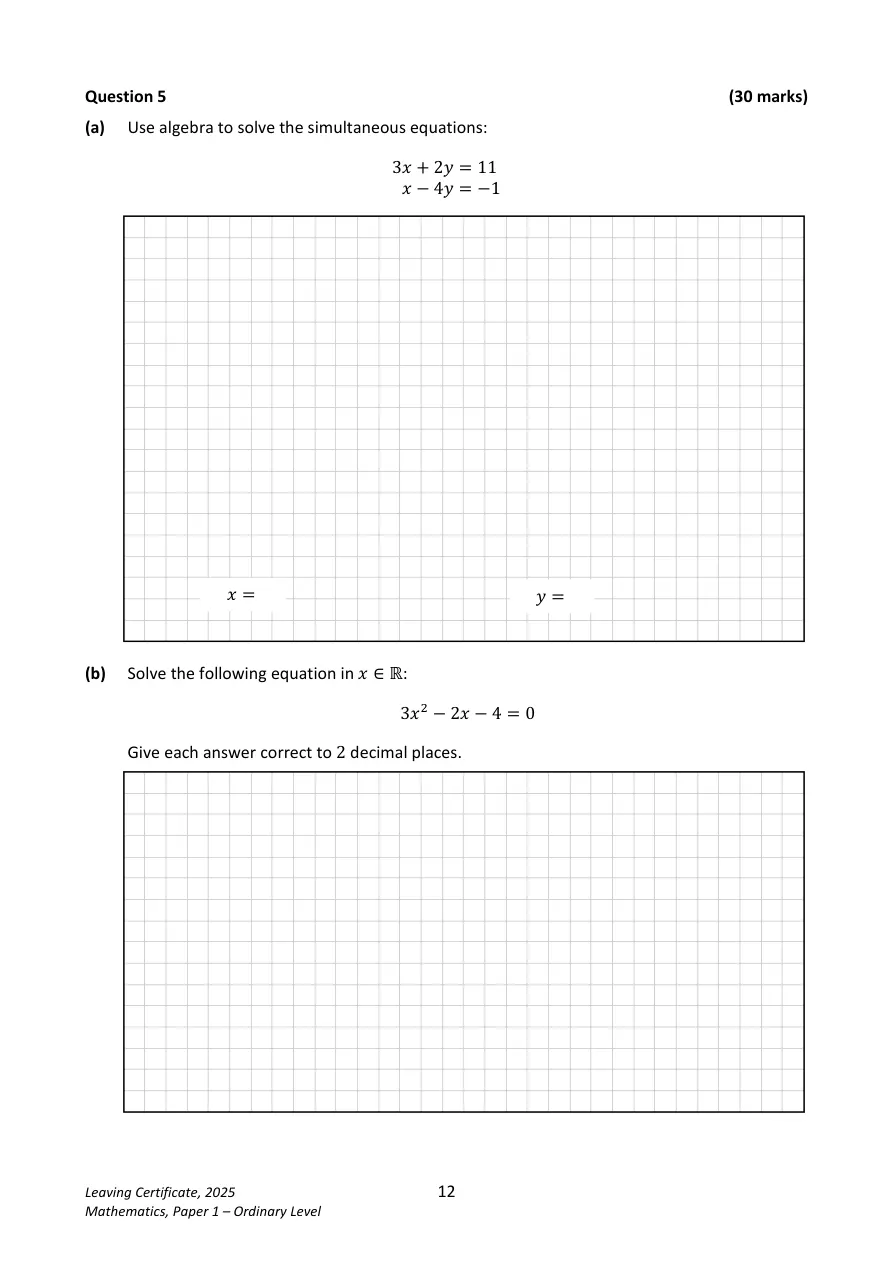
a) Eliminate y

  1. 3x+2y=11\quad(A)
  2. x-4y=-1\quad(B)
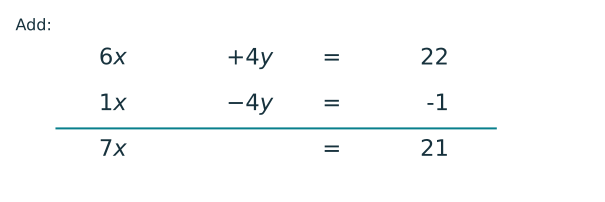
  3. Multiply A by 2 to make +4y, which cancels −4y in B. Multiply every term, including 11.
  4. 6x+4y=22\quad(2A)
  5. x-4y=-1\quad(B)
  6. 7x=21

    Add the two equations.

  7. 2025-1-5-elimination
  8. x=3
  9. 3-4y=-1
  10. -4y=-4
  11. y=1

b) Quadratic formula

  1. a=3,\quad b=-2,\quad c=-4

    Match ax² + bx + c = 0. Include the signs of the coefficients.

  2. x=\dfrac{-b\pm\sqrt{b^2-4ac}}{2a}

    Write the formula before substituting. The ± gives two calculations, one with + and one with −.

  3. x=\dfrac{2\pm\sqrt{(-2)^2-4(3)(-4)}}{2(3)}

    Use brackets when substituting negative numbers, especially when squaring b.

  4. x=\dfrac{2\pm\sqrt{52}}{6}
  5. x\approx1.54\quad\mathrm{or}\quad x\approx-0.87

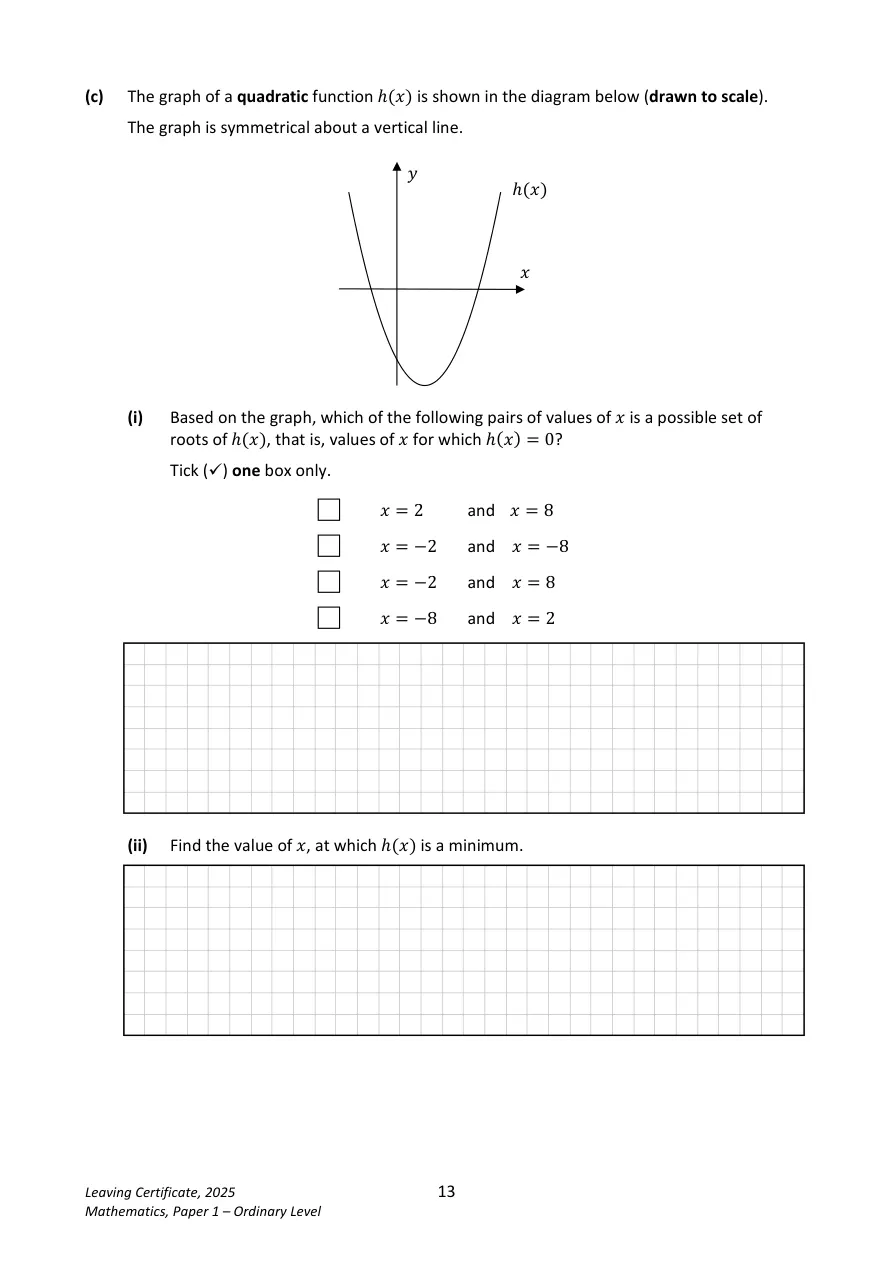
c)(i) Roots from the graph

  1. x=-2,\quad x=8

c)(ii) Minimum x-coordinate

  1. x=\dfrac{-2+8}{2}
  2. x=3

    The axis of symmetry is halfway between the roots.

Question 6

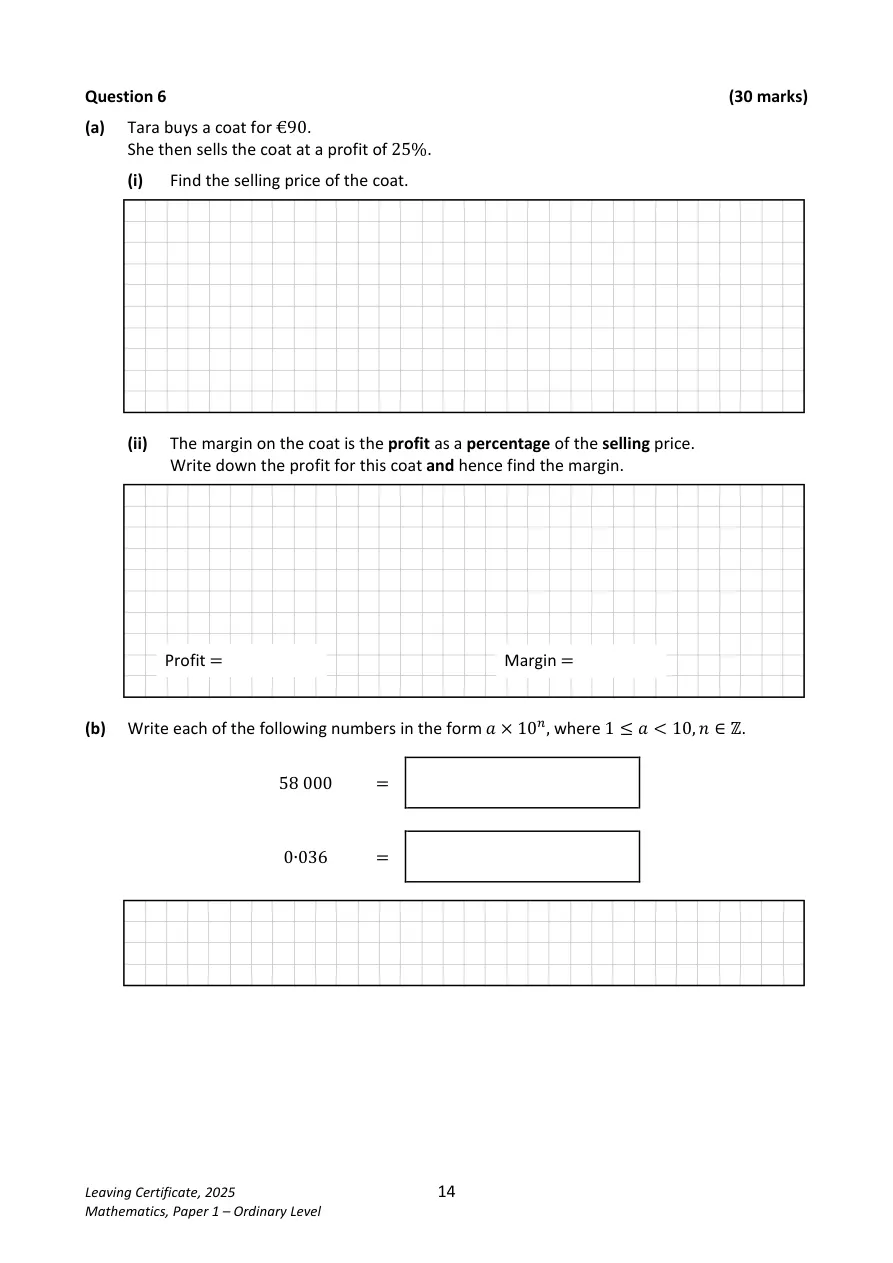
a)(i) Selling price

  1. S=90(1.25)
  2. S=\mathrm{€}112.50

a)(ii) Margin

  1. P=112.50-90=\mathrm{€}22.50
  2. M=\dfrac{22.50}{112.50}\times100
  3. M=20\%

    Margin uses selling price as the denominator; profit percentage uses cost.

b) Standard form

  1. 58000=5.8\times10^4
  2. 0.036=3.6\times10^{-2}

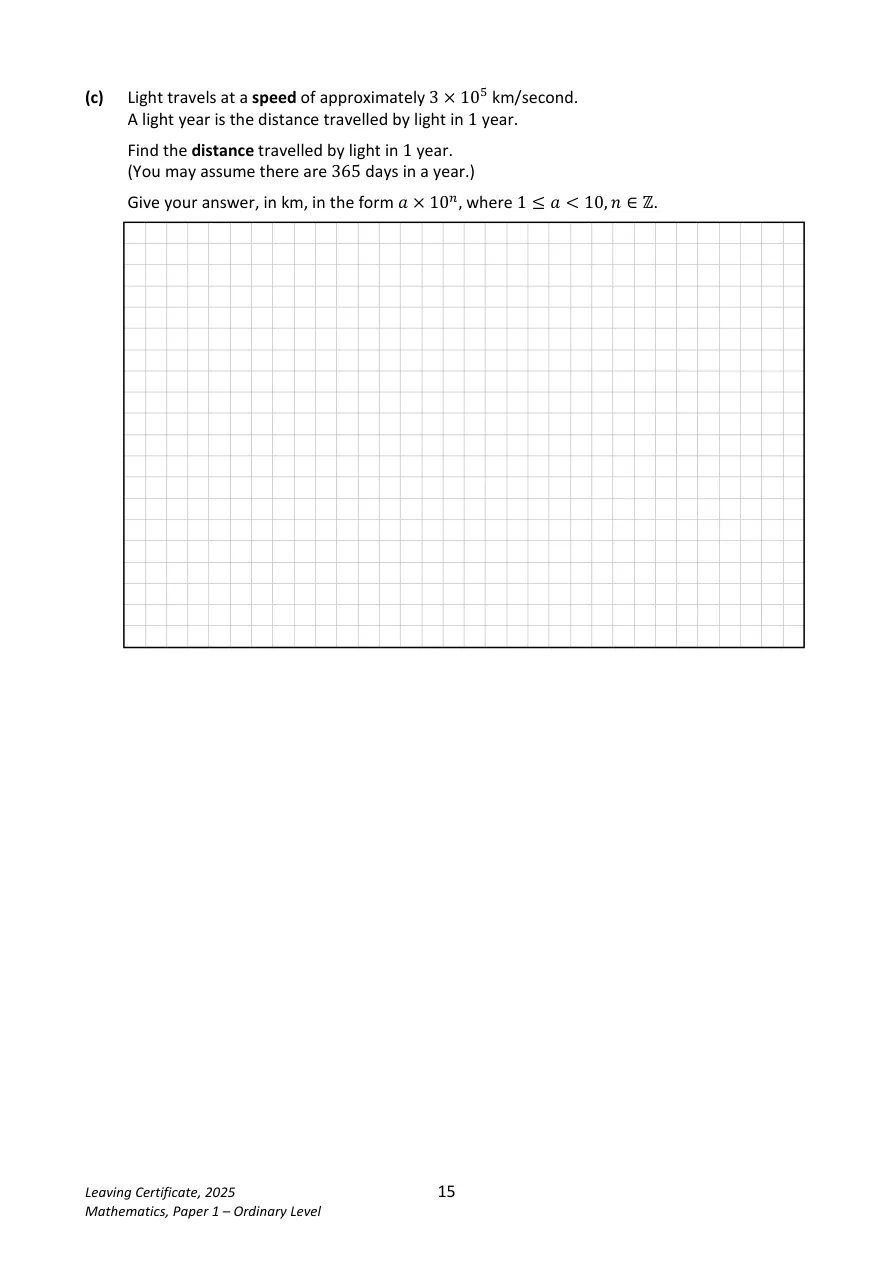
c) One light year

  1. d=(3\times10^5)(60)(60)(24)(365)
  2. d=9.4608\times10^{12}\ \mathrm{km}

Question 7

a) Read the graph

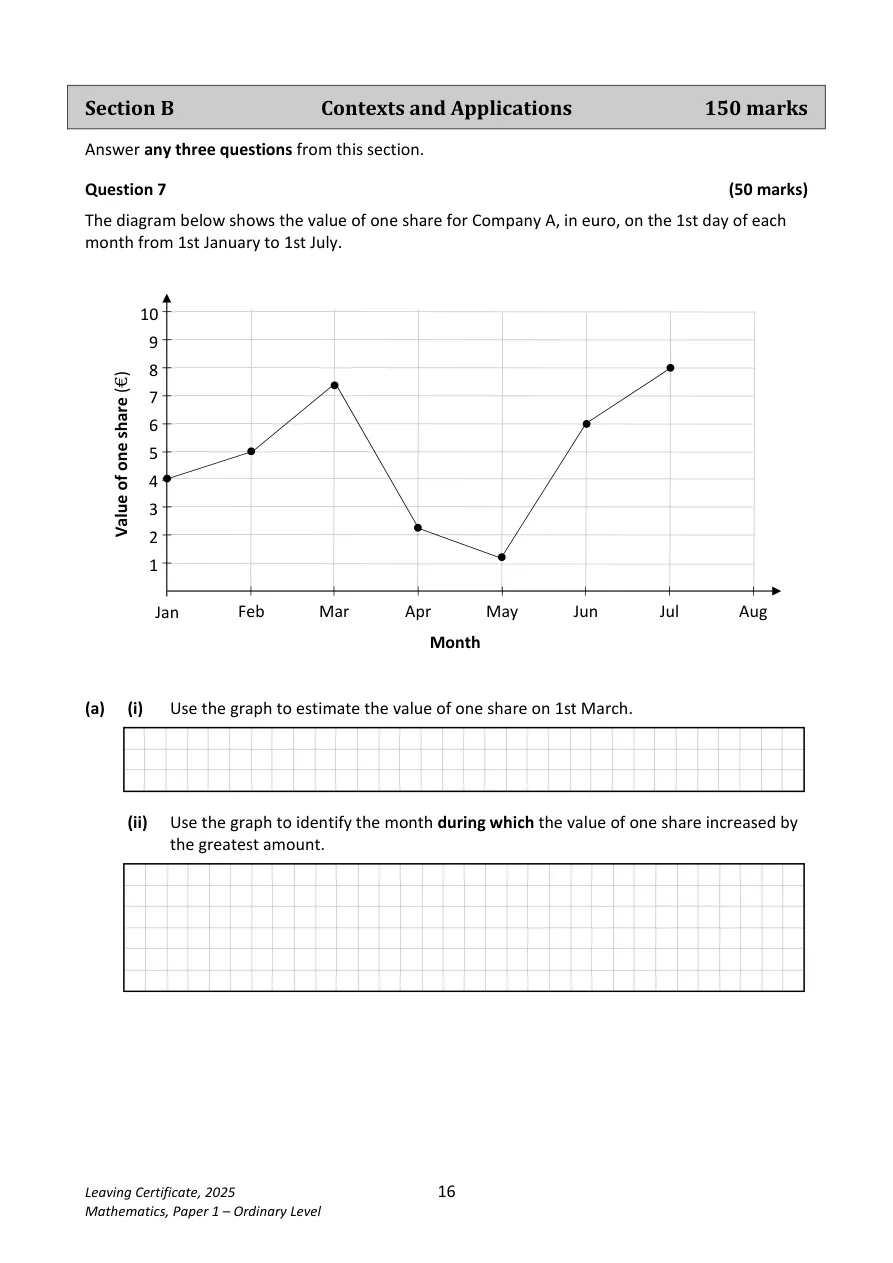
  1. (i) Approximately €7.30 on 1 March. (ii) May has the largest increase during the month (from 1 May to 1 June).

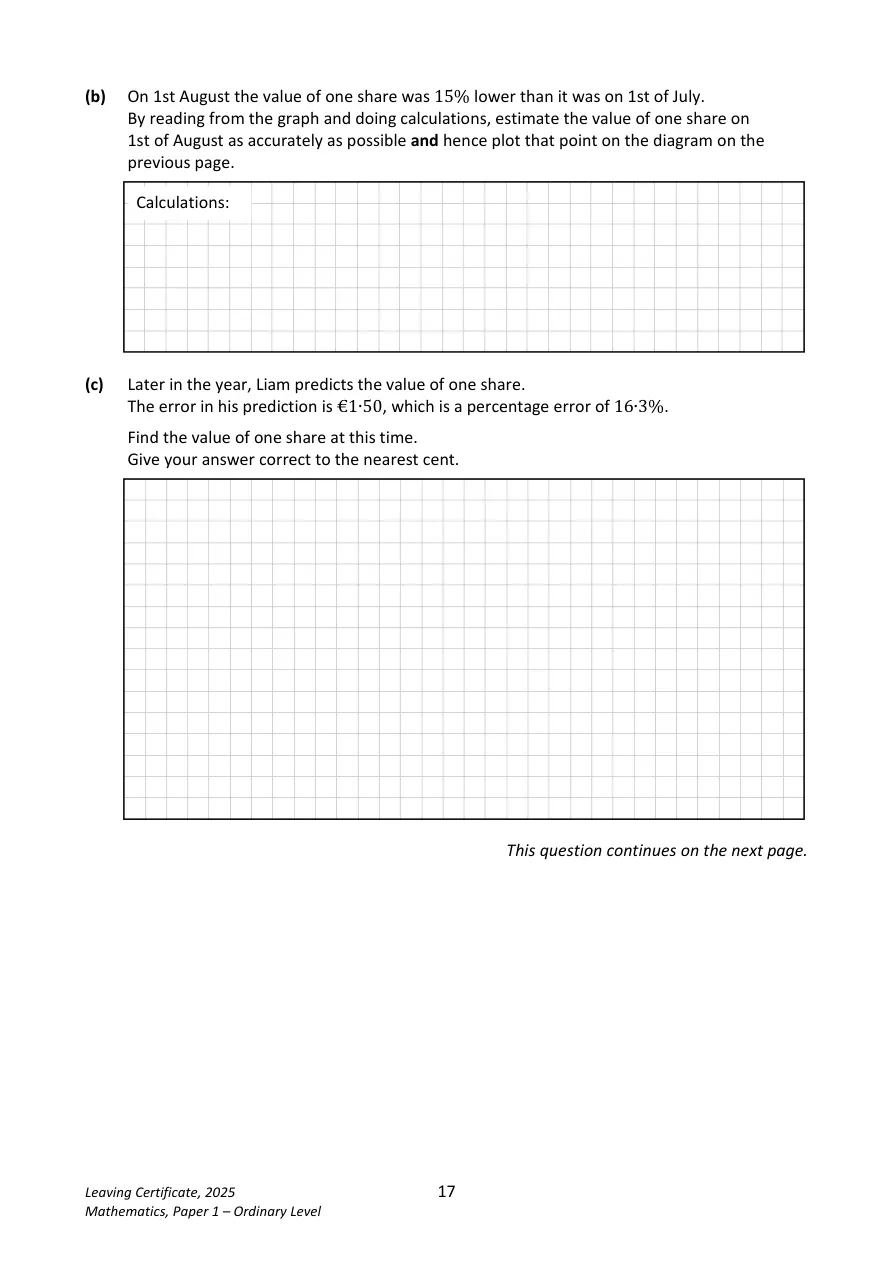
b) August value

  1. A=8(0.85)
  2. A=\mathrm{€}6.80
  3. Plot the August point at height 6.8 on the original graph.

c) Percentage error

  1. \mathrm{Actual}=\dfrac{1.50}{0.163}
  2. \mathrm{Actual}\approx\mathrm{€}9.20

d)(i) Table

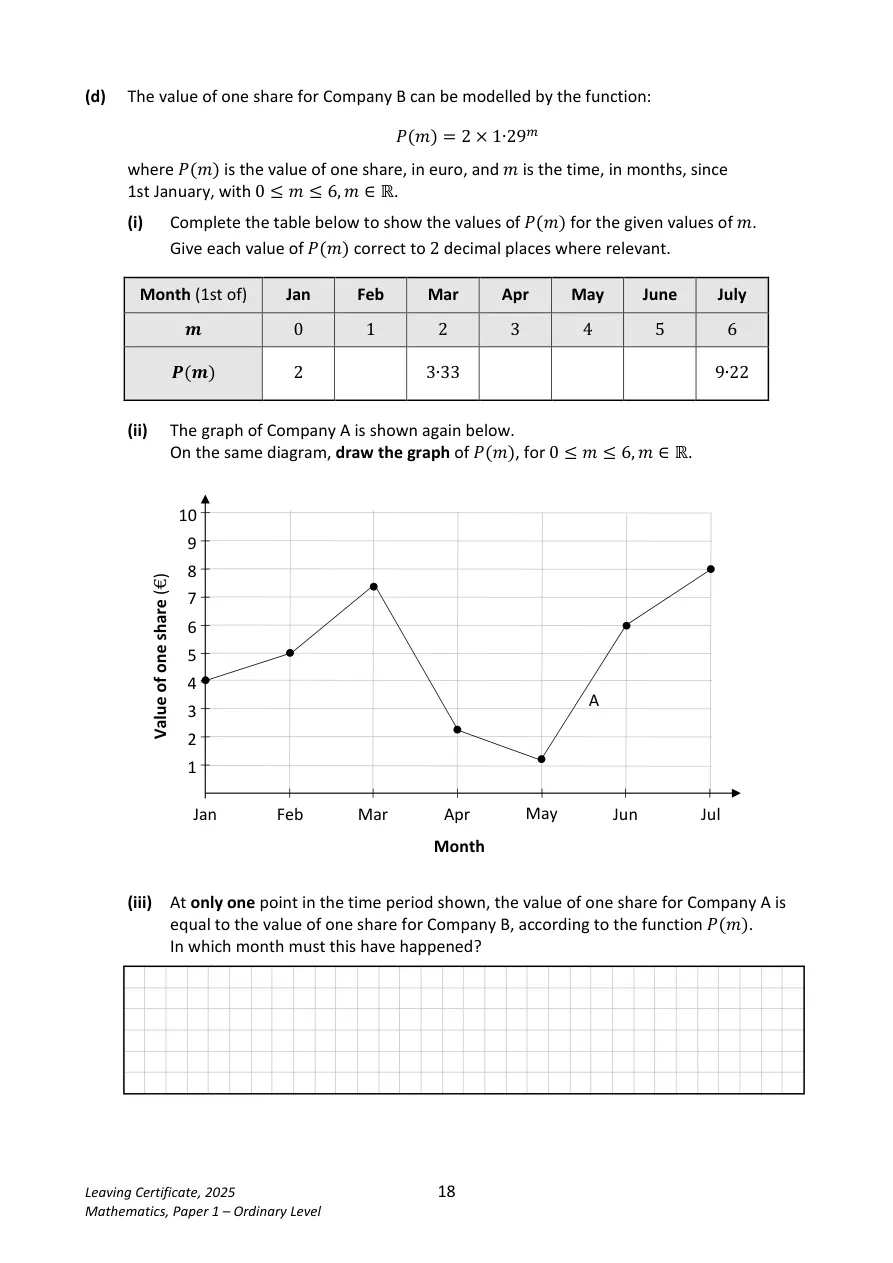
  1. P(m)=2(1.29)^m
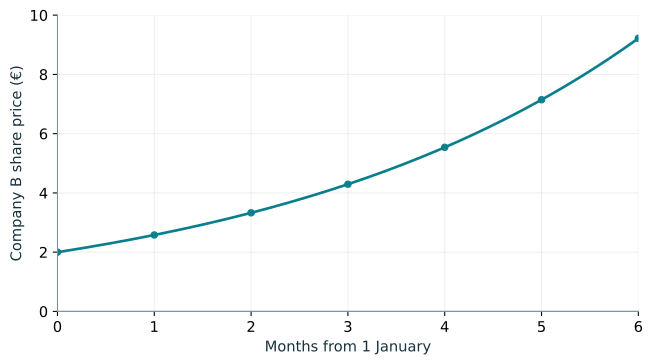
  2. For m = 0,1,2,3,4,5,6: P = 2.00, 2.58, 3.33, 4.29, 5.54, 7.14, 9.22.

d)(ii) Graph

  1. Plot the table values and join with a smooth increasing curve on the same axes as Company A.
  2. 2025-1-7-graph

d)(iii) Equal share values

  1. The curves cross during March.

e)(i) Declining model

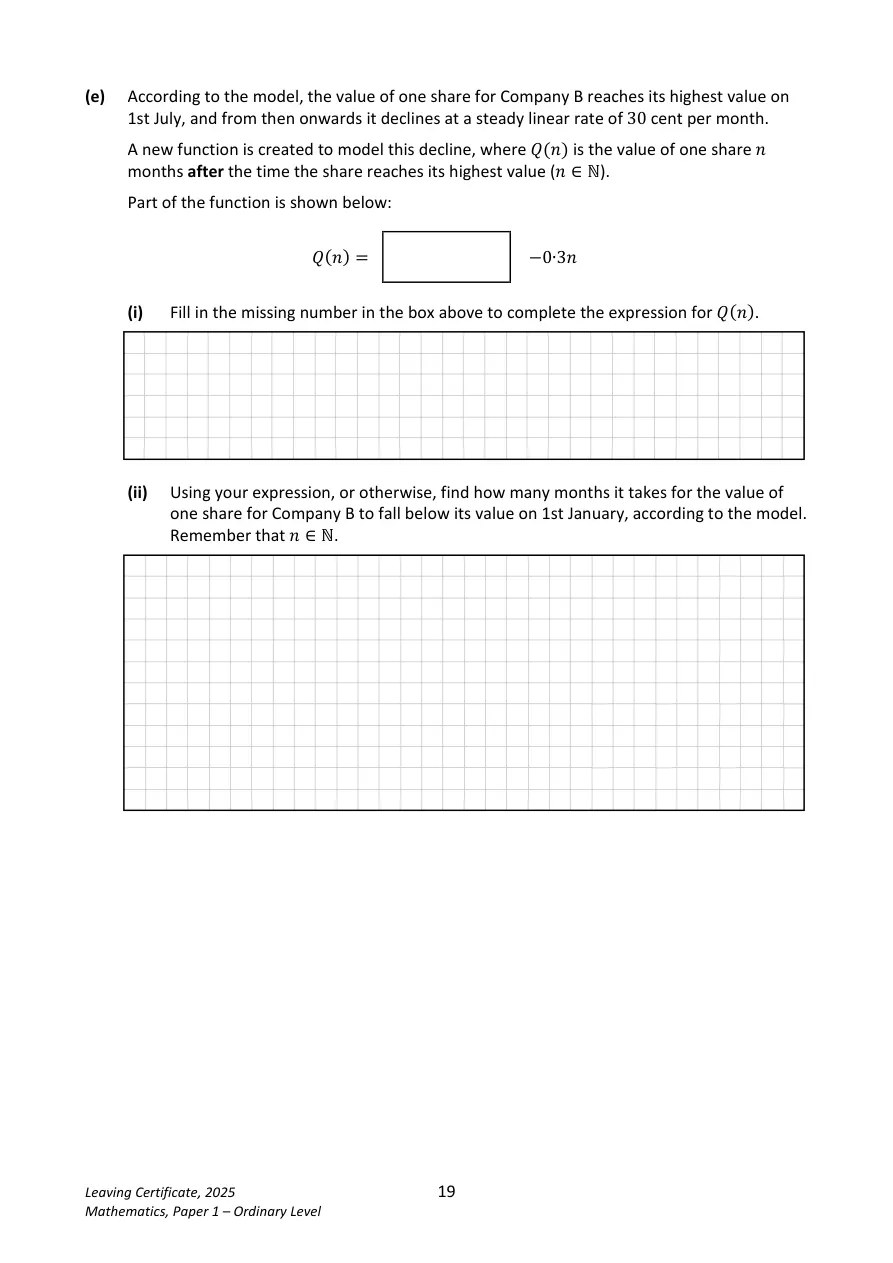
  1. Q(n)=9.22-0.3n

e)(ii) Below initial €2

  1. 9.22-0.3n<2
  2. -0.3n<-7.22
  3. n>\dfrac{7.22}{0.3}
  4. n>24.066\ldots
  5. n=25\ \mathrm{months}

    The number of months must be a whole number and the value must be strictly below €2.

Question 8

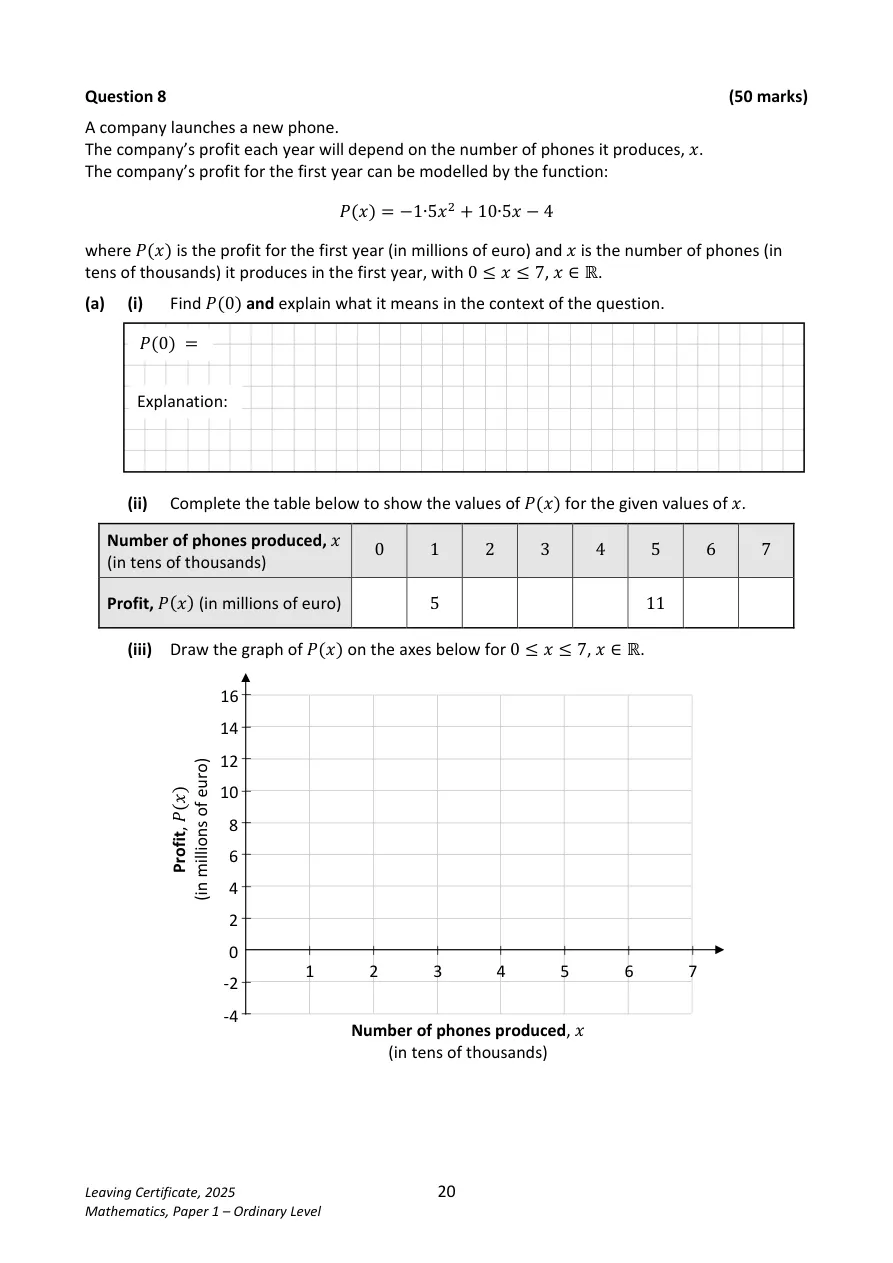
a)(i) Initial profit

  1. P(0)=-4
  2. Producing no phones gives a loss of €4 million in this model.

a)(ii) Table

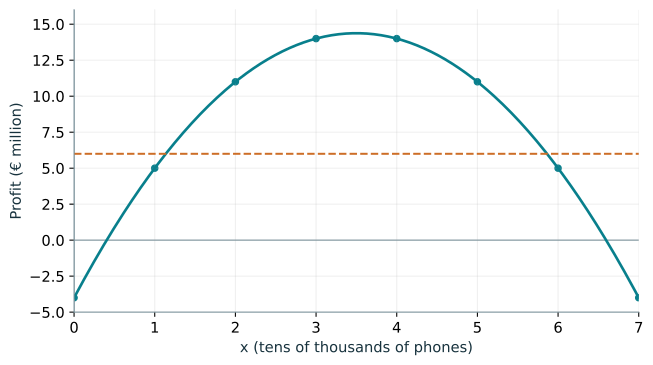
  1. For x = 0,1,2,3,4,5,6,7: P(x) = −4,5,11,14,14,11,5,−4 (millions of euro).

a)(iii) Graph

  1. 2025-1-8-graph

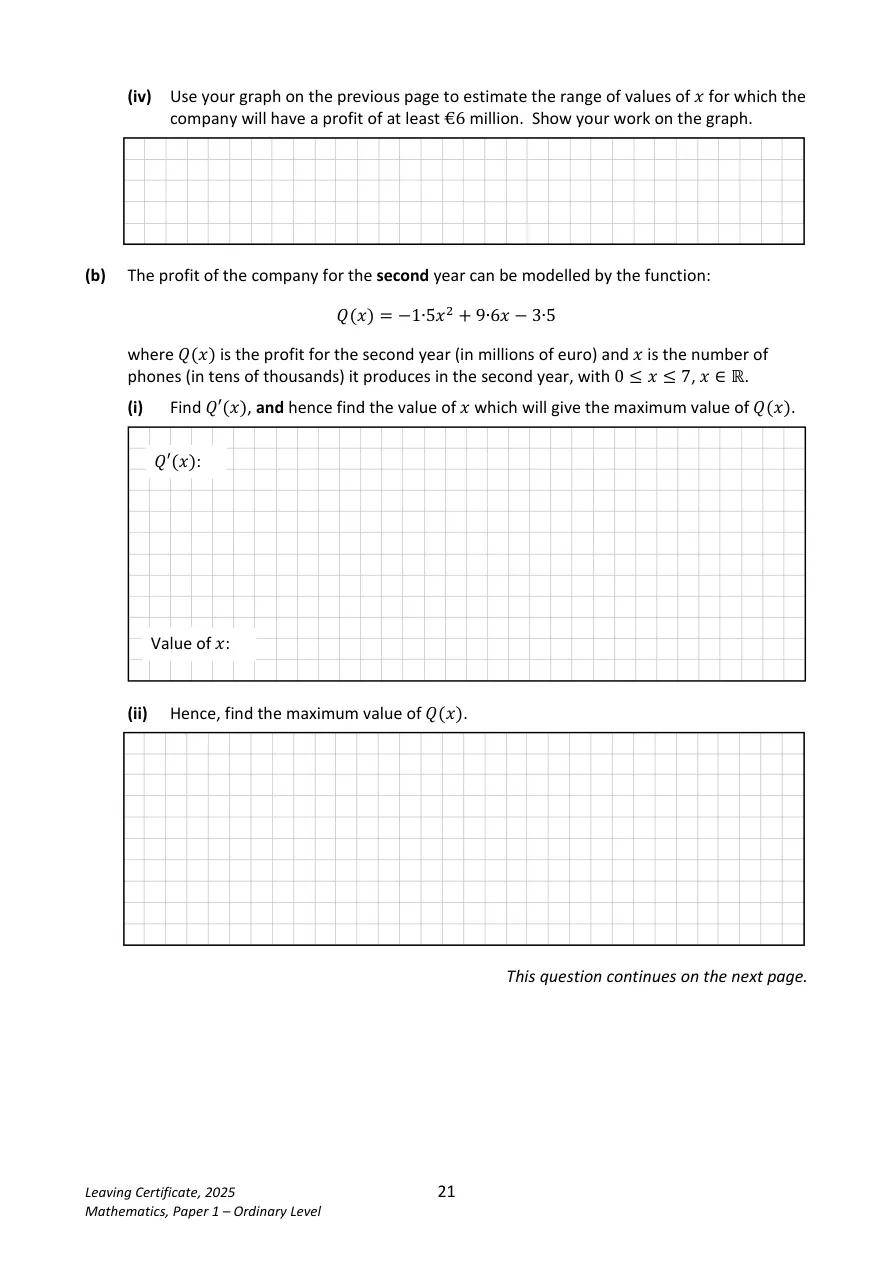
a)(iv) At least €6 million

  1. 1.2\lesssim x\lesssim5.8

    Read both intersections with the horizontal line P=6. These are graph estimates.

b)(i) Maximum of Q

  1. Q'(x)=-3x+9.6
  2. -3x+9.6=0
  3. x=3.2
  4. Q''(x)=-3<0

    Negative second derivative confirms a maximum.

b)(ii) Maximum profit

  1. Q(3.2)=-1.5(3.2)^2+9.6(3.2)-3.5
  2. Q(3.2)=11.86
  3. The maximum is €11.86 million at 32 000 phones.

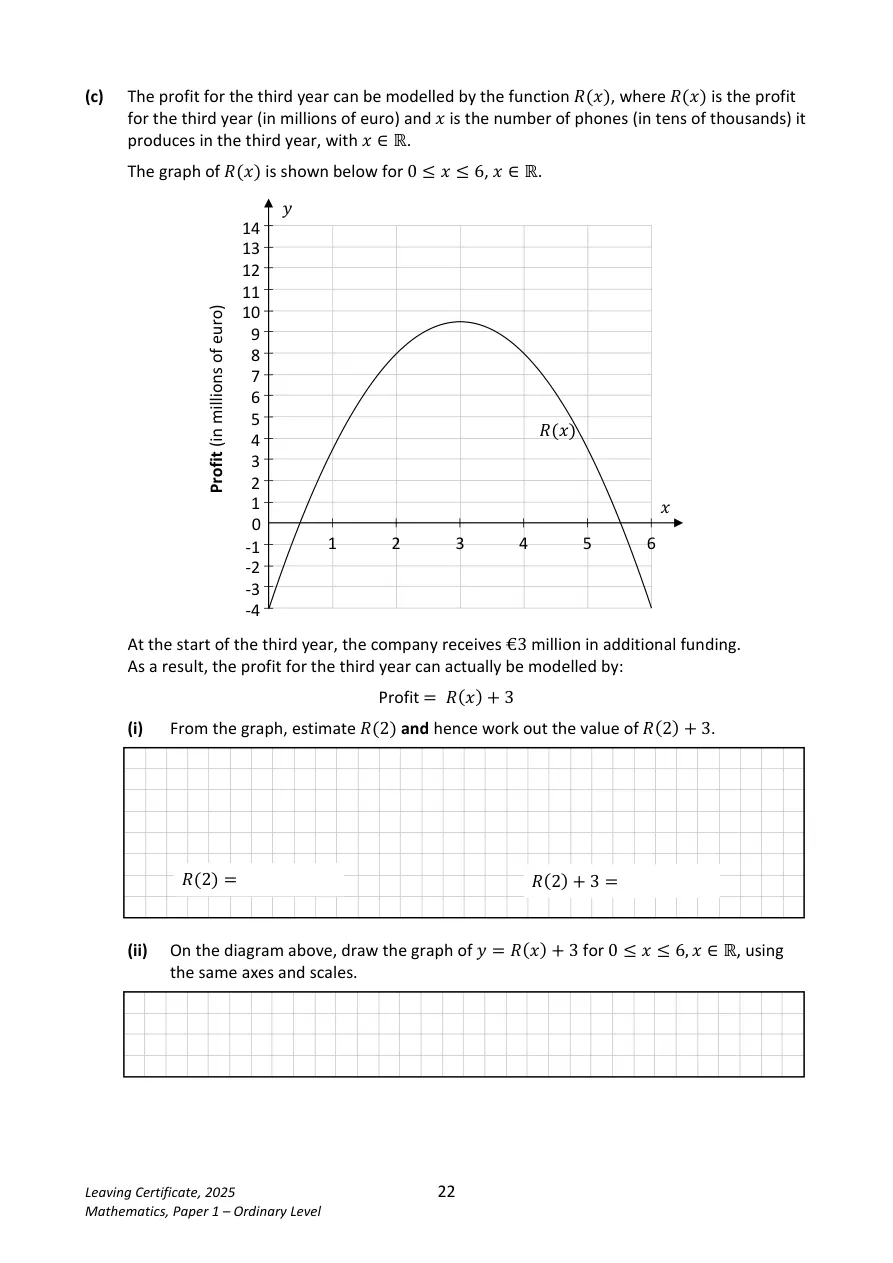
c)(i) Additional funding

  1. R(2)=8
  2. R(2)+3=11

c)(ii) Translate graph

  1. (x,y)\longmapsto(x,y+3)
  2. Move every point on the given R curve up 3 units, keeping x unchanged and the same domain 0 ≤ x ≤ 6.

Question 9

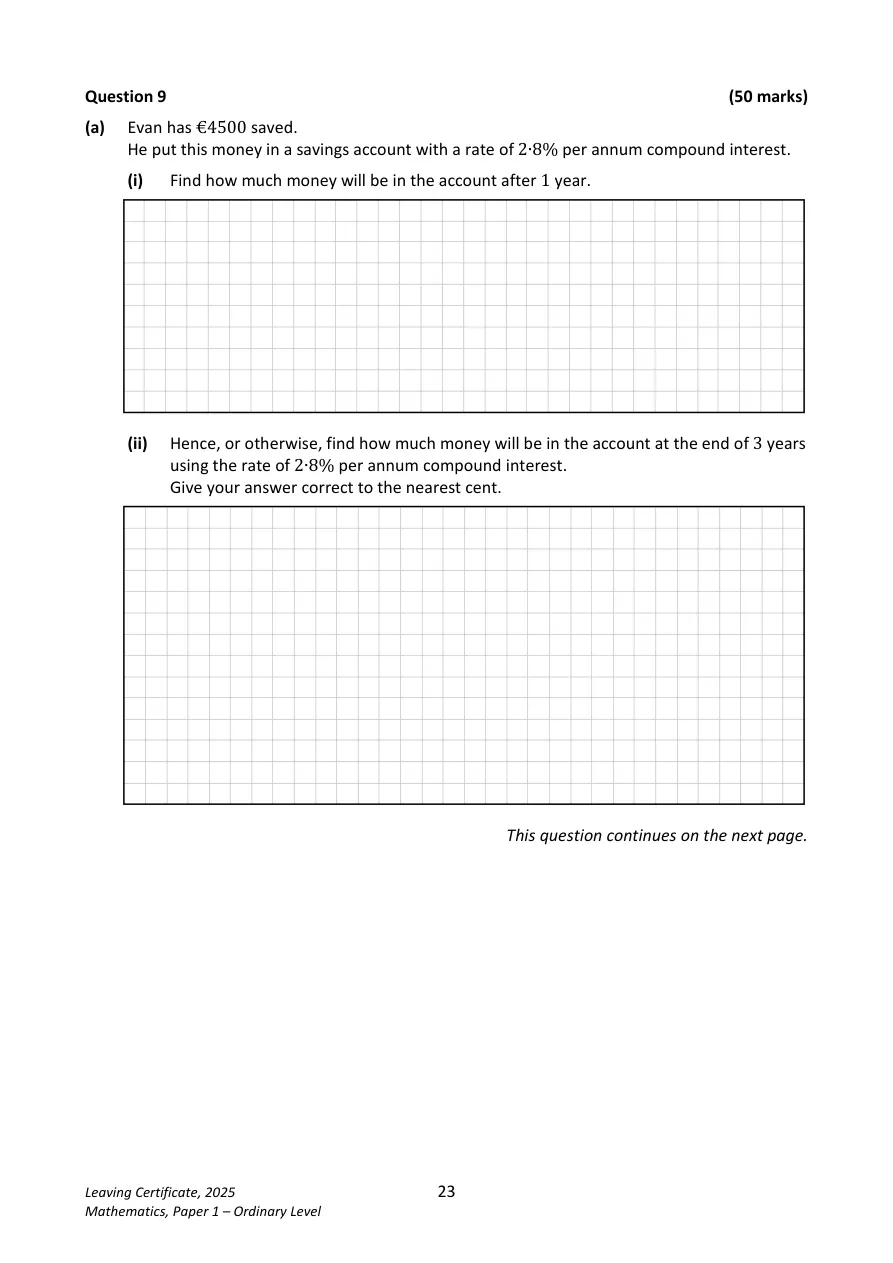
a)(i) One year

  1. A=4500(1.028)
  2. A=\mathrm{€}4626

a)(ii) Three years

  1. A=4500(1.028)^3
  2. A\approx\mathrm{€}4888.68

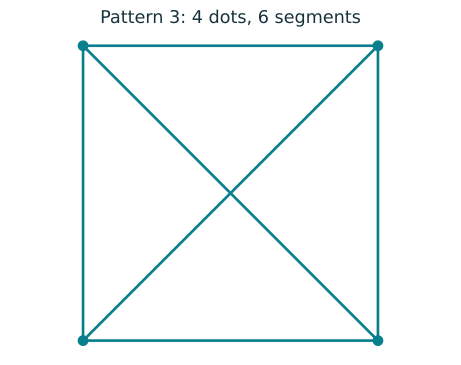
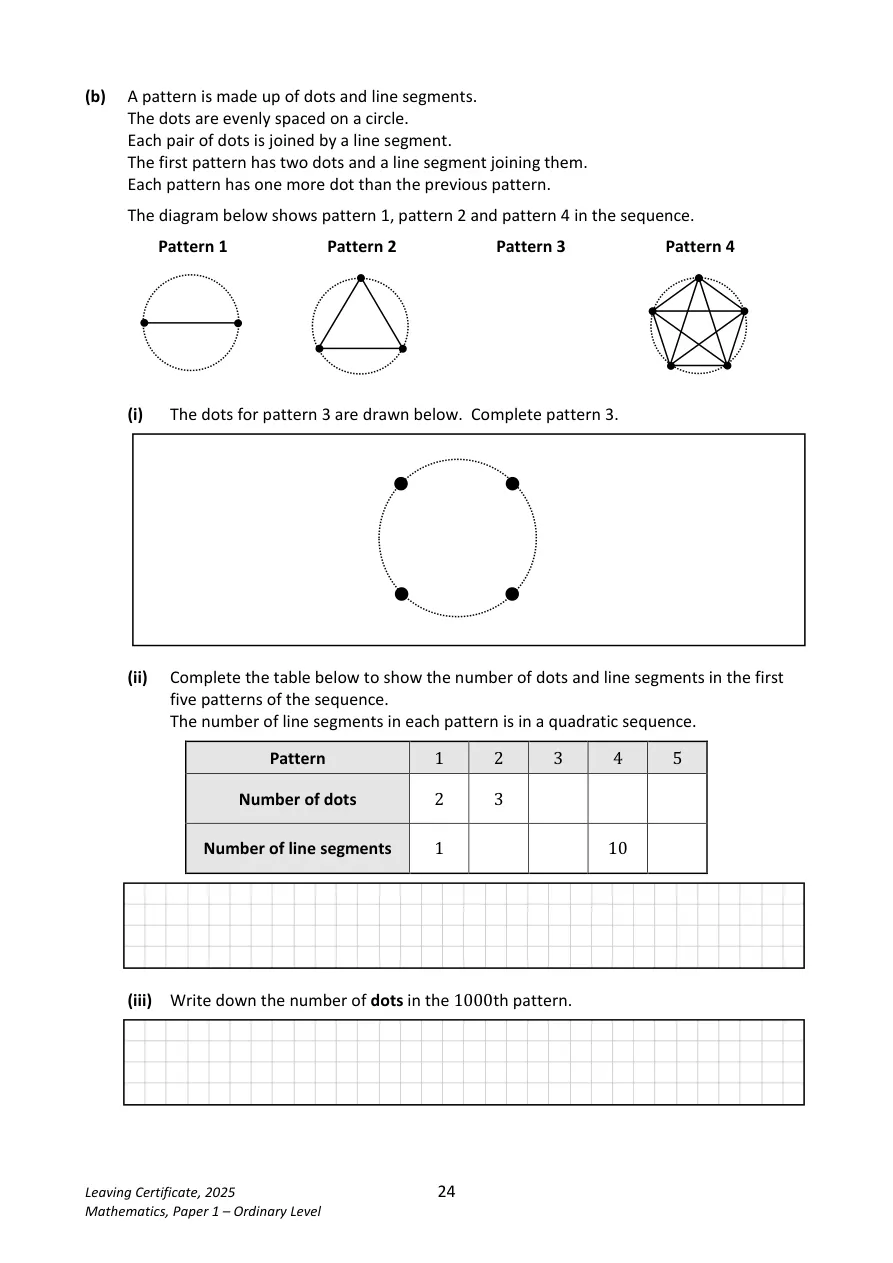
b)(i) Pattern 3

  1. Join every pair of the four given dots: four outer edges and both diagonals, six line segments altogether.
  2. 2025-1-9-pattern

b)(ii) Table

  1. Dots: 2,3,4,5,6. Line segments: 1,3,6,10,15.

b)(iii) 1000th pattern

  1. D_n=n+1
  2. D_{1000}=1001

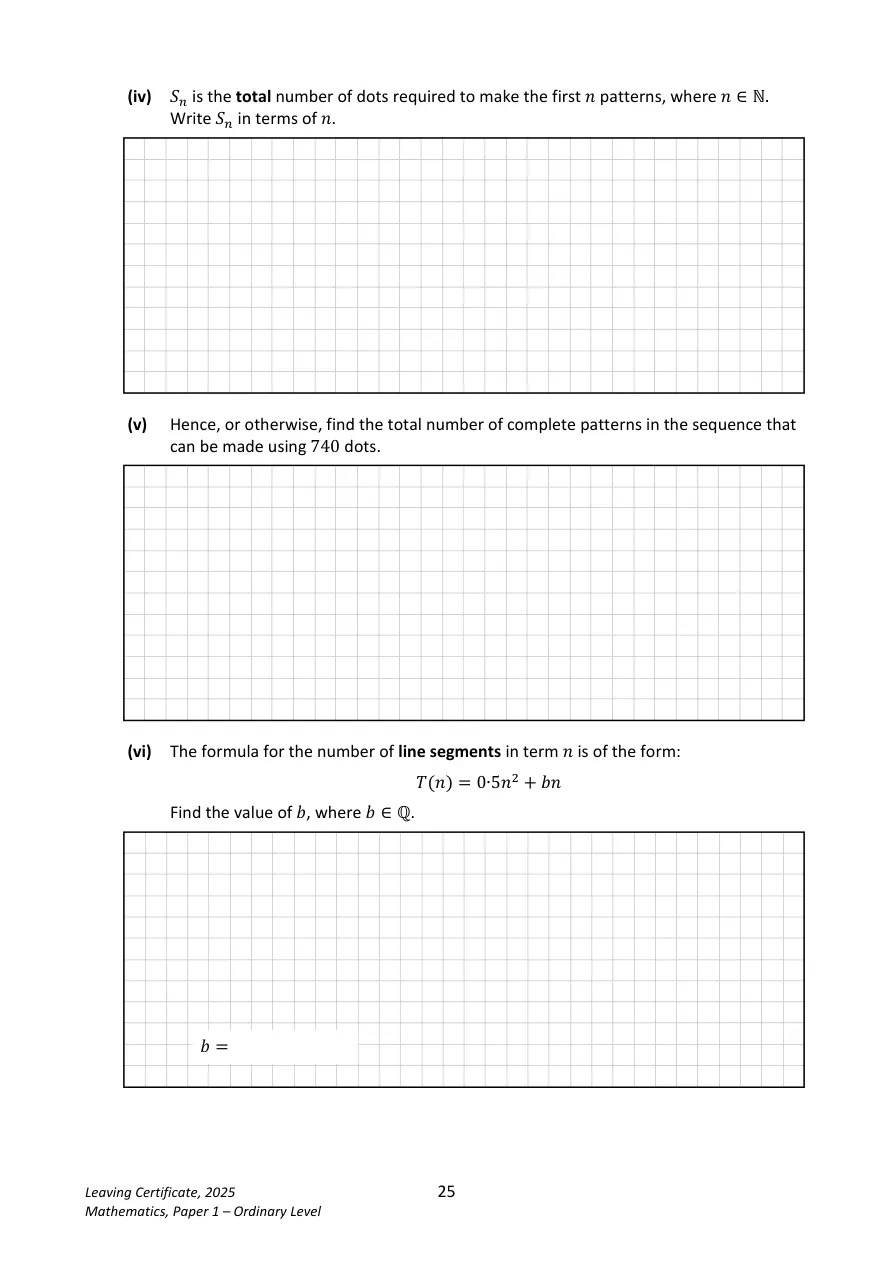
b)(iv) Total dots

  1. S_n=\dfrac{n}{2}\left(2(2)+(n-1)(1)\right)
  2. S_n=\dfrac{n(n+3)}{2}

b)(v) Use 740 dots

  1. \dfrac{n(n+3)}{2}=740
  2. n^2+3n-1480=0
  3. (n-37)(n+40)=0

    The product is zero, so at least one of the factors must be zero. Set each factor equal to zero in turn.

  4. n=37

    Reject the negative pattern count.

b)(vi) Find b

  1. T(1)=0.5(1)^2+b(1)
  2. 1=0.5+b
  3. b=0.5

Question 10

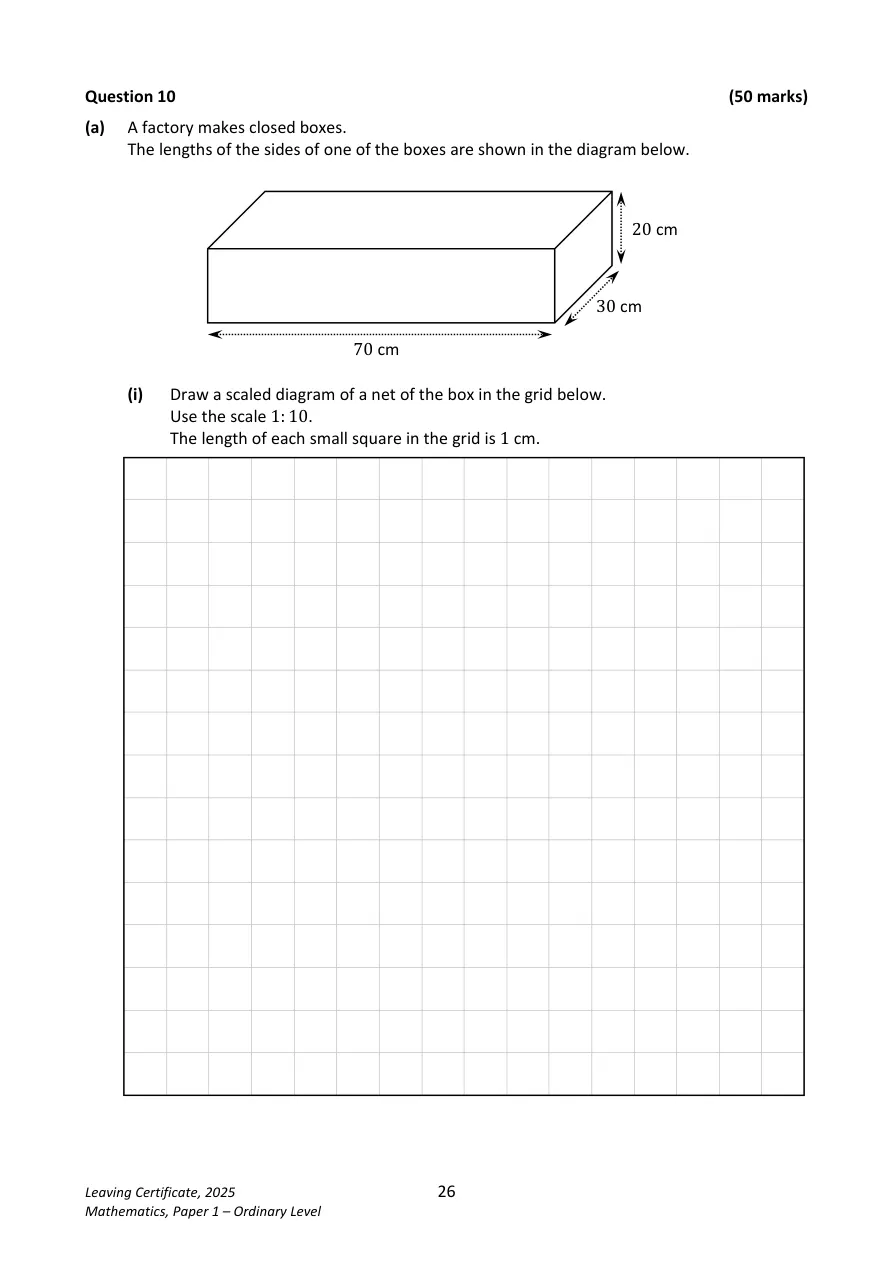
a)(i) Scaled net

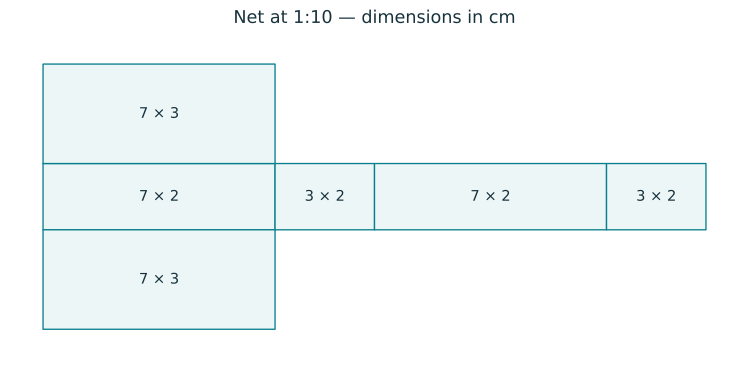
  1. Scale 1:10 gives box dimensions 7 cm, 3 cm and 2 cm. Draw four side rectangles in a strip: 7×2, 3×2, 7×2 and 3×2 cm; attach a 7×3 cm rectangle on each side of a suitable 7×2 face. The completed net has six faces.
  2. 2025-1-10-net

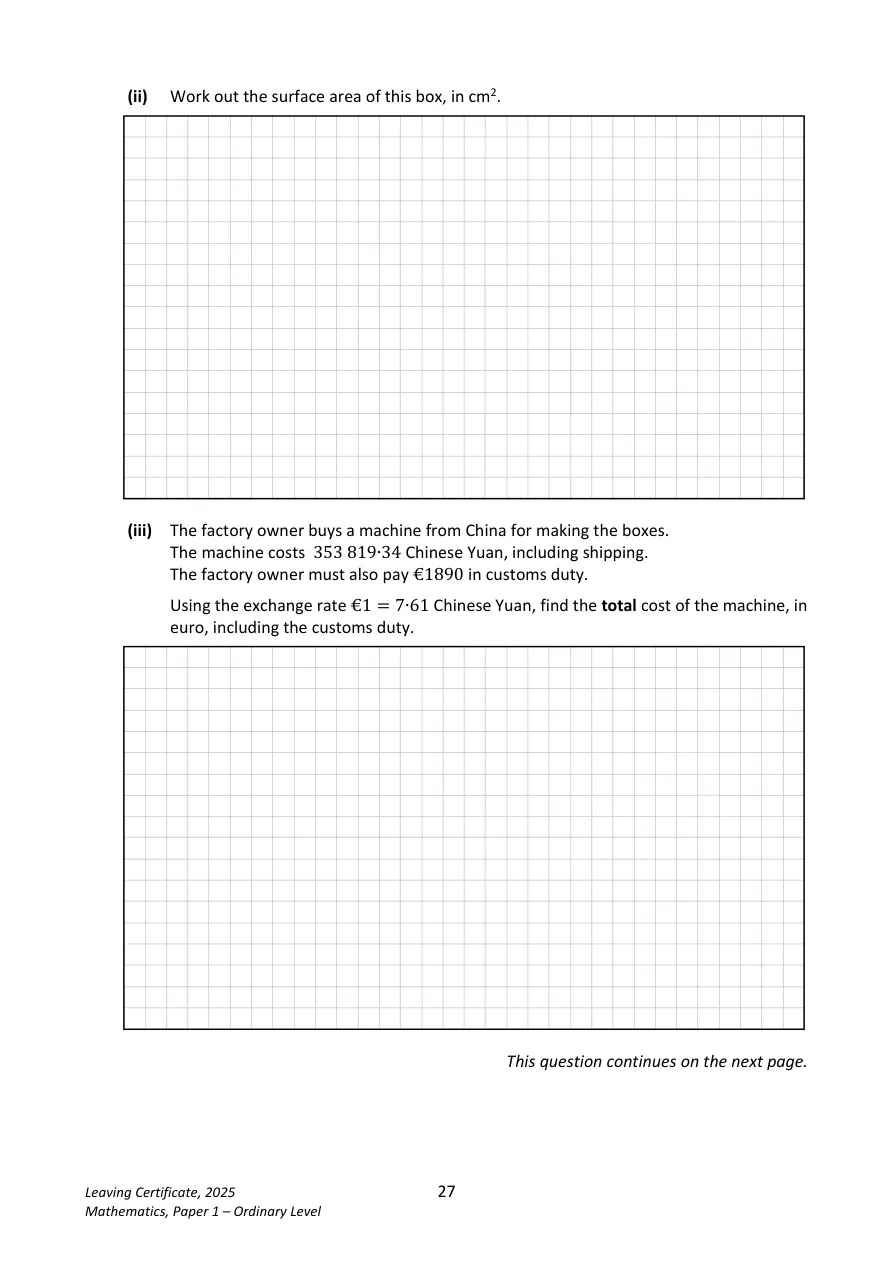
a)(ii) Surface area

  1. A=2(70(30)+70(20)+30(20))
  2. A=8200\ \mathrm{cm}^2

a)(iii) Machine cost

  1. C=\dfrac{353819.34}{7.61}+1890
  2. C=46494+1890
  3. C=\mathrm{€}48384

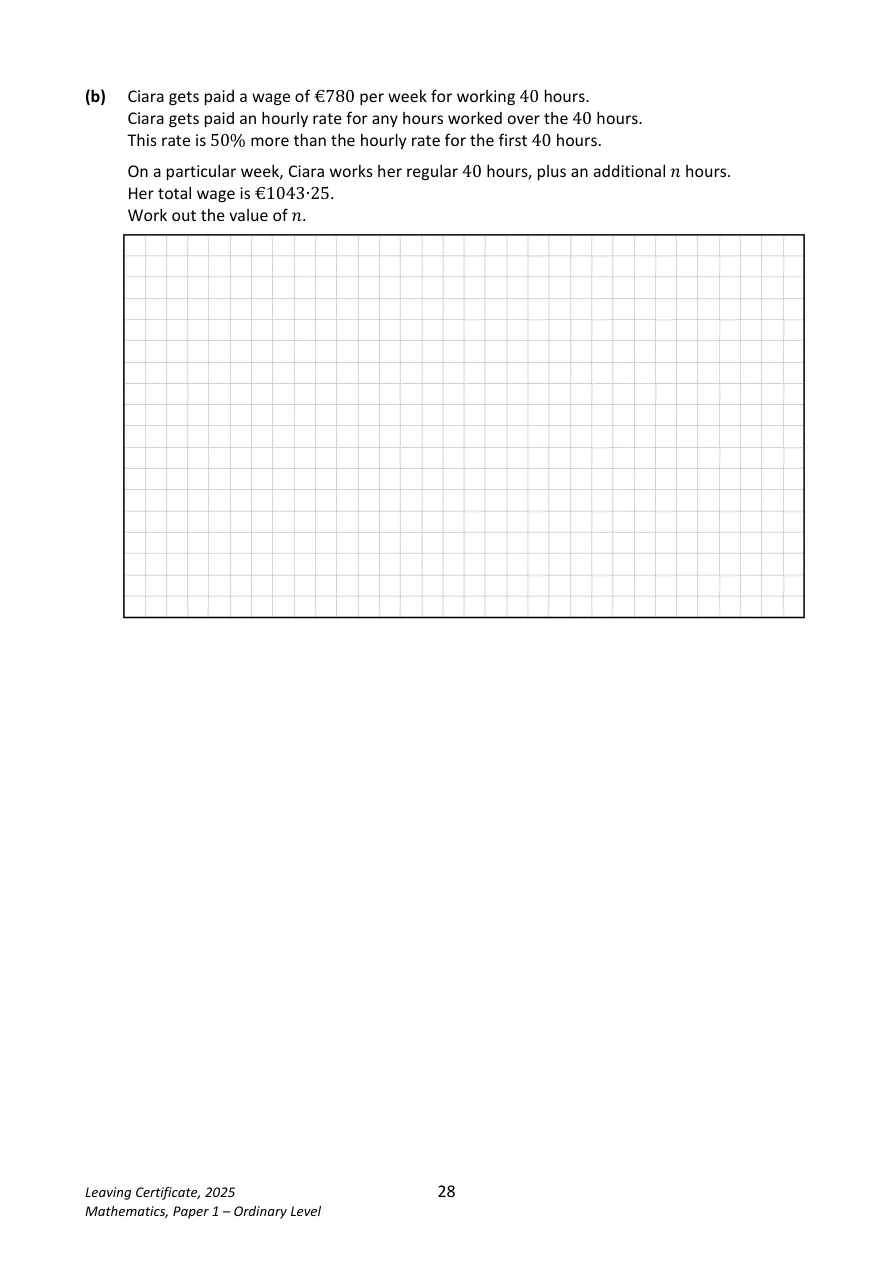
b) Overtime

  1. r=\dfrac{780}{40}=19.50
  2. r_{\mathrm{overtime}}=1.5(19.50)=29.25
  3. n=\dfrac{1043.25-780}{29.25}
  4. n=9\ \mathrm{hours}

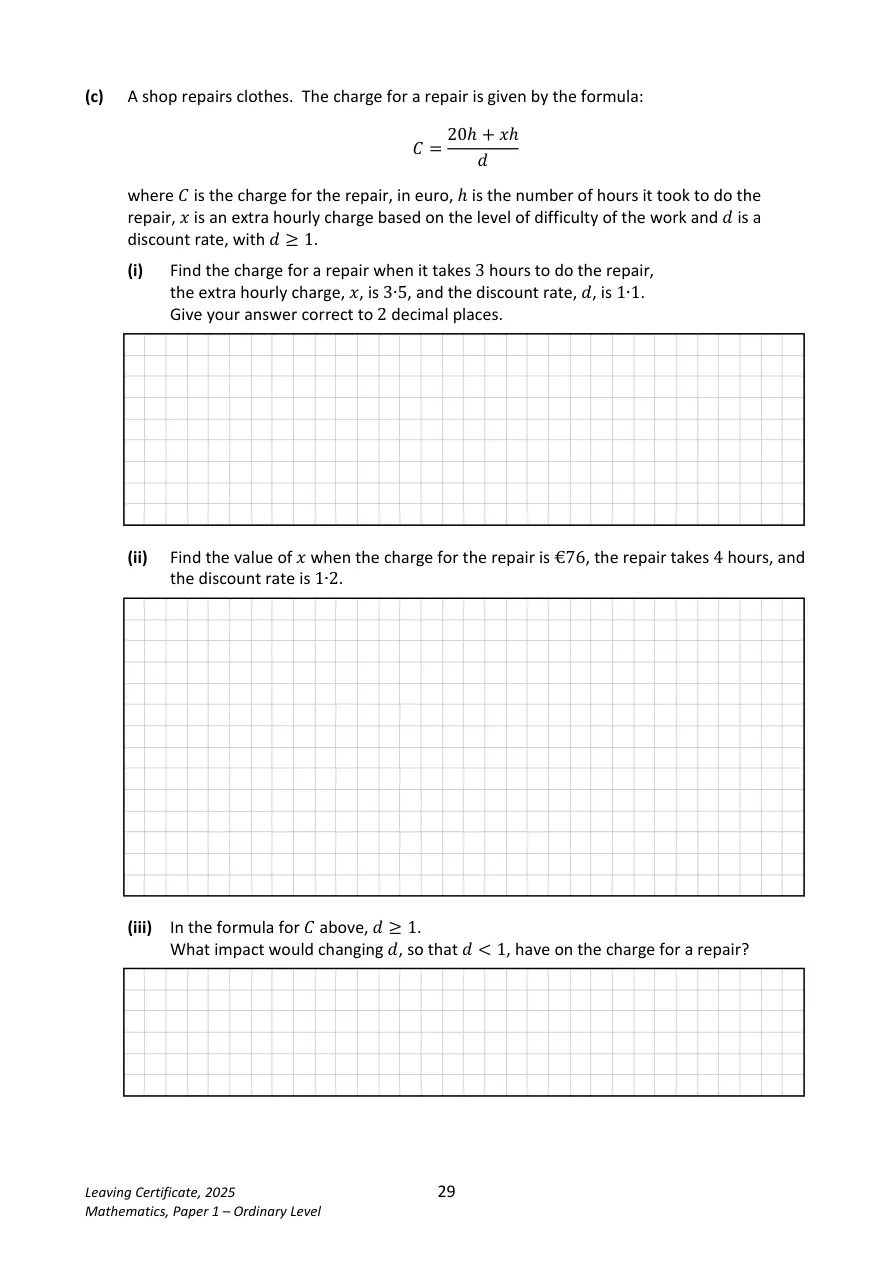
c)(i) Charge

  1. C=\dfrac{20(3)+3.5(3)}{1.1}
  2. C\approx\mathrm{€}64.09

c)(ii) Find x

  1. \dfrac{20(4)+4x}{1.2}=76
  2. 80+4x=91.2
  3. 4x=11.2
  4. x=2.8

c)(iii) Smaller divisor

  1. With the same positive numerator, a positive discount factor below 1 increases the charge above the undiscounted amount. Division by zero is undefined.
See working and diagrams on the original paper
Original exam paper page 4
C=30(1.23)
C=\mathrm{€}36.90
C_{\mathrm{usual}}=26+9=35
D=35-28=7
p=\dfrac{7}{35}\times100
p=20\%
Original exam paper page 5
\mathrm{LCM}(9,12)=36
They first finish windows together after 36 minutes: Máiréad has cleaned 4 and Diarmuid 3.
R=\dfrac{1}{9}+\dfrac{1}{12}
[add the rates, not the times]
R=\dfrac{7}{36}\ \mathrm{windows\ per\ minute}
t=\dfrac{35}{\dfrac{7}{36}}
t=180\ \mathrm{min}=3\ \mathrm{h}
Original exam paper page 6
z_2=2+3i,\quad z_3=4-i
Plot z₂ at (2,3) and z₃ at (4,−1). Horizontal axis is real; vertical axis is imaginary.
|z_1|=\sqrt{(-1)^2+2^2}
|z_1|=\sqrt{5}
z_4=1+i
|z_4|=\sqrt{2}<\sqrt{5}
[One possible answer; many others are valid.]
z₂z₃
Original exam paper page 7
\dfrac{4-6i}{1+i}\times\dfrac{1-i}{1-i}
\dfrac{4-4i-6i+6i^2}{1-i^2}
\dfrac{-2-10i}{2}
[Replace i² by −1.]
-1-5i
Original exam paper page 8
A=\dfrac{6.60}{3}=\mathrm{€}2.20
B=\dfrac{29.99}{12}\approx\mathrm{€}2.50
Offer A is cheaper per bar.
2x+4\geq6x-8
-4x\geq-12
x\leq3
[dividing by −4 reverses the sign]
Original exam paper page 9
k=6,\quad t=2
kt=12
(x+6)(x+2)=x^2+8x+12
b=8
[This value depends on the valid pair chosen in part (i).]
Original exam paper page 10
5(a-3)=2a+7
5a-15=2a+7
3a=22
a=\dfrac{22}{3}
f'(x)=3x^2-6x+4
[Differentiate each term using the power rule.]
f'(2)=3(2)^2-6(2)+4
f'(2)=4
Original exam paper page 11
P is a turning point with a horizontal tangent, so its derivative is zero.
QPR
Original exam paper page 12
x=\dfrac{2\pm\sqrt{(-2)^2-4(3)(-4)}}{2(3)}
x=\dfrac{2\pm\sqrt{52}}{6}
x\approx1.54\quad\mathrm{or}\quad x\approx-0.87
\begin{aligned}3x+2y&=11\\{}x-4y&=-1\\6x+4y&=22\\7x&=21\\{}x&=3\\3-4y&=-1\\{}y&=1\end{aligned}
[Double the first equation, then add the second; the y terms cancel.]
Original exam paper page 13
x=-2,\quad x=8
x=\dfrac{-2+8}{2}
x=3
[The axis of symmetry is halfway between the roots.]
Original exam paper page 14
S=90(1.25)
S=\mathrm{€}112.50
P=112.50-90=\mathrm{€}22.50
M=\dfrac{22.50}{112.50}\times100
M=20\%
[Margin uses selling price as the denominator; profit percentage uses cost.]
5.8 × 10⁴3.6 × 10⁻²
Original exam paper page 15
d=(3\times10^5)(60)(60)(24)(365)
d=9.4608\times10^{12}\ \mathrm{km}
Original exam paper page 16
6.8
(i) Approximately €7.30.
(ii) May: between 1 May and 1 June.
Original exam paper page 17
A=8(0.85)
A=\mathrm{€}6.80
Plot the August point at height 6.8 on the original graph.
\mathrm{Actual}=\dfrac{1.50}{0.163}
\mathrm{Actual}\approx\mathrm{€}9.20
Original exam paper page 18
Join the plotted values with a smooth increasing curve.
The curves cross during March.
B
2.584.295.547.14
Original exam paper page 19
Q(n)=9.22-0.3n
9.22-0.3n<2
-0.3n<-7.22
n>\dfrac{7.22}{0.3}
n>24.066\ldots
n=25\ \mathrm{months}
[The number of months must be a whole number and the value must be strictly below €2.]
Original exam paper page 20
−41114145−4
P(0)=-4
Producing no phones gives a loss of €4 million in this model.
Original exam paper page 21
1.2\lesssim x\lesssim5.8
[Read both intersections with the horizontal line P=6. These are graph estimates.]
Q'(x)=-3x+9.6
-3x+9.6=0
x=3.2
Q''(x)=-3<0
[Negative second derivative confirms a maximum.]
Q(3.2)=-1.5(3.2)^2+9.6(3.2)-3.5
Q(3.2)=11.86
The maximum is €11.86 million at 32 000 phones.
Original exam paper page 22
R(2)=8
R(2)+3=11
(x,y)\longmapsto(x,y+3)
Move every point on the given R curve up 3 units, keeping x unchanged and the same domain 0 ≤ x ≤ 6.
R(x) + 3
Original exam paper page 23
A=4500(1.028)
A=\mathrm{€}4626
A=4500(1.028)^3
A\approx\mathrm{€}4888.68
Original exam paper page 24
Join every pair of the four given dots: four outer edges and both diagonals, six line segments altogether.
D_n=n+1
D_{1000}=1001
4563615
Original exam paper page 25
S_n=\dfrac{n}{2}\left(2(2)+(n-1)(1)\right)
S_n=\dfrac{n(n+3)}{2}
\dfrac{n(n+3)}{2}=740
n^2+3n-1480=0
(n-37)(n+40)=0
n=37
[Reject the negative pattern count.]
T(1)=0.5(1)^2+b(1)
1=0.5+b
b=0.5
Original exam paper page 26
At scale 1:10 the box is 7 cm × 3 cm × 2 cm. The strip has four 7 cm-high faces; attach the two 3 cm × 2 cm ends.
3 × 23 × 23 × 72 × 73 × 72 × 7
Original exam paper page 27
A=2(70(30)+70(20)+30(20))
A=8200\ \mathrm{cm}^2
C=\dfrac{353819.34}{7.61}+1890
C=46494+1890
C=\mathrm{€}48384
Original exam paper page 28
r=\dfrac{780}{40}=19.50
r_{\mathrm{overtime}}=1.5(19.50)=29.25
n=\dfrac{1043.25-780}{29.25}
n=9\ \mathrm{hours}
Original exam paper page 29
C=\dfrac{20(3)+3.5(3)}{1.1}
C\approx\mathrm{€}64.09
\dfrac{20(4)+4x}{1.2}=76
80+4x=91.2
4x=11.2
x=2.8
With the same positive numerator, a positive discount factor below 1 increases the charge above the undiscounted amount. Division by zero is undefined.