← Original paper

Leaving Cert Ordinary Maths 2025 · Paper 2

Teacher worked solutions. Explanations are in blue.

Question 1

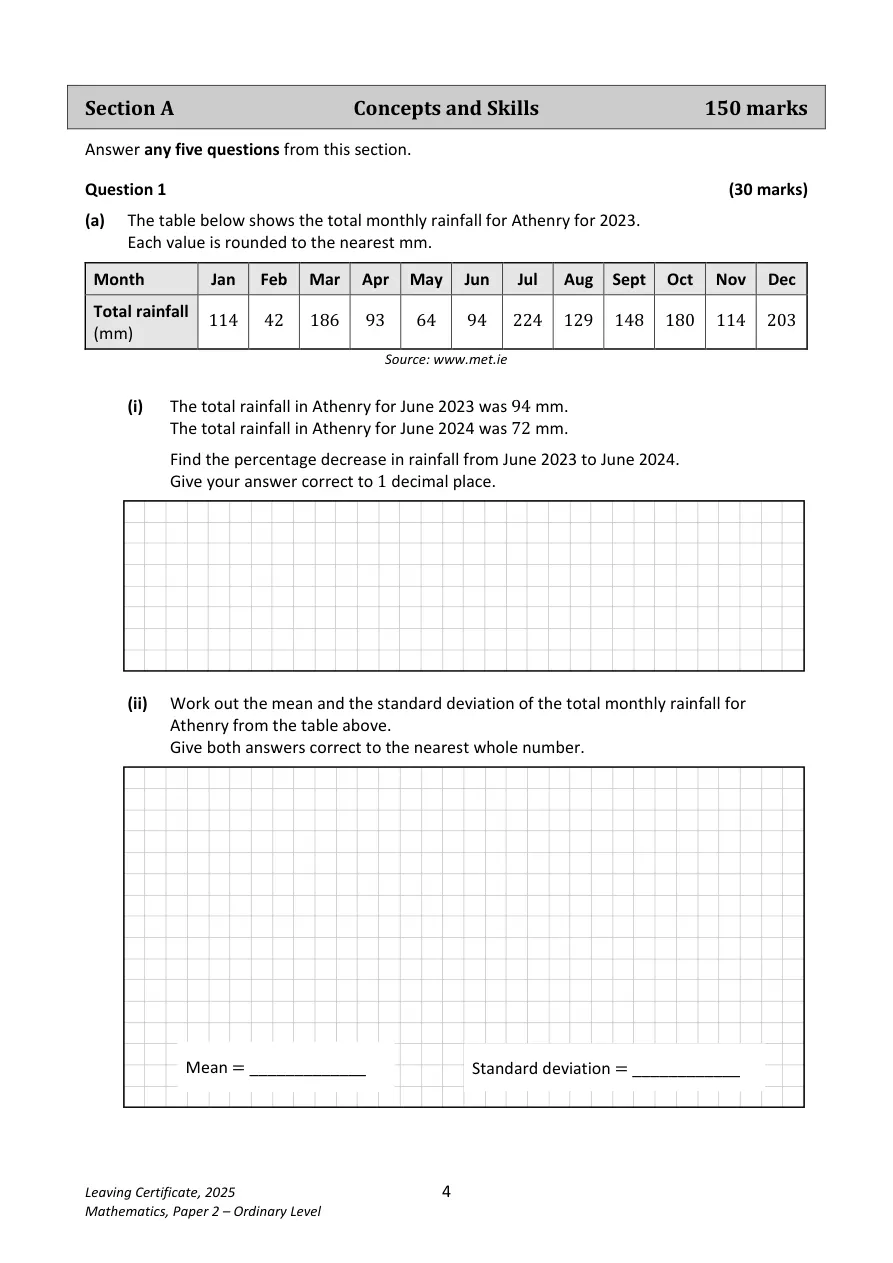
a)(i) Rainfall decrease

  1. p=\dfrac{94-72}{94}\times100
  2. p\approx23.4\%

a)(ii) Mean and population standard deviation

  1. \bar{x}=\dfrac{1591}{12}
  2. \bar{x}\approx133\ \mathrm{mm}
  3. \sigma=\sqrt{\dfrac{\sum(x-\bar{x})^2}{12}}
  4. \sigma\approx54\ \mathrm{mm}

    Use population standard deviation σ on the calculator, not sample s.

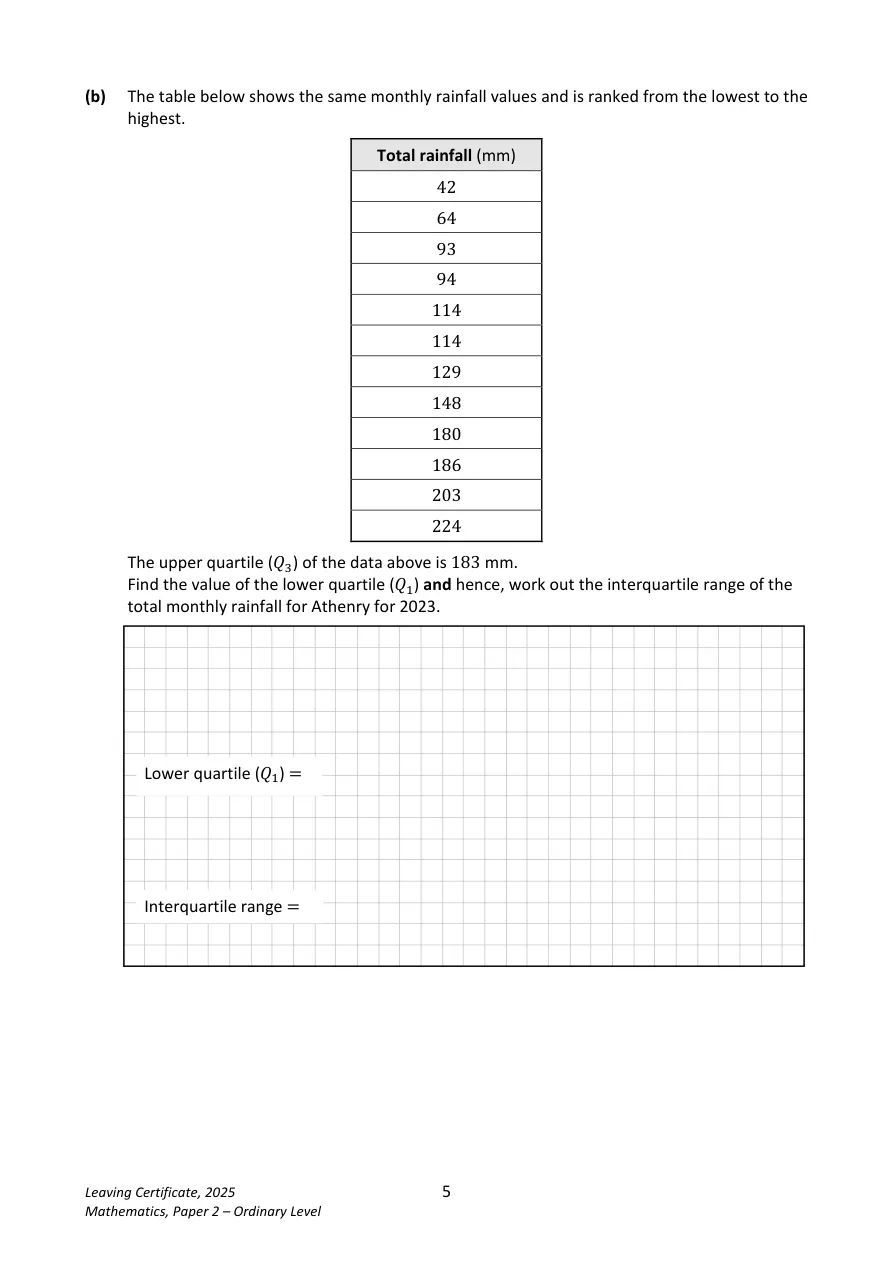
b) Quartiles

  1. Q_1=\dfrac{93+94}{2}
  2. Q_1=93.5\ \mathrm{mm}
  3. IQR=183-93.5
  4. IQR=89.5\ \mathrm{mm}
Question 2

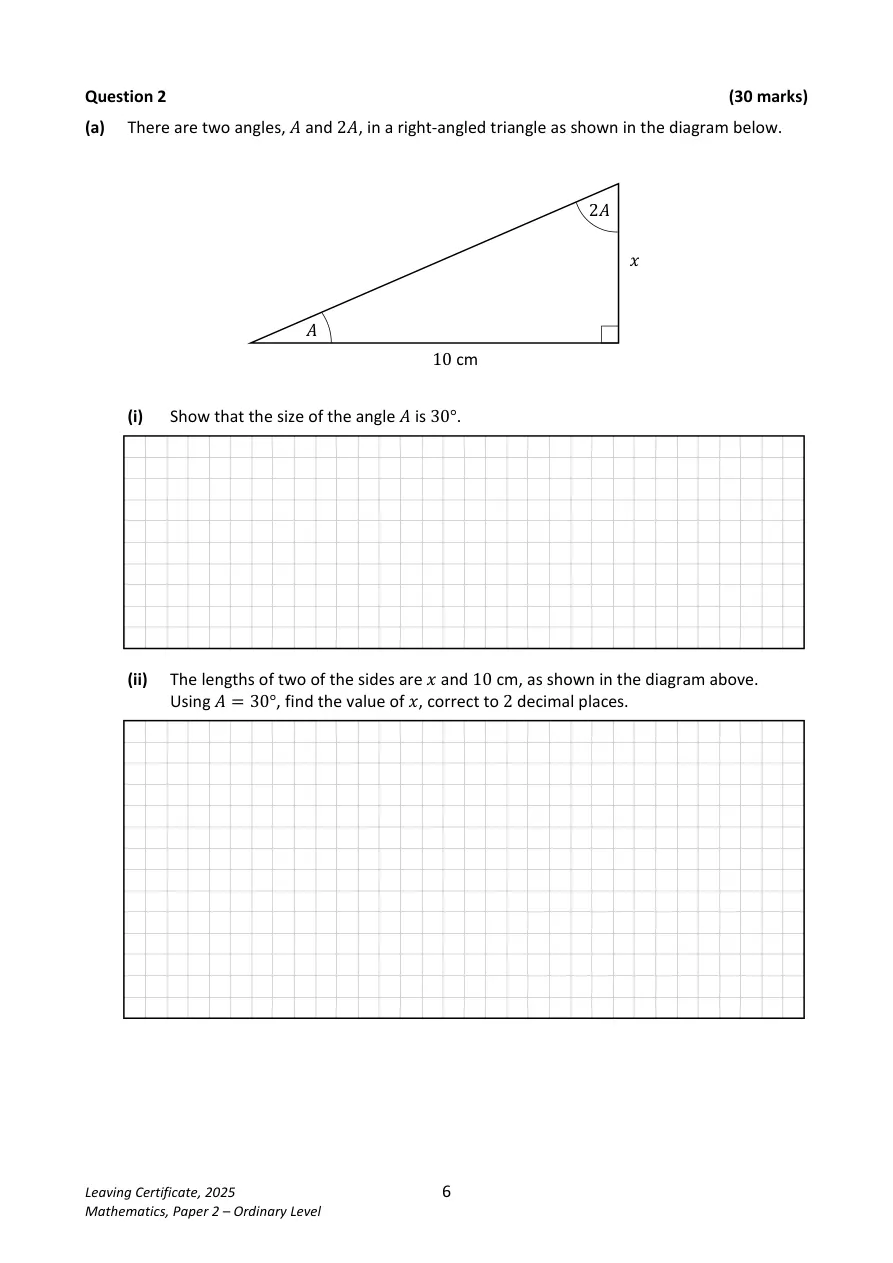
a)(i) Angle A

  1. A+2A+90^{\circ}=180^{\circ}
  2. 3A=90^{\circ}
  3. A=30^{\circ}

a)(ii) Side x

  1. \tan30^{\circ}=\dfrac{x}{10}
  2. x=10\tan30^{\circ}
  3. x\approx5.77\ \mathrm{cm}

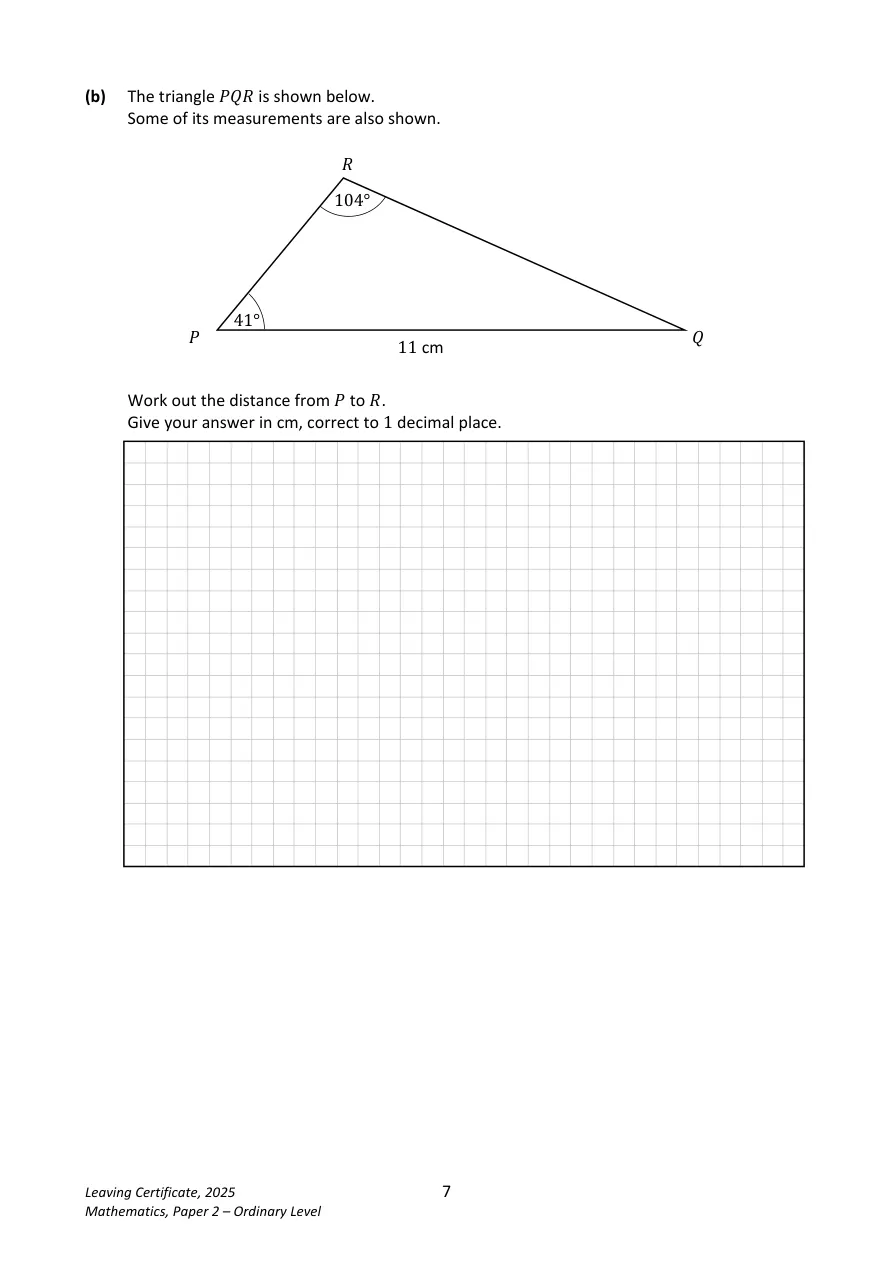
b) Side PR

  1. Q=180^{\circ}-104^{\circ}-41^{\circ}
  2. Q=35^{\circ}
  3. \dfrac{PR}{\sin35^{\circ}}=\dfrac{11}{\sin104^{\circ}}
  4. PR=\dfrac{11\sin35^{\circ}}{\sin104^{\circ}}
  5. PR\approx6.5\ \mathrm{cm}

Question 3

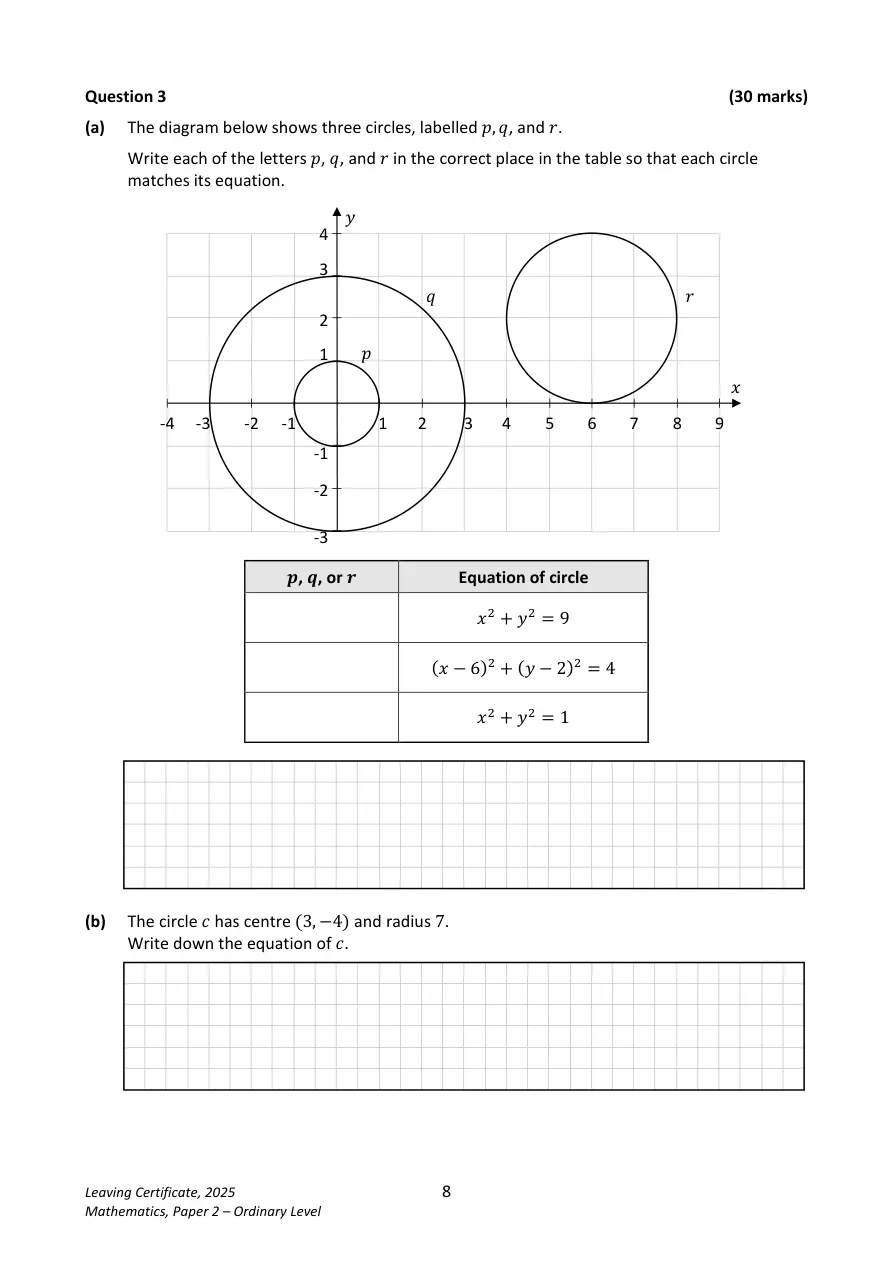
a) Match circles

  1. In table order: q; r; p. Centres and radii identify each circle.

b) Equation

  1. (x-3)^2+(y+4)^2=49

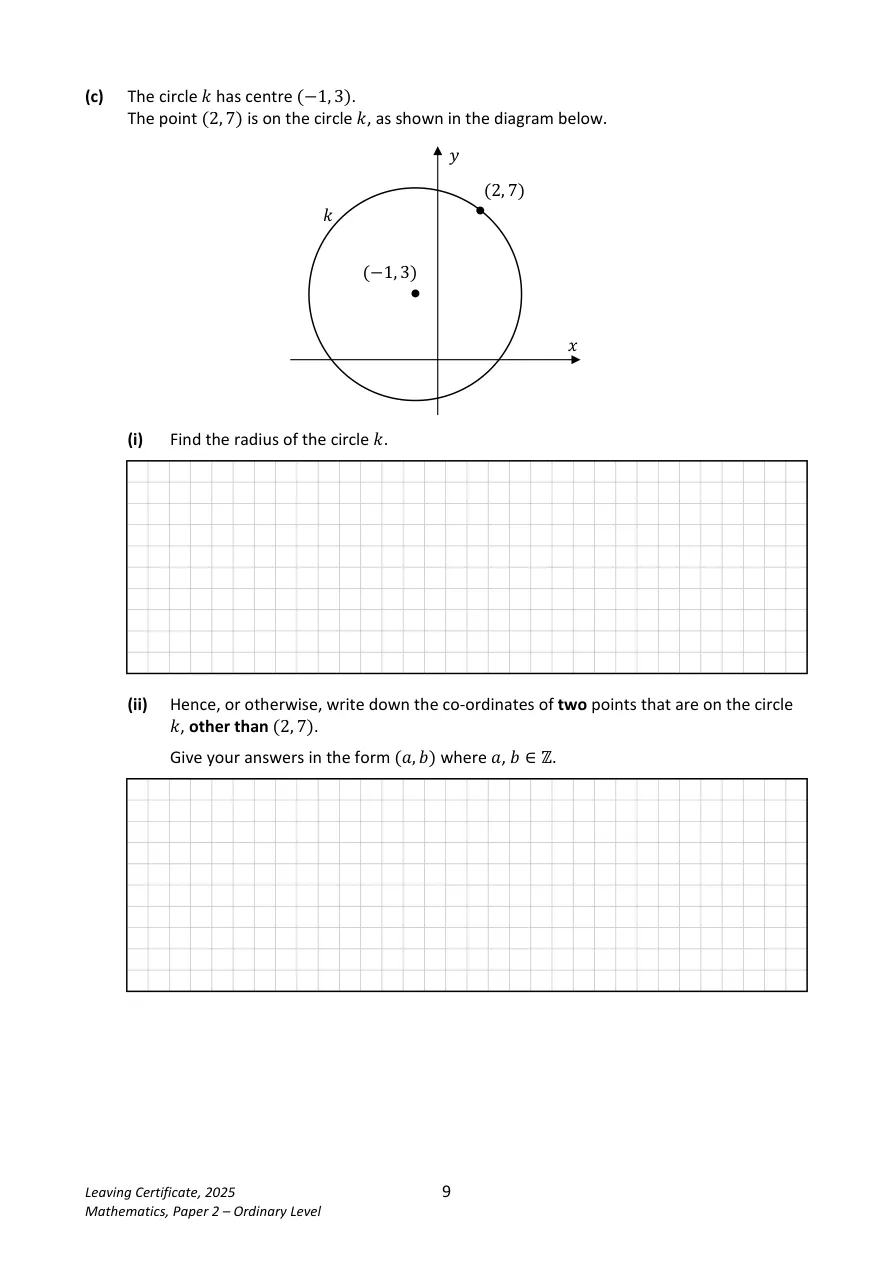
c)(i) Radius

  1. r=\sqrt{(2-(-1))^2+(7-3)^2}

    Subtract the x-coordinates and the y-coordinates separately. Square each difference, add the squares, then take the square root.

  2. r=\sqrt{9+16}
  3. r=5

c)(ii) Other points

  1. (-6,3),\quad(4,3)

    Move one radius horizontally left or right of the centre (−1,3).

Question 4

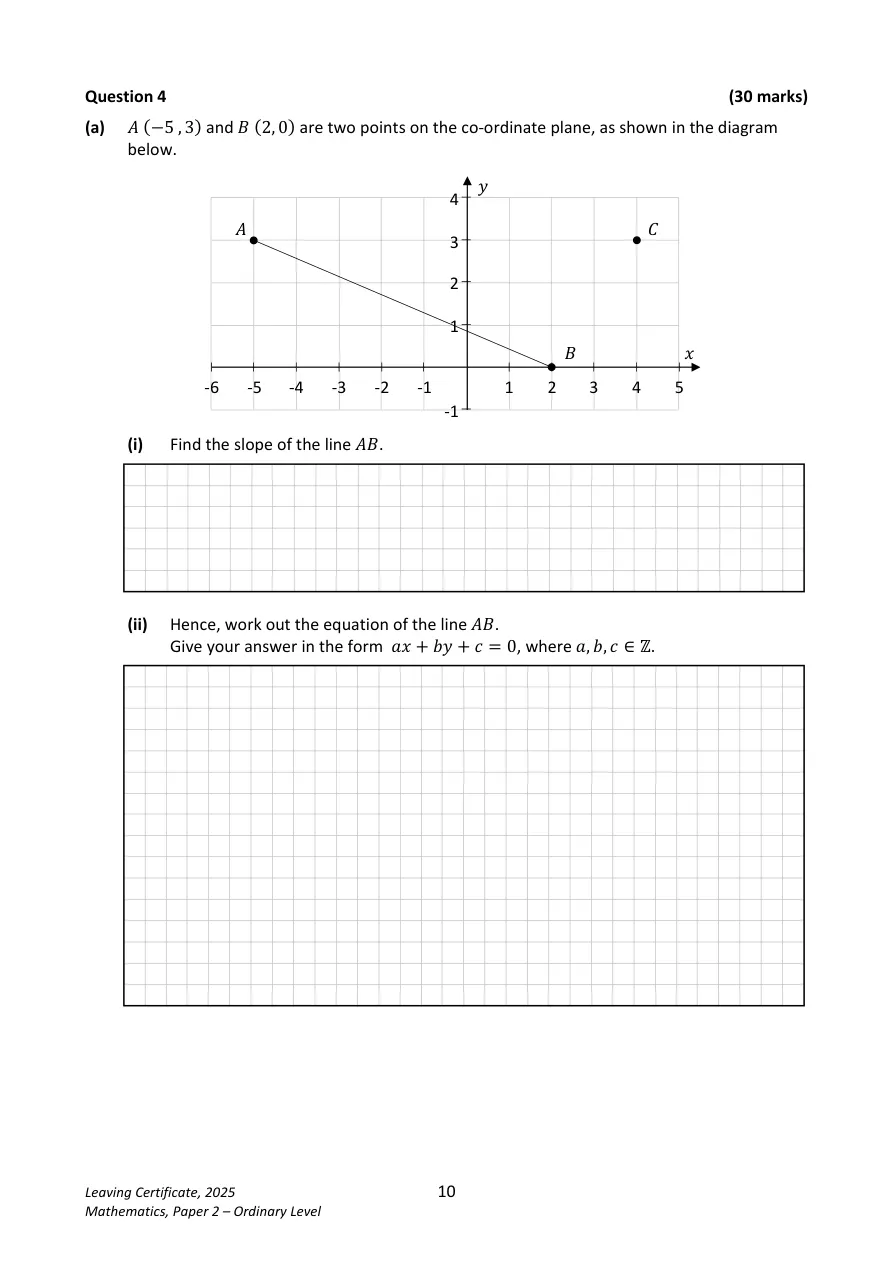
a)(i) Slope AB

  1. m=\dfrac{0-3}{2-(-5)}

    Subtract the y-coordinates for the top and the x-coordinates for the bottom. Use the same point first in both subtractions.

  2. m=-\dfrac{3}{7}

a)(ii) Equation

  1. y-3=-\dfrac{3}{7}(x+5)
  2. 7y-21=-3x-15
  3. 3x+7y-6=0

a)(iii) Area

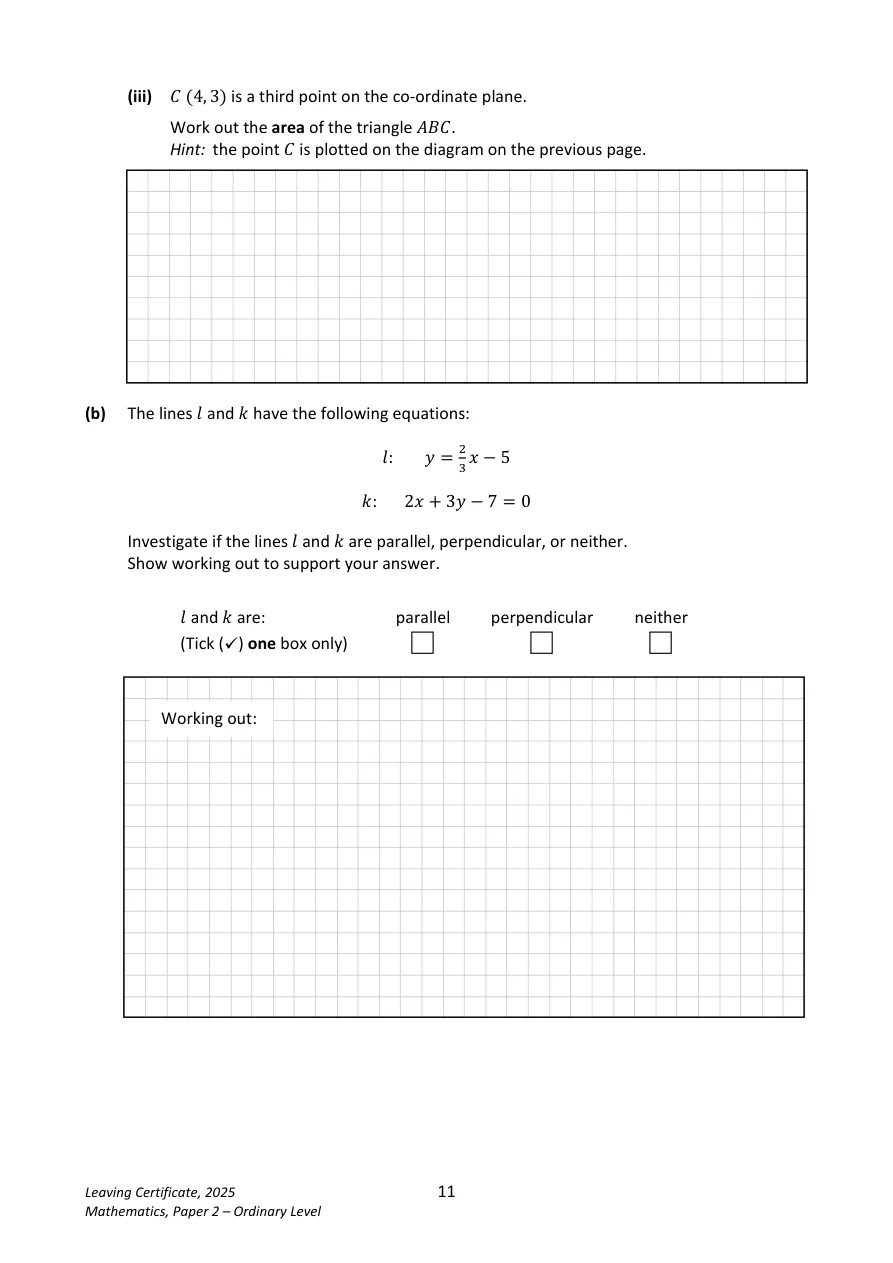
  1. A=\dfrac{1}{2}(9)(3)
  2. A=13.5\ \mathrm{units}^2

    AC is horizontal, length 9; the perpendicular height from B is 3.

b) Compare slopes

  1. m_l=\dfrac{2}{3}
  2. m_k=-\dfrac{2}{3}
  3. m_lm_k=-\dfrac{4}{9}
  4. Neither: the slopes are unequal, and their product is not −1.

Question 5

a) Angles

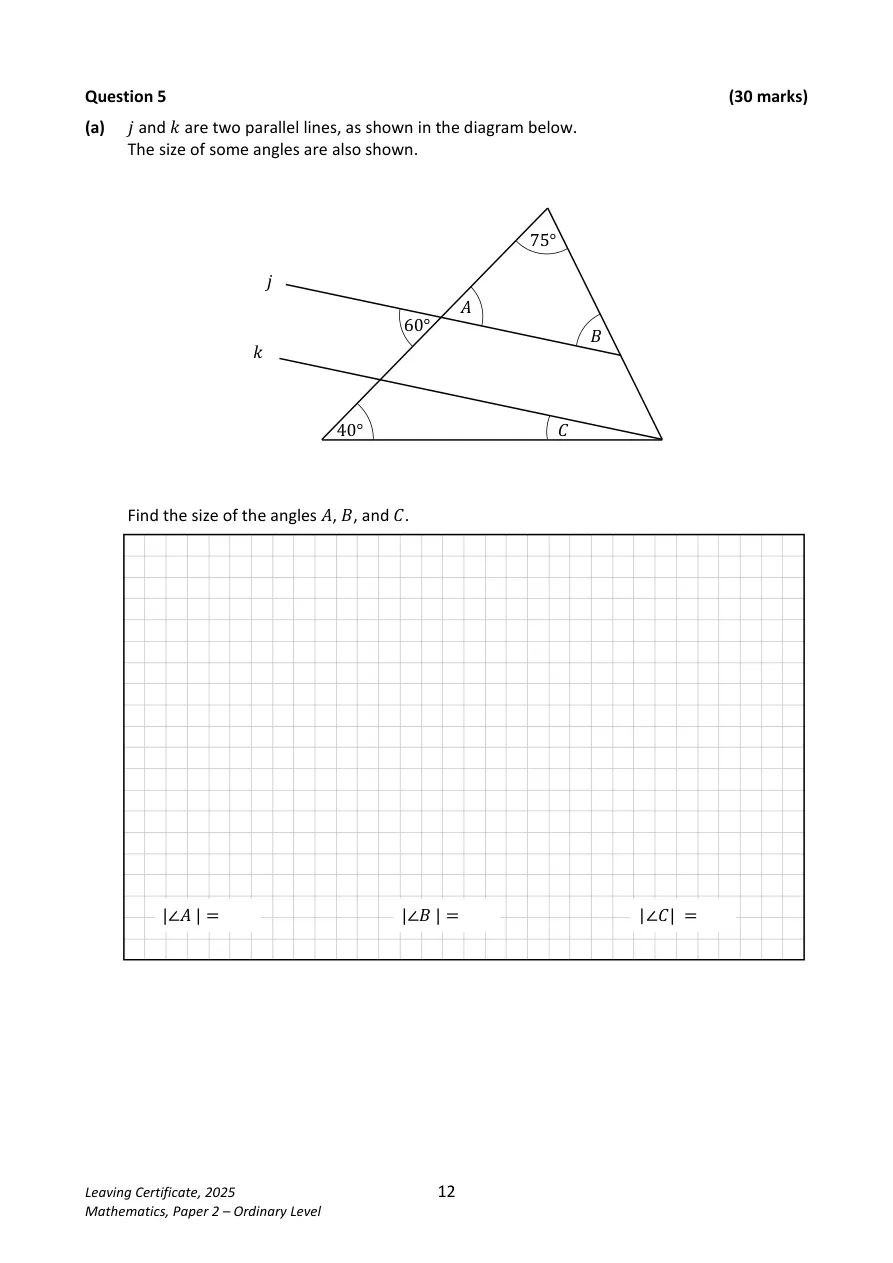
  1. A=60^{\circ}

    Corresponding/alternate angle on the parallel lines as marked.

  2. B=180^{\circ}-75^{\circ}-60^{\circ}
  3. B=45^{\circ}
  4. C=180^{\circ}-120^{\circ}-40^{\circ}
  5. C=20^{\circ}

b)(i) Height

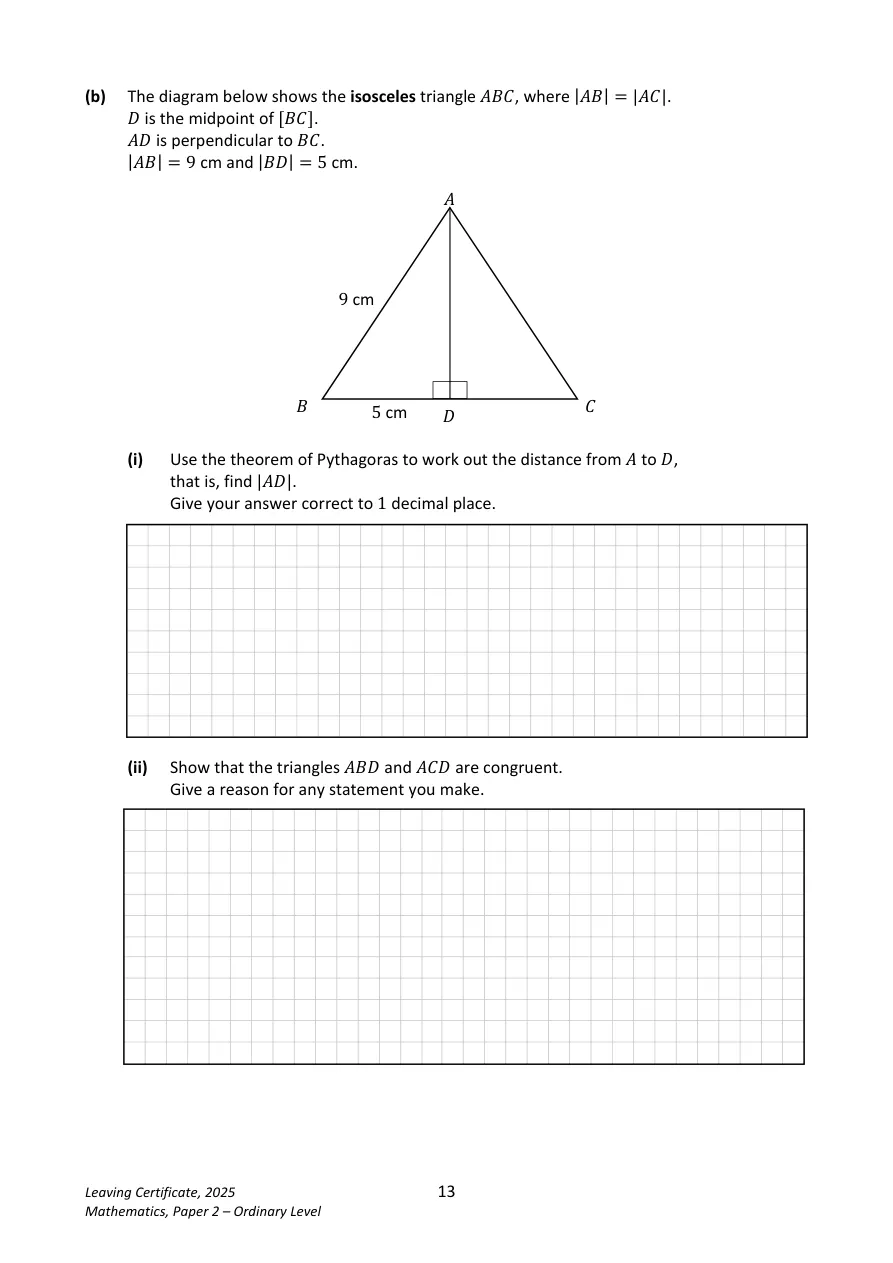
  1. AD^2+5^2=9^2
  2. AD^2=56
  3. AD=\sqrt{56}
  4. AD\approx7.5\ \mathrm{cm}

b)(ii) Congruence

  1. AB=AC

    Given isosceles triangle.

  2. BD=DC

    D is the midpoint of BC.

  3. AD=AD

    Common side.

  4. The triangles ABD and ACD are congruent by SSS.

Question 6

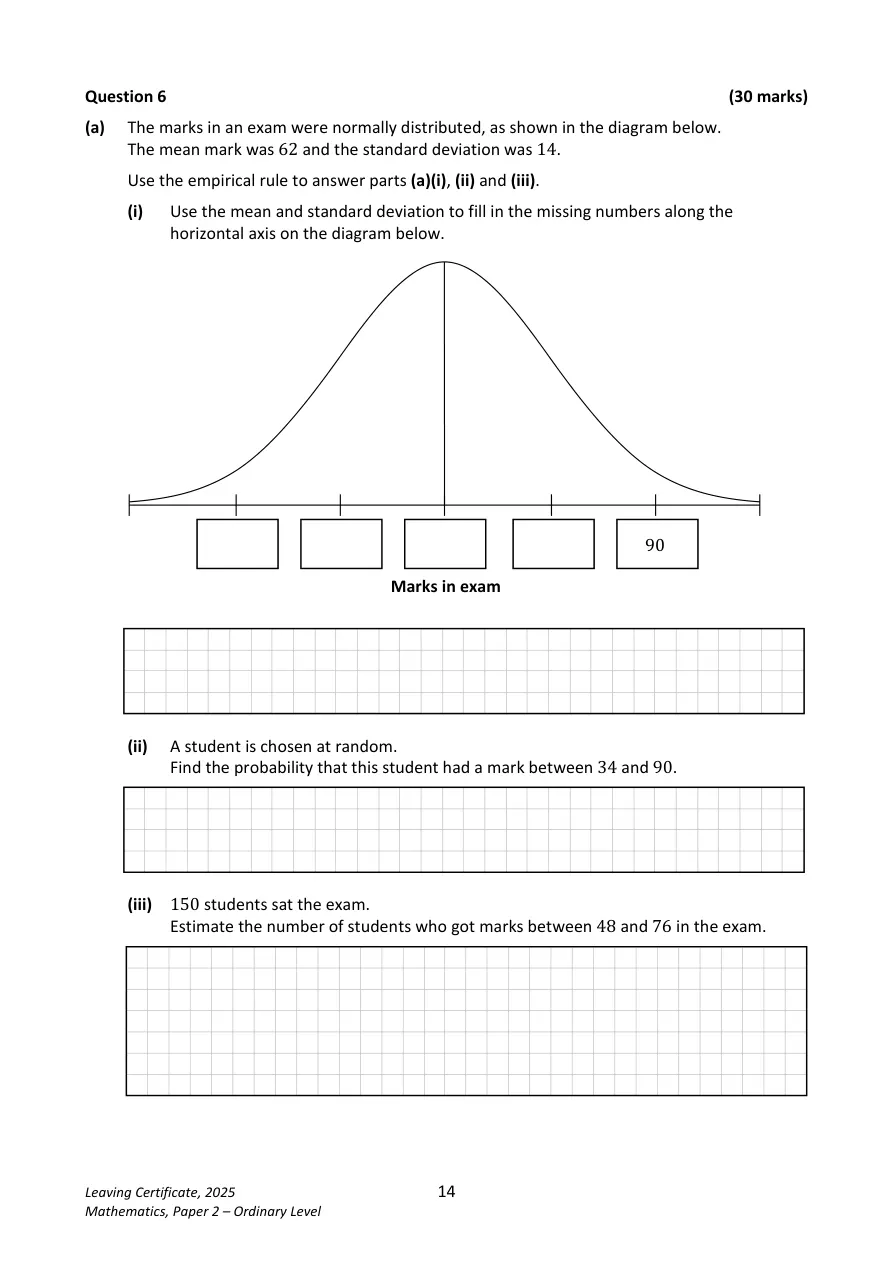
a)(i) Axis values

  1. From left to right, at μ−3σ through μ+3σ: 20, 34, 48, 62, 76, 90, 104.

a)(ii) Probability

  1. P(34\leq X\leq90)\approx0.95

    These endpoints are two standard deviations from the mean.

a)(iii) Expected count

  1. n=0.68(150)
  2. n=102\ \mathrm{students}

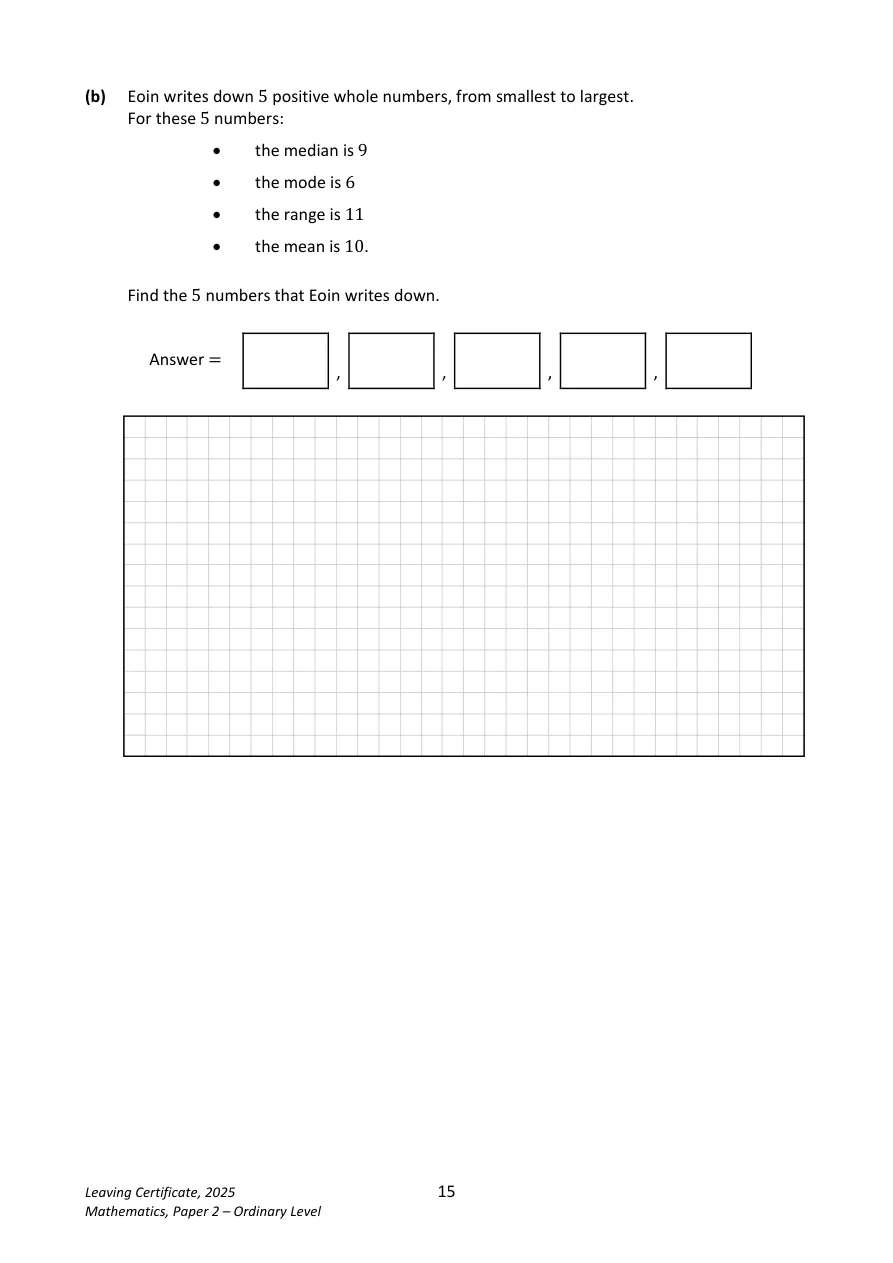
b) Five numbers

  1. The numbers are 6, 6, 9, 12, 17. Check: median 9, unique mode 6, range 17−6=11, and total 50 gives mean 10.

Question 7

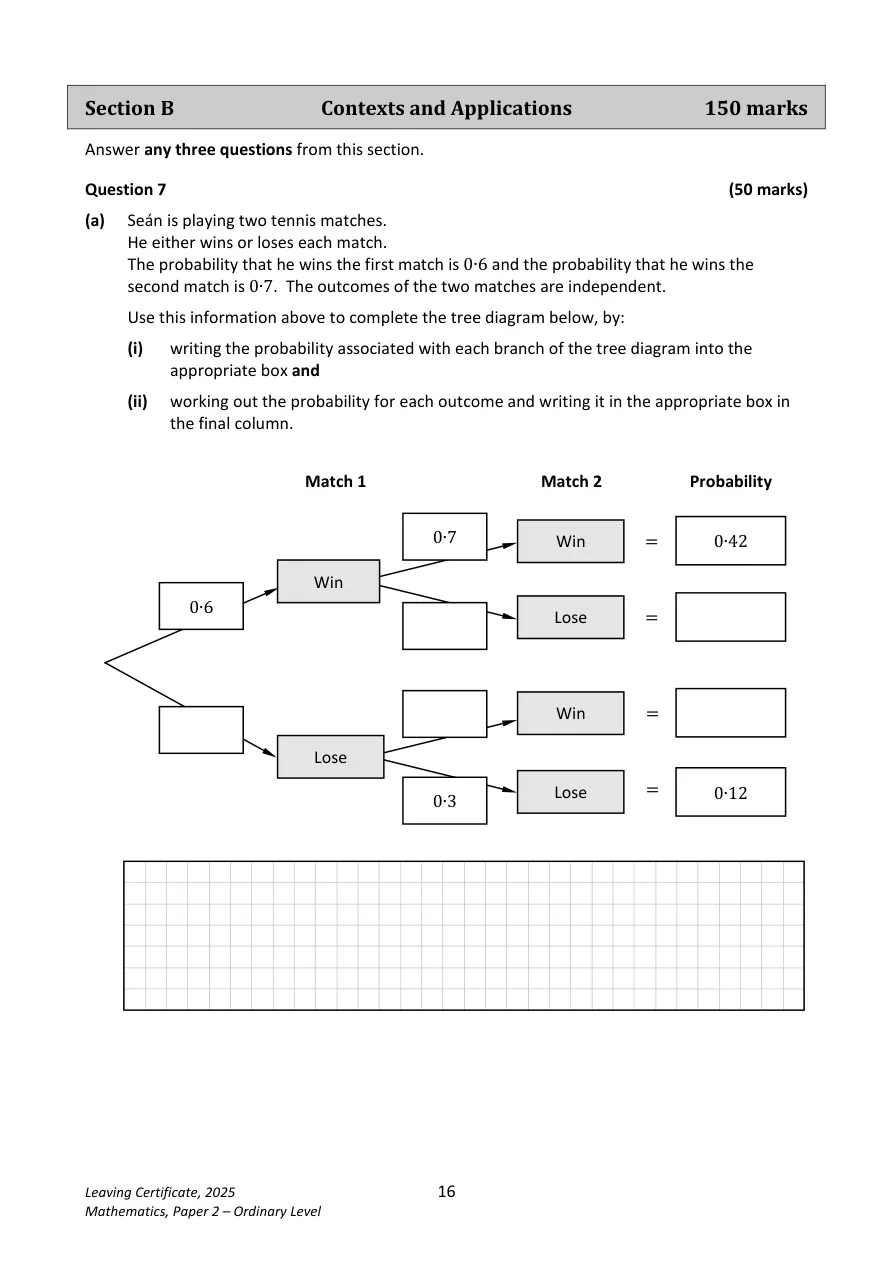
a)(i) Branch probabilities

  1. Match 1: win 0.6, lose 0.4. From either branch, Match 2: win 0.7, lose 0.3.

a)(ii) Outcome probabilities

  1. P(WW)=0.6(0.7)=0.42
  2. P(WL)=0.6(0.3)=0.18
  3. P(LW)=0.4(0.7)=0.28
  4. P(LL)=0.4(0.3)=0.12

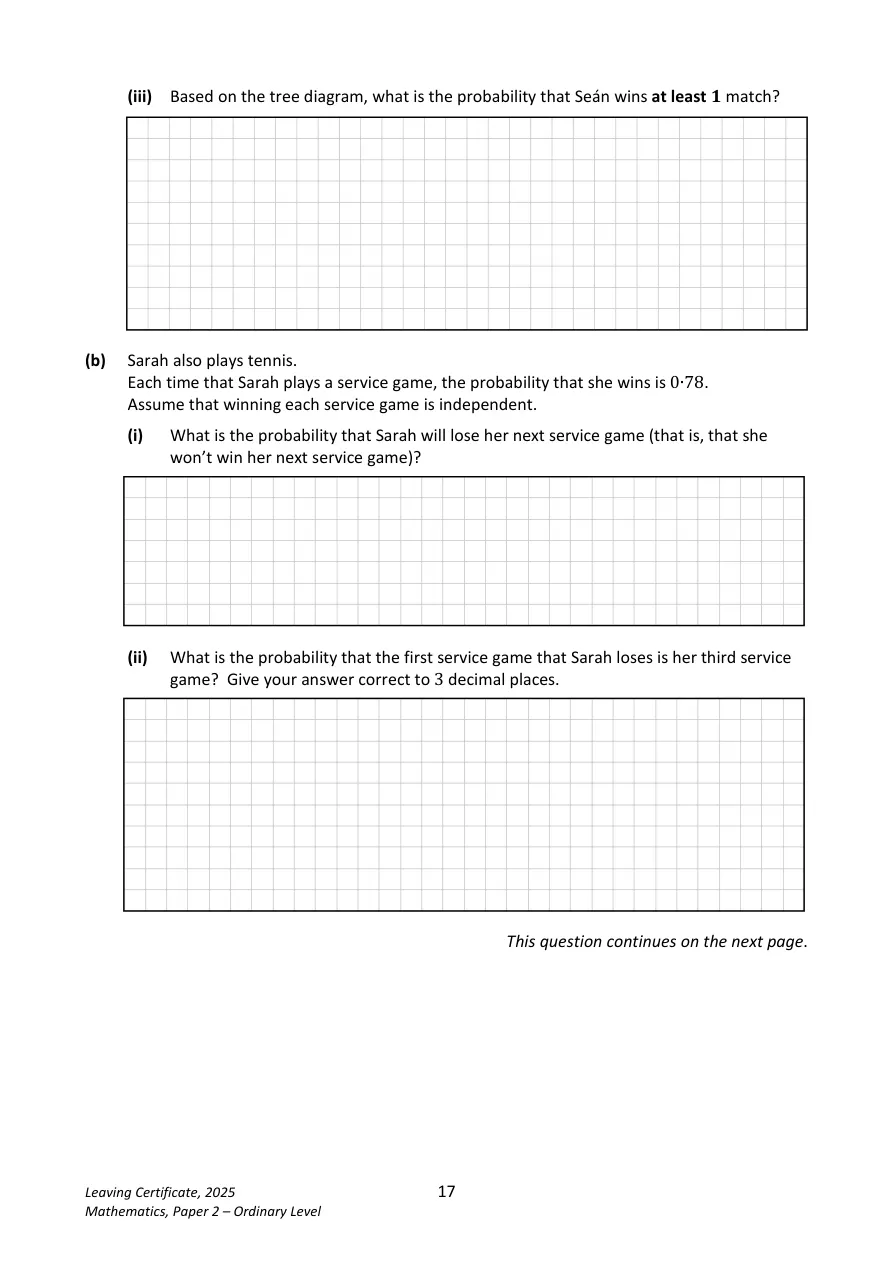
a)(iii) At least one win

  1. P=1-0.12
  2. P=0.88

b)(i) Sarah loses

  1. P(L)=1-0.78=0.22

b)(ii) First loss in third game

  1. P(WWL)=0.78^2(0.22)
  2. P(WWL)\approx0.134

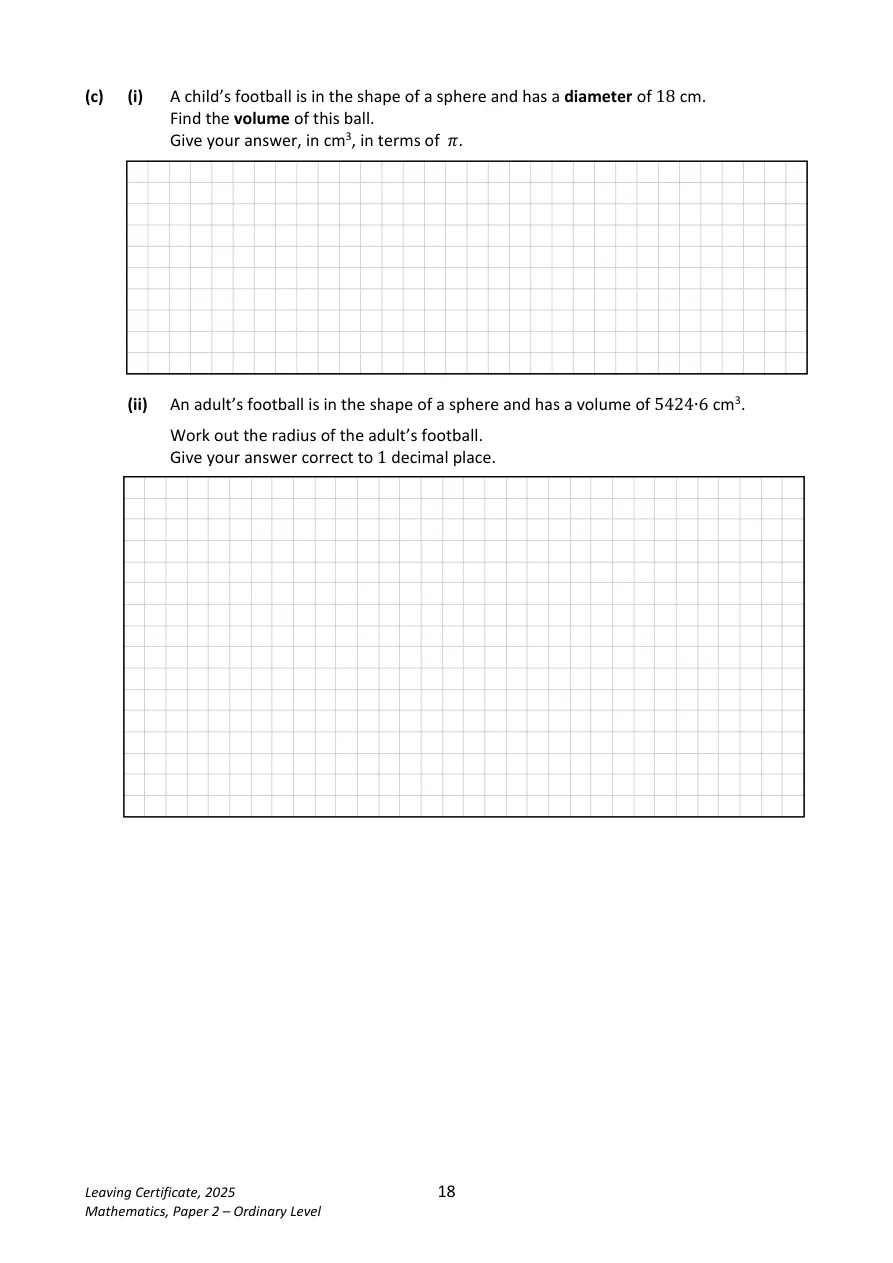
c)(i) Child's ball

  1. r=\dfrac{18}{2}=9
  2. V=\dfrac{4}{3}\pi(9)^3
  3. V=972\pi\ \mathrm{cm}^3

c)(ii) Adult's ball

  1. \dfrac{4}{3}\pi r^3=5424.6
  2. r=\sqrt[3]{\dfrac{3(5424.6)}{4\pi}}
  3. r\approx10.9\ \mathrm{cm}

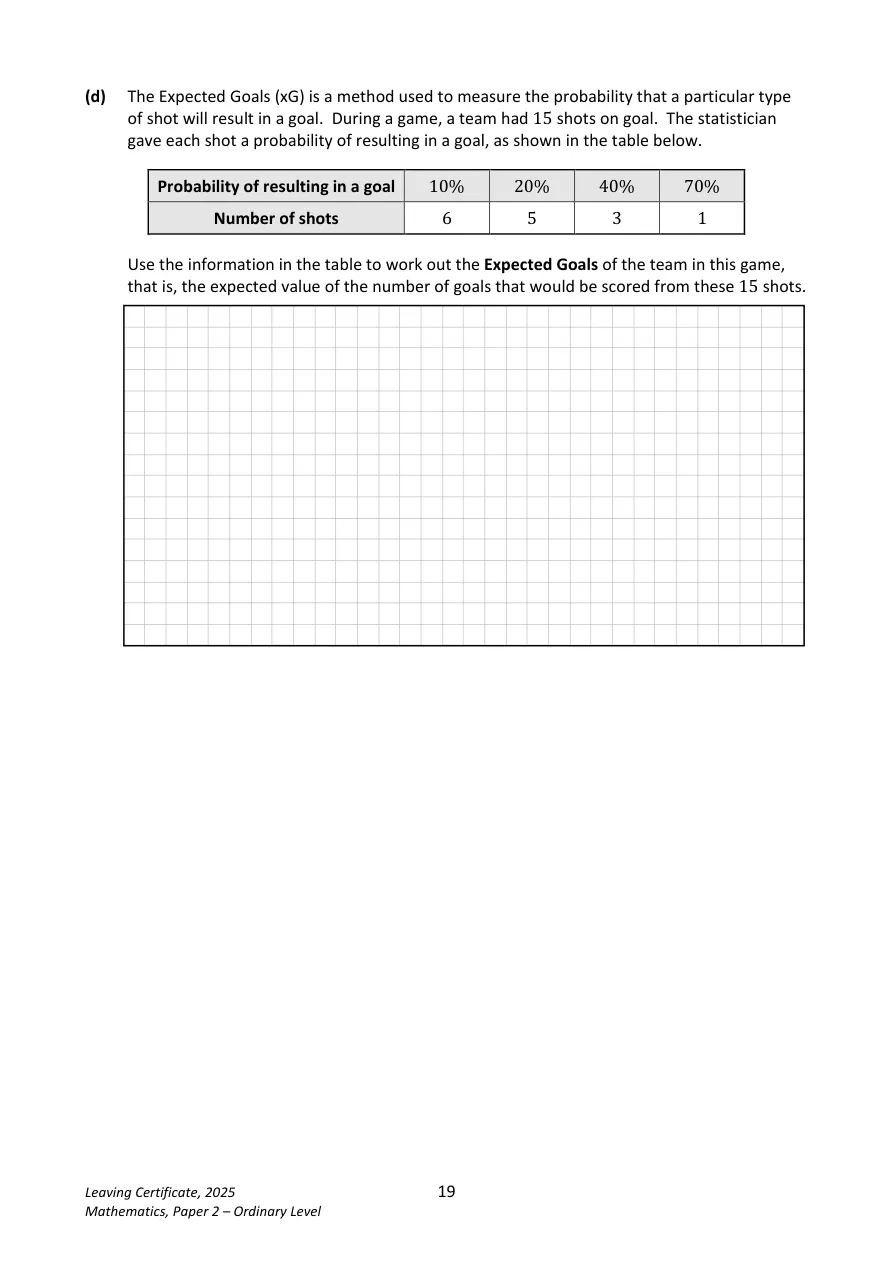
d) Expected goals

  1. E=6(0.1)+5(0.2)+3(0.4)+1(0.7)
  2. E=3.5\ \mathrm{goals}

Question 8

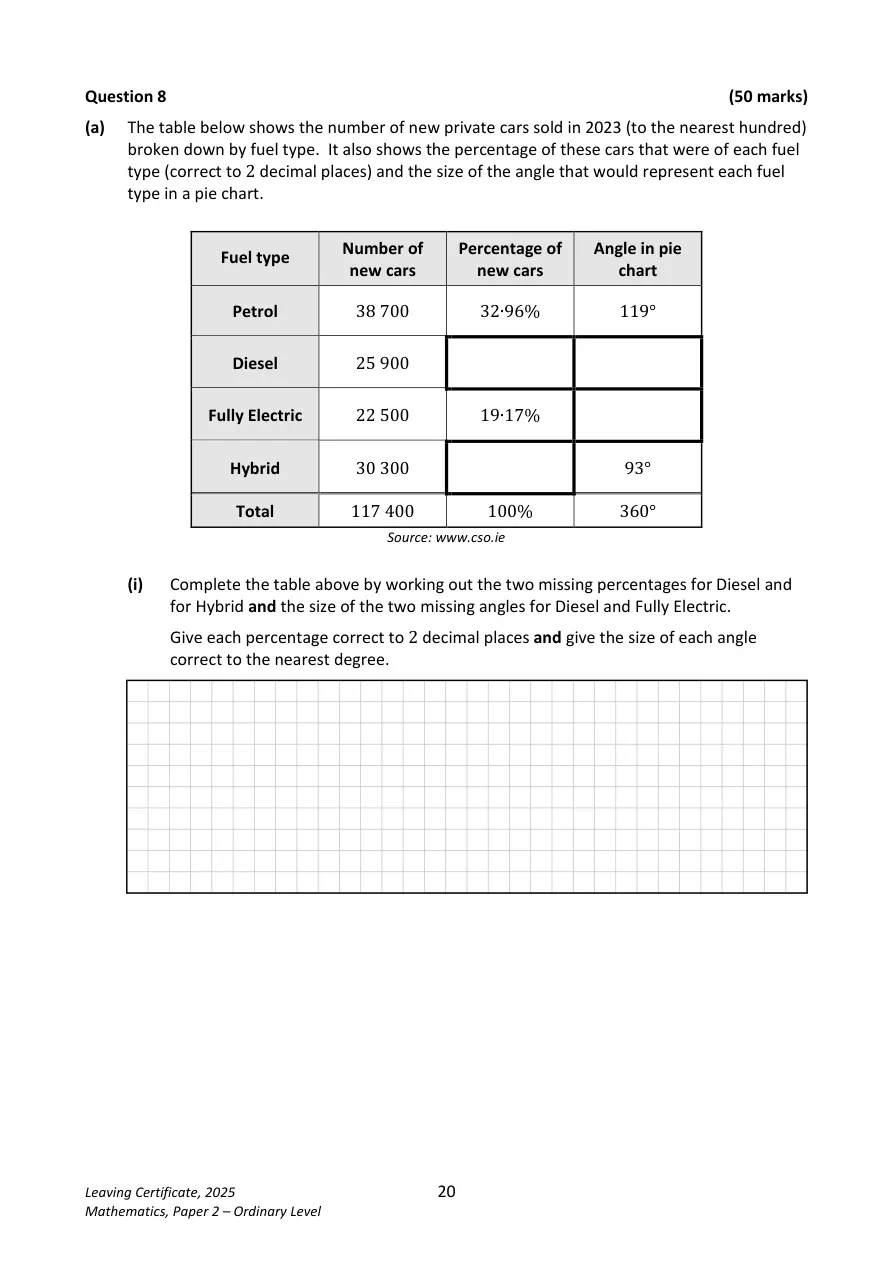
a)(i) Complete table

  1. p_D=\dfrac{25900}{117400}\times100\approx22.06\%
  2. p_H=\dfrac{30300}{117400}\times100\approx25.81\%
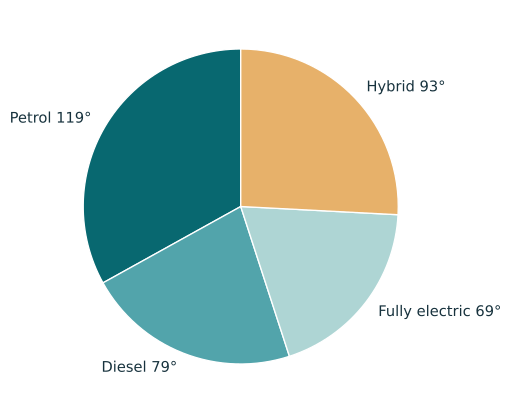
  3. \theta_D=\dfrac{25900}{117400}\times360^{\circ}\approx79^{\circ}
  4. \theta_E=\dfrac{22500}{117400}\times360^{\circ}\approx69^{\circ}

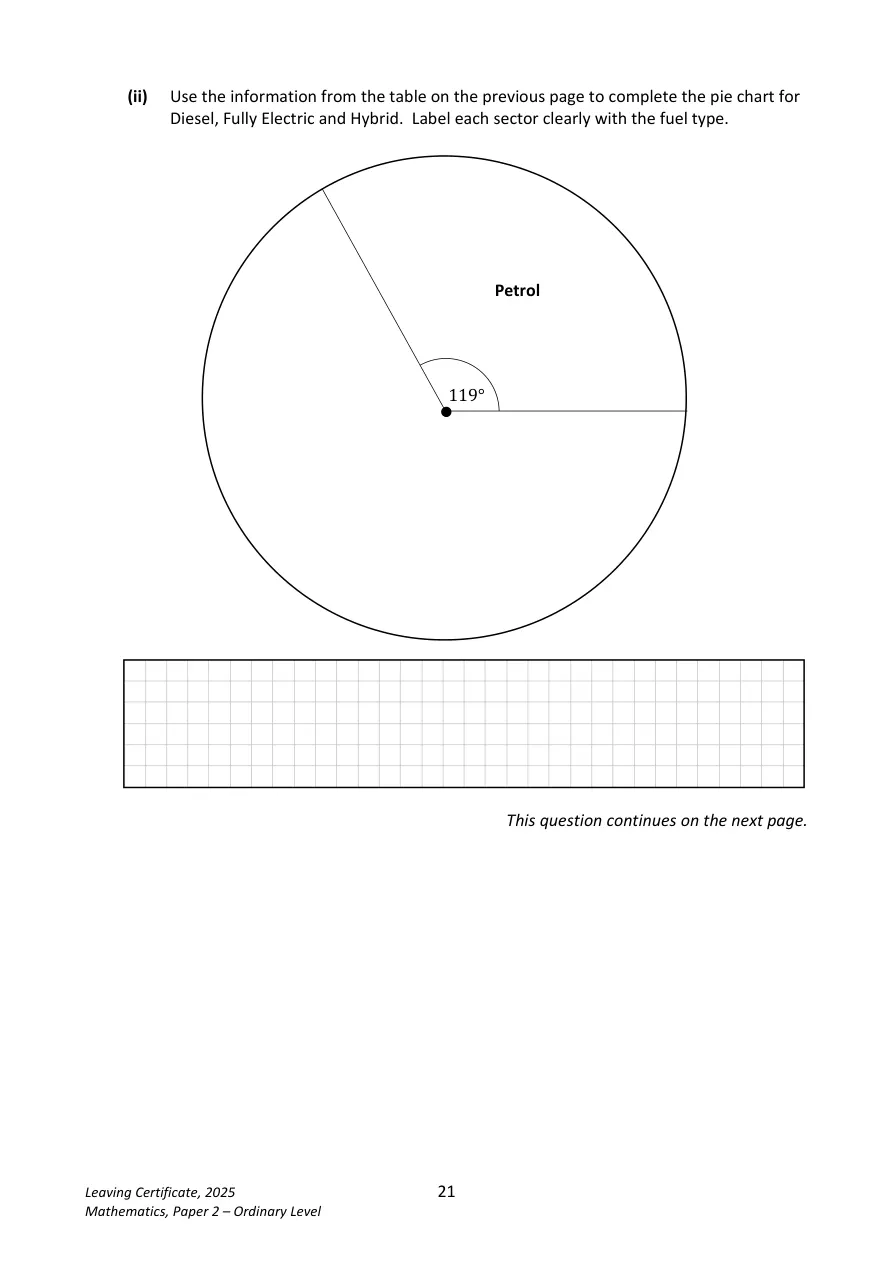
a)(ii) Pie chart

  1. Petrol 119°, Diesel 79°, Fully Electric 69°, Hybrid 93°. Label all sectors.
  2. 2025-2-8-pie

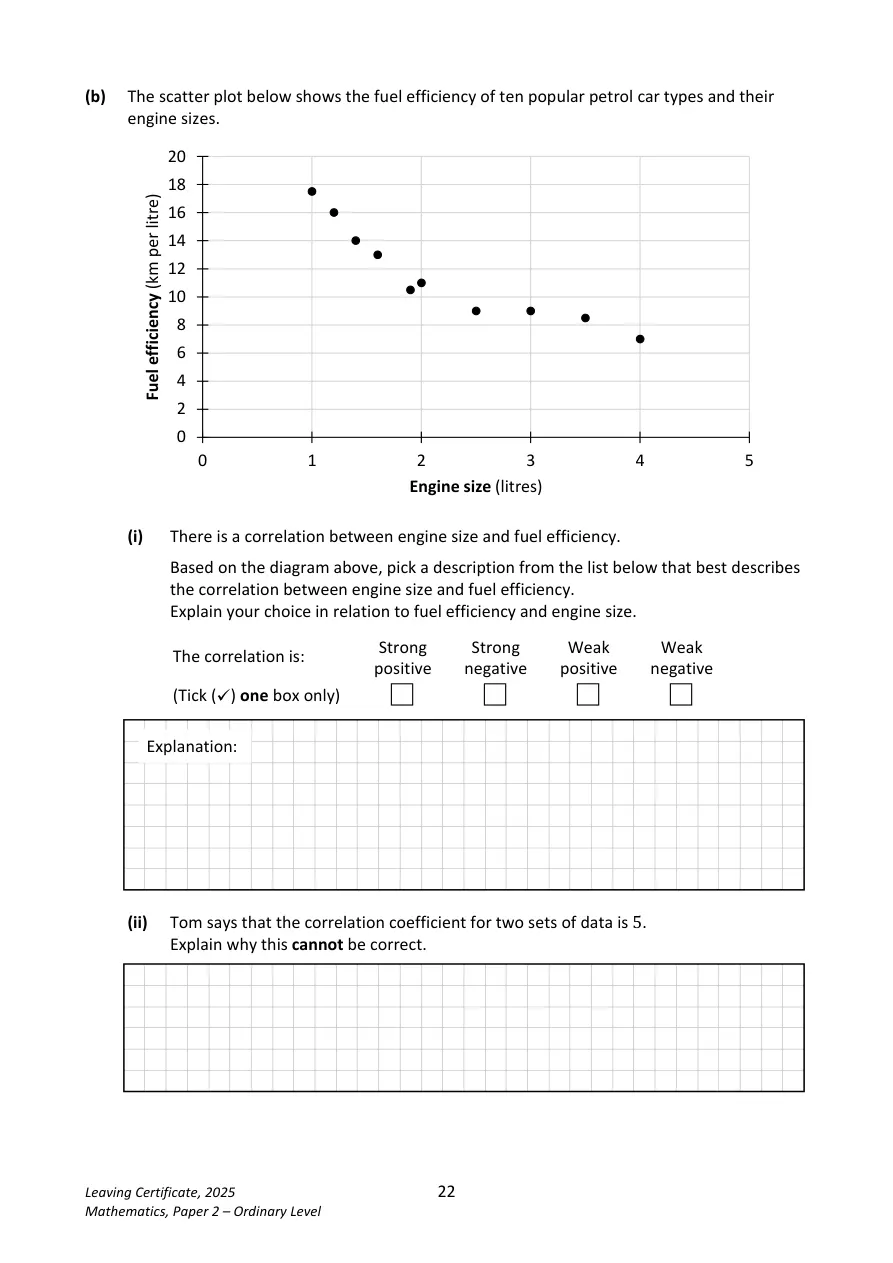
b)(i) Correlation

  1. Strong negative: cars with larger engines tend to travel fewer kilometres per litre. This is association, not proof of causation.

b)(ii) Correlation coefficient

  1. -1\leq r\leq1
  2. A coefficient of 5 is impossible.

c)(i) Margin of error

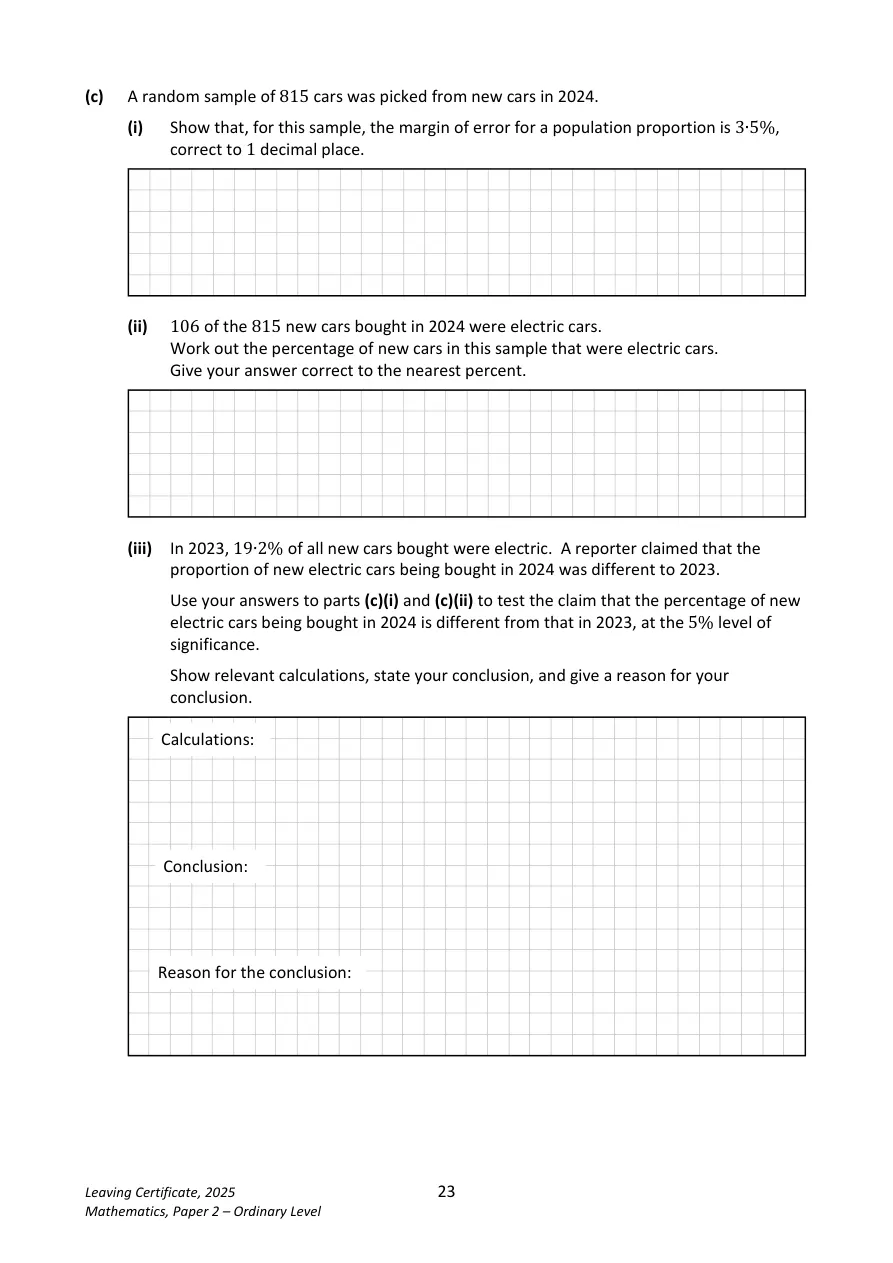
  1. E=\dfrac{1}{\sqrt{815}}\times100\%
  2. E\approx3.5\%

c)(ii) Sample percentage

  1. \hat{p}=\dfrac{106}{815}\times100\%
  2. \hat{p}\approx13\%

c)(iii) Test at 5%

  1. CI=13\%\pm3.5\%
  2. CI=[9.5\%,16.5\%]
  3. The historical 19.2% is outside the approximate 95% interval. Reject the no-change claim: there is evidence that the population percentage changed. This does not mean every possible change is proven with certainty.

Question 9

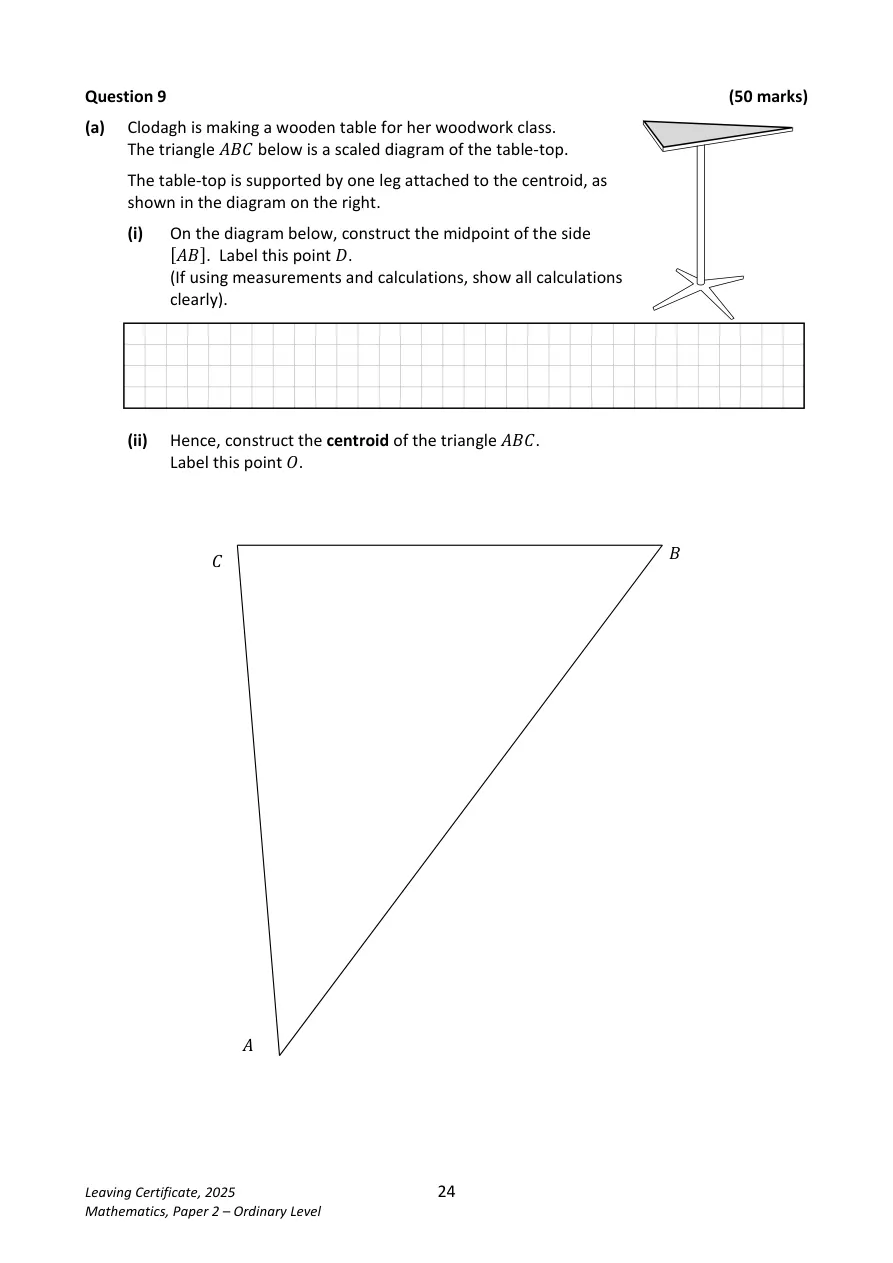
a)(i) Midpoint

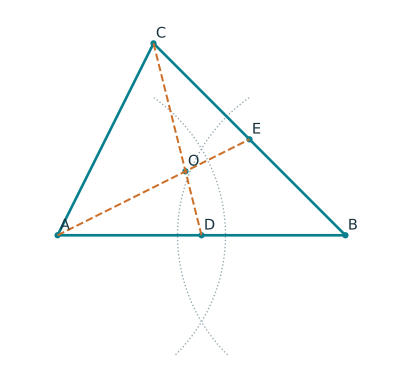
  1. With equal compass radii greater than half AB, draw intersecting arcs from A and B above and below AB. Join the arc intersections; its intersection with AB is D.

a)(ii) Centroid

  1. Construct the midpoint of a second side and join it to the opposite vertex. The intersection of this median with CD is the centroid O. Show both medians and construction arcs.
  2. 2025-2-9-centroid

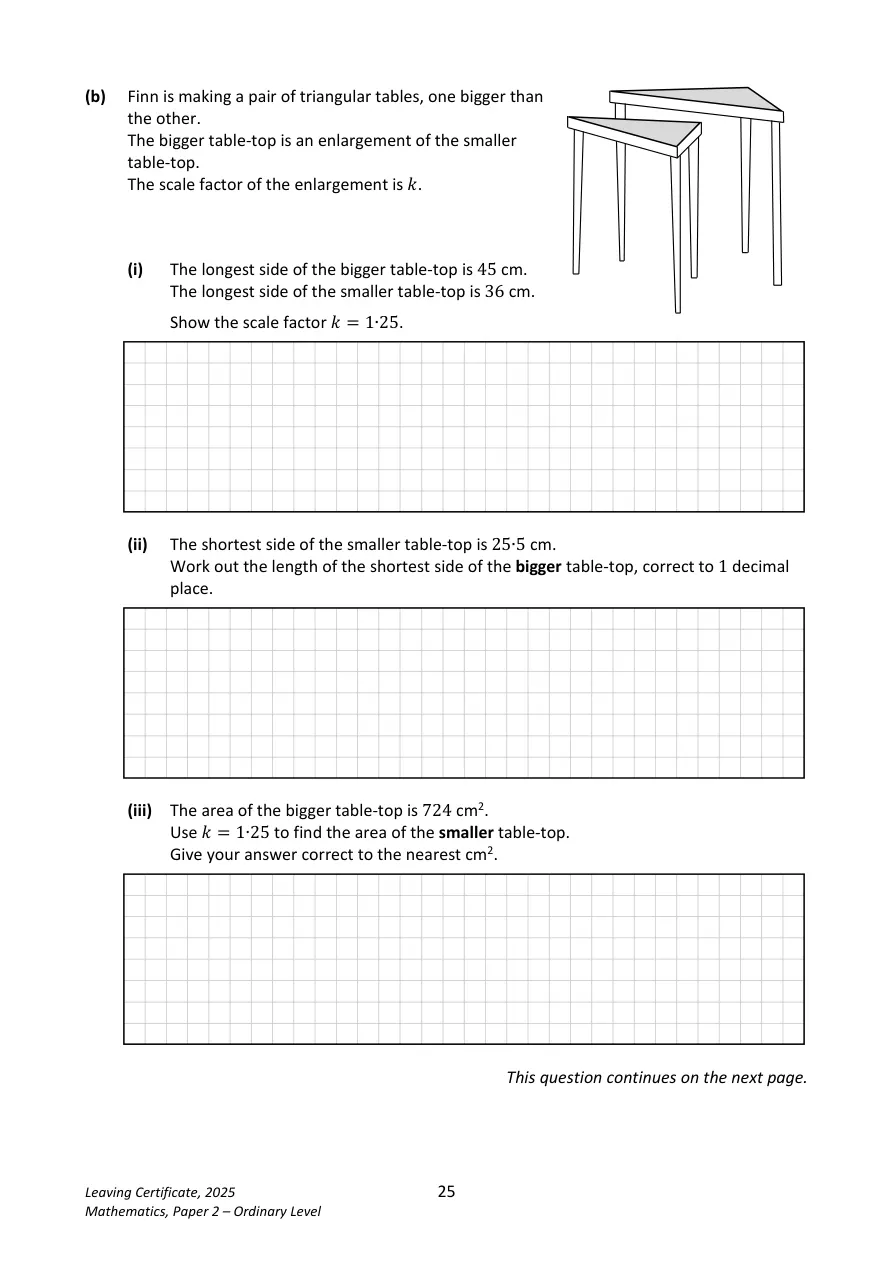
b)(i) Scale factor

  1. k=\dfrac{45}{36}
  2. k=1.25

b)(ii) New side

  1. L=25.5(1.25)
  2. L\approx31.9\ \mathrm{cm}

b)(iii) Smaller area

  1. A_{\mathrm{small}}=\dfrac{724}{1.25^2}
  2. A_{\mathrm{small}}\approx463\ \mathrm{cm}^2

    Areas scale by the square of the length factor.

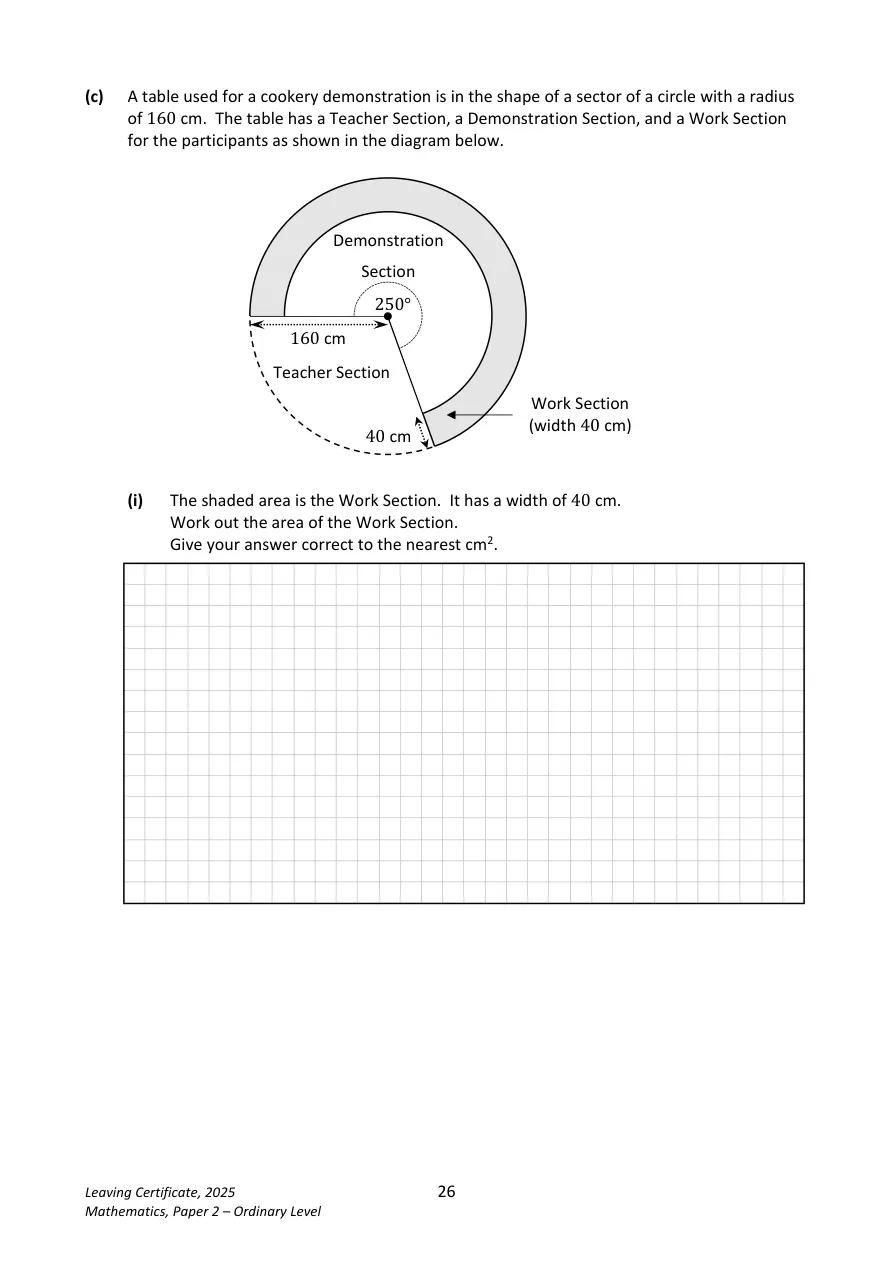
c)(i) Work section area

  1. A=\dfrac{250}{360}\pi(160^2-120^2)
  2. A\approx24435\ \mathrm{cm}^2

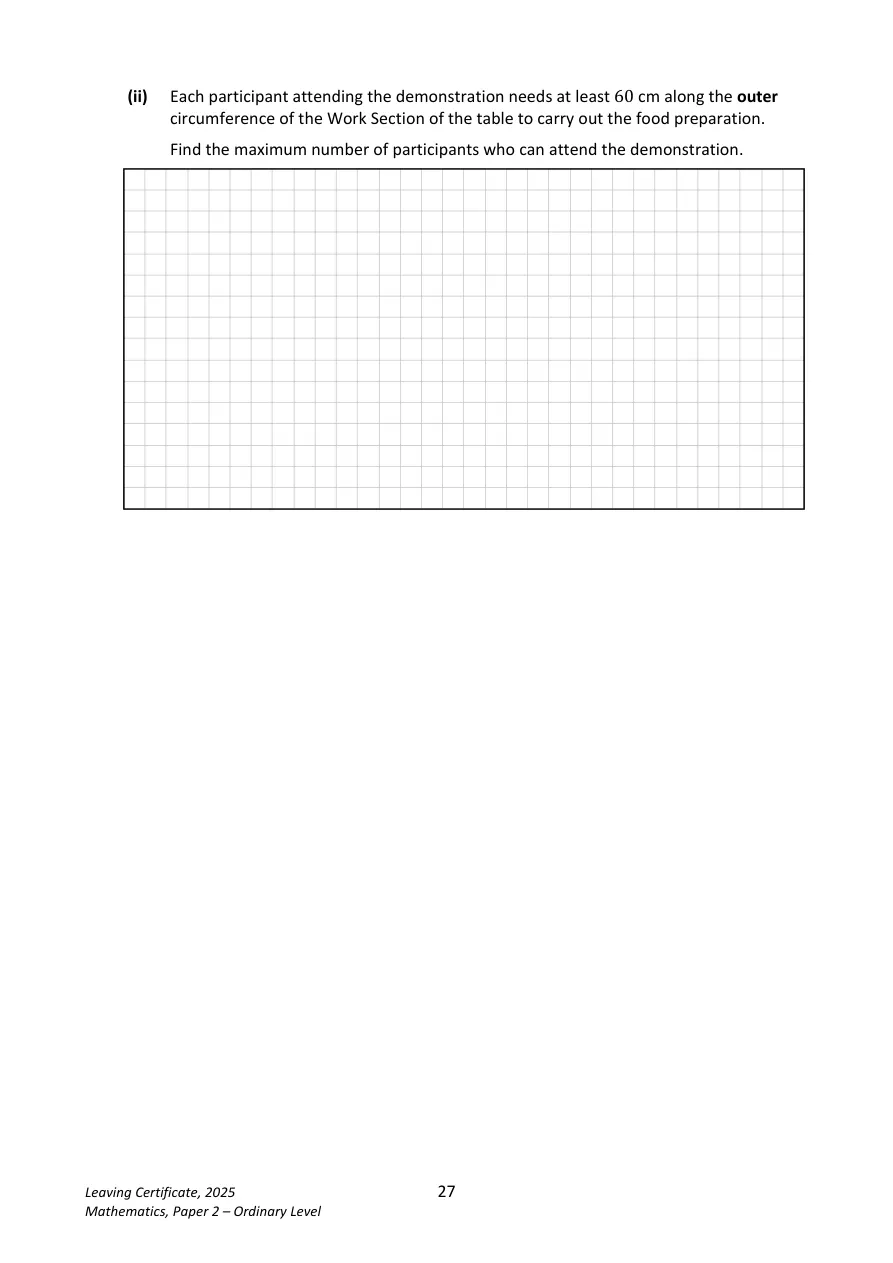
c)(ii) Participants

  1. L=\dfrac{250}{360}(2\pi)(160)
  2. n=\left\lfloor\dfrac{L}{60}\right\rfloor
  3. n=11

    Round down because each person needs at least 60 cm.

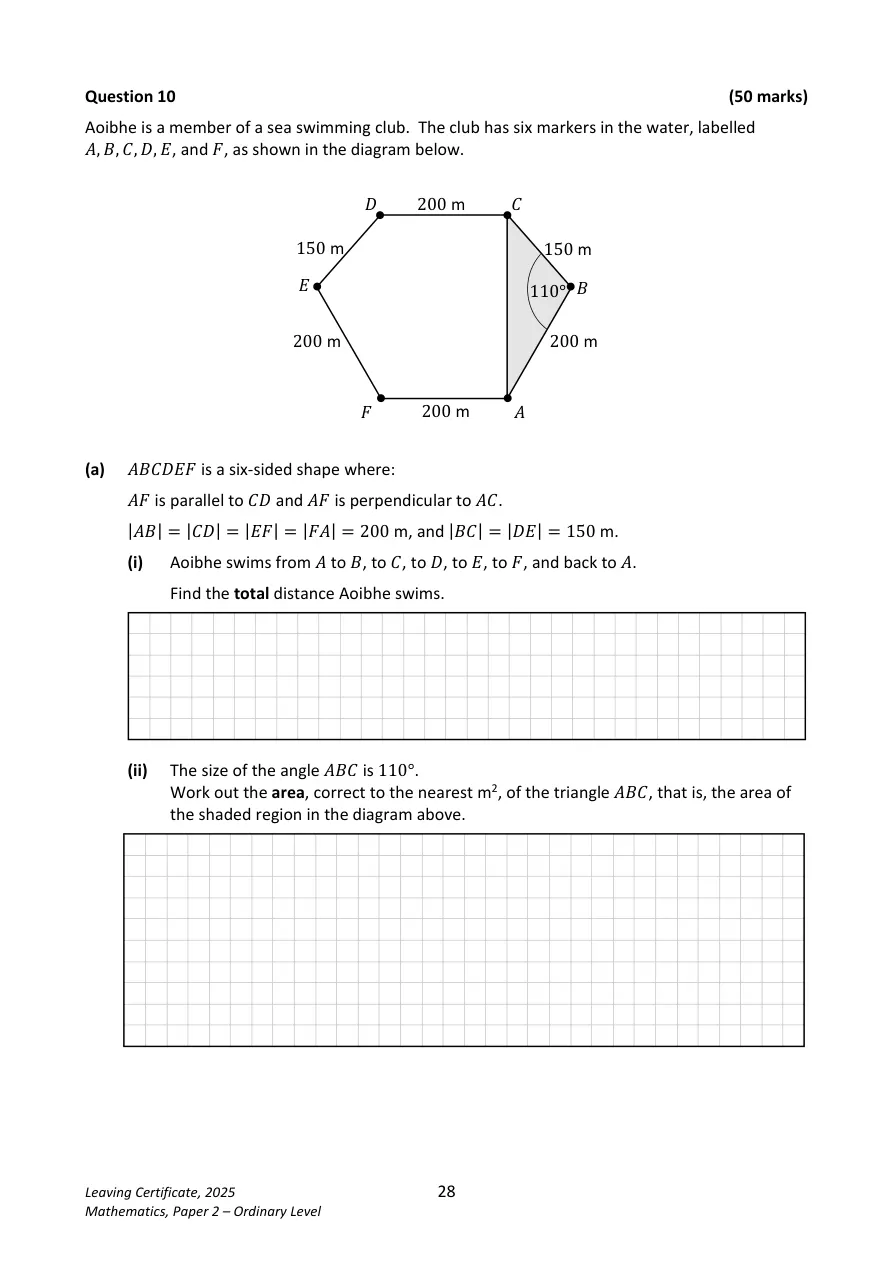
Question 10

a)(i) Perimeter

  1. P=4(200)+2(150)
  2. P=1100\ \mathrm{m}

a)(ii) Triangle area

  1. A=\dfrac{1}{2}(150)(200)\sin110^{\circ}
  2. A\approx14095\ \mathrm{m}^2

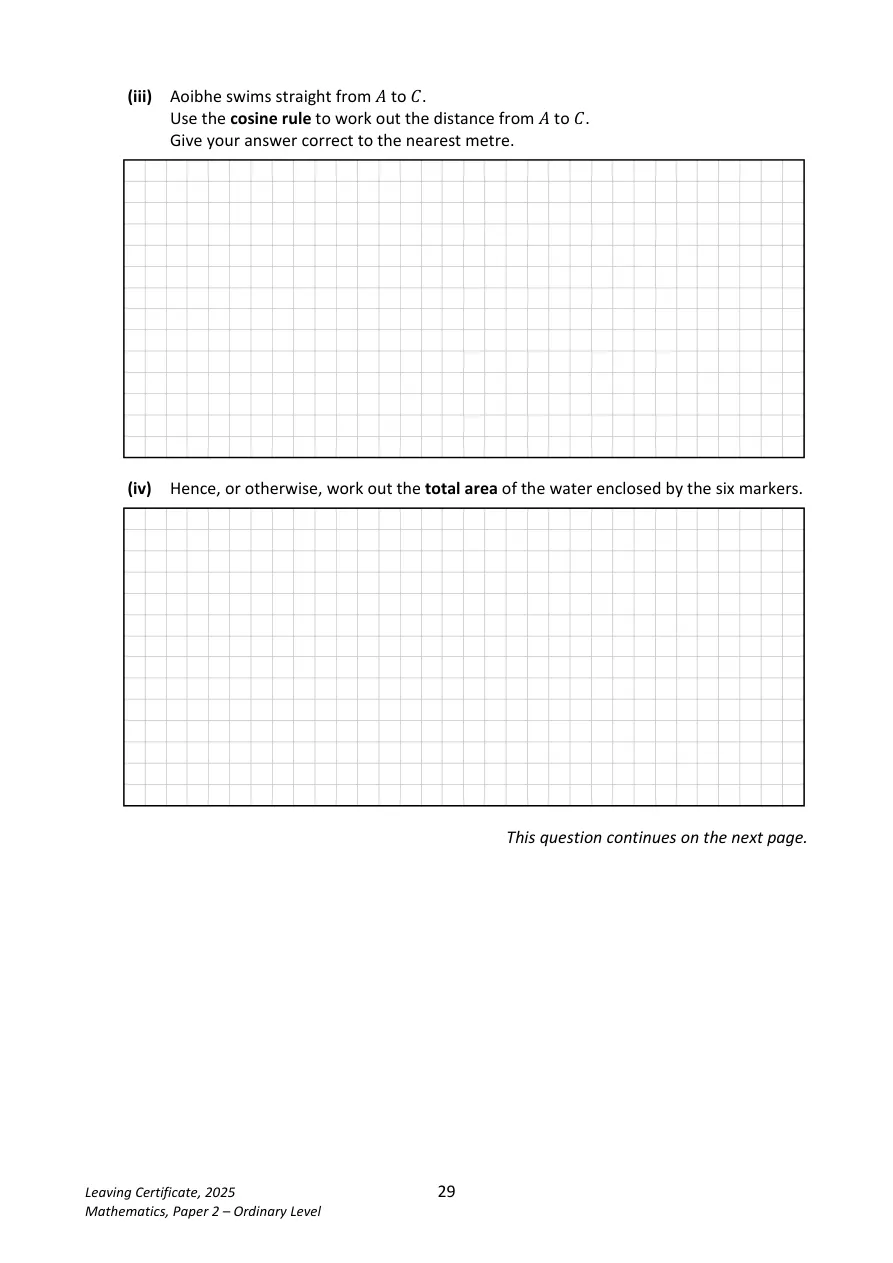
a)(iii) Diagonal AC

  1. AC^2=150^2+200^2-2(150)(200)\cos110^{\circ}
  2. AC\approx288\ \mathrm{m}

a)(iv) Total area

  1. A_{\mathrm{total}}=2(14095)+200(288)
  2. A_{\mathrm{total}}=85790\ \mathrm{m}^2

    This follows the rounded preceding answers used by the SEC model. Using unrounded intermediate values gives about 85 817 m².

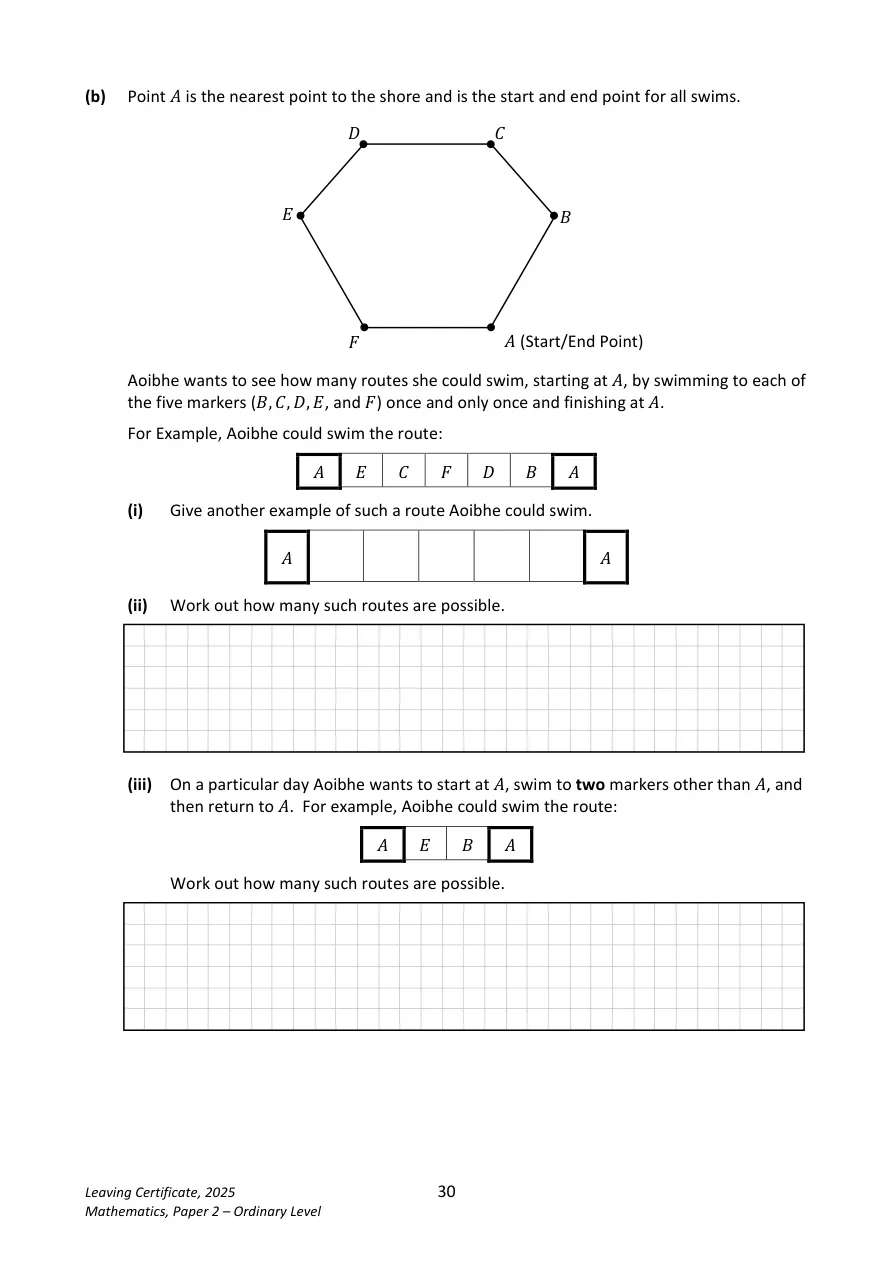
b)(i) Another route

  1. A–B–C–D–E–F–A is one example; each other marker is visited once.

b)(ii) All routes

  1. N=5!
  2. N=120

b)(iii) Two-marker routes

  1. N=5(4)
  2. N=20

    Order matters: going first to E then B differs from first B then E.

See working and diagrams on the original paper
Original exam paper page 4
p=\dfrac{94-72}{94}\times100
p\approx23.4\%
\bar{x}=\dfrac{1591}{12}
\bar{x}\approx133\ \mathrm{mm}
\sigma=\sqrt{\dfrac{\sum(x-\bar{x})^2}{12}}
\sigma\approx54\ \mathrm{mm}
[Use population standard deviation σ on the calculator, not sample s.]
Original exam paper page 5
Q_1=\dfrac{93+94}{2}
Q_1=93.5\ \mathrm{mm}
IQR=183-93.5
IQR=89.5\ \mathrm{mm}
Original exam paper page 6
A+2A+90^{\circ}=180^{\circ}
3A=90^{\circ}
A=30^{\circ}
\tan30^{\circ}=\dfrac{x}{10}
x=10\tan30^{\circ}
x\approx5.77\ \mathrm{cm}
Original exam paper page 7
Q=180^{\circ}-104^{\circ}-41^{\circ}
Q=35^{\circ}
\dfrac{PR}{\sin35^{\circ}}=\dfrac{11}{\sin104^{\circ}}
PR=\dfrac{11\sin35^{\circ}}{\sin104^{\circ}}
PR\approx6.5\ \mathrm{cm}
Original exam paper page 8
In table order: q; r; p. Centres and radii identify each circle.
(x-3)^2+(y+4)^2=49
Original exam paper page 9
r=\sqrt{(2-(-1))^2+(7-3)^2}
r=\sqrt{9+16}
r=5
(-6,3),\quad(4,3)
[Move one radius horizontally left or right of the centre (−1,3).]
Original exam paper page 10
m=\dfrac{0-3}{2-(-5)}
m=-\dfrac{3}{7}
y-3=-\dfrac{3}{7}(x+5)
7y-21=-3x-15
3x+7y-6=0
Original exam paper page 11
A=\dfrac{1}{2}(9)(3)
A=13.5\ \mathrm{units}^2
[AC is horizontal, length 9; the perpendicular height from B is 3.]
m_l=\dfrac{2}{3}
m_k=-\dfrac{2}{3}
m_lm_k=-\dfrac{4}{9}
Neither: the slopes are unequal, and their product is not −1.
Original exam paper page 12
A=60^{\circ}
[Corresponding/alternate angle on the parallel lines as marked.]
B=180^{\circ}-75^{\circ}-60^{\circ}
B=45^{\circ}
C=180^{\circ}-120^{\circ}-40^{\circ}
C=20^{\circ}
Original exam paper page 13
AD^2+5^2=9^2
AD^2=56
AD=\sqrt{56}
AD\approx7.5\ \mathrm{cm}
AB=AC
[Given isosceles triangle.]
BD=DC
[D is the midpoint of BC.]
AD=AD
[Common side.]
The triangles ABD and ACD are congruent by SSS.
Original exam paper page 14
From left to right, at μ−3σ through μ+3σ: 20, 34, 48, 62, 76, 90, 104.
P(34\leq X\leq90)\approx0.95
[These endpoints are two standard deviations from the mean.]
n=0.68(150)
n=102\ \mathrm{students}
34486276
Original exam paper page 15
The numbers are 6, 6, 9, 12, 17. Check: median 9, unique mode 6, range 17−6=11, and total 50 gives mean 10.
6691217
Original exam paper page 16
Match 1: win 0.6, lose 0.4. From either branch, Match 2: win 0.7, lose 0.3.
P(WW)=0.6(0.7)=0.42
P(WL)=0.6(0.3)=0.18
P(LW)=0.4(0.7)=0.28
P(LL)=0.4(0.3)=0.12
0.40.30.70.180.28
Original exam paper page 17
P=1-0.12
P=0.88
P(L)=1-0.78=0.22
P(WWL)=0.78^2(0.22)
P(WWL)\approx0.134
Original exam paper page 18
r=\dfrac{18}{2}=9
V=\dfrac{4}{3}\pi(9)^3
V=972\pi\ \mathrm{cm}^3
\dfrac{4}{3}\pi r^3=5424.6
r=\sqrt[3]{\dfrac{3(5424.6)}{4\pi}}
r\approx10.9\ \mathrm{cm}
Original exam paper page 19
E=6(0.1)+5(0.2)+3(0.4)+1(0.7)
E=3.5\ \mathrm{goals}
Original exam paper page 20
p_D=\dfrac{25900}{117400}\times100\approx22.06\%
p_H=\dfrac{30300}{117400}\times100\approx25.81\%
\theta_D=\dfrac{25900}{117400}\times360^{\circ}\approx79^{\circ}
\theta_E=\dfrac{22500}{117400}\times360^{\circ}\approx69^{\circ}
22.06%25.81%79°69°
Original exam paper page 21
Petrol 119°, Diesel 79°, Fully Electric 69°, Hybrid 93°. Label all sectors.
DieselElectricHybrid
Original exam paper page 22
Strong negative: cars with larger engines tend to travel fewer kilometres per litre. This is association, not proof of causation.
-1\leq r\leq1
A coefficient of 5 is impossible.
Original exam paper page 23
E=\dfrac{1}{\sqrt{815}}\times100\%
E\approx3.5\%
\hat{p}=\dfrac{106}{815}\times100\%
\hat{p}\approx13\%
CI=13\%\pm3.5\%
CI=[9.5\%,16.5\%]
The historical 19.2% is outside the approximate 95% interval. Reject the no-change claim: there is evidence that the population percentage changed. This does not mean every possible change is proven with certainty.
Original exam paper page 24
With equal compass radii greater than half AB, draw intersecting arcs from A and B above and below AB. Join the arc intersections; its intersection with AB is D.
Construct the midpoint of a second side and join it to the opposite vertex. The intersection of this median with CD is the centroid O. Show both medians and construction arcs.
DO
Original exam paper page 25
k=\dfrac{45}{36}
k=1.25
L=25.5(1.25)
L\approx31.9\ \mathrm{cm}
A_{\mathrm{small}}=\dfrac{724}{1.25^2}
A_{\mathrm{small}}\approx463\ \mathrm{cm}^2
[Areas scale by the square of the length factor.]
Original exam paper page 26
A=\dfrac{250}{360}\pi(160^2-120^2)
A\approx24435\ \mathrm{cm}^2
Original exam paper page 27
L=\dfrac{250}{360}(2\pi)(160)
n=\left\lfloor\dfrac{L}{60}\right\rfloor
n=11
[Round down because each person needs at least 60 cm.]
Original exam paper page 28
P=4(200)+2(150)
P=1100\ \mathrm{m}
A=\dfrac{1}{2}(150)(200)\sin110^{\circ}
A\approx14095\ \mathrm{m}^2
Original exam paper page 29
AC^2=150^2+200^2-2(150)(200)\cos110^{\circ}
AC\approx288\ \mathrm{m}
A_{\mathrm{total}}=2(14095)+200(288)
A_{\mathrm{total}}=85790\ \mathrm{m}^2
[This follows the rounded preceding answers used by the SEC model. Using unrounded intermediate values gives about 85 817 m².]
Original exam paper page 30
N=5!
N=120
N=5(4)
N=20
[Order matters: going first to E then B differs from first B then E.]
BCDEF