← Original paper

Leaving Cert Ordinary Maths 2026 · Paper 1

Teacher worked solutions. Explanations are in blue. These 2026 maths answers are independent teacher solutions; an SEC marking scheme has not been obtained.

Question 1

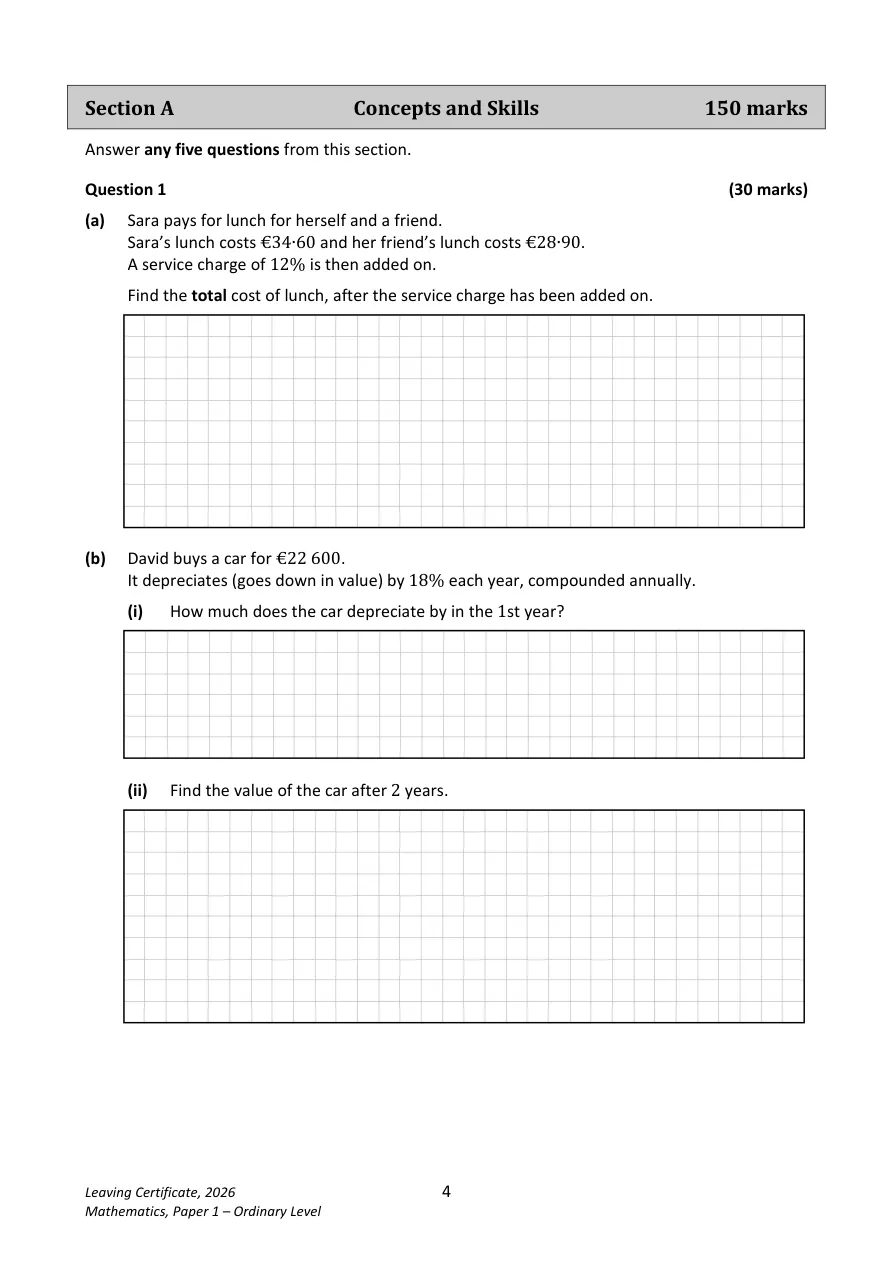
a) Lunch

  1. C=(34.60+28.90)(1.12)
  2. C=\mathrm{€}71.12

b)(i) First-year depreciation

  1. D=22600(0.18)
  2. D=\mathrm{€}4068

b)(ii) Value after two years

  1. V=22600(0.82)^2
  2. V=\mathrm{€}15196.24

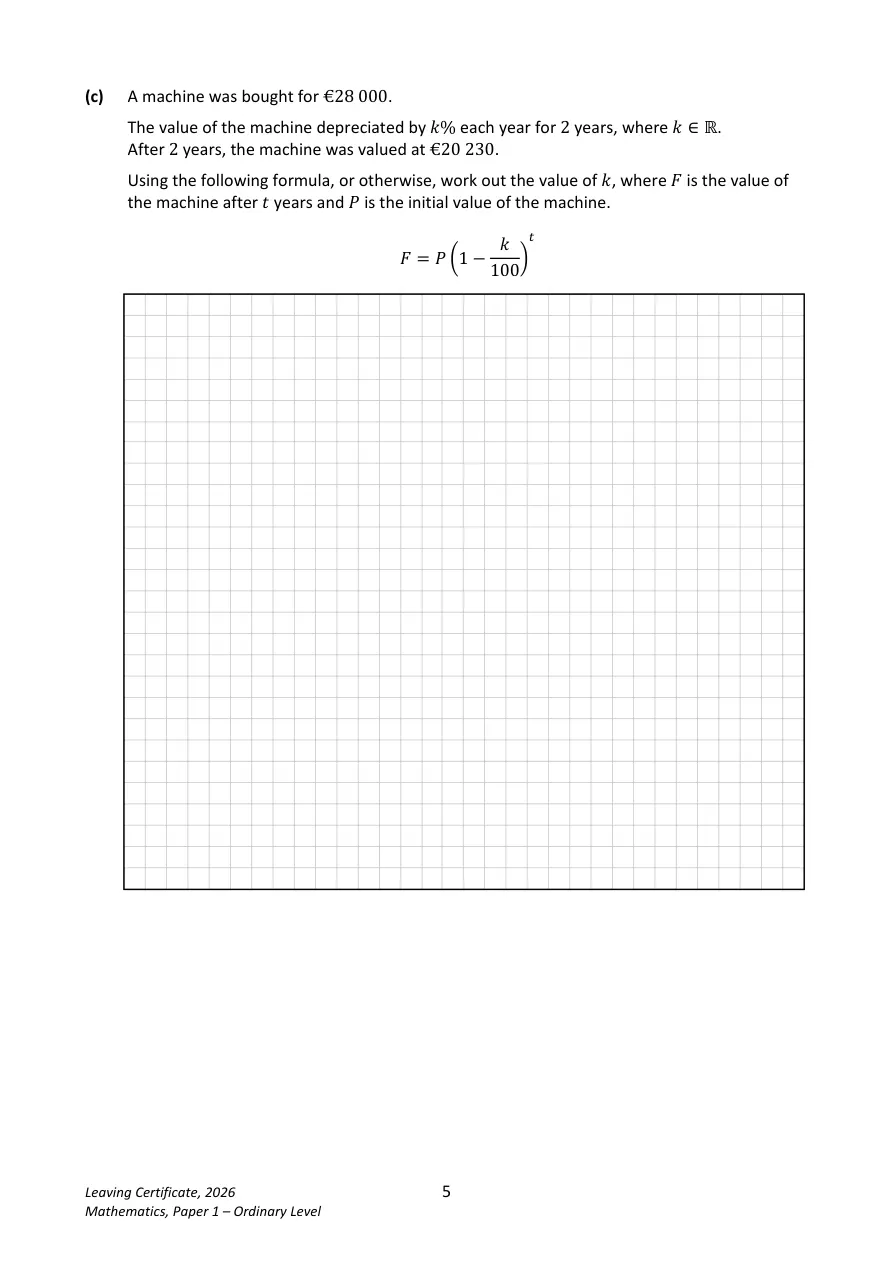
c) Annual rate

  1. 20230=28000\left(1-\dfrac{k}{100}\right)^2
  2. \left(1-\dfrac{k}{100}\right)^2=0.7225
  3. 1-\dfrac{k}{100}=0.85

    Take the non-negative retention factor appropriate to depreciation.

  4. \dfrac{k}{100}=0.15
  5. k=15

Question 2

a) Expand

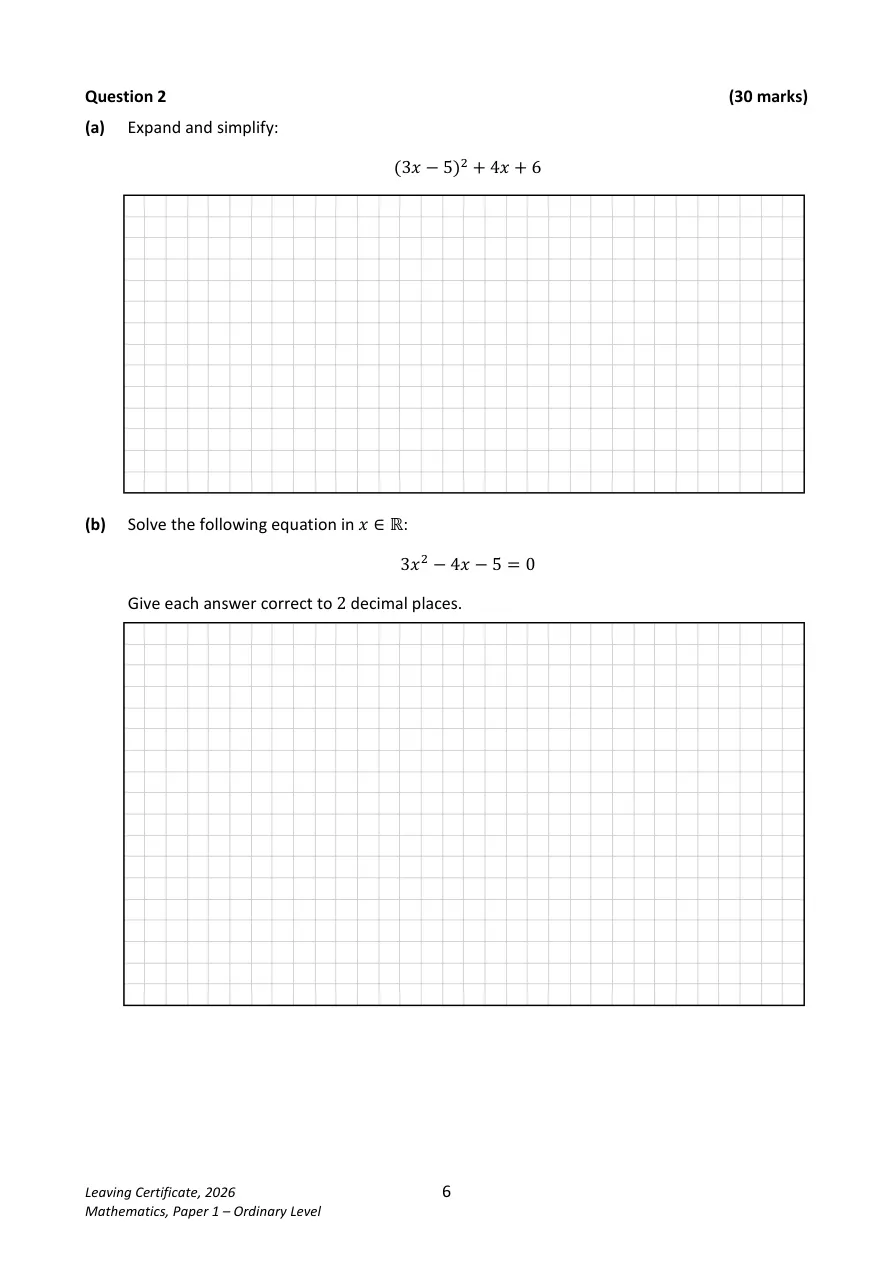
  1. (3x-5)^2+4x+6

    The square applies to the whole bracket. Leave +4x and +6 alone for now.

  2. (3x-5)(3x-5)+4x+6

    Squaring a bracket means multiplying it by itself.

  3. (3x)(3x)+(3x)(-5)+(-5)(3x)+(-5)(-5)+4x+6

    Multiply each term in the first bracket by both terms in the second bracket. There are four products.

  4. 9x^2-15x-15x+25+4x+6

    The two middle products are negative. The product of two negatives is positive.

  5. 9x^2-26x+31

    Combine the x-terms: −15x − 15x + 4x = −26x. Then add 25 and 6.

b) Quadratic

  1. 3x^2-4x-5=0

    The equation is already equal to zero, so we can match the coefficients.

  2. a=3,\quad b=-4,\quad c=-5

    a multiplies x², b multiplies x, and c is the number on its own. Keep their signs.

  3. x=\dfrac{-b\pm\sqrt{b^2-4ac}}{2a}

    This is the quadratic (minus-b) formula. Divide the whole numerator by 2a.

  4. x=\dfrac{-(-4)\pm\sqrt{(-4)^2-4(3)(-5)}}{2(3)}

    Substitute negative values in brackets. In particular, −b = −(−4) = 4.

  5. x=\dfrac{4\pm\sqrt{76}}6

    Inside the root, (−4)² = 16 and −4(3)(−5) = 60, so add them.

  6. x=\dfrac{4+\sqrt{76}}6\approx 2.12

    Use the plus sign for the first answer. Round the final result to two decimal places.

  7. x=\dfrac{4-\sqrt{76}}6\approx -0.79

    Use the minus sign for the second answer.

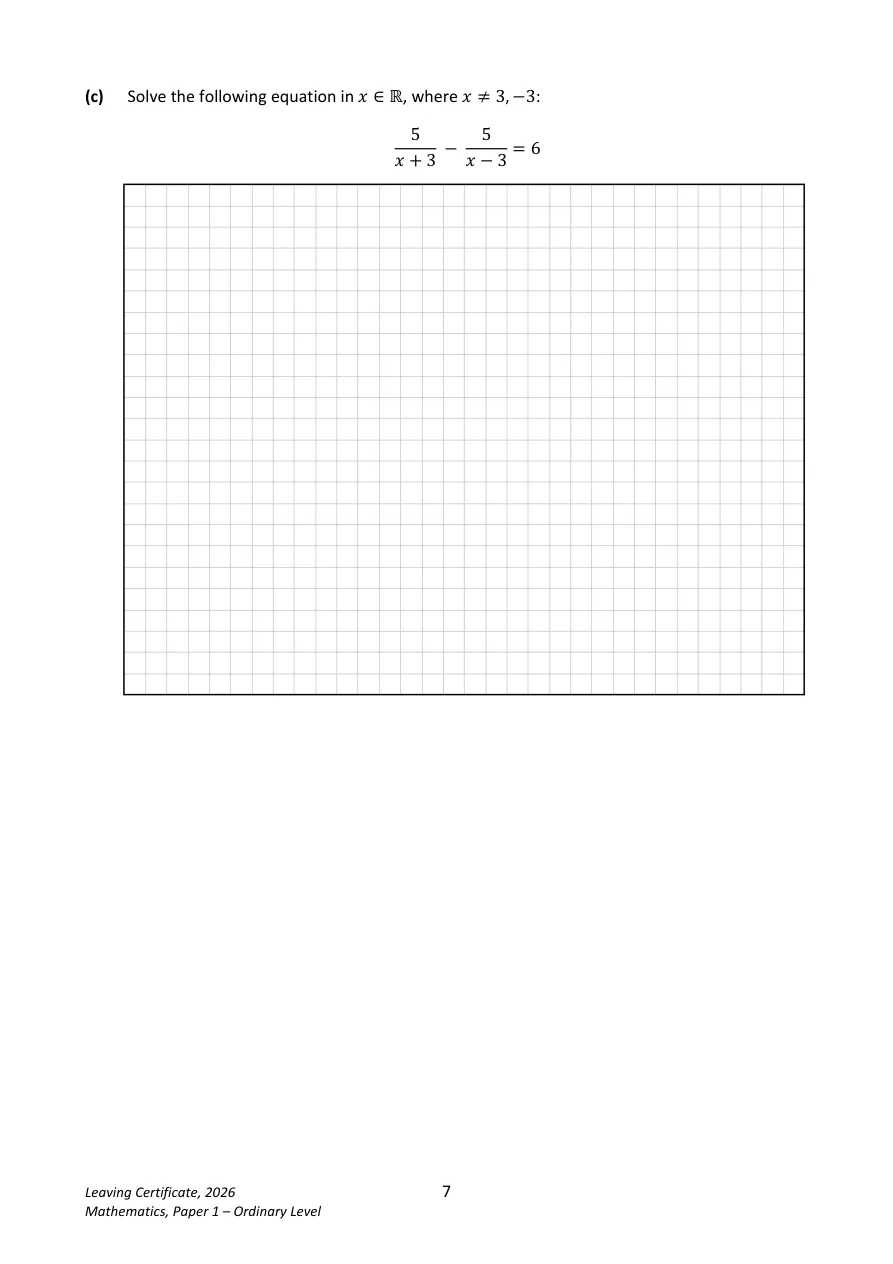
c) Rational equation

  1. \dfrac{5}{x+3}-\dfrac{5}{x-3}=6

    The denominators cannot be zero, so x cannot be −3 or 3.

  2. 5(x-3)-5(x+3)=6(x+3)(x-3)

    Multiply both sides by (x + 3)(x − 3). On the left, cancel x + 3 in the first term and x − 3 in the second.

  3. 5x-15-5x-15=6(x^2-9)

    Distribute the negative sign as well: −5(x + 3) = −5x − 15.

  4. -30=6x^2-54

    The x-terms on the left cancel. On the right, (x + 3)(x − 3) = x² − 9 because the middle terms cancel.

  5. 6x^2=24

    Add 54 to both sides.

  6. x^2=4

    Divide both sides by 6.

  7. x=2\quad\mathrm{or}\quad x=-2

    Both 2 and −2 square to 4.

  8. Both answers satisfy the denominator restrictions and the original equation.

Question 3

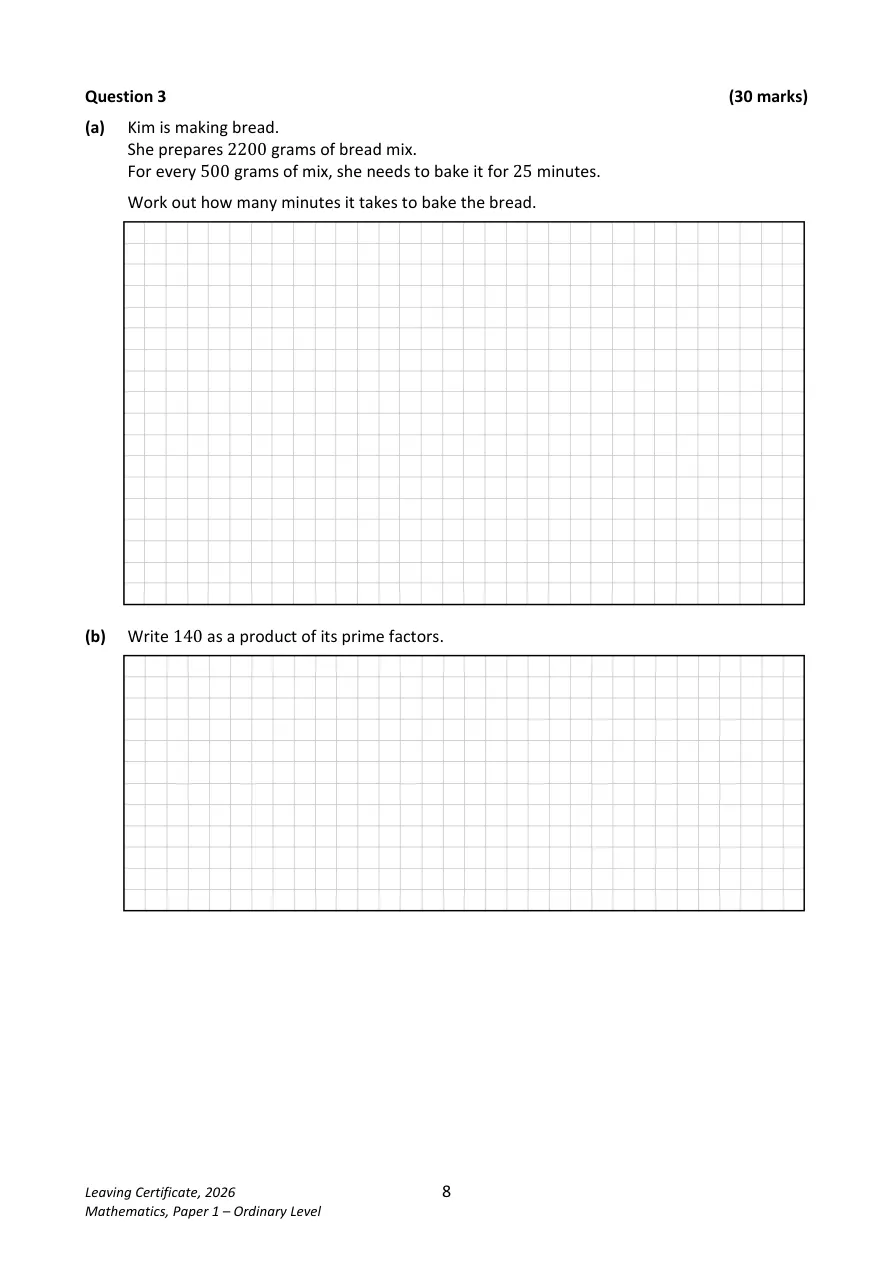
a) Baking time

  1. t=\dfrac{2200}{500}(25)
  2. t=110\ \mathrm{min}

b) Prime factors

  1. 140=2(70)
  2. 140=2^2(5)(7)

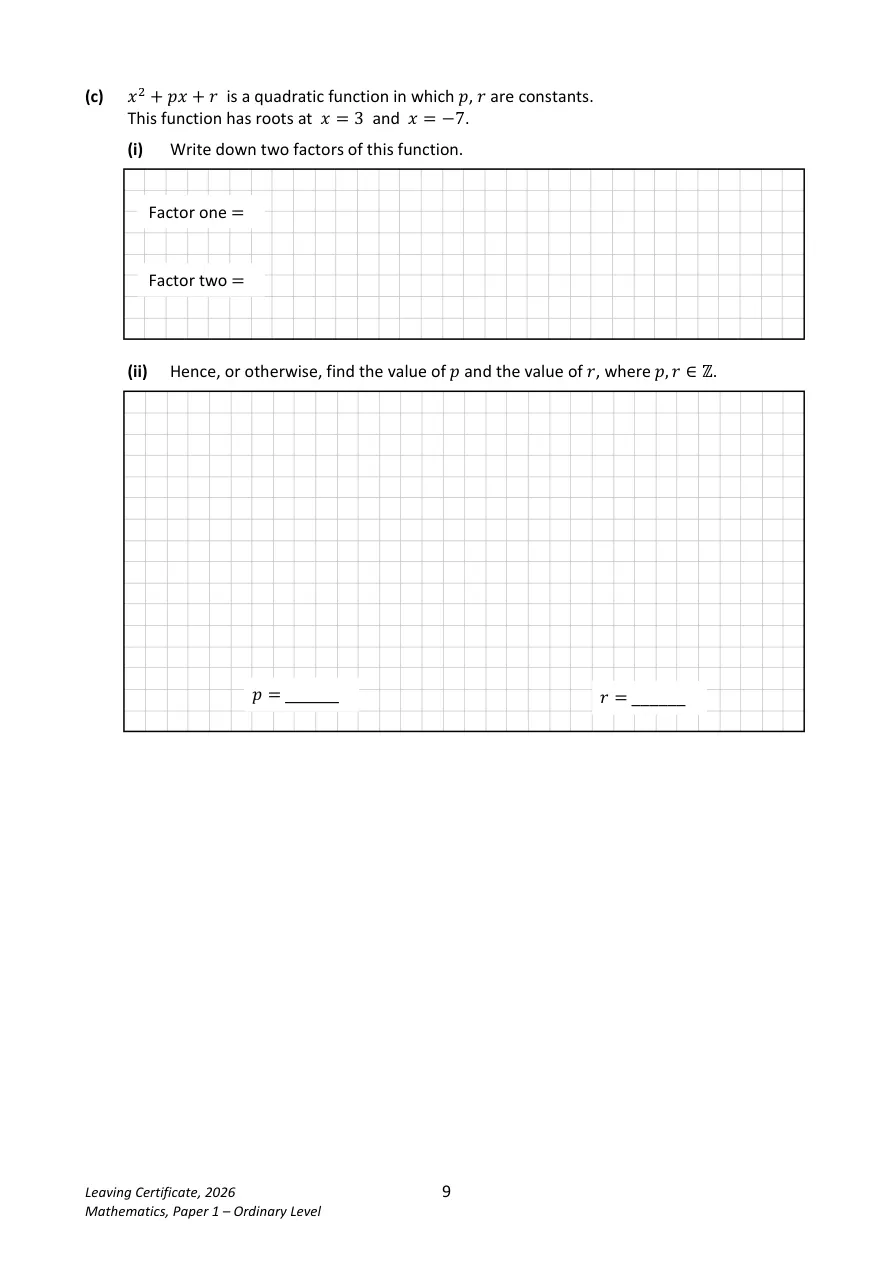
c)(i) Factors

  1. (x-3),\quad(x+7)

c)(ii) Coefficients

  1. (x-3)(x+7)=x^2+4x-21
  2. p=4,\quad r=-21

Question 4

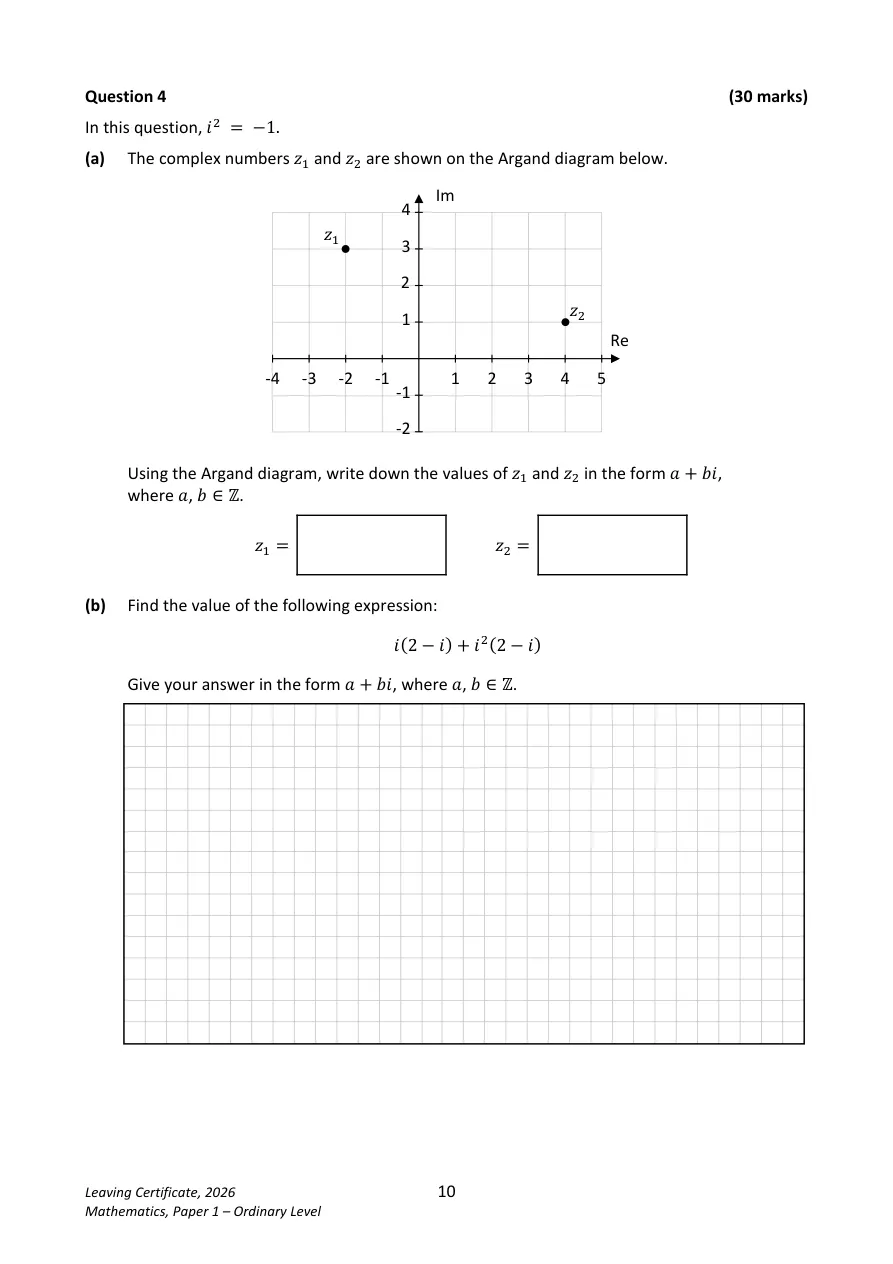
a) Read Argand diagram

  1. z_1=-2+3i,\quad z_2=4+i

b) Simplify

  1. i(2-i)+i^2(2-i)
  2. 2i-i^2+2i^2-i^3

    Multiply each term in the bracket by the expression in front of it.

  3. 2i+i^2-i^3

    Collect the two i² terms.

  4. 2i-1+i

    Use i² = −1 and i³ = i² × i = −i.

  5. -1+3i

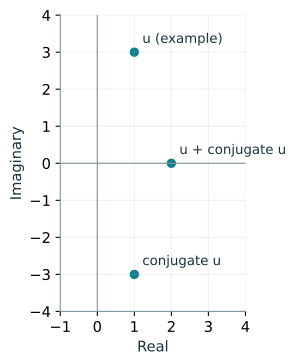
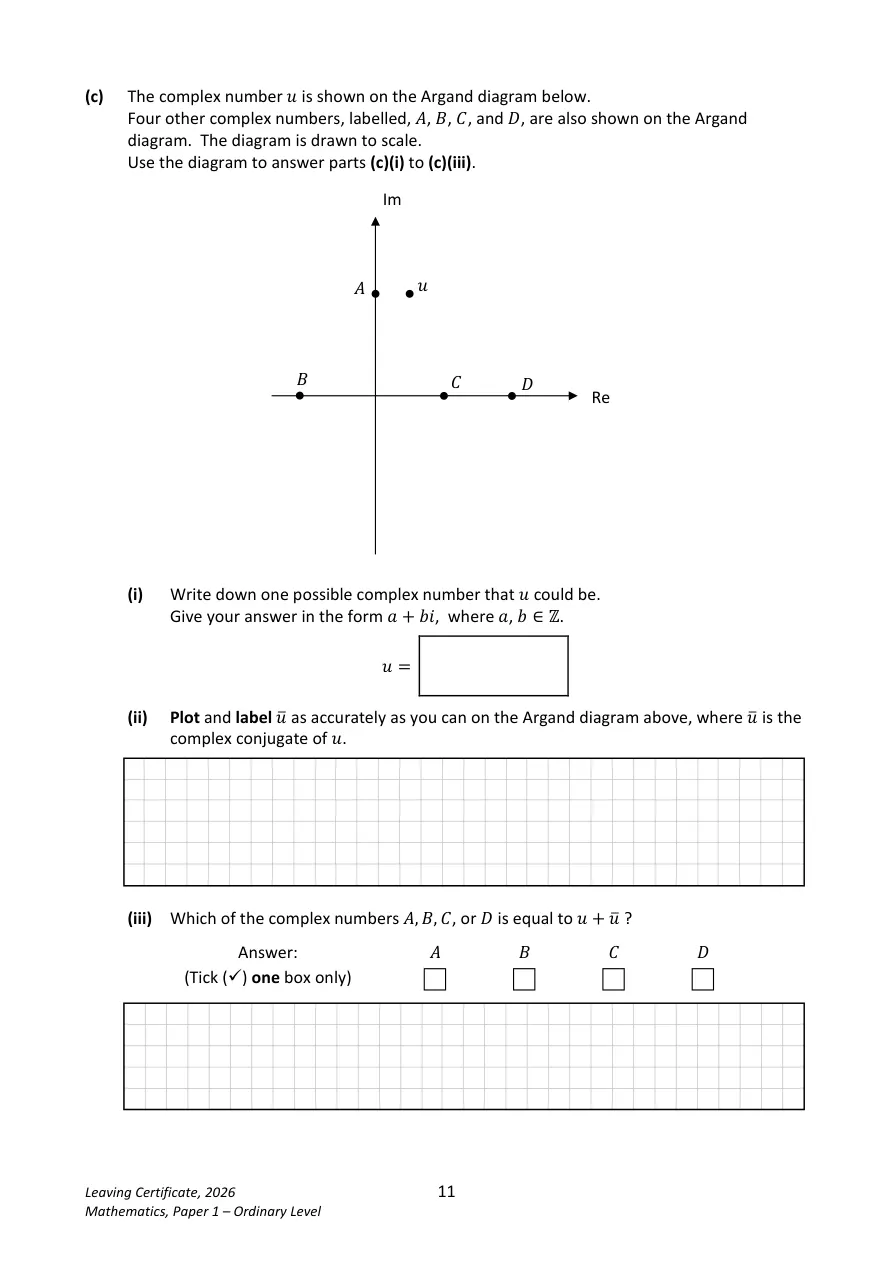
c)(i) Possible u

  1. u=1+3i

    The chosen real/imaginary ratio must match the scaled diagram; this is one valid example.

c)(ii) Conjugate

  1. \bar{u}=1-3i
  2. Reflect u in the real axis: same horizontal position, equal distance below the axis.
  3. 2026-1-4-argand

c)(iii) Sum

  1. u+\bar{u}=2\operatorname{Re}(u)
  2. Choose C: the sum is real and twice u's real coordinate.

Question 5

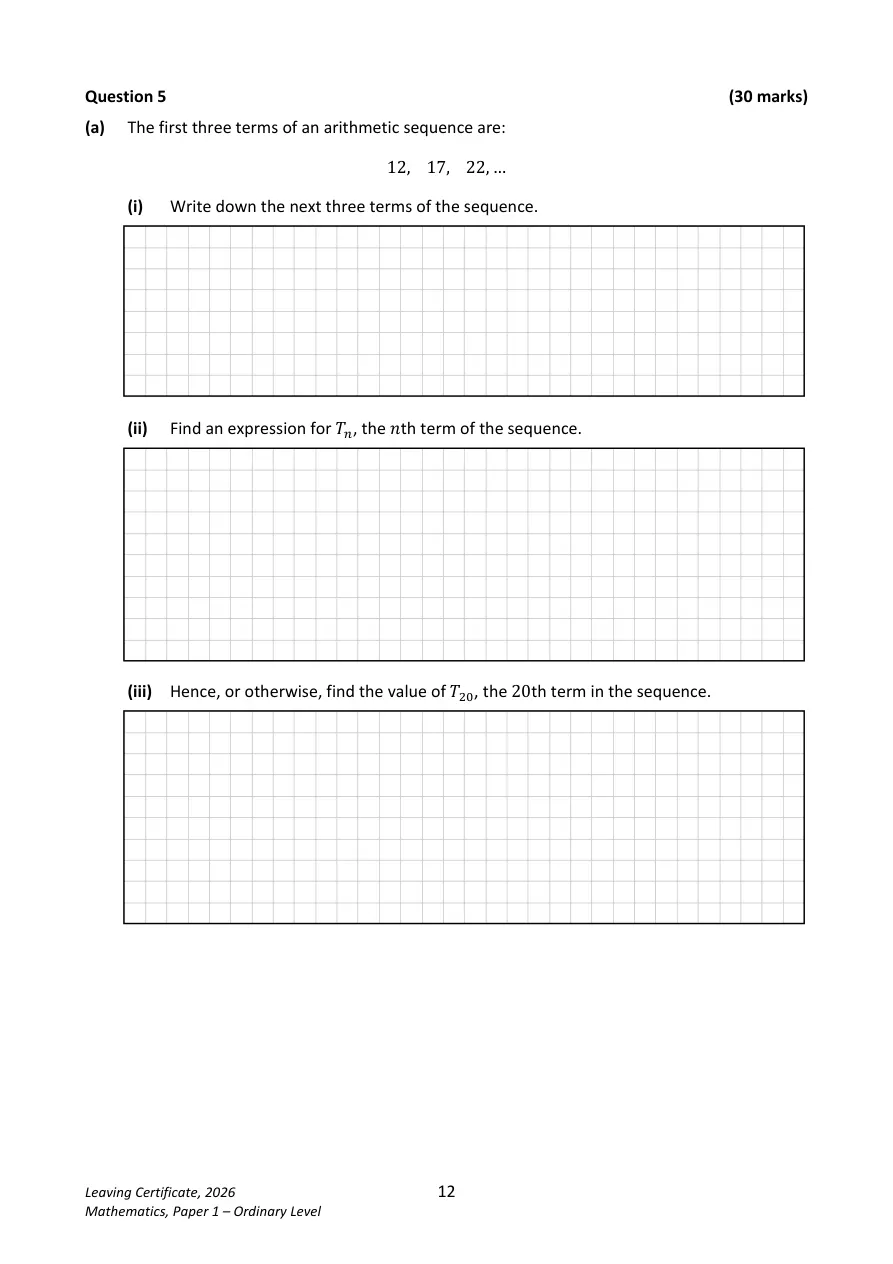
a)(i) Next terms

  1. 27,\quad32,\quad37

a)(ii) General term

  1. T_n=a+(n-1)d
  2. T_n=12+5(n-1)
  3. T_n=5n+7

a)(iii) Twentieth term

  1. T_{20}=5(20)+7
  2. T_{20}=107

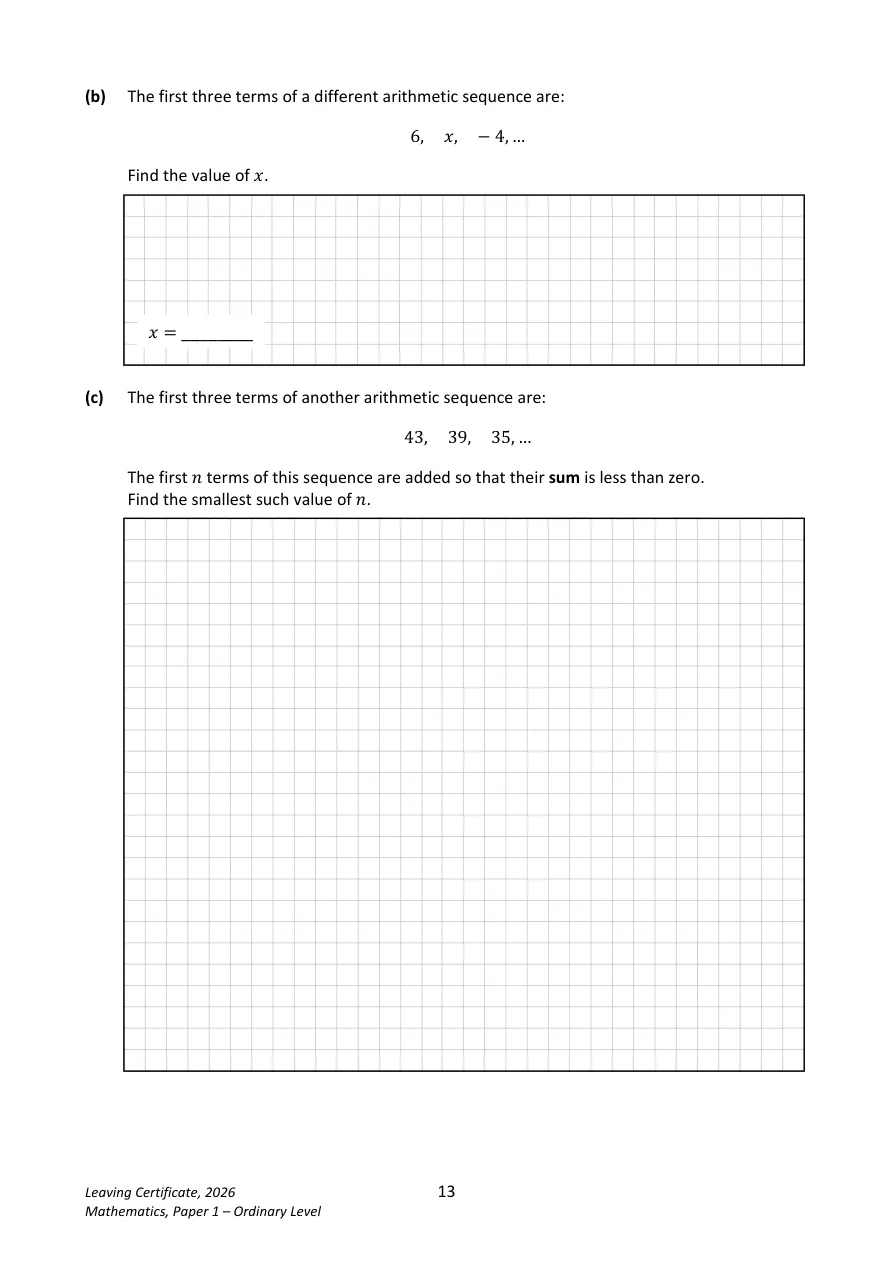
b) Middle term

  1. x=\dfrac{6+(-4)}{2}
  2. x=1

c) First negative sum

  1. S_n=\dfrac{n}{2}\left(2(43)+(n-1)(-4)\right)
  2. S_n=n(45-2n)
  3. n(45-2n)<0
  4. n>22.5

    n is positive, so the sign comes from the second factor.

  5. n=23

Question 6

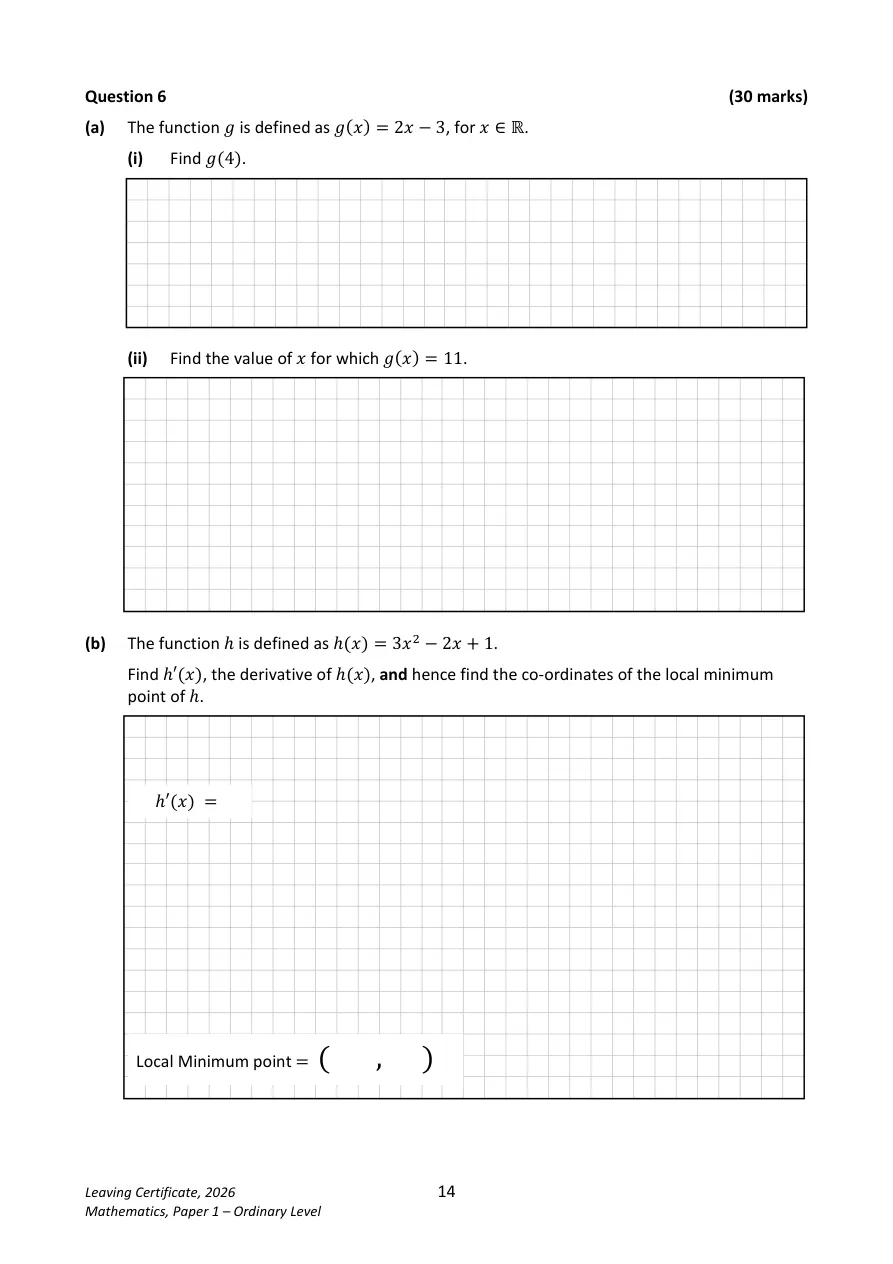
a)(i) Evaluate

  1. g(4)=2(4)-3=5

a)(ii) Solve

  1. 2x-3=11
  2. 2x=14
  3. x=7

b) Local minimum

  1. h'(x)=6x-2
  2. 6x-2=0
  3. x=\dfrac{1}{3}
  4. h\left(\dfrac{1}{3}\right)=3\left(\dfrac{1}{3}\right)^2-2\left(\dfrac{1}{3}\right)+1
  5. h\left(\dfrac{1}{3}\right)=\dfrac{2}{3}
  6. \left(\dfrac{1}{3},\dfrac{2}{3}\right)

    h''(x)=6>0, confirming a local minimum.

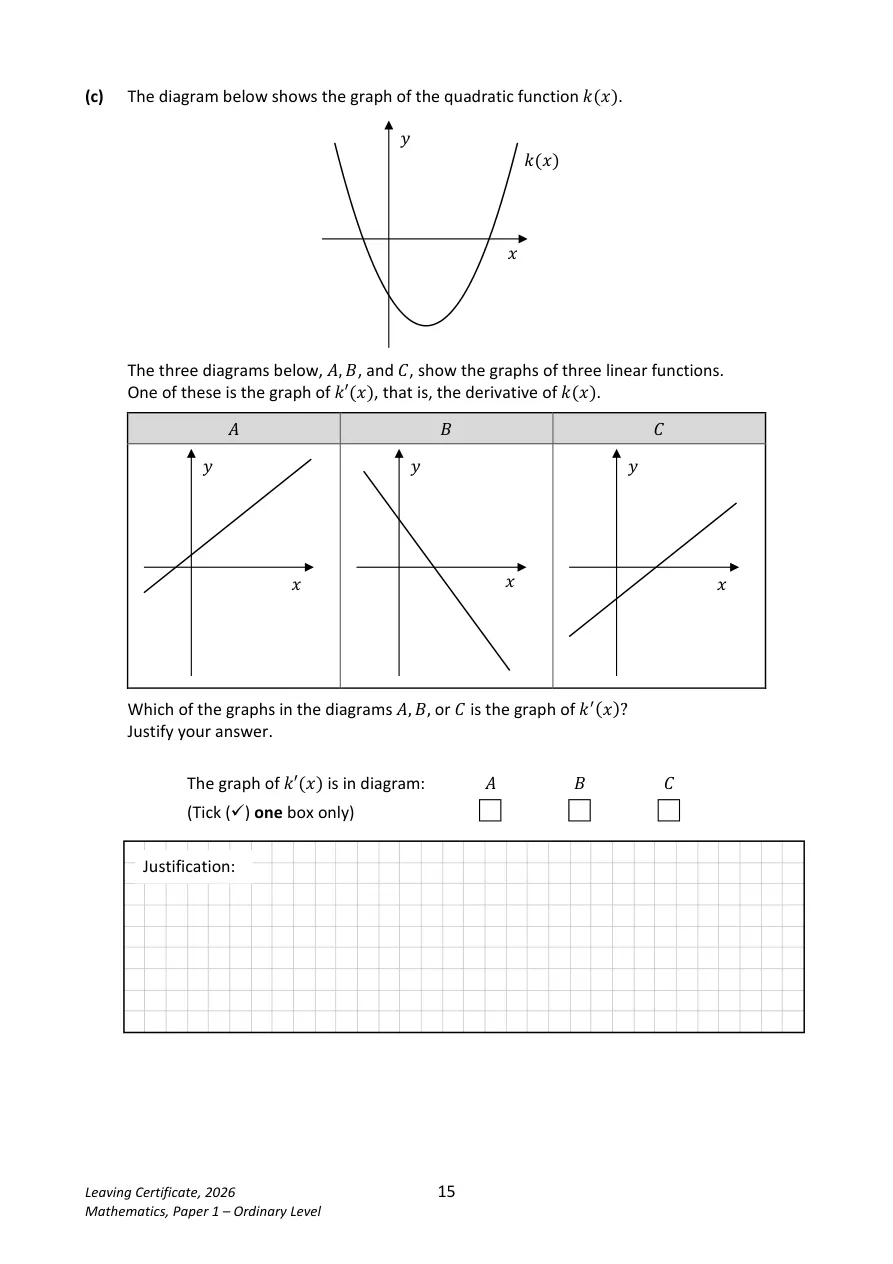
c) Derivative graph

  1. Choose C. The parabola opens upwards, so its derivative has positive slope. Its minimum is to the right of the y-axis, so the derivative is zero at a positive x-coordinate.

Question 7

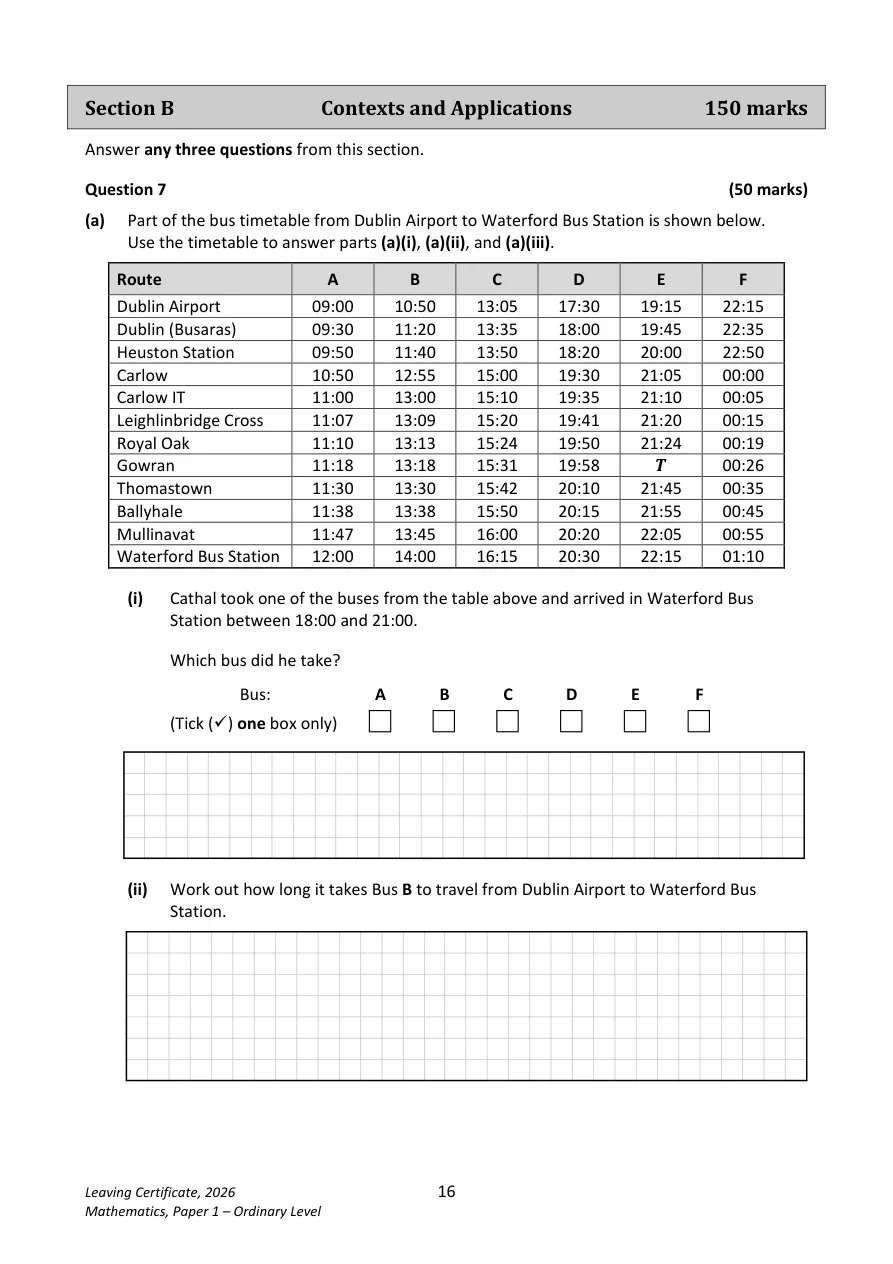
a)(i) Bus

  1. Bus D arrives at 20:30, between 18:00 and 21:00.

a)(ii) Journey time

  1. 14{:}00-10{:}50=3\ \mathrm{h}\ 10\ \mathrm{min}

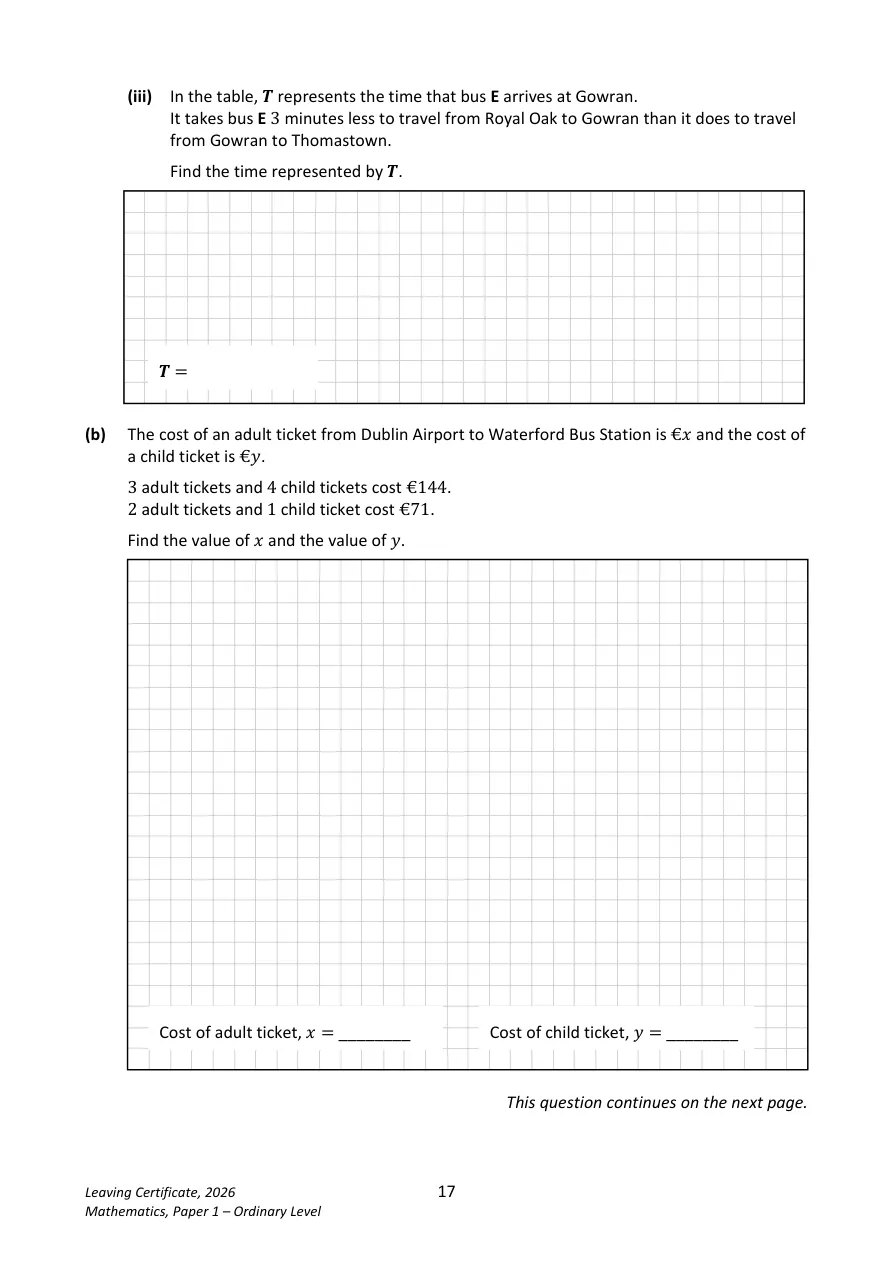
a)(iii) Gowran time

  1. t+(t+3)=21

    The two legs together take 21 minutes; the first is 3 minutes shorter.

  2. 2t=18
  3. t=9\ \mathrm{min}
  4. T=21{:}24+9\ \mathrm{min}
  5. T=21{:}33

b) Ticket costs

  1. 3x+4y=144\quad(A)
  2. 2x+y=71\quad(B)
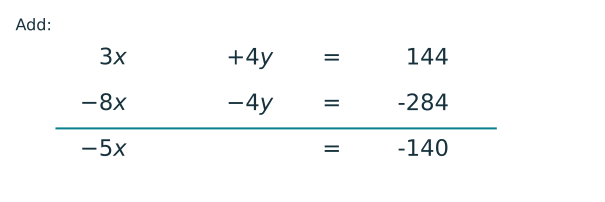
  3. Eliminate y by multiplying B by −4. Then +4y and −4y cancel when the equations are added.
  4. 3x+4y=144
  5. -8x-4y=-284
  6. -5x=-140
  7. 2026-1-7-elimination
  8. x=28
  9. 2(28)+y=71
  10. y=15
  11. Adult €28; child €15.

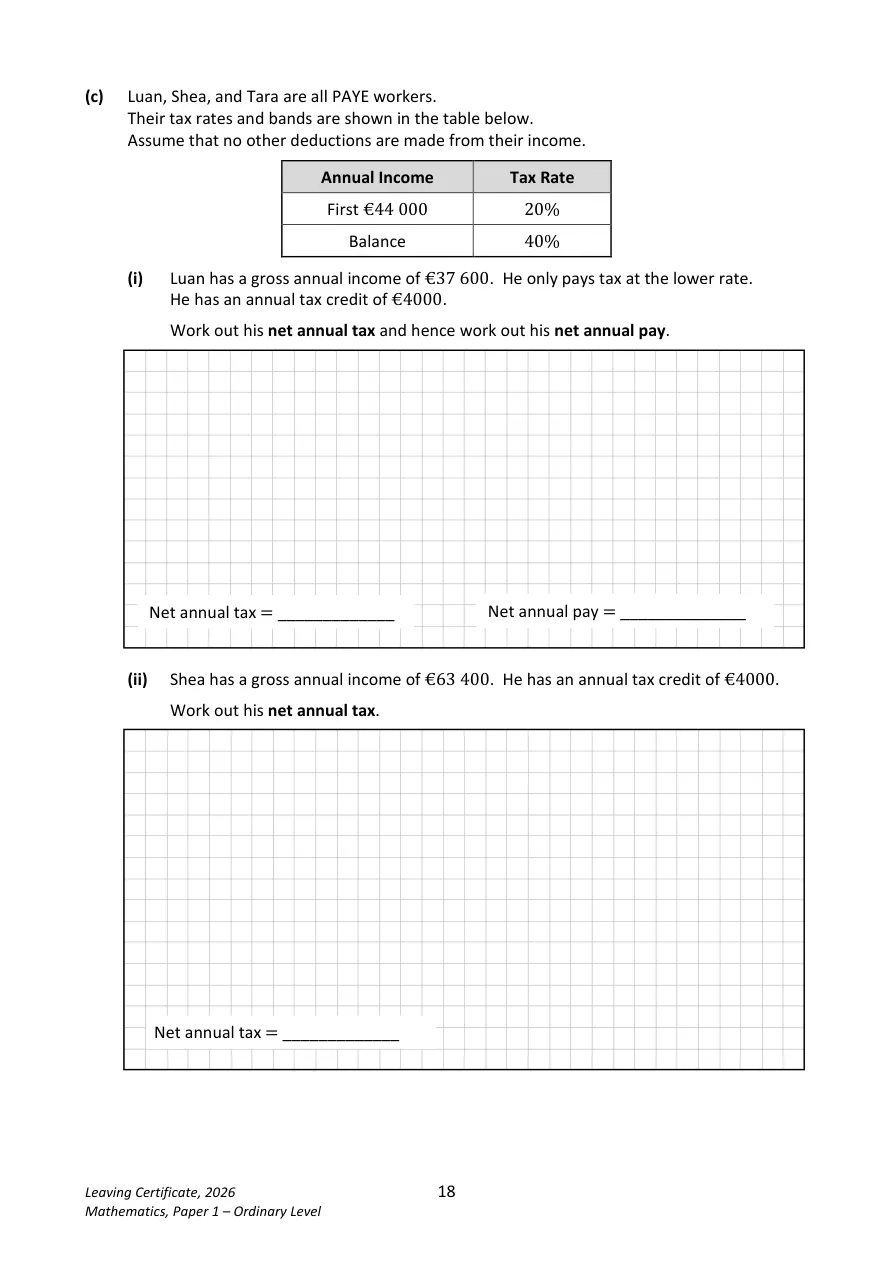
c)(i) Luan

  1. T=37600(0.20)-4000
  2. T=\mathrm{€}3520
  3. N=37600-3520
  4. N=\mathrm{€}34080

c)(ii) Shea

  1. T=44000(0.20)+(63400-44000)(0.40)-4000
  2. T=\mathrm{€}12560

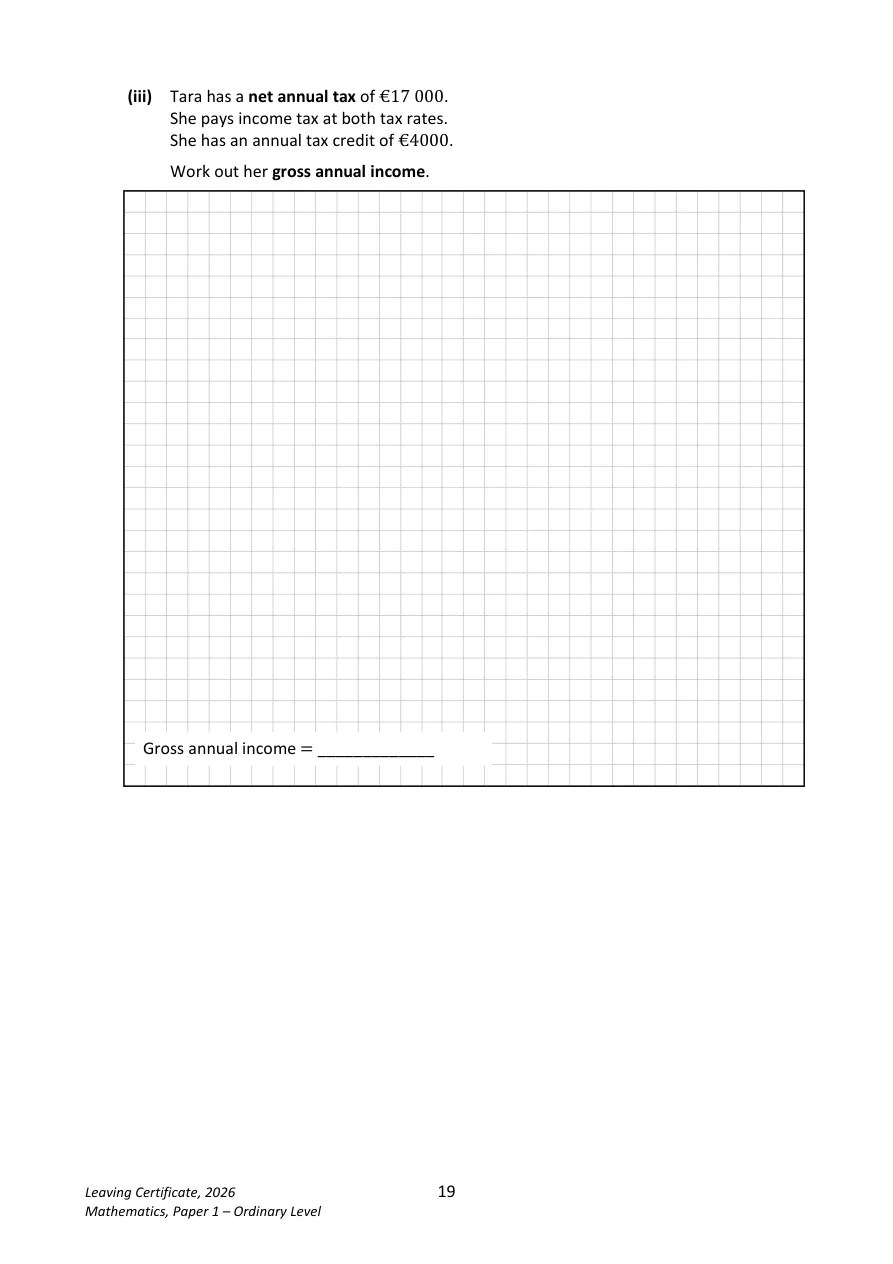
c)(iii) Tara

  1. 8800+0.40(G-44000)-4000=17000
  2. 0.40(G-44000)=12200
  3. G-44000=30500
  4. G=\mathrm{€}74500
  5. These calculations use only the tax bands and deductions given in the paper.

Question 8

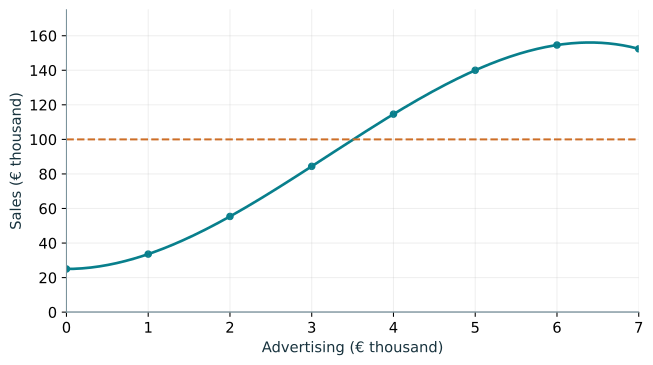
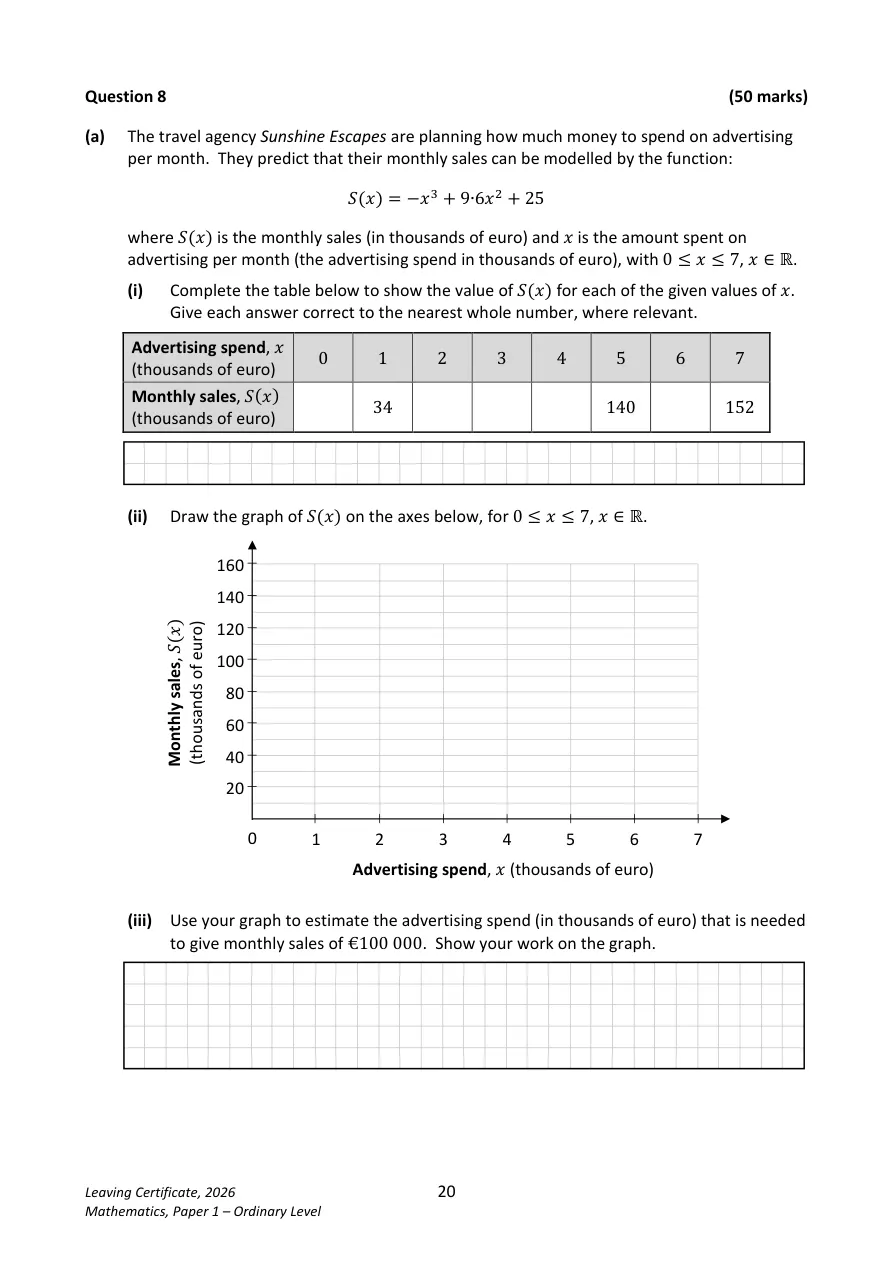
a)(i) Sales table

  1. For x = 0,1,2,3,4,5,6,7: rounded S(x) = 25,34,55,84,115,140,155,152 (thousands of euro).

a)(ii) Graph

  1. 2026-1-8-graph

a)(iii) €100 000 sales

  1. x\approx3.5\text{ thousand euro}

    Trace horizontally from S=100 to the curve, then down to the x-axis; approximately €3500 advertising.

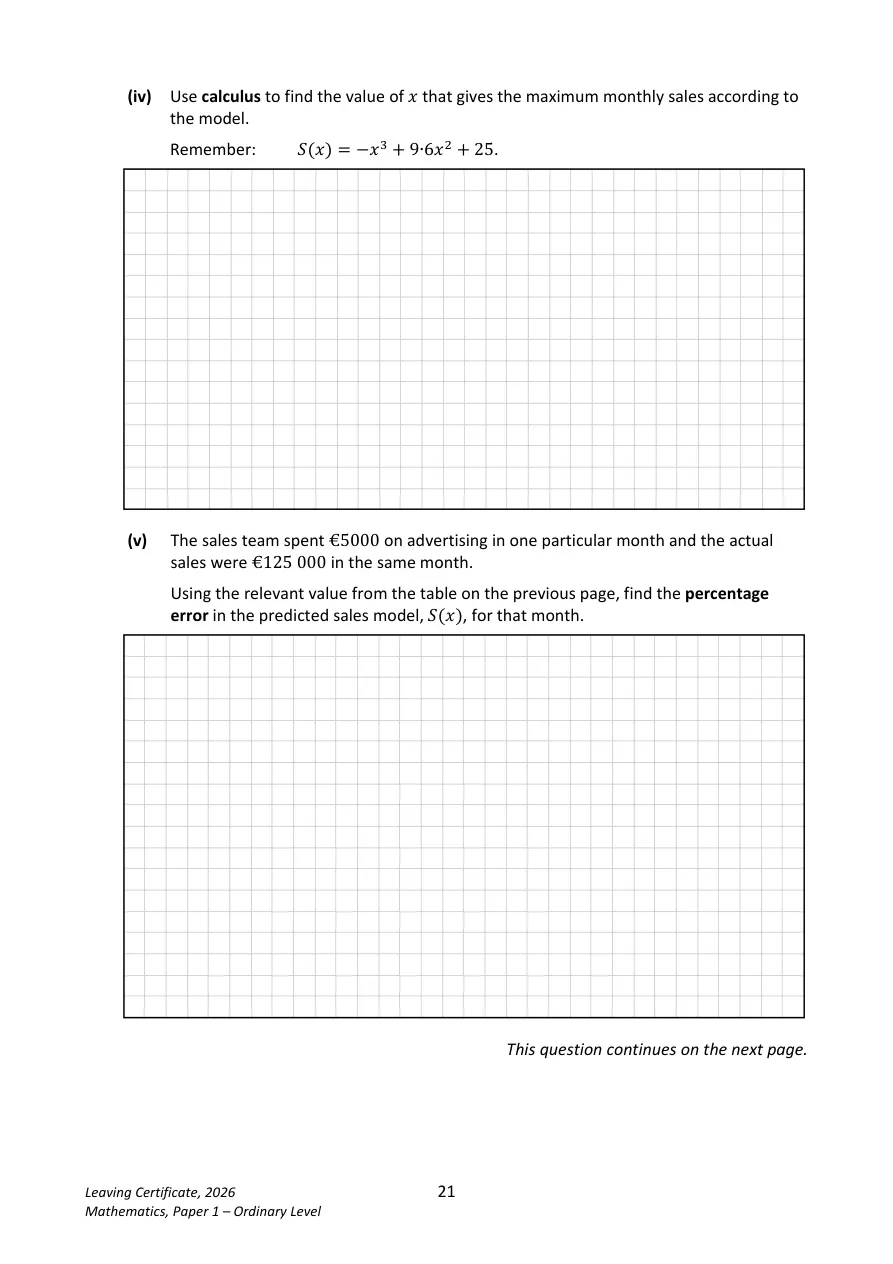
a)(iv) Maximum sales

  1. S'(x)=-3x^2+19.2x
  2. x(-3x+19.2)=0
  3. x=0\quad\mathrm{or}\quad x=6.4
  4. S''(6.4)=-6(6.4)+19.2<0
  5. x=6.4

    This gives the maximum on the stated domain; compare the endpoints as well.

a)(v) Percentage error

  1. p=\dfrac{|140-125|}{125}\times100
  2. p=12\%

    Divide by the actual sales, not the predicted sales.

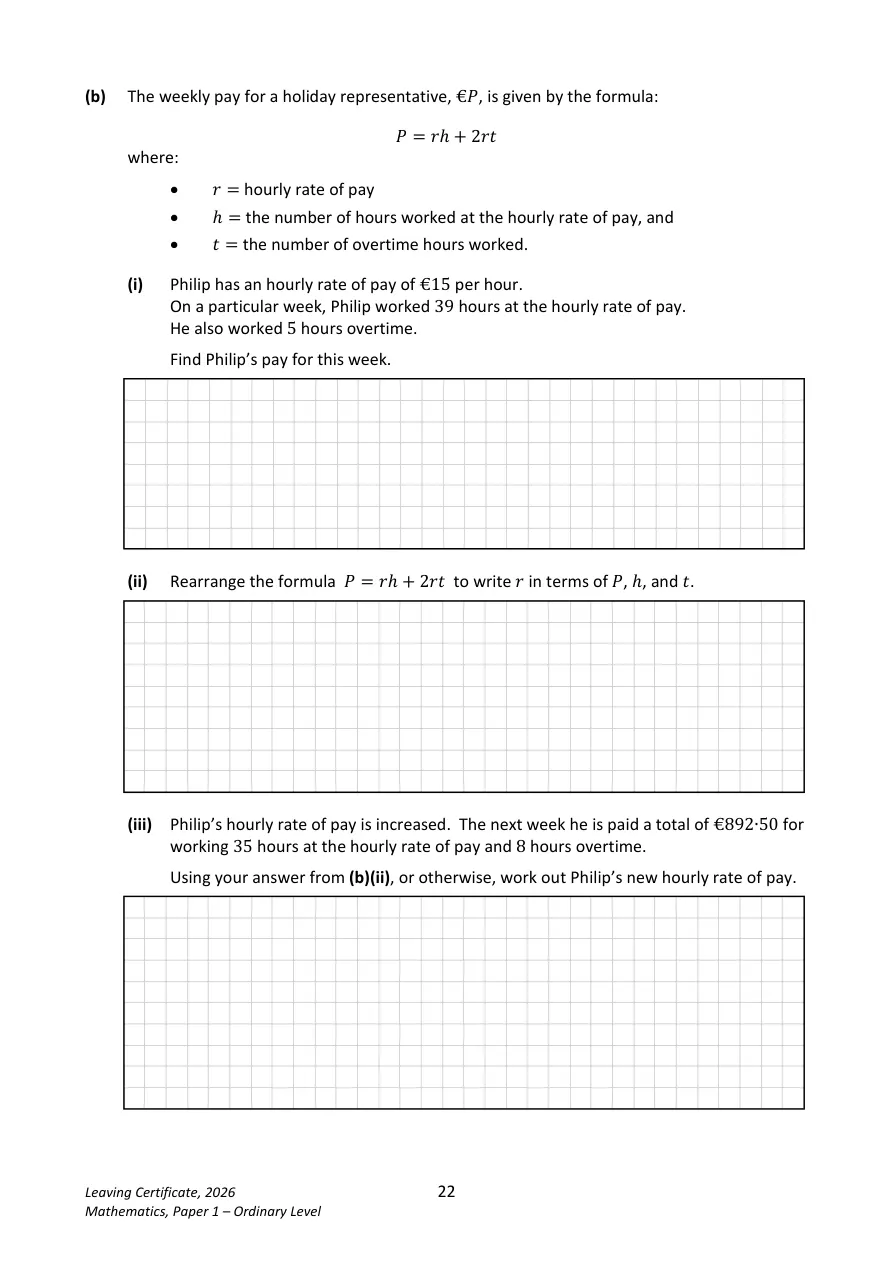
b)(i) Weekly pay

  1. P=15(39)+2(15)(5)
  2. P=\mathrm{€}735

b)(ii) Rearrange

  1. P=r(h+2t)
  2. r=\dfrac{P}{h+2t}

b)(iii) New hourly rate

  1. r=\dfrac{892.50}{35+2(8)}
  2. r=\mathrm{€}17.50

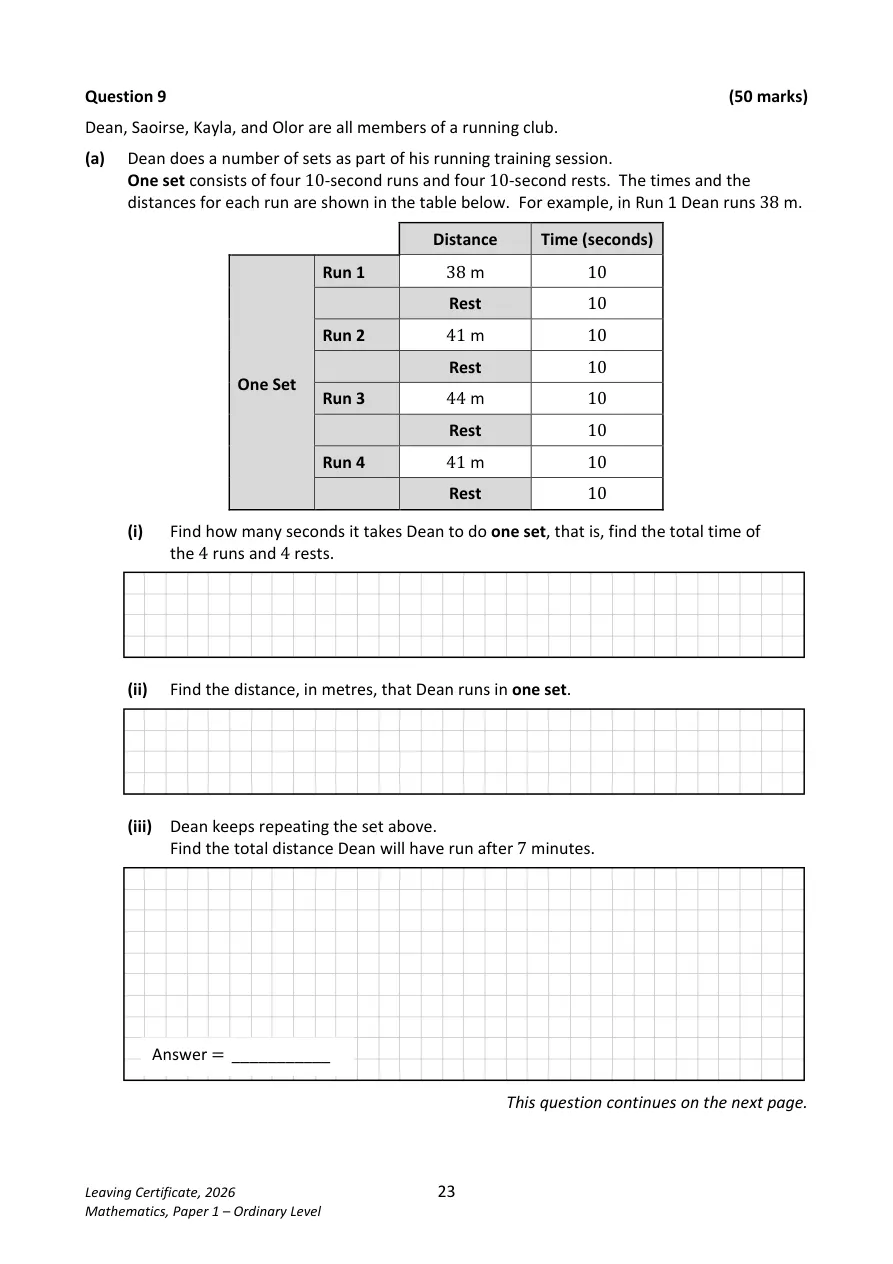
Question 9

a)(i) One set

  1. t=8(10)=80\ \mathrm{s}

a)(ii) Set distance

  1. d=38+41+44+41
  2. d=164\ \mathrm{m}

a)(iii) Seven minutes

  1. 420=5(80)+20
  2. d=5(164)+38

    In the remaining 20 seconds Dean completes the first 10-second run and its rest.

  3. d=858\ \mathrm{m}

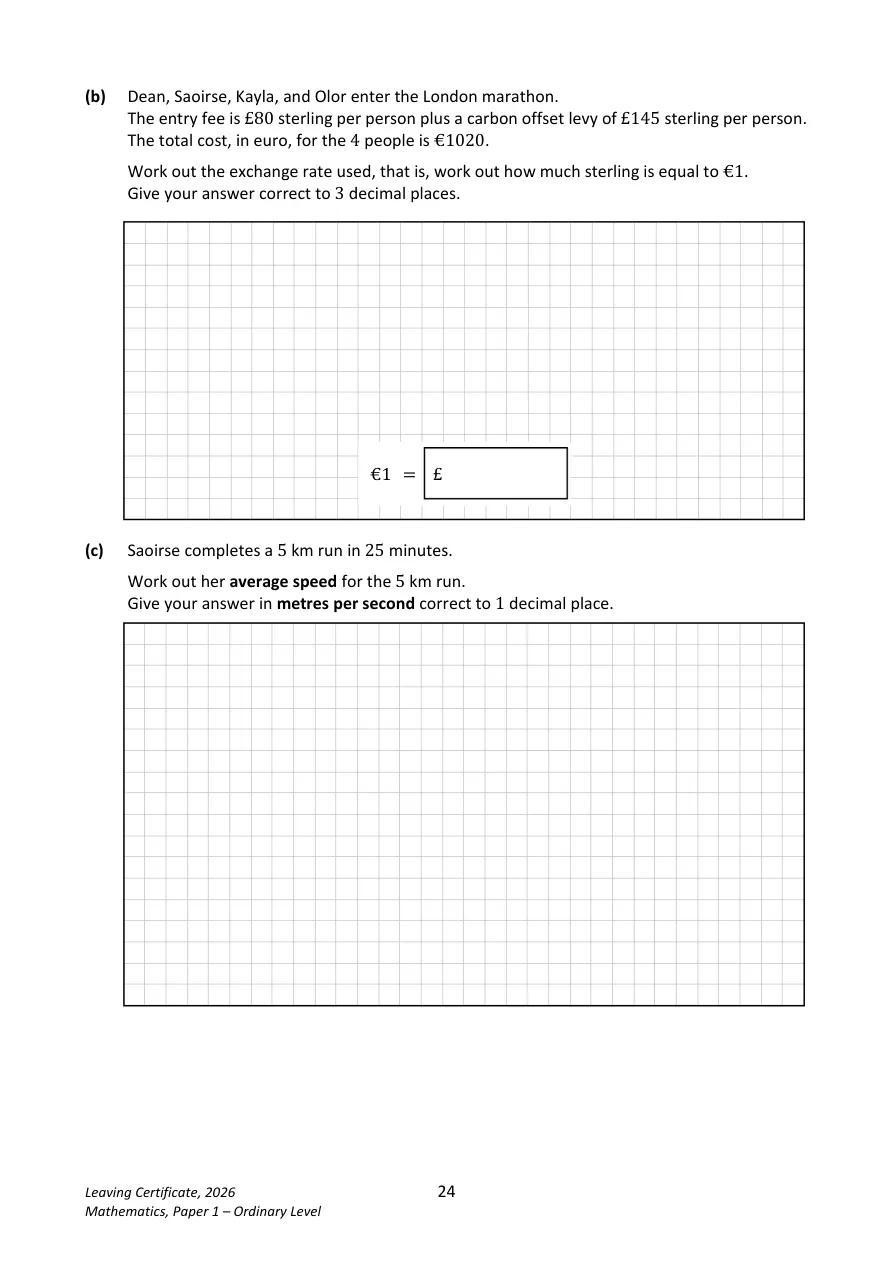
b) Exchange rate

  1. S=4(80+145)=900\ \mathrm{pounds}
  2. r=\dfrac{900}{1020}
  3. \mathrm{€}1\approx\mathrm{£}0.882

c) Average speed

  1. v=\dfrac{5000}{25(60)}
  2. v\approx3.3\ \mathrm{m\ s}^{-1}

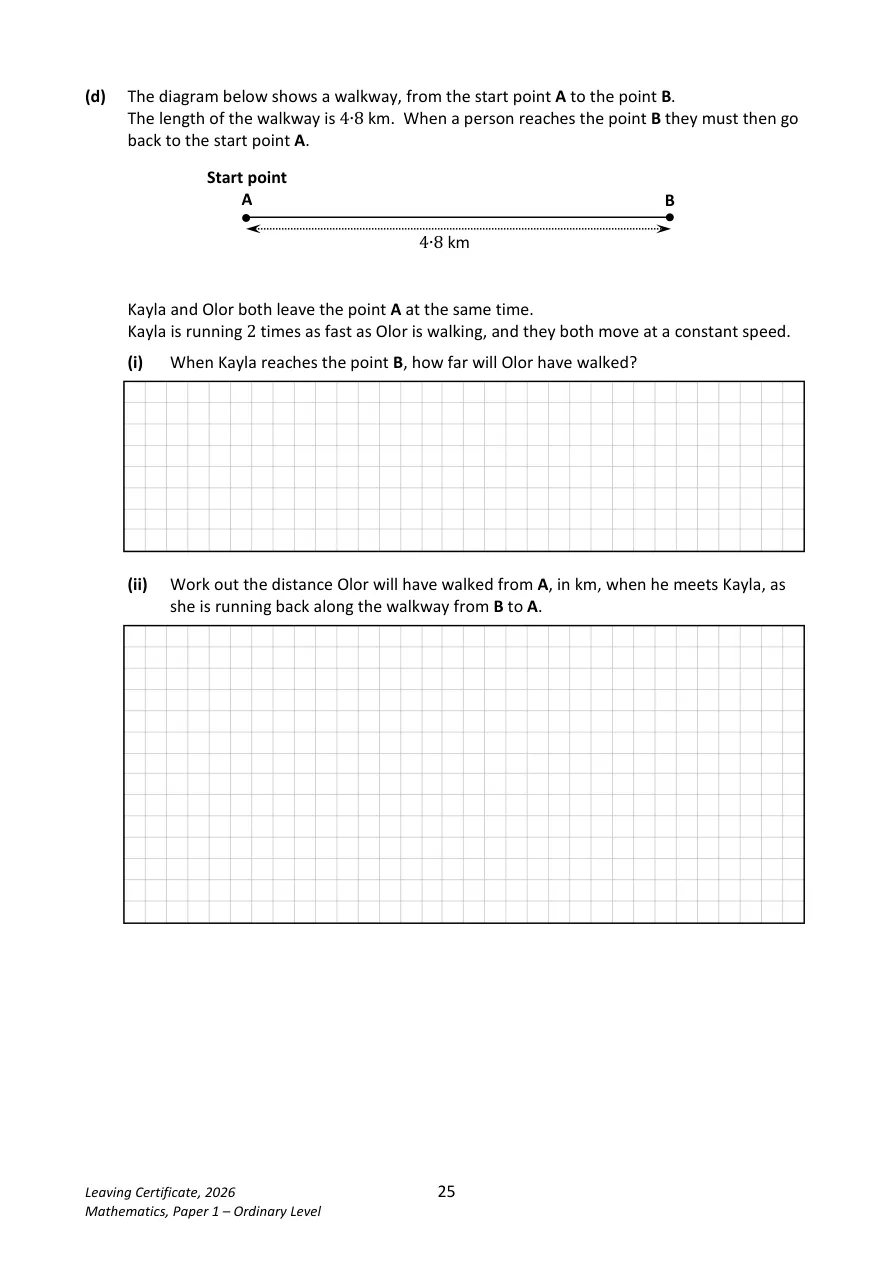
d)(i) At B

  1. d_O=\dfrac{4.8}{2}
  2. d_O=2.4\ \mathrm{km}

d)(ii) Meeting point

  1. d_K=9.6-d_O

    Kayla has gone to B and back to Olor's position.

  2. d_K=2d_O
  3. 3d_O=9.6
  4. d_O=3.2\ \mathrm{km}

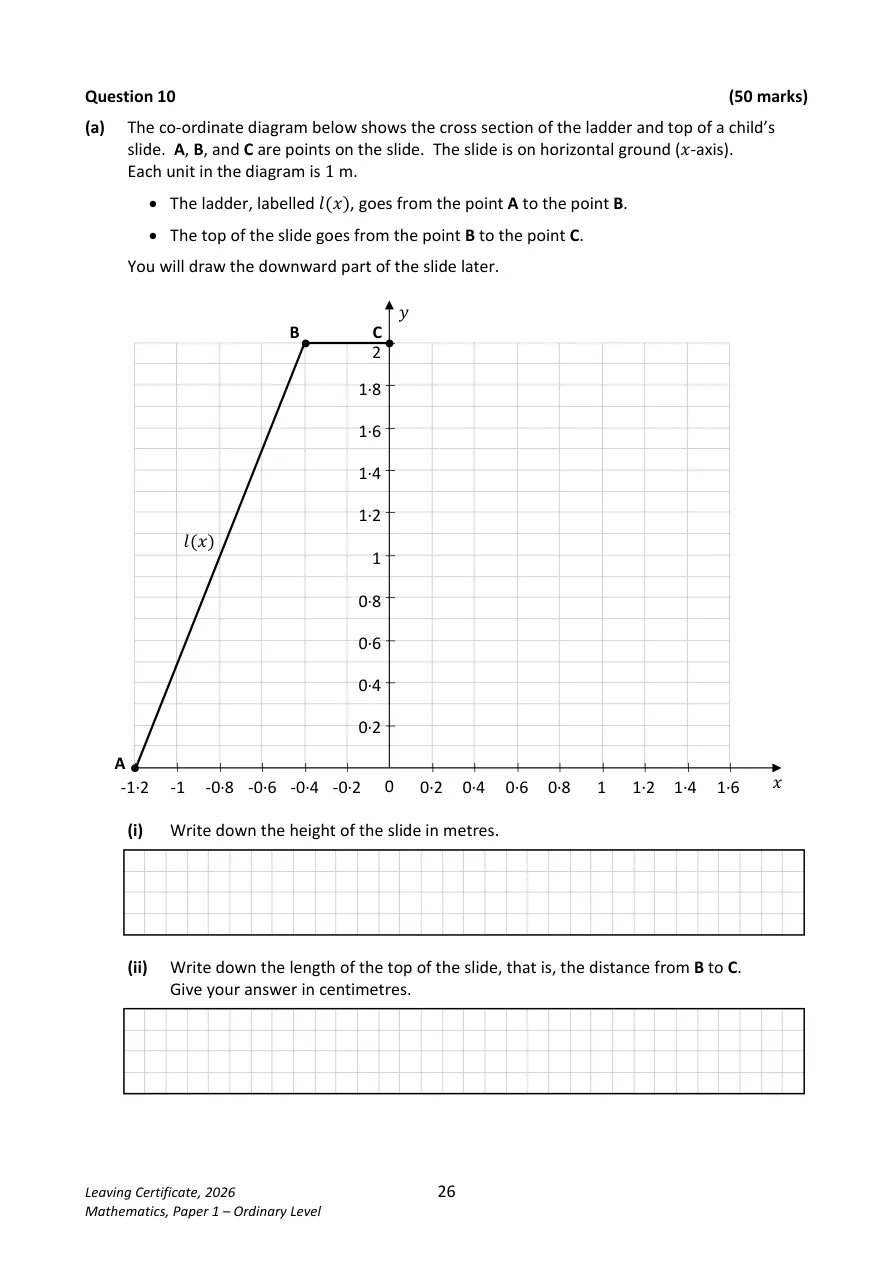
Question 10

a)(i) Height

  1. h=2\ \mathrm{m}

a)(ii) Top length

  1. BC=0.4\ \mathrm{m}=40\ \mathrm{cm}

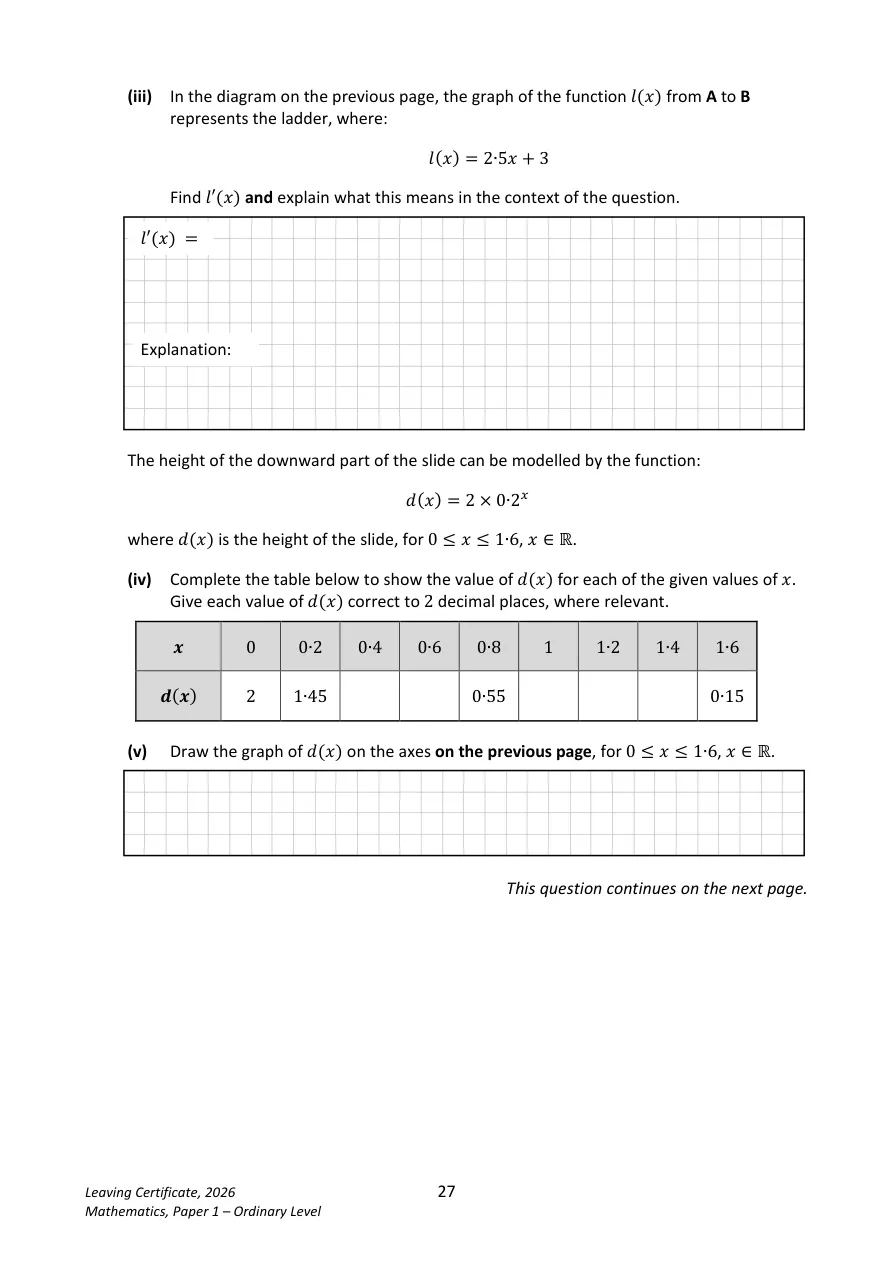
a)(iii) Derivative

  1. l'(x)=2.5
  2. The ladder's height increases by 2.5 metres for each metre of horizontal increase. Its slope is constant.

a)(iv) Table

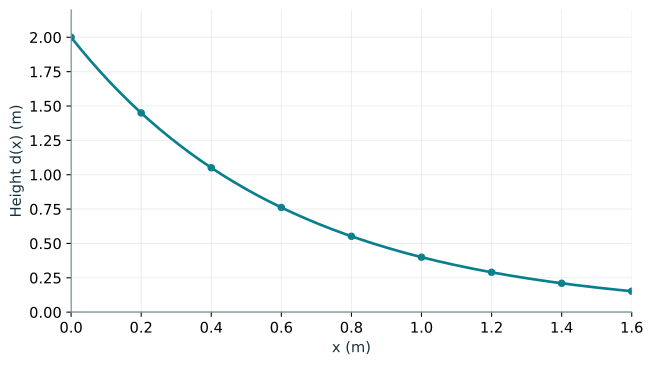
  1. For x = 0,0.2,0.4,0.6,0.8,1,1.2,1.4,1.6: d(x) = 2.00,1.45,1.05,0.76,0.55,0.40,0.29,0.21,0.15.

a)(v) Graph

  1. 2026-1-10-graph

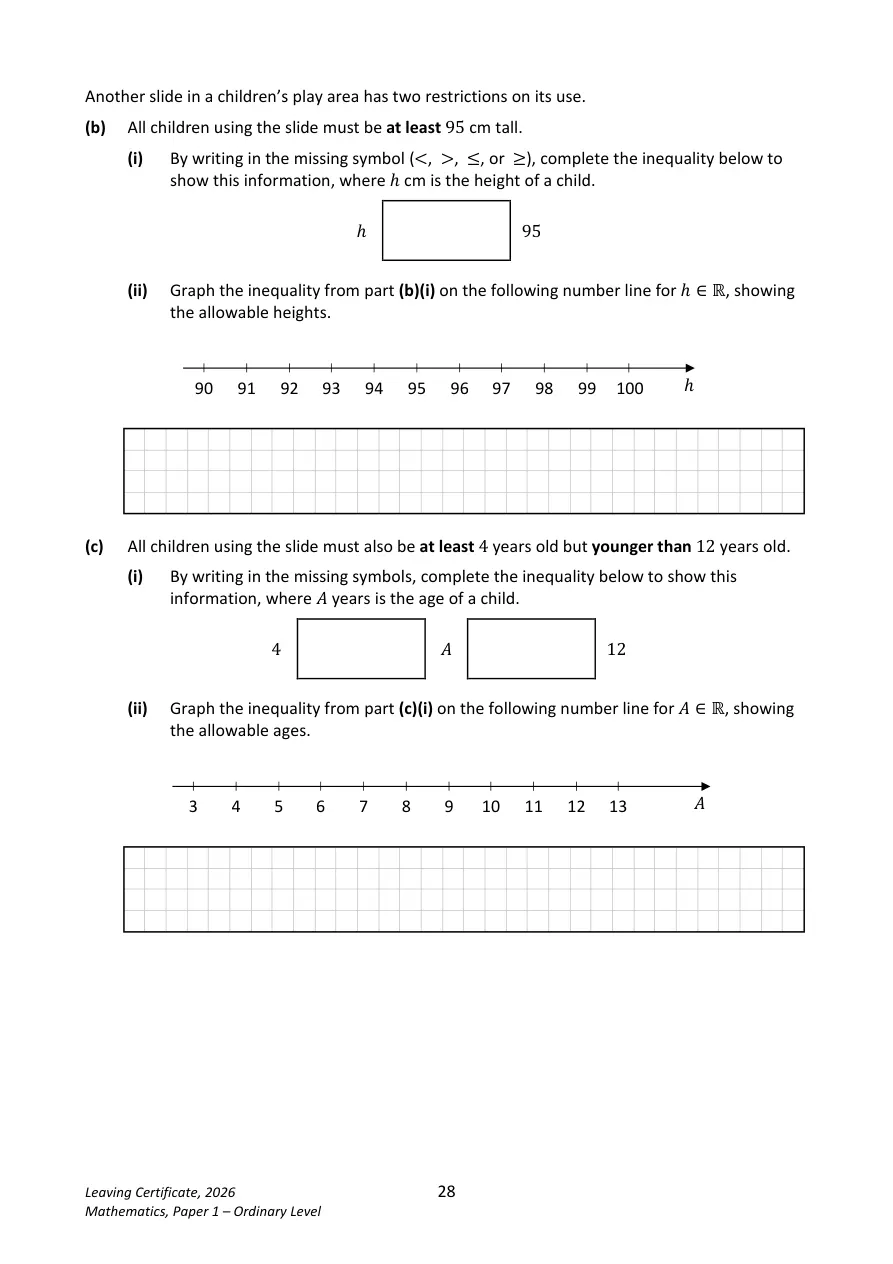
b) Height restriction

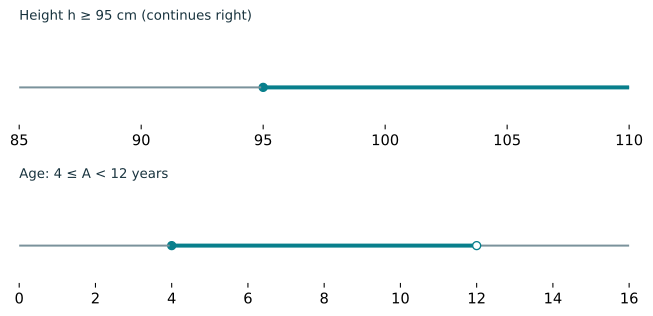
  1. h\geq95
  2. Closed dot at 95, continuous ray to the right.

c) Age restriction

  1. 4\leq A<12
  2. Closed dot at 4, open dot at 12, continuous segment between them.
  3. 2026-1-10-numberlines

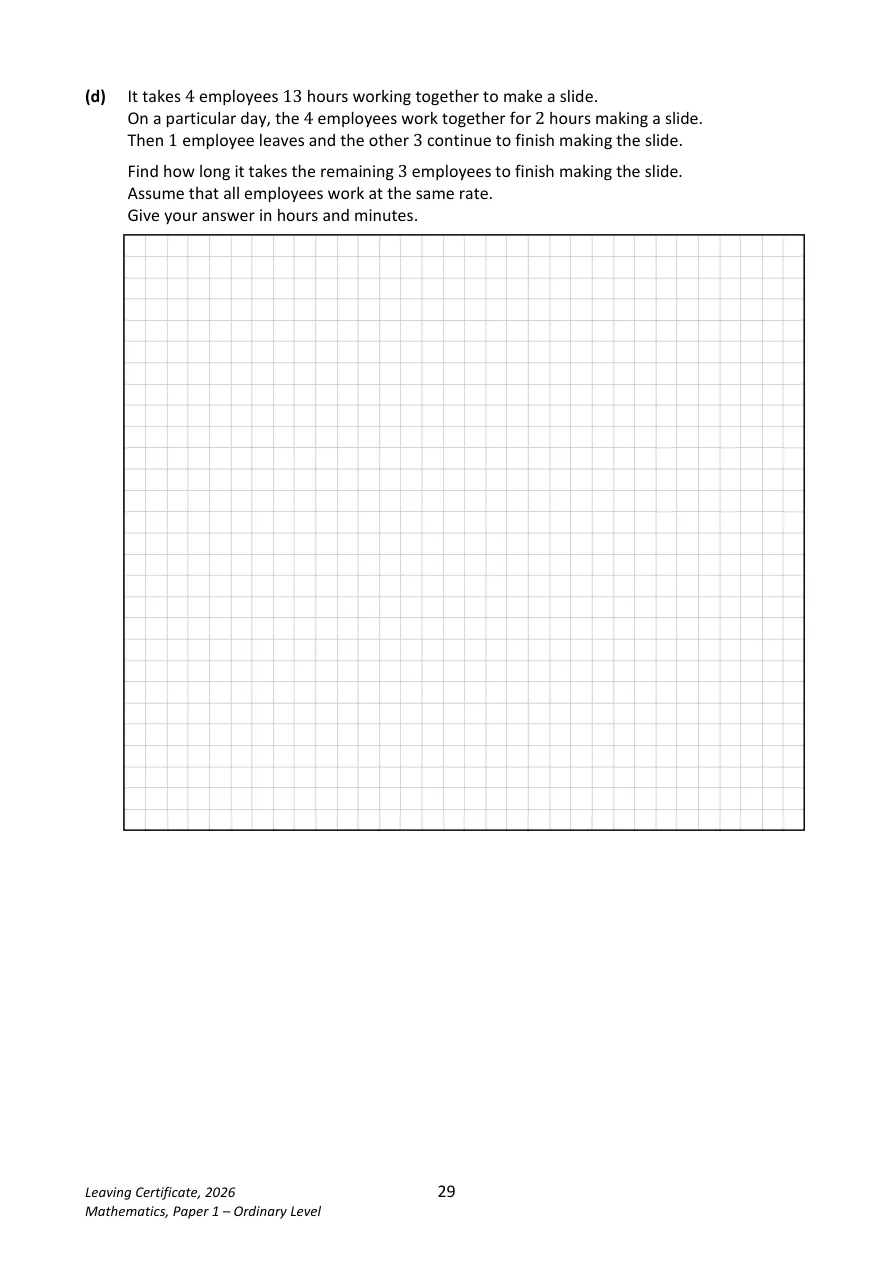
d) Remaining work

  1. W=4(13)=52\ \mathrm{worker\ hours}
  2. W_{\mathrm{done}}=4(2)=8
  3. W_{\mathrm{remaining}}=52-8=44
  4. t=\dfrac{44}{3}\ \mathrm{h}
  5. t=14\ \mathrm{h}\ 40\ \mathrm{min}

    This is the time after one employee leaves, not the full elapsed time.

See working and diagrams on the original paper
Original exam paper page 4
C=(34.60+28.90)(1.12)
C=\mathrm{€}71.12
D=22600(0.18)
D=\mathrm{€}4068
V=22600(0.82)^2
V=\mathrm{€}15196.24
Original exam paper page 5
20230=28000\left(1-\dfrac{k}{100}\right)^2
\left(1-\dfrac{k}{100}\right)^2=0.7225
1-\dfrac{k}{100}=0.85
[Take the non-negative retention factor appropriate to depreciation.]
\dfrac{k}{100}=0.15
k=15
Original exam paper page 6
(3x-5)^2+4x+6
9x^2-30x+25+4x+6
9x^2-26x+31
x=\dfrac{4\pm\sqrt{(-4)^2-4(3)(-5)}}{6}
x=\dfrac{4\pm\sqrt{76}}{6}
x\approx2.12\quad\mathrm{or}\quad x\approx-0.79
Original exam paper page 7
\dfrac{5}{x+3}-\dfrac{5}{x-3}=6
5(x-3)-5(x+3)=6(x+3)(x-3)
[Multiply every term by the common denominator; x cannot be ±3.]
-30=6x^2-54
6x^2=24
x^2=4
x=2\quad\mathrm{or}\quad x=-2
Both answers satisfy the denominator restrictions and the original equation.
Original exam paper page 8
t=\dfrac{2200}{500}(25)
t=110\ \mathrm{min}
140=2(70)
140=2^2(5)(7)
Original exam paper page 9
x - 3
x + 7
(x-3)(x+7)=x^2+4x-21
p=4,\quad r=-21
Original exam paper page 10
-2 + 3i
4 + i
i(2-i)+i^2(2-i)
2i-i^2+2i^2-i^3
2i+i^2-i^3
2i-1+i
[Use i² = -1 and i³ = -i.]
-1+3i
Original exam paper page 11
1 + 3i
\bar{u}=1-3i
Reflect u in the real axis: same horizontal position, equal distance below the axis.
conjugate u
u+\bar{u}=2\operatorname{Re}(u)
Choose C: the sum is real and twice u's real coordinate.
Original exam paper page 12
27,\quad32,\quad37
T_n=a+(n-1)d
T_n=12+5(n-1)
T_n=5n+7
T_{20}=5(20)+7
T_{20}=107
Original exam paper page 13
x=\dfrac{6+(-4)}{2}
x=1
S_n=\dfrac{n}{2}\left(2(43)+(n-1)(-4)\right)
S_n=n(45-2n)
n(45-2n)<0
n>22.5
[n is positive, so the sign comes from the second factor.]
n=23
Original exam paper page 14
g(4)=2(4)-3=5
2x-3=11
2x=14
x=7
h'(x)=6x-2
6x-2=0
x=\dfrac{1}{3}
h\left(\dfrac{1}{3}\right)=3\left(\dfrac{1}{3}\right)^2-2\left(\dfrac{1}{3}\right)+1
h\left(\dfrac{1}{3}\right)=\dfrac{2}{3}
\left(\dfrac{1}{3},\dfrac{2}{3}\right)
[h''(x)=6>0, confirming a local minimum.]
Original exam paper page 15
Choose C. The parabola opens upwards, so its derivative has positive slope. Its minimum is to the right of the y-axis, so the derivative is zero at a positive x-coordinate.
Original exam paper page 16
Bus D arrives at 20:30, between 18:00 and 21:00.
14{:}00-10{:}50=3\ \mathrm{h}\ 10\ \mathrm{min}
Original exam paper page 17
t+(t+3)=21
[The two legs together take 21 minutes; the first is 3 minutes shorter.]
2t=18
t=9\ \mathrm{min}
T=21{:}24+9\ \mathrm{min}
T=21{:}33
3x+4y=144\quad(A)
2x+y=71\quad(B)
Eliminate y by multiplying B by −4. Then +4y and −4y cancel when the equations are added.
3x+4y=144
-8x-4y=-284
-5x=-140
x=28
2(28)+y=71
y=15
Adult €28; child €15.
3x + 4y = 144 -8x - 4y = -284 -5x = -140
Original exam paper page 18
T=37600(0.20)-4000
T=\mathrm{€}3520
N=37600-3520
N=\mathrm{€}34080
T=44000(0.20)+(63400-44000)(0.40)-4000
T=\mathrm{€}12560
Original exam paper page 19
8800+0.40(G-44000)-4000=17000
0.40(G-44000)=12200
G-44000=30500
G=\mathrm{€}74500
These calculations use only the tax bands and deductions given in the paper.
Original exam paper page 20
25
55
84
115
155
x\approx3.5\text{ thousand euro}
[Trace horizontally from S=100 to the curve, then down to the x-axis; approximately €3500 advertising.]
Original exam paper page 21
S'(x)=-3x^2+19.2x
x(-3x+19.2)=0
x=0\quad\mathrm{or}\quad x=6.4
S''(6.4)=-6(6.4)+19.2<0
x=6.4
[This gives the maximum on the stated domain; compare the endpoints as well.]
p=\dfrac{|140-125|}{125}\times100
p=12\%
[Divide by the actual sales, not the predicted sales.]
Original exam paper page 22
P=15(39)+2(15)(5)
P=\mathrm{€}735
P=r(h+2t)
r=\dfrac{P}{h+2t}
r=\dfrac{892.50}{35+2(8)}
r=\mathrm{€}17.50
Original exam paper page 23
t=8(10)=80\ \mathrm{s}
d=38+41+44+41
d=164\ \mathrm{m}
420=5(80)+20
d=5(164)+38
[In the remaining 20 seconds Dean completes the first 10-second run and its rest.]
d=858\ \mathrm{m}
Original exam paper page 24
S=4(80+145)=900\ \mathrm{pounds}
r=\dfrac{900}{1020}
\mathrm{€}1\approx\mathrm{£}0.882
v=\dfrac{5000}{25(60)}
v\approx3.3\ \mathrm{m\ s}^{-1}
Original exam paper page 25
d_O=\dfrac{4.8}{2}
d_O=2.4\ \mathrm{km}
d_K=9.6-d_O
[Kayla has gone to B and back to Olor's position.]
d_K=2d_O
3d_O=9.6
d_O=3.2\ \mathrm{km}
Original exam paper page 26
h=2\ \mathrm{m}
BC=0.4\ \mathrm{m}=40\ \mathrm{cm}
Original exam paper page 27
l'(x)=2.5
The ladder's height increases by 2.5 metres for each metre of horizontal increase. Its slope is constant.
1.05
0.76
0.40
0.29
0.21
Original exam paper page 28
h\geq95
Closed dot at 95, continuous ray to the right.
4\leq A<12
Closed dot at 4, open dot at 12, continuous segment between them.
\geq
\leq
<
Original exam paper page 29
W=4(13)=52\ \mathrm{worker\ hours}
W_{\mathrm{done}}=4(2)=8
W_{\mathrm{remaining}}=52-8=44
t=\dfrac{44}{3}\ \mathrm{h}
t=14\ \mathrm{h}\ 40\ \mathrm{min}
[This is the time after one employee leaves, not the full elapsed time.]