← Original paper

Leaving Cert Ordinary Maths 2026 · Paper 2

Teacher worked solutions. Explanations are in blue. These 2026 maths answers are independent teacher solutions; an SEC marking scheme has not been obtained.

Question 1

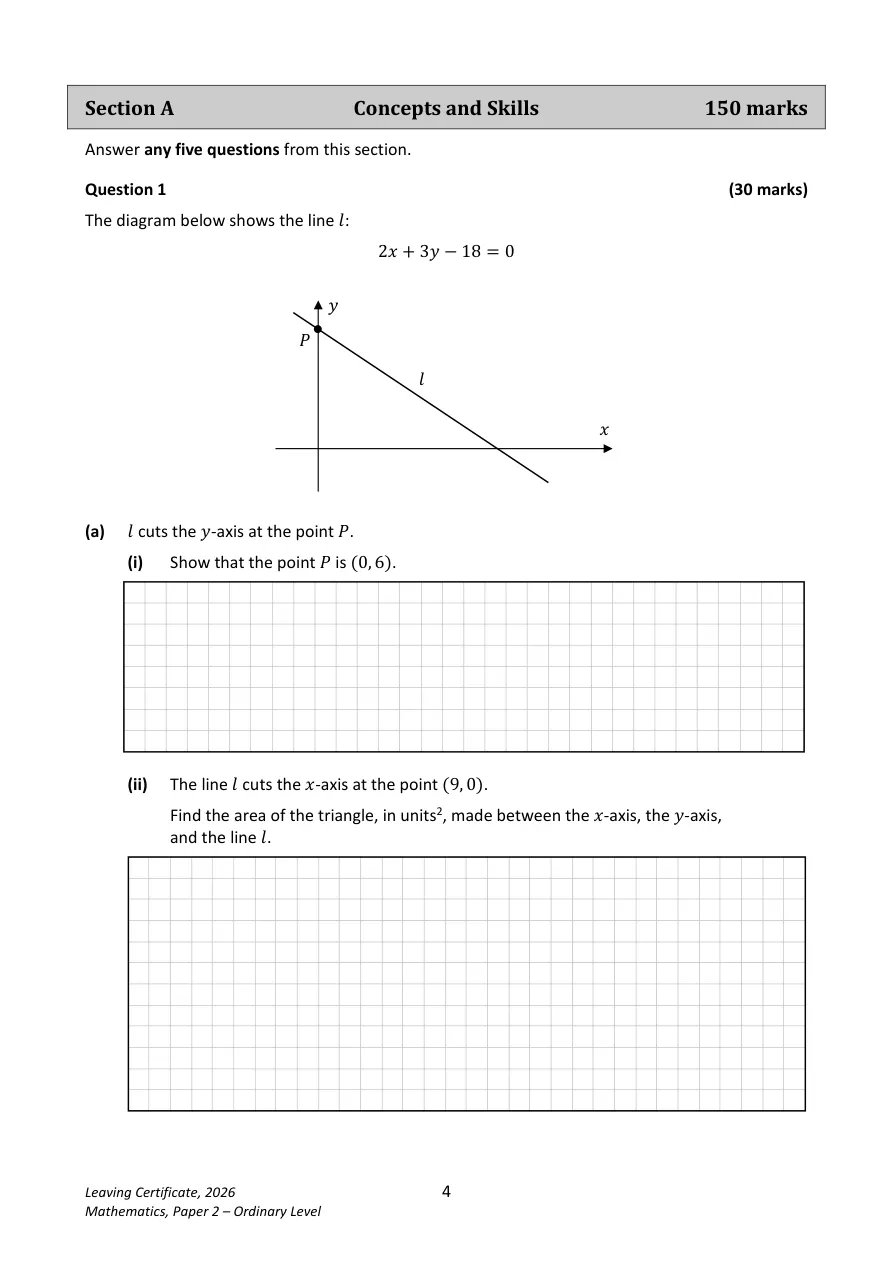
a)(i) y-intercept

  1. x=0
  2. 3y-18=0
  3. y=6
  4. P=(0,6)

a)(ii) Triangle area

  1. A=\dfrac{1}{2}(9)(6)
  2. A=27\ \mathrm{units}^2

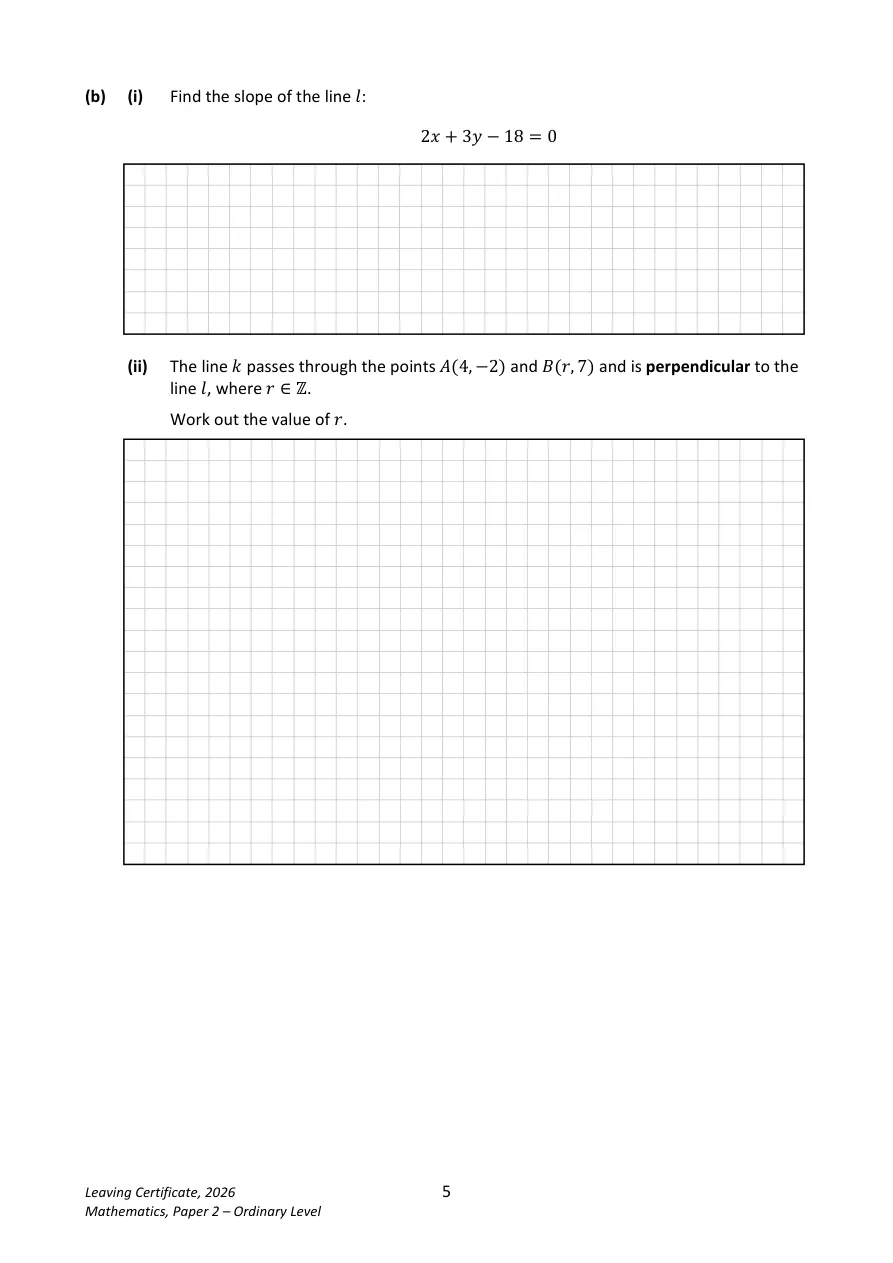
b)(i) Slope

  1. y=-\dfrac{2}{3}x+6
  2. m_l=-\dfrac{2}{3}

b)(ii) Find r

  1. m_k=\dfrac{3}{2}
  2. \dfrac{7-(-2)}{r-4}=\dfrac{3}{2}
  3. 18=3(r-4)
  4. r=10

Question 2

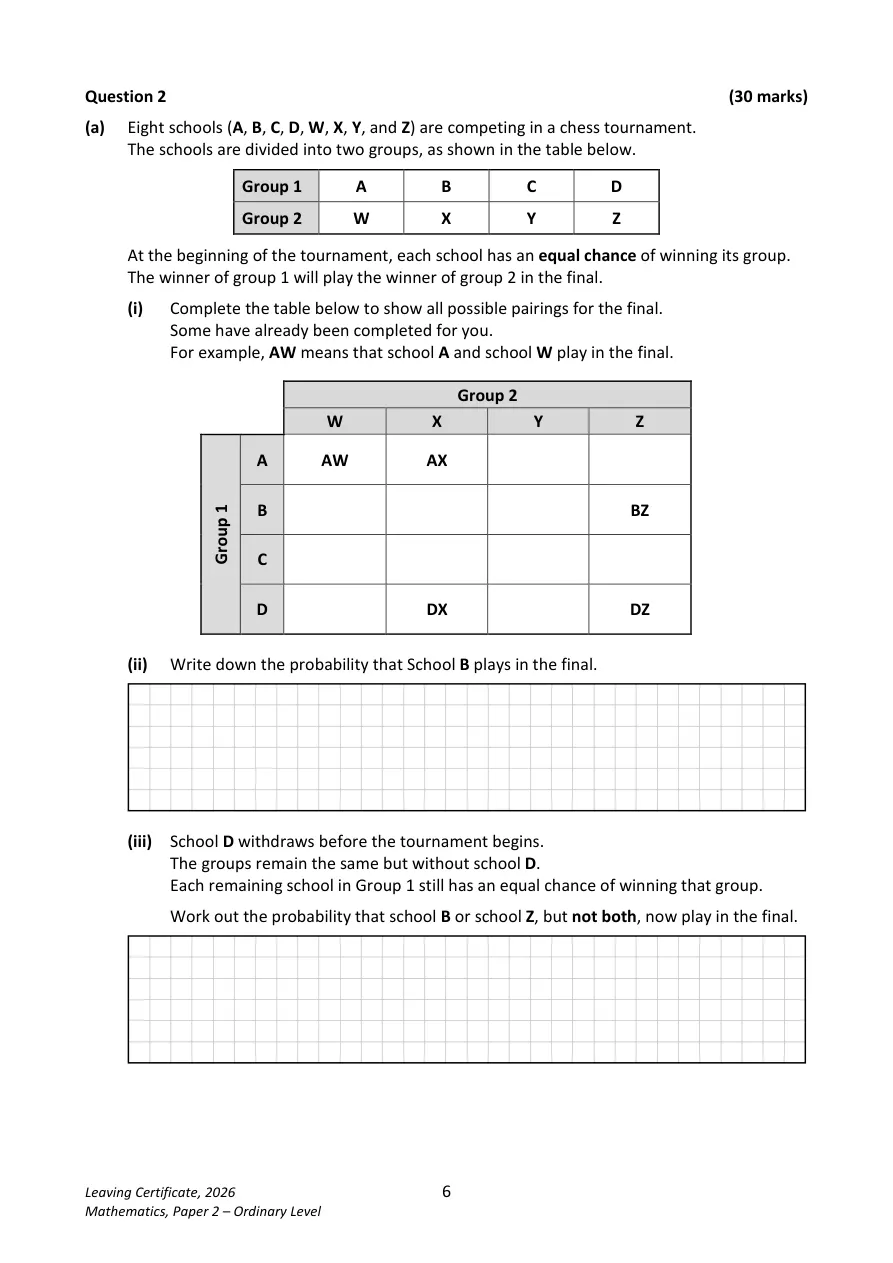
a)(i) Sample space

  1. AW, AX, AY, AZ; BW, BX, BY, BZ; CW, CX, CY, CZ; DW, DX, DY, DZ.

a)(ii) School B

  1. P(B)=\dfrac{4}{16}=\dfrac{1}{4}

a)(iii) B or Z, not both, after D withdraws

  1. P=\dfrac{1}{3}\dfrac{3}{4}+\dfrac{2}{3}\dfrac{1}{4}
  2. P=\dfrac{5}{12}

    First term: B but not Z. Second term: Z but not B.

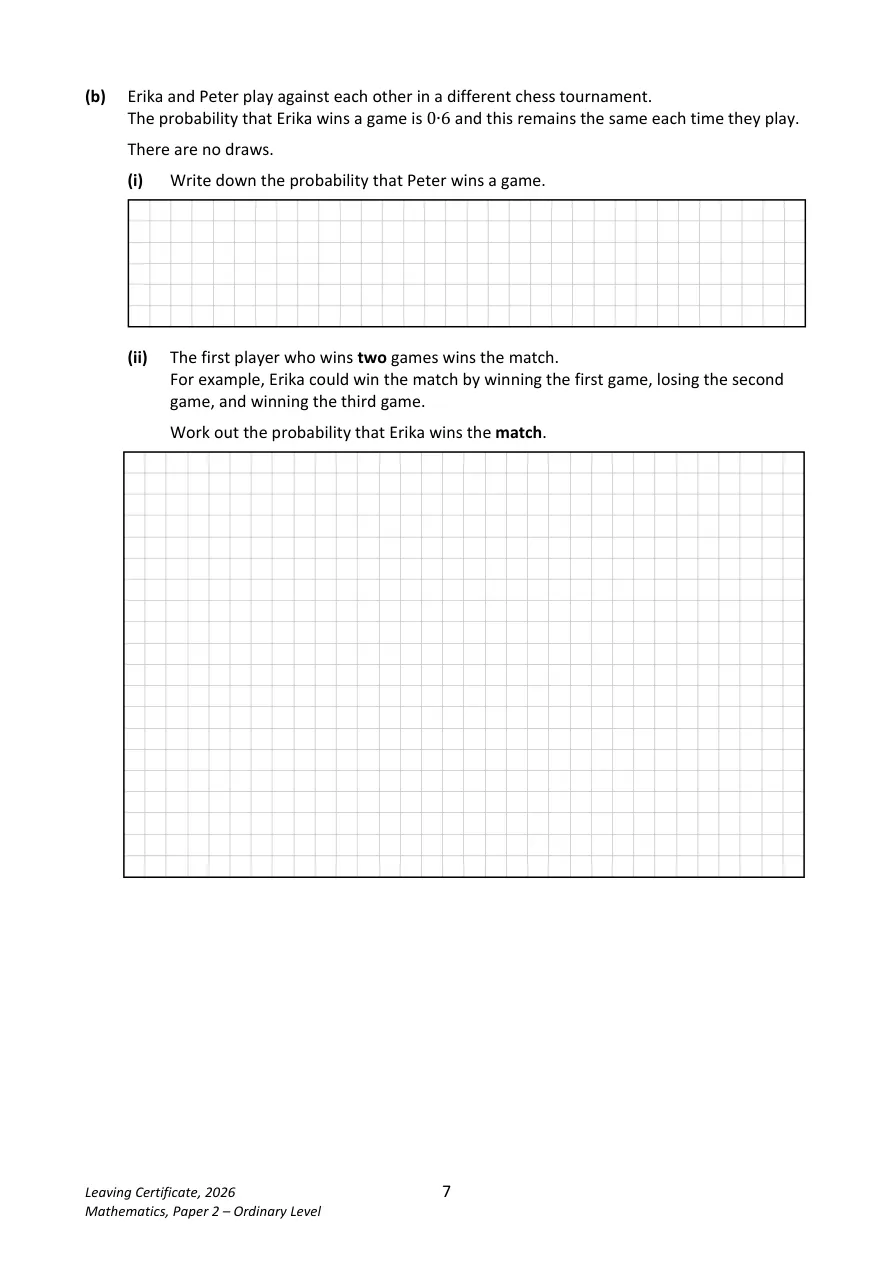
b)(i) Peter wins

  1. P(P)=1-0.6=0.4

b)(ii) Erika wins match

  1. P(E)=0.6^2+0.6(0.4)(0.6)+0.4(0.6)^2
  2. P(E)=0.648

    Winning paths are EE, EPE and PEE, assuming independent games as in this model.
Question 3

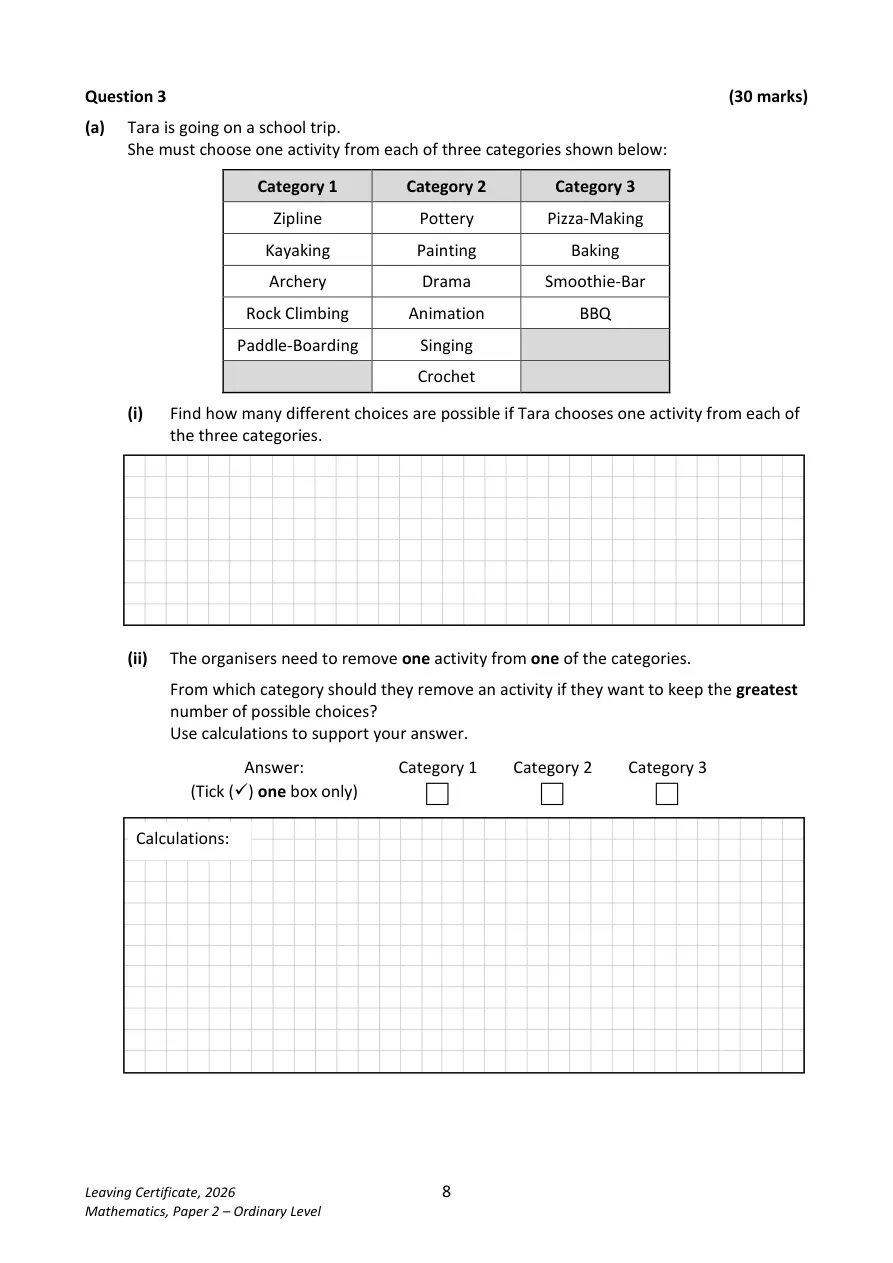
a)(i) Choices

  1. N=5(6)(4)=120

a)(ii) Remove one activity

  1. N_1=4(6)(4)=96
  2. N_2=5(5)(4)=100
  3. N_3=5(6)(3)=90
  4. Remove from category 2; it leaves the greatest number of choices, 100.

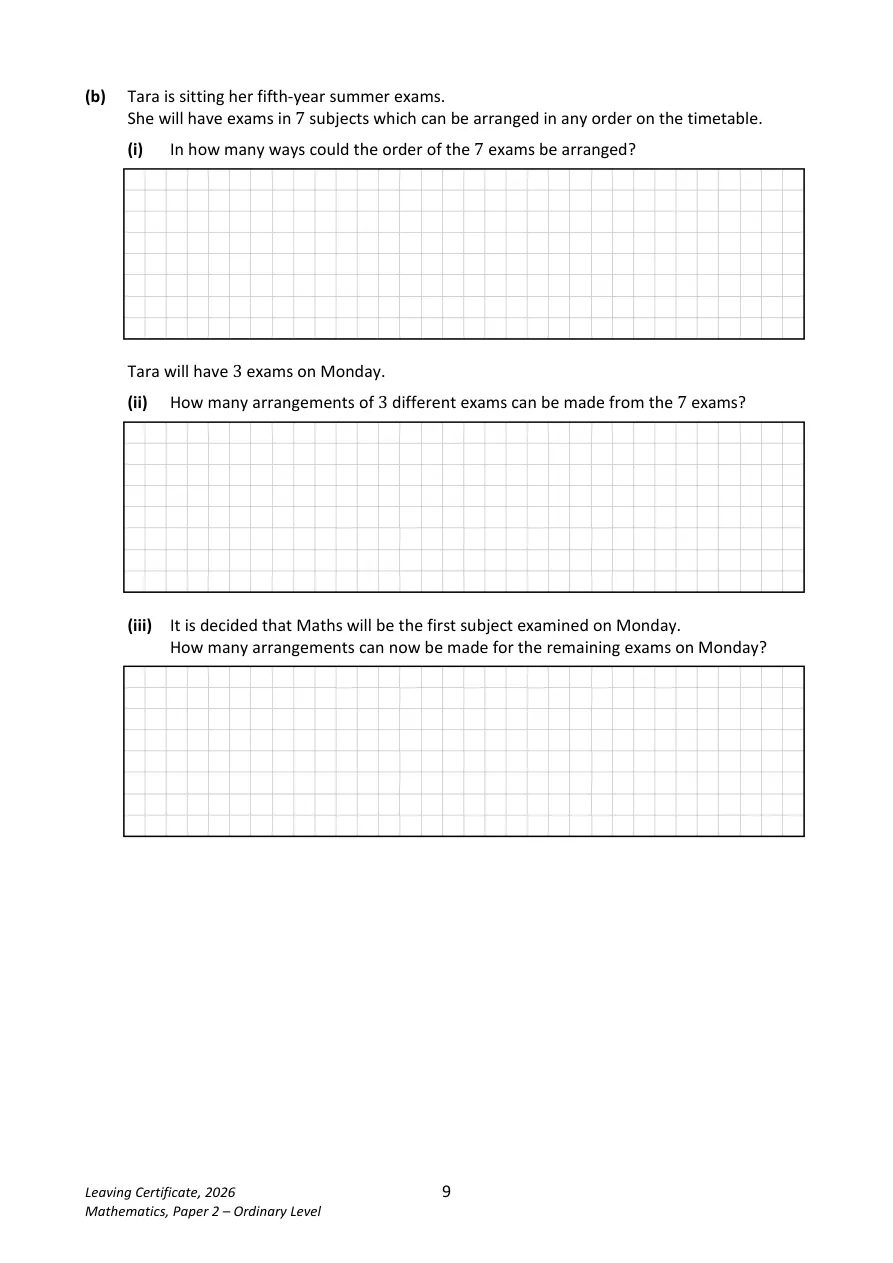
b)(i) Seven exams

  1. N=7!=5040

b)(ii) Three ordered exams

  1. N=7(6)(5)=210

b)(iii) Maths fixed first

  1. N=6(5)=30

Question 4

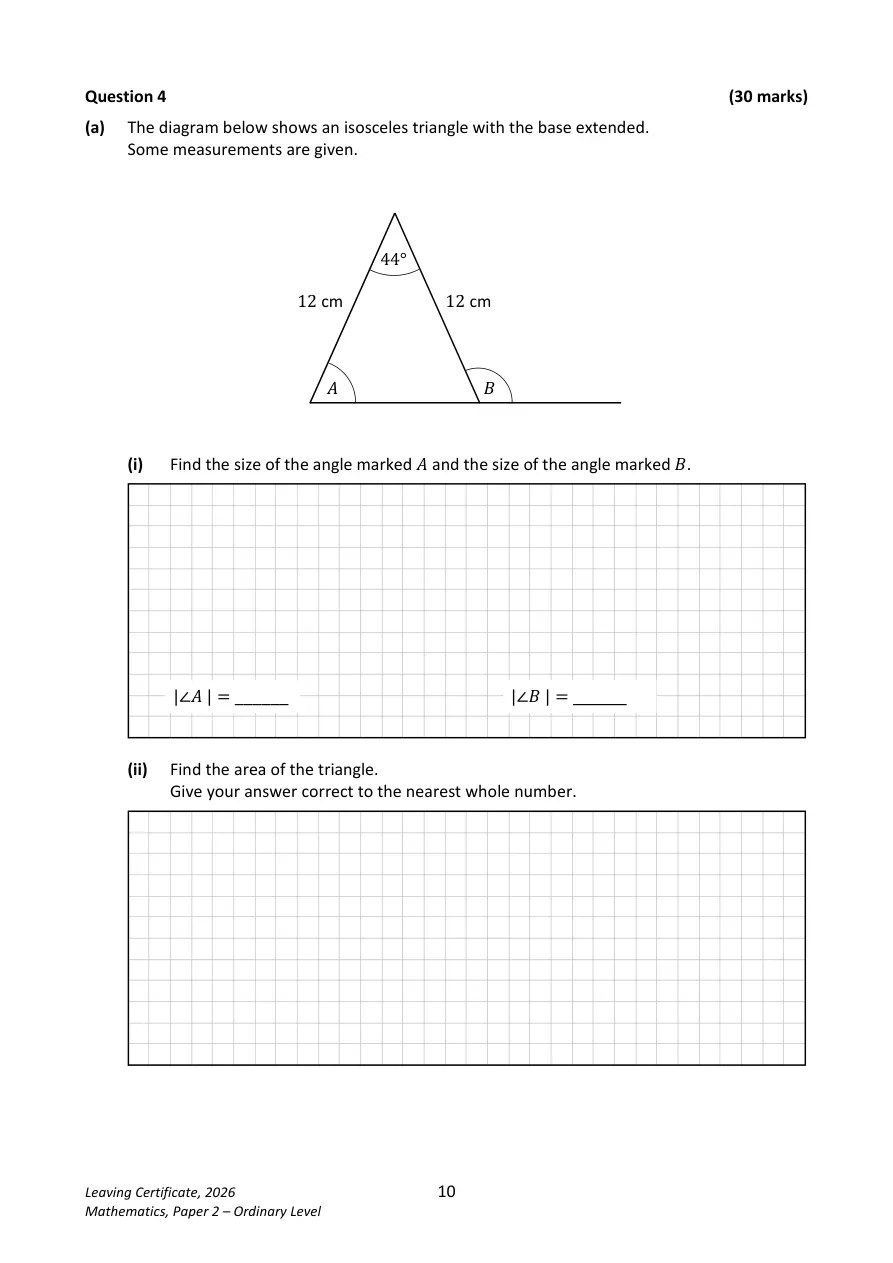
a)(i) Angles

  1. A=\dfrac{180^{\circ}-44^{\circ}}{2}
  2. A=68^{\circ}
  3. B=180^{\circ}-68^{\circ}
  4. B=112^{\circ}

a)(ii) Area

  1. K=\dfrac{1}{2}(12)(12)\sin44^{\circ}
  2. K\approx50\ \mathrm{cm}^2

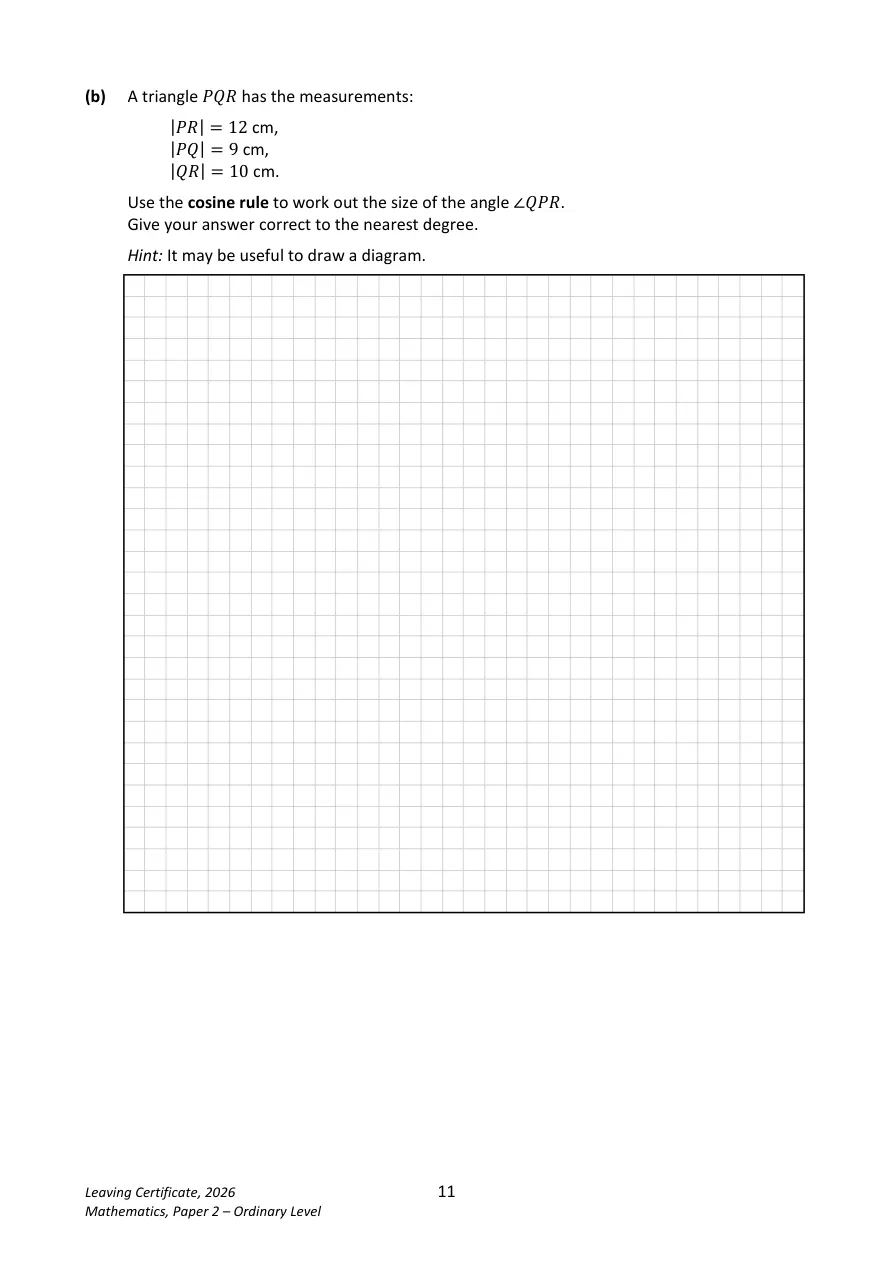
b) Angle QPR

  1. \cos P=\dfrac{12^2+9^2-10^2}{2(12)(9)}
  2. P=\cos^{-1}\left(\dfrac{125}{216}\right)
  3. P\approx55^{\circ}

Question 5

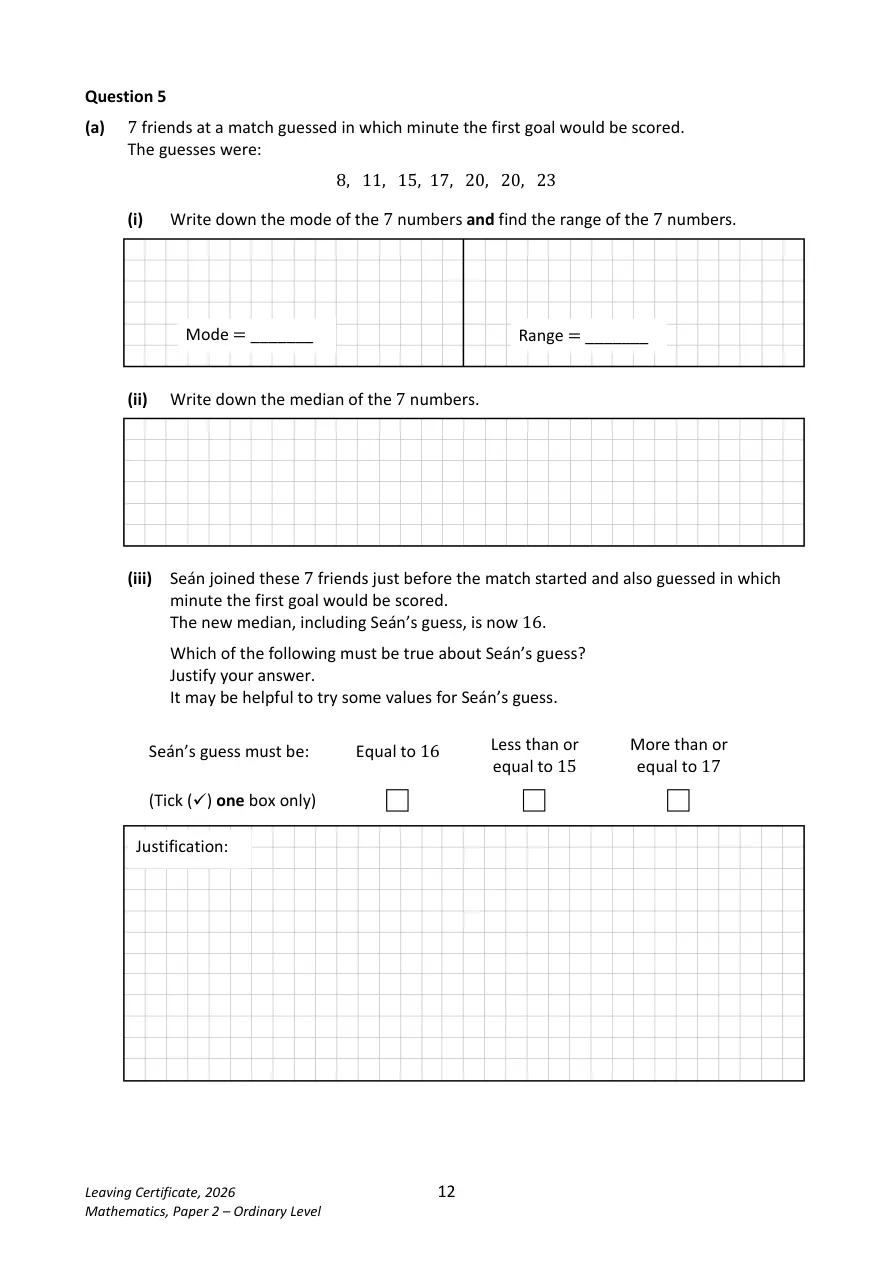
a)(i) Mode and range

  1. \mathrm{Mode}=20
  2. \mathrm{Range}=23-8=15

a)(ii) Median

  1. \mathrm{Median}=17

a)(iii) Sean's guess

  1. It must be less than or equal to 15. Then the two middle values in the eight-number list are 15 and 17, giving median 16. A guess strictly between 15 and 17 makes the fourth value exceed 15; a guess of 17 or more leaves the median at least 17.

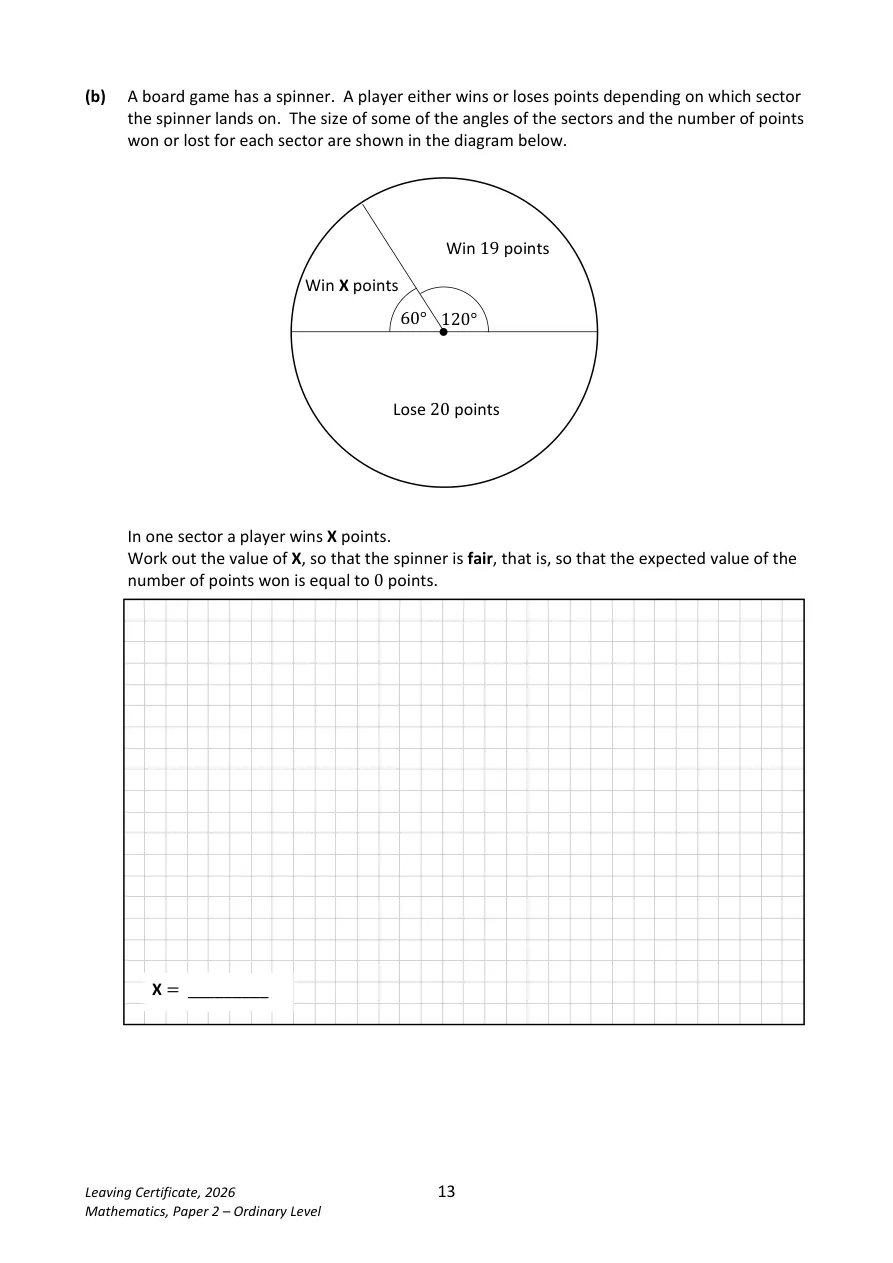
b) Fair spinner

  1. E=\dfrac{60}{360}X+\dfrac{120}{360}(19)+\dfrac{180}{360}(-20)
  2. \dfrac{X}{6}+\dfrac{19}{3}-10=0
  3. X+38-60=0
  4. X=22

Question 6

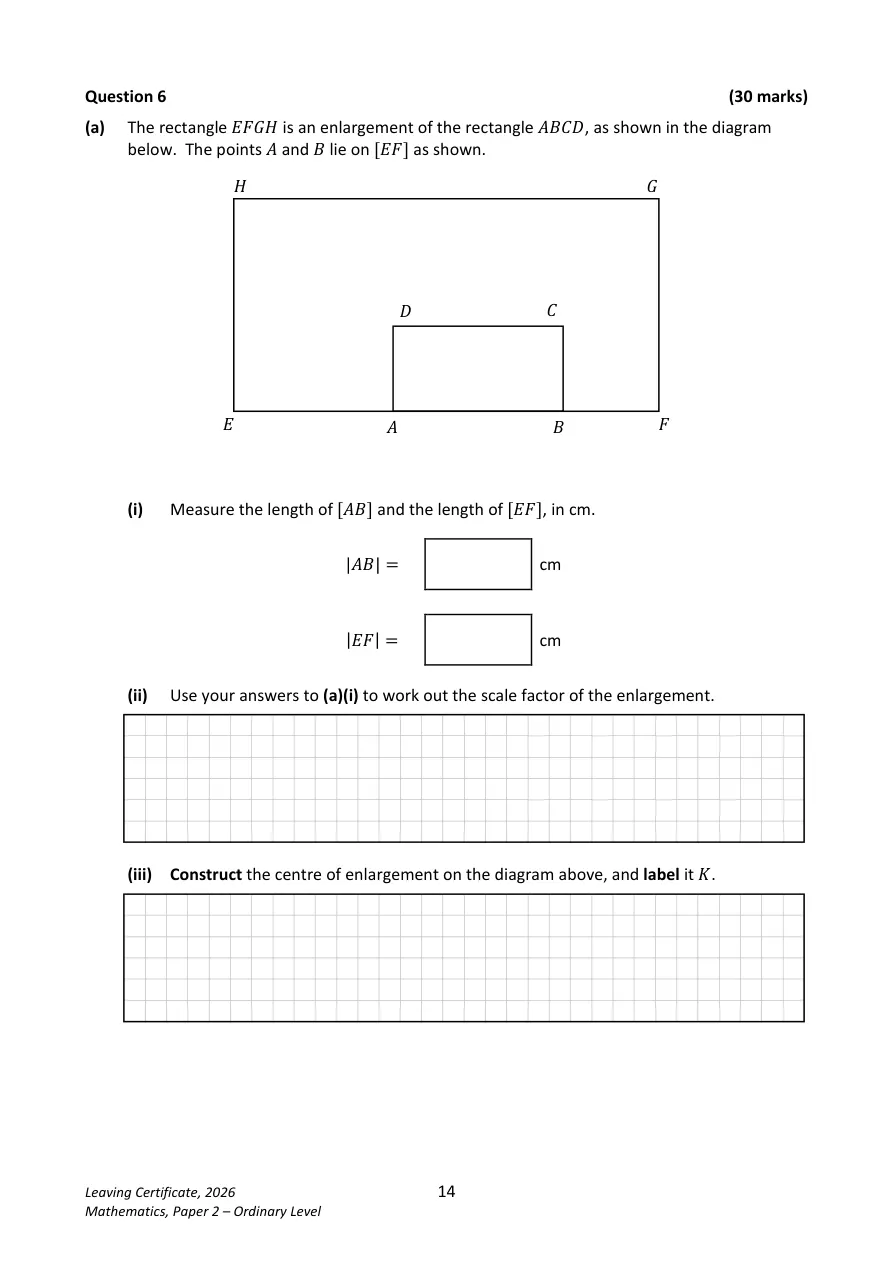
a)(i) Measure the original paper

  1. AB\approx4\ \mathrm{cm},\quad EF\approx10\ \mathrm{cm}
  2. Measure on the original PDF printed at 100%, not a resized browser image. Uniform resizing changes both lengths but leaves their ratio unchanged.

a)(ii) Scale factor

  1. k=\dfrac{10}{4}
  2. k=2.5

a)(iii) Centre of enlargement

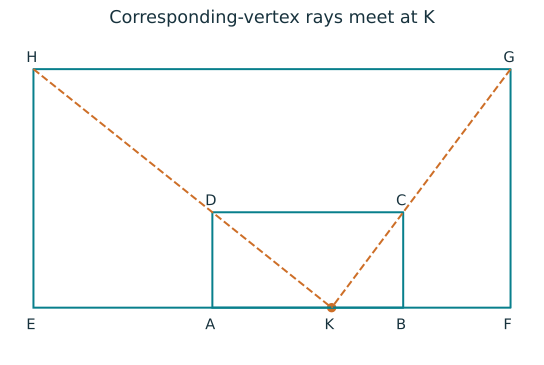
  1. Join corresponding vertices D to H and C to G and extend the lines. Their intersection K is the centre of enlargement on the line EF. Joining A to E or B to F provides a check.
  2. 2026-2-6-enlargement

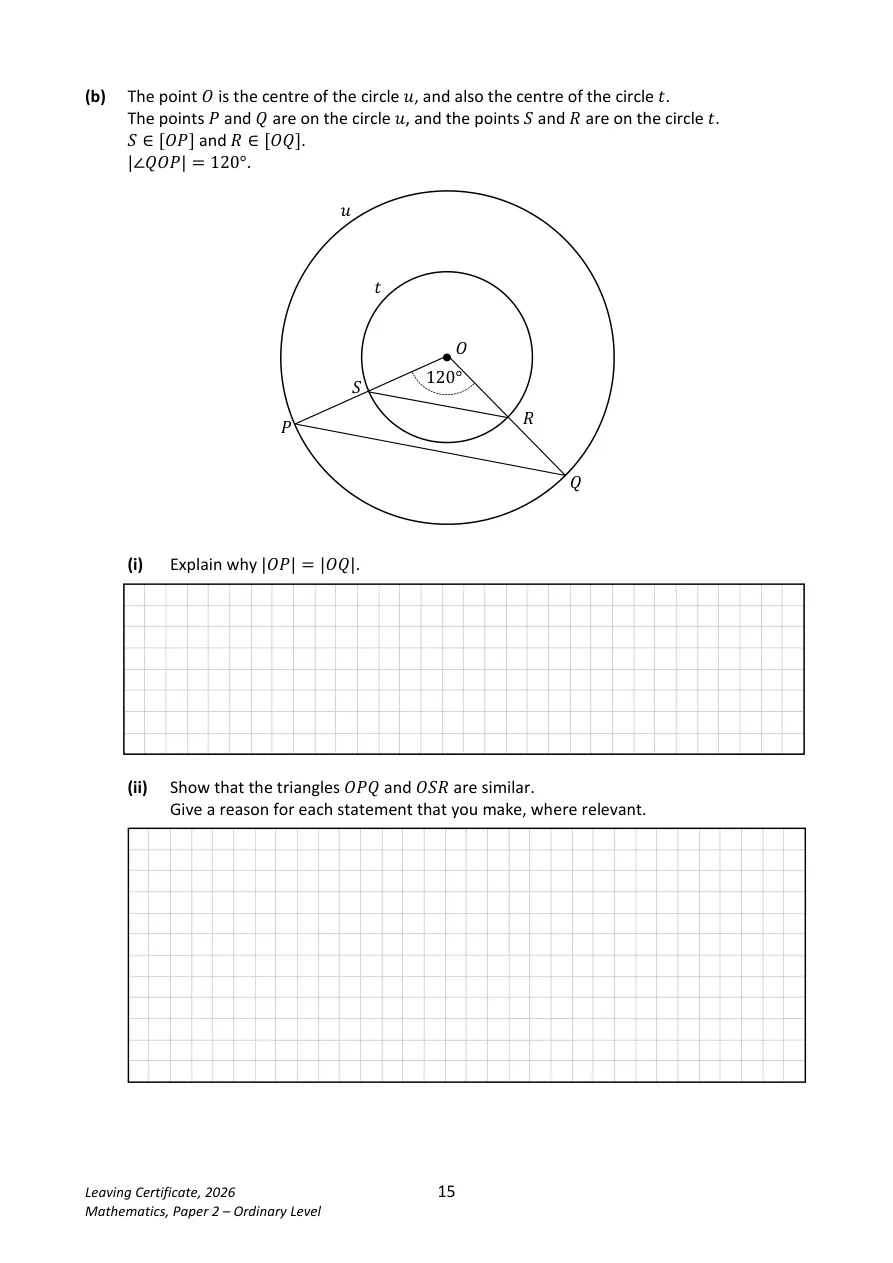
b)(i) Equal radii

  1. OP=OQ

    Both are radii of circle u.

b)(ii) Similarity

  1. \angle POQ=\angle SOR=120^{\circ}

    OP and OS are collinear; OQ and OR are collinear.

  2. \angle OPQ=\angle OQP=30^{\circ}

    Triangle OPQ is isosceles.

  3. \angle OSR=\angle ORS=30^{\circ}

    OS and OR are radii of circle t.

  4. Therefore triangles OPQ and OSR are similar by AA.

Question 7

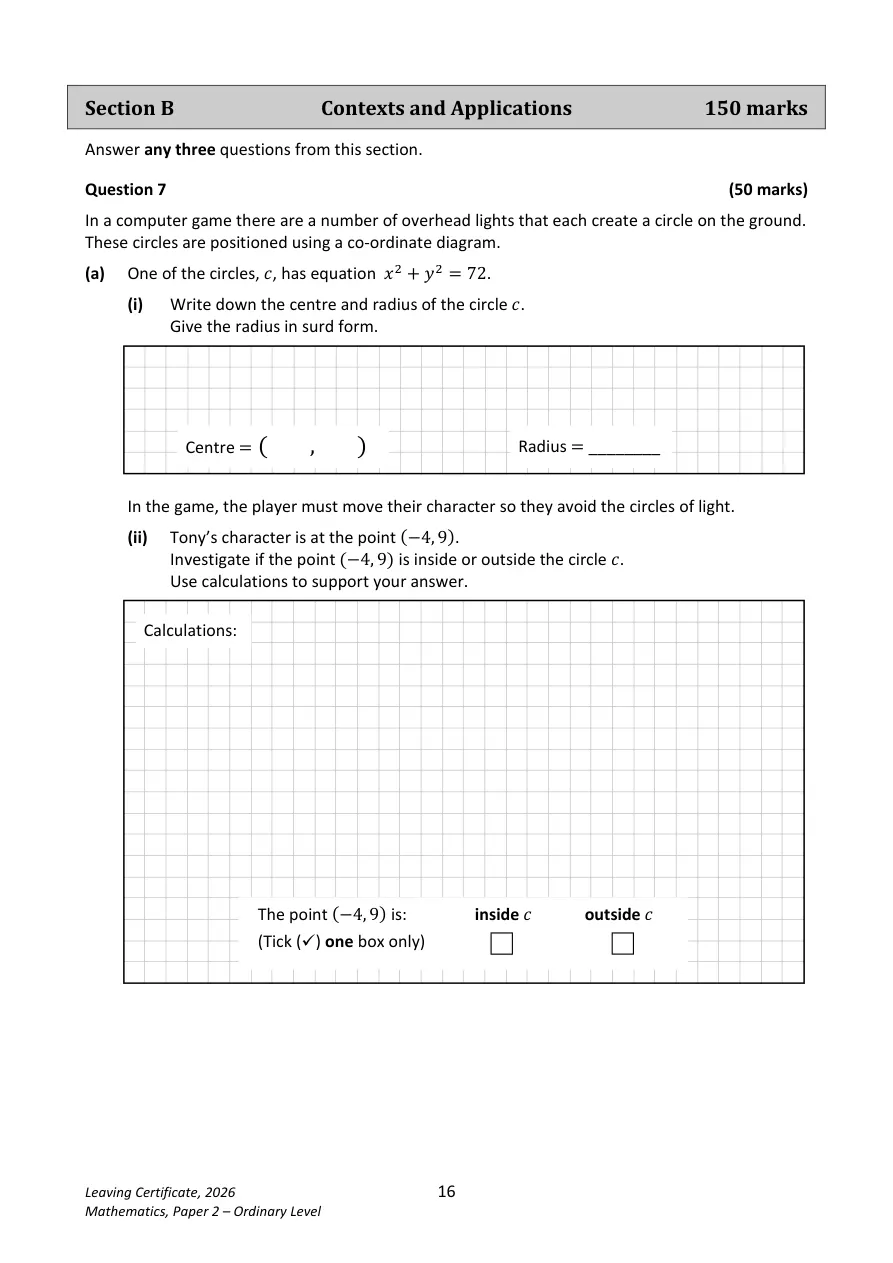
a)(i) Centre and radius

  1. O=(0,0)
  2. r=\sqrt{72}=6\sqrt{2}

a)(ii) Inside or outside

  1. (-4)^2+9^2=97
  2. 97>72
  3. Outside: its squared distance from the centre exceeds the squared radius.

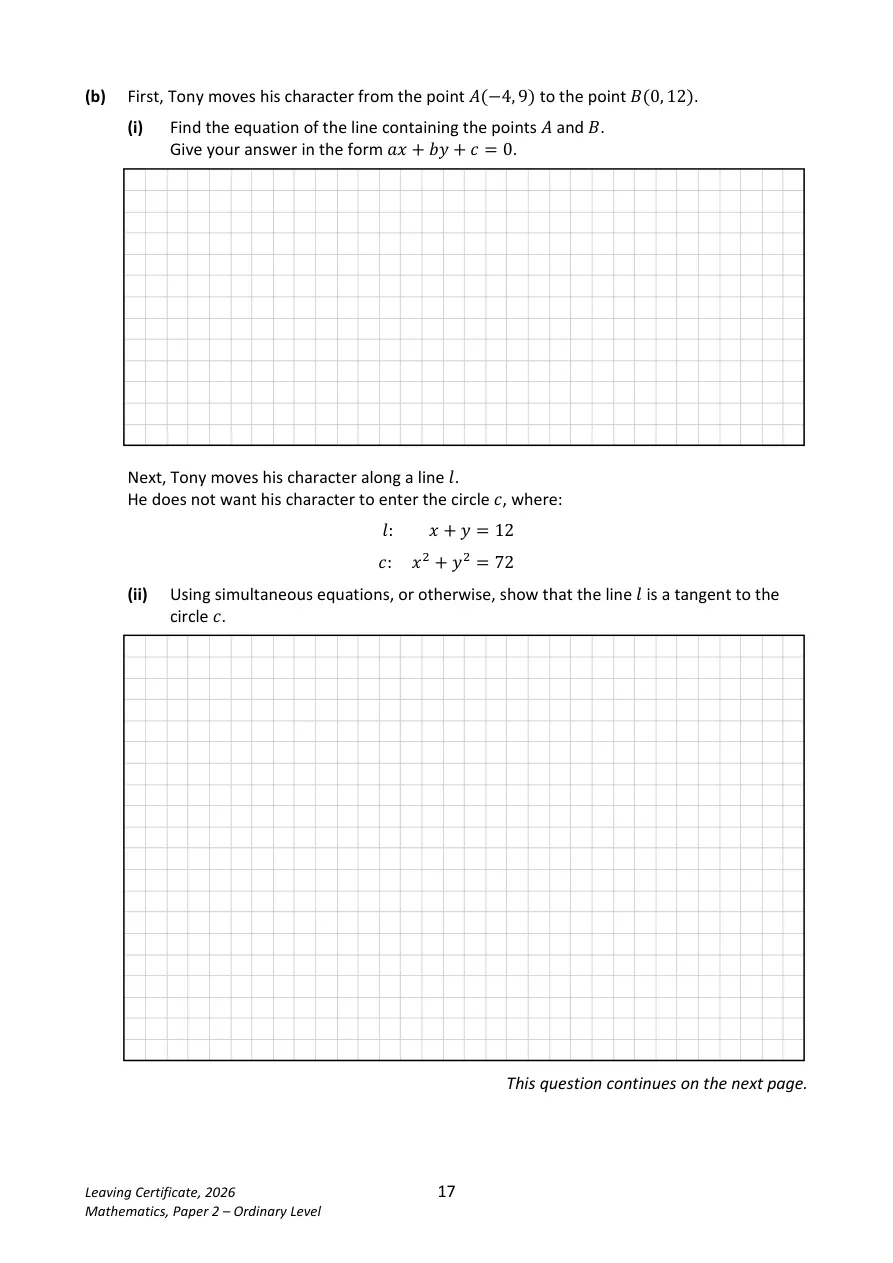
b)(i) Equation of AB

  1. m=\dfrac{12-9}{0-(-4)}=\dfrac{3}{4}

    Subtract the y-coordinates for the top and the x-coordinates for the bottom. Use the same point first in both subtractions.
  2. y-12=\dfrac{3}{4}x
  3. 3x-4y+48=0

b)(ii) Tangency

  1. y=12-x
  2. x^2+(12-x)^2=72
  3. 2x^2-24x+72=0
  4. (x-6)^2=0
  5. x=6,\quad y=6
  6. Exactly one intersection, (6,6), so the line is tangent.

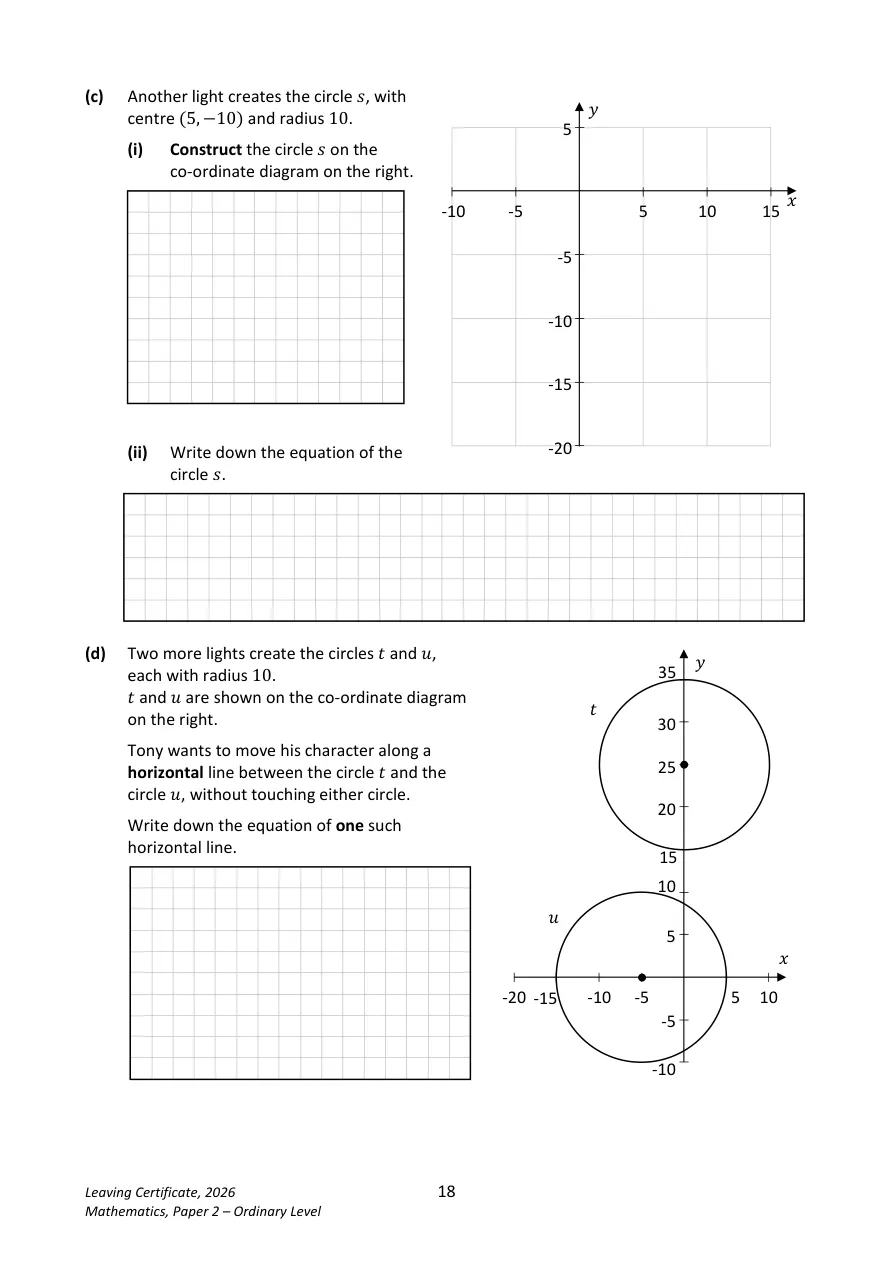
c) Circle s

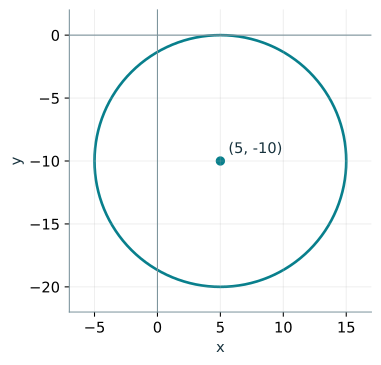
  1. (x-5)^2+(y+10)^2=100
  2. Draw centre (5,−10) and a circle through (5,0), (15,−10), (5,−20) and (−5,−10).
  3. 2026-2-7-circle

d) Horizontal path

  1. y=12
  2. Any horizontal line with 10 < y < 15 fits between the two circles without touching them.

Question 8

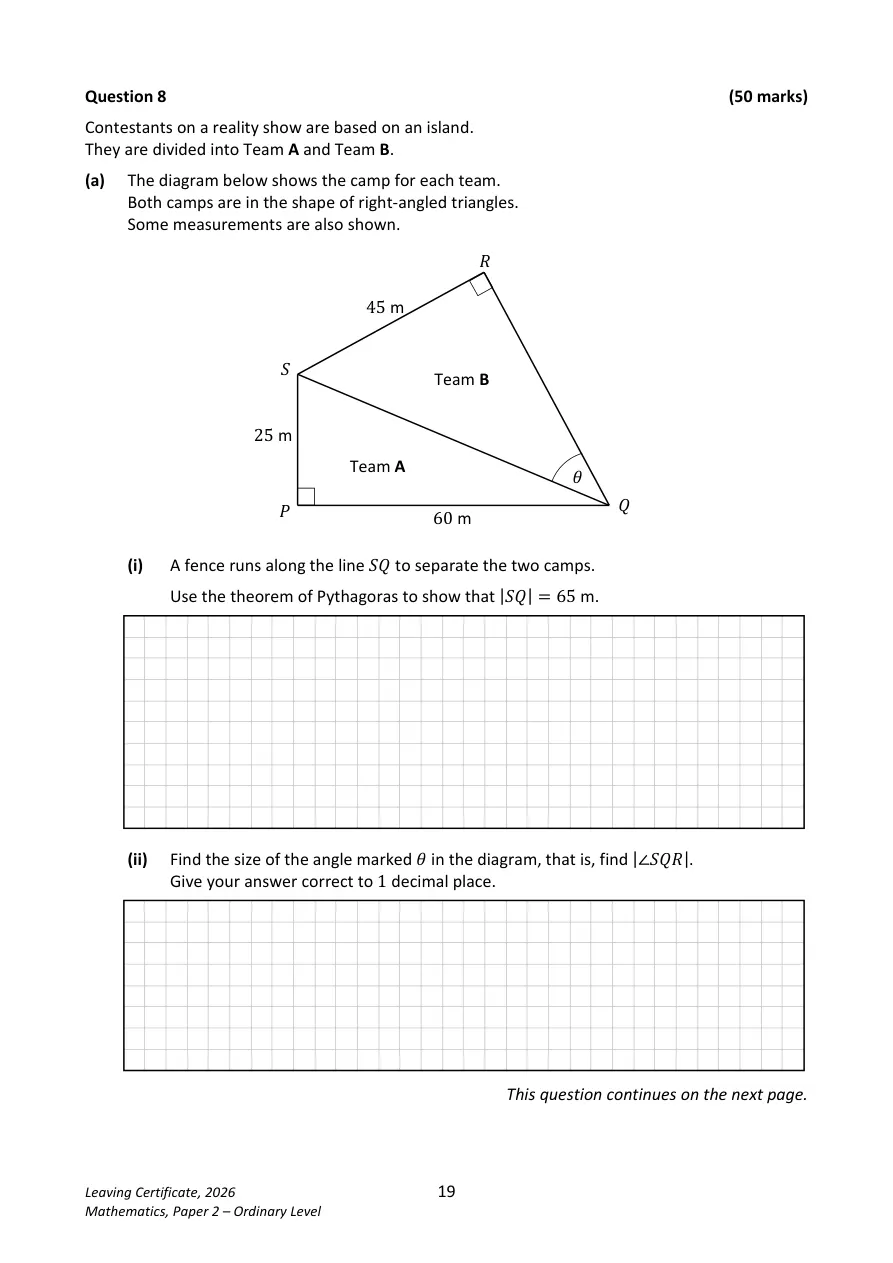
a)(i) Fence SQ

  1. SQ=\sqrt{25^2+60^2}
  2. SQ=65\ \mathrm{m}

a)(ii) Angle SQR

  1. \sin\theta=\dfrac{45}{65}

    Use right triangle SQR: SQ is its hypotenuse.

  2. \theta=\sin^{-1}\left(\dfrac{45}{65}\right)
  3. \theta\approx43.8^{\circ}

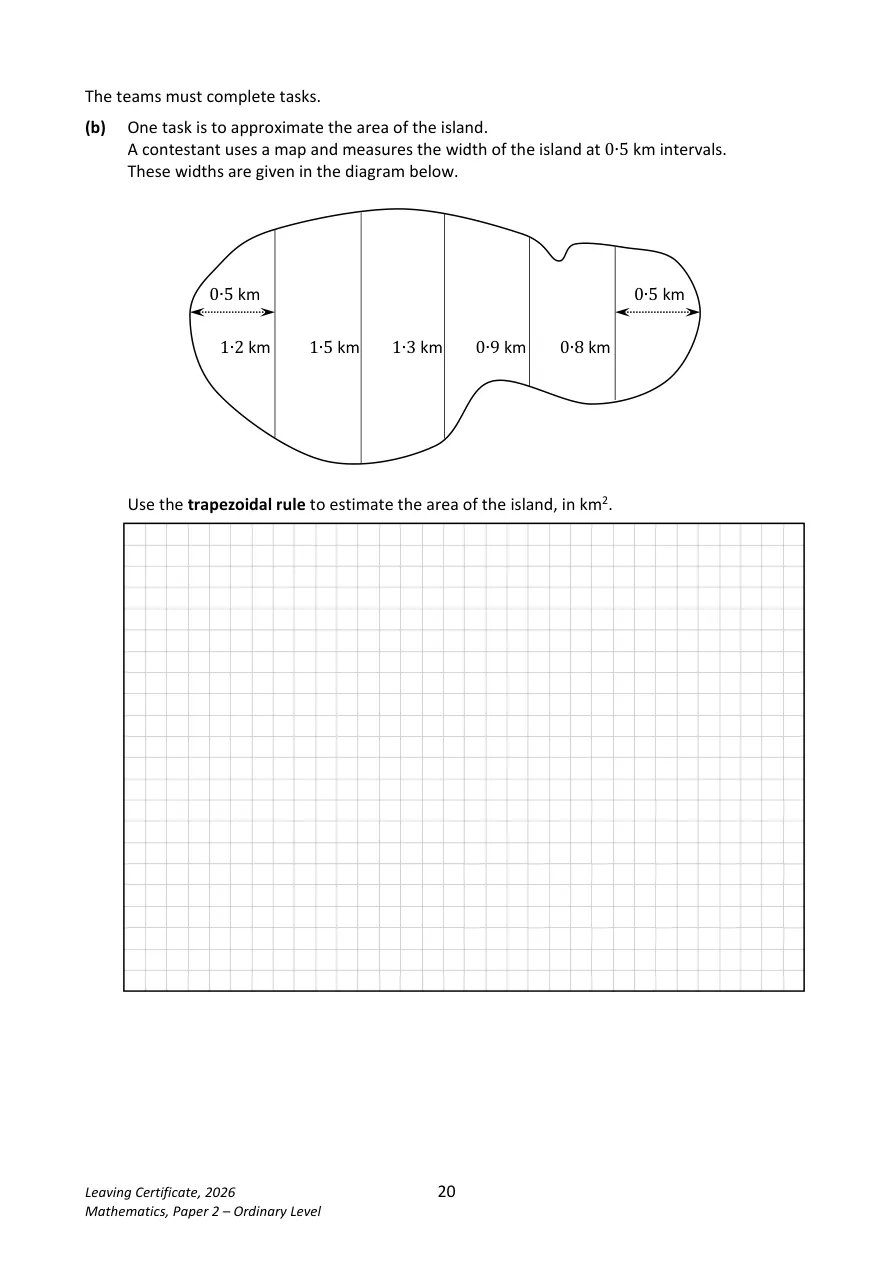
b) Island area

  1. A\approx\dfrac{0.5}{2}\left[0+0+2(1.2+1.5+1.3+0.9+0.8)\right]
  2. A\approx2.85\ \mathrm{km}^2

    Include the zero-width endpoints shown at the island tips.

c) Rowing distance

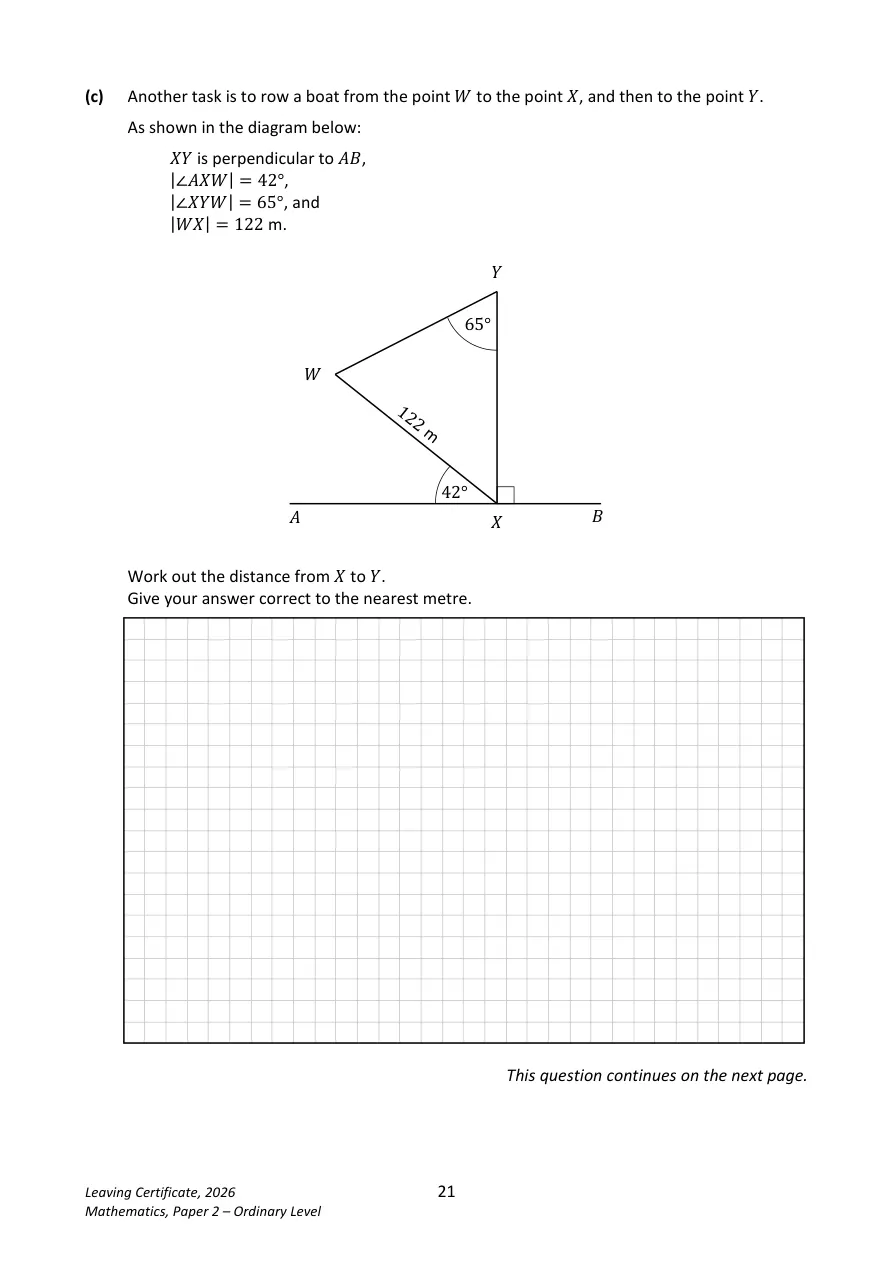
  1. \angle WXY=90^{\circ}-42^{\circ}=48^{\circ}
  2. \angle XWY=180^{\circ}-48^{\circ}-65^{\circ}=67^{\circ}
  3. \dfrac{XY}{\sin67^{\circ}}=\dfrac{122}{\sin65^{\circ}}
  4. XY=\dfrac{122\sin67^{\circ}}{\sin65^{\circ}}
  5. XY\approx124\ \mathrm{m}

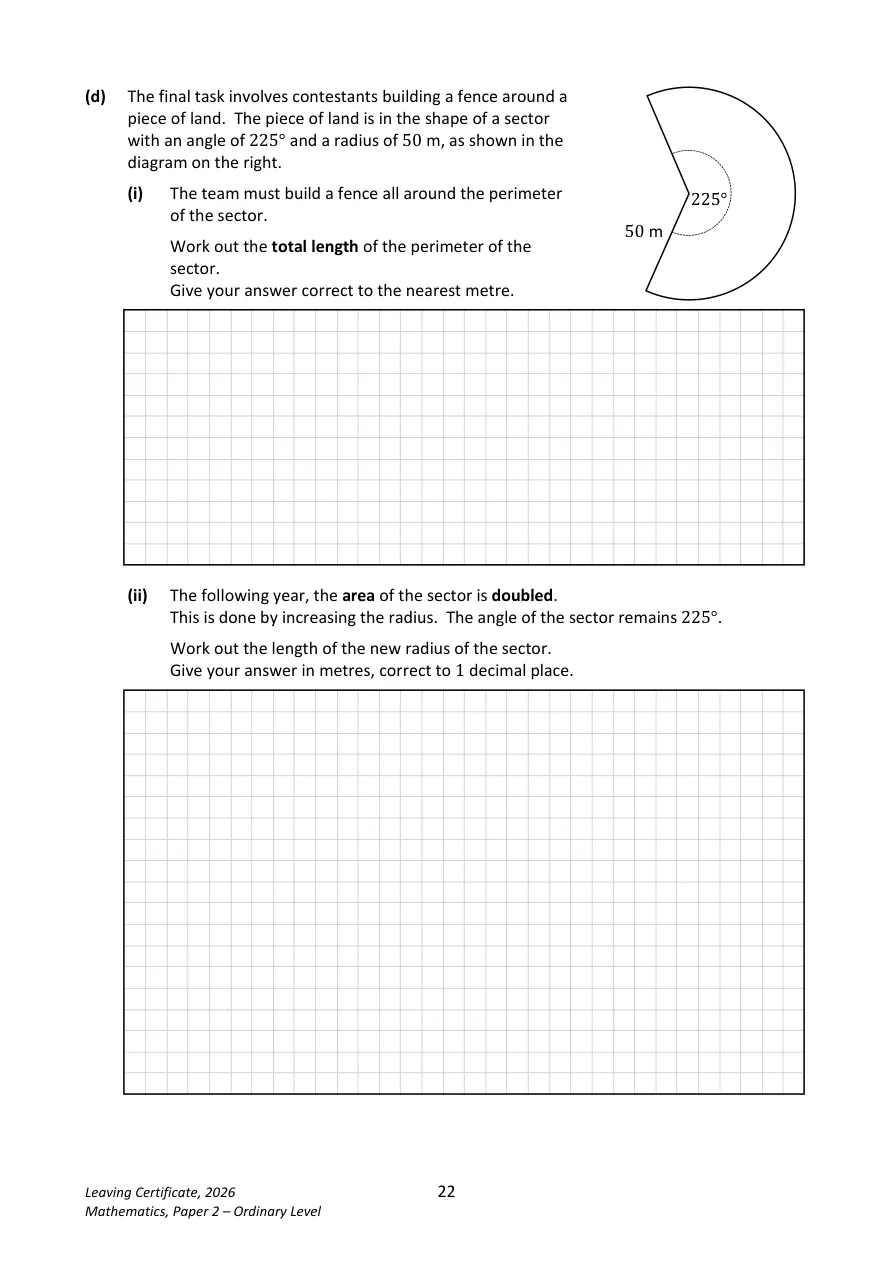
d)(i) Sector perimeter

  1. P=2(50)+\dfrac{225}{360}(2\pi)(50)
  2. P\approx296\ \mathrm{m}

d)(ii) Double area

  1. r_{\mathrm{new}}=50\sqrt{2}

    With the same angle, area is proportional to radius squared.

  2. r_{\mathrm{new}}\approx70.7\ \mathrm{m}

Question 9

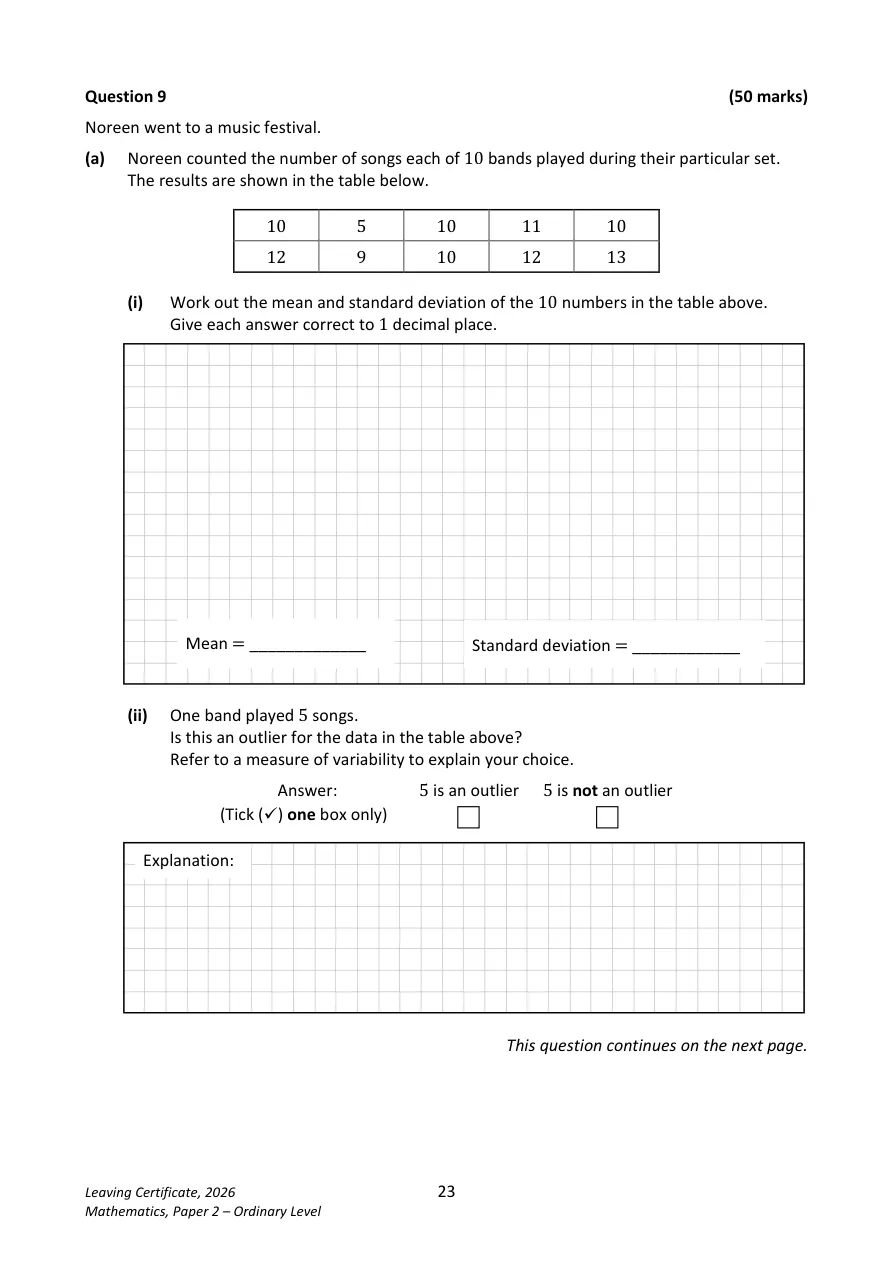
a)(i) Mean and standard deviation

  1. \bar{x}=\dfrac{102}{10}
  2. \bar{x}=10.2
  3. \sigma=\sqrt{\dfrac{\sum(x-10.2)^2}{10}}
  4. \sigma\approx2.1

a)(ii) Outlier

  1. 10.2-2(2.1)=6.0
  2. 5<6.0
  3. Yes: 5 is more than two standard deviations below the mean, using this variability criterion. An IQR-based rule also identifies it as an outlier.

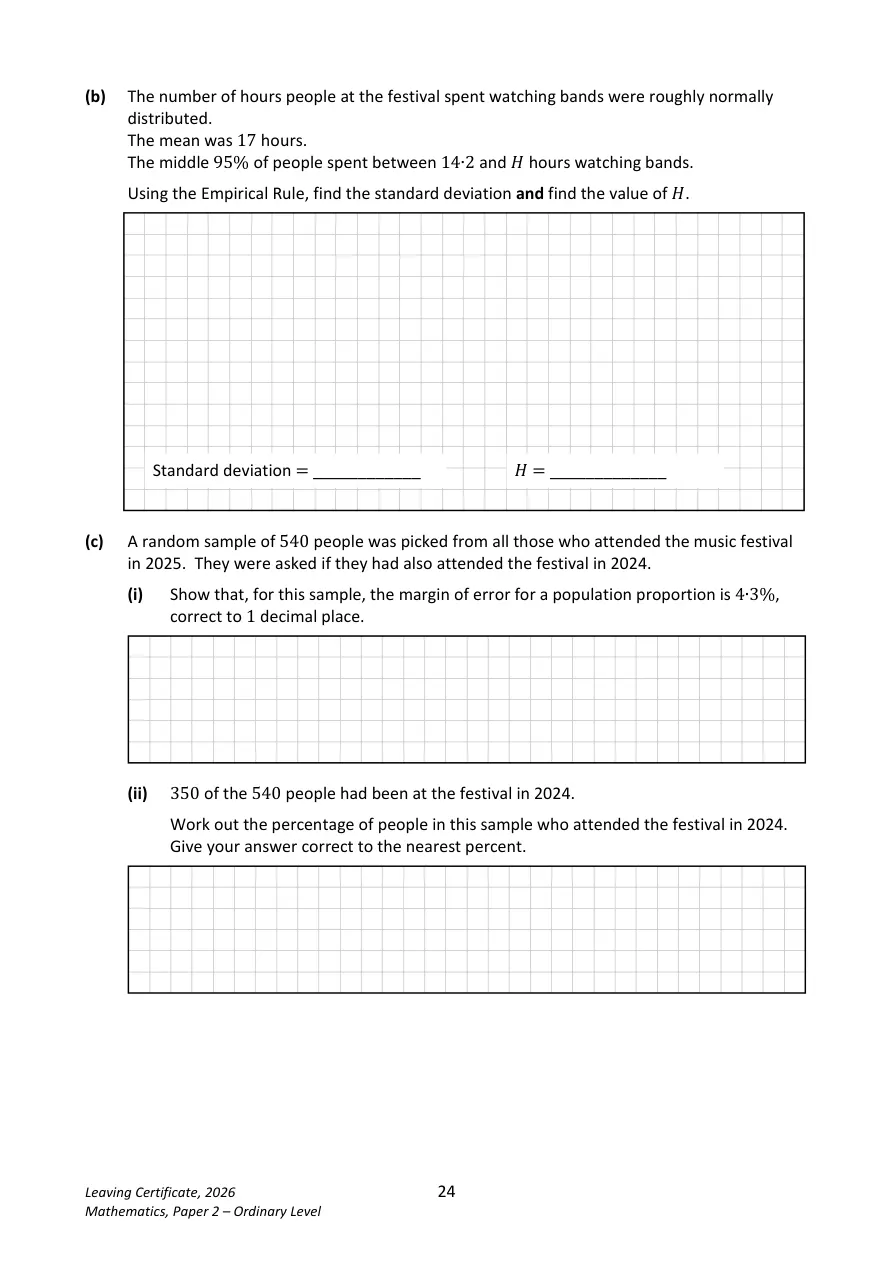
b) Empirical rule

  1. 2\sigma=17-14.2=2.8
  2. \sigma=1.4\ \mathrm{h}
  3. H=17+2.8=19.8\ \mathrm{h}

c)(i) Margin of error

  1. E=\dfrac{1}{\sqrt{540}}\times100\%
  2. E\approx4.3\%

c)(ii) Sample percentage

  1. \hat{p}=\dfrac{350}{540}\times100\%
  2. \hat{p}\approx65\%

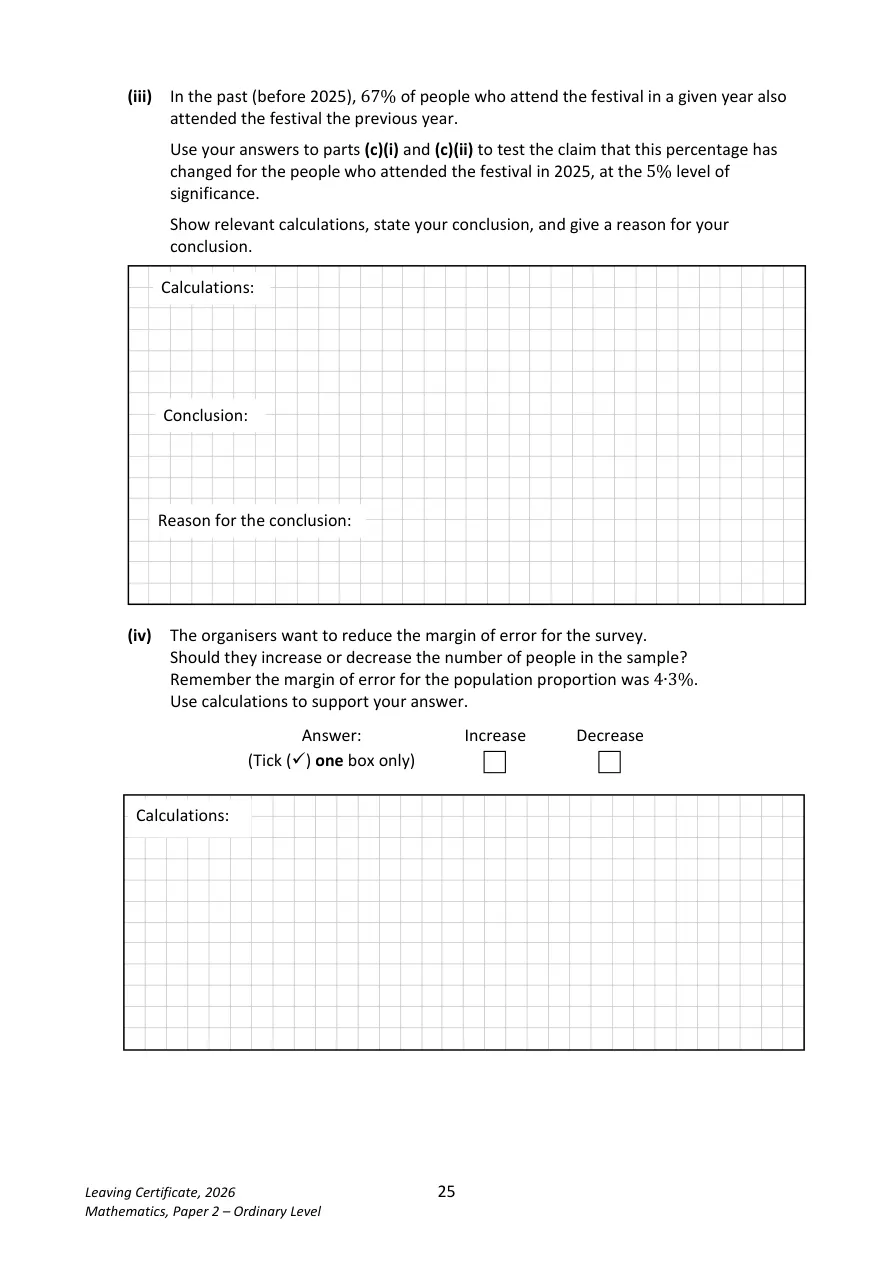
c)(iii) Test

  1. CI=65\%\pm4.3\%
  2. CI=[60.7\%,69.3\%]
  3. The historical 67% lies inside the approximate 95% interval. Do not reject the no-change claim: the sample does not provide sufficient evidence of a change at the 5% level. This does not prove the percentage stayed exactly the same.

c)(iv) Reduce error

  1. E_{1000}=\dfrac{1}{\sqrt{1000}}\times100\%
  2. E_{1000}\approx3.2\%<4.3\%
  3. Increase the sample size. The margin of error decreases as the square root of sample size increases.

Question 10

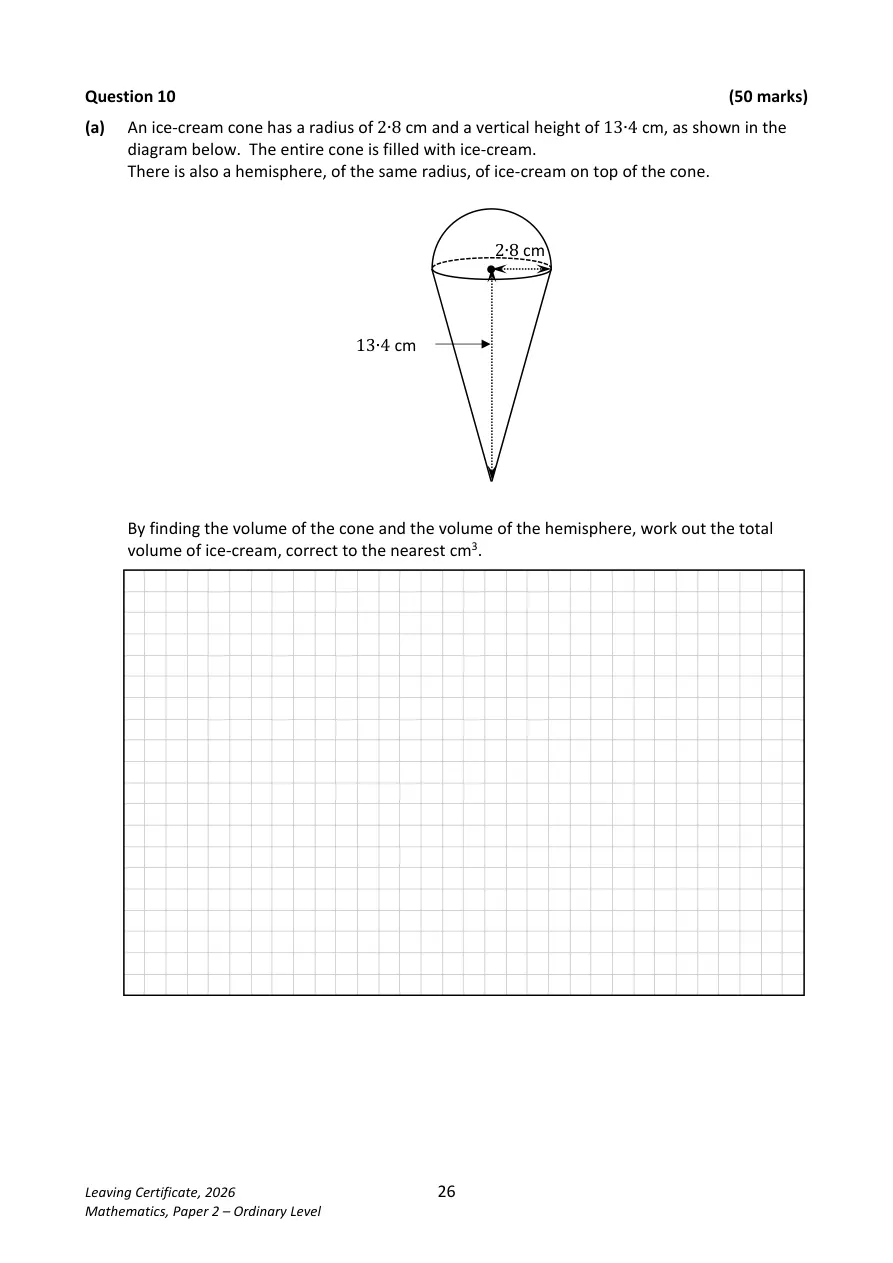
a) Ice-cream volume

  1. V_c=\dfrac{1}{3}\pi(2.8)^2(13.4)
  2. V_h=\dfrac{2}{3}\pi(2.8)^3
  3. V=V_c+V_h
  4. V\approx156\ \mathrm{cm}^3

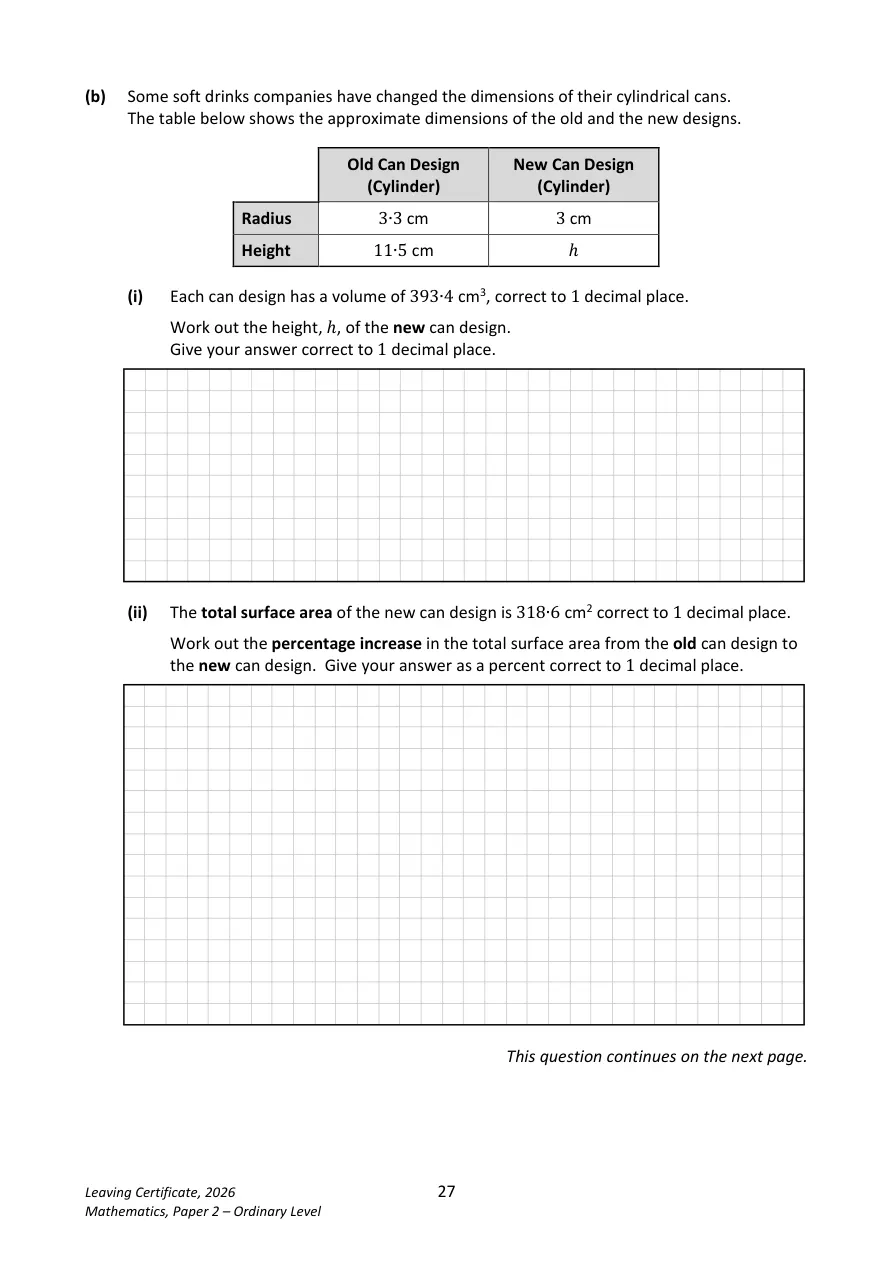
b)(i) New can height

  1. 393.4=\pi(3)^2h
  2. h=\dfrac{393.4}{9\pi}
  3. h\approx13.9\ \mathrm{cm}

b)(ii) Surface area increase

  1. A_{\mathrm{old}}=2\pi(3.3)^2+2\pi(3.3)(11.5)
  2. p=\dfrac{318.6-A_{\mathrm{old}}}{A_{\mathrm{old}}}\times100
  3. p\approx3.8\%

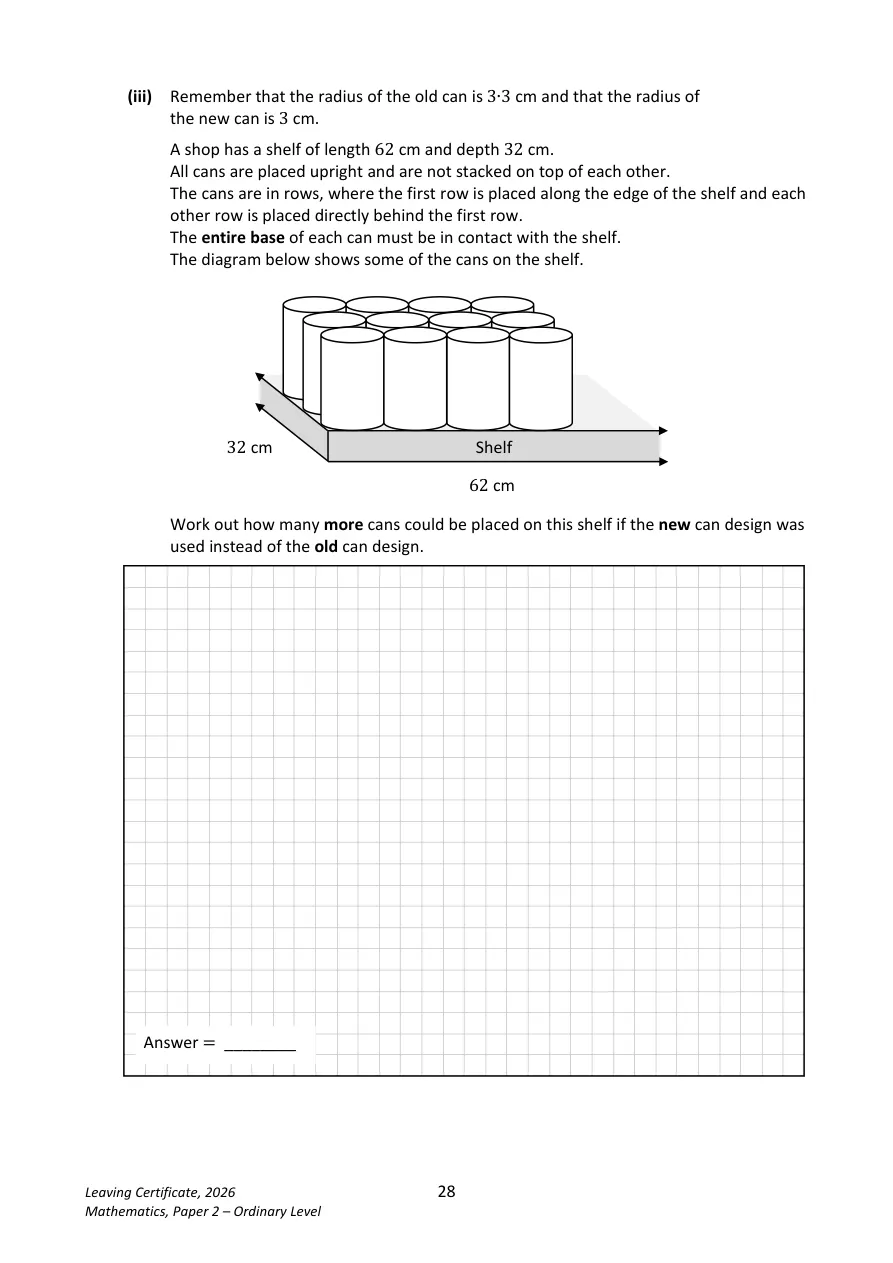
b)(iii) Shelf capacity

  1. N_{\mathrm{old}}=\left\lfloor\dfrac{62}{6.6}\right\rfloor\left\lfloor\dfrac{32}{6.6}\right\rfloor
  2. N_{\mathrm{old}}=9(4)=36
  3. N_{\mathrm{new}}=\left\lfloor\dfrac{62}{6}\right\rfloor\left\lfloor\dfrac{32}{6}\right\rfloor
  4. N_{\mathrm{new}}=10(5)=50
  5. 50-36=14\ \mathrm{extra\ cans}

c) Sugar reductions

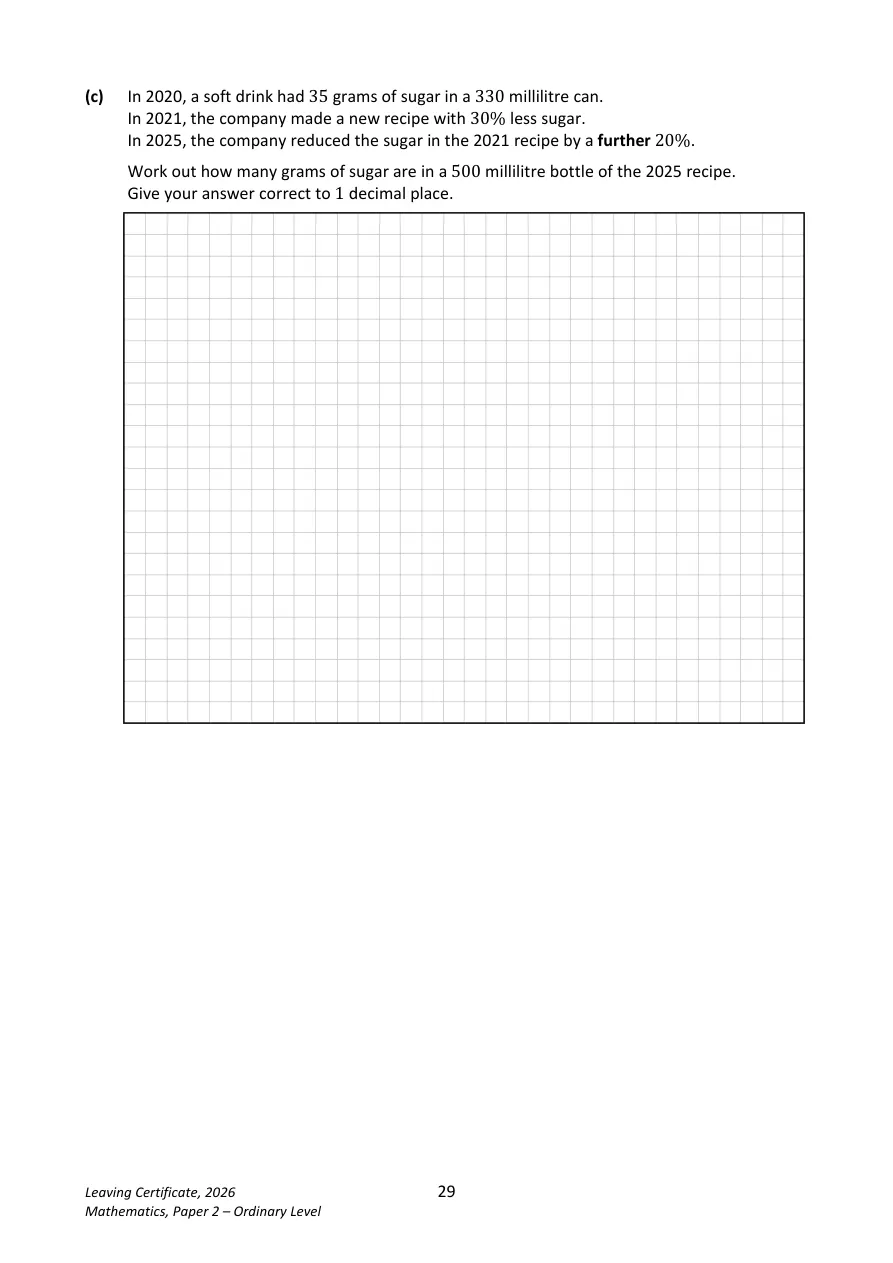
  1. m=35(0.70)(0.80)

    Successive reductions multiply; they do not combine to a 50% reduction.
  2. m_{500}=35(0.70)(0.80)\dfrac{500}{330}
  3. m_{500}\approx29.7\ \mathrm{g}
See working and diagrams on the original paper
Original exam paper page 4
x=0
3y-18=0
y=6
P=(0,6)
A=\dfrac{1}{2}(9)(6)
A=27\ \mathrm{units}^2
Original exam paper page 5
y=-\dfrac{2}{3}x+6
m_l=-\dfrac{2}{3}
m_k=\dfrac{3}{2}
\dfrac{7-(-2)}{r-4}=\dfrac{3}{2}
18=3(r-4)
r=10
Original exam paper page 6
AYAZBWBXBYCWCXCYCZDWDY
P(B)=\dfrac{4}{16}=\dfrac{1}{4}
P=\dfrac{1}{3}\dfrac{3}{4}+\dfrac{2}{3}\dfrac{1}{4}
P=\dfrac{5}{12}
[First term: B but not Z. Second term: Z but not B.]
Original exam paper page 7
P(P)=1-0.6=0.4
P(E)=0.6^2+0.6(0.4)(0.6)+0.4(0.6)^2
P(E)=0.648
[Winning paths are EE, EPE and PEE, assuming independent games as in this model.]
Original exam paper page 8
N=5(6)(4)=120
N_1=4(6)(4)=96
N_2=5(5)(4)=100
N_3=5(6)(3)=90
Remove from category 2; it leaves the greatest number of choices, 100.
Original exam paper page 9
N=7!=5040
N=7(6)(5)=210
N=6(5)=30
Original exam paper page 10
A=\dfrac{180^{\circ}-44^{\circ}}{2}
A=68^{\circ}
B=180^{\circ}-68^{\circ}
B=112^{\circ}
K=\dfrac{1}{2}(12)(12)\sin44^{\circ}
K\approx50\ \mathrm{cm}^2
Original exam paper page 11
\cos P=\dfrac{12^2+9^2-10^2}{2(12)(9)}
P=\cos^{-1}\left(\dfrac{125}{216}\right)
P\approx55^{\circ}
Original exam paper page 12
\mathrm{Mode}=20
\mathrm{Range}=23-8=15
\mathrm{Median}=17
It must be less than or equal to 15. Then the two middle values in the eight-number list are 15 and 17, giving median 16. A guess strictly between 15 and 17 makes the fourth value exceed 15; a guess of 17 or more leaves the median at least 17.
Original exam paper page 13
E=\dfrac{60}{360}X+\dfrac{120}{360}(19)+\dfrac{180}{360}(-20)
\dfrac{X}{6}+\dfrac{19}{3}-10=0
X+38-60=0
X=22
Original exam paper page 14
4 cm
10 cm
Measure at 100% on the original paper; resizing changes lengths, not their ratio.
k=\dfrac{10}{4}
k=2.5
Join corresponding vertices D to H and C to G and extend the lines. Their intersection K is the centre of enlargement on the line EF. Joining A to E or B to F provides a check.
K
Original exam paper page 15
OP=OQ
[Both are radii of circle c.]
\angle POQ=\angle SOR=120^{\circ}
[OP and OS are collinear; OQ and OR are collinear.]
\angle OPQ=\angle OQP=30^{\circ}
[Triangle OPQ is isosceles.]
\angle OSR=\angle ORS=30^{\circ}
[OS and OR are radii of circle t.]
Therefore triangles OPQ and OSR are similar by AA.
Original exam paper page 16
O=(0,0)
r=\sqrt{72}=6\sqrt{2}
(-4)^2+9^2=97
97>72
Outside: its squared distance from the centre exceeds the squared radius.
Original exam paper page 17
m=\dfrac{12-9}{0-(-4)}=\dfrac{3}{4}
y-12=\dfrac{3}{4}x
3x-4y+48=0
y=12-x
x^2+(12-x)^2=72
2x^2-24x+72=0
(x-6)^2=0
x=6,\quad y=6
Exactly one intersection, (6,6), so the line is tangent.
Original exam paper page 18
(x-5)^2+(y+10)^2=100
Draw centre (5,−10) and a circle through (5,0), (15,−10), (5,−20) and (−5,−10).
(5,-10)
y=12
Any horizontal line with 10 < y < 15 fits between the two circles without touching them.
Original exam paper page 19
SQ=\sqrt{25^2+60^2}
SQ=65\ \mathrm{m}
\sin\theta=\dfrac{45}{65}
[Use right triangle SQR: SQ is its hypotenuse.]
\theta=\sin^{-1}\left(\dfrac{45}{65}\right)
\theta\approx43.8^{\circ}
Original exam paper page 20
A\approx\dfrac{0.5}{2}\left[0+0+2(1.2+1.5+1.3+0.9+0.8)\right]
A\approx2.85\ \mathrm{km}^2
[Include the zero-width endpoints shown at the island tips.]
Original exam paper page 21
\angle WXY=90^{\circ}-42^{\circ}=48^{\circ}
\angle XWY=180^{\circ}-48^{\circ}-65^{\circ}=67^{\circ}
\dfrac{XY}{\sin67^{\circ}}=\dfrac{122}{\sin65^{\circ}}
XY=\dfrac{122\sin67^{\circ}}{\sin65^{\circ}}
XY\approx124\ \mathrm{m}
Original exam paper page 22
P=2(50)+\dfrac{225}{360}(2\pi)(50)
P\approx296\ \mathrm{m}
r_{\mathrm{new}}=50\sqrt{2}
[With the same angle, area is proportional to radius squared.]
r_{\mathrm{new}}\approx70.7\ \mathrm{m}
Original exam paper page 23
\bar{x}=\dfrac{102}{10}
\bar{x}=10.2
\sigma=\sqrt{\dfrac{\sum(x-10.2)^2}{10}}
\sigma\approx2.1
10.2-2(2.1)=6.0
5<6.0
Yes: 5 is more than two standard deviations below the mean, using this variability criterion. An IQR-based rule also identifies it as an outlier.
Original exam paper page 24
2\sigma=17-14.2=2.8
\sigma=1.4\ \mathrm{h}
H=17+2.8=19.8\ \mathrm{h}
E=\dfrac{1}{\sqrt{540}}\times100\%
E\approx4.3\%
\hat{p}=\dfrac{350}{540}\times100\%
\hat{p}\approx65\%
Original exam paper page 25
CI=65\%\pm4.3\%
CI=[60.7\%,69.3\%]
Do not reject the no-change claim.
67% is inside the 95% interval; there is insufficient evidence of a change.
E_{1000}=\dfrac{1}{\sqrt{1000}}\times100\%
E_{1000}\approx3.2\%<4.3\%
Increase the sample size. The margin of error decreases as the square root of sample size increases.
Original exam paper page 26
V_c=\dfrac{1}{3}\pi(2.8)^2(13.4)
V_h=\dfrac{2}{3}\pi(2.8)^3
V=V_c+V_h
V\approx156\ \mathrm{cm}^3
Original exam paper page 27
393.4=\pi(3)^2h
h=\dfrac{393.4}{9\pi}
h\approx13.9\ \mathrm{cm}
A_{\mathrm{old}}=2\pi(3.3)^2+2\pi(3.3)(11.5)
p=\dfrac{318.6-A_{\mathrm{old}}}{A_{\mathrm{old}}}\times100
p\approx3.8\%
Original exam paper page 28
N_{\mathrm{old}}=\left\lfloor\dfrac{62}{6.6}\right\rfloor\left\lfloor\dfrac{32}{6.6}\right\rfloor
N_{\mathrm{old}}=9(4)=36
N_{\mathrm{new}}=\left\lfloor\dfrac{62}{6}\right\rfloor\left\lfloor\dfrac{32}{6}\right\rfloor
N_{\mathrm{new}}=10(5)=50
50-36=14\ \mathrm{extra\ cans}
Original exam paper page 29
m=35(0.70)(0.80)
[Successive reductions multiply; they do not combine to a 50% reduction.]
m_{500}=35(0.70)(0.80)\dfrac{500}{330}
m_{500}\approx29.7\ \mathrm{g}