2023 · Paper 1 · Question 6 · Ordinary Level
Quadratics
Substitution · Differentiation · Expanding brackets · Quadratic equations
Mixed topics · The selected topic applies to some parts of this whole question.
Open in original paper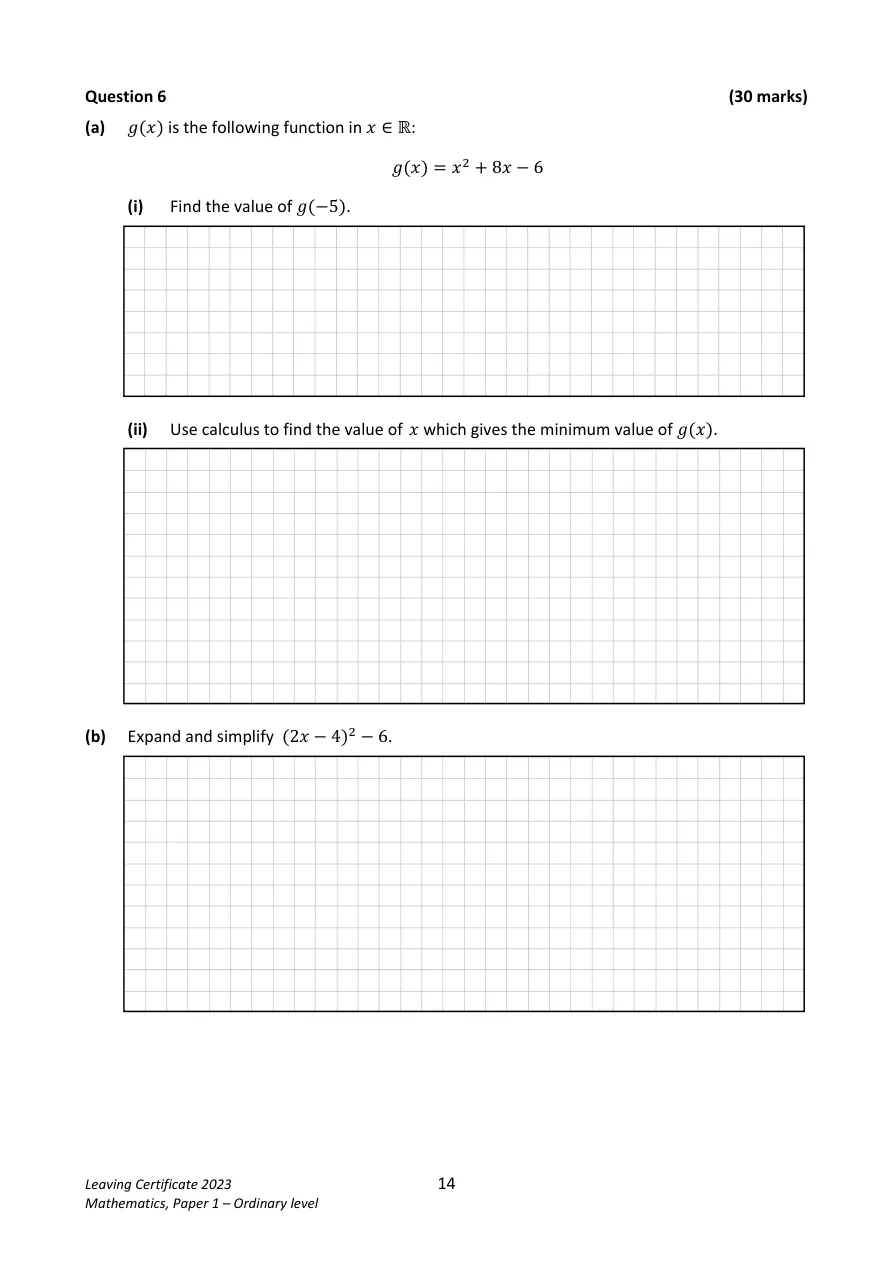
Show solutions
Follow the working below. The original question is unchanged.
a) Function g
- g(-5)=(-5)^2+8(-5)-6
- g(-5)=-21
- g'(x)=2x+8
- 2x+8=0
- x=-4
The coefficient of x² is positive, so this stationary point is a minimum.
b) Expand
- (2x-4)^2-6
- (2x-4)(2x-4)-6
Write the squared bracket twice, then multiply each term of the first bracket by both terms of the second.
- =4x^2-8x-8x+16-6
- =4x^2-16x+10
Combine the x-terms (−8x − 8x) and the constants (16 − 6).
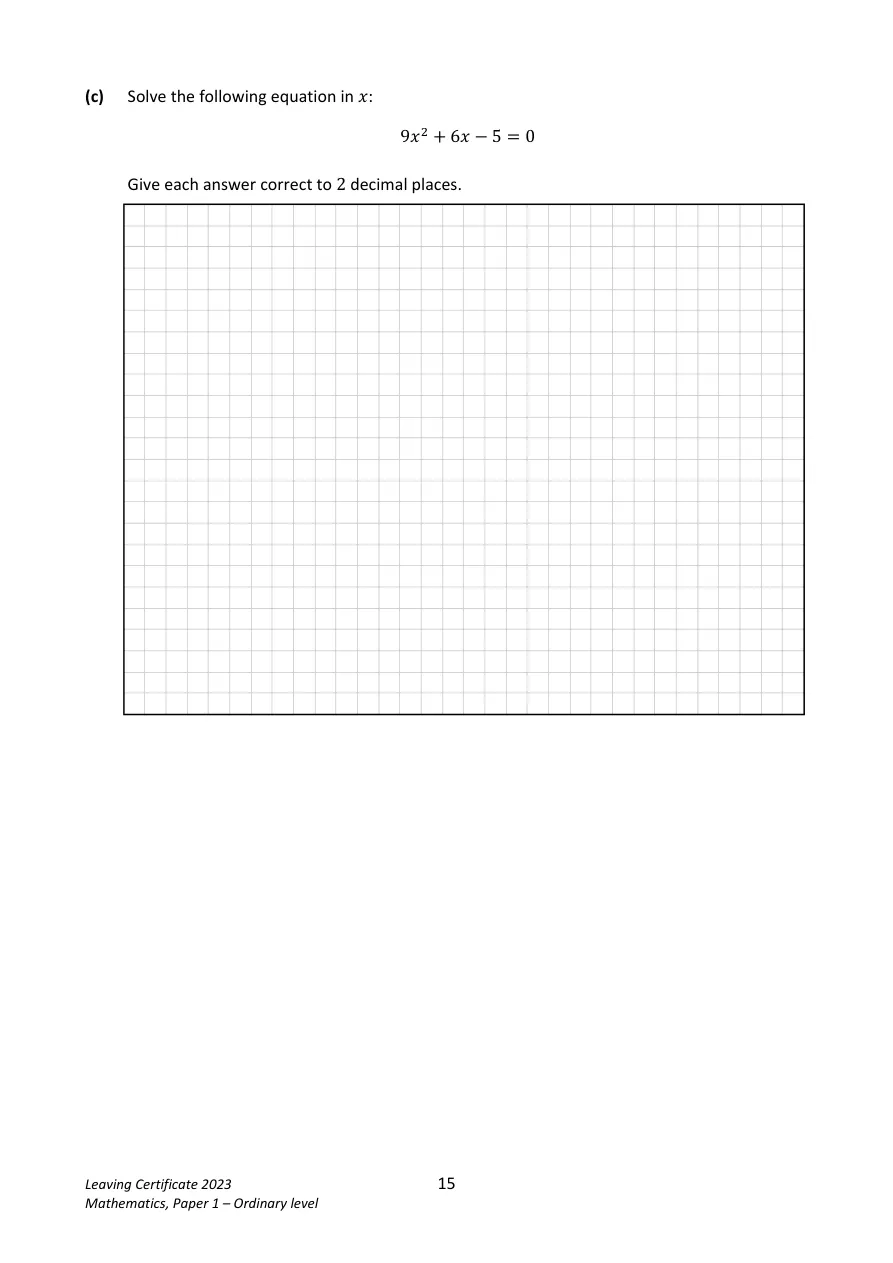
c) Solve
- a=9,\quad b=6,\quad c=-5
Match ax² + bx + c = 0. Include the signs of the coefficients.
- x=\dfrac{-b\pm\sqrt{b^2-4ac}}{2a}
Write the formula before substituting. The ± gives two calculations, one with + and one with −.
- x=\dfrac{-6\pm\sqrt{6^2-4(9)(-5)}}{2(9)}
Use brackets when substituting negative numbers, especially when squaring b.
- x=\dfrac{-6\pm\sqrt{216}}{18}
- x\approx0.48\quad\mathrm{or}\quad x\approx-1.15
See working and diagrams on the original paper
Teacher sign-in and homework controls
Use your existing homework account. Questions and solutions are open to everyone.
Join a class or open your homework →