← Original paper

Junior Cycle Higher Maths 2022

Teacher worked solutions. Explanations are in blue.

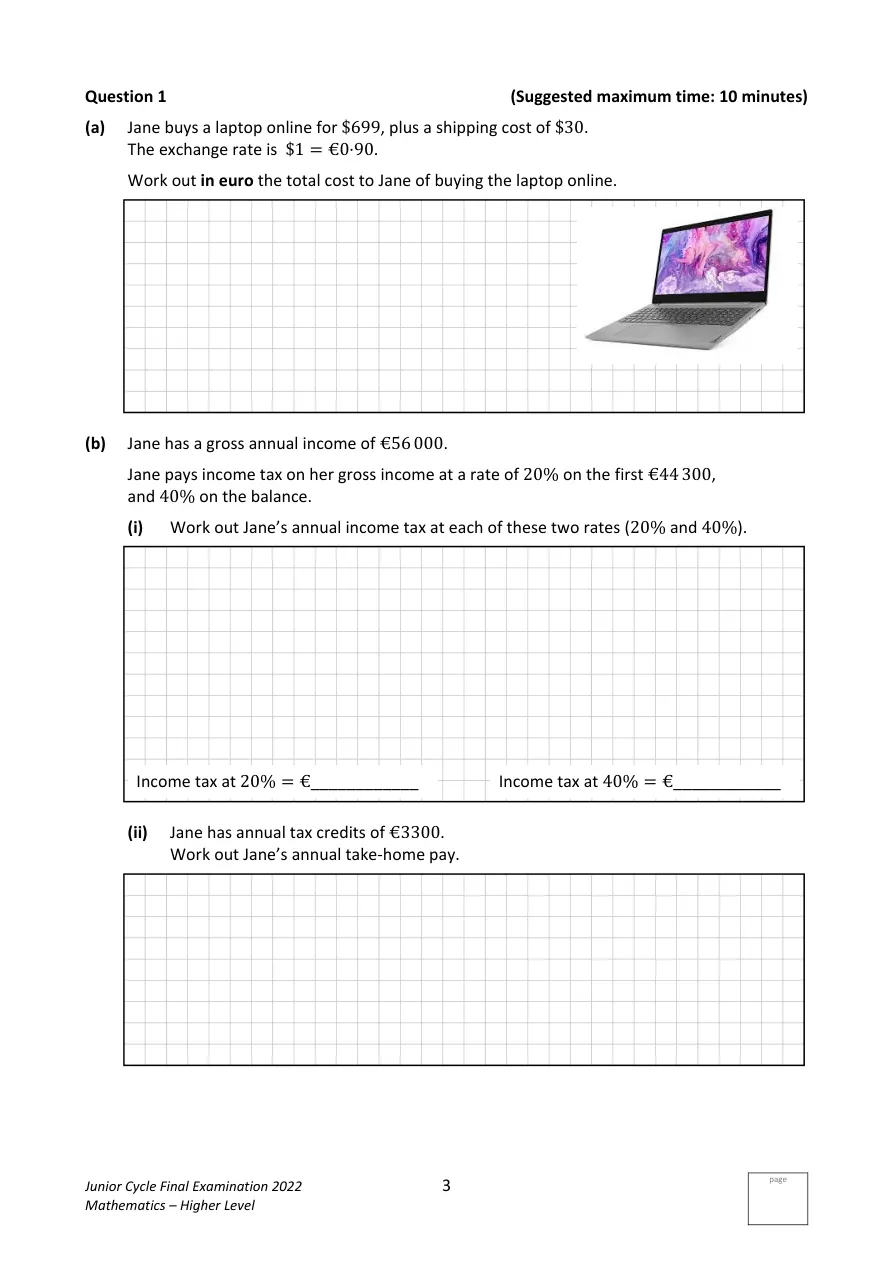
Question 1

a) Laptop and shipping

  1. 699+30=729

    Add both dollar costs before converting.

  2. 729\times0.90=656.10

    Each dollar is worth €0.90.

  3. \mathrm{Total}=\mathrm{€}656.10

b)(i) Tax in each band

  1. T_{20}=44300\times0.20
  2. T_{20}=\mathrm{€}8860
  3. 56000-44300=11700

    Only the balance is taxed at 40%.

  4. T_{40}=11700\times0.40
  5. T_{40}=\mathrm{€}4680

b)(ii) Take-home pay

  1. T=8860+4680-3300

    Tax credits reduce the tax bill, not gross income.

  2. T=10240
  3. \mathrm{Net}=56000-10240
  4. \mathrm{Net}=\mathrm{€}45760
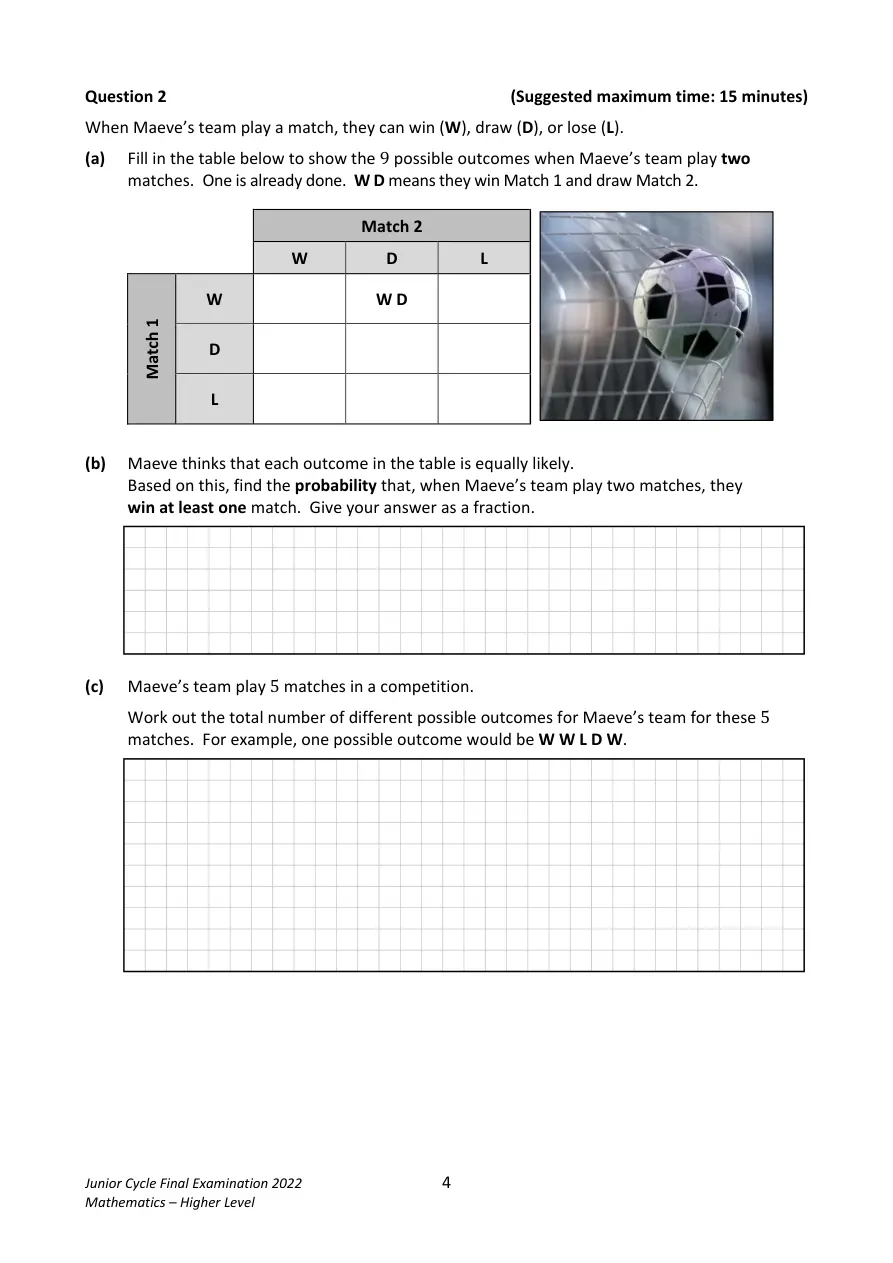
Question 2

a) All outcomes

  1. Rows correspond to Match 1; columns to Match 2: WW, WD, WL; DW, DD, DL; LW, LD, LL.

b) At least one win

  1. P(\mathrm{at\ least\ one\ win})=\dfrac{5}{9}

    WW, WD, WL, DW and LW are favourable. Count WW once.

c) Five matches

  1. N=3^5

    Three choices for each of five matches.

  2. N=243

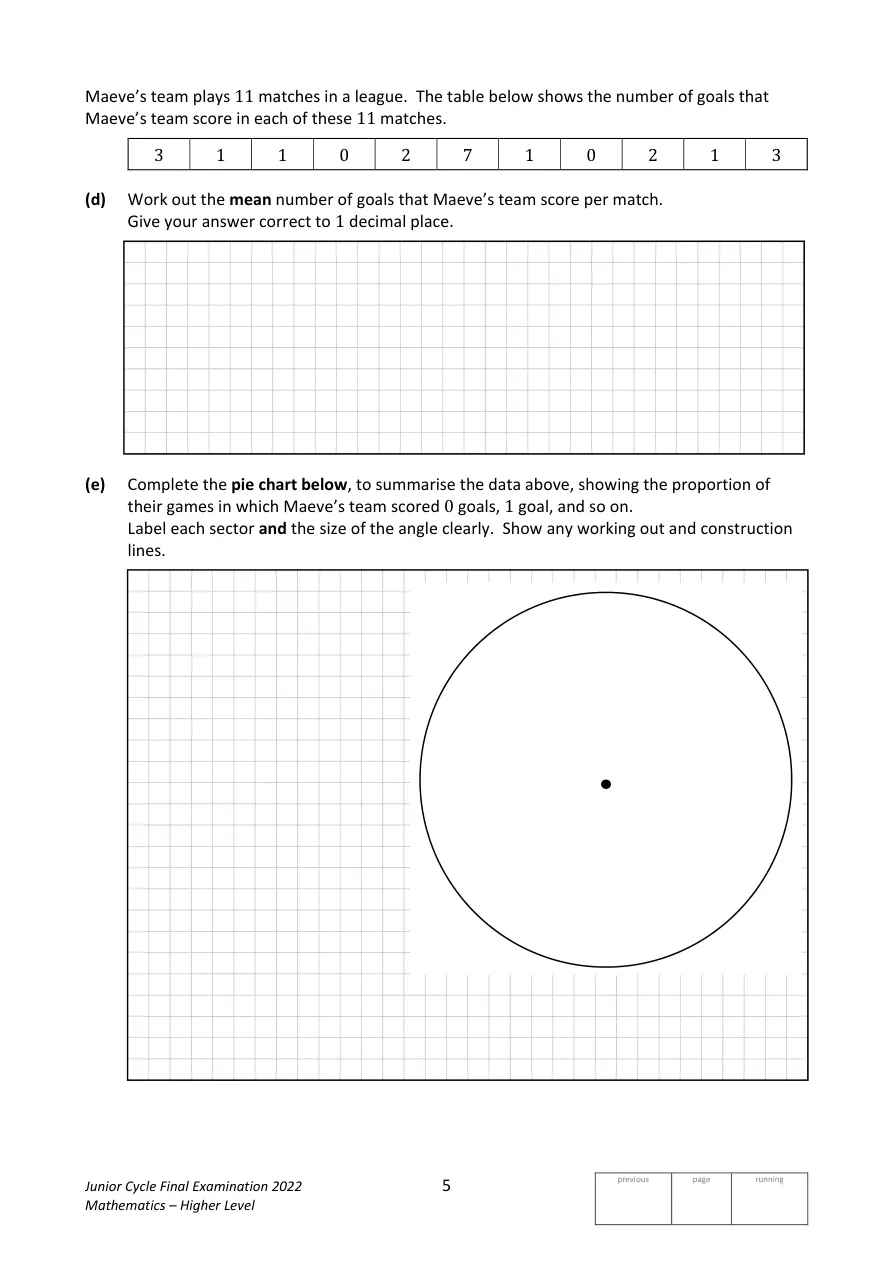
d) Mean goals

  1. \bar{x}=\dfrac{21}{11}
  2. \bar{x}\approx1.9\ \mathrm{goals}

    Round only the final mean to one decimal place.

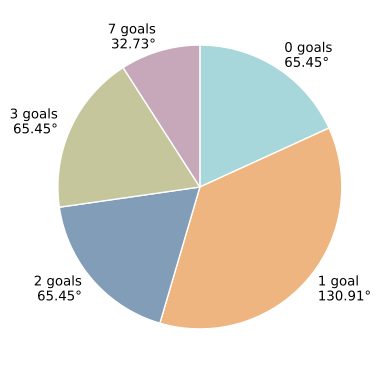
e) Pie chart

  1. \theta=\dfrac{\mathrm{frequency}}{11}\times360^{\circ}
  2. \theta_{0}=\theta_{2}=\theta_{3}=\dfrac{2}{11}\times360^{\circ}
  3. \theta_{0}=\theta_{2}=\theta_{3}\approx65.45^{\circ}
  4. \theta_{1}=\dfrac{4}{11}\times360^{\circ}
  5. \theta_{1}\approx130.91^{\circ}
  6. \theta_{7}=\dfrac{1}{11}\times360^{\circ}
  7. \theta_{7}\approx32.73^{\circ}
  8. Frequencies: 0 goals: 2; 1 goal: 4; 2 goals: 2; 3 goals: 2; 7 goals: 1. Draw the sectors with a protractor; the independently rounded whole-degree angles total 359°, so use the unrounded proportions for the full circle.
  9. 2022-2-pie

Question 3

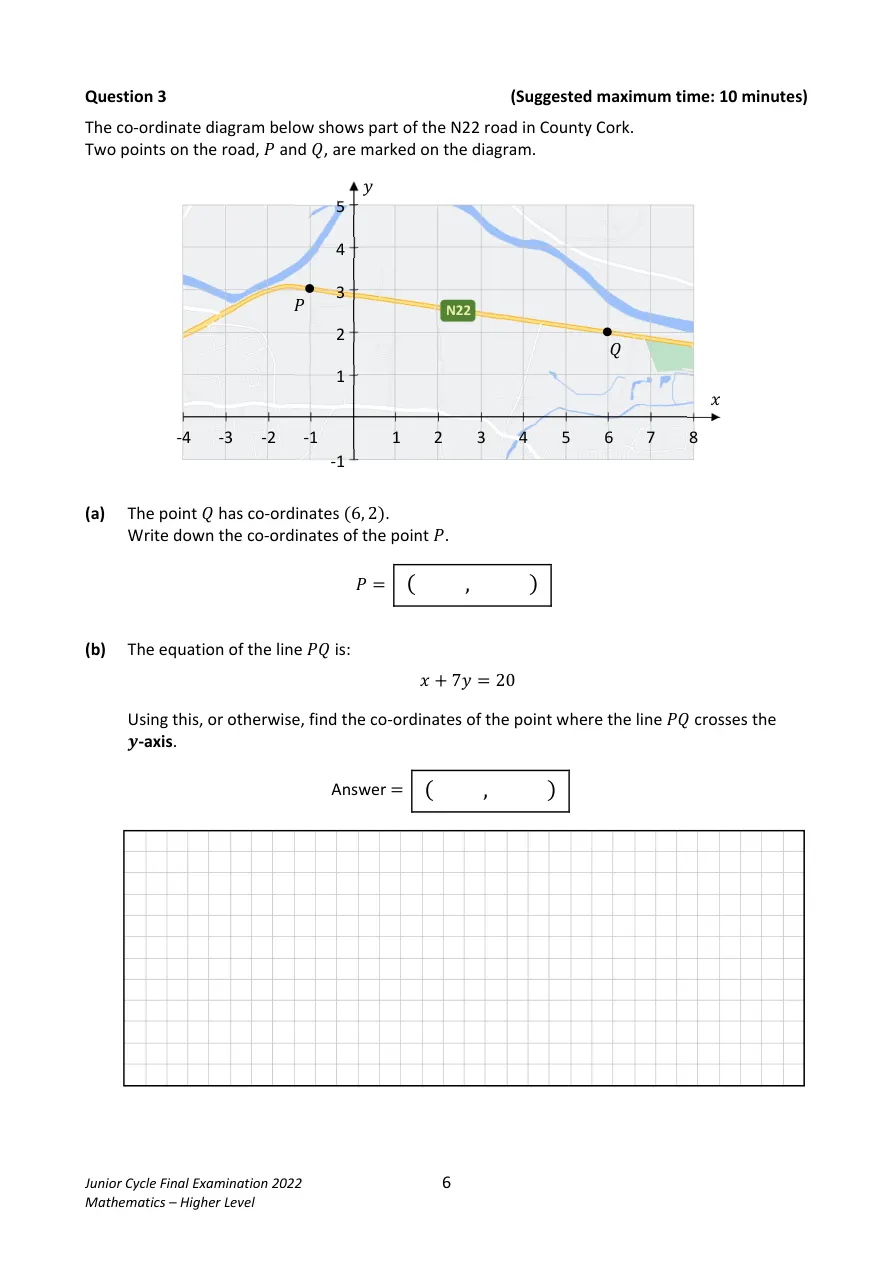
a) Read the point

  1. P=(-1,3)

b) y-intercept

  1. x=0

    Every point on the y-axis has x-coordinate zero.

  2. 7y=20
  3. y=\dfrac{20}{7}
  4. \left(0,\dfrac{20}{7}\right)

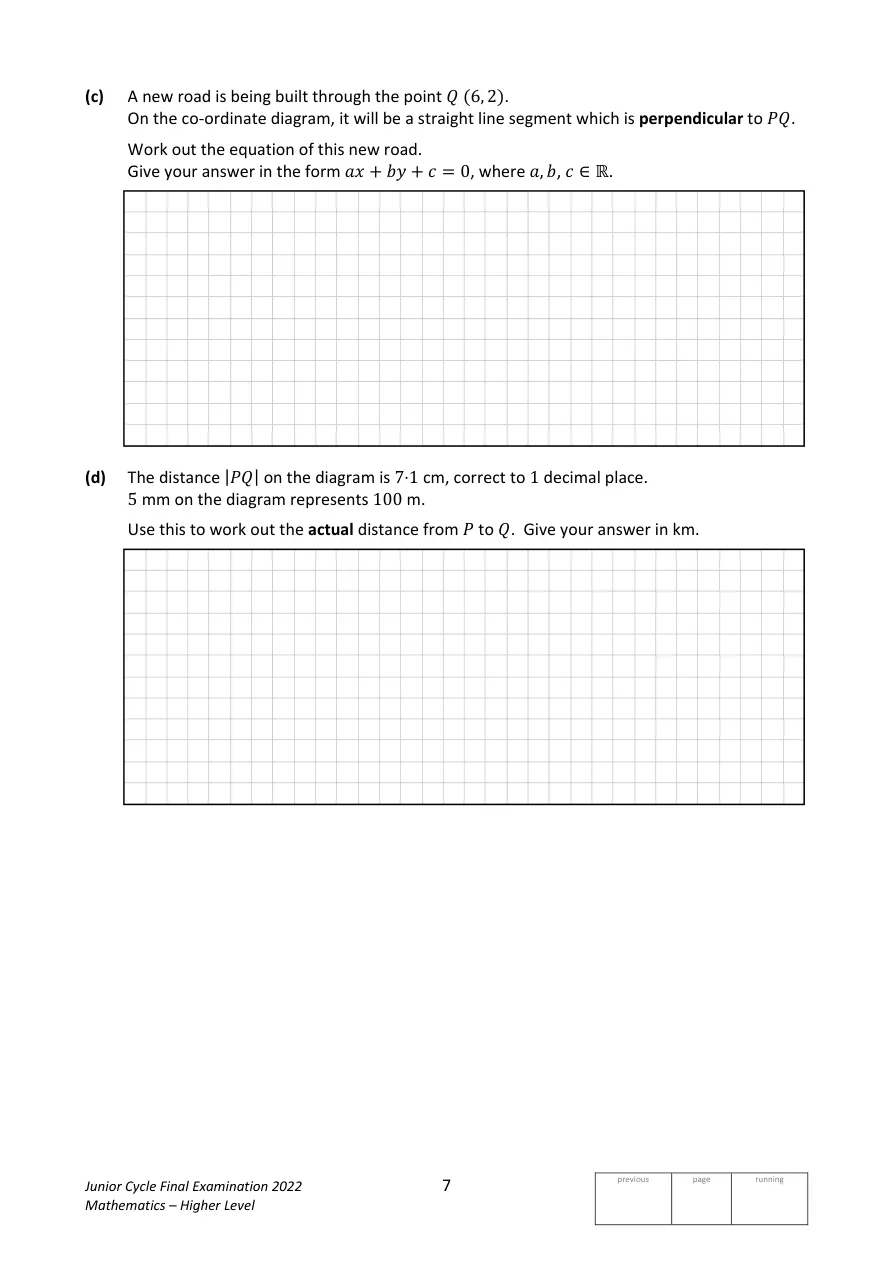
c) Perpendicular road through Q

  1. y=-\dfrac{1}{7}x+\dfrac{20}{7}

    Rearrange the original line to identify its slope.

  2. m_{PQ}=-\dfrac{1}{7}
  3. m_{\perp}=7

    Perpendicular slopes multiply to −1.

  4. y-2=7(x-6)

    Use the known point (6,2).

  5. y-2=7x-42
  6. 7x-y-40=0

d) Scale distance

  1. 7.1\ \mathrm{cm}=71\ \mathrm{mm}
  2. d=\dfrac{71}{5}\times100
  3. d=1420\ \mathrm{m}
  4. d=1.42\ \mathrm{km}

Question 4

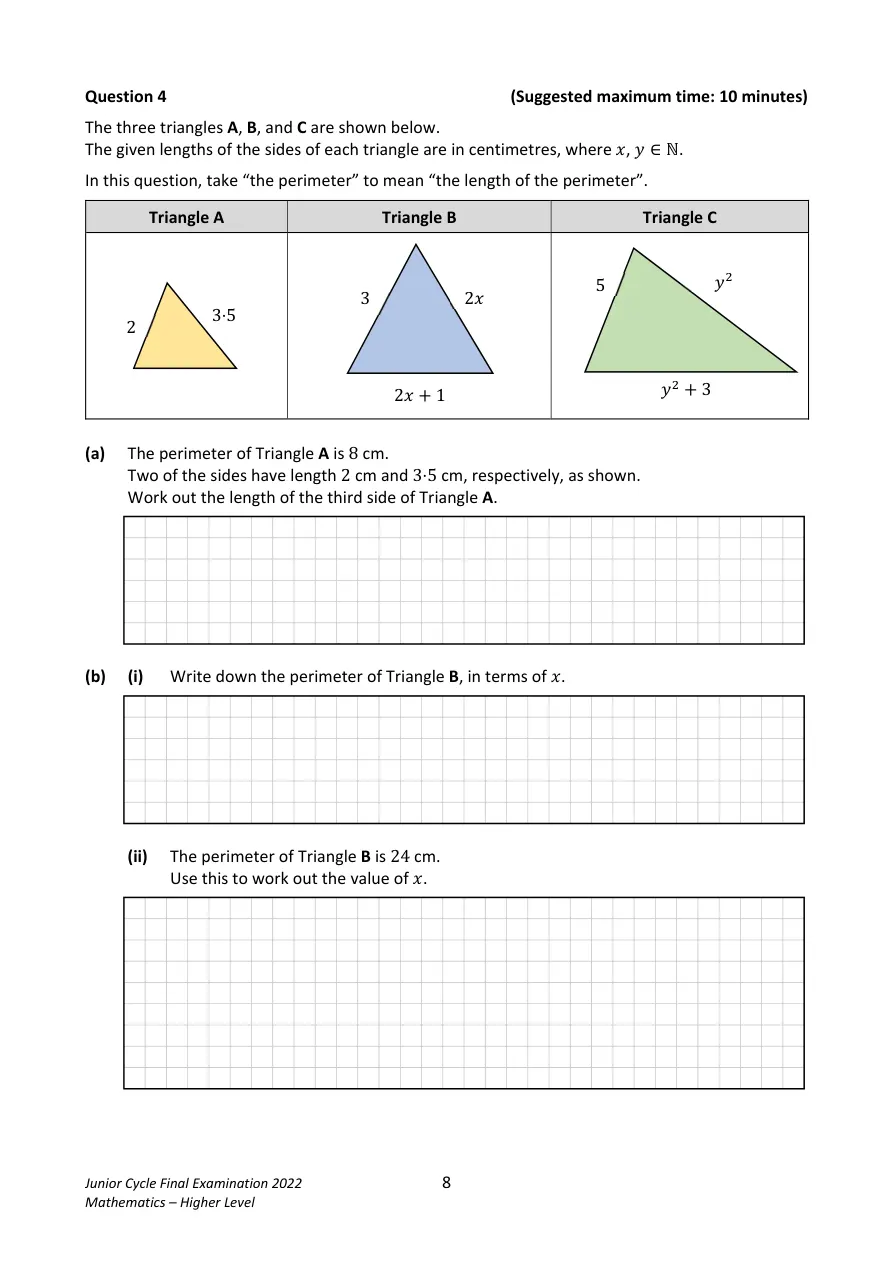
a) Missing side

  1. 8-2-3.5=2.5\ \mathrm{cm}

b)(i) Perimeter of B

  1. P_B=3+2x+(2x+1)
  2. P_B=4x+4

b)(ii) Find x

  1. 4x+4=24
  2. 4x=20

    Subtract 4 from both sides.

  3. x=5

    Divide both sides by 4.

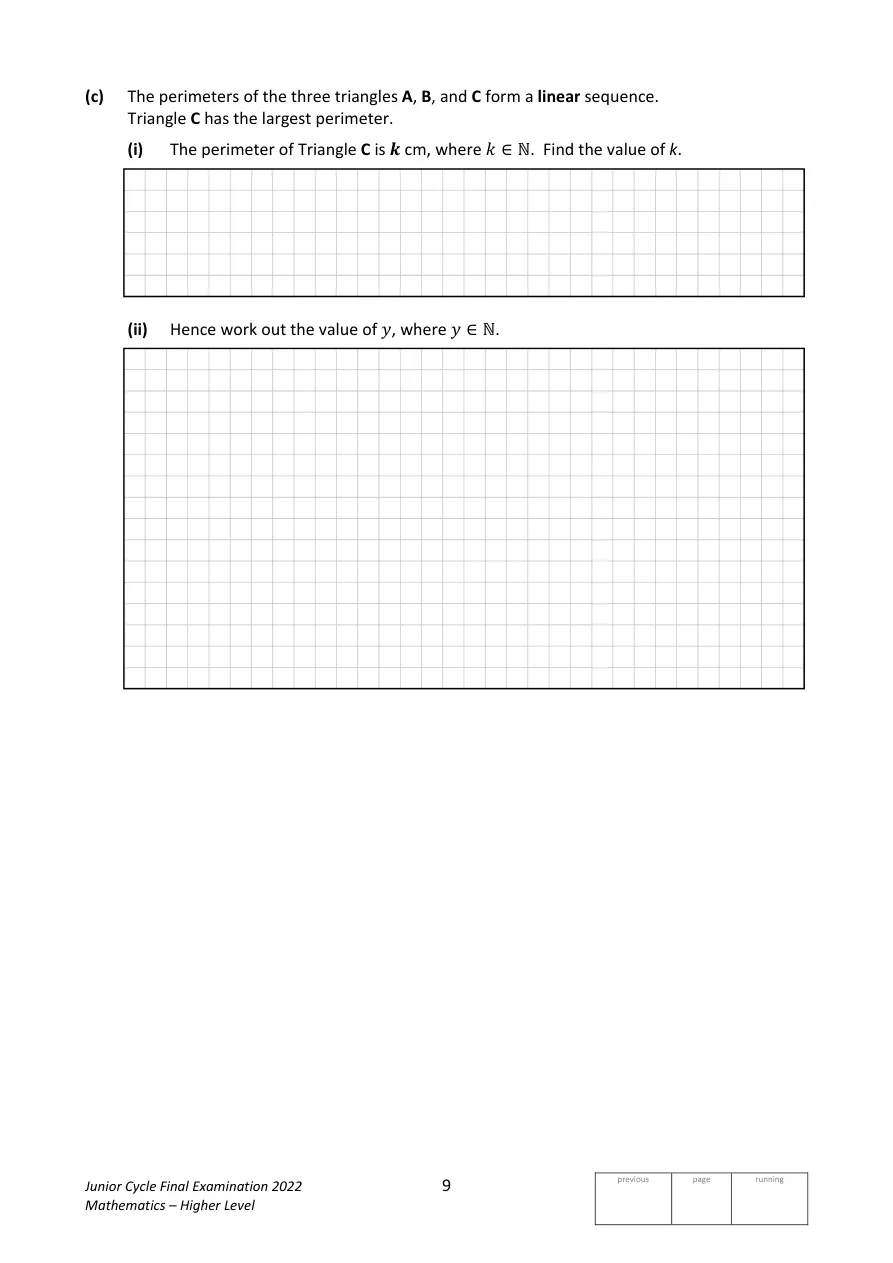
c)(i) Perimeter of C

  1. d=24-8
  2. d=16
  3. k=24+16
  4. k=40\ \mathrm{cm}

c)(ii) Find y

  1. 5+y^2+(y^2+3)=40
  2. 2y^2+8=40
  3. 2y^2=32
  4. y^2=16
  5. y=4

    Take the positive root because y is a natural number.

Question 5

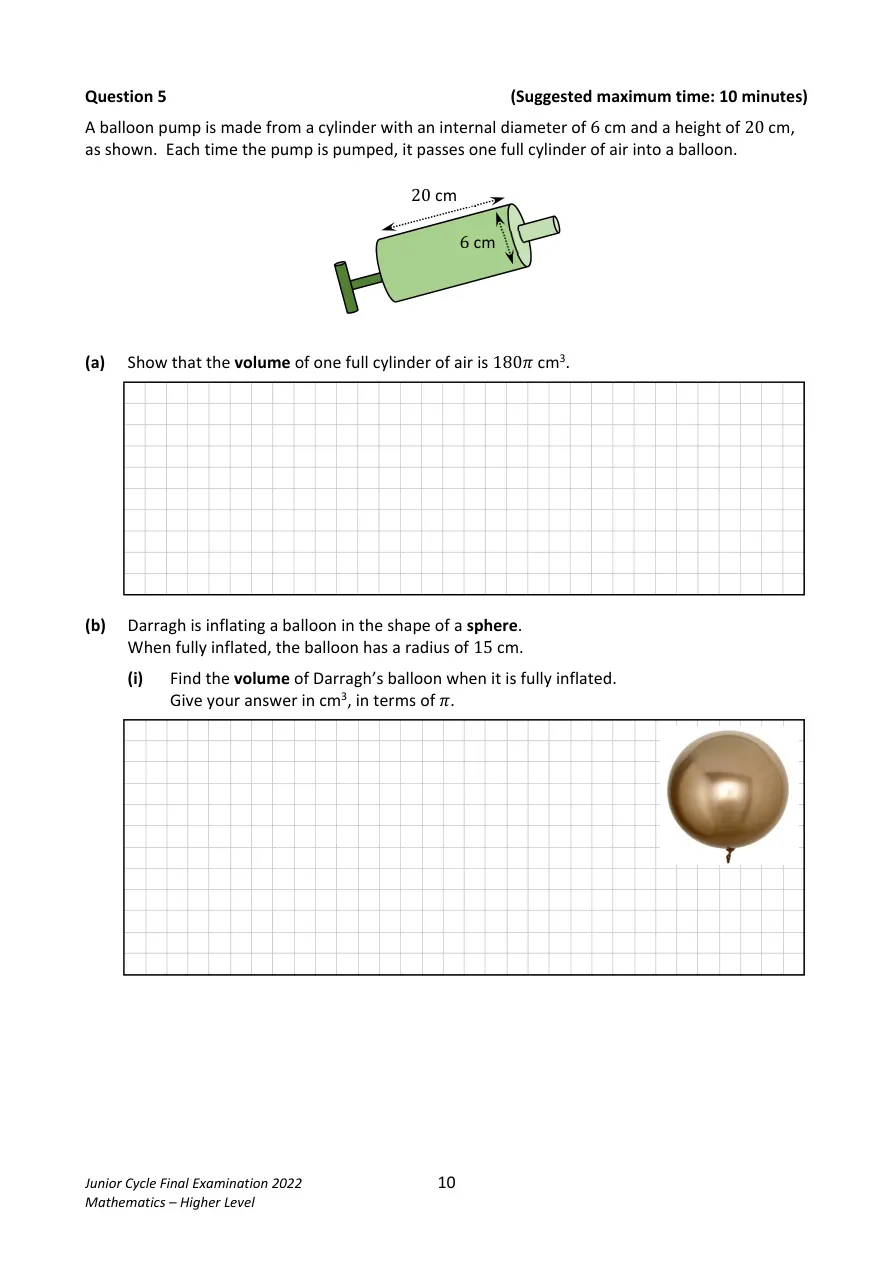
a) Pump volume

  1. r=\dfrac{6}{2}
  2. r=3\ \mathrm{cm}
  3. V=\pi r^2h
  4. V=\pi(3)^2(20)
  5. V=180\pi\ \mathrm{cm}^3

b)(i) First balloon

  1. V=\dfrac{4}{3}\pi r^3
  2. V=\dfrac{4}{3}\pi(15)^3
  3. V=4500\pi\ \mathrm{cm}^3

b)(ii) Time

  1. n=\dfrac{4500\pi}{180\pi}
  2. n=25
  3. t=25\ \mathrm{s}

    One full pump each second.

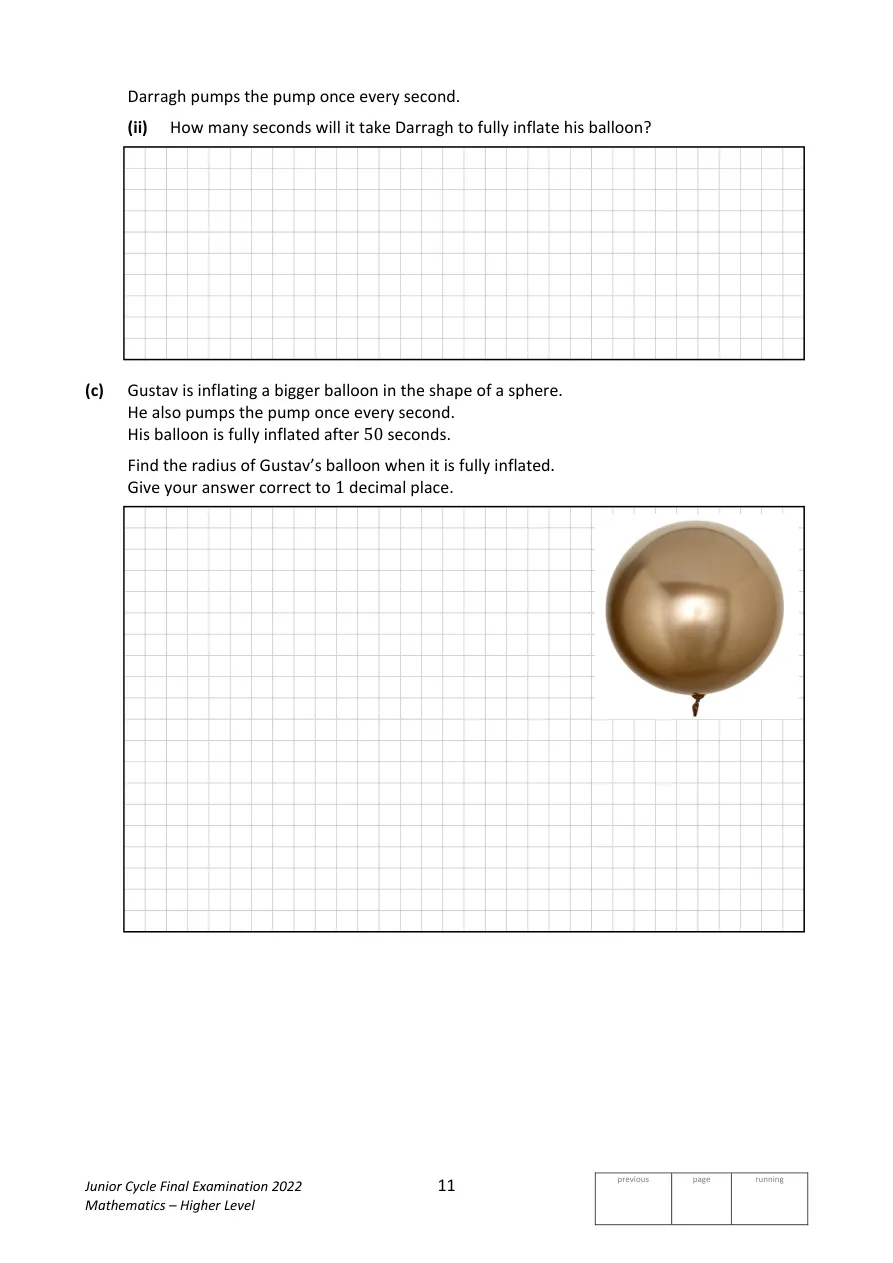
c) Larger balloon

  1. V=50(180\pi)
  2. V=9000\pi
  3. \dfrac{4}{3}\pi r^3=9000\pi
  4. r^3=\dfrac{3(9000)}{4}

    Cancel π and isolate the cube.

  5. r^3=6750
  6. r=\sqrt[3]{6750}
  7. r\approx18.9\ \mathrm{cm}

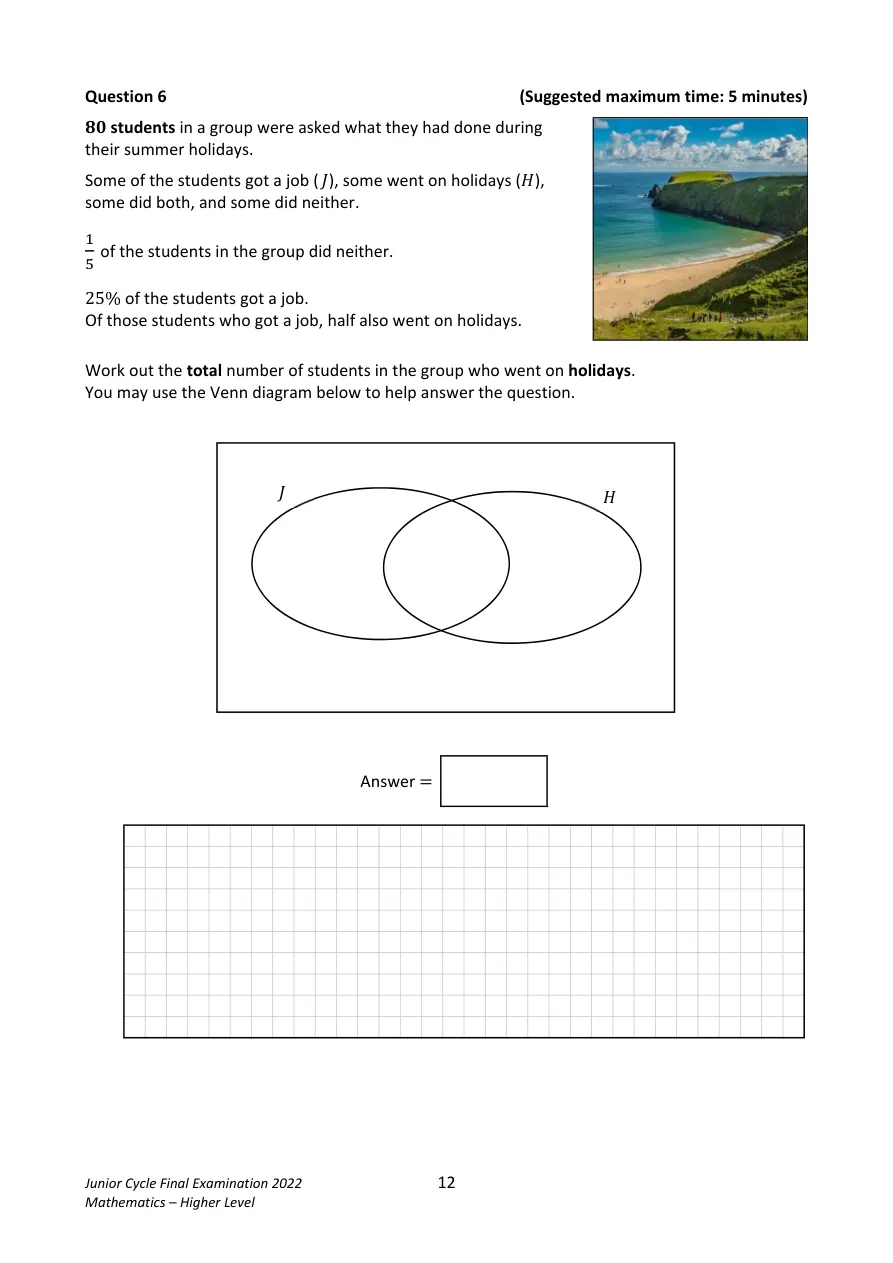
Question 6

Solution

  1. \mathrm{Neither}=\dfrac{1}{5}(80)
  2. \mathrm{Neither}=16
  3. n(J)=0.25(80)
  4. n(J)=20
  5. \#(J\cap H)=\dfrac{20}{2}
  6. \#(J\cap H)=10
  7. \mathrm{Holidays\ only}=80-16-20

    Remove neither and the entire job set.

  8. \mathrm{Holidays\ only}=44
  9. n(H)=44+10

    Add back students who did both.

  10. n(H)=54

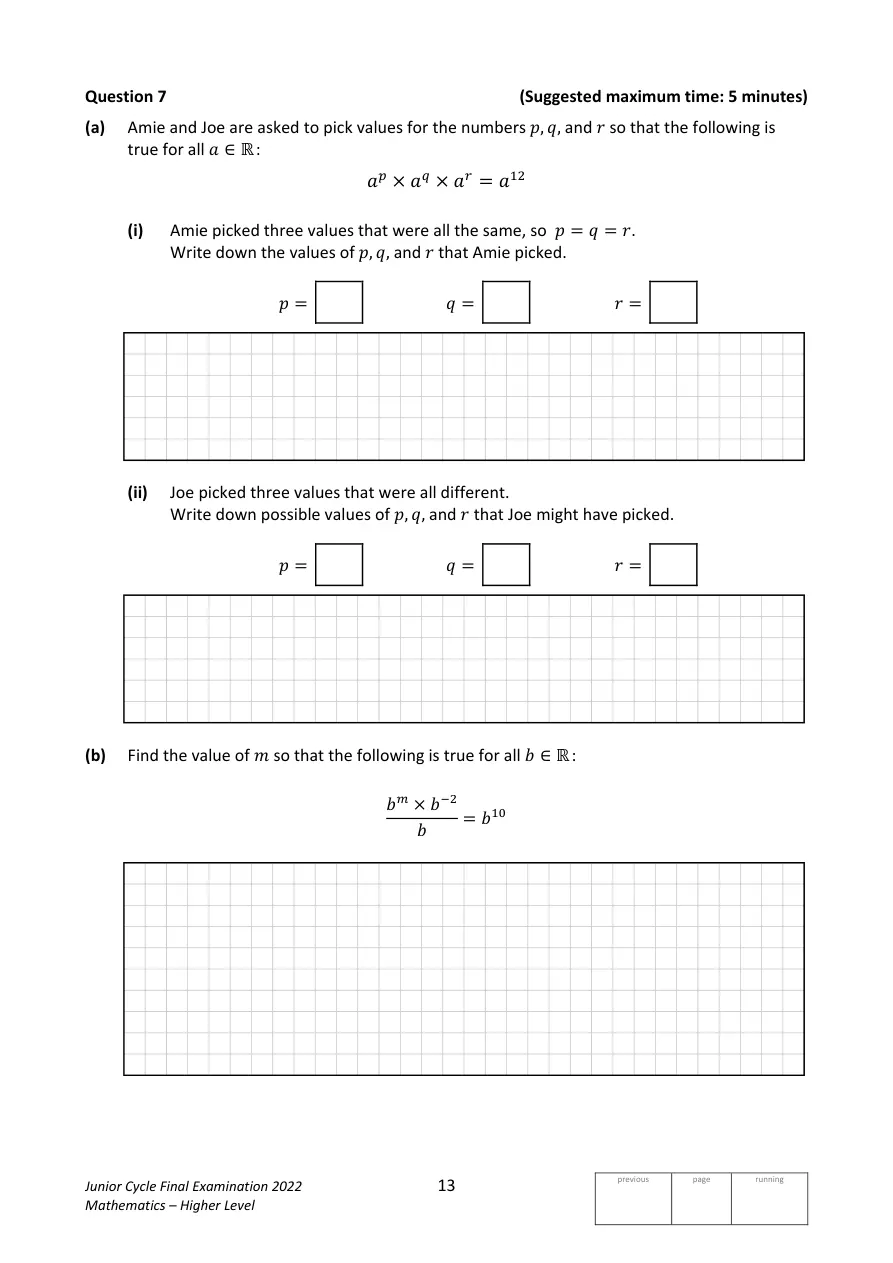
Question 7

a)(i) Equal exponents

  1. p+q+r=12

    Multiplying powers of the same base adds their exponents.

  2. 3p=12
  3. p=q=r=4

a)(ii) Different exponents

  1. p=3,\quad q=4,\quad r=5

    One valid choice: all different and their sum is 12.

b) Find m

  1. \dfrac{b^m b^{-2}}{b}=b^{10}
  2. b^{m-2-1}=b^{10}

    Subtract the denominator's exponent, 1.

  3. m-3=10
  4. m=13
  5. The fraction in the original expression requires b ≠ 0, despite the paper's broad real-number wording.

Question 8

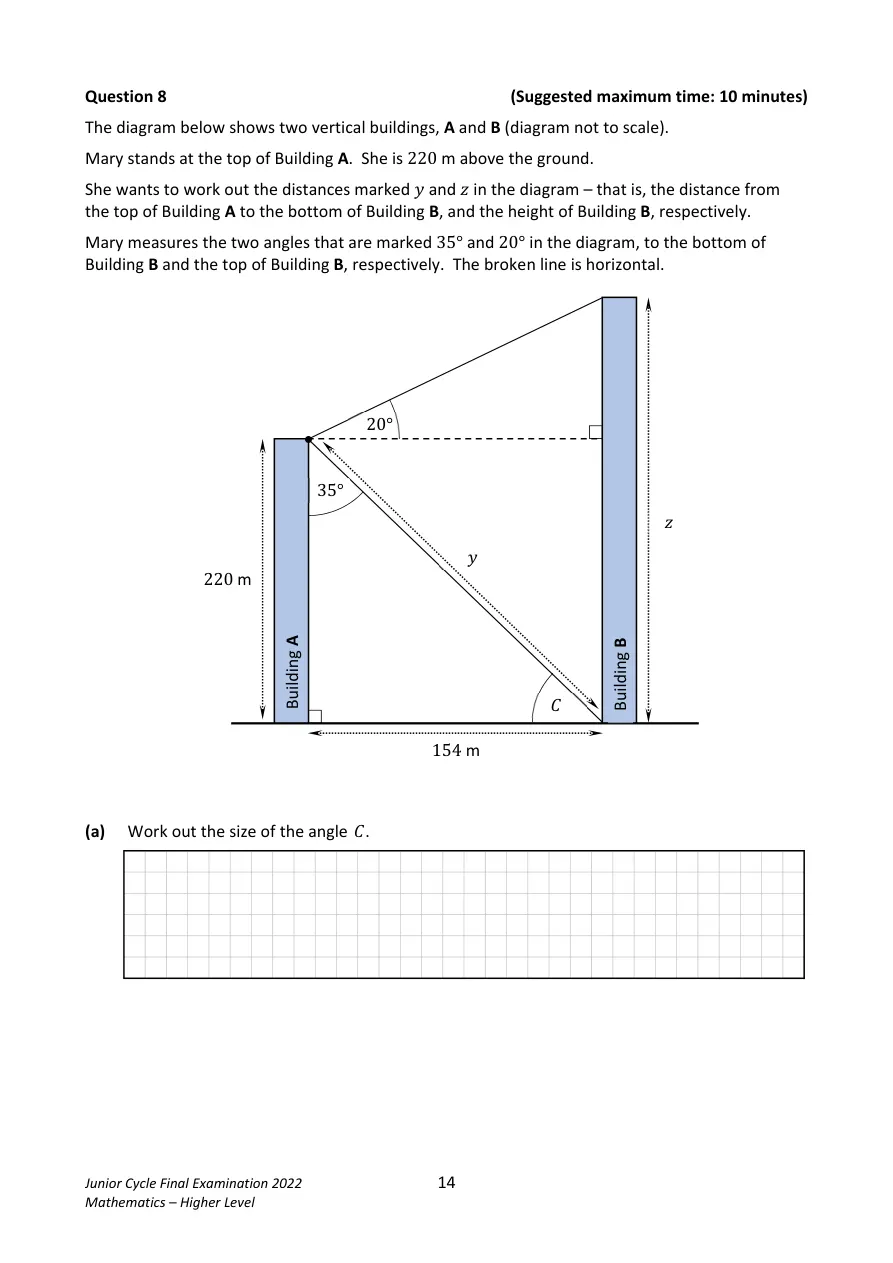
a) Angle C

  1. C=180^{\circ}-90^{\circ}-35^{\circ}
  2. C=55^{\circ}

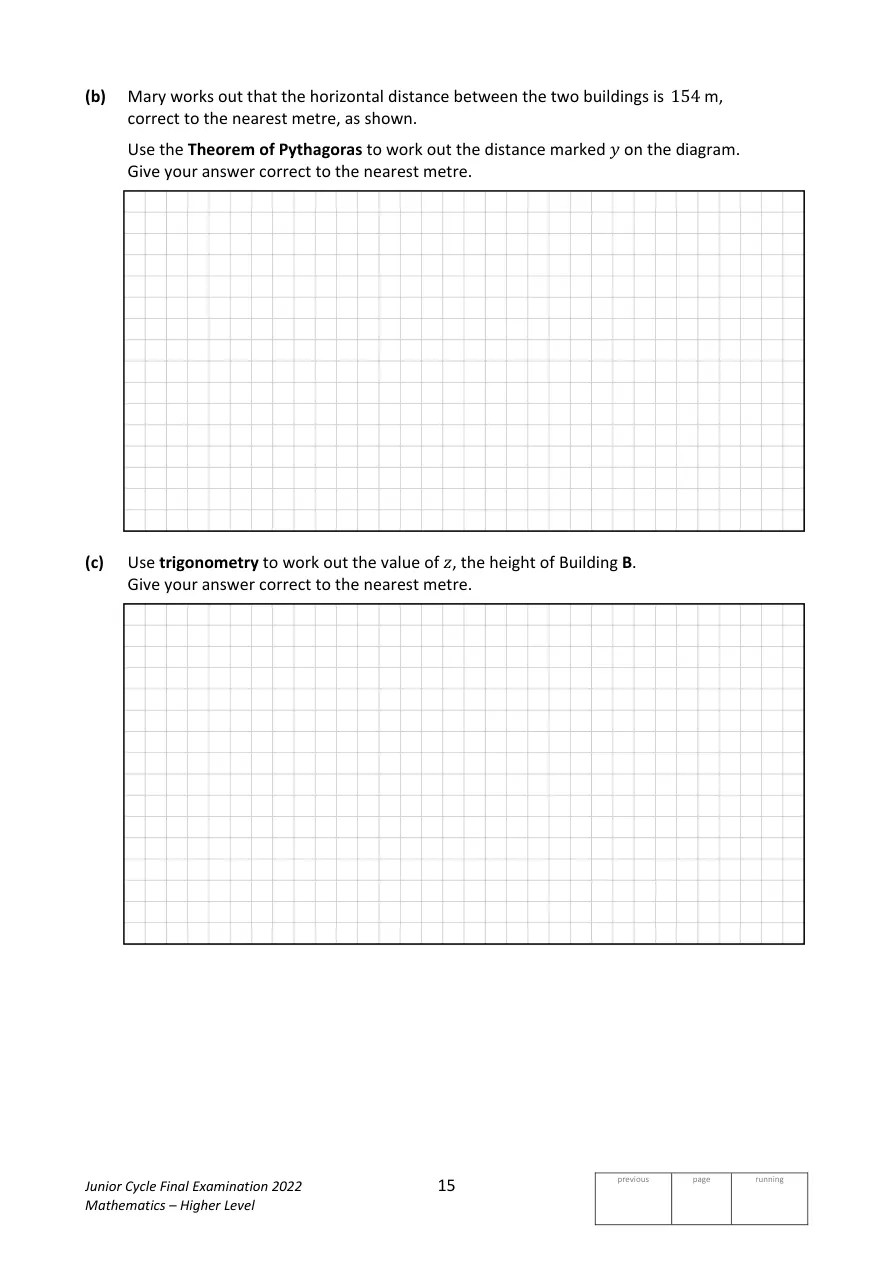
b) Sloping distance

  1. y^2=154^2+220^2
  2. y^2=72116
  3. y=\sqrt{72116}
  4. y\approx269\ \mathrm{m}

c) Height of building B

  1. \tan20^{\circ}=\dfrac{z-220}{154}

    The opposite side is the additional height above Mary's level.

  2. z-220=154\tan20^{\circ}
  3. z=220+154\tan20^{\circ}
  4. z\approx276\ \mathrm{m}

Question 9

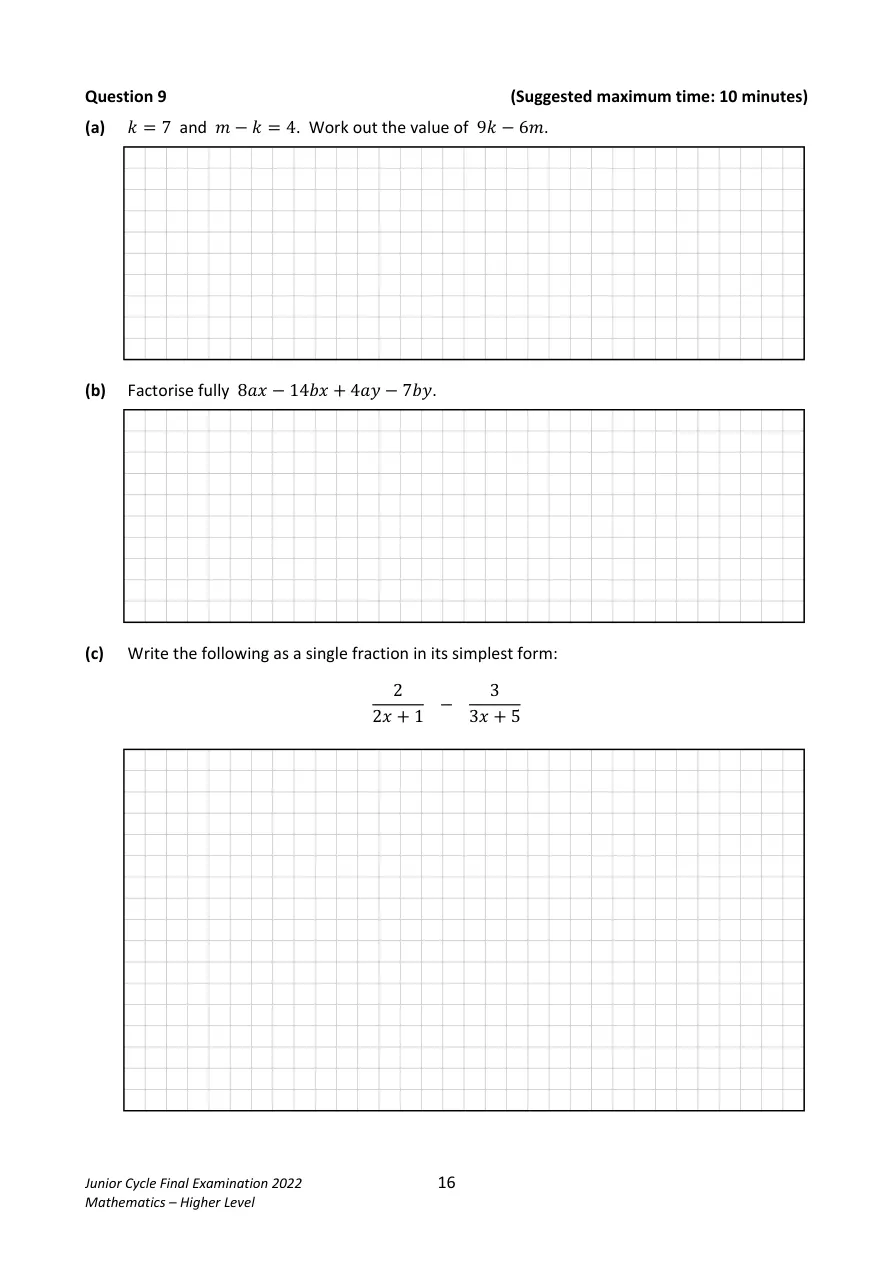
a) Substitution

  1. m-7=4
  2. m=11
  3. 9k-6m=9(7)-6(11)
  4. 9k-6m=63-66
  5. 9k-6m=-3

b) Factorise by grouping

  1. 8ax-14bx+4ay-7by
  2. 2x(4a-7b)+y(4a-7b)

    Take 2x out of the first pair and y out of the second pair. Both pairs leave the same bracket.

  3. (2x+y)(4a-7b)

    Take the common bracket (4a − 7b) out as one factor.

c) One algebraic fraction

  1. \dfrac{2}{2x+1}-\dfrac{3}{3x+5}
  2. \dfrac{2(3x+5)-3(2x+1)}{(2x+1)(3x+5)}

    Use the product of the denominators as a common denominator.

  3. \dfrac{6x+10-6x-3}{(2x+1)(3x+5)}

    The minus sign applies to the whole second bracket.

  4. \dfrac{7}{(2x+1)(3x+5)}
  5. x\ne-\dfrac{1}{2},\quad x\ne-\dfrac{5}{3}

    Original denominators cannot be zero.

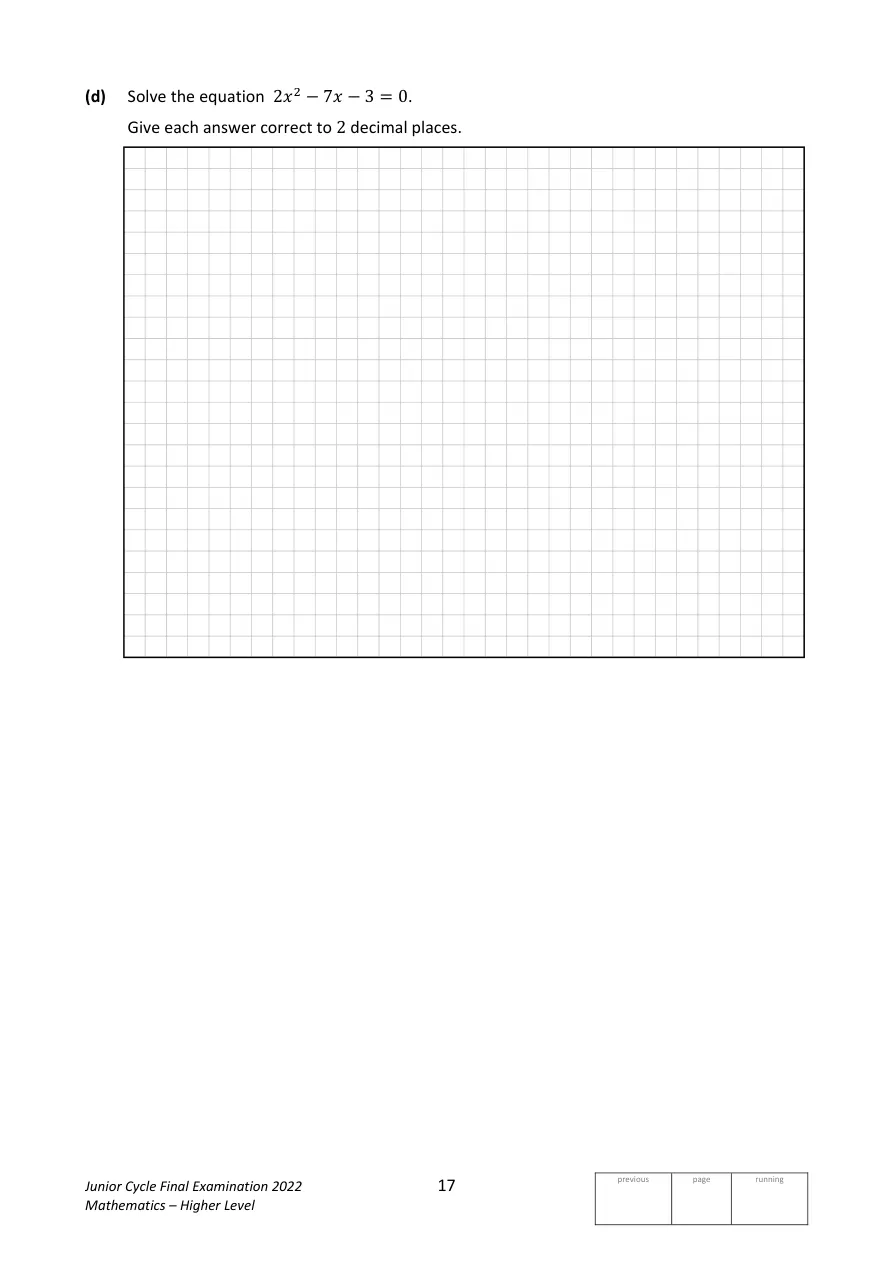
d) Quadratic formula

  1. a=2,\quad b=-7,\quad c=-3

    a is the coefficient of x², b is the coefficient of x, and c is the constant. Take the signs with the numbers.

  2. x=\dfrac{-b\pm\sqrt{b^2-4ac}}{2a}

    Use the quadratic formula after writing the equation in the form ax² + bx + c = 0.

  3. x=\dfrac{7\pm\sqrt{(-7)^2-4(2)(-3)}}{2(2)}

    Use brackets when substituting negative numbers, especially when squaring b.

  4. x=\dfrac{7\pm\sqrt{73}}{4}
  5. x\approx3.89\quad\mathrm{or}\quad x\approx-0.39

Question 10

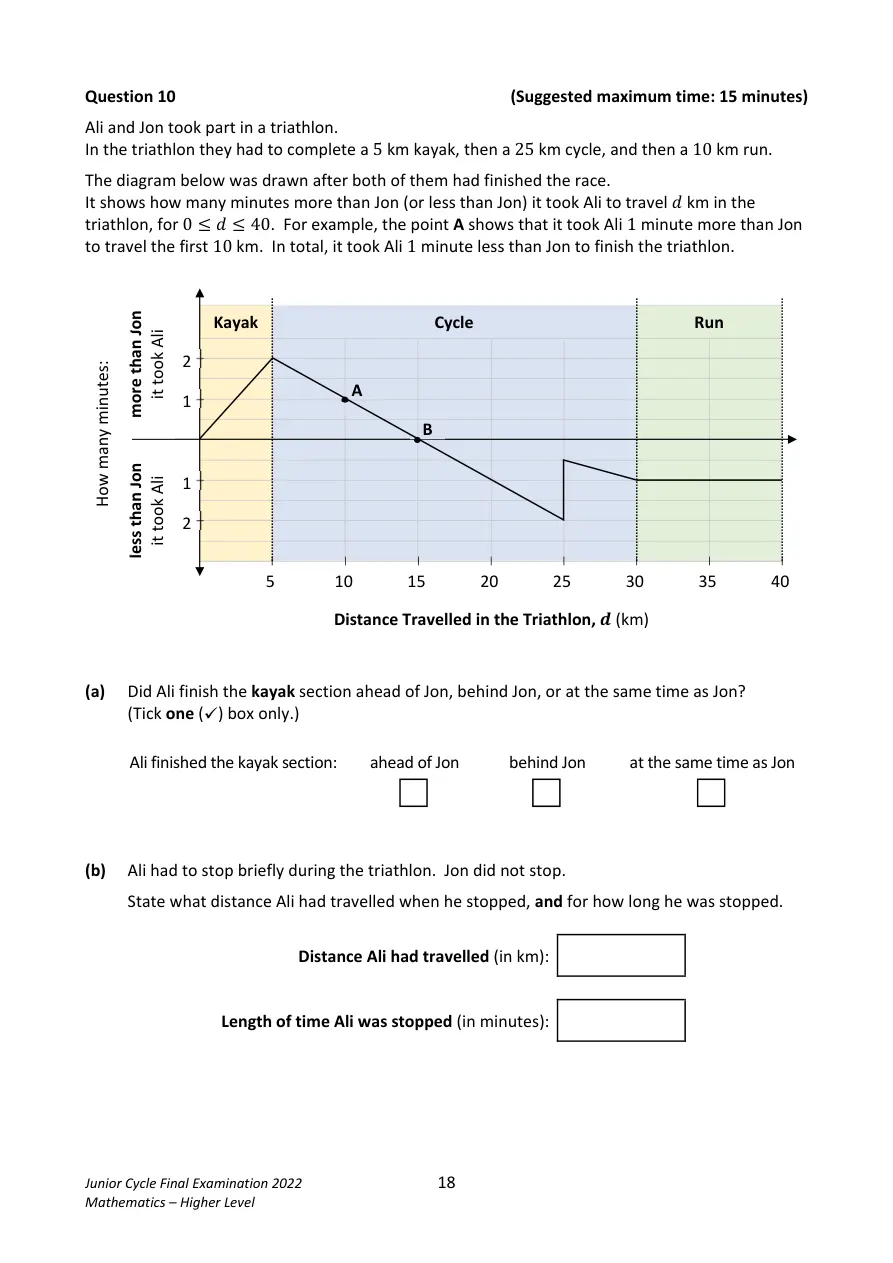
a) Kayak

  1. Ali finishes behind Jon: at 5 km the graph is +2 minutes, so Ali takes 2 minutes longer.

b) Stop

  1. Ali stops at 25 km. The vertical increase in the graph is 1.5 minutes, so the stop lasts 1.5 minutes.

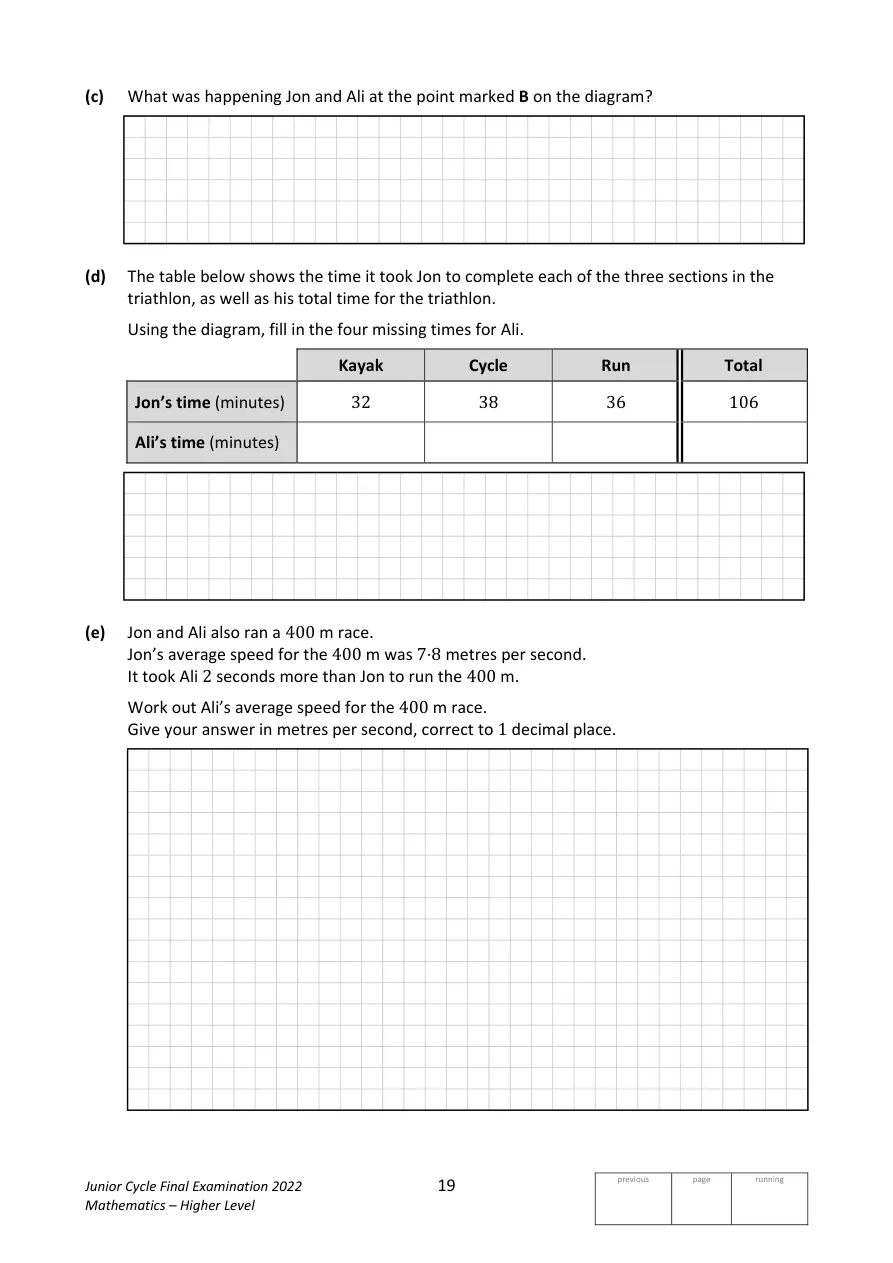
c) Point B

  1. They have taken the same elapsed time to reach this distance. Ali catches up with and passes Jon there.

d) Section times

  1. t_{A,5}=32+2=34\ \mathrm{min}
  2. t_{A,30}=32+38-1=69\ \mathrm{min}

    At 30 km Ali is one minute ahead in cumulative time.

  3. t_{A,\mathrm{cycle}}=69-34=35\ \mathrm{min}
  4. t_{A,\mathrm{total}}=106-1=105\ \mathrm{min}
  5. t_{A,\mathrm{run}}=105-69=36\ \mathrm{min}
  6. Ali's table: kayak 34 min; cycle 35 min; run 36 min; total 105 min.

e) 400 m race

  1. t_J=\dfrac{400}{7.8}
  2. t_A=\dfrac{400}{7.8}+2
  3. v_A=\dfrac{400}{\dfrac{400}{7.8}+2}

    Keep the unrounded time in the calculation.

  4. v_A\approx7.5\ \mathrm{m\ s}^{-1}

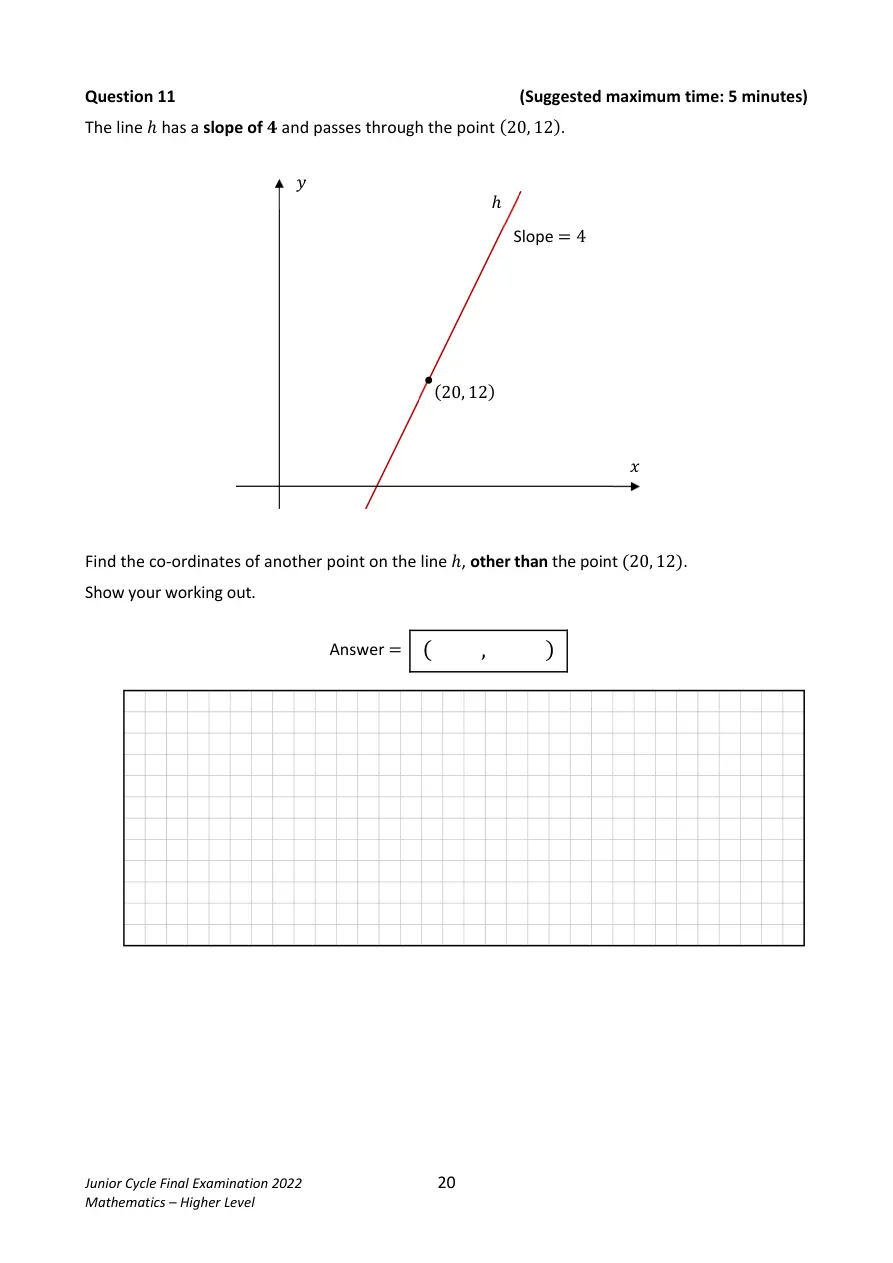
Question 11

Solution

  1. m=\dfrac{\mathrm{rise}}{\mathrm{run}}
  2. 4=\dfrac{4}{1}

    Move right by 1 and up by 4.

  3. x_2=20+1=21
  4. y_2=12+4=16
  5. (21,16)

    One possible point; many others are valid.

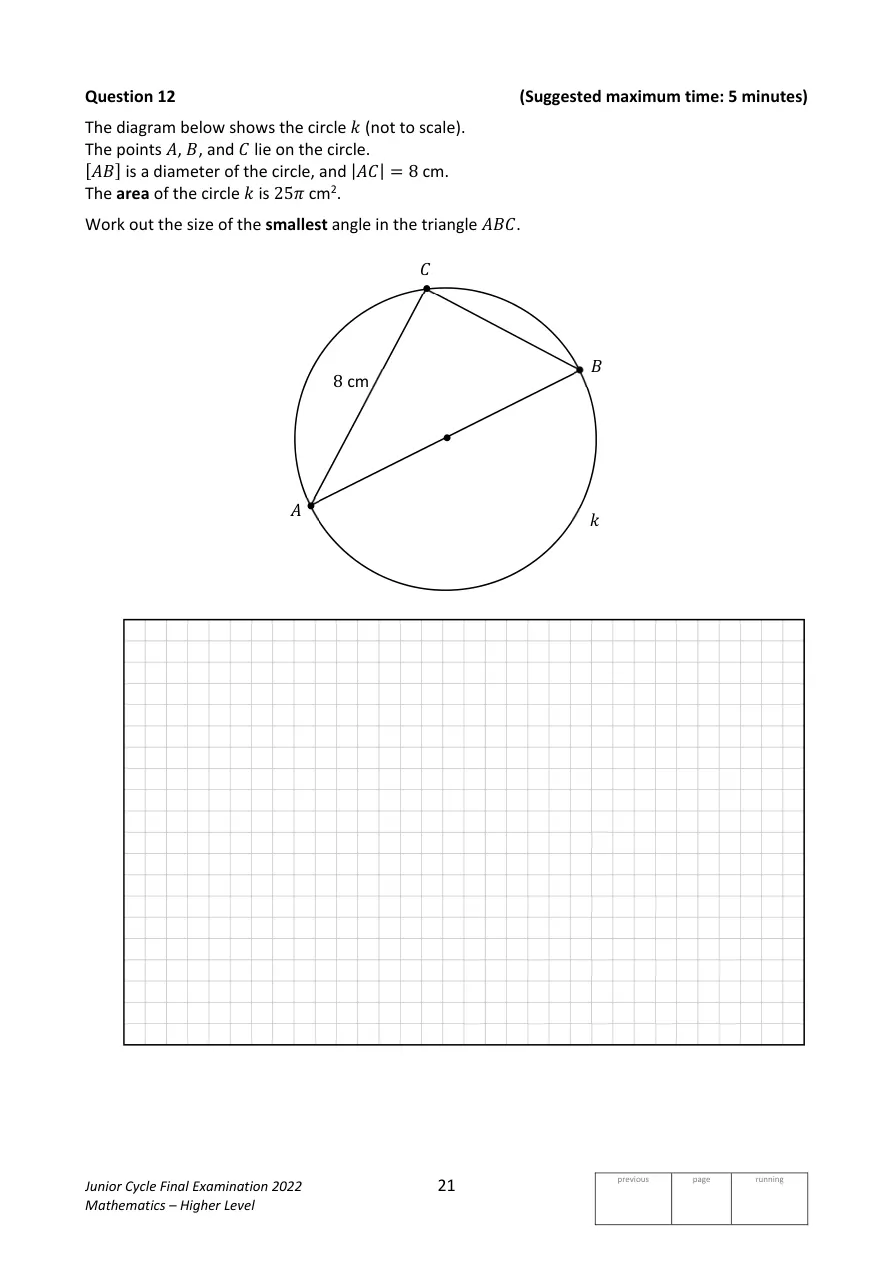
Question 12

Solution

  1. \pi r^2=25\pi
  2. r^2=25
  3. r=5\ \mathrm{cm}
  4. AB=2r=10\ \mathrm{cm}
  5. \angle ACB=90^{\circ}

    An angle in a semicircle is a right angle.

  6. \cos A=\dfrac{8}{10}
  7. A=\cos^{-1}\left(\dfrac{8}{10}\right)
  8. A\approx36.87^{\circ}

    The other acute angle is about 53.13°, so A is the smallest.

See working and diagrams on the original paper
Original exam paper page 3
699+30=729
729\times0.90=656.10
[Convert all dollars to euro.]
\mathrm{Total}=\mathrm{€}656.10
T_{20}=44300\times0.20
T_{20}=\mathrm{€}8860
56000-44300=11700
[Only the balance is taxed at 40%.]
T_{40}=11700\times0.40
T_{40}=\mathrm{€}4680
T=8860+4680-3300
[Tax credits reduce the tax bill, not gross income.]
T=10240
\mathrm{Net}=56000-10240
\mathrm{Net}=\mathrm{€}45760
Original exam paper page 4
P(\mathrm{at\ least\ one\ win})=\dfrac{5}{9}
[WW, WD, WL, DW and LW are favourable. Count WW once.]
N=3^5
[Three choices for each of five matches.]
N=243
WWWLDWDDDLLWLDLL
Original exam paper page 5
\bar{x}=\dfrac{21}{11}
\bar{x}\approx1.9\ \mathrm{goals}
[Round only the final mean to one decimal place.]
\theta=\dfrac{\mathrm{frequency}}{11}\times360^{\circ}
\theta_{0}=\theta_{2}=\theta_{3}=\dfrac{2}{11}\times360^{\circ}
\theta_{0}=\theta_{2}=\theta_{3}\approx65.45^{\circ}
\theta_{1}=\dfrac{4}{11}\times360^{\circ}
\theta_{1}\approx130.91^{\circ}
\theta_{7}=\dfrac{1}{11}\times360^{\circ}
\theta_{7}\approx32.73^{\circ}
Frequencies: 0 goals: 2; 1 goal: 4; 2 goals: 2; 3 goals: 2; 7 goals: 1. Draw the sectors with a protractor; the independently rounded whole-degree angles total 359°, so use the unrounded proportions for the full circle.
0 goals1 goal2 goals3 goals7 goals
Original exam paper page 6
-1, 3
x=0
[At the y-axis, x = 0.]
7y=20
y=\dfrac{20}{7}
\left(0,\dfrac{20}{7}\right)
0, 20/7
Original exam paper page 7
y=-\dfrac{1}{7}x+\dfrac{20}{7}
m_{PQ}=-\dfrac{1}{7}
m_{\perp}=7
[Perpendicular slopes multiply to -1.]
y-2=7(x-6)
y-2=7x-42
7x-y-40=0
7.1\ \mathrm{cm}=71\ \mathrm{mm}
d=\dfrac{71}{5}\times100
d=1420\ \mathrm{m}
d=1.42\ \mathrm{km}
Original exam paper page 8
8-2-3.5=2.5\ \mathrm{cm}
P_B=3+2x+(2x+1)
P_B=4x+4
4x+4=24
4x=20
[Subtract 4 from both sides.]
x=5
[Divide both sides by 4.]
Original exam paper page 9
d=24-8
d=16
k=24+16
k=40\ \mathrm{cm}
5+y^2+(y^2+3)=40
2y^2+8=40
2y^2=32
y^2=16
y=4
[Take the positive root because y is a natural number.]
Original exam paper page 10
r=\dfrac{6}{2}
r=3\ \mathrm{cm}
V=\pi r^2h
V=\pi(3)^2(20)
V=180\pi\ \mathrm{cm}^3
V=\dfrac{4}{3}\pi r^3
V=\dfrac{4}{3}\pi(15)^3
V=4500\pi\ \mathrm{cm}^3
Original exam paper page 11
n=\dfrac{4500\pi}{180\pi}
n=25
t=25\ \mathrm{s}
[One full pump each second.]
V=50(180\pi)
V=9000\pi
\dfrac{4}{3}\pi r^3=9000\pi
r^3=\dfrac{3(9000)}{4}
r^3=6750
r=\sqrt[3]{6750}
[Use the cube root to undo cubing.]
r\approx18.9\ \mathrm{cm}
Original exam paper page 12
\mathrm{Neither}=\dfrac{1}{5}(80)
\mathrm{Neither}=16
n(J)=0.25(80)
n(J)=20
\#(J\cap H)=\dfrac{20}{2}
\#(J\cap H)=10
10104416
\mathrm{Holidays\ only}=80-16-20
\mathrm{Holidays\ only}=44
n(H)=44+10
n(H)=54
54
Original exam paper page 13
p+q+r=12
[Multiplying powers of the same base adds their exponents.]
3p=12
p=q=r=4
p=3,\quad q=4,\quad r=5
[One valid choice: all different and their sum is 12.]
\dfrac{b^m b^{-2}}{b}=b^{10}
b^{m-2-1}=b^{10}
[Subtract the denominator's exponent, 1.]
m-3=10
m=13
The fraction in the original expression requires b ≠ 0, despite the paper's broad real-number wording.
444
345
Original exam paper page 14
C=180^{\circ}-90^{\circ}-35^{\circ}
C=55^{\circ}
Original exam paper page 15
y^2=154^2+220^2
y^2=72116
y=\sqrt{72116}
y\approx269\ \mathrm{m}
\tan20^{\circ}=\dfrac{z-220}{154}
[The opposite side is the additional height above Mary's level.]
z-220=154\tan20^{\circ}
z=220+154\tan20^{\circ}
z\approx276\ \mathrm{m}
Original exam paper page 16
m-7=4
m=11
9k-6m=9(7)-6(11)
9k-6m=63-66
9k-6m=-3
8ax-14bx+4ay-7by
2x(4a-7b)+y(4a-7b)
[Factor each pair so that the bracket is the same.]
(2x+y)(4a-7b)
[Factor out the common bracket.]
\dfrac{2}{2x+1}-\dfrac{3}{3x+5}
\dfrac{2(3x+5)-3(2x+1)}{(2x+1)(3x+5)}
[Use the product of the denominators as a common denominator.]
\dfrac{6x+10-6x-3}{(2x+1)(3x+5)}
[The minus sign applies to the whole second bracket.]
\dfrac{7}{(2x+1)(3x+5)}
x\ne-\dfrac{1}{2},\quad x\ne-\dfrac{5}{3}
[Original denominators cannot be zero.]
Original exam paper page 17
a=2,\quad b=-7,\quad c=-3
x=\dfrac{-b\pm\sqrt{b^2-4ac}}{2a}
x=\dfrac{7\pm\sqrt{(-7)^2-4(2)(-3)}}{2(2)}
x=\dfrac{7\pm\sqrt{73}}{4}
x\approx3.89\quad\mathrm{or}\quad x\approx-0.39
Original exam paper page 18
Ali finishes 2 minutes behind Jon.
Distance: 25 km. Stop: 1.5 minutes.
251.5
Original exam paper page 19
They have taken the same elapsed time to reach this distance. Ali catches up with and passes Jon there.
t_{A,5}=32+2=34\ \mathrm{min}
t_{A,30}=32+38-1=69\ \mathrm{min}
t_{A,\mathrm{cycle}}=69-34=35\ \mathrm{min}
t_{A,\mathrm{total}}=106-1=105\ \mathrm{min}
t_{A,\mathrm{run}}=105-69=36\ \mathrm{min}
t_J=\dfrac{400}{7.8}
t_A=\dfrac{400}{7.8}+2
v_A=\dfrac{400}{\dfrac{400}{7.8}+2}
[Keep the unrounded time in the calculation.]
v_A\approx7.5\ \mathrm{m\ s}^{-1}
343536105
Original exam paper page 20
m=\dfrac{\mathrm{rise}}{\mathrm{run}}
4=\dfrac{4}{1}
[Move 1 right and 4 up.]
x_2=20+1=21
y_2=12+4=16
(21,16)
Original exam paper page 21
\pi r^2=25\pi
r^2=25
r=5\ \mathrm{cm}
AB=2r=10\ \mathrm{cm}
\angle ACB=90^{\circ}
[An angle in a semicircle is 90°.]
\cos A=\dfrac{8}{10}
A=\cos^{-1}\left(\dfrac{8}{10}\right)
A\approx36.87^{\circ}