← Original paper

Junior Cycle Higher Maths 2024

Teacher worked solutions. Explanations are in blue.

Question 1

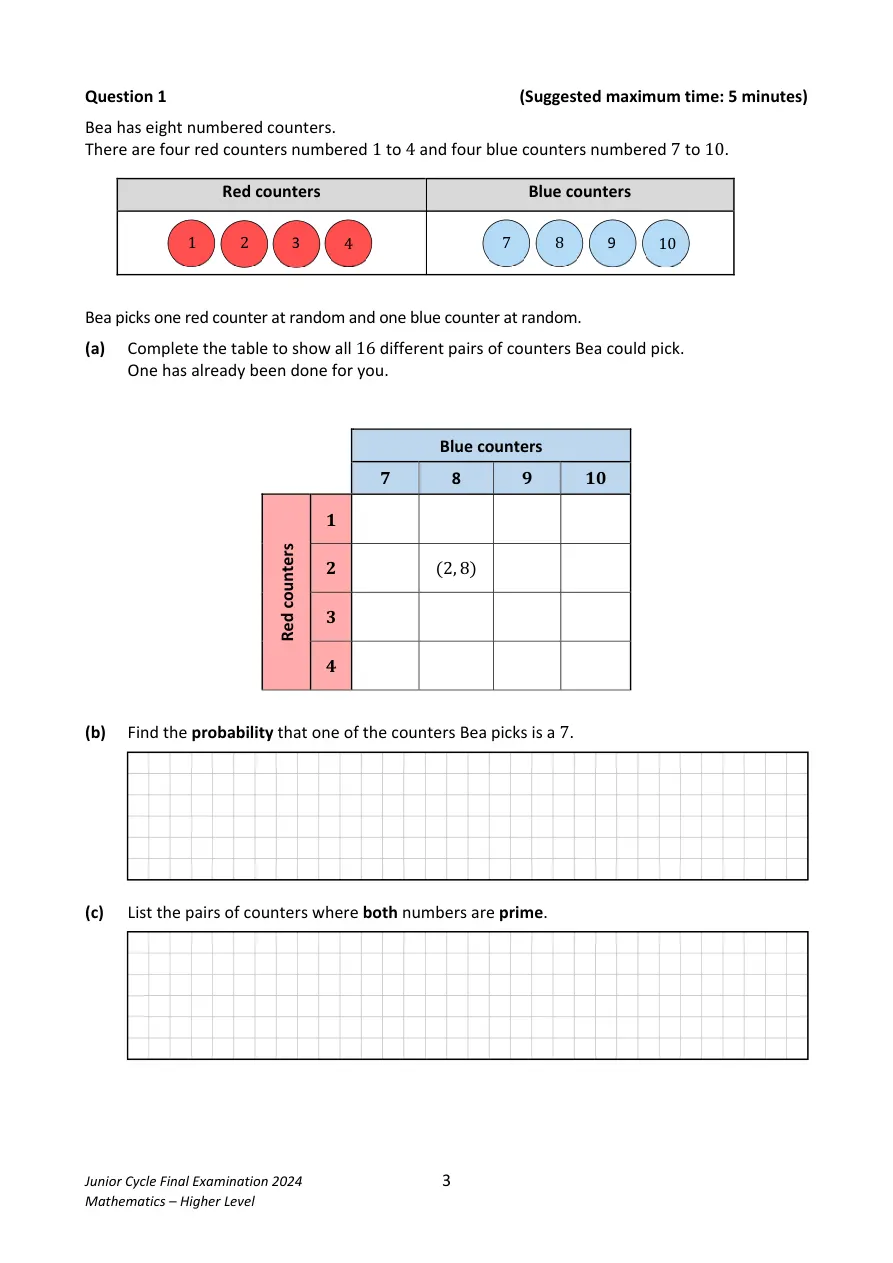
a) Sample space

  1. Rows: (1,7), (1,8), (1,9), (1,10); (2,7), (2,8), (2,9), (2,10); (3,7), (3,8), (3,9), (3,10); (4,7), (4,8), (4,9), (4,10).

b) A 7 is selected

  1. P(7)=\dfrac{4}{16}
  2. P(7)=\dfrac{1}{4}

    The blue counter must be 7; any of the four red counters can accompany it.

c) Both prime

  1. (2,7),\quad(3,7)

    1 is not prime; 9 and 10 are not prime.
Question 2

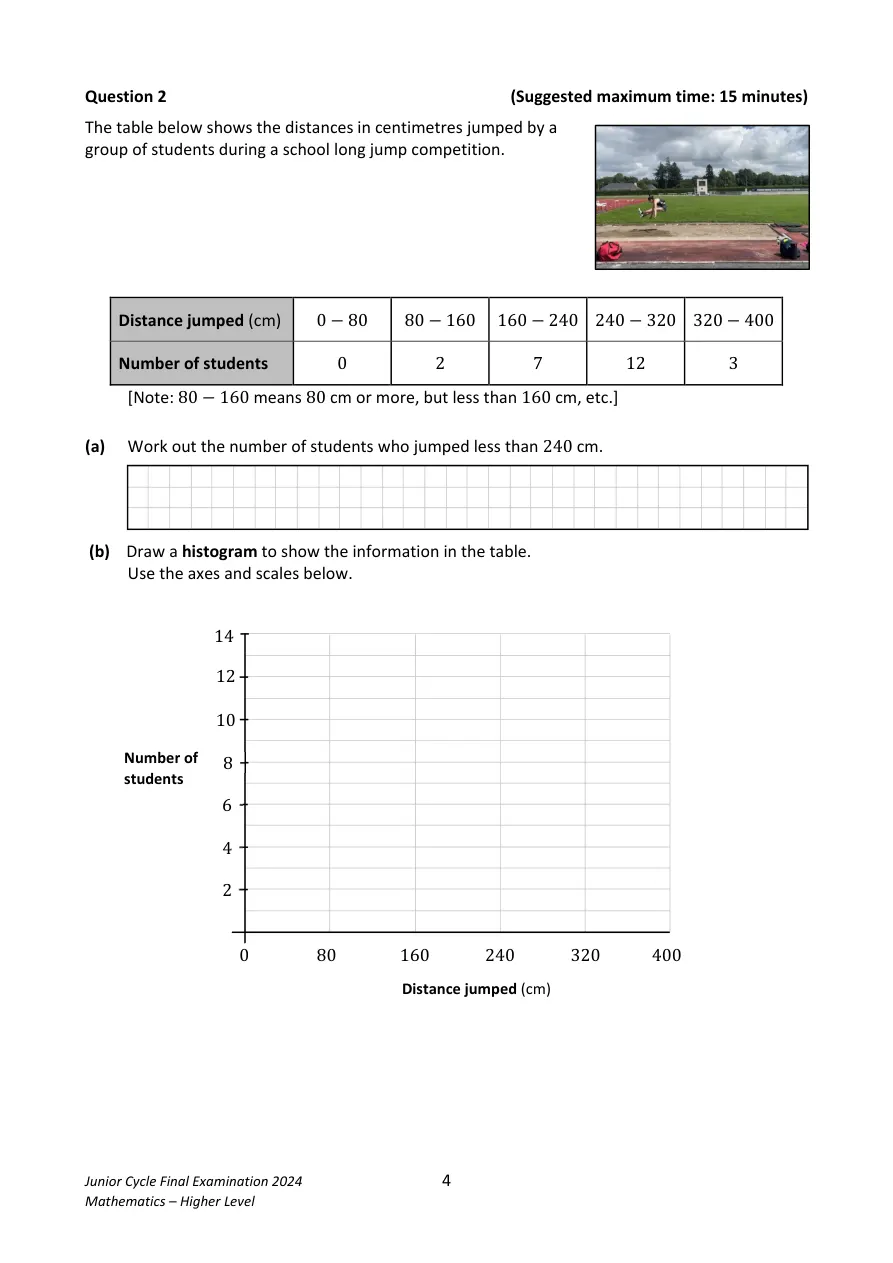
a) Below 240 cm

  1. 0+2+7=9\ \mathrm{students}

b) Histogram

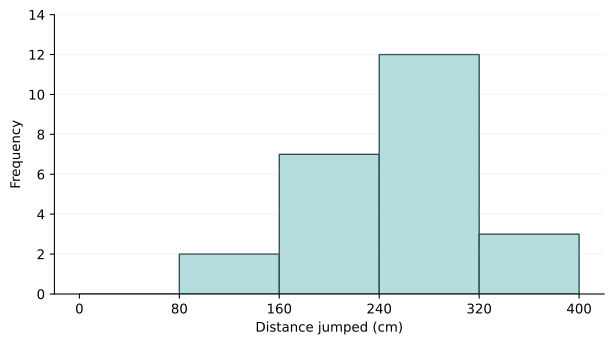
  1. Touching bars on intervals 0–80, 80–160, 160–240, 240–320, 320–400 cm have heights 0, 2, 7, 12, 3. The intervals have equal widths.
  2. 2024-2-hist

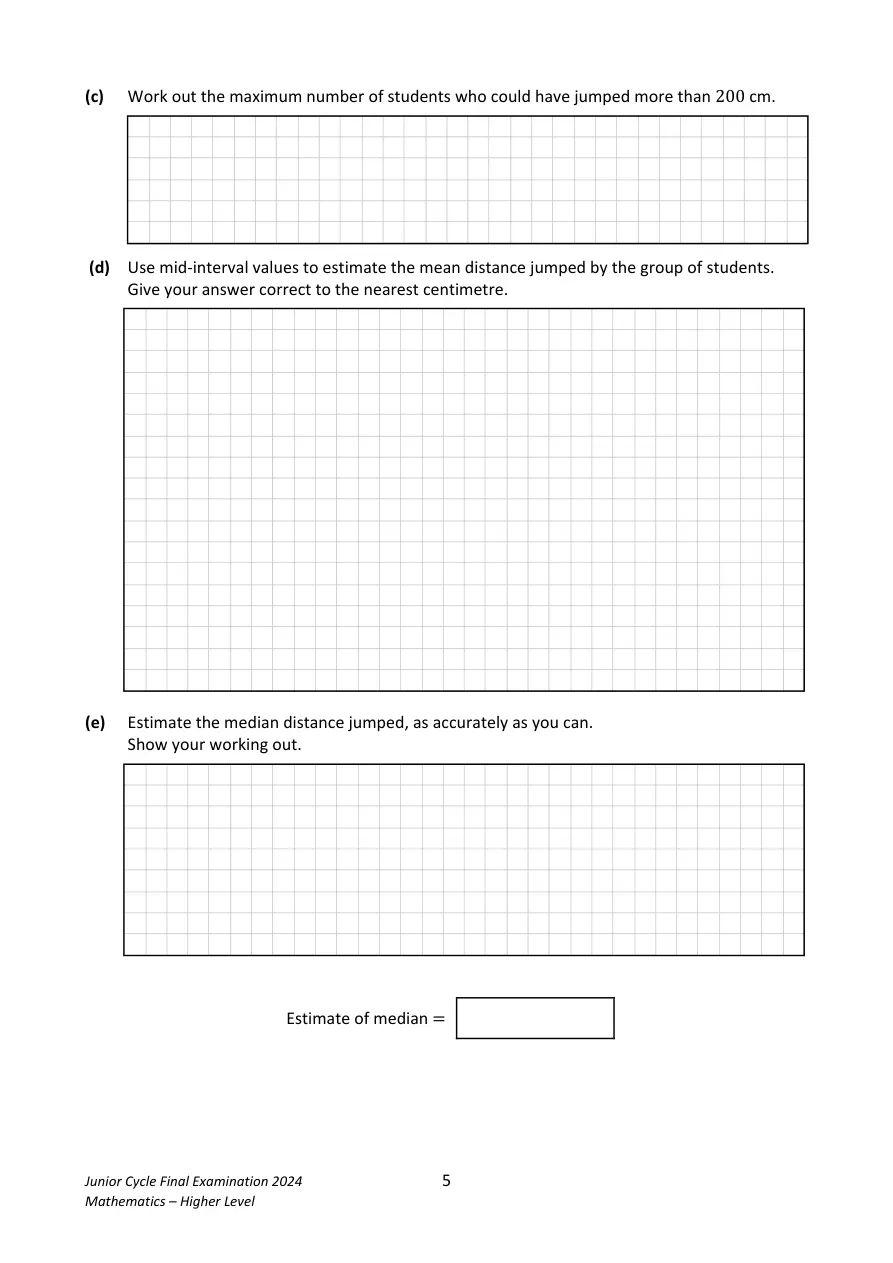
c) Maximum above 200 cm

  1. 7+12+3=22

    All seven in the 160–240 interval could be above 200 cm.

d) Estimated mean

  1. \bar{x}=\dfrac{0(40)+2(120)+7(200)+12(280)+3(360)}{24}
  2. \bar{x}=\dfrac{6080}{24}
  3. \bar{x}\approx253\ \mathrm{cm}

e) Estimated median

  1. N=24
  2. \mathrm{Median\ class}=240\text{–}320\ \mathrm{cm}

    There are 9 students before this class; the middle observations are the 12th and 13th.

  3. M\approx240+\dfrac{12-9}{12}(80)

    Linear interpolation assumes values spread uniformly in the class.

  4. M\approx260\ \mathrm{cm}
  5. The grouped data cannot give an exact median. The SEC model gives approximately 260 cm; an explicitly stated interpolation convention can give a nearby estimate.

Question 3

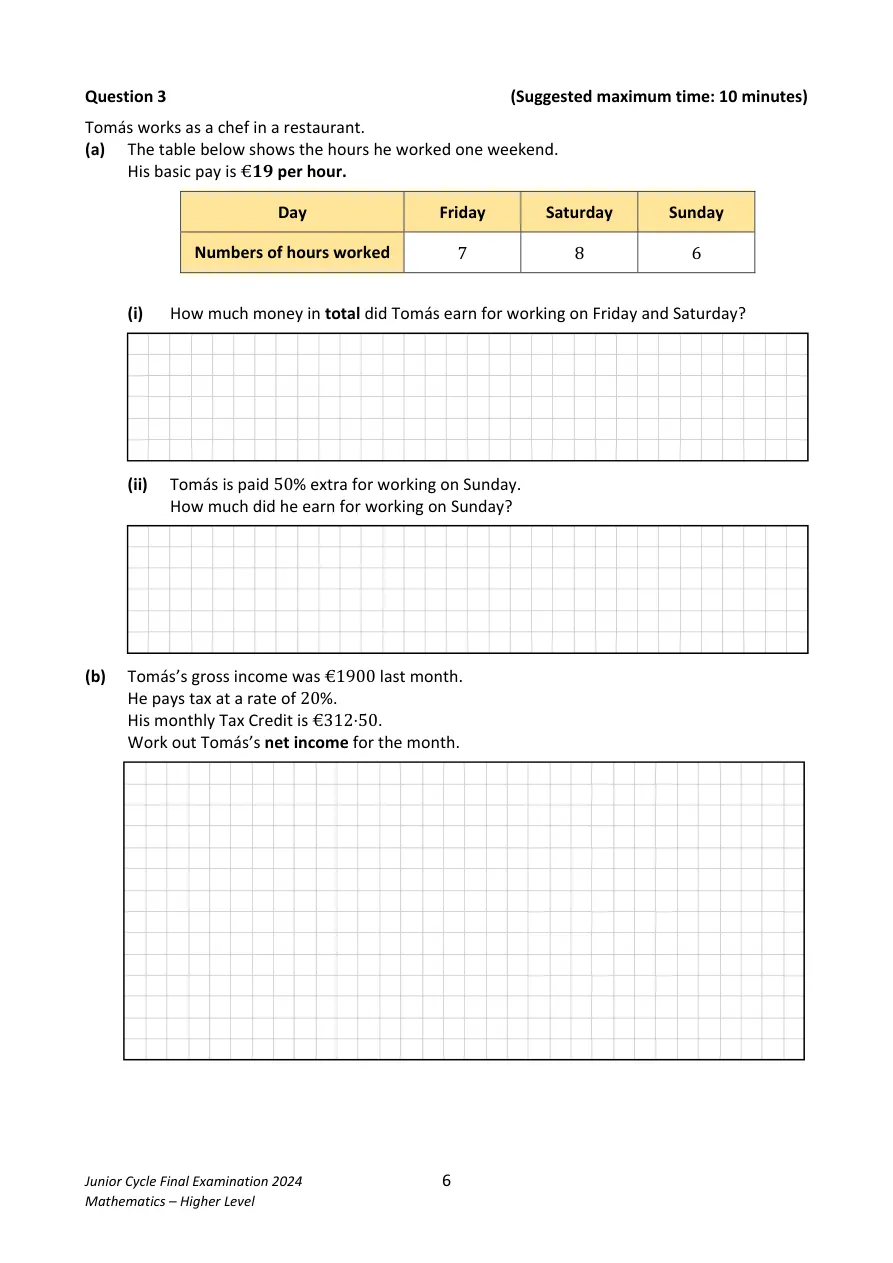
a)(i) Friday and Saturday

  1. h=7+8=15
  2. P=15(19)
  3. P=\mathrm{€}285

a)(ii) Sunday

  1. r=19(1.5)
  2. r=\mathrm{€}28.50\ \mathrm{per\ hour}
  3. P=6(28.50)
  4. P=\mathrm{€}171

b) Monthly net income

  1. T_{\mathrm{gross}}=1900(0.20)
  2. T_{\mathrm{gross}}=380
  3. T_{\mathrm{net}}=380-312.50
  4. T_{\mathrm{net}}=67.50
  5. \mathrm{Net}=1900-67.50
  6. \mathrm{Net}=\mathrm{€}1832.50

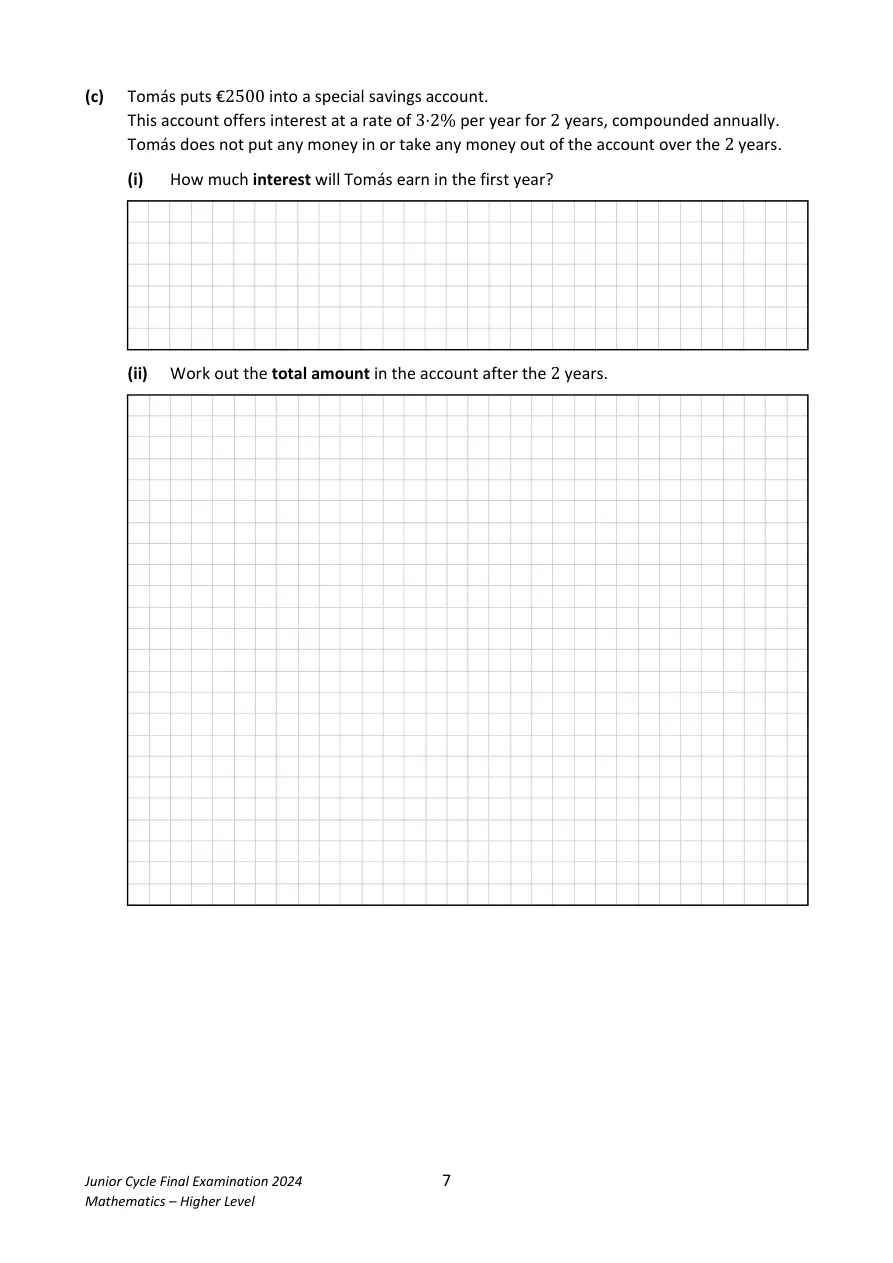
c)(i) First year's interest

  1. I=2500(0.032)
  2. I=\mathrm{€}80

c)(ii) Balance after two years

  1. A=P\left(1+\dfrac{r}{100}\right)^n
  2. A=2500(1.032)^2

    Compound interest earns interest on the first year's interest too.

  3. A=\mathrm{€}2662.56

Question 4

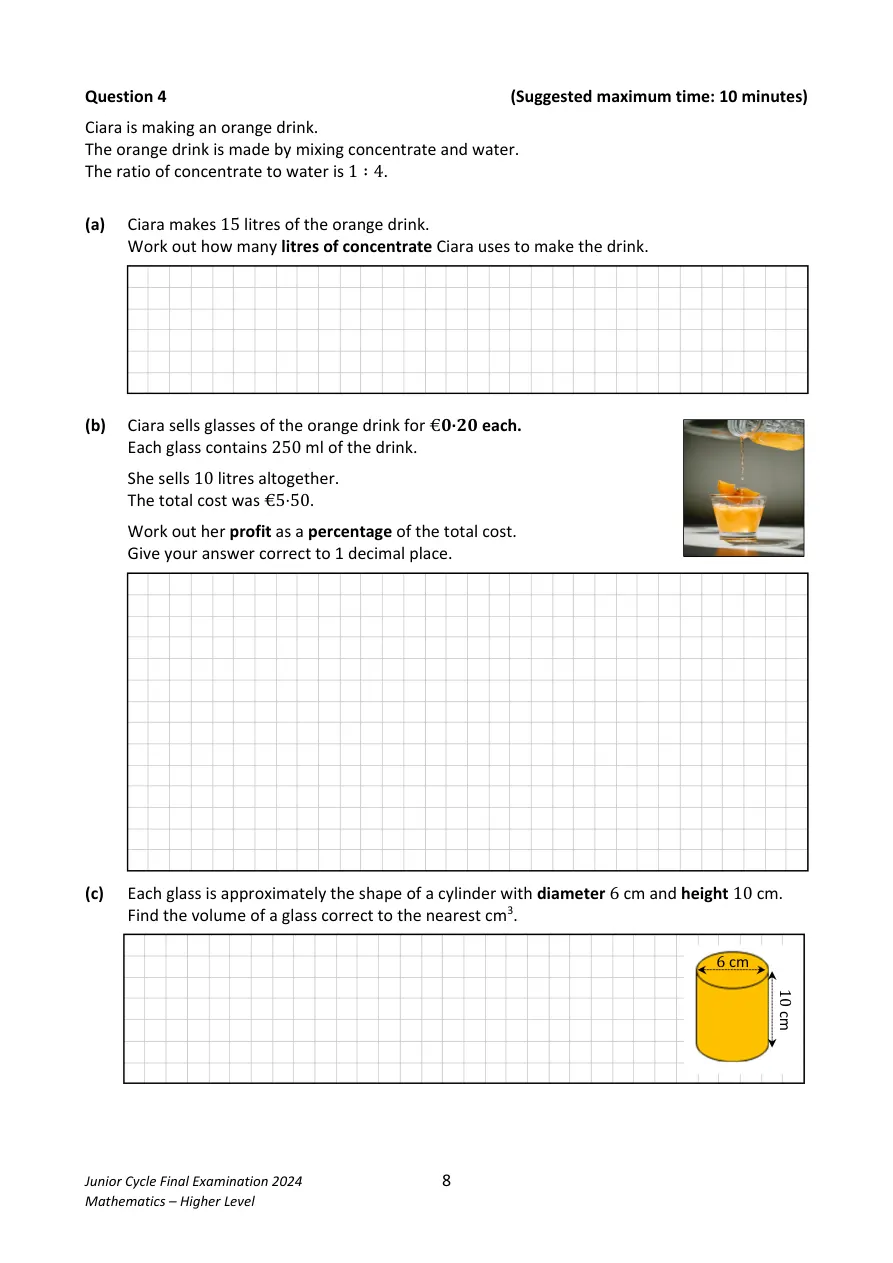
a) Concentrate

  1. \mathrm{Parts}=1+4=5
  2. C=\dfrac{1}{5}(15)
  3. C=3\ \mathrm{litres}

b) Profit percentage

  1. n=\dfrac{10000}{250}
  2. n=40\ \mathrm{glasses}
  3. R=40(0.20)
  4. R=\mathrm{€}8
  5. \mathrm{Profit}=8-5.50
  6. \mathrm{Profit}=\mathrm{€}2.50
  7. p=\dfrac{2.50}{5.50}\times100

    Profit is expressed as a percentage of cost, not revenue.

  8. p\approx45.5\%

c) Glass volume

  1. r=\dfrac{6}{2}=3\ \mathrm{cm}
  2. V=\pi r^2h
  3. V=\pi(3)^2(10)
  4. V\approx283\ \mathrm{cm}^3

Question 5

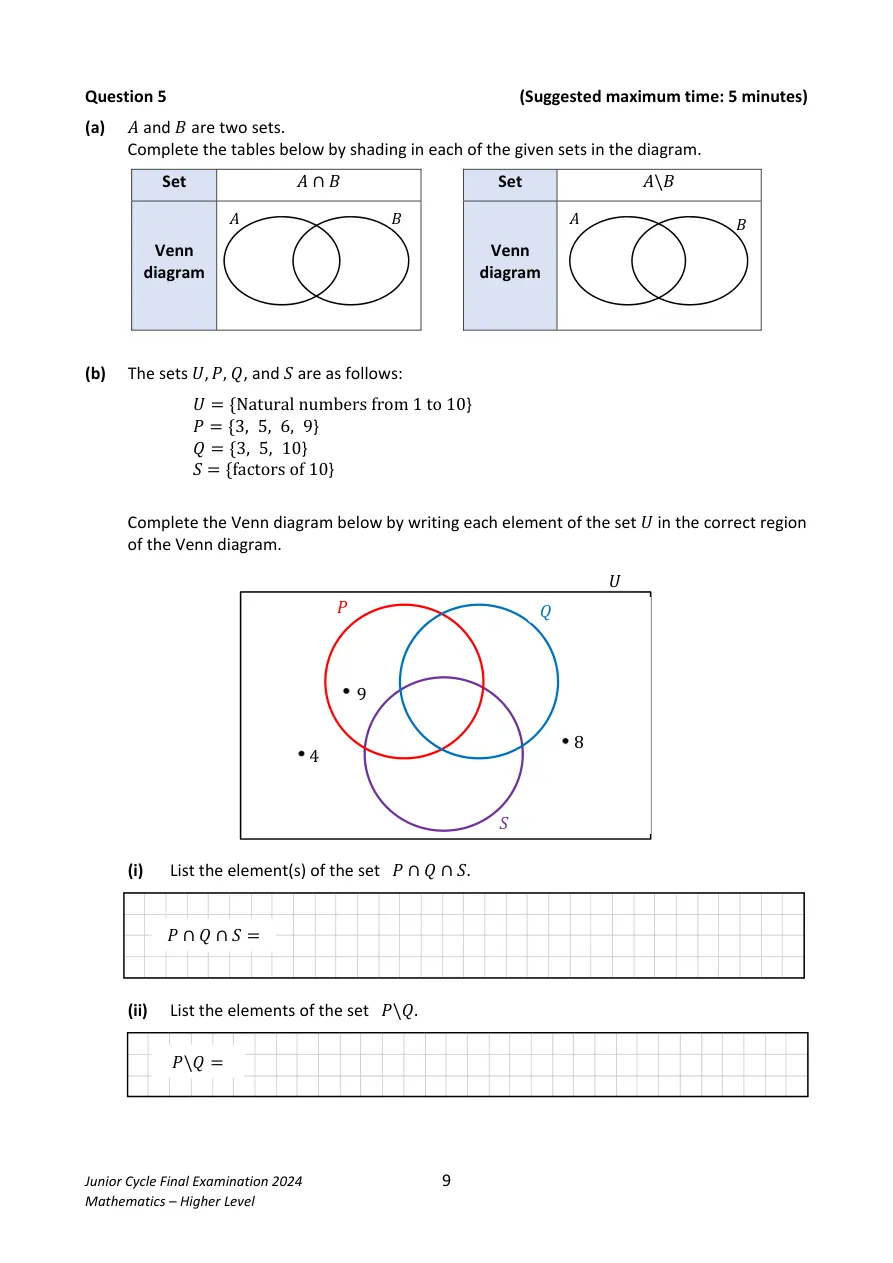
a) Shading

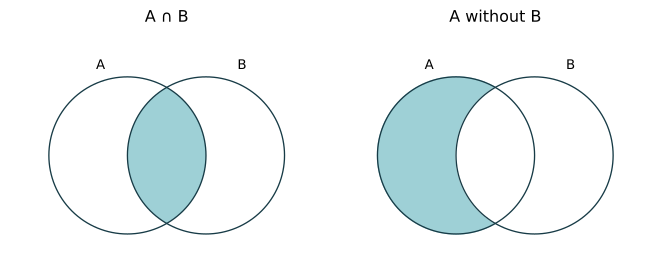
  1. A ∩ B: shade only the overlap. A without B: shade only the part inside A and outside B. See the two labelled diagrams.
  2. 2024-5-shading

b) Three-set diagram

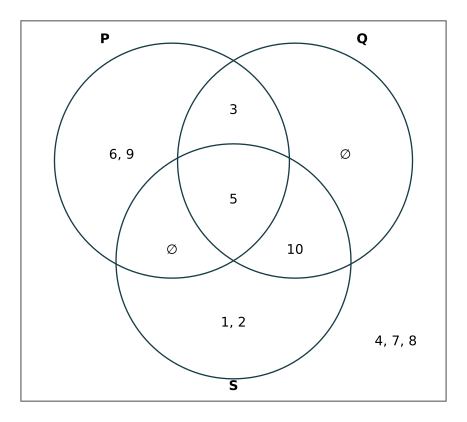
  1. S=\{1,2,5,10\}
  2. P only: {6,9}. Q only: empty. S only: {1,2}. P∩Q but not S: {3}. P∩S but not Q: empty. Q∩S but not P: {10}. All three: {5}. Outside: {4,7,8}.
  3. 2024-5-venn

b)(i) All three

  1. P\cap Q\cap S=\{5\}

b)(ii) P but not Q

  1. P\setminus Q=\{6,9\}

Question 6

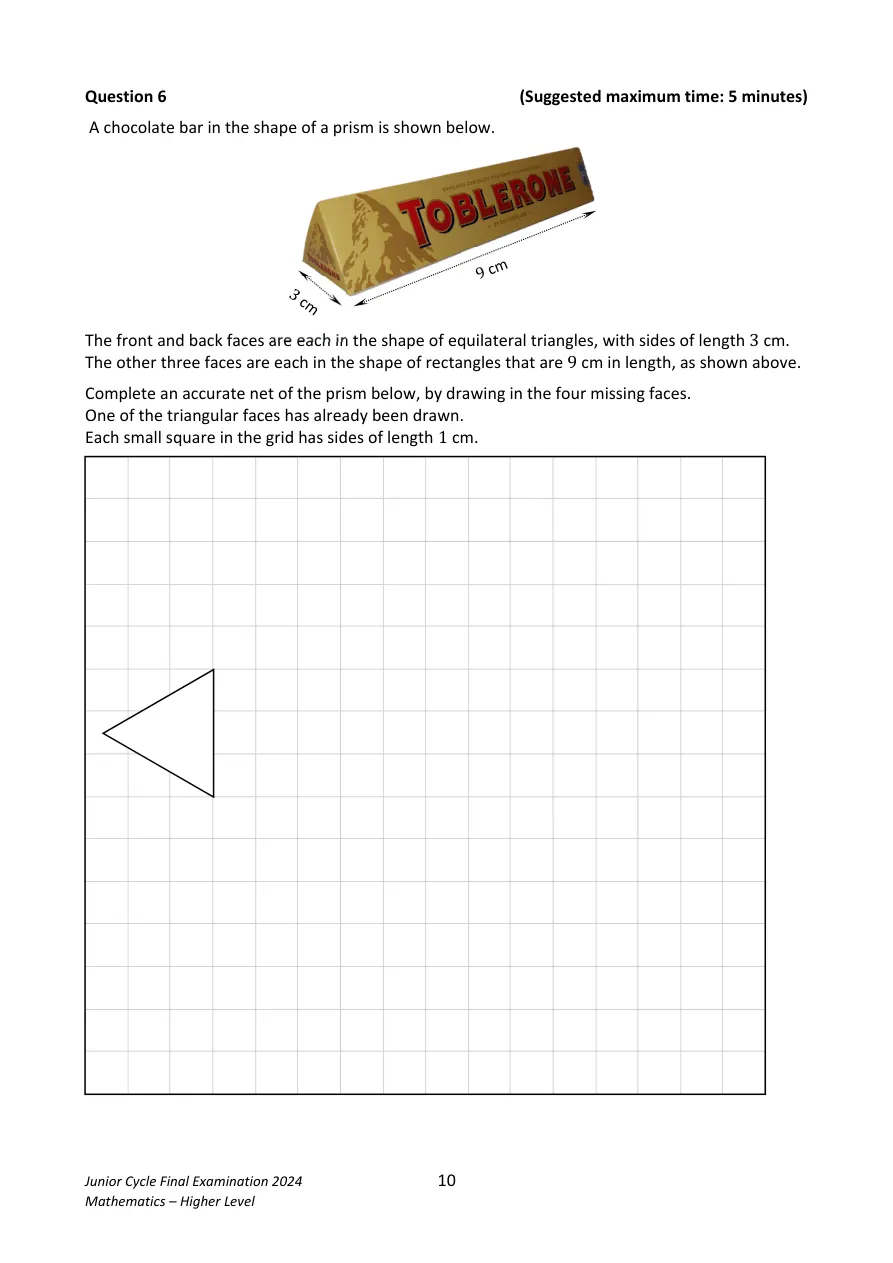
Solution

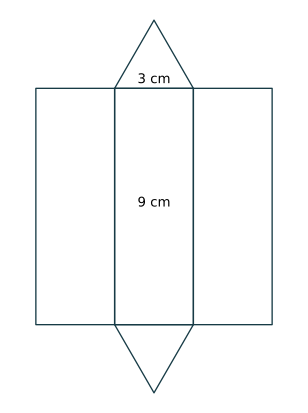
  1. Add three 9 cm × 3 cm rectangles and one more equilateral triangle of side 3 cm to the given triangle. The final net has three rectangles in a strip and a triangle attached at each end of the middle rectangle. See the dimensioned example. Rotate or translate it to match the triangle already printed on the exam grid. Keep all dimensions accurate.
  2. 2024-6-net

Question 7

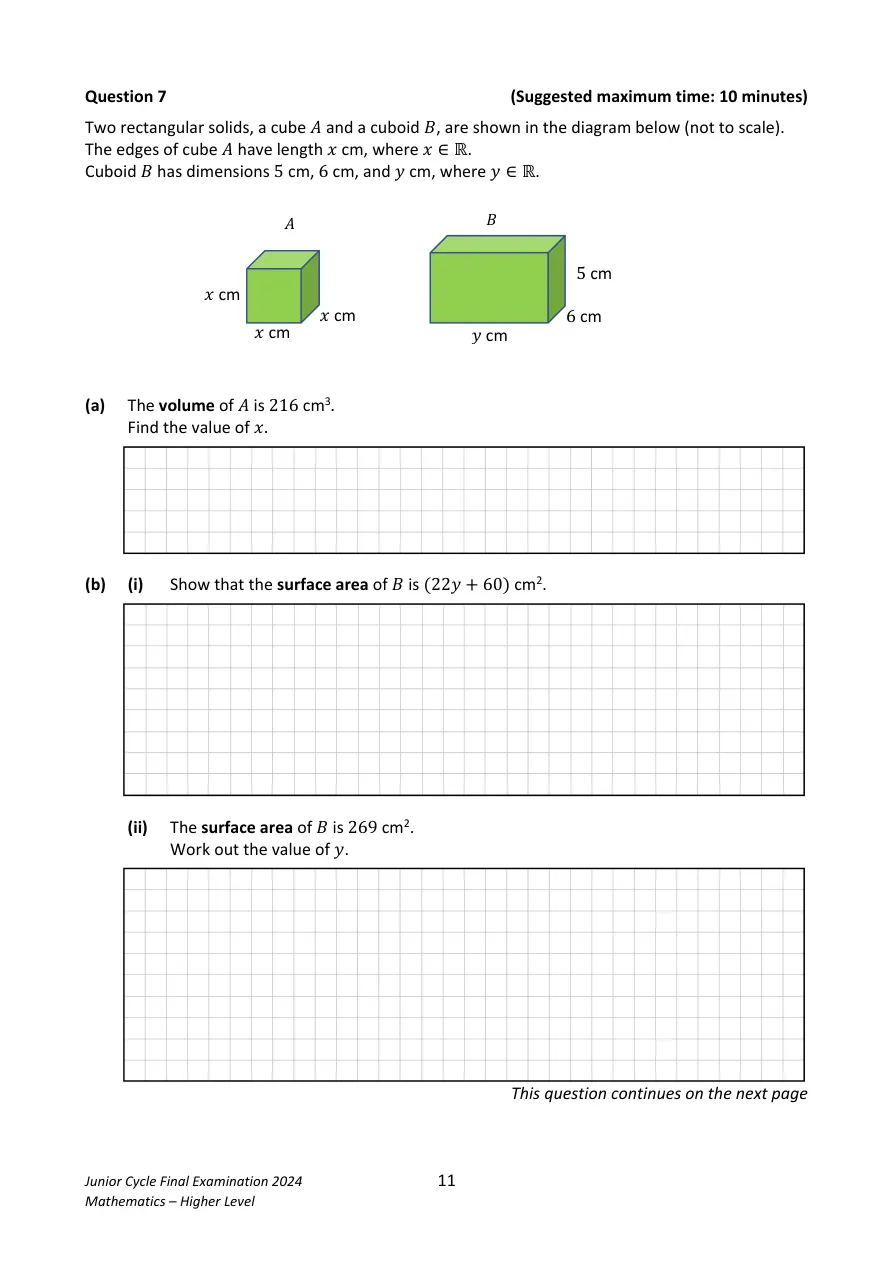
a) Cube edge

  1. x^3=216
  2. x=\sqrt[3]{216}
  3. x=6\ \mathrm{cm}

b)(i) Surface area

  1. A=2(5y+5\times6+6y)
  2. A=10y+60+12y
  3. A=22y+60\ \mathrm{cm}^2

b)(ii) Find y

  1. 22y+60=269
  2. 22y=209
  3. y=\dfrac{209}{22}
  4. y=9.5\ \mathrm{cm}

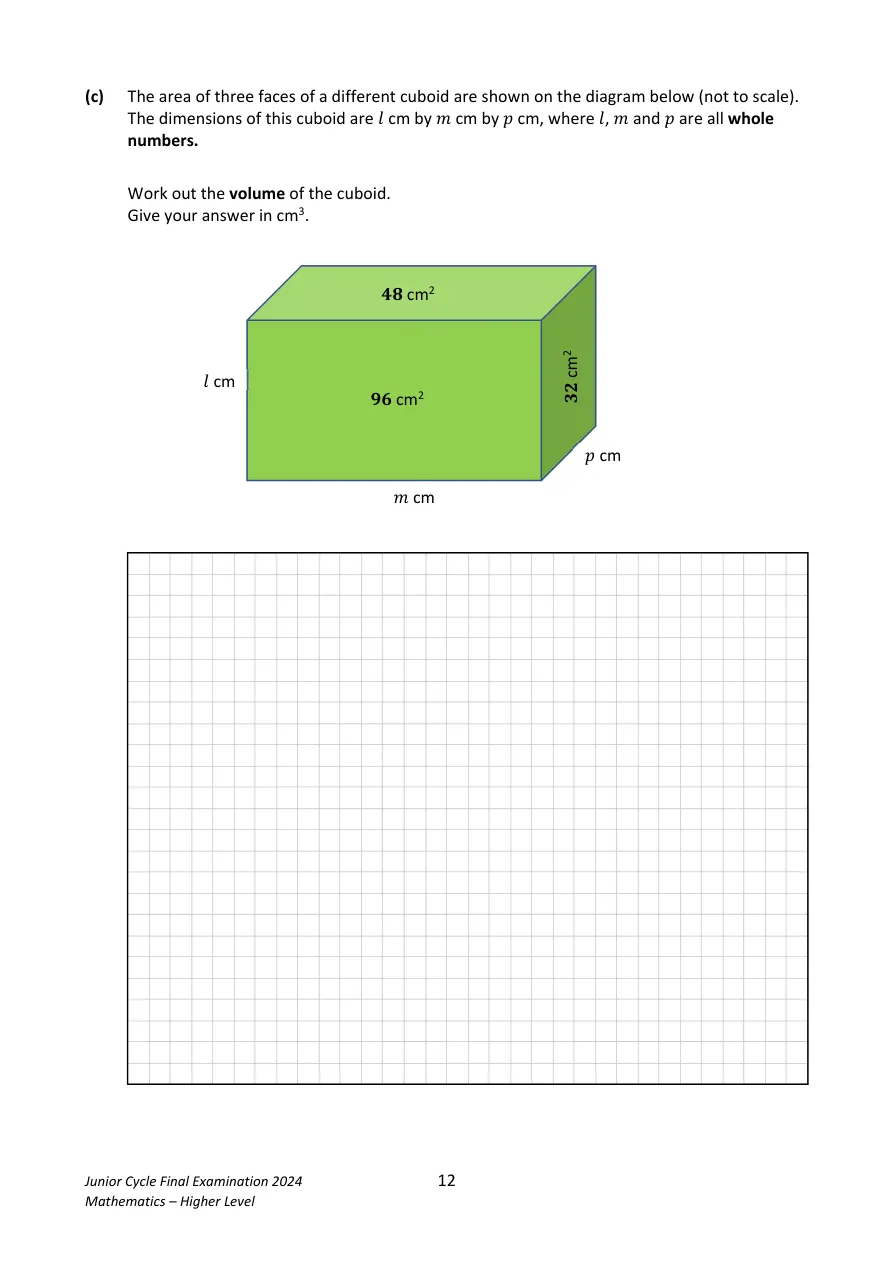
c) Volume from face areas

  1. lm=96,\quad mp=48,\quad lp=32
  2. (lm)(mp)(lp)=96(48)(32)
  3. (lmp)^2=147456
  4. V=lmp=\sqrt{147456}

    The product of the three face areas is the square of the volume.

  5. V=384\ \mathrm{cm}^3

Question 8

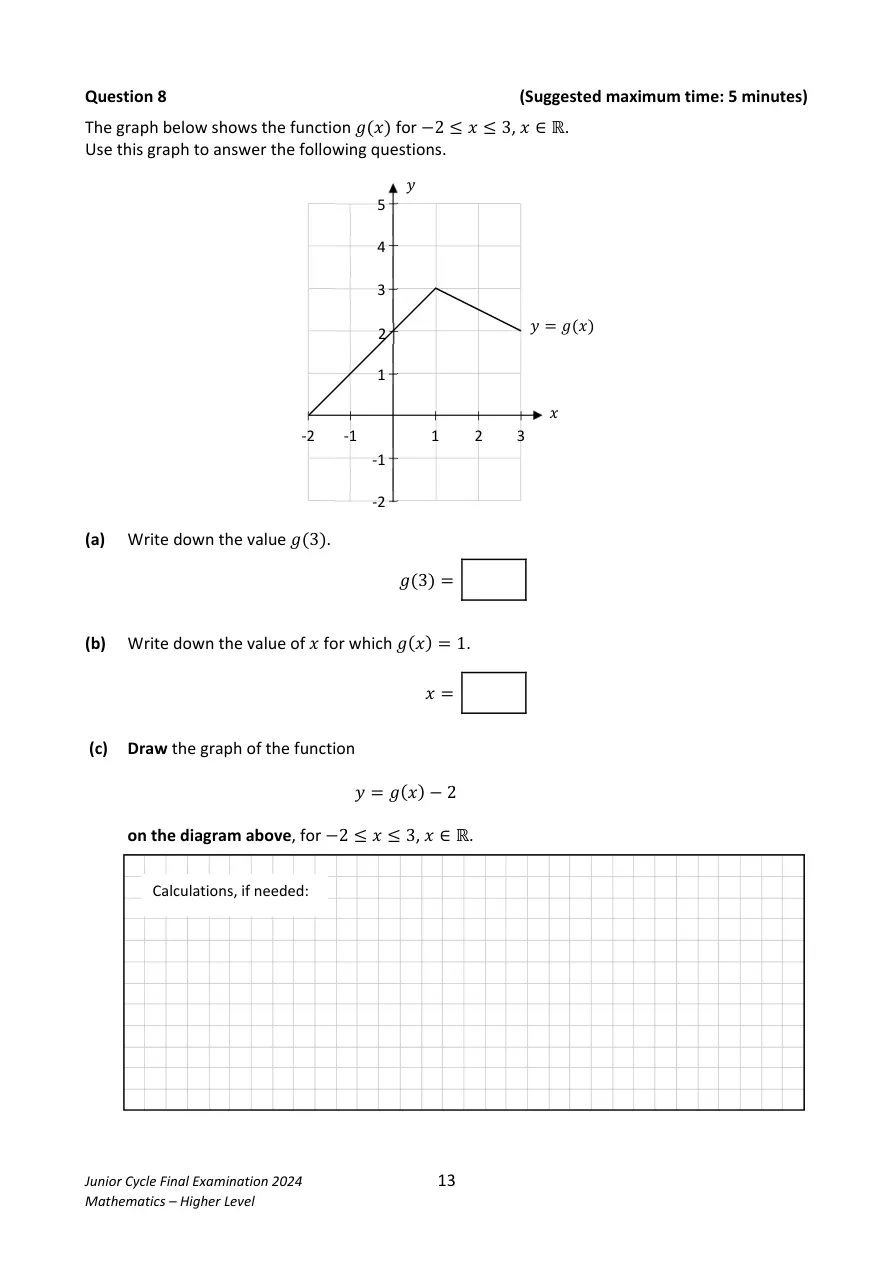
a) Read g(3)

  1. g(3)=2

b) Read x

  1. x=-1

    Read the x-coordinate where the graph has height 1.

c) Translate down

  1. y=g(x)-2
  2. (x,y)\longmapsto(x,y-2)

    Keep every x-coordinate unchanged and move each point down 2 units.

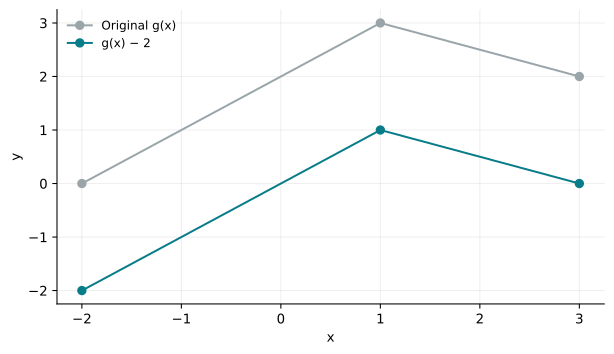
  3. The entire curve retains its shape on −2 ≤ x ≤ 3. See the shifted curve in the solution graph.
  4. 2024-8-shift

Question 9

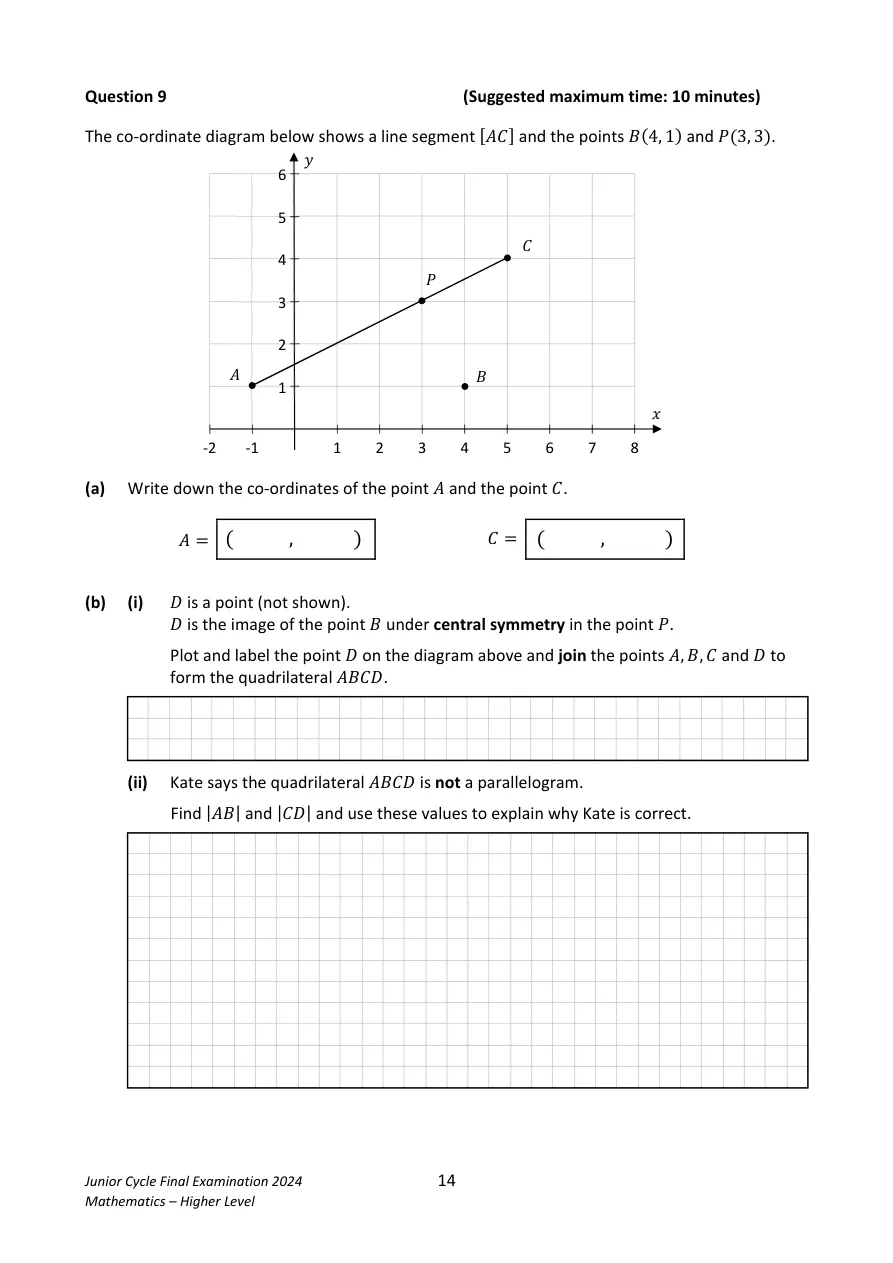
a) Coordinates

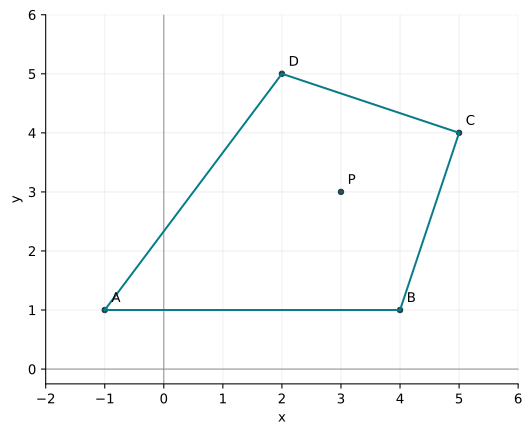
  1. A=(-1,1),\quad C=(5,4)

b)(i) Image of B

  1. D=2P-B

    P is the midpoint of BD.

  2. D=(2(3)-4,\ 2(3)-1)
  3. D=(2,5)
  4. Plot D and join A–B–C–D–A, in that order.
  5. 2024-9-coords

b)(ii) Opposite sides

  1. AB=4-(-1)=5
  2. CD=\sqrt{(5-2)^2+(4-5)^2}

    Subtract the x-coordinates and the y-coordinates separately. Square each difference, add the squares, then take the square root.

  3. CD=\sqrt{10}
  4. 5\ne\sqrt{10}
  5. Kate is correct: opposite sides of a parallelogram must be equal, but AB and CD are not.

Question 10

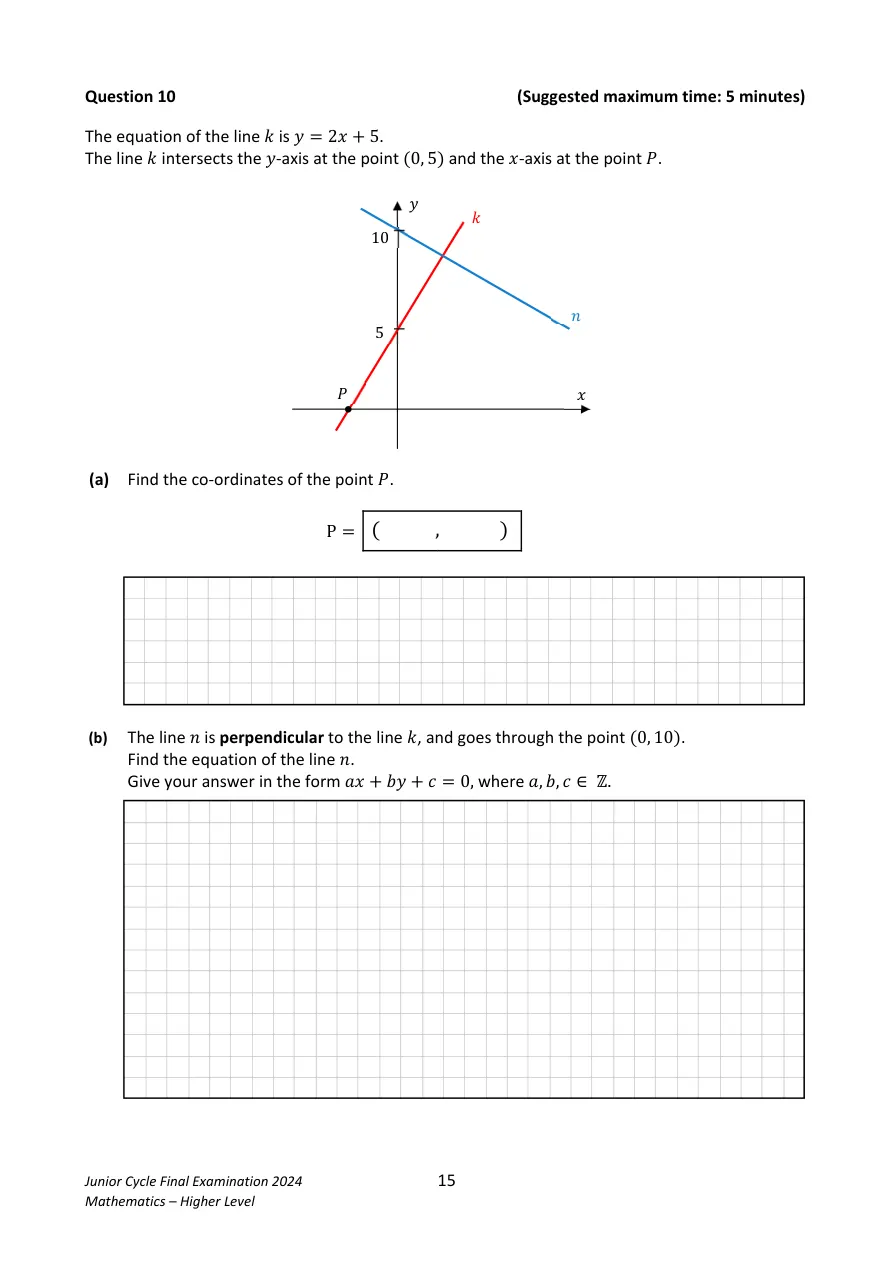
a) x-intercept

  1. y=0

    On the x-axis, y is zero.

  2. 2x+5=0
  3. 2x=-5
  4. x=-\dfrac{5}{2}
  5. P=\left(-\dfrac{5}{2},0\right)

b) Equation of n

  1. m_k=2
  2. m_n=-\dfrac{1}{2}

    Take the negative reciprocal for a perpendicular line.

  3. y-10=-\dfrac{1}{2}(x-0)
  4. 2y-20=-x

    Multiply every term by 2 to clear the fraction.

  5. x+2y-20=0

Question 11

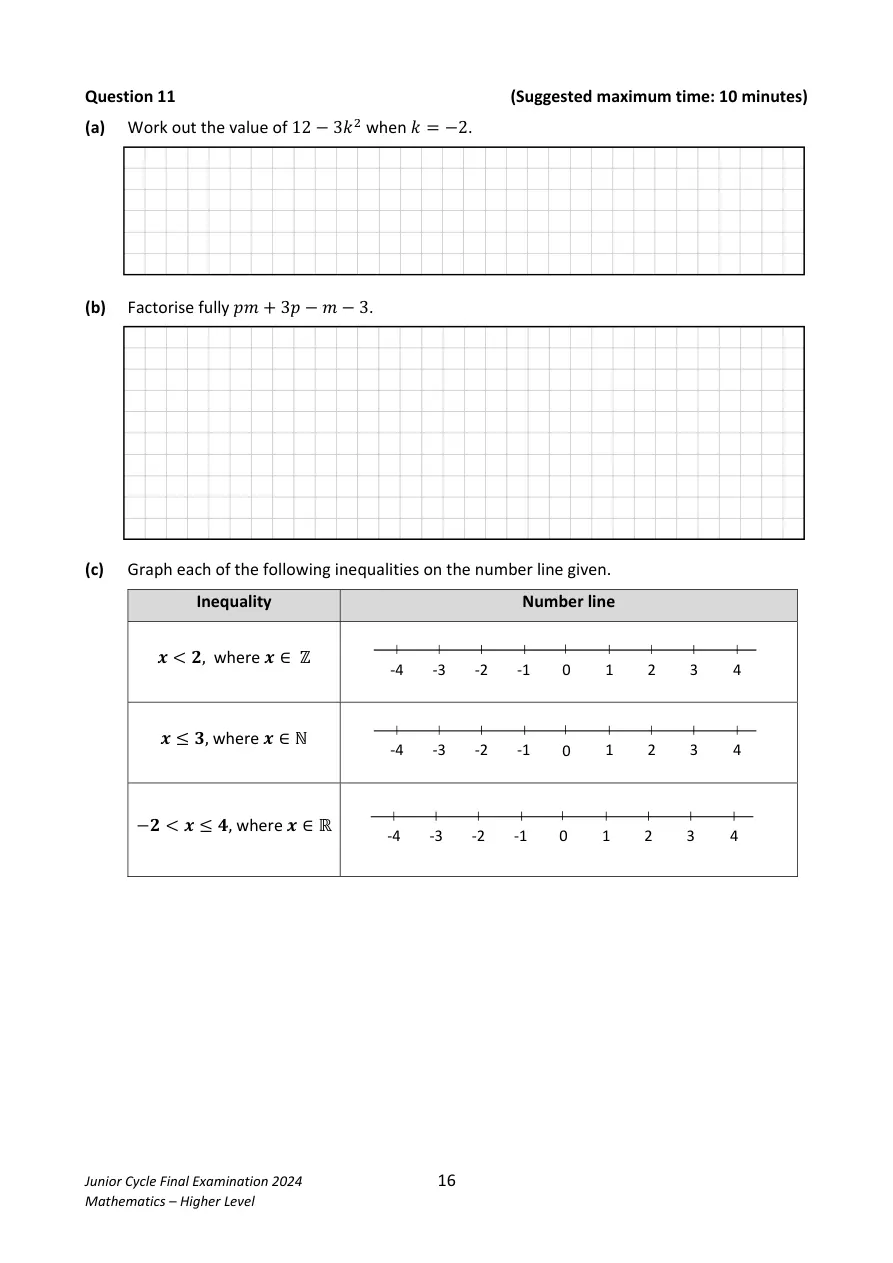
a) Substitute k = −2

  1. 12-3(-2)^2
  2. 12-3(4)

    Square the entire negative number first.

  3. 0

b) Factorise

  1. pm+3p-m-3
  2. p(m+3)-1(m+3)

    Factor p out of the first pair and −1 out of the second pair. Both pairs leave (m + 3).

  3. (p-1)(m+3)

    Take out the common bracket (m + 3).

c) Number lines

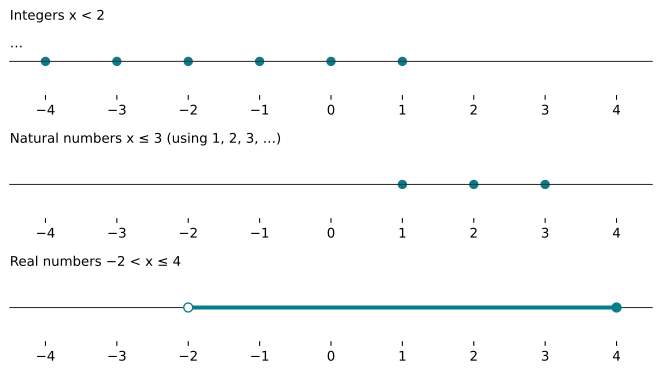
  1. First: solid dots at every integer less than 2, extending to the left. Second: solid dots at natural numbers 1, 2 and 3. Under the convention that 0 is natural, include 0; the SEC scheme accepts either convention. Third: a continuous segment from an open circle at −2 to a closed circle at 4.
  2. 2024-11-numberlines

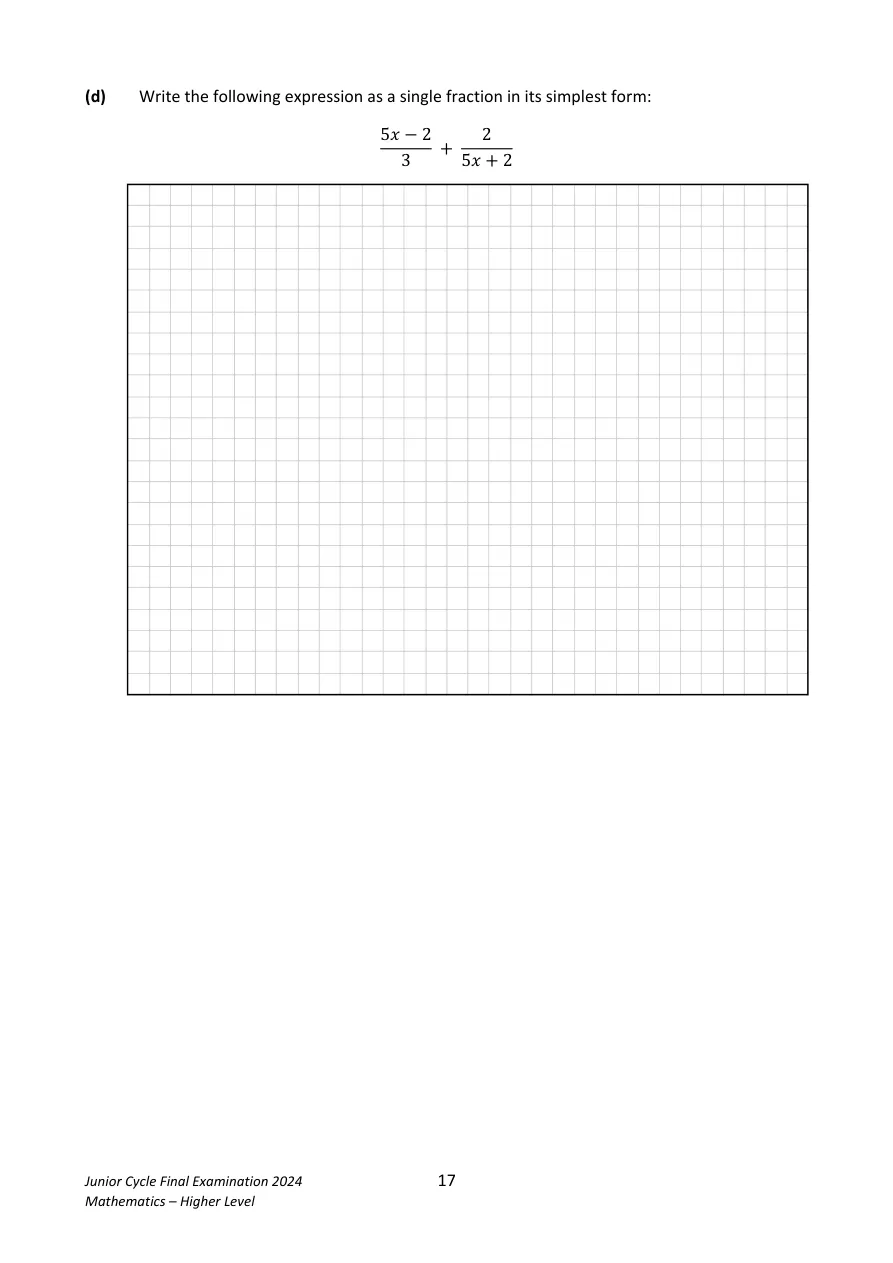
d) Add fractions

  1. \dfrac{5x-2}{3}+\dfrac{2}{5x+2}
  2. \dfrac{(5x-2)(5x+2)+6}{3(5x+2)}
  3. \dfrac{25x^2-4+6}{3(5x+2)}

    Use the difference of squares for the product.

  4. \dfrac{25x^2+2}{3(5x+2)}
  5. x\ne-\dfrac{2}{5}

Question 12

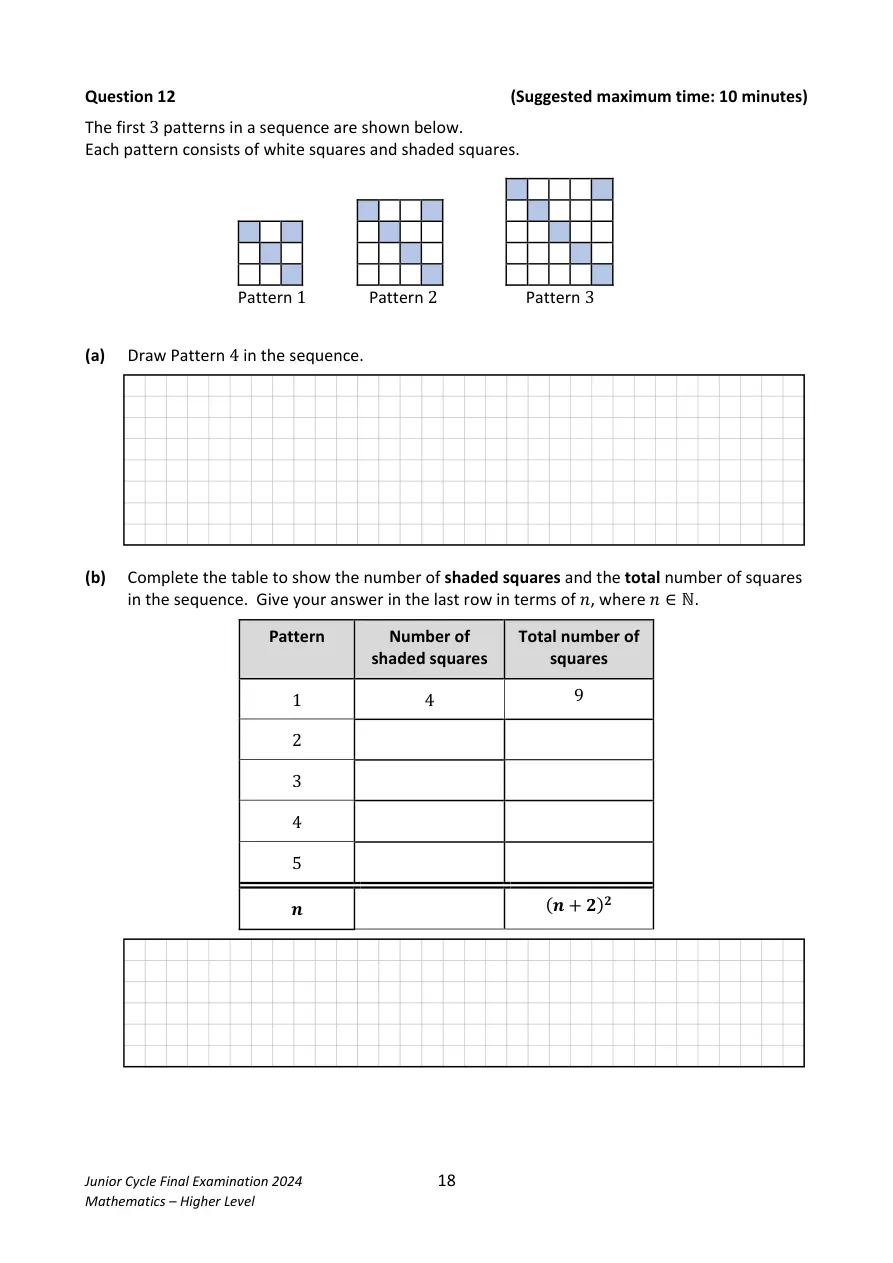
a) Pattern 4

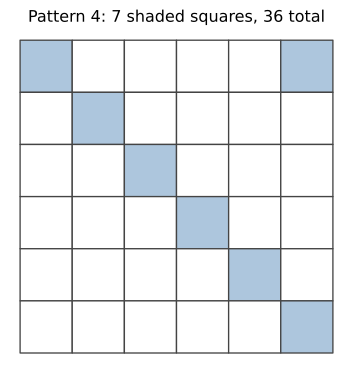
  1. Draw the 6 × 6 grid, continuing the main diagonal and extra upper-right square shading from the preceding patterns: 7 shaded squares in total. See the completed pattern.
  2. 2024-12-pattern

b) Table

  1. S_n=n+3
  2. T_n=(n+2)^2
  3. Rows (pattern, shaded, total): (1,4,9), (2,5,16), (3,6,25), (4,7,36), (5,8,49).

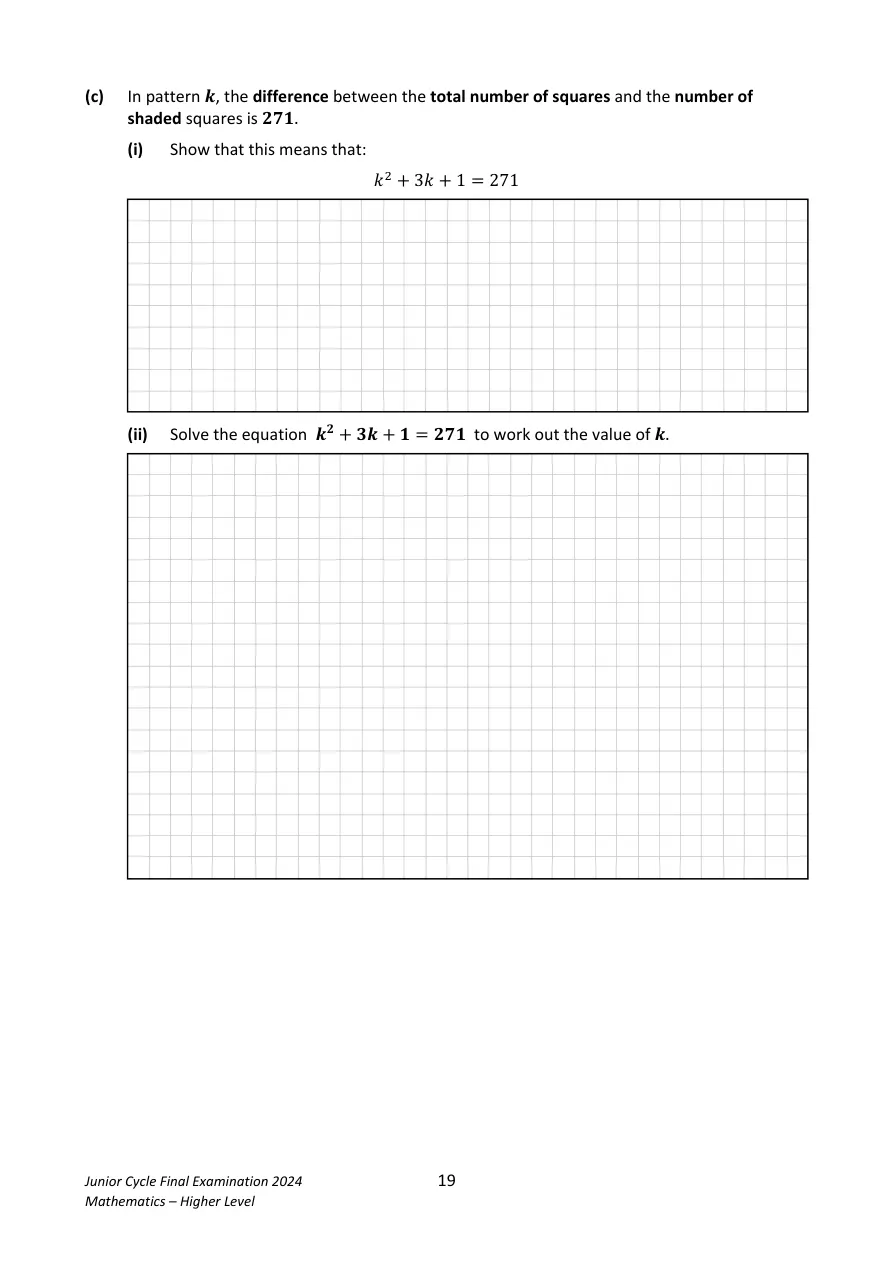
c)(i) Form the equation

  1. (k+2)^2-(k+3)=271

    The exponent applies to the whole bracket.

  2. (k+2)(k+2)-(k+3)=271

    Write the square as the bracket multiplied by itself.

  3. k^2+2k+2k+4-k-3=271

    Multiply each term in the first bracket by both terms in the second, then subtract both terms of (k + 3).

  4. k^2+4k+4-k-3=271
  5. k^2+3k+1=271

c)(ii) Solve

  1. k^2+3k-270=0
  2. (k-15)(k+18)=0

    The product is zero, so at least one of the factors must be zero. Set each factor equal to zero in turn.

  3. k=15\quad\mathrm{or}\quad k=-18
  4. k=15

    Reject −18 because a pattern number must be positive.

Question 13

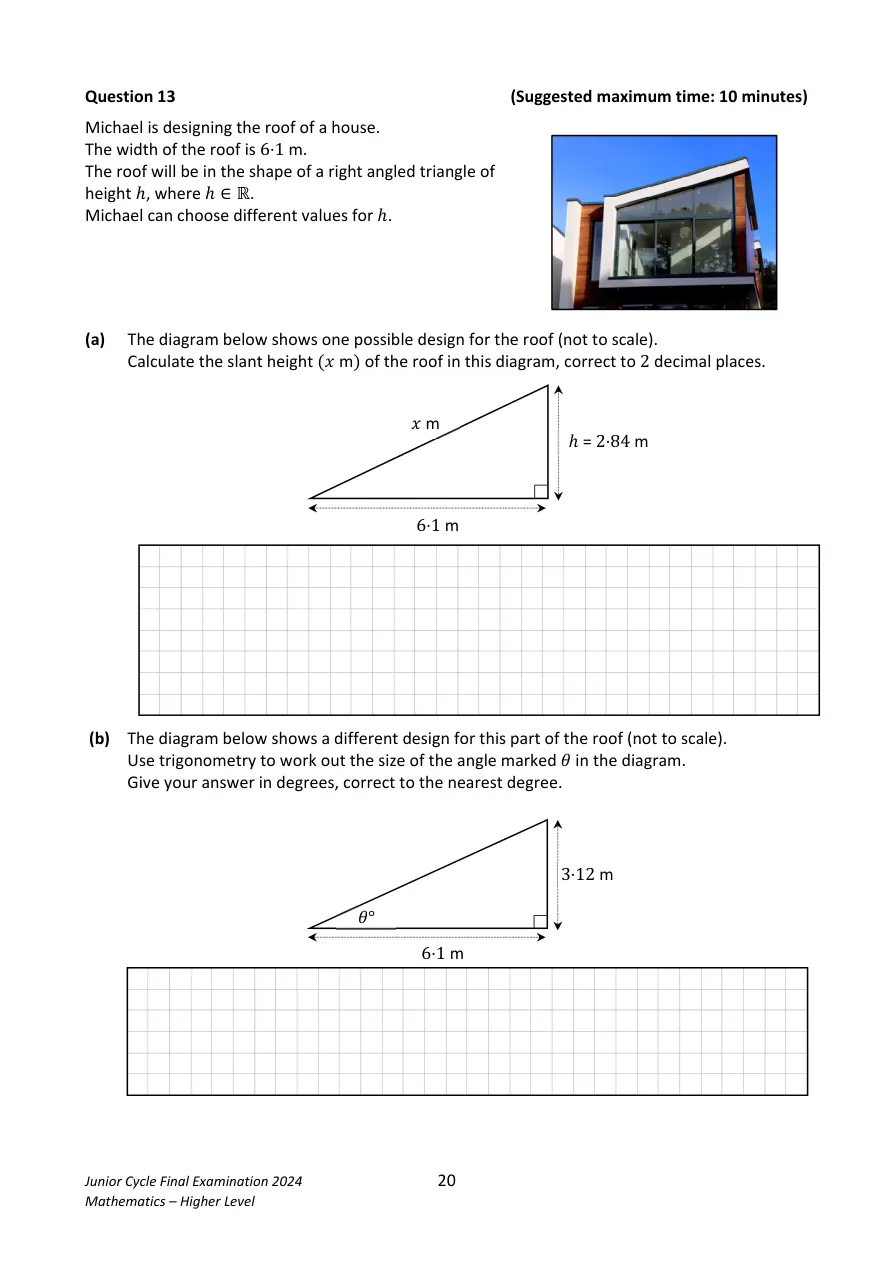
a) Slant height

  1. x^2=6.1^2+2.84^2
  2. x^2=45.2756
  3. x=\sqrt{45.2756}
  4. x\approx6.73\ \mathrm{m}

b) Roof angle

  1. \tan\theta=\dfrac{3.12}{6.1}
  2. \theta=\tan^{-1}\left(\dfrac{3.12}{6.1}\right)
  3. \theta\approx27^{\circ}

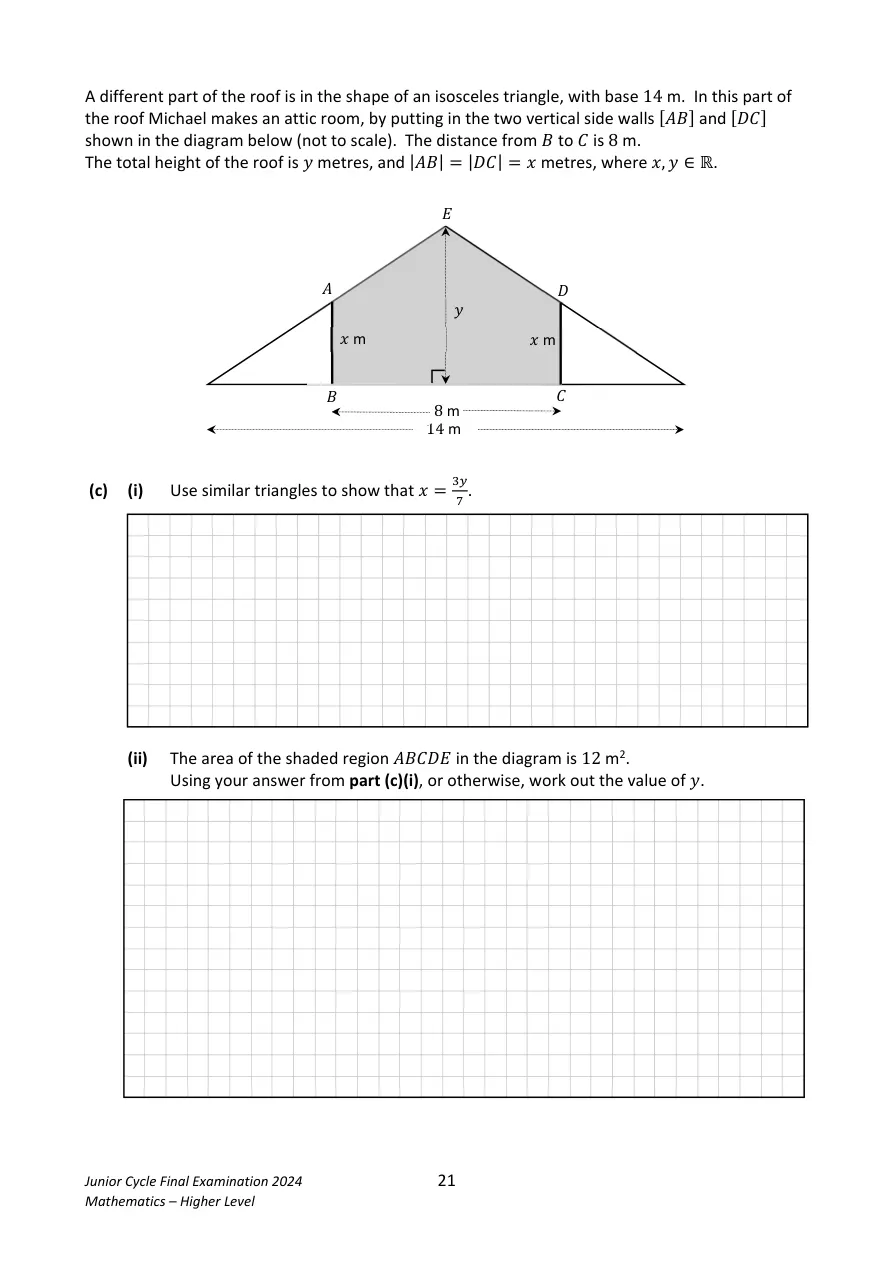
c)(i) Similar triangles

  1. \mathrm{Outer\ base}=\dfrac{14-8}{2}=3\ \mathrm{m}
  2. \dfrac{x}{3}=\dfrac{y}{7}

    Compare the small outer triangle with half the full roof.

  3. x=\dfrac{3y}{7}

c)(ii) Attic area

  1. \dfrac{1}{2}(14)y-2\left(\dfrac{1}{2}(3)x\right)=12

    Full triangle minus the two outer triangles.

  2. 7y-3x=12
  3. 7y-3\left(\dfrac{3y}{7}\right)=12
  4. 49y-9y=84

    Multiply every term by 7.

  5. 40y=84
  6. y=\dfrac{84}{40}
  7. y=2.1\ \mathrm{m}
See working and diagrams on the original paper
Original exam paper page 3
(1,7)(1,8)(1,9)(1,10)(2,7)(2,9)(2,10)(3,7)(3,8)(3,9)(3,10)(4,7)(4,8)(4,9)(4,10)
P(7)=\dfrac{4}{16}
[Four of sixteen equally likely pairs.]
P(7)=\dfrac{1}{4}
(2,7),\quad(3,7)
[1 is not prime; 9 and 10 are not prime.]
Original exam paper page 4
0+2+7=9\ \mathrm{students}
Original exam paper page 5
7+12+3=22
[All seven in the 160–240 interval could be above 200 cm.]
\bar{x}=\dfrac{0(40)+2(120)+7(200)+12(280)+3(360)}{24}
[Use each class midpoint.]
\bar{x}=\dfrac{6080}{24}
\bar{x}\approx253\ \mathrm{cm}
N=24
\mathrm{Median\ class}=240\text{–}320\ \mathrm{cm}
M\approx240+\dfrac{12-9}{12}(80)
[Interpolate within the median class.]
M\approx260\ \mathrm{cm}
The grouped data cannot give an exact median. The SEC model gives approximately 260 cm; an explicitly stated interpolation convention can give a nearby estimate.
260
Original exam paper page 6
h=7+8=15
P=15(19)
P=\mathrm{€}285
r=19(1.5)
r=\mathrm{€}28.50\ \mathrm{per\ hour}
P=6(28.50)
P=\mathrm{€}171
T_{\mathrm{gross}}=1900(0.20)
T_{\mathrm{gross}}=380
T_{\mathrm{net}}=380-312.50
[Subtract the tax credit from tax, not income.]
T_{\mathrm{net}}=67.50
\mathrm{Net}=1900-67.50
\mathrm{Net}=\mathrm{€}1832.50
Original exam paper page 7
I=2500(0.032)
I=\mathrm{€}80
A=P\left(1+\dfrac{r}{100}\right)^n
A=2500(1.032)^2
[Compound growth: apply 1.032 twice.]
A=\mathrm{€}2662.56
Original exam paper page 8
\mathrm{Parts}=1+4=5
C=\dfrac{1}{5}(15)
C=3\ \mathrm{litres}
n=\dfrac{10000}{250}
n=40\ \mathrm{glasses}
R=40(0.20)
R=\mathrm{€}8
\mathrm{Profit}=8-5.50
\mathrm{Profit}=\mathrm{€}2.50
p=\dfrac{2.50}{5.50}\times100
[Profit percentage uses cost as the base.]
p\approx45.5\%
r=\dfrac{6}{2}=3\ \mathrm{cm}
V=\pi r^2h
V=\pi(3)^2(10)
V\approx283\ \mathrm{cm}^3
Original exam paper page 9
635101, 27
\{5\}
\{6,9\}
Original exam paper page 10
Original exam paper page 11
x^3=216
x=\sqrt[3]{216}
x=6\ \mathrm{cm}
A=2(5y+5\times6+6y)
[Three different faces; each occurs twice.]
A=10y+60+12y
A=22y+60\ \mathrm{cm}^2
22y+60=269
22y=209
y=\dfrac{209}{22}
y=9.5\ \mathrm{cm}
Original exam paper page 12
lm=96,\quad mp=48,\quad lp=32
(lm)(mp)(lp)=96(48)(32)
[Multiplying the face areas gives volume squared.]
(lmp)^2=147456
V=lmp=\sqrt{147456}
V=384\ \mathrm{cm}^3
Original exam paper page 13
2
-1
y=g(x)-2
(x,y)\longmapsto(x,y-2)
[Keep every x-coordinate unchanged and move each point down 2 units.]
The entire curve retains its shape on −2 ≤ x ≤ 3. See the shifted curve in the solution graph.
Original exam paper page 14
-1,1
5,4
D=2P-B
[P is the midpoint of BD.]
D=(2(3)-4,\ 2(3)-1)
D=(2,5)
D
AB=4-(-1)=5
CD=\sqrt{(5-2)^2+(4-5)^2}
CD=\sqrt{10}
5\ne\sqrt{10}
[Opposite sides would be equal in a parallelogram.]
Kate is correct: opposite sides of a parallelogram must be equal, but AB and CD are not.
Original exam paper page 15
y=0
[On the x-axis, y is zero.]
2x+5=0
2x=-5
x=-\dfrac{5}{2}
m_k=2
m_n=-\dfrac{1}{2}
[Perpendicular slopes multiply to −1.]
y-10=-\dfrac{1}{2}(x-0)
2y-20=-x
x+2y-20=0
-\frac52,\ 0
Original exam paper page 16
12-3(-2)^2
12-3(4)
[Square the entire negative number first.]
0
pm+3p-m-3
p(m+3)-1(m+3)
[Factor each pair, then the common bracket.]
(p-1)(m+3)
Original exam paper page 17
\dfrac{5x-2}{3}+\dfrac{2}{5x+2}
\dfrac{(5x-2)(5x+2)+6}{3(5x+2)}
[Use the common denominator 3(5x+2).]
\dfrac{25x^2-4+6}{3(5x+2)}
\dfrac{25x^2+2}{3(5x+2)}
x\ne-\dfrac{2}{5}
Original exam paper page 18
516625736849n + 3
Original exam paper page 19
(k+2)^2-(k+3)=271
[Unshaded = total − shaded.]
k^2+4k+4-k-3=271
k^2+3k+1=271
k^2+3k-270=0
(k-15)(k+18)=0
k=15\quad\mathrm{or}\quad k=-18
k=15
[Reject −18: a pattern number must be positive.]
Original exam paper page 20
x^2=6.1^2+2.84^2
[Pythagoras: perpendicular sides are 6.1 and 2.84.]
x^2=45.2756
x=\sqrt{45.2756}
x\approx6.73\ \mathrm{m}
\tan\theta=\dfrac{3.12}{6.1}
\theta=\tan^{-1}\left(\dfrac{3.12}{6.1}\right)
\theta\approx27^{\circ}
Original exam paper page 21
\mathrm{Outer\ base}=\dfrac{14-8}{2}=3\ \mathrm{m}
\dfrac{x}{3}=\dfrac{y}{7}
[Corresponding side ratios are equal.]
x=\dfrac{3y}{7}
\dfrac{1}{2}(14)y-2\left(\dfrac{1}{2}(3)x\right)=12
7y-3x=12
[Large triangle minus the two outer triangles.]
7y-3\left(\dfrac{3y}{7}\right)=12
49y-9y=84
40y=84
y=\dfrac{84}{40}
y=2.1\ \mathrm{m}