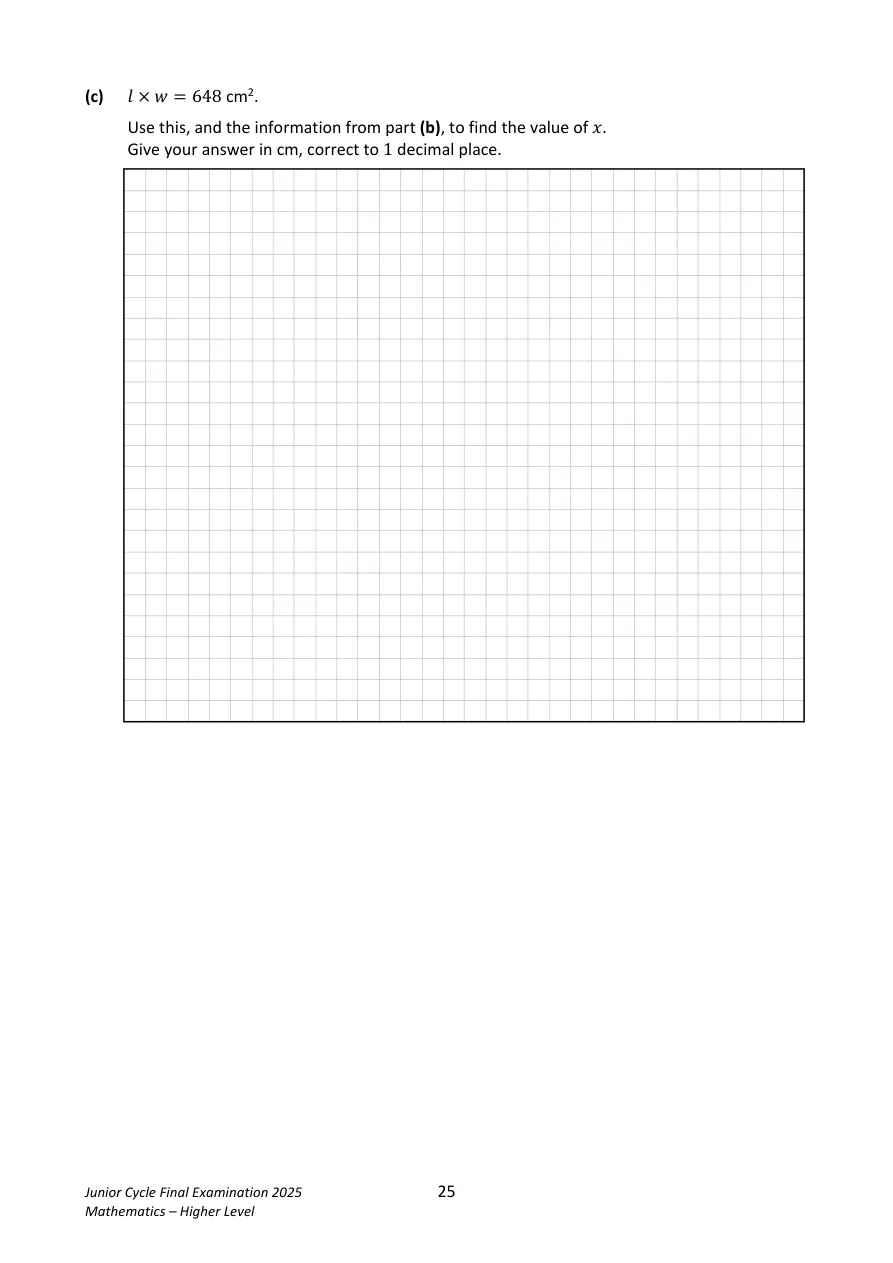
← Original paper

Junior Cycle Higher Maths 2025

Teacher worked solutions. Explanations are in blue.

Question 1

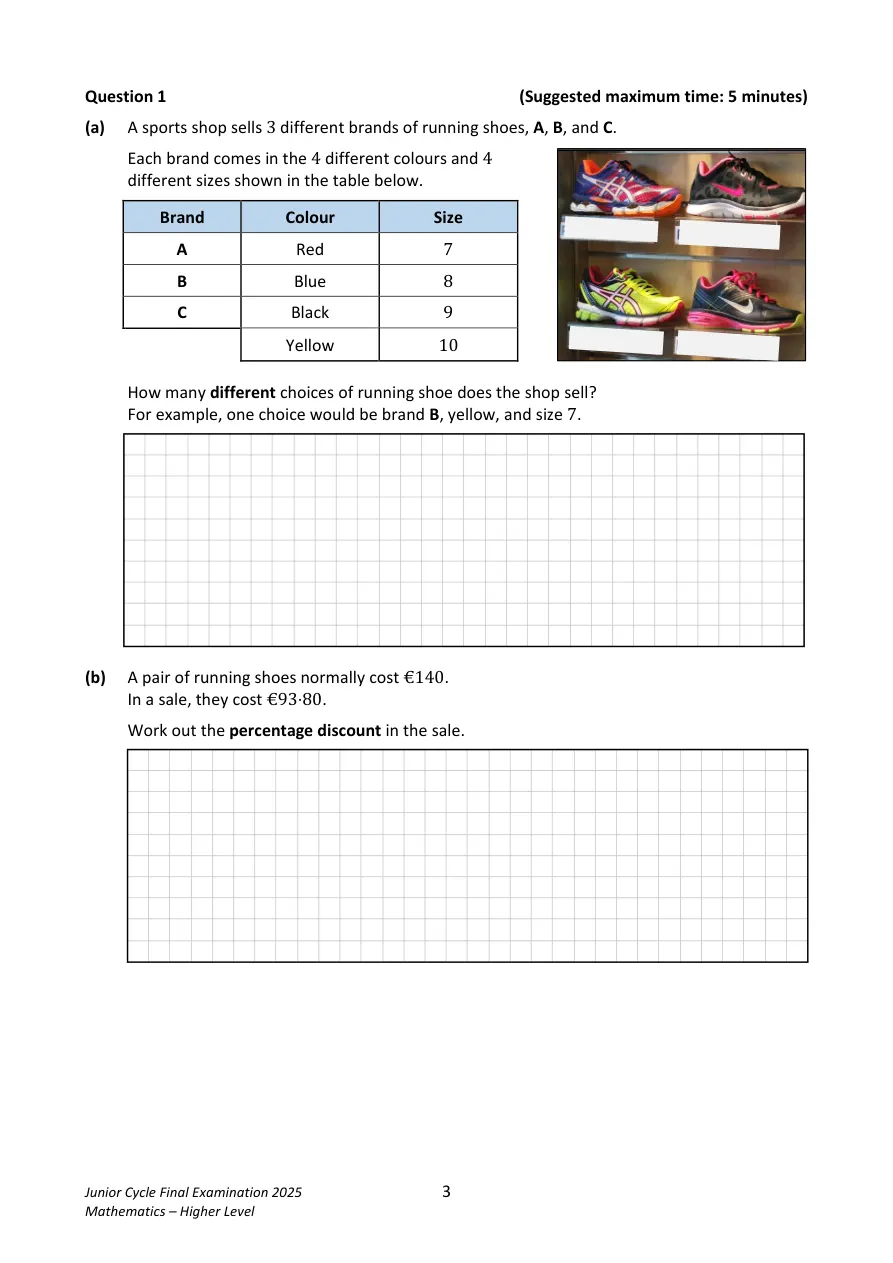
a) Choices

  1. N=3\times4\times4
  2. N=48

b) Discount percentage

  1. D=140-93.80
  2. D=46.20
  3. p=\dfrac{46.20}{140}\times100

    Divide the reduction by the original price.

  4. p=33\%

Question 2

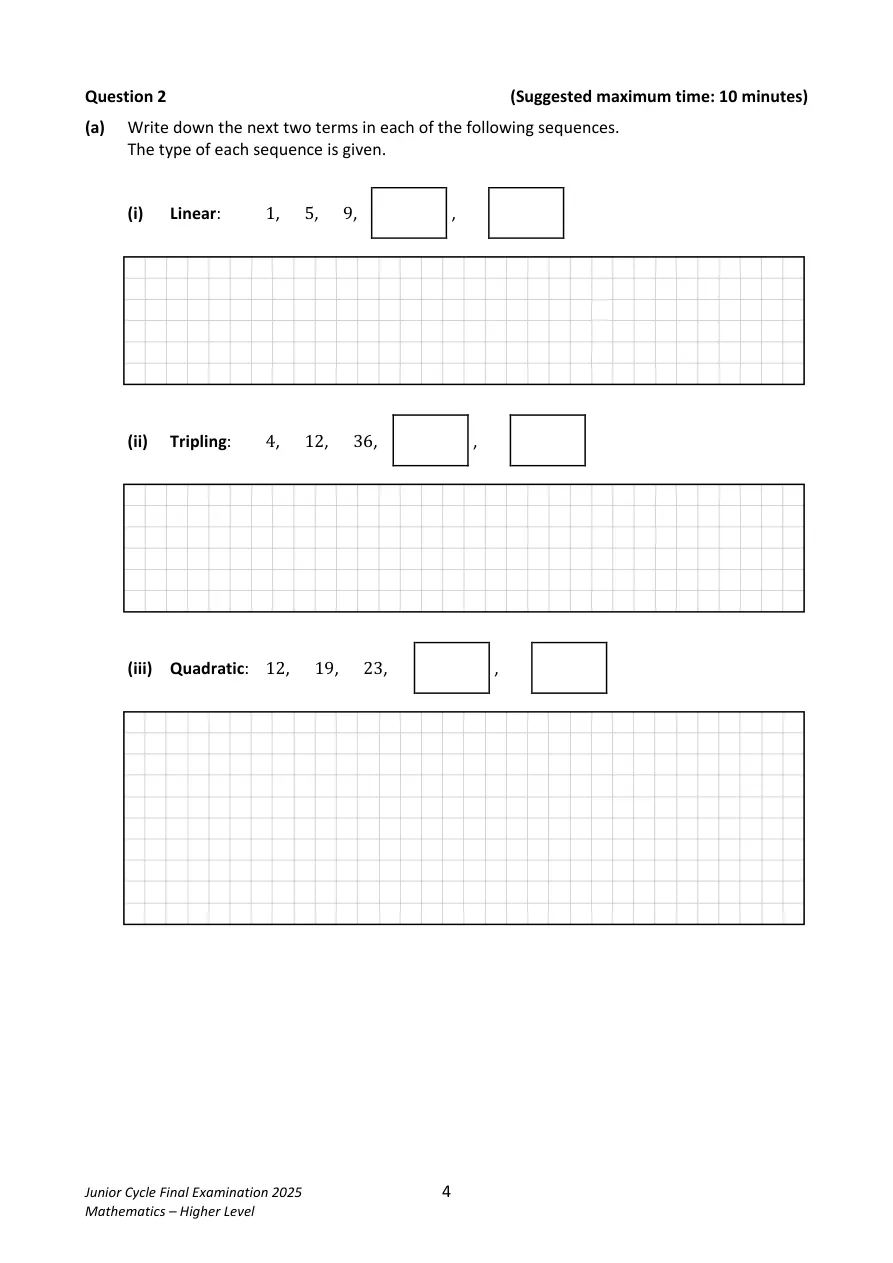
a)(i) Linear

  1. d=5-1=4
  2. 13,\quad17

    Add 4 each time.

a)(ii) Tripling

  1. 36\times3=108
  2. 108\times3=324

a)(iii) Quadratic

  1. \mathrm{First\ differences}:\quad7,\ 4,\ 1,\ -2

    The second difference is −3.

  2. 23+1=24
  3. 24-2=22

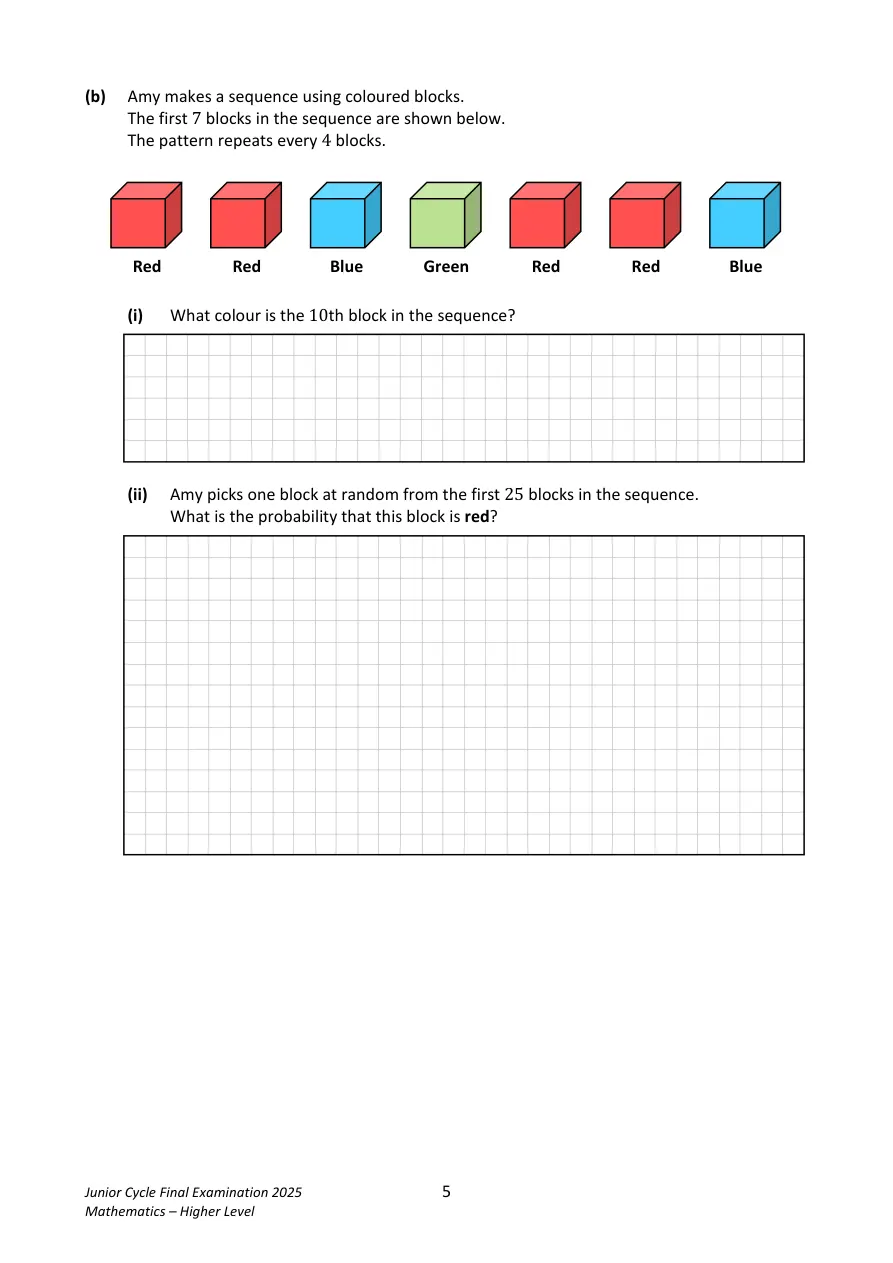
b)(i) Tenth block

  1. 10=2(4)+2
  2. The tenth block occupies position 2 in the repeating group, so it is red.

b)(ii) Red probability

  1. 25=6(4)+1
  2. N_R=6(2)+1
  3. N_R=13
  4. P(R)=\dfrac{13}{25}

Question 3

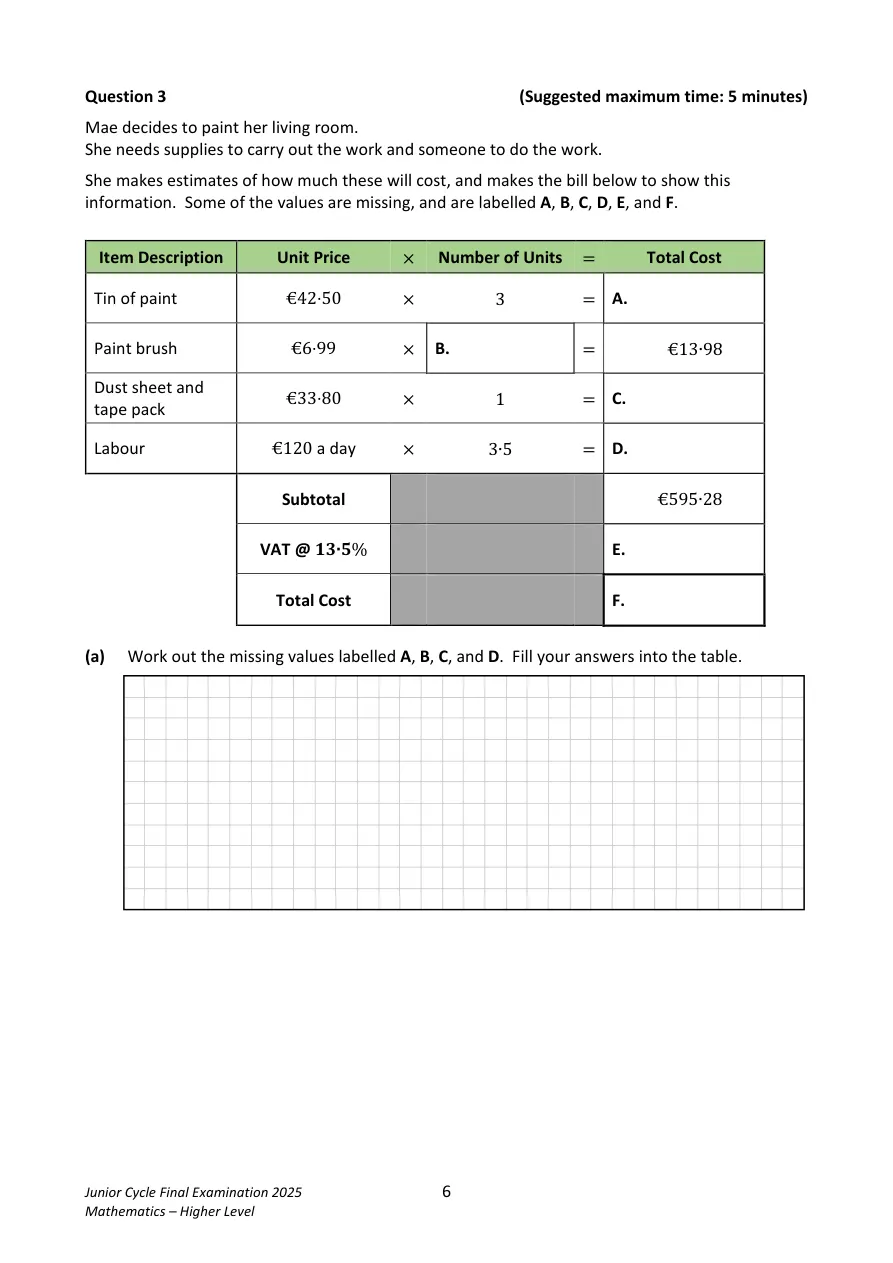
a) Missing values

  1. A=42.50(3)
  2. A=\mathrm{€}127.50
  3. B=\dfrac{13.98}{6.99}
  4. B=2
  5. C=33.80(1)
  6. C=\mathrm{€}33.80
  7. D=120(3.5)
  8. D=\mathrm{€}420

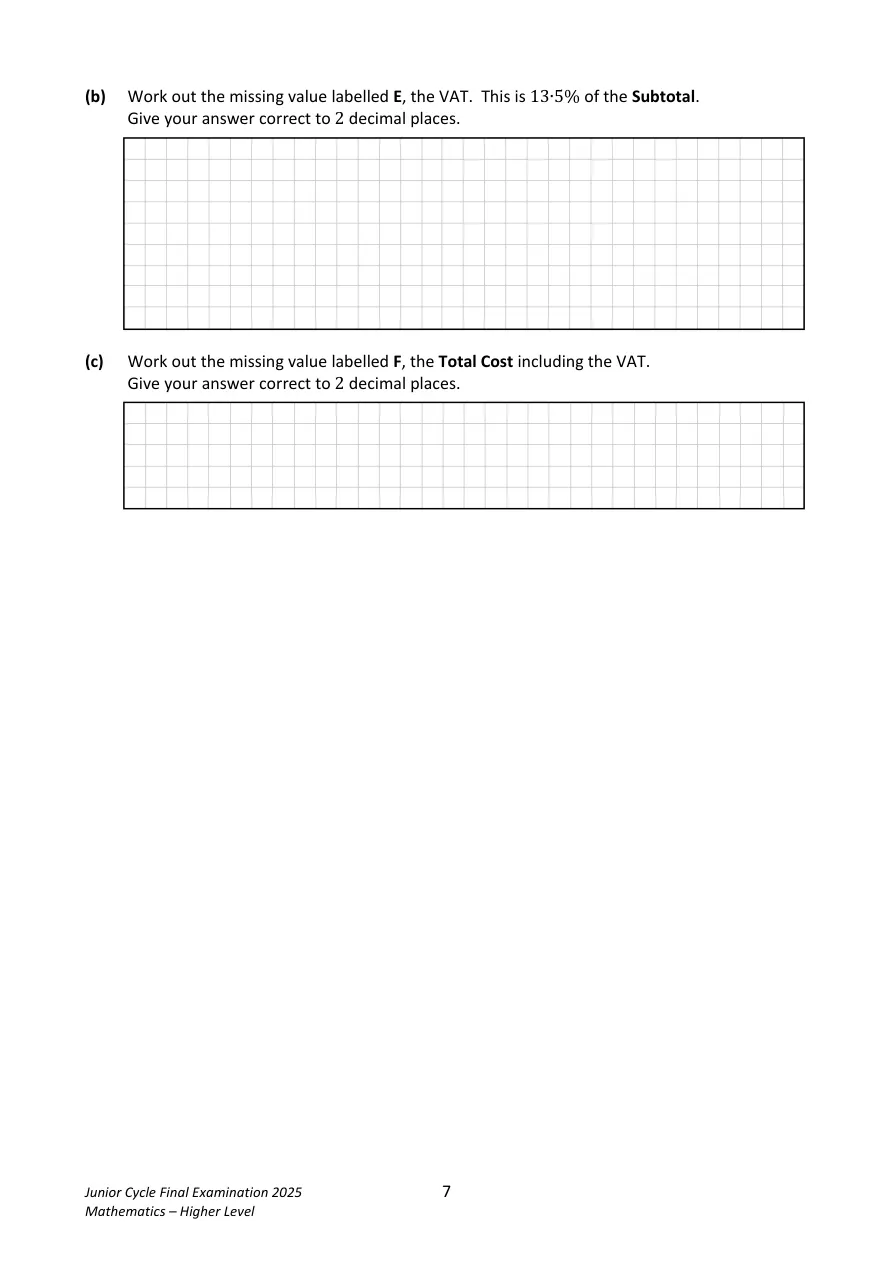
b) VAT

  1. E=595.28\left(\dfrac{13.5}{100}\right)
  2. E=80.3628
  3. E\approx\mathrm{€}80.36

c) Total cost

  1. F=595.28+80.36
  2. F=\mathrm{€}675.64

Question 4

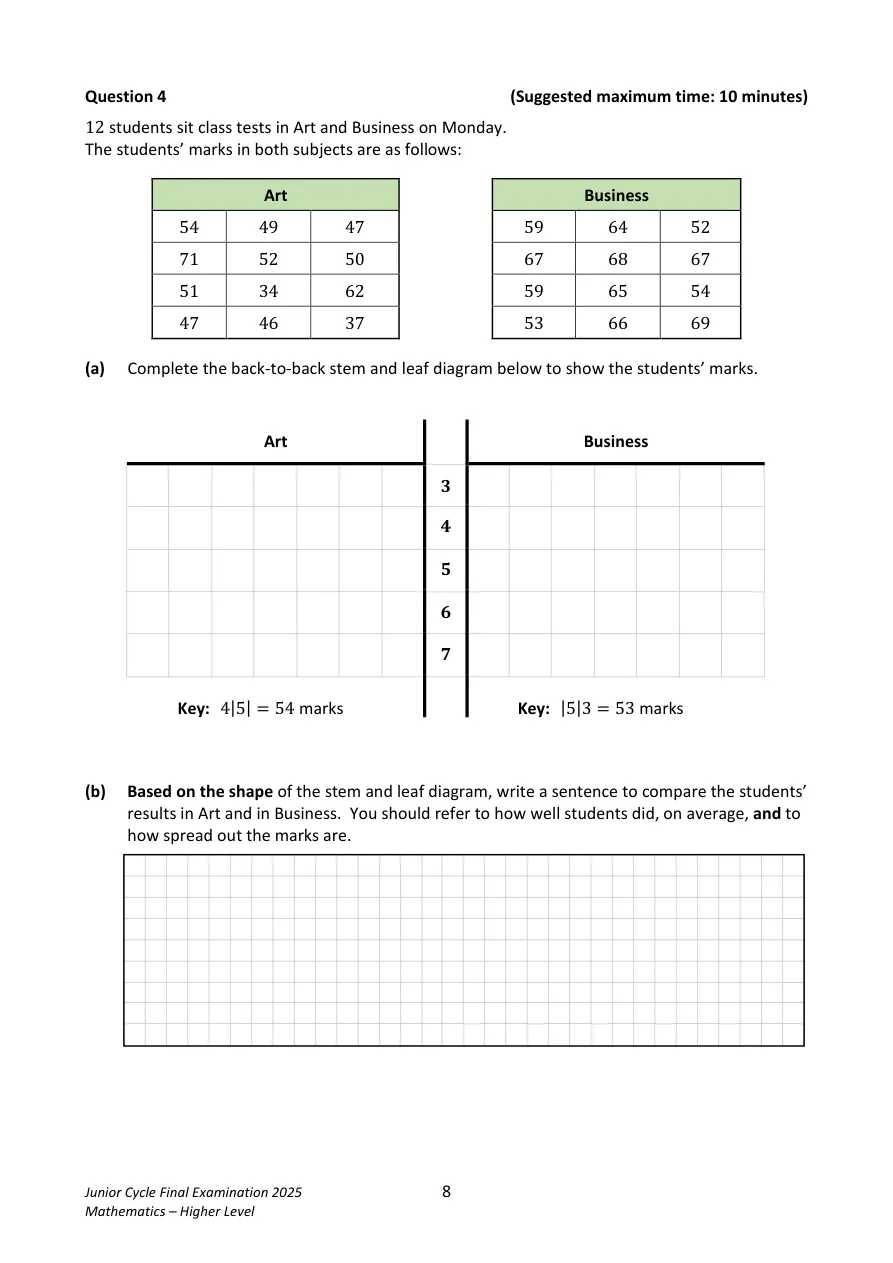
a) Back-to-back stem and leaf

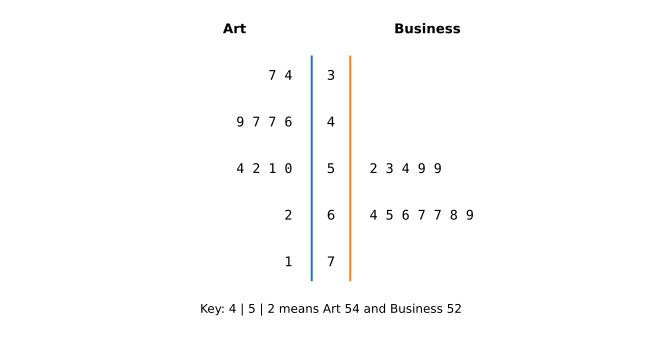
  1. See the completed diagram. On the Art side, leaves run in reverse order from left to right so that smaller values are nearest the central stem. Business leaves increase to the right.
  2. 2025-4-stem

b) Comparison

  1. Students generally scored higher in Business. Art marks have the greater spread: range 37, compared with 17 for Business.

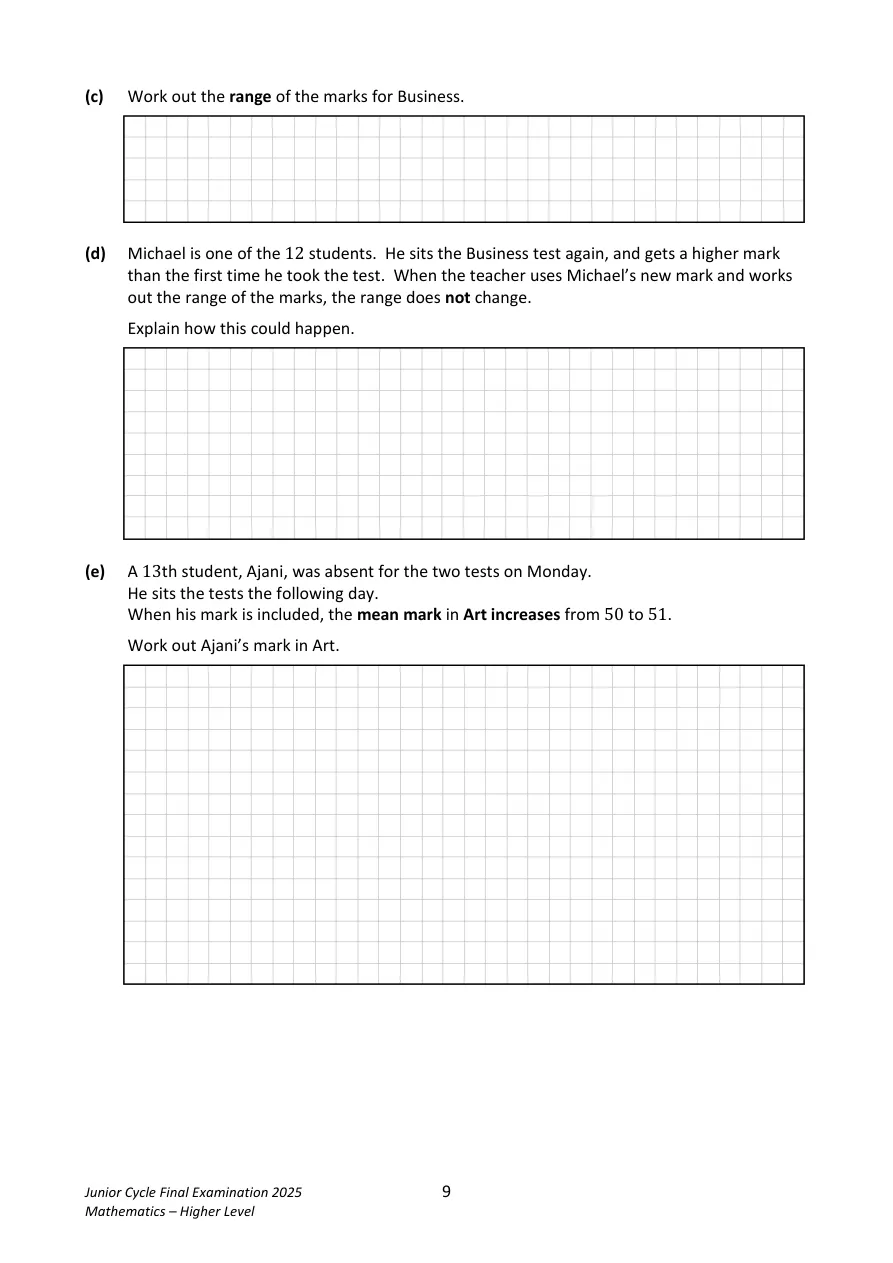
c) Business range

  1. R=69-52
  2. R=17\ \mathrm{marks}

d) Unchanged range

  1. For example, Michael's mark rises from 53 to 54. The minimum remains 52 and the maximum remains 69, so the range stays 17.

e) Ajani's mark

  1. T_{12}=12(50)=600
  2. T_{13}=13(51)=663
  3. A=663-600
  4. A=63\ \mathrm{marks}

Question 5

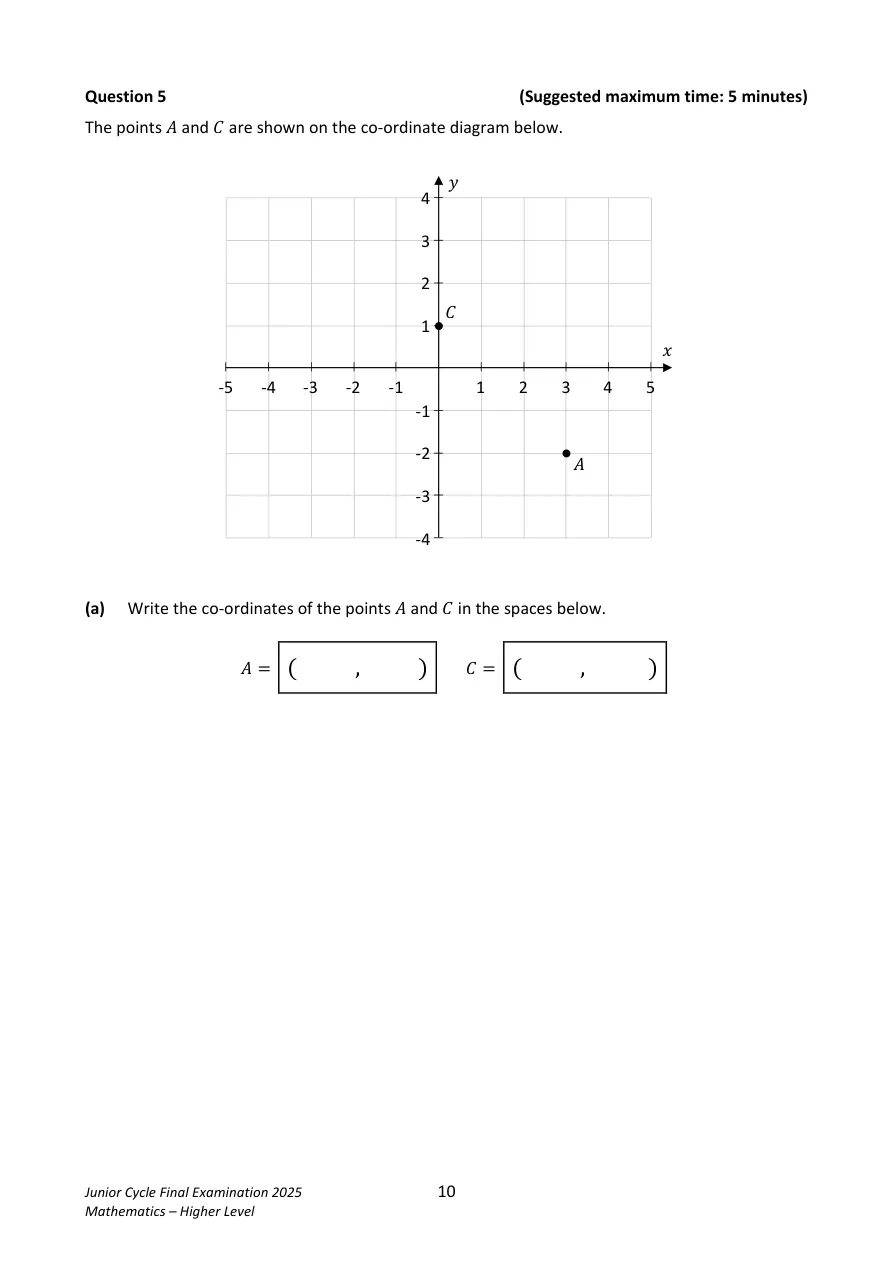
a) Coordinates

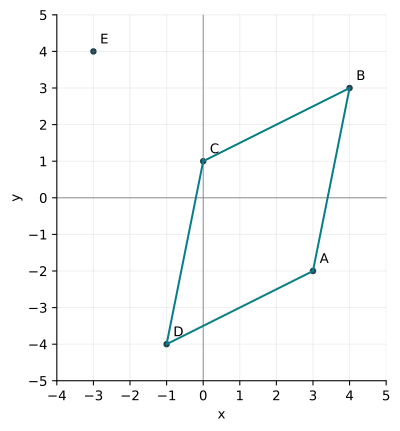
  1. A=(3,-2),\quad C=(0,1)

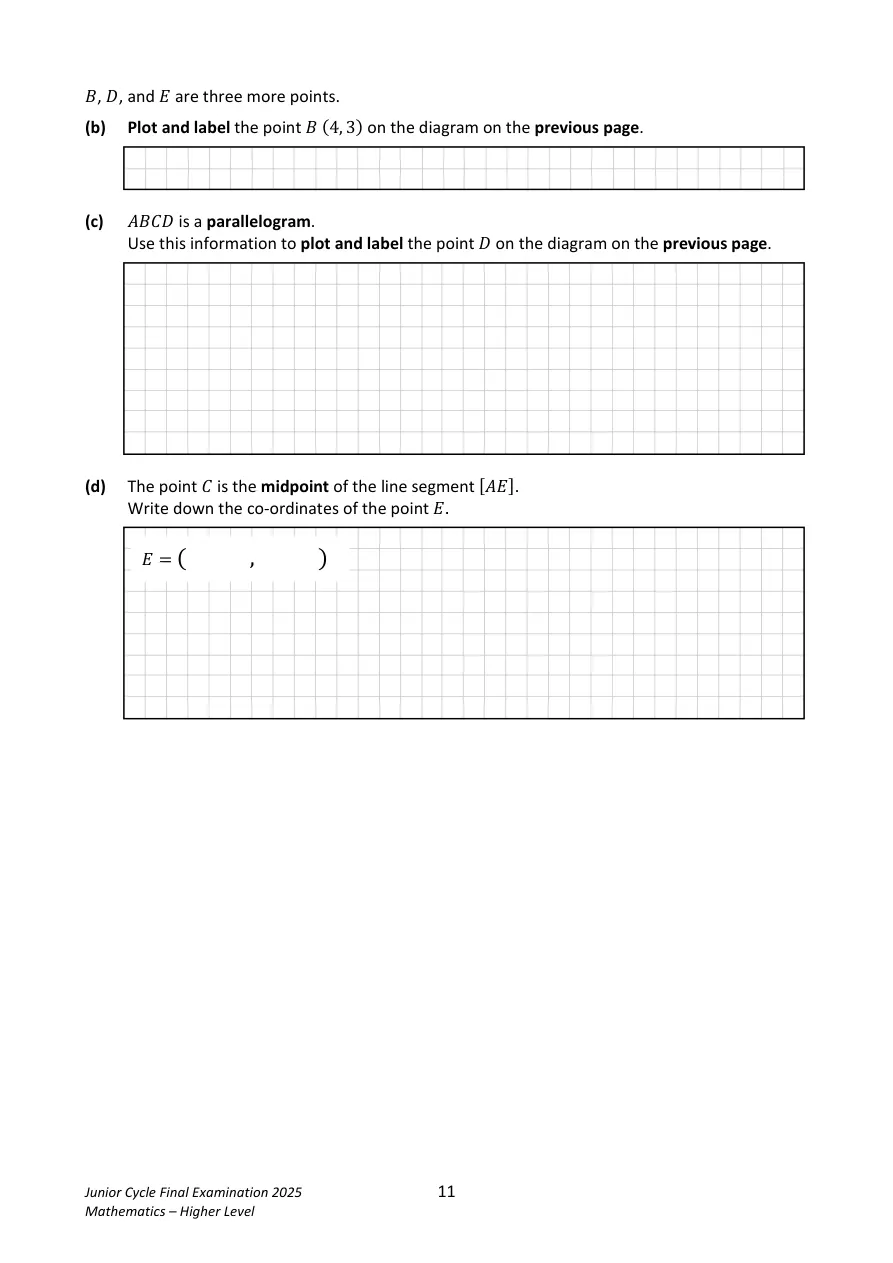
b) Plot B

  1. B=(4,3)

c) Fourth vertex

  1. D=A+C-B

    In parallelogram ABCD the diagonals have the same midpoint.

  2. D=(3+0-4,\ -2+1-3)
  3. D=(-1,-4)

d) Endpoint E

  1. E=2C-A

    C is halfway from A to E.

  2. E=(2(0)-3,\ 2(1)-(-2))
  3. E=(-3,4)
  4. 2025-5-coords

Question 6

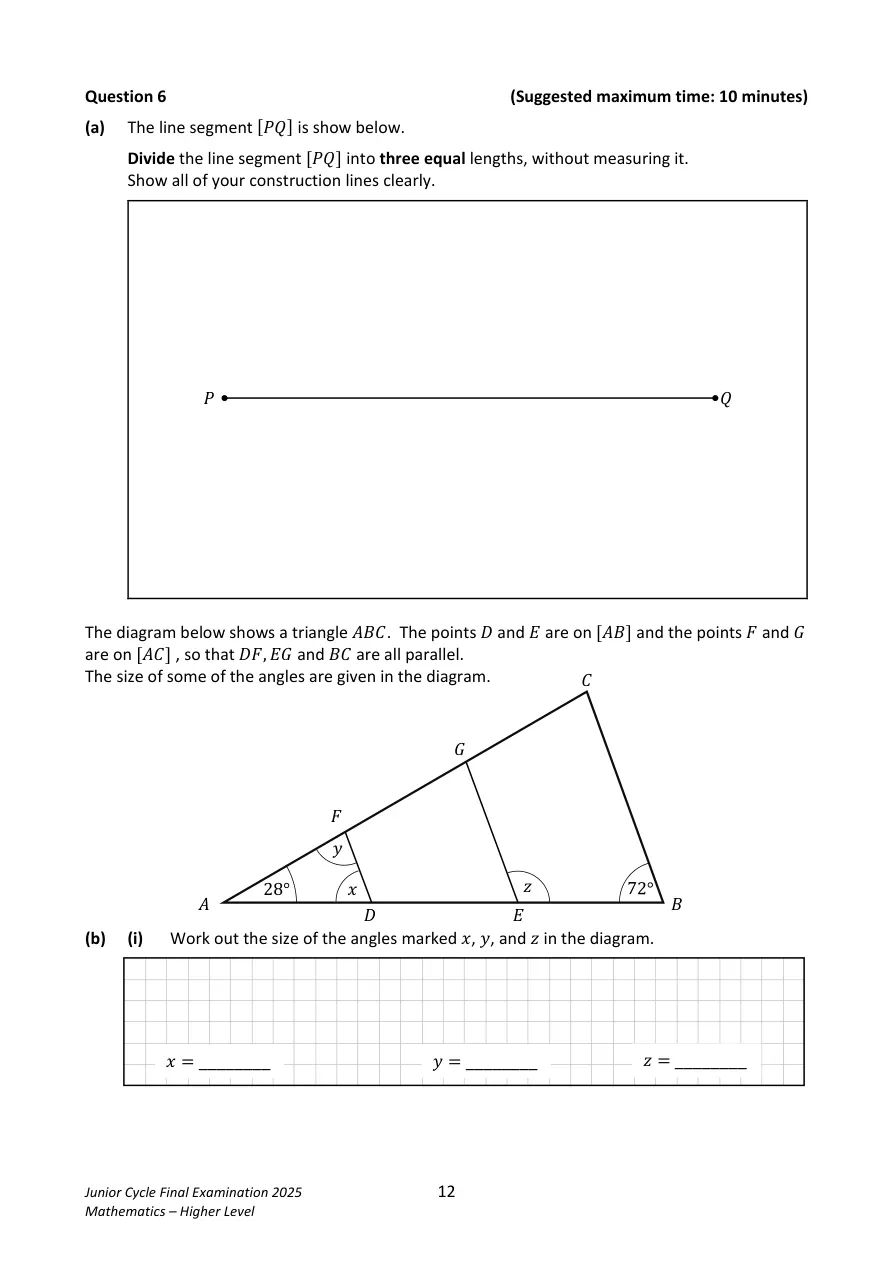
a) Divide PQ into three

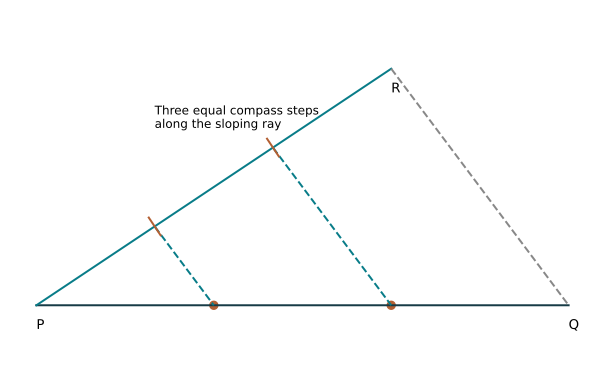
  1. Draw a ray from P at an angle to PQ. Mark three equal compass steps on it, ending at R. Join R to Q. Through each of the first two marks construct a line parallel to RQ, using equal-angle construction. These meet PQ at its trisection points. Keep construction lines visible; do not measure PQ.
  2. 2025-6-trisect

b)(i) Angles

  1. x=72^{\circ}

    Corresponding angles on the parallel lines are equal.

  2. y=180^{\circ}-28^{\circ}-72^{\circ}
  3. y=80^{\circ}
  4. z=180^{\circ}-72^{\circ}
  5. z=108^{\circ}

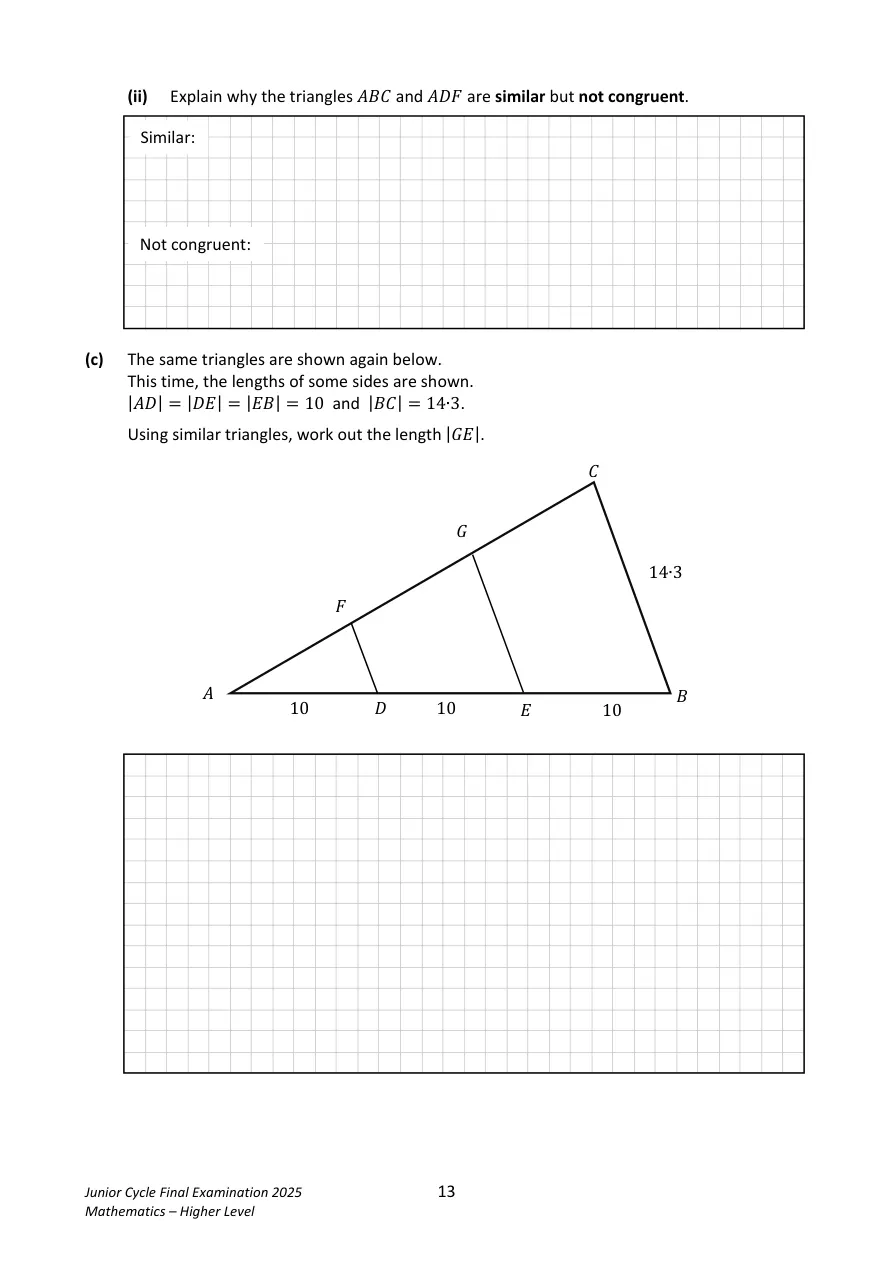
b)(ii) Similar, not congruent

  1. The triangles have equal corresponding angles, so they are similar by AA. Their corresponding lengths differ, so they are not congruent.

c) Length GE

  1. \dfrac{GE}{14.3}=\dfrac{20}{30}

    Corresponding sides have the same scale factor.

  2. GE=\dfrac{20(14.3)}{30}
  3. GE=\dfrac{143}{15}
  4. GE\approx9.533\ldots

    Exact fraction is preferable because no rounding was requested.

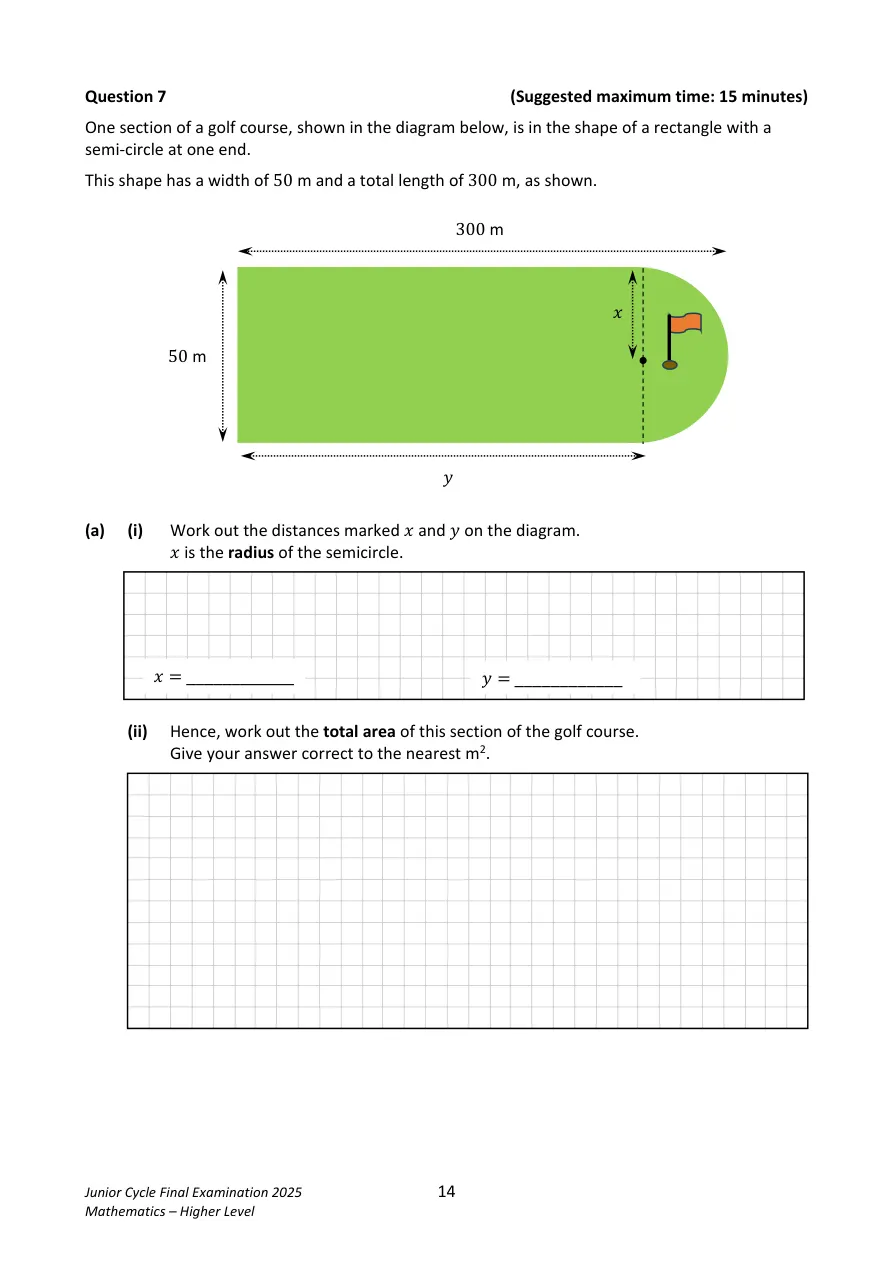
Question 7

a)(i) Dimensions

  1. x=\dfrac{50}{2}=25\ \mathrm{m}
  2. y=300-25=275\ \mathrm{m}

a)(ii) Total area

  1. A=275(50)+\dfrac{1}{2}\pi(25)^2
  2. A\approx14731.7477
  3. A\approx14732\ \mathrm{m}^2

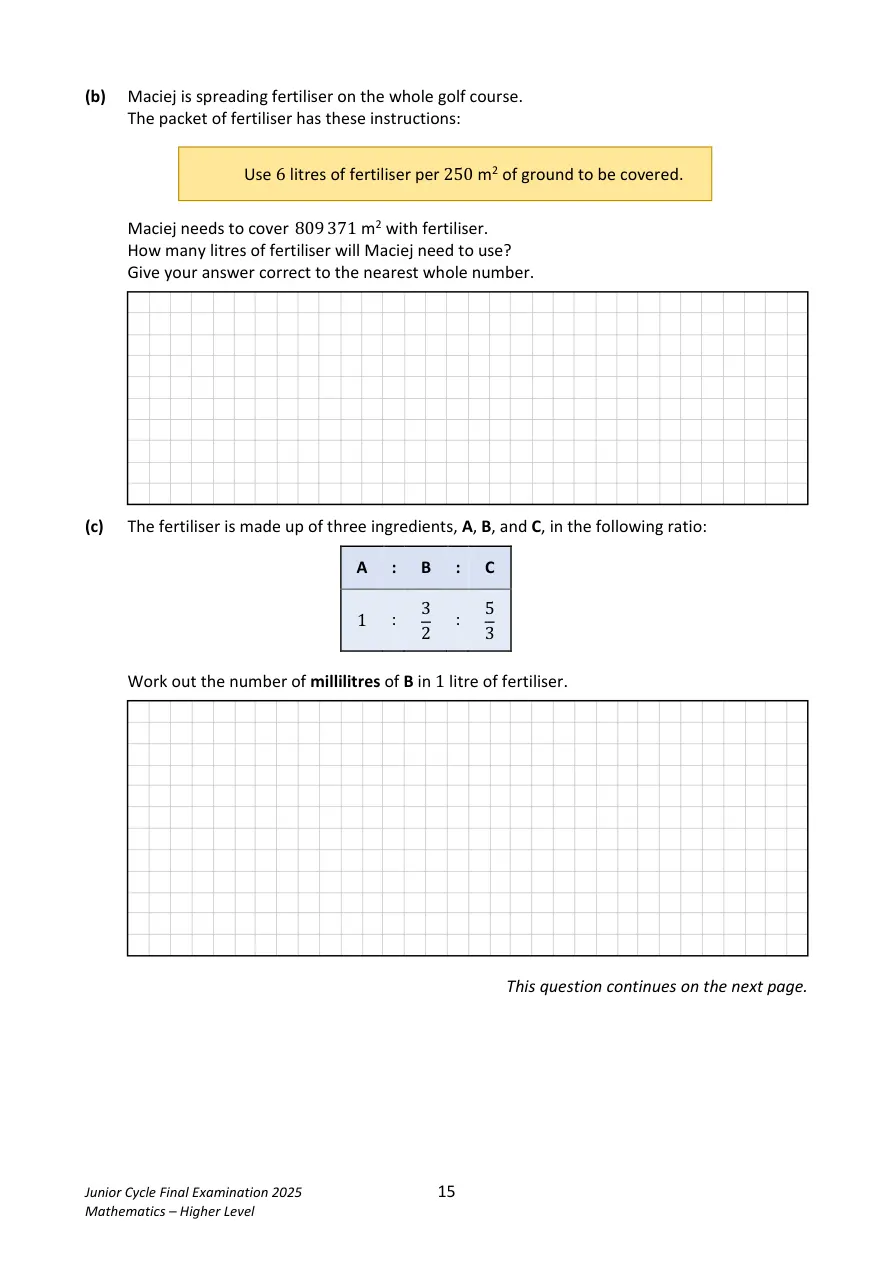
b) Fertiliser required

  1. L=\dfrac{809371}{250}\times6
  2. L=19424.904
  3. L\approx19425\ \mathrm{litres}

c) Ingredient B

  1. 1:\dfrac{3}{2}:\dfrac{5}{3}=6:9:10

    Multiply every ratio term by 6 to clear both fractions.

  2. \mathrm{Total\ parts}=6+9+10=25
  3. B=\dfrac{9}{25}(1000)
  4. B=360\ \mathrm{ml}

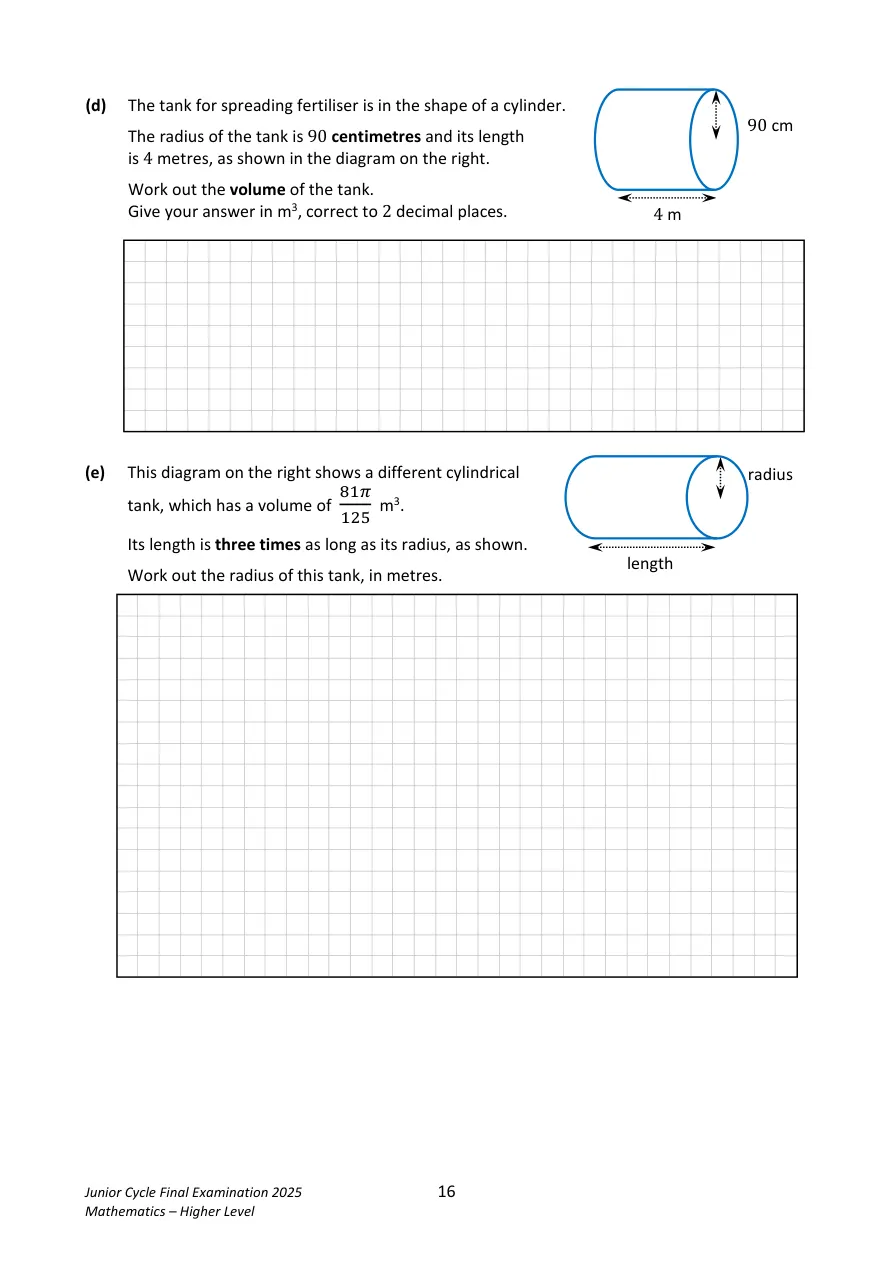
d) Tank volume

  1. r=90\ \mathrm{cm}=0.9\ \mathrm{m}
  2. V=\pi r^2h
  3. V=\pi(0.9)^2(4)
  4. V\approx10.18\ \mathrm{m}^3

e) Radius of second tank

  1. h=3r
  2. \pi r^2(3r)=\dfrac{81\pi}{125}
  3. 3r^3=\dfrac{81}{125}
  4. r^3=\dfrac{27}{125}
  5. r=\sqrt[3]{\dfrac{27}{125}}
  6. r=\dfrac{3}{5}\ \mathrm{m}
  7. r=0.6\ \mathrm{m}

Question 8

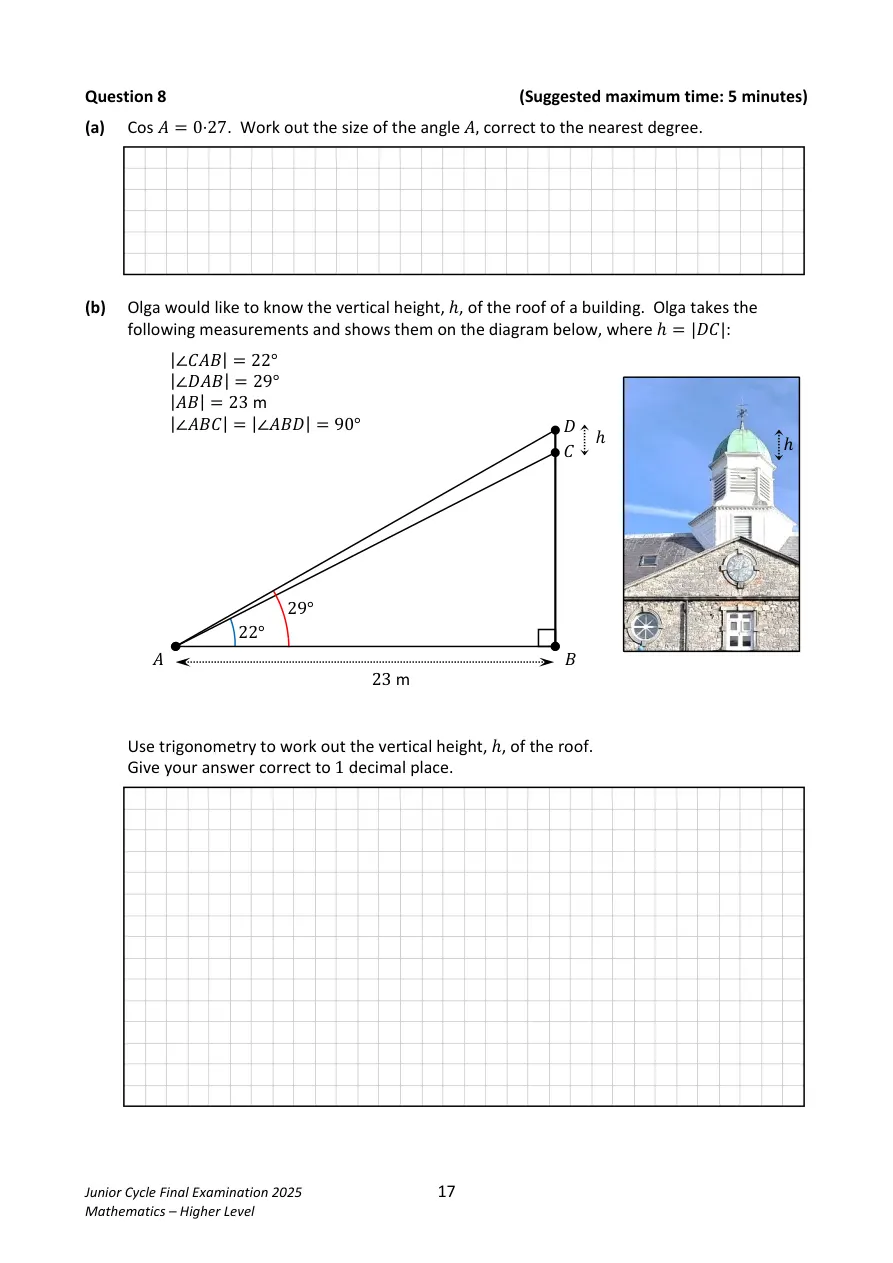
a) Angle A

  1. A=\cos^{-1}(0.27)
  2. A\approx74^{\circ}

    Calculator in degree mode.

b) Roof height

  1. BC=23\tan22^{\circ}
  2. BC\approx9.2926\ \mathrm{m}
  3. BD=23\tan29^{\circ}
  4. BD\approx12.7491\ \mathrm{m}
  5. h=BD-BC
  6. h=23(\tan29^{\circ}-\tan22^{\circ})

    Use unrounded heights in the subtraction.

  7. h\approx3.5\ \mathrm{m}

Question 9

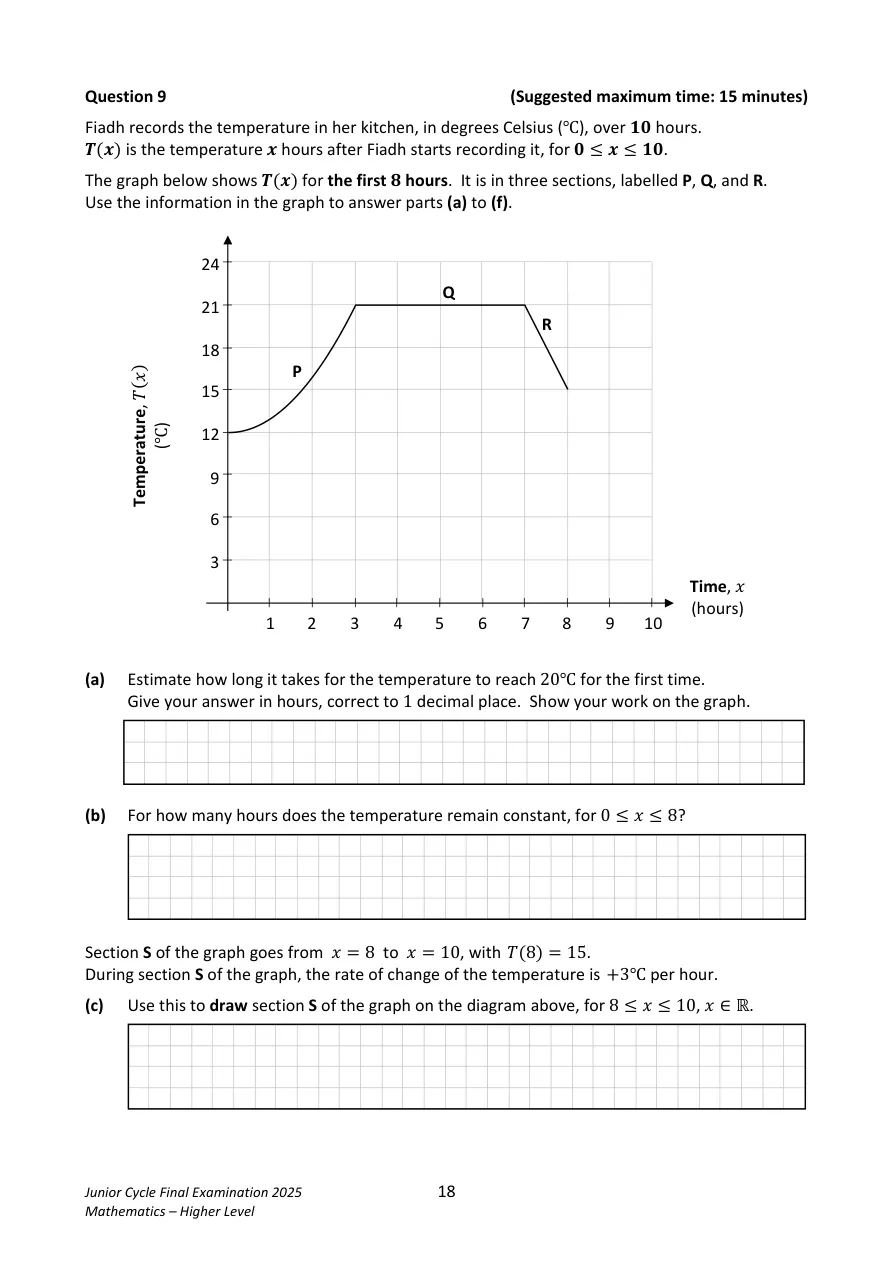
a) First reaches 20°C

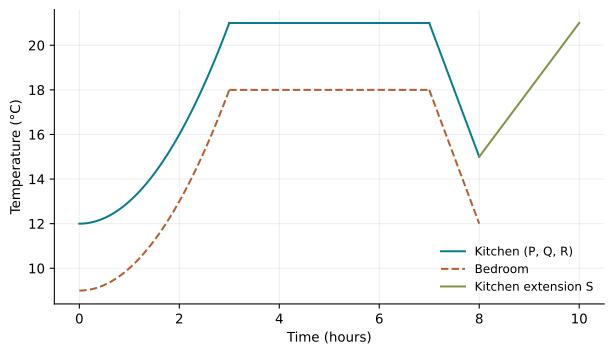
  1. Trace horizontally from 20°C to section P, then down to the time axis: approximately 2.8 hours. Reading the curve is required; solving x²+12=20 gives a useful check.
  2. x=\sqrt{8}\approx2.8\ \mathrm{h}

b) Constant temperature

  1. 7-3=4\ \mathrm{h}

c) Section S

  1. \Delta T=3(10-8)=6^{\circ}\mathrm{C}
  2. T(10)=15+6=21^{\circ}\mathrm{C}
  3. Join (8,15) to (10,21) with a straight line.

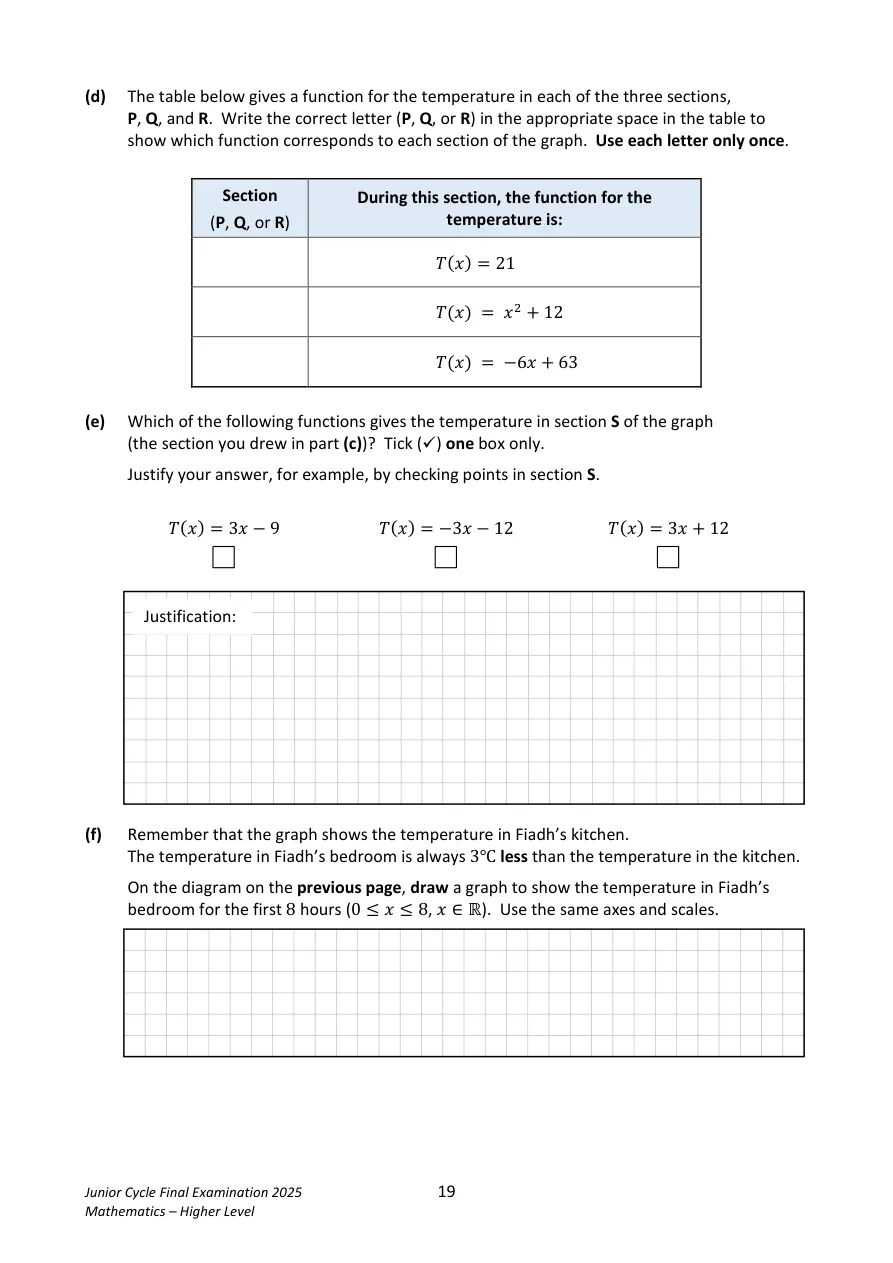
d) Match functions

  1. Q:\quad T(x)=21
  2. P:\quad T(x)=x^2+12
  3. R:\quad T(x)=-6x+63

e) Equation of S

  1. T(x)=3x+c
  2. 15=3(8)+c
  3. c=-9
  4. T(x)=3x-9
  5. T(10)=3(10)-9=21

    Confirms the other endpoint too.

f) Bedroom graph

  1. T_{\mathrm{bed}}(x)=T_{\mathrm{kitchen}}(x)-3
  2. Shift the original three sections down 3°C on 0 ≤ x ≤ 8. Keep their x-coordinates and shapes unchanged.
  3. 2025-9-graph

Question 10

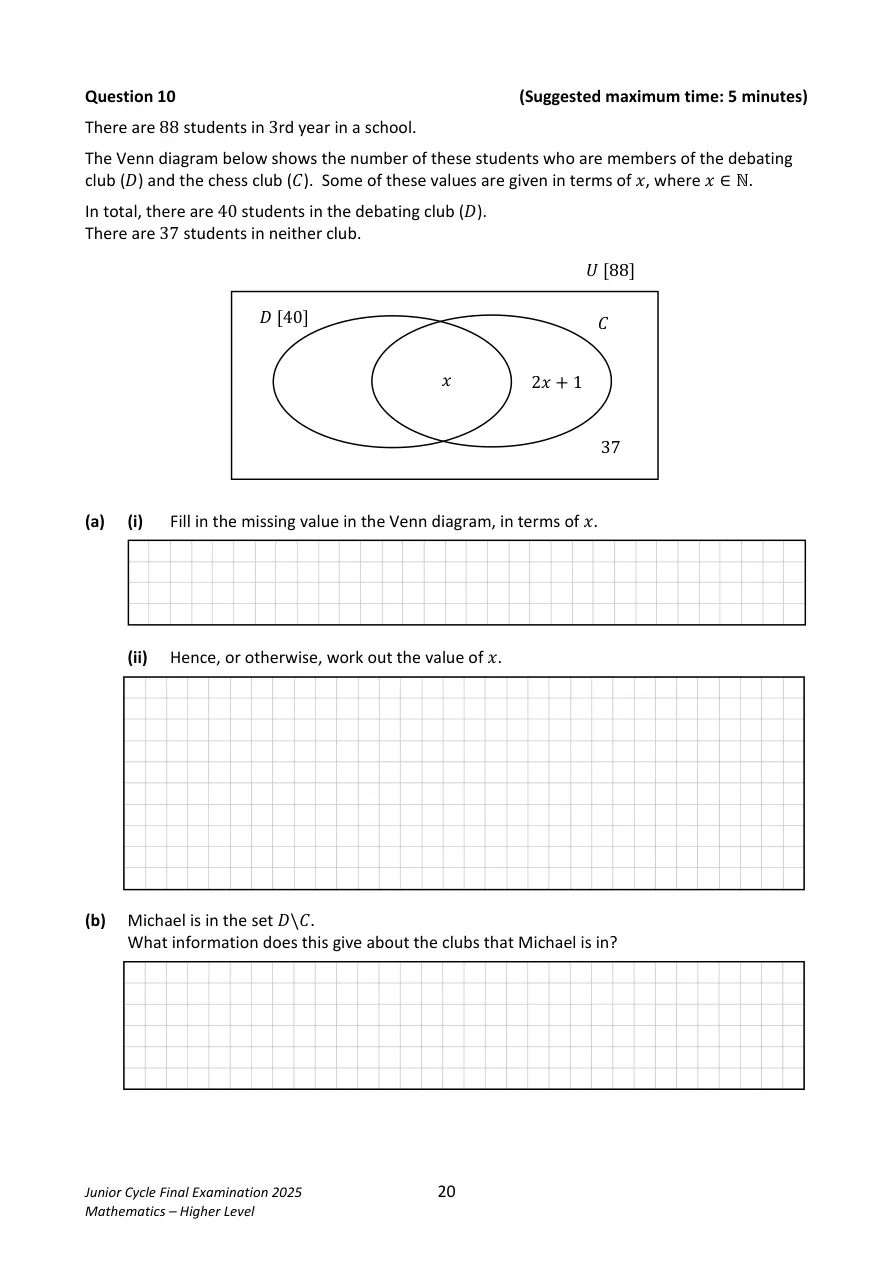
a)(i) Missing region

  1. \mathrm{Debating\ only}=40-x

a)(ii) Find x

  1. 40+(2x+1)+37=88

    Use the whole debating set once, then add chess-only and neither.

  2. 2x+78=88
  3. 2x=10
  4. x=5

b) Set difference

  1. Michael belongs to the debating club and does not belong to the chess club.

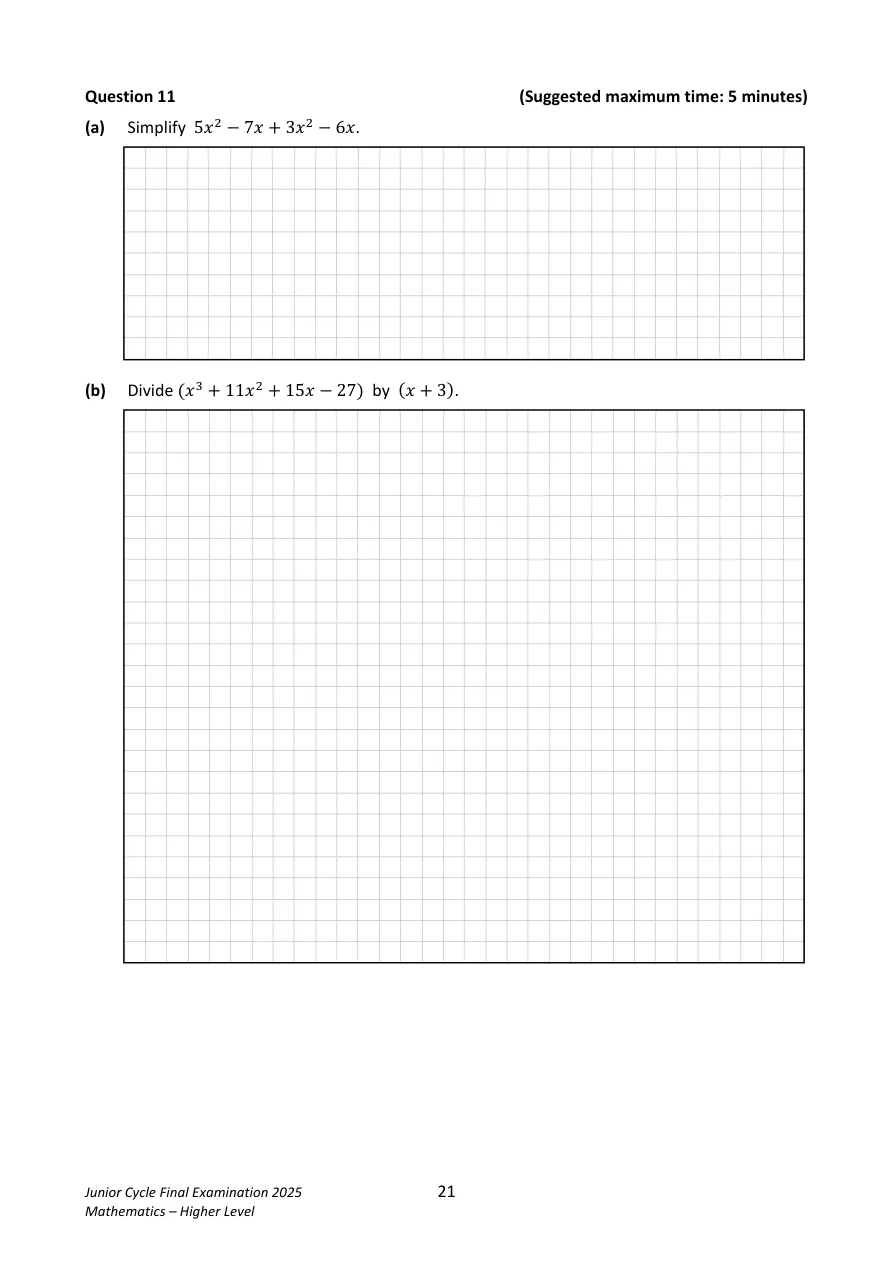
Question 11

a) Collect like terms

  1. 5x^2-7x+3x^2-6x
  2. (5+3)x^2+(-7-6)x
  3. 8x^2-13x

b) Divide by x+3

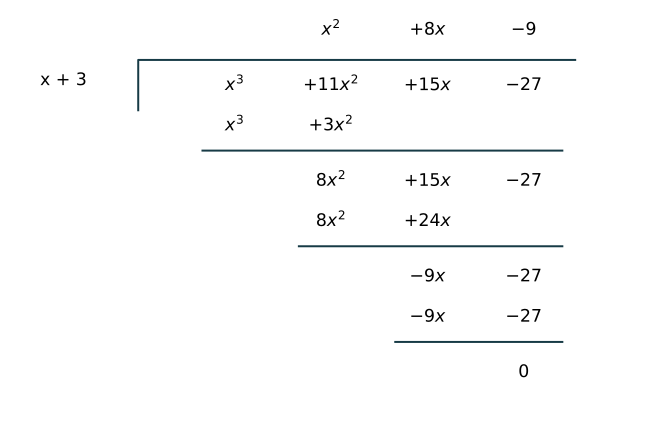
  1. \dfrac{x^3+11x^2+15x-27}{x+3}
  2. \dfrac{x^3}{x}=x^2

    First quotient term: multiply the divisor by x².

  3. (x^3+11x^2+15x-27)-(x^3+3x^2)
  4. 8x^2+15x-27
  5. \dfrac{8x^2}{x}=8x

    Next quotient term: multiply the divisor by 8x.

  6. (8x^2+15x-27)-(8x^2+24x)
  7. -9x-27
  8. \dfrac{-9x}{x}=-9
  9. (-9x-27)-(-9x-27)=0

    Remainder zero.

  10. \mathrm{Quotient}=x^2+8x-9
  11. Each subtraction uses matching powers underneath one another in the long-division diagram.
  12. 2025-11-division

Question 12

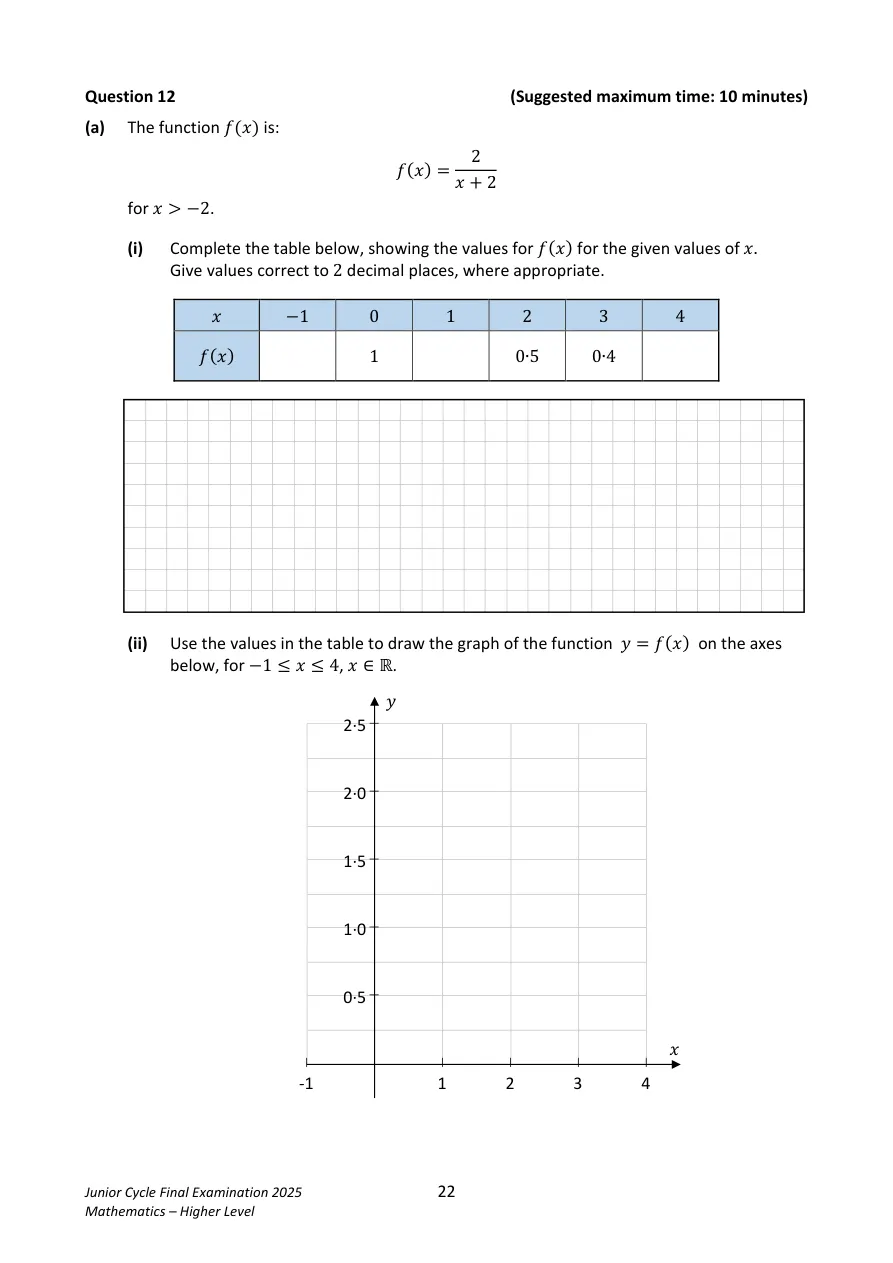
a)(i) Function table

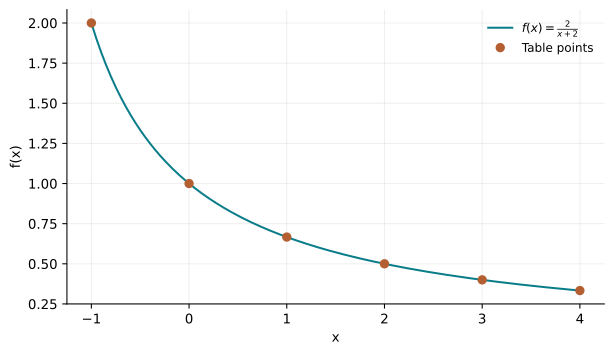
  1. f(x)=\dfrac{2}{x+2}
  2. For x = −1, 0, 1, 2, 3, 4 the values are 2, 1, 0.67, 0.50, 0.40, 0.33 respectively (rounded where required).

a)(ii) Graph

  1. Plot all six table values, then draw a smooth decreasing curve, not a set of straight line segments. Use the unrounded function values for the curve.
  2. 2025-12-graph

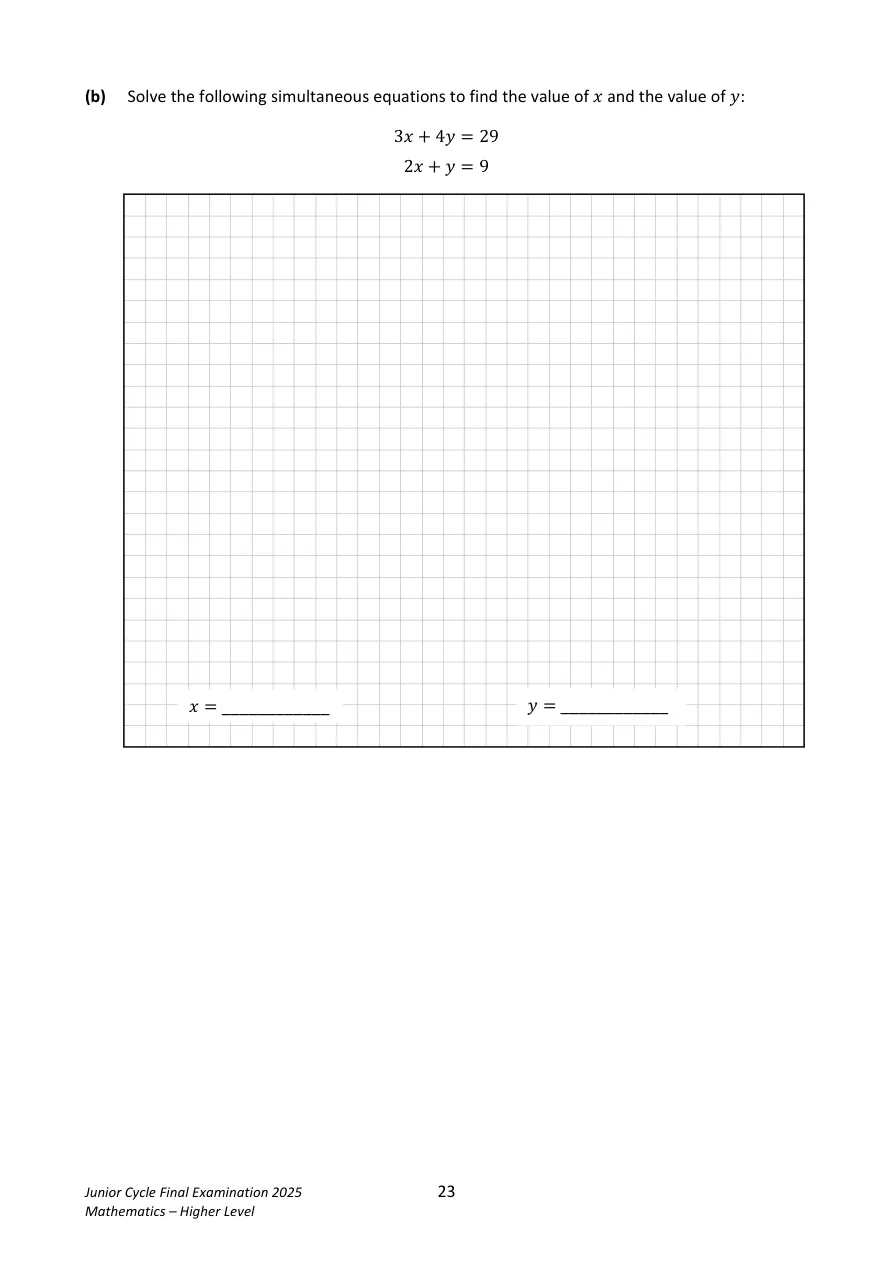
b) Simultaneous equations

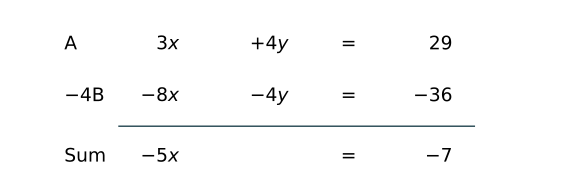
  1. 3x+4y=29\qquad(A)
  2. 2x+\quad y=9\qquad(B)
  3. Eliminate y. Equation A has +4y. Multiply every term of B by −4 to make −4y: the coefficients are equal in size and opposite in sign.
  4. 2025-12-simult
  5. Add the equations; +4y and −4y cancel.
  6. x=\dfrac{-7}{-5}
  7. x=\dfrac{7}{5}
  8. 2\left(\dfrac{7}{5}\right)+y=9

    Substitute x into equation B.

  9. y=9-\dfrac{14}{5}
  10. y=\dfrac{45-14}{5}
  11. y=\dfrac{31}{5}
  12. Check in A: 3×1.4 + 4×6.2 = 29. Check in B: 2×1.4 + 6.2 = 9.

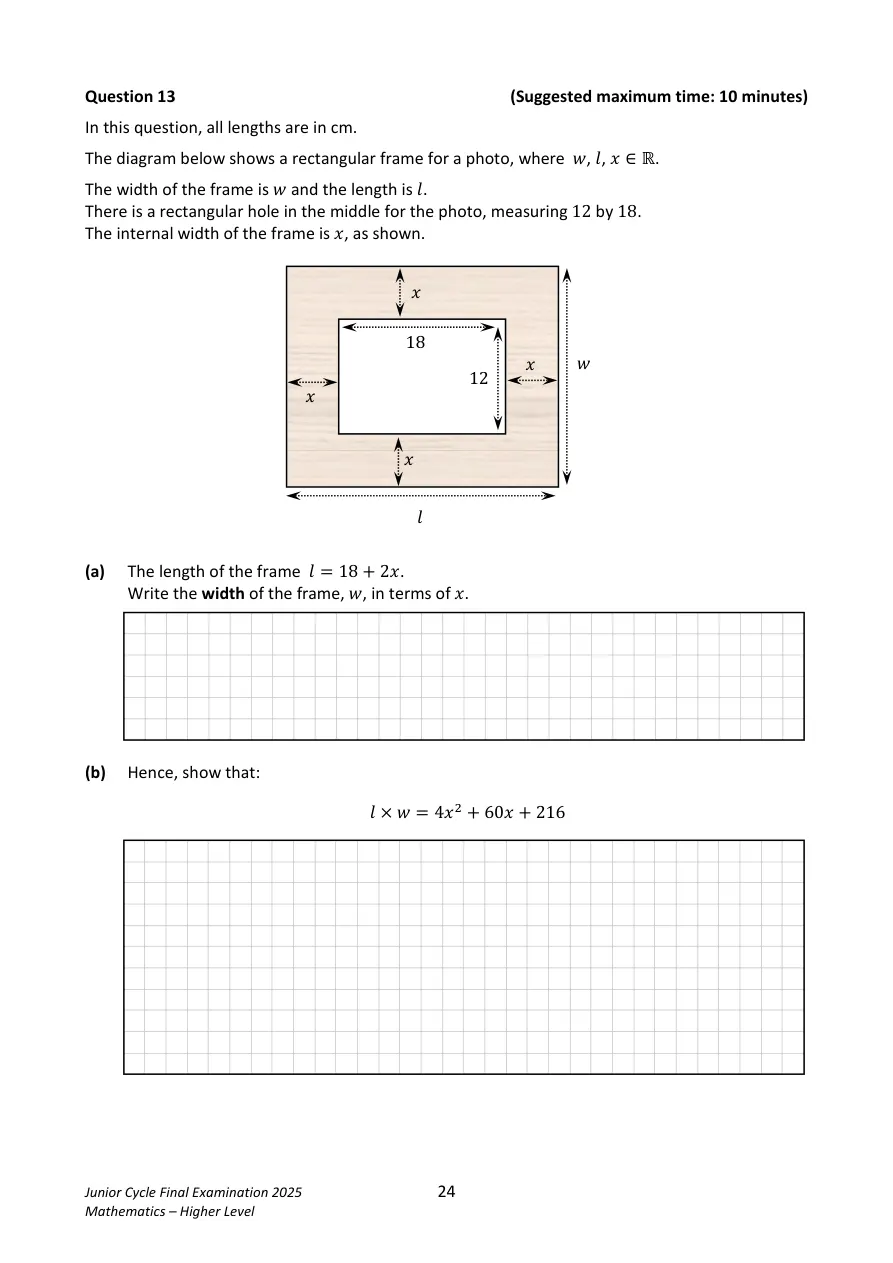
Question 13

a) Width

  1. w=12+2x

b) Expand area

  1. lw=(18+2x)(12+2x)
  2. lw=216+36x+24x+4x^2

    Multiply each term of the first bracket by both terms in the second: 18 × 12, 18 × 2x, 2x × 12 and 2x × 2x.

  3. lw=4x^2+60x+216

    Combine the two x-terms: 36x + 24x = 60x.

c) Find frame thickness

  1. 4x^2+60x+216=648
  2. 4x^2+60x-432=0
  3. x^2+15x-108=0

    Divide every term by 4.

  4. a=1,\quad b=15,\quad c=-108

    Match ax² + bx + c = 0. Include the signs of the coefficients.

  5. x=\dfrac{-b\pm\sqrt{b^2-4ac}}{2a}

    Write the formula before substituting. The ± gives two calculations, one with + and one with −.

  6. x=\dfrac{-15\pm\sqrt{15^2-4(1)(-108)}}{2}

    Use brackets when substituting negative numbers, especially when squaring b.

  7. x=\dfrac{-15\pm\sqrt{657}}{2}
  8. x\approx5.315\quad\mathrm{or}\quad x\approx-20.315
  9. x\approx5.3\ \mathrm{cm}

    Reject the negative value because x is a width.
See working and diagrams on the original paper
Original exam paper page 3
N=3\times4\times4
N=48
D=140-93.80
D=46.20
p=\dfrac{46.20}{140}\times100
[discount ÷ original price]
p=33\%
Original exam paper page 4
d=5-1=4
13,\quad17
[Add 4 each time.]
36\times3=108
108\times3=324
\mathrm{First\ differences}:\quad7,\ 4,\ 1,\ -2
[differences decrease by 3]
23+1=24
24-2=22
13171083242422
Original exam paper page 5
10=2(4)+2
The tenth block occupies position 2 in the repeating group, so it is red.
25=6(4)+1
N_R=6(2)+1
N_R=13
P(R)=\dfrac{13}{25}
Original exam paper page 6
A=42.50(3)
A=\mathrm{€}127.50
B=\dfrac{13.98}{6.99}
B=2
C=33.80(1)
C=\mathrm{€}33.80
D=120(3.5)
D=\mathrm{€}420
127.50233.8042080.36675.64
Original exam paper page 7
E=595.28\left(\dfrac{13.5}{100}\right)
E=80.3628
E\approx\mathrm{€}80.36
F=595.28+80.36
F=\mathrm{€}675.64
Original exam paper page 8
Leaves nearest the stem are the smallest.
Students generally scored higher in Business. Art marks have the greater spread: range 37, compared with 17 for Business.
7 49 7 7 64 2 1 0212 3 4 9 94 5 6 7 7 8 9
Original exam paper page 9
R=69-52
R=17\ \mathrm{marks}
For example, Michael's mark rises from 53 to 54. The minimum remains 52 and the maximum remains 69, so the range stays 17.
T_{12}=12(50)=600
T_{13}=13(51)=663
A=663-600
A=63\ \mathrm{marks}
Original exam paper page 10
BDE
3, −20, 1
Original exam paper page 11
B=(4,3)
D=A+C-B
[In parallelogram ABCD the diagonals have the same midpoint.]
D=(3+0-4,\ -2+1-3)
D=(-1,-4)
E=2C-A
[C is halfway from A to E.]
E=(2(0)-3,\ 2(1)-(-2))
E=(-3,4)
Original exam paper page 12
Draw a ray from P at an angle to PQ. Mark three equal compass steps on it, ending at R. Join R to Q. Through each of the first two marks construct a line parallel to RQ, using equal-angle construction. These meet PQ at its trisection points. Keep construction lines visible; do not measure PQ.
R
y=180^{\circ}-28^{\circ}-72^{\circ}
z=180^{\circ}-72^{\circ}
72°80°108°
Original exam paper page 13
The triangles have equal corresponding angles, so they are similar by AA. Their corresponding lengths differ, so they are not congruent.
\dfrac{GE}{14.3}=\dfrac{20}{30}
[corresponding sides have equal ratios]
GE=\dfrac{20(14.3)}{30}
GE=\dfrac{143}{15}
GE\approx9.533\ldots
Original exam paper page 14
x=\dfrac{50}{2}=25\ \mathrm{m}
y=300-25=275\ \mathrm{m}
A=275(50)+\dfrac{1}{2}\pi(25)^2
A\approx14731.7477
A\approx14732\ \mathrm{m}^2
Original exam paper page 15
L=\dfrac{809371}{250}\times6
L=19424.904
L\approx19425\ \mathrm{litres}
1:\dfrac{3}{2}:\dfrac{5}{3}=6:9:10
[Multiply every ratio term by 6 to clear both fractions.]
\mathrm{Total\ parts}=6+9+10=25
B=\dfrac{9}{25}(1000)
B=360\ \mathrm{ml}
Original exam paper page 16
r=90\ \mathrm{cm}=0.9\ \mathrm{m}
V=\pi r^2h
V=\pi(0.9)^2(4)
V\approx10.18\ \mathrm{m}^3
h=3r
\pi r^2(3r)=\dfrac{81\pi}{125}
3r^3=\dfrac{81}{125}
r^3=\dfrac{27}{125}
r=\sqrt[3]{\dfrac{27}{125}}
[take the cube root]
r=\dfrac{3}{5}\ \mathrm{m}
r=0.6\ \mathrm{m}
Original exam paper page 17
A=\cos^{-1}(0.27)
A\approx74^{\circ}
[Calculator in degree mode.]
BC=23\tan22^{\circ}
BC\approx9.2926\ \mathrm{m}
BD=23\tan29^{\circ}
BD\approx12.7491\ \mathrm{m}
h=BD-BC
h=23(\tan29^{\circ}-\tan22^{\circ})
[Use unrounded heights in the subtraction.]
h\approx3.5\ \mathrm{m}
Original exam paper page 18
Trace horizontally from 20°C to section P, then down to the time axis: approximately 2.8 hours. Reading the curve is required; solving x²+12=20 gives a useful check.
x=\sqrt{8}\approx2.8\ \mathrm{h}
7-3=4\ \mathrm{h}
\Delta T=3(10-8)=6^{\circ}\mathrm{C}
T(10)=15+6=21^{\circ}\mathrm{C}
Join (8,15) to (10,21) with a straight line.
Sbedroom
Original exam paper page 19
T(x)=3x+c
15=3(8)+c
c=-9
T(x)=3x-9
T(10)=3(10)-9=21
[Confirms the other endpoint too.]
T_{\mathrm{bed}}(x)=T_{\mathrm{kitchen}}(x)-3
Shift the original three sections down 3°C on 0 ≤ x ≤ 8. Keep their x-coordinates and shapes unchanged.
QPR
Original exam paper page 20
\mathrm{Debating\ only}=40-x
40+(2x+1)+37=88
[Use the whole debating set once, then add chess-only and neither.]
2x+78=88
2x=10
x=5
Michael belongs to the debating club and does not belong to the chess club.
40 − x
Original exam paper page 21
5x^2-7x+3x^2-6x
(5+3)x^2+(-7-6)x
8x^2-13x
\dfrac{x^3+11x^2+15x-27}{x+3}
\dfrac{x^3}{x}=x^2
[First quotient term: multiply the divisor by x².]
(x^3+11x^2+15x-27)-(x^3+3x^2)
8x^2+15x-27
\dfrac{8x^2}{x}=8x
[Next quotient term: multiply the divisor by 8x.]
(8x^2+15x-27)-(8x^2+24x)
-9x-27
\dfrac{-9x}{x}=-9
(-9x-27)-(-9x-27)=0
[Remainder zero.]
\mathrm{Quotient}=x^2+8x-9
Each subtraction uses matching powers underneath one another in the long-division diagram.
2025-11-division
Original exam paper page 22
f(x)=\dfrac{2}{x+2}
For x = −1, 0, 1, 2, 3, 4 the values are 2, 1, 0.67, 0.50, 0.40, 0.33 respectively (rounded where required).
Plot all six table values, then draw a smooth decreasing curve, not a set of straight line segments. Use the unrounded function values for the curve.
20.670.33
Original exam paper page 23
\begin{aligned}3x+4y&=29\\2x+y&=9\\-8x-4y&=-36\\-5x&=-7\\{}x&=7/5\\2(7/5)+y&=9\\{}y&=9-14/5\\{}y&=31/5\end{aligned}
[Multiply the second equation by −4; add to eliminate y.]
Original exam paper page 24
w=12+2x
lw=(18+2x)(12+2x)
lw=216+36x+24x+4x^2
lw=4x^2+60x+216
Original exam paper page 25
4x^2+60x+216=648
4x^2+60x-432=0
x^2+15x-108=0
x=\dfrac{-15\pm\sqrt{15^2-4(1)(-108)}}{2}
x=\dfrac{-15\pm\sqrt{657}}{2}
x\approx5.315\quad\mathrm{or}\quad x\approx-20.315
x\approx5.3\ \mathrm{cm}
[reject the negative length]