← Original paper

Junior Cycle Higher Maths 2026

Teacher worked solutions. Explanations are in blue. These 2026 maths answers are independent teacher solutions; an SEC marking scheme has not been obtained.

Question 1

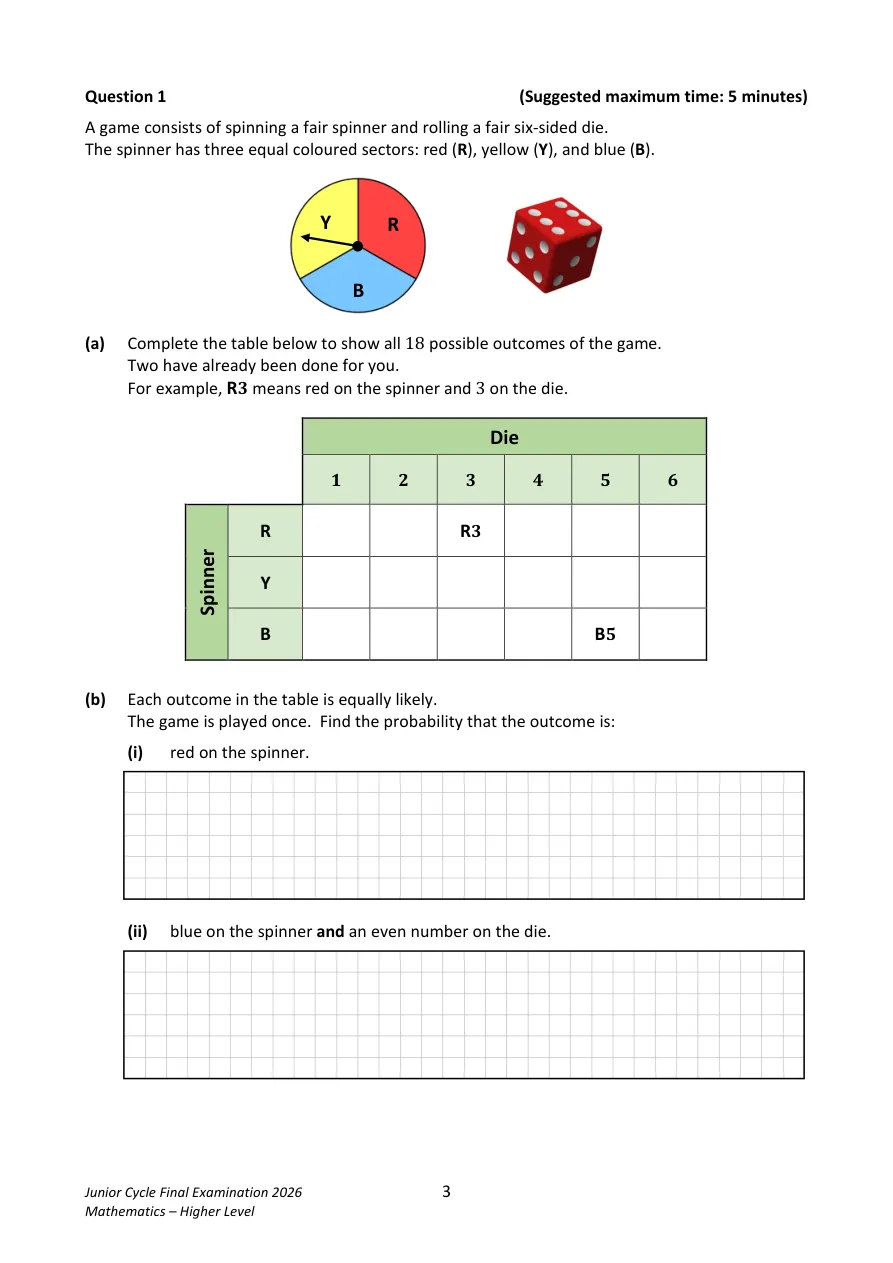
a) Sample space

  1. Rows: R1, R2, R3, R4, R5, R6; Y1, Y2, Y3, Y4, Y5, Y6; B1, B2, B3, B4, B5, B6. There are 18 equally likely outcomes.

b)(i) Red

  1. P(R)=\dfrac{6}{18}
  2. P(R)=\dfrac{1}{3}

b)(ii) Blue and even

  1. P(B\cap\mathrm{even})=\dfrac{3}{18}

    Favourable outcomes: B2, B4, B6.

  2. P(B\cap\mathrm{even})=\dfrac{1}{6}
Question 2

a)(i) Histogram

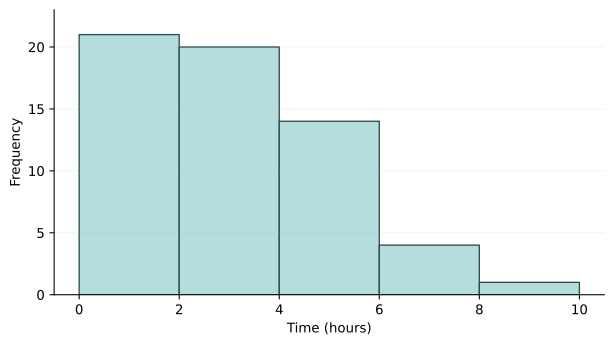
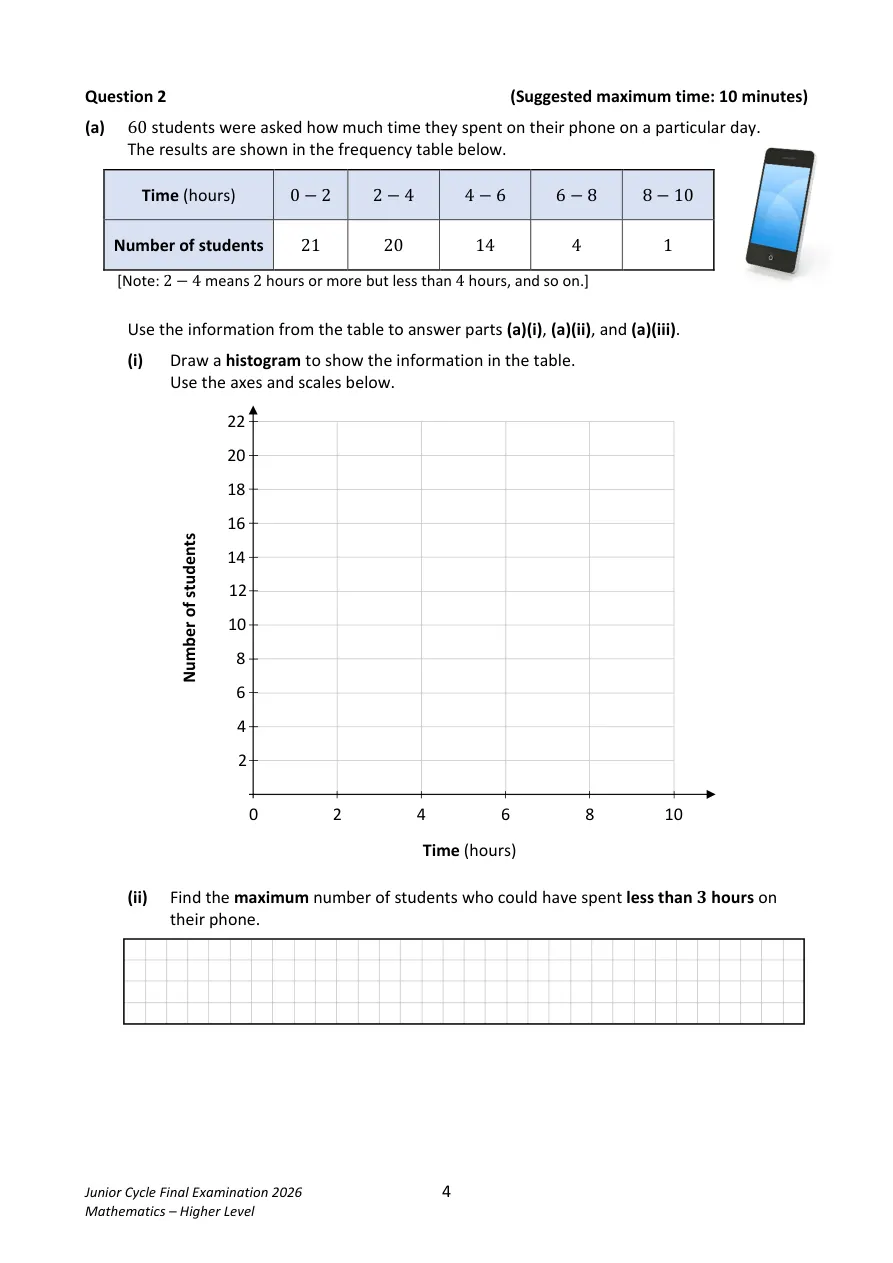
  1. Draw touching bars for 0–2, 2–4, 4–6, 6–8, 8–10 hours, with heights 21, 20, 14, 4 and 1. Label axes and retain the given scale.
  2. 2026-2-hist

a)(ii) Maximum below 3 hours

  1. N=21+20
  2. N=41

    All twenty in the 2–4 band could fall below 3 hours.

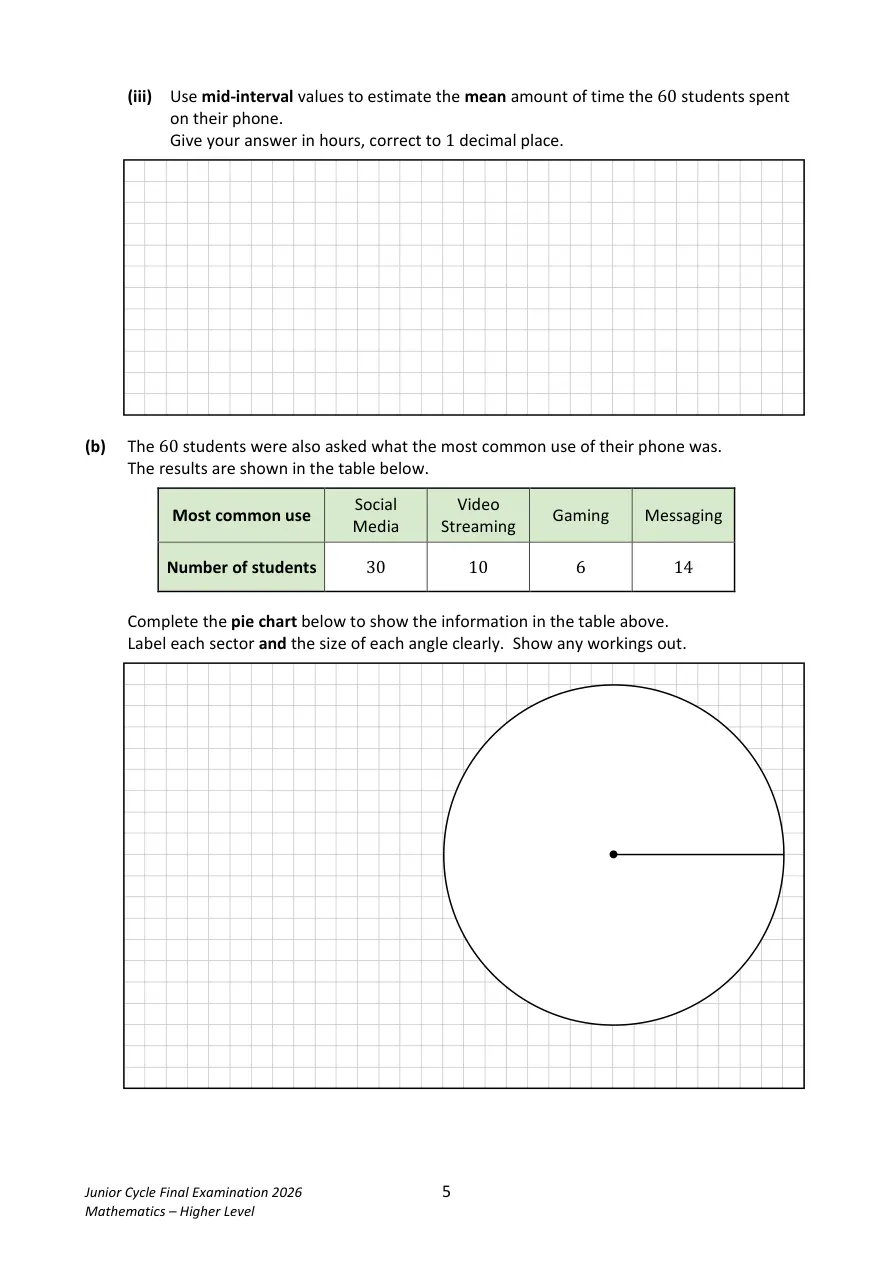
a)(iii) Estimated mean

  1. \bar{x}=\dfrac{21(1)+20(3)+14(5)+4(7)+1(9)}{60}
  2. \bar{x}=\dfrac{188}{60}
  3. \bar{x}\approx3.1\ \mathrm{h}

b) Pie chart

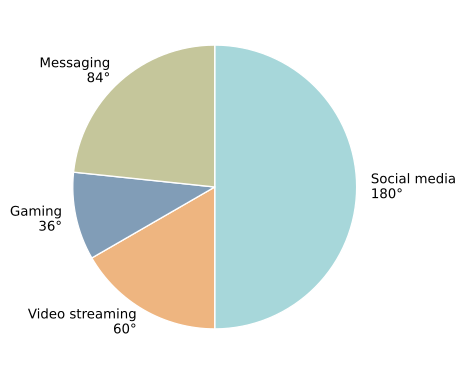
  1. \theta=\dfrac{f}{60}\times360^{\circ}
  2. \theta_{\mathrm{social}}=180^{\circ}
  3. \theta_{\mathrm{video}}=60^{\circ}
  4. \theta_{\mathrm{gaming}}=36^{\circ}
  5. \theta_{\mathrm{messaging}}=84^{\circ}
  6. 180+60+36+84=360

    Check that the sectors fill one circle.

  7. 2026-2-pie

Question 3

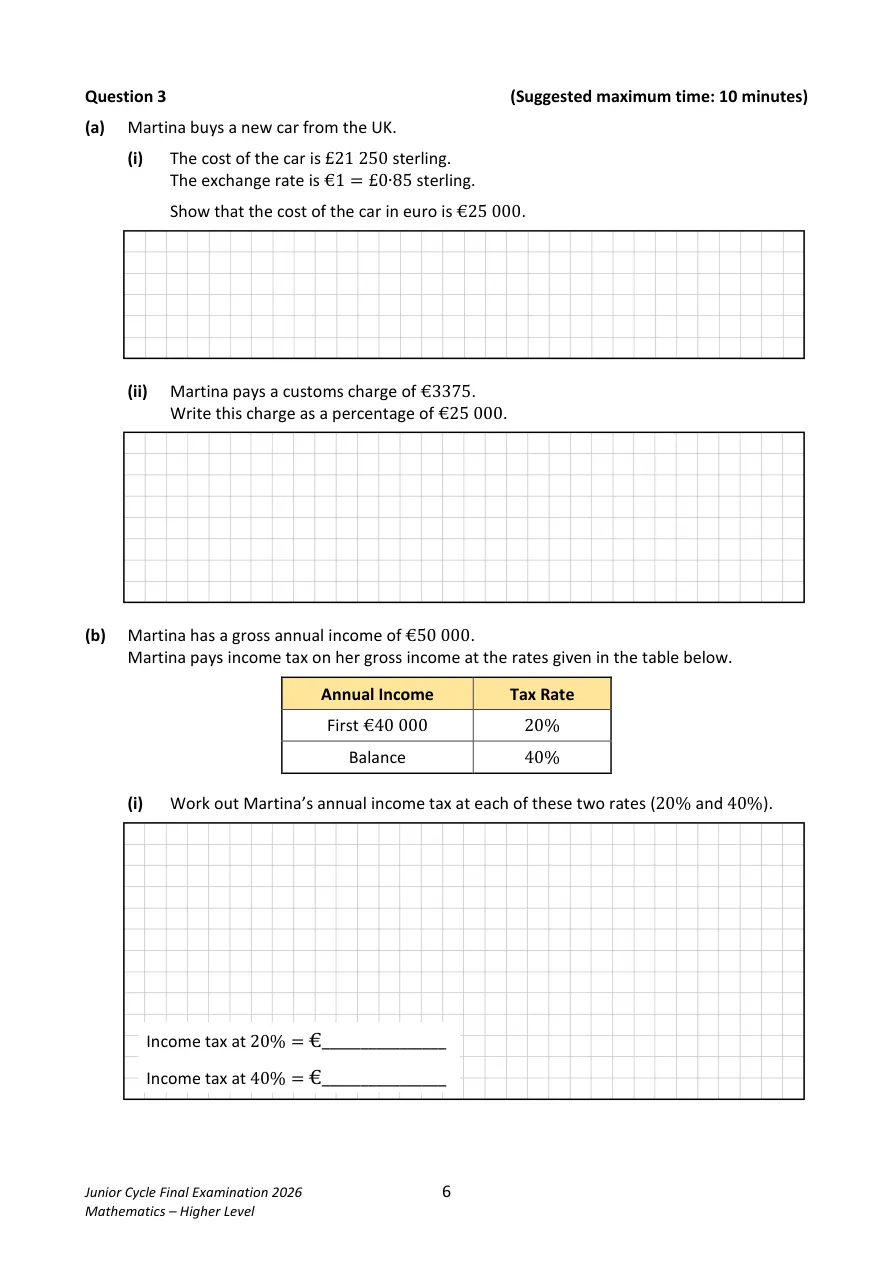
a)(i) Convert sterling

  1. C=\dfrac{21250}{0.85}

    Divide because each euro buys £0.85.

  2. C=\mathrm{€}25000

a)(ii) Customs percentage

  1. p=\dfrac{3375}{25000}\times100
  2. p=13.5\%

b)(i) Income tax

  1. T_{20}=40000(0.20)
  2. T_{20}=\mathrm{€}8000
  3. T_{40}=(50000-40000)(0.40)
  4. T_{40}=\mathrm{€}4000

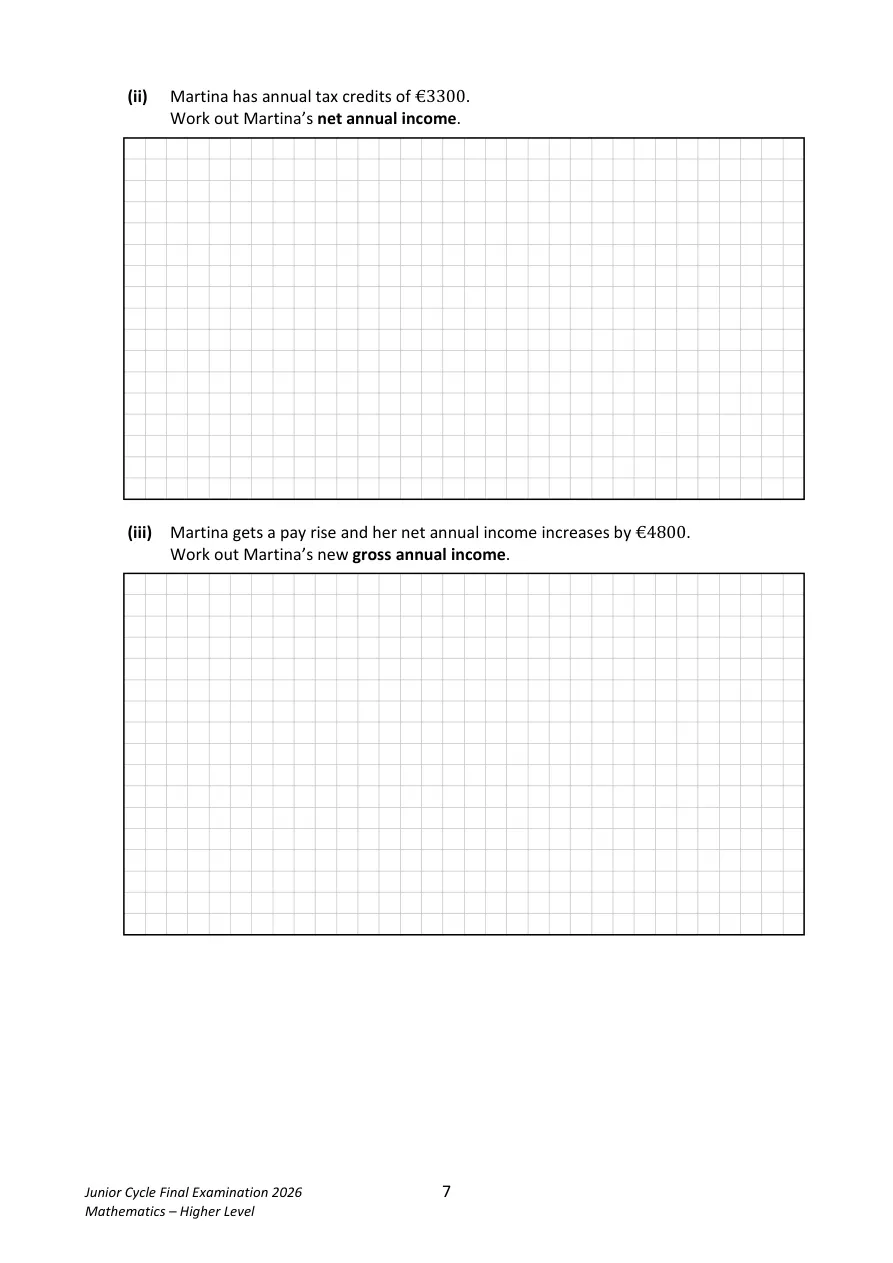
b)(ii) Net income

  1. T=8000+4000-3300
  2. T=8700
  3. N=50000-8700
  4. N=\mathrm{€}41300

b)(iii) New gross income

  1. \mathrm{Net\ fraction\ of\ rise}=1-0.40
  2. \mathrm{Net\ fraction\ of\ rise}=0.60

    The entire rise is in the 40% band; credits and stated rates are unchanged.

  3. \Delta G=\dfrac{4800}{0.60}
  4. \Delta G=8000
  5. G_{\mathrm{new}}=50000+8000
  6. G_{\mathrm{new}}=\mathrm{€}58000
  7. Apply only the tax model supplied in this exam. Other deductions are not part of this question.

Question 4

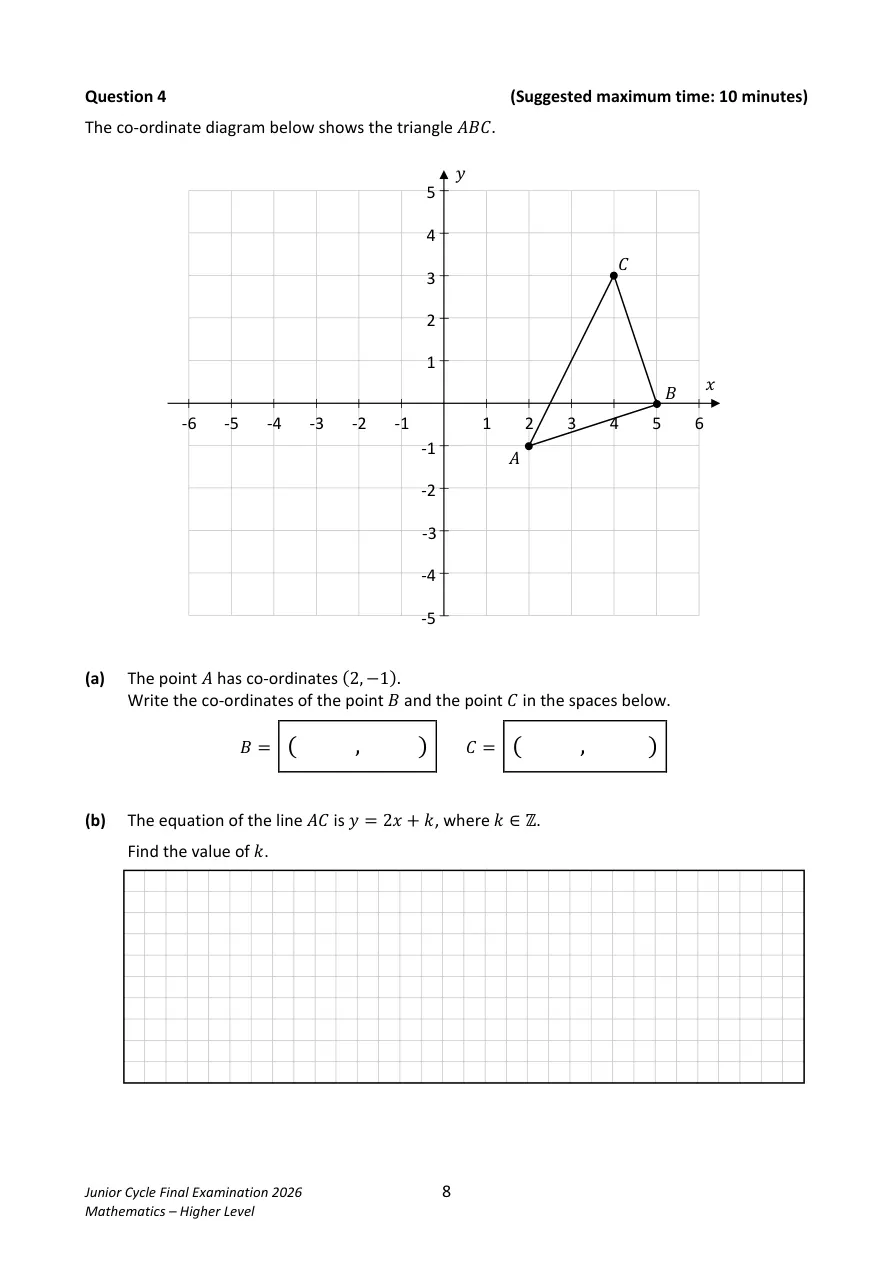
a) Coordinates

  1. B=(5,0),\quad C=(4,3)

b) Find k

  1. -1=2(2)+k

    Substitute the known point A(2,−1).

  2. -1=4+k
  3. k=-5

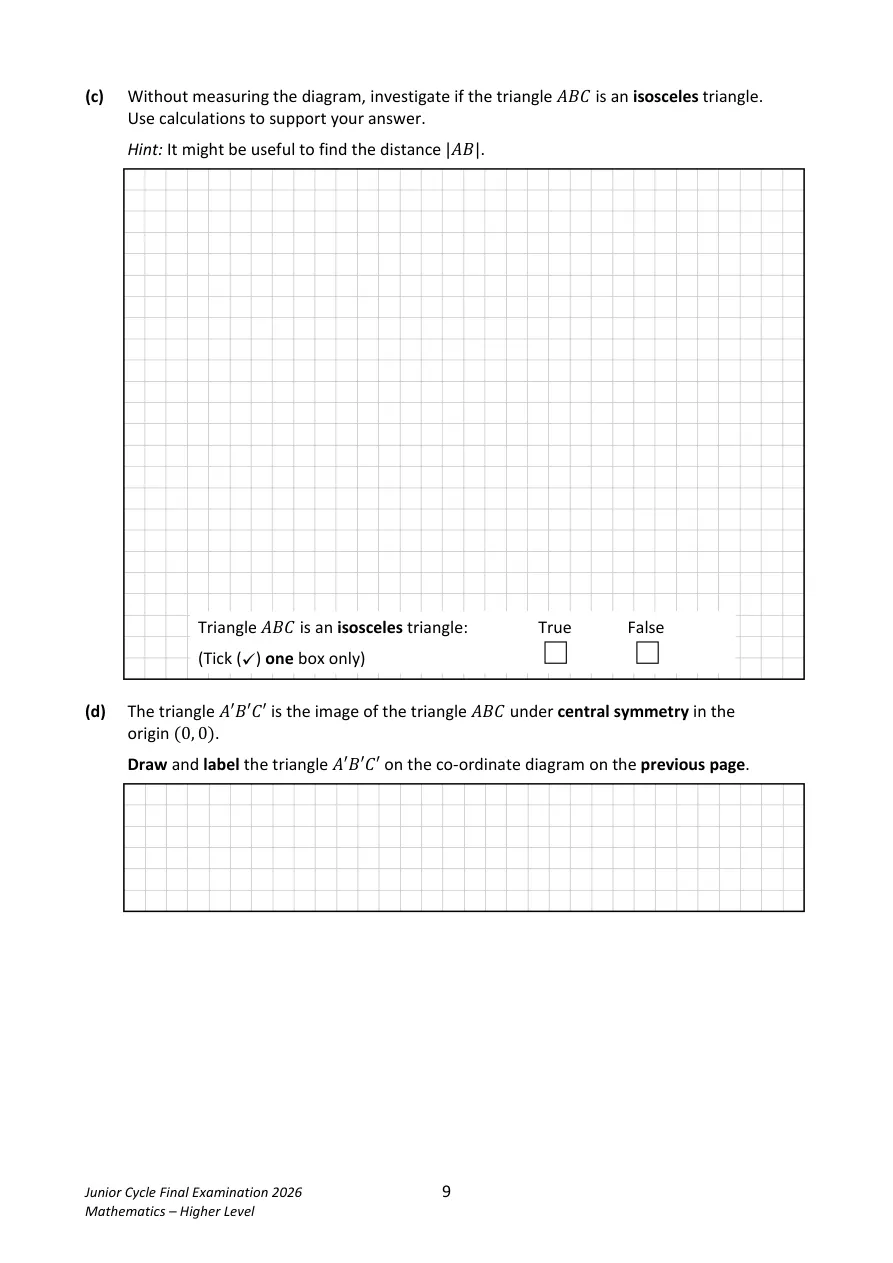
c) Isosceles test

  1. AB^2=(5-2)^2+(0-(-1))^2
  2. AB^2=10
  3. BC^2=(4-5)^2+(3-0)^2
  4. BC^2=10
  5. AB=BC=\sqrt{10}
  6. True: two sides have equal length, so the triangle is isosceles. Its third side AC has squared length 20.

d) Central symmetry in the origin

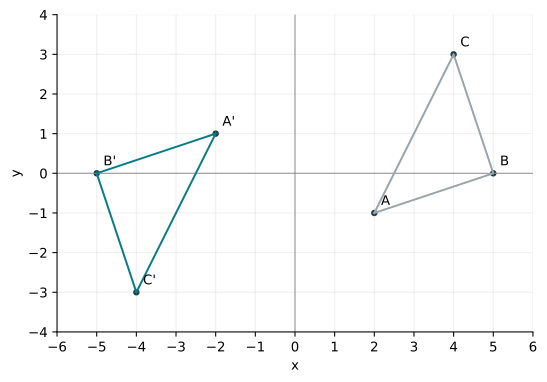
  1. (x,y)\longmapsto(-x,-y)
  2. A'=(-2,1)
  3. B'=(-5,0)
  4. C'=(-4,-3)
  5. Plot the three image points and join them.
  6. 2026-4-coords

Question 5

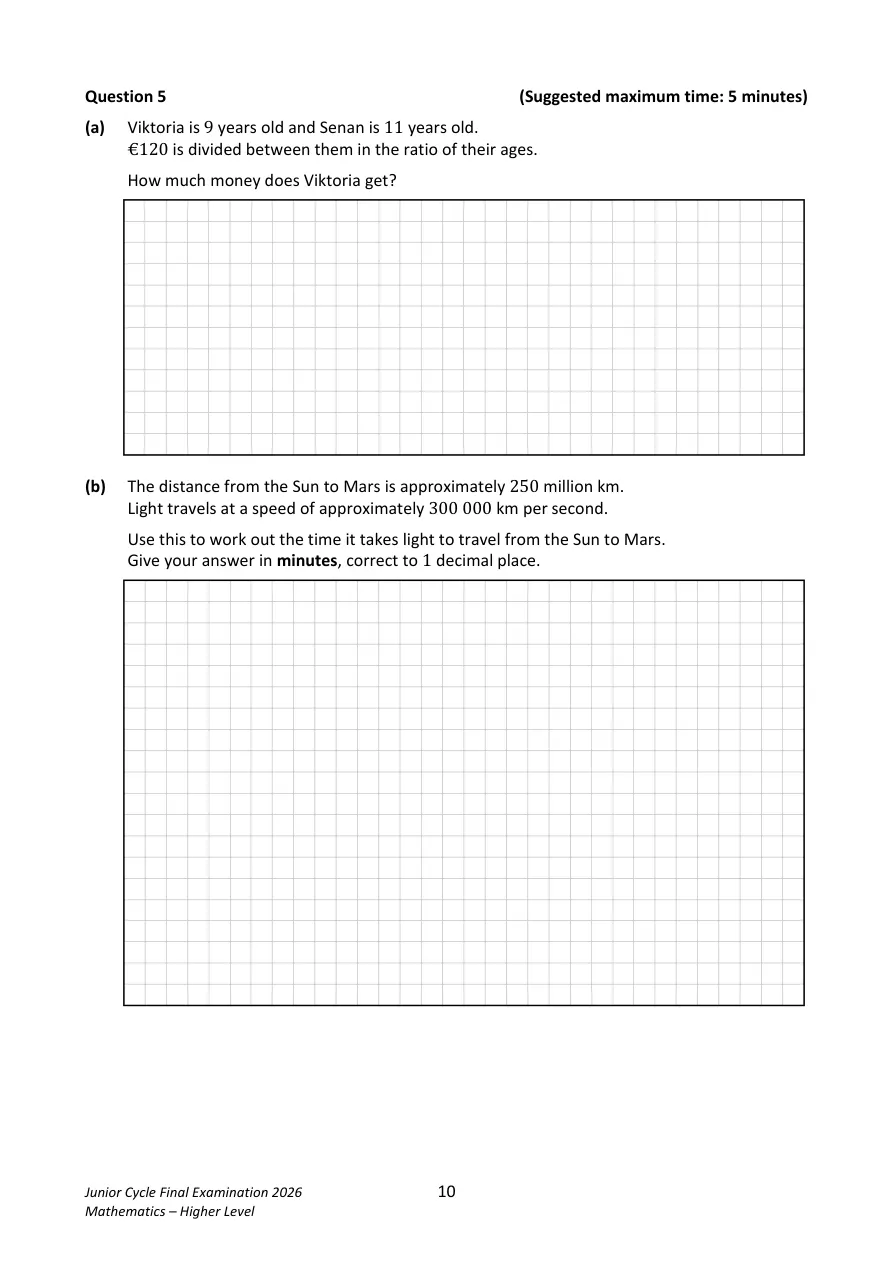
a) Viktoria's share

  1. \mathrm{Total\ parts}=9+11=20
  2. V=\dfrac{9}{20}(120)
  3. V=\mathrm{€}54

b) Travel time

  1. t=\dfrac{\mathrm{distance}}{\mathrm{speed}}
  2. t=\dfrac{250000000}{300000}\ \mathrm{s}
  3. t=\dfrac{250000000}{300000\times60}\ \mathrm{min}
  4. t\approx13.9\ \mathrm{min}

Question 6

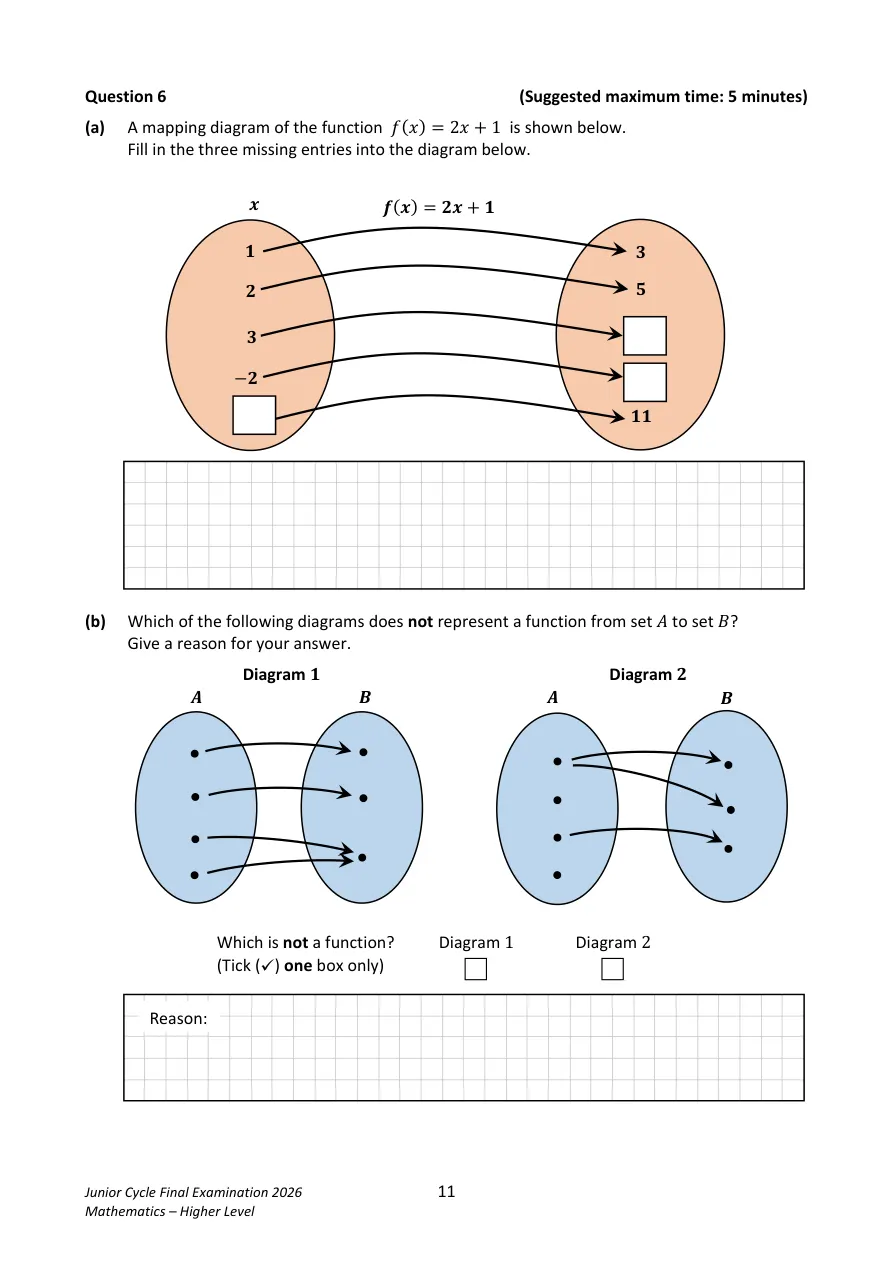
a) Missing entries

  1. f(3)=2(3)+1
  2. f(3)=7
  3. f(-2)=2(-2)+1
  4. f(-2)=-3
  5. 2x+1=11
  6. 2x=10
  7. x=5

b) Not a function

  1. Diagram 2 is not a function: an input in A is connected to two different outputs in B. Each input must have exactly one output. Different inputs may share the same output.

Question 7

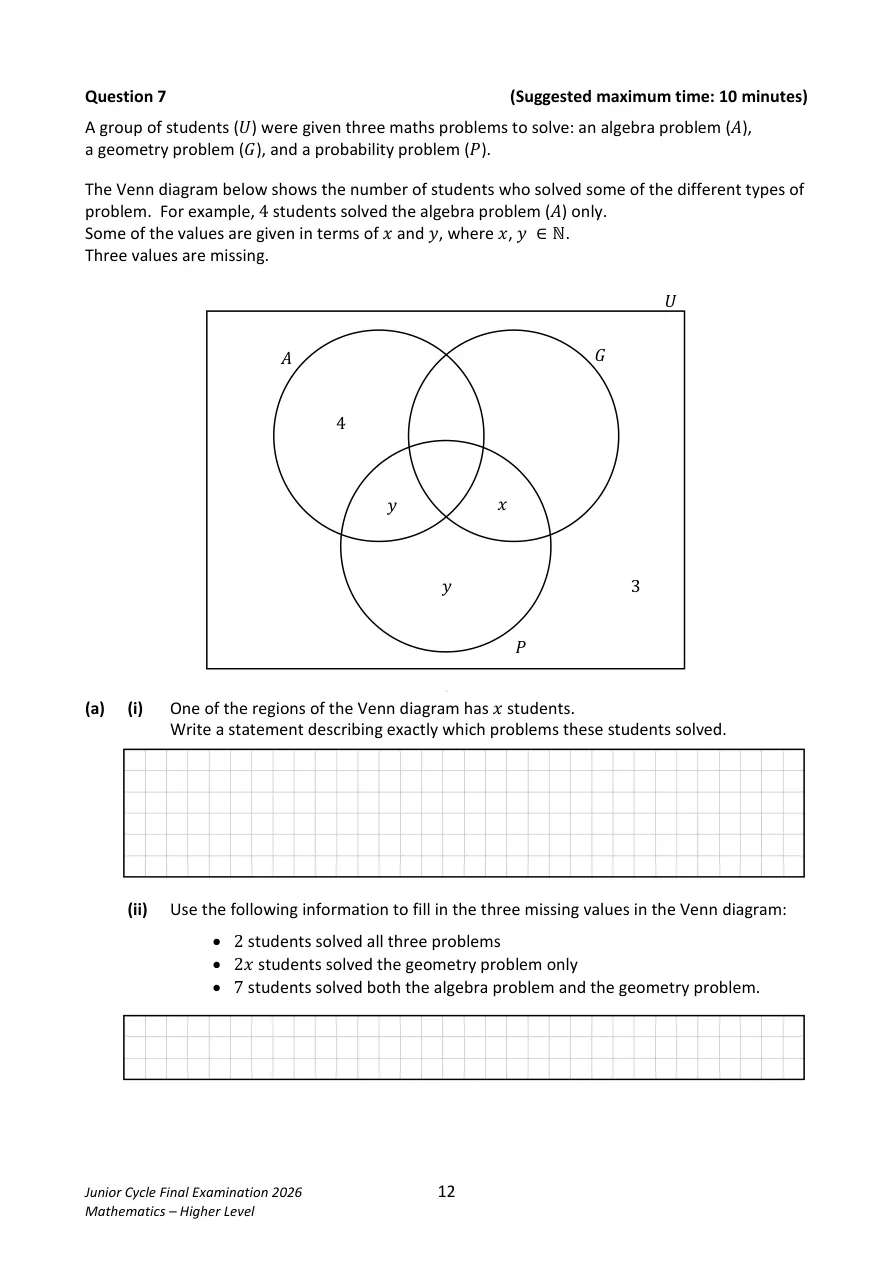
a)(i) Region x

  1. These students solved geometry and probability, but did not solve algebra.

a)(ii) Fill regions

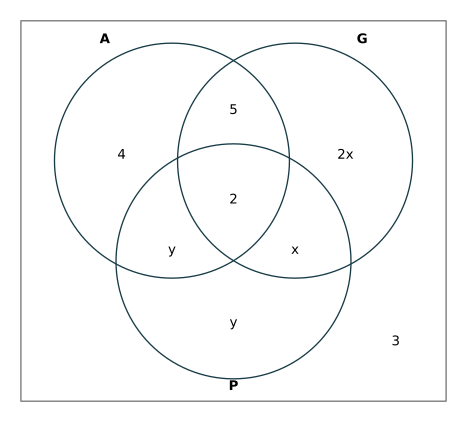
  1. \mathrm{All\ three}=2
  2. \mathrm{Geometry\ only}=2x
  3. \mathrm{Algebra\ and\ geometry\ only}=7-2
  4. \mathrm{Algebra\ and\ geometry\ only}=5

    The stated 7 includes the two who solved all three.

a) Completed Venn diagram

  1. 2026-7-venn

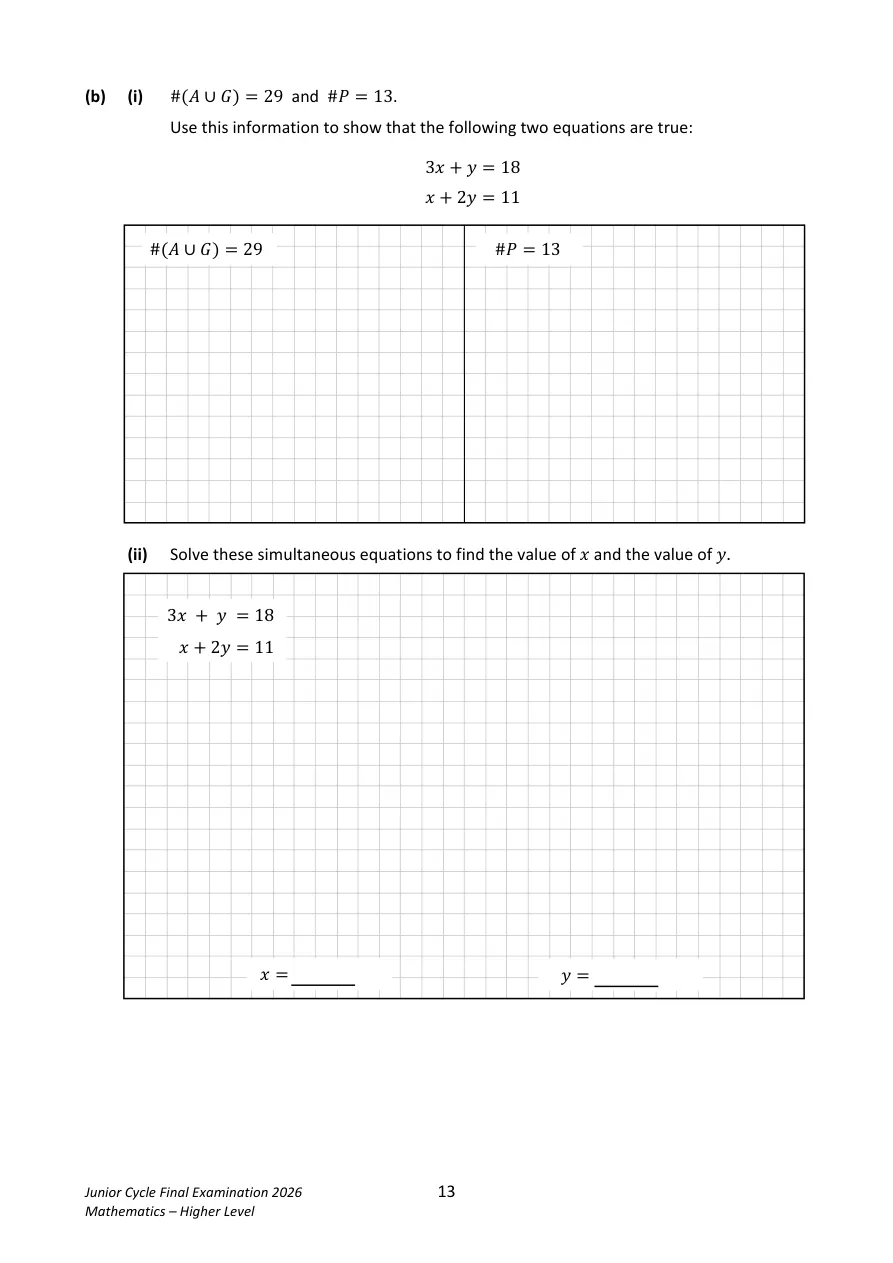
b)(i) Form equations

  1. 4+5+2+y+2x+x=29

    Add all regions belonging to A or G; count overlaps once.

  2. 3x+y+11=29
  3. 3x+y=18
  4. y+2+x+y=13

    Add all four regions inside P.

  5. x+2y+2=13
  6. x+2y=11

b)(ii) Solve

  1. 3x+y=18\qquad(A)
  2. x+2y=11\qquad(B)
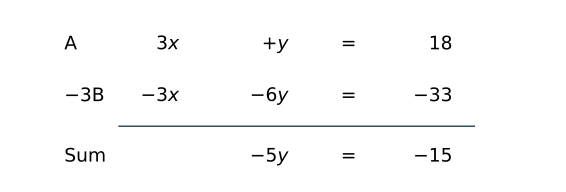
  3. Eliminate x. Multiply every term of B by −3 to give −3x, opposite to +3x in A.
  4. 2026-7-simult
  5. Add the equations to cancel x.
  6. y=\dfrac{-15}{-5}
  7. y=3
  8. x+2(3)=11

    Substitute y into B.

  9. x+6=11
  10. x=5
  11. Check A: 3×5+3 = 18. Check B: 5+2×3 = 11.

Question 8

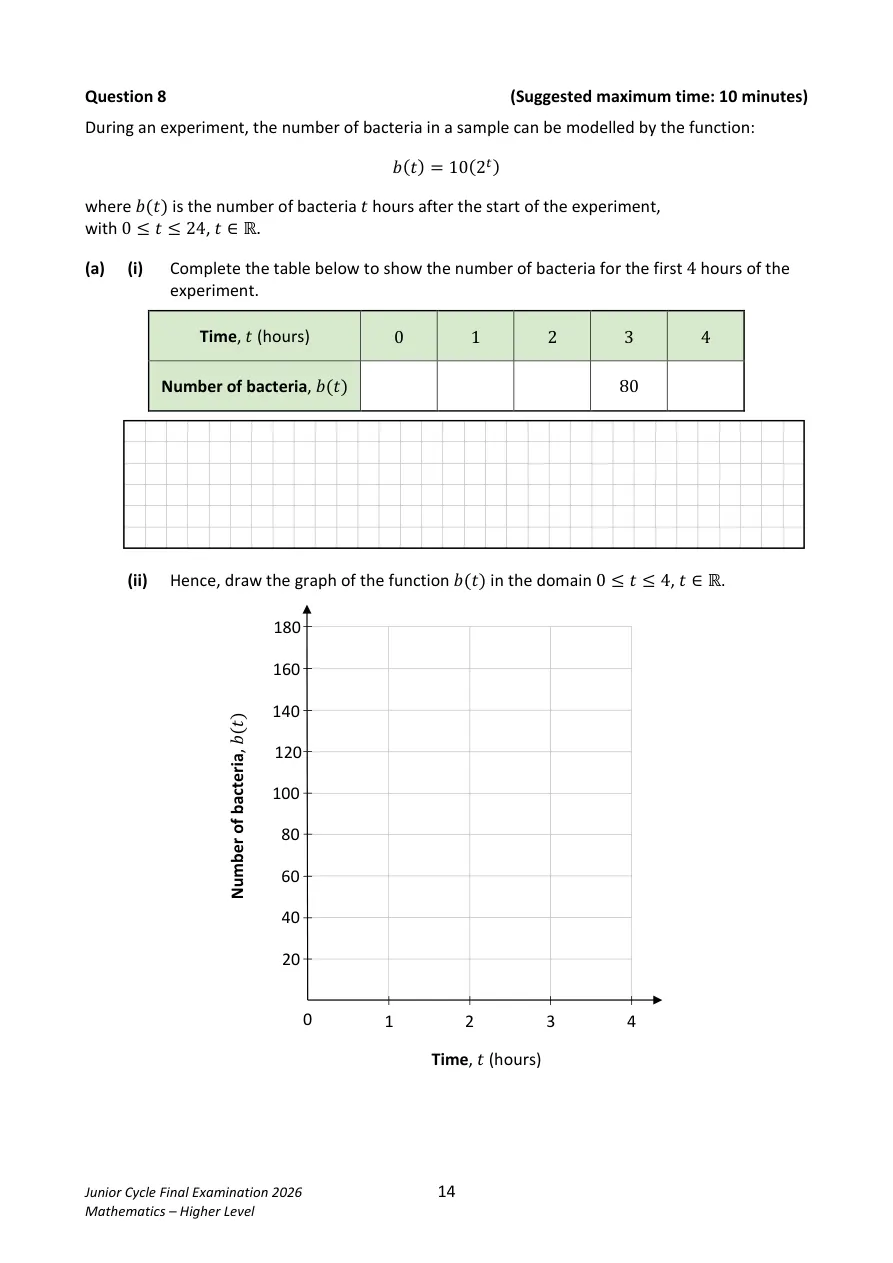
a)(i) Table

  1. b(t)=10(2^t)
  2. b(0)=10,\quad b(1)=20,\quad b(2)=40
  3. b(3)=80,\quad b(4)=160

a)(ii) Graph

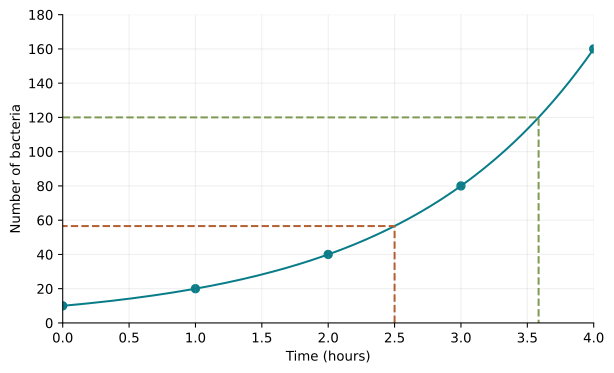
  1. Plot (0,10), (1,20), (2,40), (3,80), (4,160) and draw a smooth increasing exponential curve.
  2. 2026-8-graph

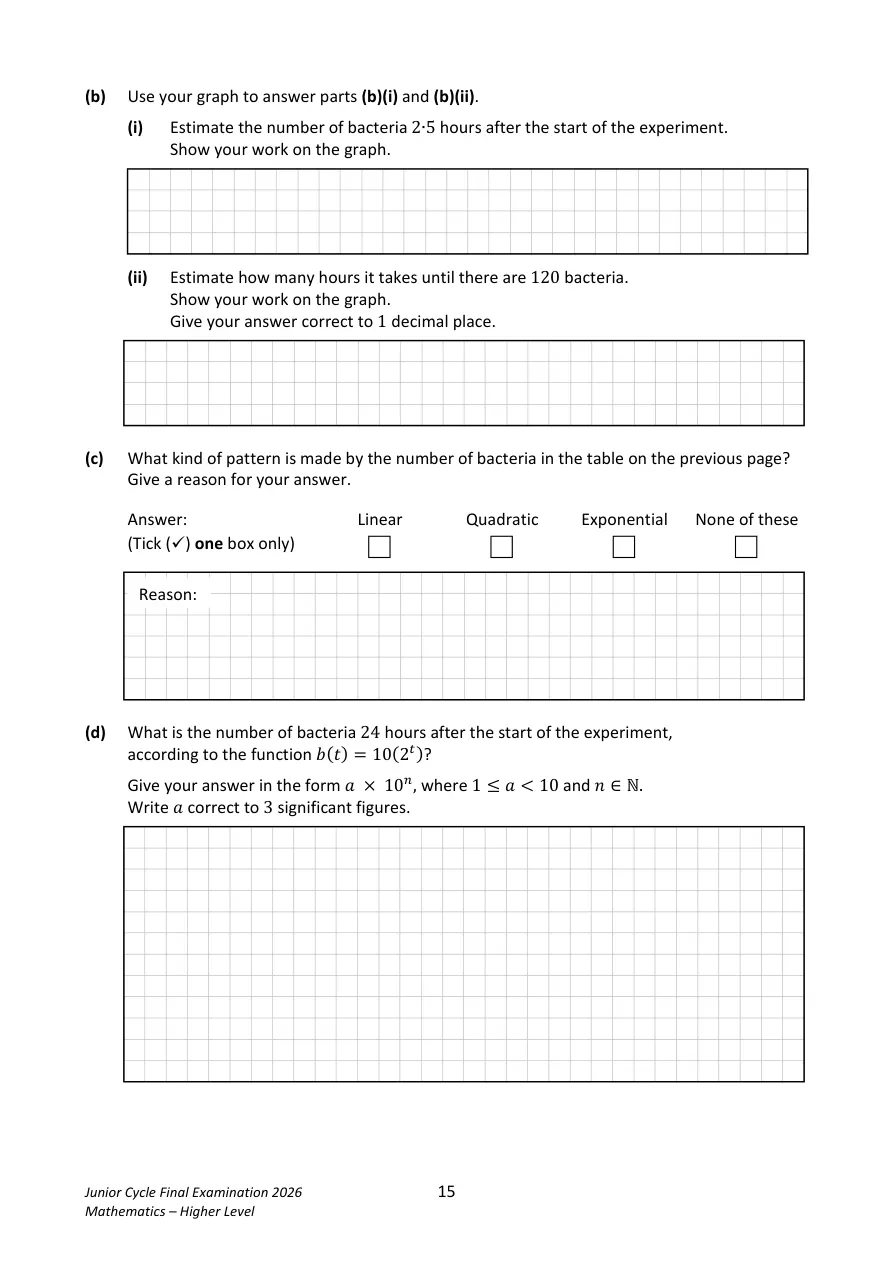
b)(i) At 2.5 hours

  1. b(2.5)\approx57

    Trace up from t=2.5 and across to the vertical axis. Approximately 57 bacteria; the continuous model need not be integer-valued.

b)(ii) Reaches 120

  1. t\approx3.6\ \mathrm{h}

    Trace horizontally from 120 to the curve, then down to the time axis.

c) Pattern type

  1. Exponential: each successive hourly value is multiplied by 2, rather than increasing by a fixed difference.

d) After 24 hours

  1. b(24)=10(2^{24})
  2. b(24)=167772160
  3. b(24)=1.67772160\times10^8
  4. b(24)\approx1.68\times10^8

    Round the coefficient to three significant figures.

Question 9

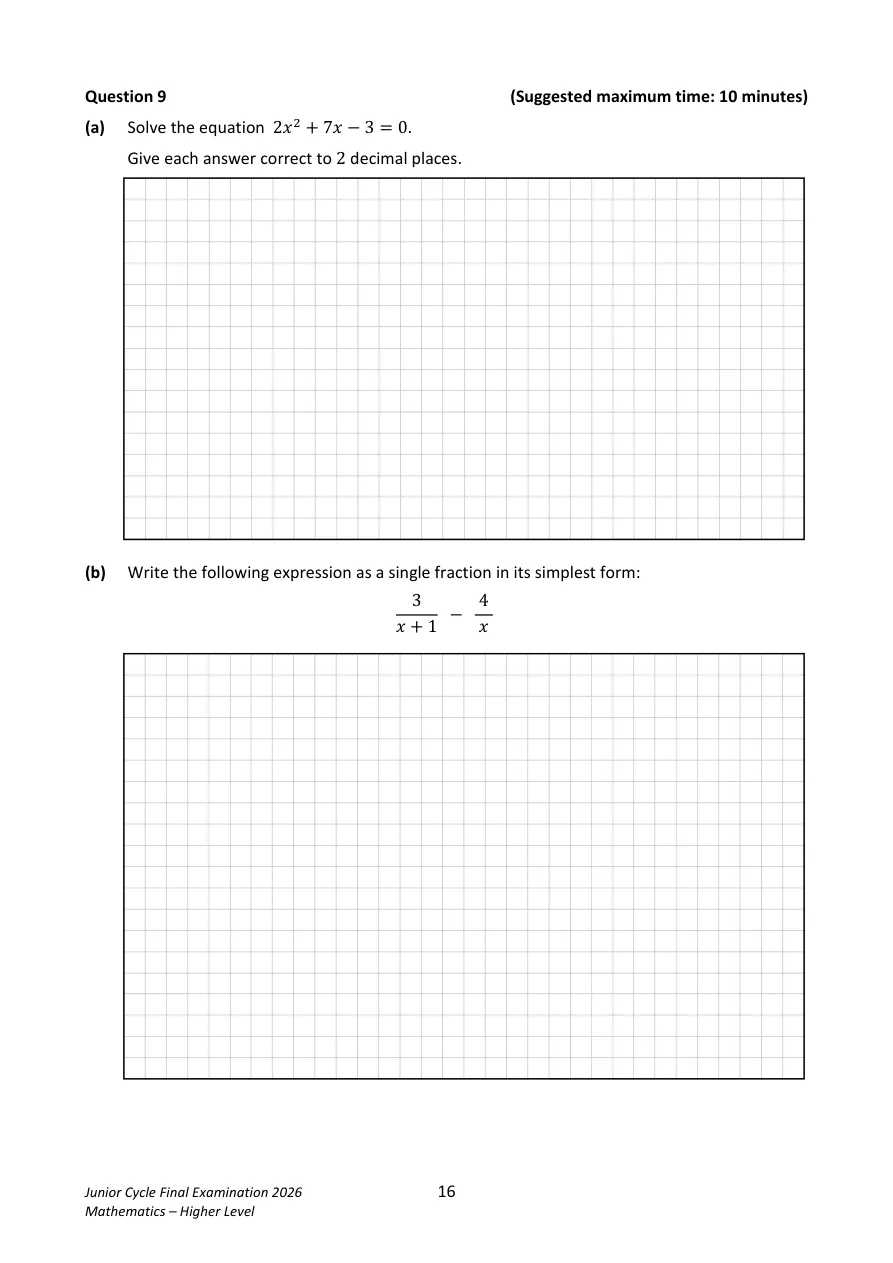
a) Solve the quadratic

  1. a=2,\quad b=7,\quad c=-3

    a is the coefficient of x², b is the coefficient of x, and c is the constant. Take the signs with the numbers.

  2. x=\dfrac{-b\pm\sqrt{b^2-4ac}}{2a}

    Use the quadratic formula after writing the equation in the form ax² + bx + c = 0.

  3. x=\dfrac{-7\pm\sqrt{7^2-4(2)(-3)}}{2(2)}

    Use brackets when substituting negative numbers, especially when squaring b.

  4. x=\dfrac{-7\pm\sqrt{73}}{4}
  5. x\approx0.39\quad\mathrm{or}\quad x\approx-3.89

b) Single fraction

  1. \dfrac{3}{x+1}-\dfrac{4}{x}
  2. \dfrac{3x-4(x+1)}{x(x+1)}
  3. \dfrac{3x-4x-4}{x(x+1)}
  4. \dfrac{-x-4}{x(x+1)}
  5. x\ne0,\quad x\ne-1

c) Find coefficients

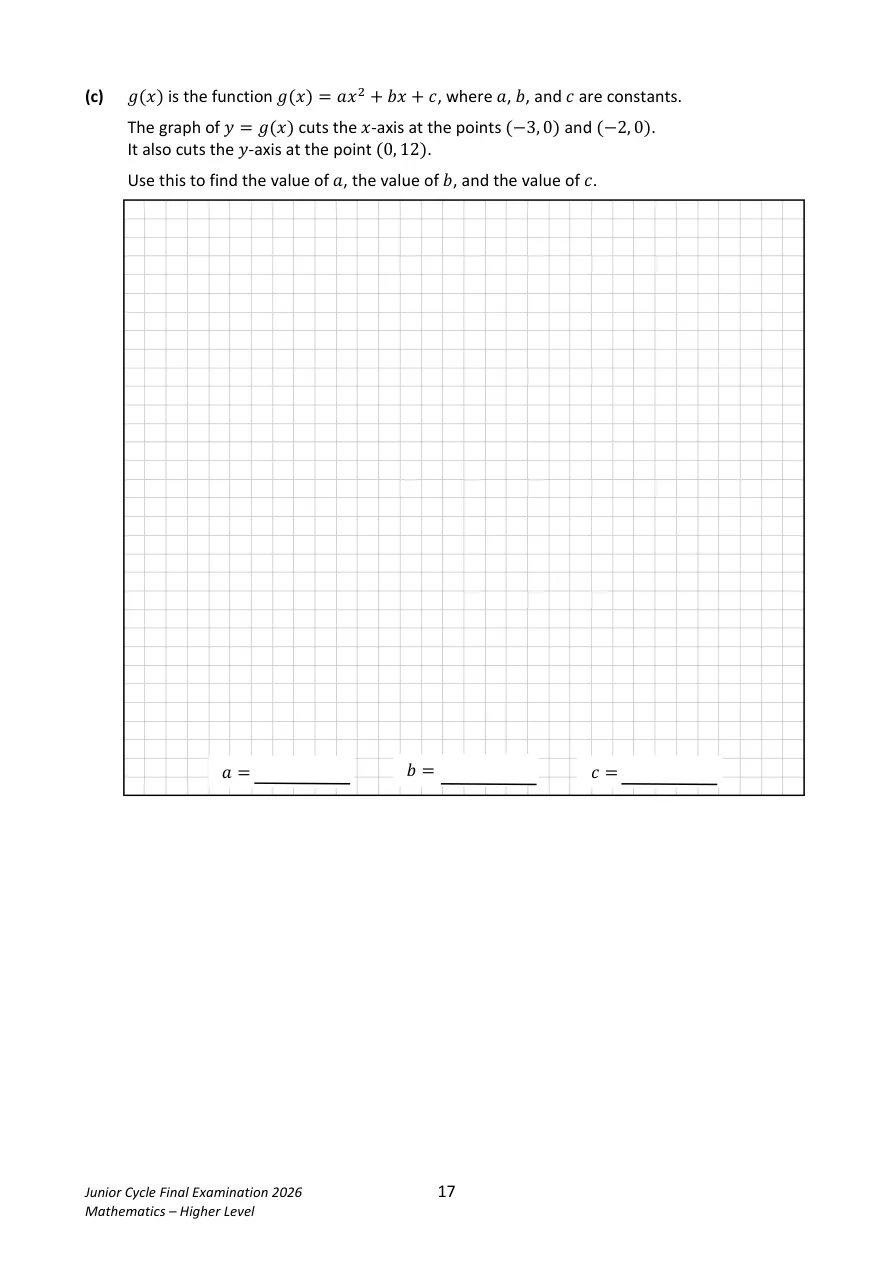
  1. g(x)=a(x+3)(x+2)

    Roots −3 and −2 give the factors.

  2. 12=a(3)(2)

    Use the y-intercept (0,12).

  3. a=2
  4. g(x)=2(x+3)(x+2)
  5. g(x)=2(x^2+5x+6)
  6. g(x)=2x^2+10x+12
  7. a=2,\quad b=10,\quad c=12

    a is the coefficient of x², b is the coefficient of x, and c is the constant. Take the signs with the numbers.

Question 10

a)(i) Square

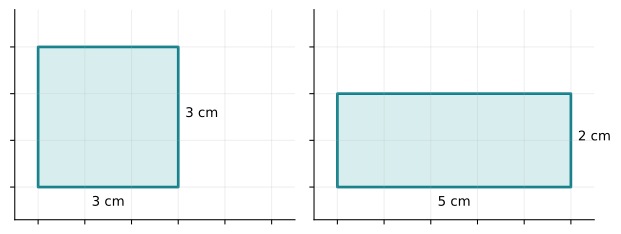
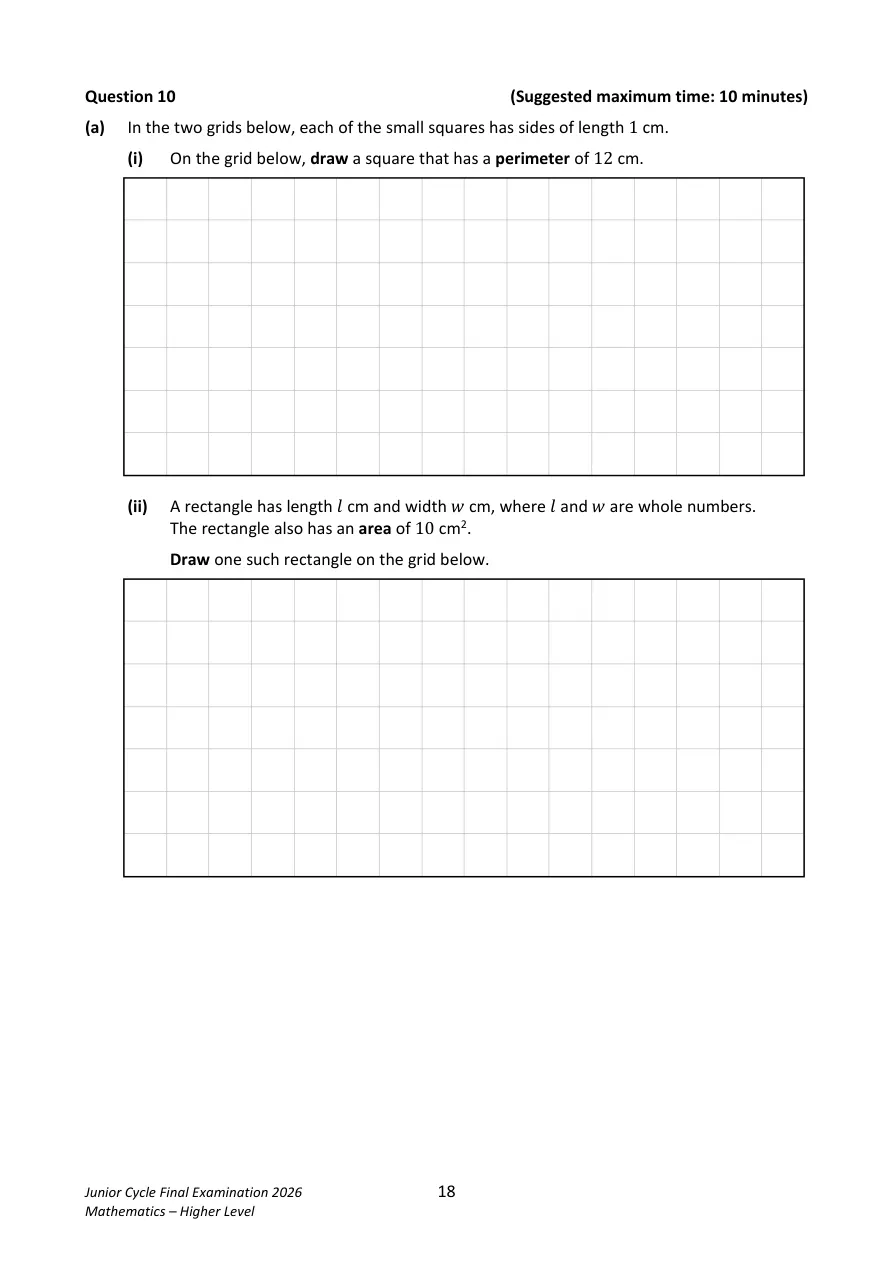
  1. 4s=12
  2. s=3\ \mathrm{cm}
  3. Draw a 3 cm × 3 cm square on the unit grid.

a)(ii) Rectangle

  1. l=5\ \mathrm{cm},\quad w=2\ \mathrm{cm}
  2. A=5(2)=10\ \mathrm{cm}^2
  3. Draw a 5 cm × 2 cm rectangle. A 10 cm × 1 cm rectangle is also valid if it fits the grid.
  4. 2026-10-shapes

b)(i) Base k

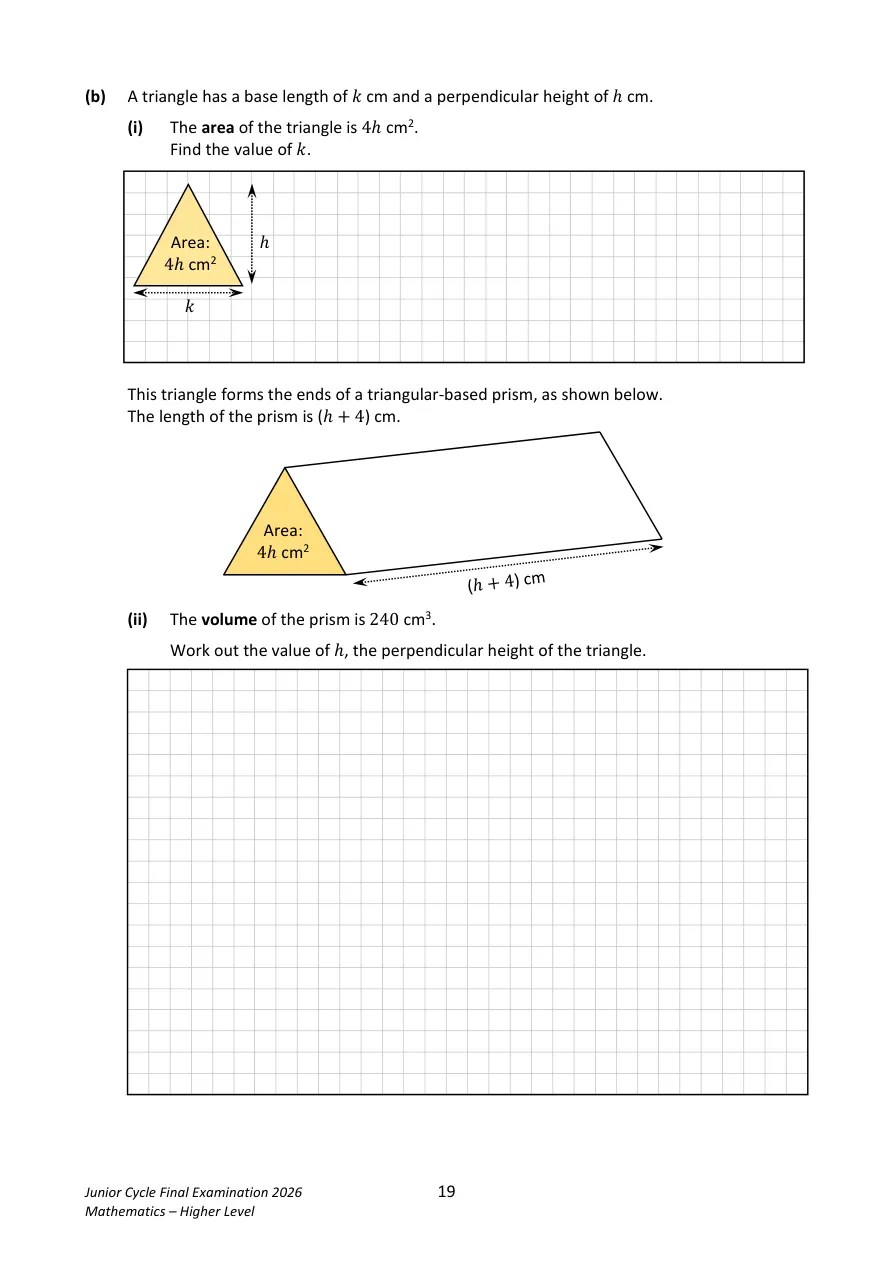
  1. A=\dfrac{1}{2}kh
  2. \dfrac{1}{2}kh=4h
  3. \dfrac{k}{2}=4

    Divide by h, which is positive for this triangle.

  4. k=8

b)(ii) Prism height

  1. V=\mathrm{cross\!\! -\!sectional\ area}\times\mathrm{length}
  2. 4h(h+4)=240
  3. h(h+4)=60
  4. h^2+4h-60=0
  5. (h+10)(h-6)=0

    The product is zero, so at least one of the factors must be zero. Set each factor equal to zero in turn.

  6. h=-10\quad\mathrm{or}\quad h=6
  7. h=6\ \mathrm{cm}

    A physical height cannot be negative.

Question 11

a) Check slope

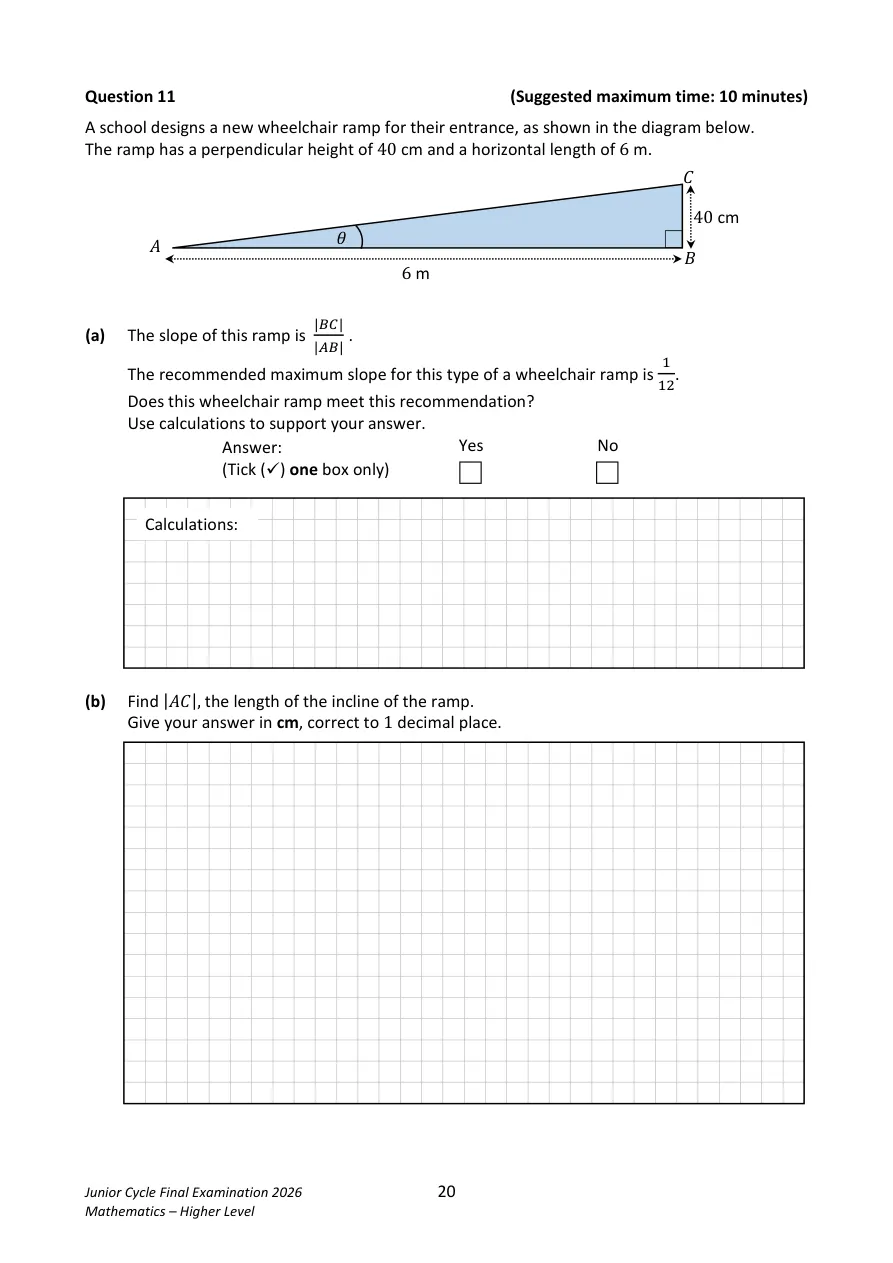
  1. 6\ \mathrm{m}=600\ \mathrm{cm}
  2. m=\dfrac{40}{600}
  3. m=\dfrac{1}{15}
  4. \dfrac{1}{15}<\dfrac{1}{12}
  5. Yes: its slope is less than the recommended maximum.

b) Incline length

  1. AC^2=600^2+40^2
  2. AC^2=361600
  3. AC=\sqrt{361600}
  4. AC\approx601.3\ \mathrm{cm}

c) Angle

  1. \tan\theta=\dfrac{40}{600}
  2. \theta=\tan^{-1}\left(\dfrac{40}{600}\right)
  3. \theta\approx3.8^{\circ}

d) Other ramp

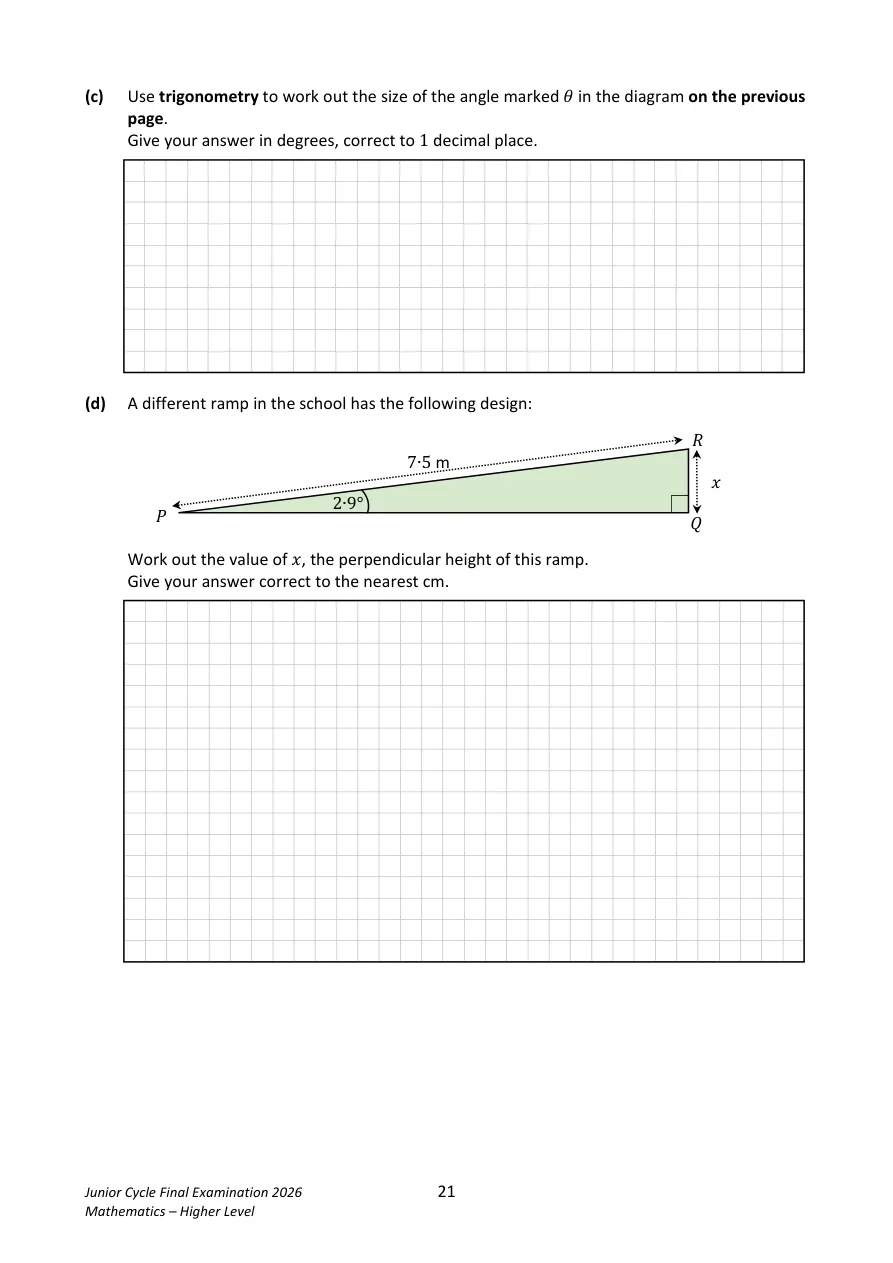
  1. x=7.5\sin2.9^{\circ}\ \mathrm{m}

    Opposite = hypotenuse × sine.

  2. x=750\sin2.9^{\circ}\ \mathrm{cm}
  3. x\approx38\ \mathrm{cm}

Question 12

a) Angles a and b

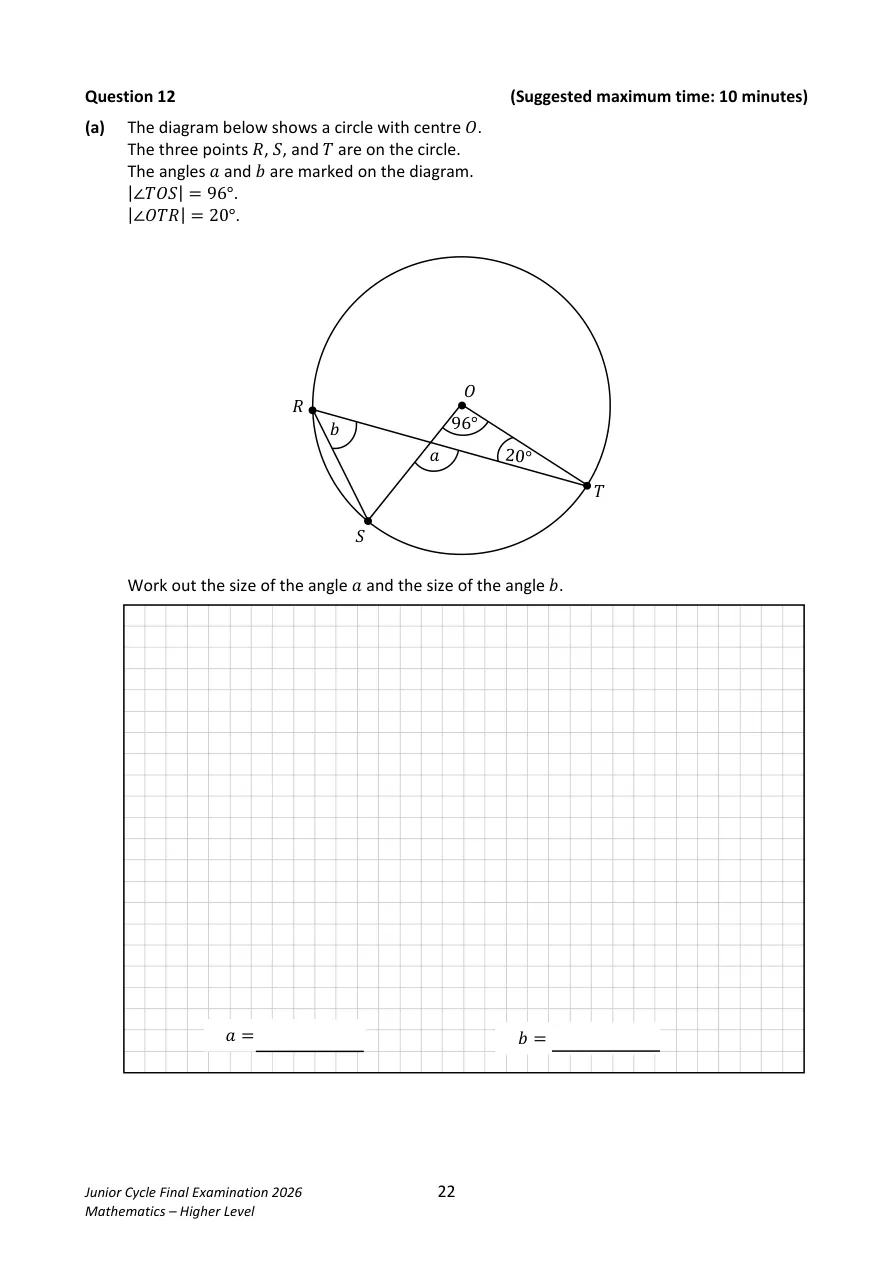
  1. Let X be the intersection of OS and RT. Use triangle OXT to find its angle at X first.
  2. \angle OXT=180^{\circ}-96^{\circ}-20^{\circ}
  3. \angle OXT=64^{\circ}
  4. a=180^{\circ}-64^{\circ}

    Angles OXT and a lie on a straight line because O, X and S are collinear.

  5. a=116^{\circ}
  6. b=\dfrac{96^{\circ}}{2}

    Angle SRT at the circumference is half angle SOT at the centre, on the same arc ST.

  7. b=48^{\circ}

b) Construct triangle ABC

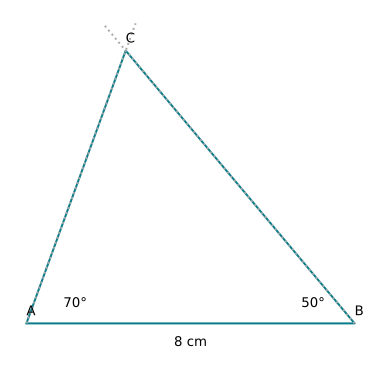
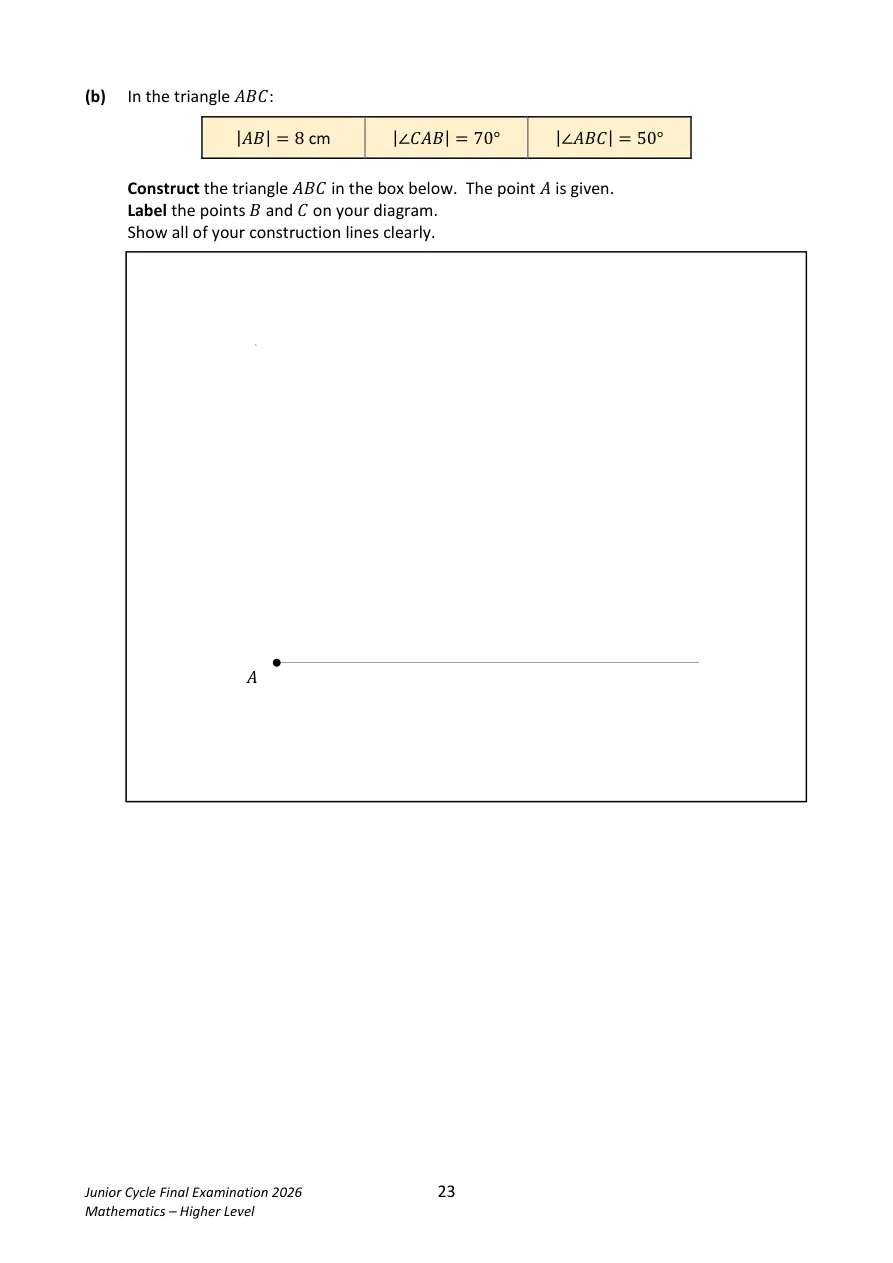
  1. Draw AB = 8 cm from the supplied point A. Construct a ray at 70° to AB at A, and a ray at 50° to BA at B. Their intersection is C. Label B and C and retain the construction rays. The remaining angle is 60°.
  2. 2026-12-triangle

Question 13

Solution

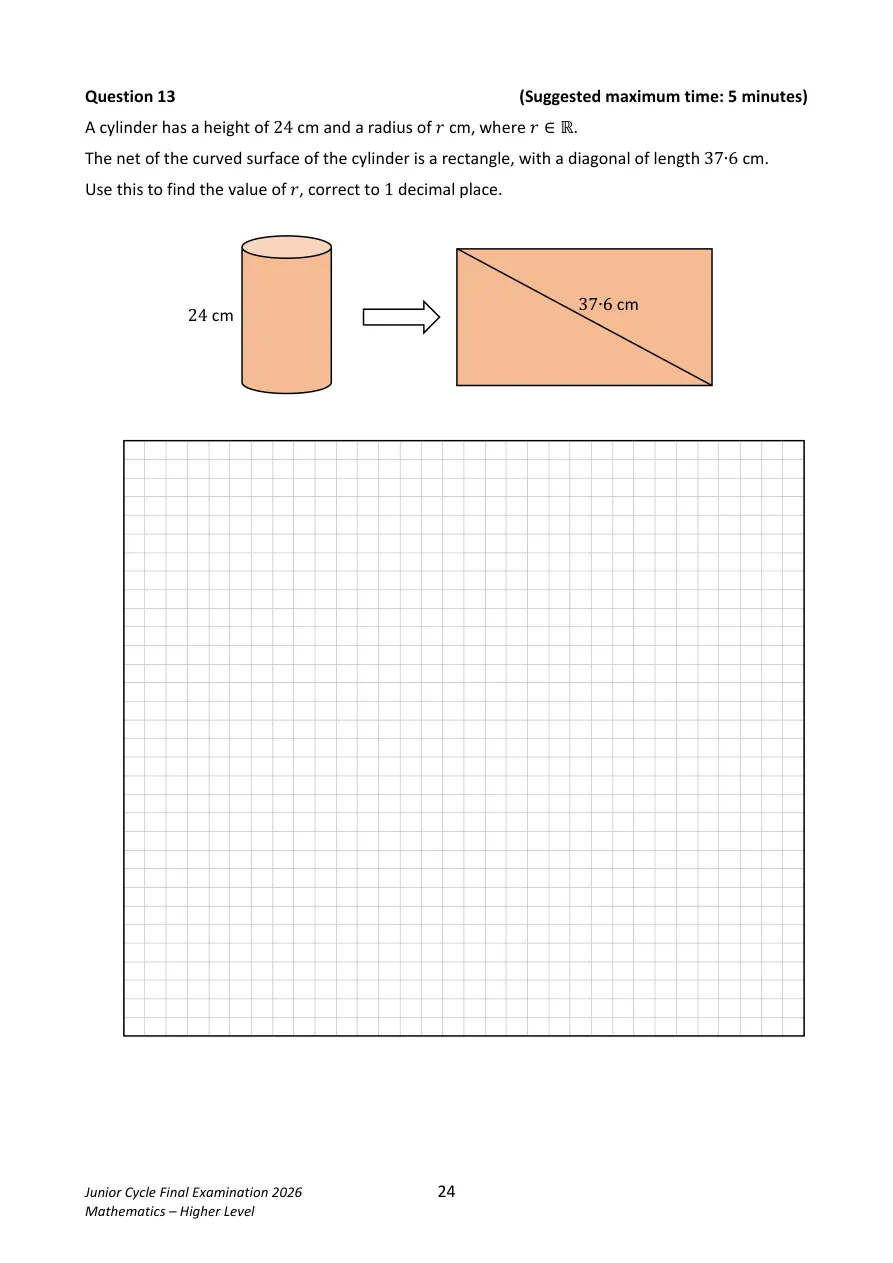
  1. w^2+24^2=37.6^2

    Unrolling the curved surface gives a rectangle. Its width is the cylinder's circumference.

  2. w^2=37.6^2-24^2
  3. w^2=837.76
  4. w=\sqrt{837.76}
  5. 2\pi r=\sqrt{837.76}
  6. r=\dfrac{\sqrt{837.76}}{2\pi}
  7. r\approx4.6\ \mathrm{cm}
See working and diagrams on the original paper
Original exam paper page 3
R1R2R4R5R6Y1Y2Y3Y4Y5Y6B1B2B3B4B6
P(R)=\dfrac{6}{18}
P(R)=\dfrac{1}{3}
P(B\cap\mathrm{even})=\dfrac{3}{18}
[Favourable outcomes: B2, B4, B6.]
P(B\cap\mathrm{even})=\dfrac{1}{6}
Original exam paper page 4
N=21+20
N=41
[All twenty in the 2–4 band could fall below 3 hours.]
Original exam paper page 5
\bar{x}=\dfrac{21(1)+20(3)+14(5)+4(7)+1(9)}{60}
[Use class midpoints.]
\bar{x}=\dfrac{188}{60}
\bar{x}\approx3.1\ \mathrm{h}
\theta=\dfrac{f}{60}\times360^{\circ}
\theta_{\mathrm{social}}=180^{\circ}
\theta_{\mathrm{video}}=60^{\circ}
\theta_{\mathrm{gaming}}=36^{\circ}
\theta_{\mathrm{messaging}}=84^{\circ}
180+60+36+84=360
[Check that the sectors fill one circle.]
Social mediaVideoGamingMessaging
Original exam paper page 6
C=\dfrac{21250}{0.85}
[Divide because each euro buys £0.85.]
C=\mathrm{€}25000
p=\dfrac{3375}{25000}\times100
p=13.5\%
T_{20}=40000(0.20)
T_{20}=\mathrm{€}8000
T_{40}=(50000-40000)(0.40)
T_{40}=\mathrm{€}4000
Original exam paper page 7
T=8000+4000-3300
T=8700
N=50000-8700
N=\mathrm{€}41300
\mathrm{Net\ fraction\ of\ rise}=1-0.40
\mathrm{Net\ fraction\ of\ rise}=0.60
\Delta G=\dfrac{4800}{0.60}
[Only 60% of the rise remains after tax.]
\Delta G=8000
G_{\mathrm{new}}=50000+8000
G_{\mathrm{new}}=\mathrm{€}58000
Apply only the tax model supplied in this exam. Other deductions are not part of this question.
Original exam paper page 8
5, 0
4, 3
-1=2(2)+k
[Substitute the known point A(2,−1).]
-1=4+k
k=-5
A'B'C'
Original exam paper page 9
AB^2=(5-2)^2+(0-(-1))^2
AB^2=10
BC^2=(4-5)^2+(3-0)^2
BC^2=10
AB=BC=\sqrt{10}
True: two sides have equal length, so the triangle is isosceles. Its third side AC has squared length 20.
(x,y)\longmapsto(-x,-y)
Plot the three image points and join them.
A'=(-2,1)
B'=(-5,0)
C'=(-4,-3)
Original exam paper page 10
\mathrm{Total\ parts}=9+11=20
V=\dfrac{9}{20}(120)
V=\mathrm{€}54
t=\dfrac{\mathrm{distance}}{\mathrm{speed}}
t=\dfrac{250000000}{300000}\ \mathrm{s}
t=\dfrac{250000000}{300000\times60}\ \mathrm{min}
[Divide seconds by 60.]
t\approx13.9\ \mathrm{min}
Original exam paper page 11
f(3)=2(3)+1
f(3)=7
f(-2)=2(-2)+1
f(-2)=-3
2x+1=11
2x=10
x=5
7
-3
5
Diagram 2 is not a function: an input in A is connected to two different outputs in B. Each input must have exactly one output. Different inputs may share the same output.
Original exam paper page 12
These students solved geometry and probability, but did not solve algebra.
All three = 2; geometry only = 2x
Algebra and geometry only = 7 - 2 = 5
2x25
Original exam paper page 13
4+5+2+y+2x+x=29
[Add all regions belonging to A or G; count overlaps once.]
3x+y+11=29
3x+y=18
y+2+x+y=13
[Add all four regions inside P.]
x+2y+2=13
x+2y=11
3x+y=18\qquad(A)
x+2y=11\qquad(B)
Eliminate x. Multiply every term of B by −3 to give −3x, opposite to +3x in A.
Add the equations to cancel x.
y=\dfrac{-15}{-5}
y=3
x+2(3)=11
[Substitute y into B.]
x+6=11
x=5
Check A: 3×5+3 = 18. Check B: 5+2×3 = 11.
-3x - 6y = -33 3x + y = 18 -5y = -15
Original exam paper page 14
b(t)=10(2^t)
b(0)=10,\quad b(1)=20,\quad b(2)=40
b(3)=80,\quad b(4)=160
10
20
40
160
Original exam paper page 15
b(2.5)\approx57
[Trace up from t=2.5 and across to the vertical axis. Approximately 57 bacteria; the continuous model need not be integer-valued.]
t\approx3.6\ \mathrm{h}
[Trace horizontally from 120 to the curve, then down to the time axis.]
Exponential: each successive hourly value is multiplied by 2, rather than increasing by a fixed difference.
b(24)=10(2^{24})
b(24)=167772160
b(24)=1.67772160\times10^8
b(24)\approx1.68\times10^8
[Round the coefficient to three significant figures.]
Original exam paper page 16
a=2,\quad b=7,\quad c=-3
x=\dfrac{-b\pm\sqrt{b^2-4ac}}{2a}
x=\dfrac{-7\pm\sqrt{7^2-4(2)(-3)}}{2(2)}
[Keep the negative sign on c.]
x=\dfrac{-7\pm\sqrt{73}}{4}
x\approx0.39\quad\mathrm{or}\quad x\approx-3.89
\dfrac{3}{x+1}-\dfrac{4}{x}
\dfrac{3x-4(x+1)}{x(x+1)}
\dfrac{3x-4x-4}{x(x+1)}
\dfrac{-x-4}{x(x+1)}
x\ne0,\quad x\ne-1
Original exam paper page 17
g(x)=a(x+3)(x+2)
[Roots −3 and −2 give the factors.]
12=a(3)(2)
[Use the y-intercept (0,12).]
a=2
g(x)=2(x+3)(x+2)
g(x)=2(x^2+5x+6)
g(x)=2x^2+10x+12
a=2,\quad b=10,\quad c=12
Original exam paper page 18
4s=12
s=3\ \mathrm{cm}
l=5\ \mathrm{cm},\quad w=2\ \mathrm{cm}
A=5(2)=10\ \mathrm{cm}^2
Original exam paper page 19
A=\dfrac{1}{2}kh
\dfrac{1}{2}kh=4h
\dfrac{k}{2}=4
[Divide by h, which is positive for this triangle.]
k=8
V=\mathrm{cross\!\! -\!sectional\ area}\times\mathrm{length}
4h(h+4)=240
h(h+4)=60
h^2+4h-60=0
(h+10)(h-6)=0
h=-10\quad\mathrm{or}\quad h=6
h=6\ \mathrm{cm}
[A physical height cannot be negative.]
Original exam paper page 20
6\ \mathrm{m}=600\ \mathrm{cm}
m=\dfrac{40}{600}
m=\dfrac{1}{15}
\dfrac{1}{15}<\dfrac{1}{12}
Yes: its slope is less than the recommended maximum.
AC^2=600^2+40^2
AC^2=361600
AC=\sqrt{361600}
AC\approx601.3\ \mathrm{cm}
Original exam paper page 21
\tan\theta=\dfrac{40}{600}
\theta=\tan^{-1}\left(\dfrac{40}{600}\right)
\theta\approx3.8^{\circ}
x=7.5\sin2.9^{\circ}\ \mathrm{m}
[Opposite = hypotenuse × sine.]
x=750\sin2.9^{\circ}\ \mathrm{cm}
x\approx38\ \mathrm{cm}
Original exam paper page 22
Let X be the intersection of OS and RT. Use triangle OXT to find its angle at X first.
\angle OXT=180^{\circ}-96^{\circ}-20^{\circ}
\angle OXT=64^{\circ}
a=180^{\circ}-64^{\circ}
[Angles on a straight line total 180 degrees.]
a=116^{\circ}
b=\dfrac{96^{\circ}}{2}
[Angle at centre is twice angle at circumference.]
b=48^{\circ}
Original exam paper page 23
BC8 cm70°50°
Original exam paper page 24
w^2+24^2=37.6^2
w^2=37.6^2-24^2
w^2=837.76
w=\sqrt{837.76}
2\pi r=\sqrt{837.76}
[The rectangle width becomes the circumference.]
r=\dfrac{\sqrt{837.76}}{2\pi}
r\approx4.6\ \mathrm{cm}