2026 · Question 13 · Section B
Seasons and planetary motion
Earth and Moon · Solar system · Gravity · Graphs
Mixed topics: some parts assess other topics. The whole question is preserved.
Open in original paper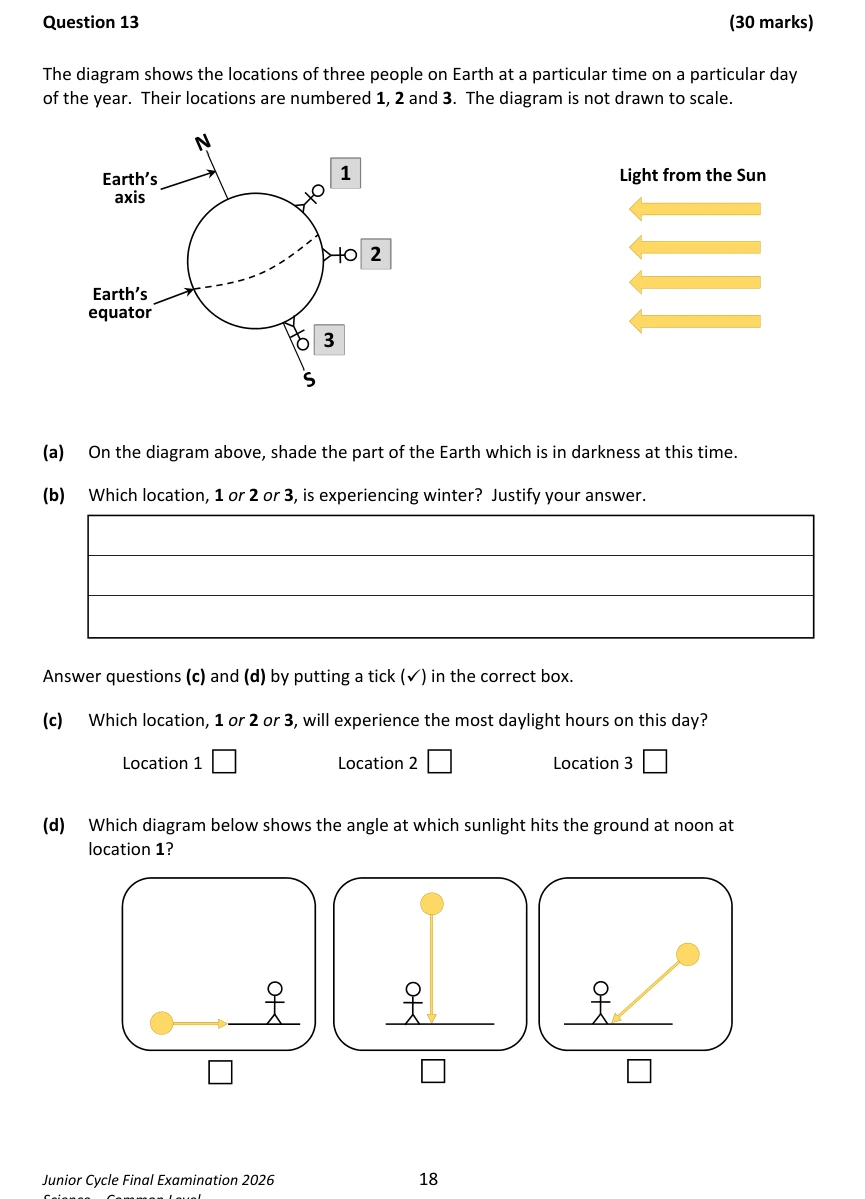
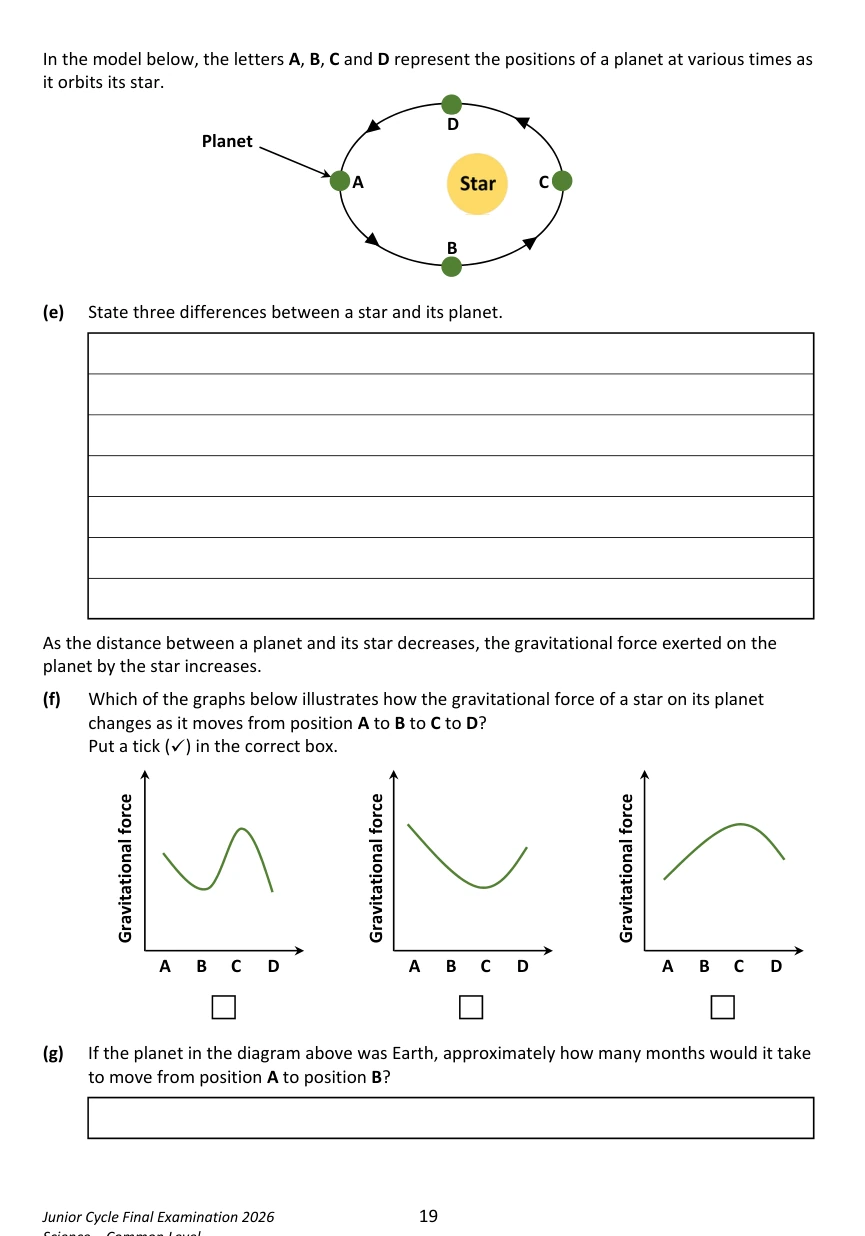
Show solutions
2026 · Question 13 · Worked solution
Answers are placed on the original paper, with diagram labels and blue teaching notes alongside. Teacher-completed model based on the SEC marking scheme. Added explanations are teaching notes; no answer mark allocations have been added.
Text version and further explanations
Teacher solution based on the SEC 2026 marking scheme with added explanations. Teaching guidance, not an official SEC worked answer.
Working and answers are in dark text. Blue “Why this works” notes explain the key ideas beside the relevant step. On a phone, the note appears directly underneath.
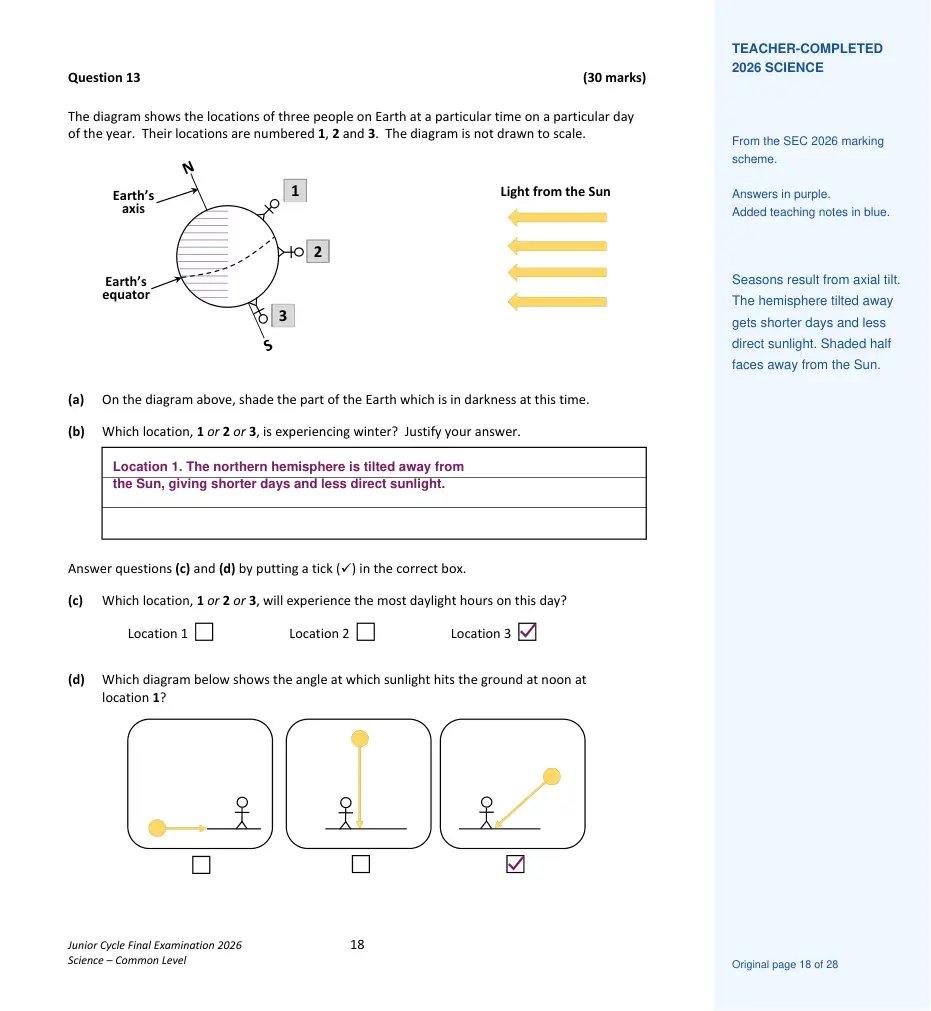
a) Shade the left-hand half of Earth, away from incoming sunlight.
b) Location 1: the northern hemisphere is tilted away from the Sun.
c) Location 3 has the longest daylight hours.
d) Third diagram: the Sun is at a low angle above the horizon.
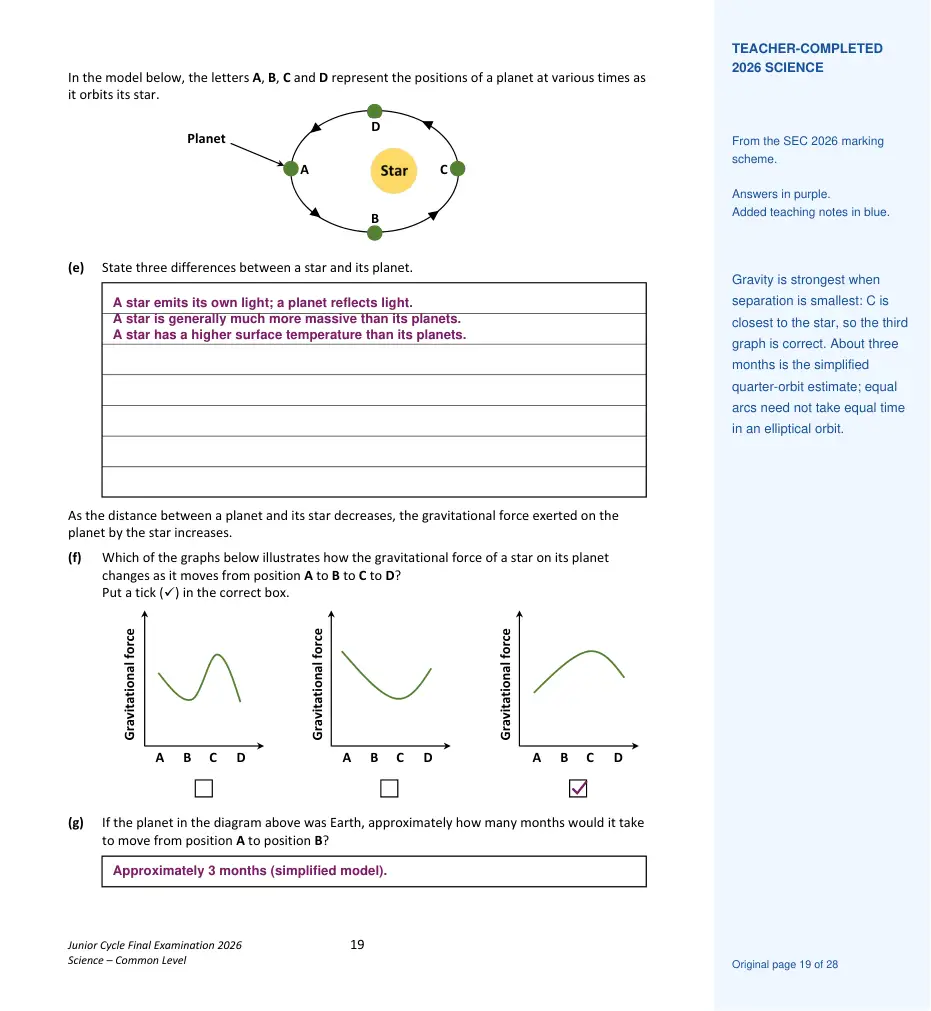
e) A star emits its own light; a planet reflects light. A star has a higher surface temperature. A star has a greater mass than its planet.
f) Third graph: force is weakest at A, furthest from the star, and strongest at C, nearest the star.
g) Approximately 3 months in the simplified quarter-orbit model used by the question. In a strongly elliptical real orbit, quarter-arcs need not take equal times.
Teacher sign-in and homework controls
Questions and worked solutions are open to everyone. Teachers can sign in to assign homework.
Join a class or manage your homework →