2024 · Paper 1 · Question 5 · Ordinary Level
Functions and calculus
Substitution · Fractions · Differentiation · Minimum points · Slope
Mixed topics · The selected topic applies to some parts of this whole question.
Open in original paper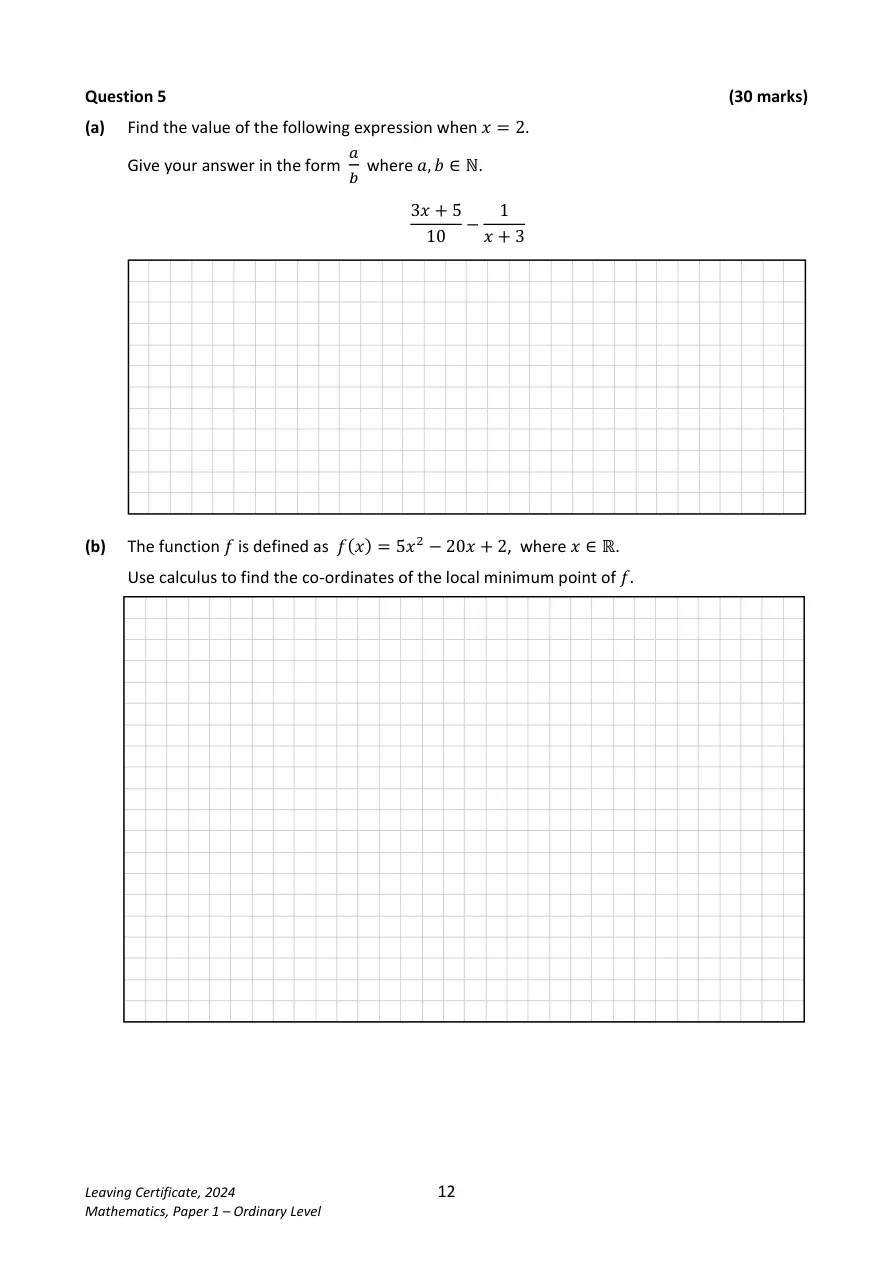
Show solutions
Follow the working below. The original question is unchanged.
a) Substitute x = 2
- \dfrac{3(2)+5}{10}-\dfrac{1}{2+3}
- =\dfrac{11}{10}-\dfrac{2}{10}
- =\dfrac{9}{10}
b) Minimum
- f'(x)=10x-20
- 10x-20=0
- x=2
- f(2)=5(2)^2-20(2)+2
- f(2)=-18
- The minimum point is (2, −18); the positive quadratic coefficient confirms a minimum.
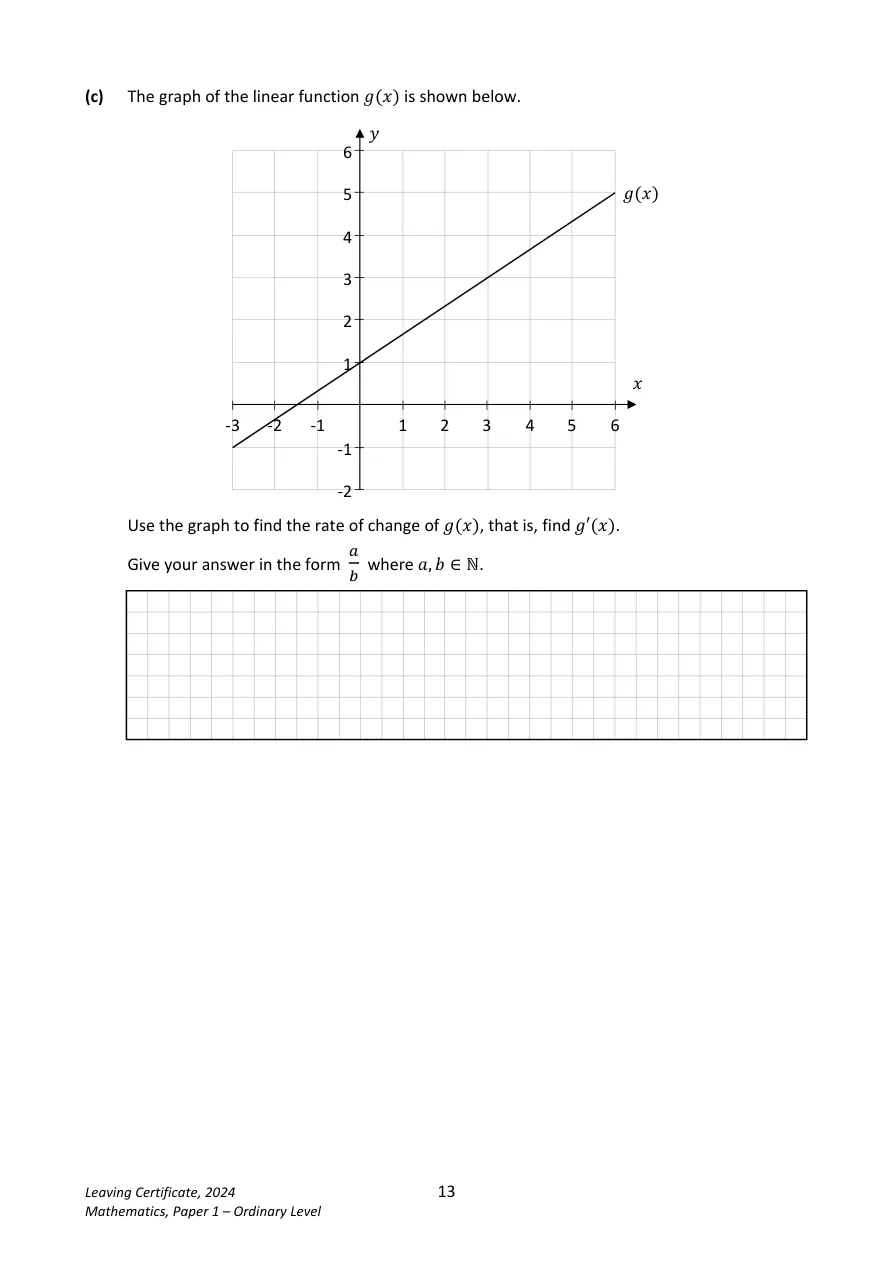
c) Rate of change
- g'(x)=\dfrac{2}{3}
The straight line rises 2 units for every 3 units across.
See working and diagrams on the original paper
\dfrac{3(2)+5}{10}-\dfrac{1}{2+3}
=\dfrac{11}{10}-\dfrac{2}{10}
=\dfrac{9}{10}
f'(x)=10x-20
10x-20=0
[At a stationary point, the derivative is zero.]x=2
f(2)=5(2)^2-20(2)+2
f(2)=-18
The minimum point is (2, −18); the positive quadratic coefficient confirms a minimum.
g'(x)=\dfrac{2}{3}
[The straight line rises 2 units for every 3 units across.]Teacher sign-in and homework controls
Use your existing homework account. Questions and solutions are open to everyone.
Join a class or open your homework →