2024 · Paper 1 · Question 7 · Ordinary Level
Bacteria models
Functions · Graphs · Differentiation · Exponential growth
Mixed topics · The selected topic applies to some parts of this whole question.
Open in original paper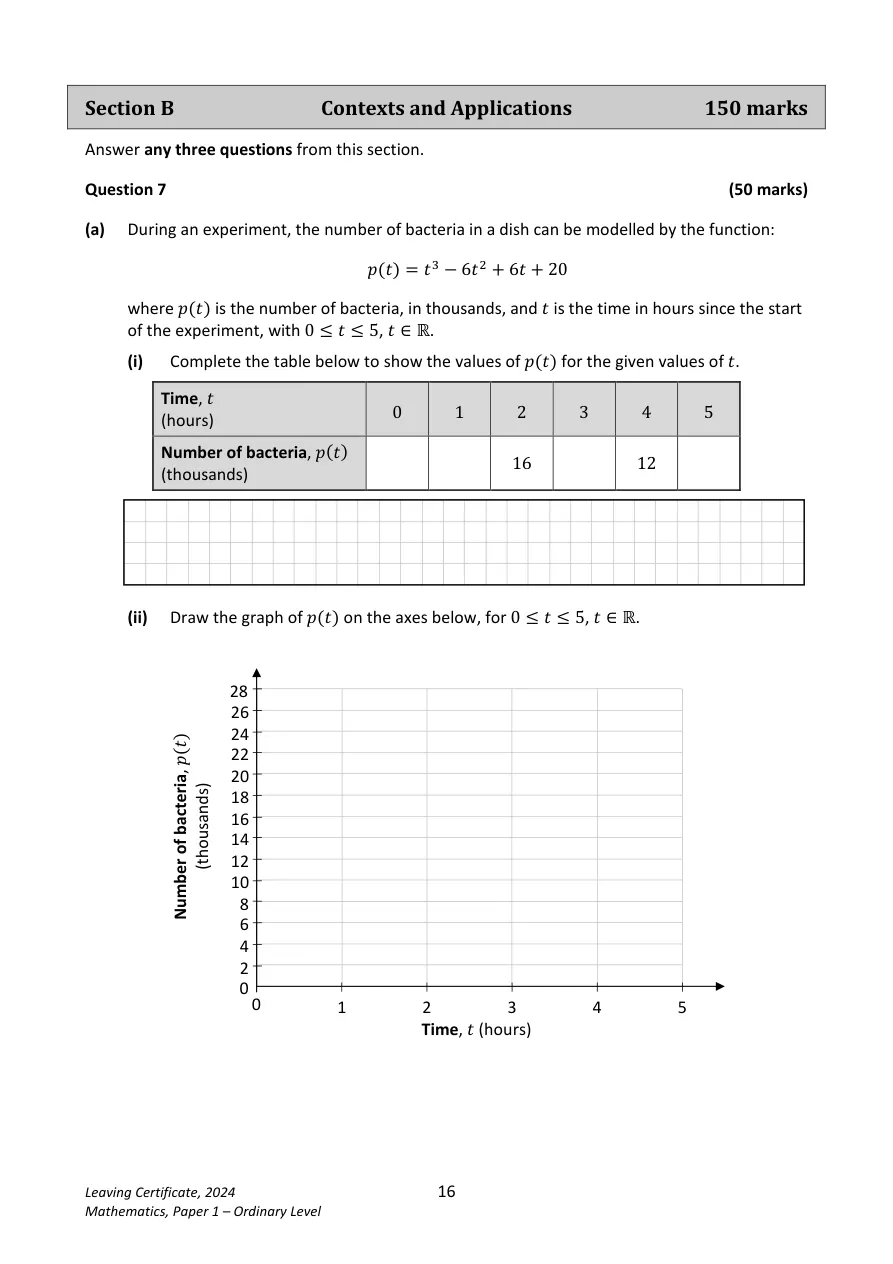
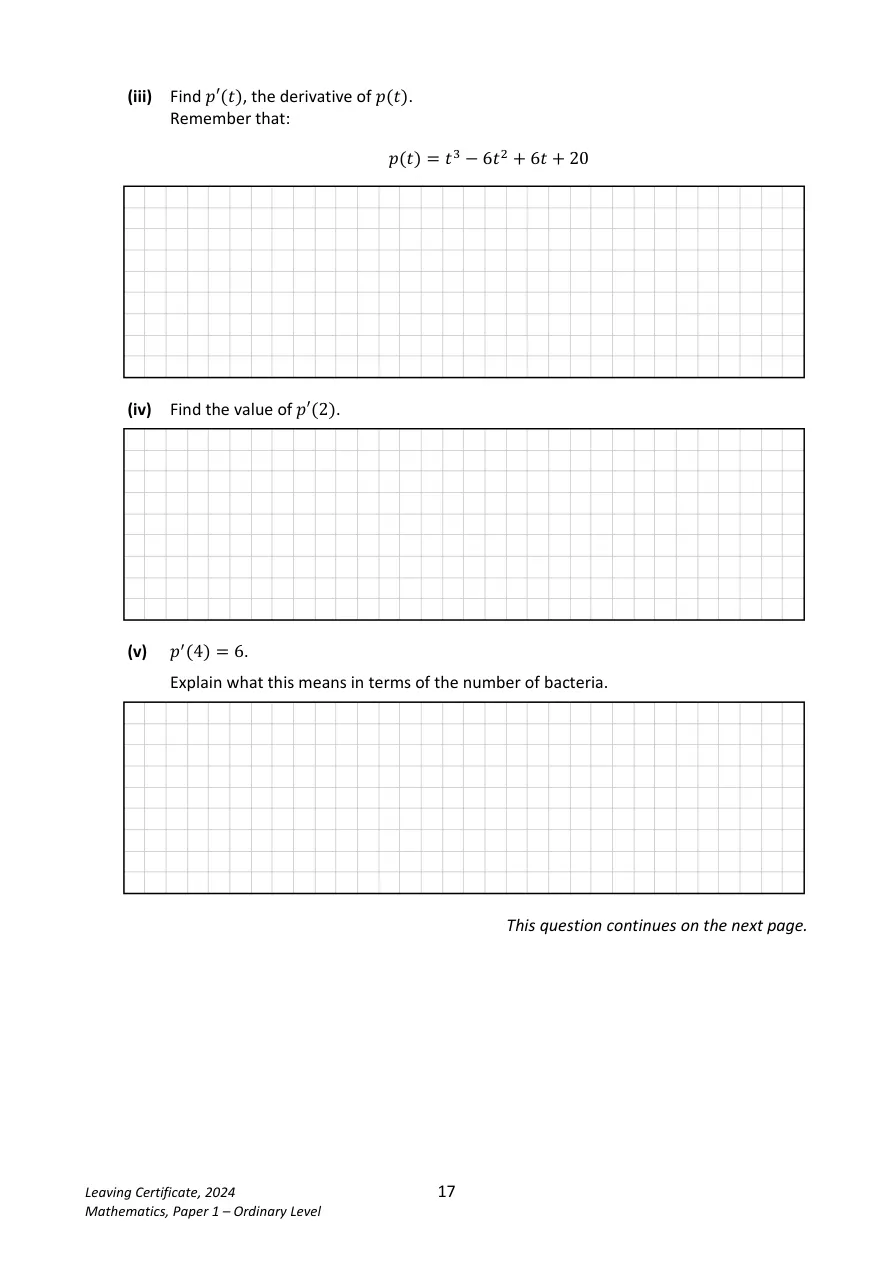
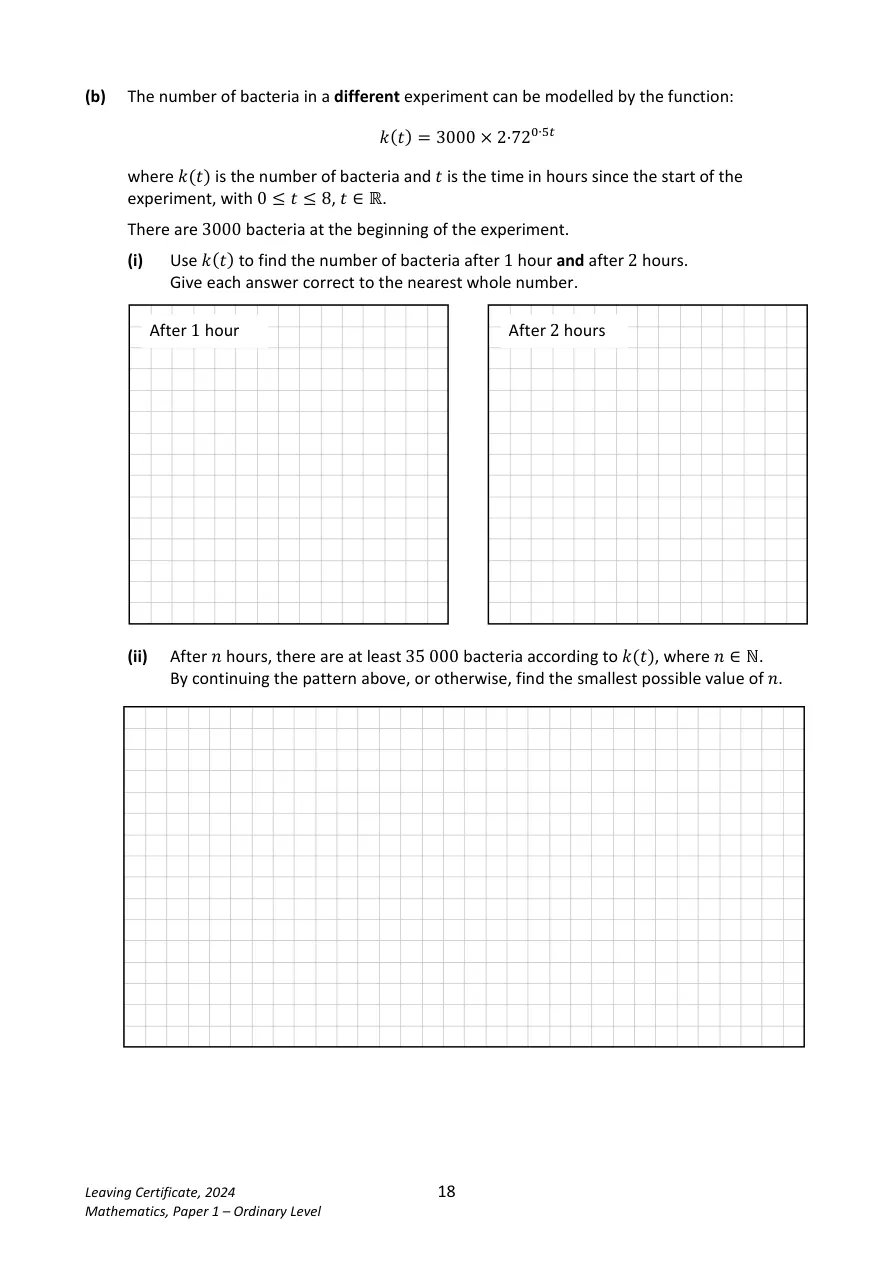
Show solutions
Follow the working below. The original question is unchanged.
a) First experiment
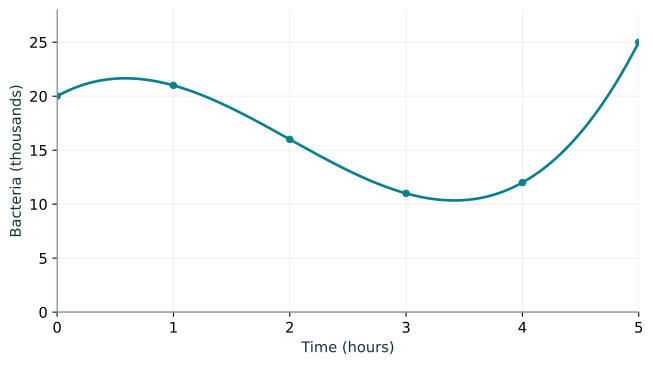
- p(0)=20,\quad p(1)=21,\quad p(2)=16
- p(3)=11,\quad p(4)=12,\quad p(5)=25
- p'(t)=3t^2-12t+6
- p'(2)=3(2)^2-12(2)+6
- p'(2)=-6
At two hours the number is decreasing by 6000 bacteria per hour.
- p′(4) = 6 means that after four hours the number of bacteria is increasing at 6000 per hour. The model counts bacteria in thousands.
b) Second experiment
- k(1)=3000(2.72)^{0.5}
- k(1)\approx4948
- k(2)=3000(2.72)^1
- k(2)=8160
- k(4)\approx22195<35000
- k(5)\approx36605>35000
- n=5
The model is increasing; 5 is the first whole number of hours that meets the target.
See working and diagrams on the original paper
p(0)=20,\quad p(1)=21,\quad p(2)=16
p(3)=11,\quad p(4)=12,\quad p(5)=25
p'(t)=3t^2-12t+6
p'(2)=3(2)^2-12(2)+6
p'(2)=-6
[At two hours the number is decreasing by 6000 bacteria per hour.]p′(4) = 6 means that after four hours the number of bacteria is increasing at 6000 per
hour. The model counts bacteria in thousands.
k(1)=3000(2.72)^{0.5}
k(1)\approx4948
k(2)=3000(2.72)^1
k(2)=8160
k(4)\approx22195<35000
k(5)\approx36605>35000
n=5
[The model is increasing; 5 is the first whole number of hours that meets the target.]Teacher sign-in and homework controls
Use your existing homework account. Questions and solutions are open to everyone.
Join a class or open your homework →