2026 · Paper 1 · Question 2 · Ordinary Level
Expansion and equations
Algebra · Quadratic equations · Algebraic fractions
Mixed topics · The selected topic applies to some parts of this whole question.
Open in original paper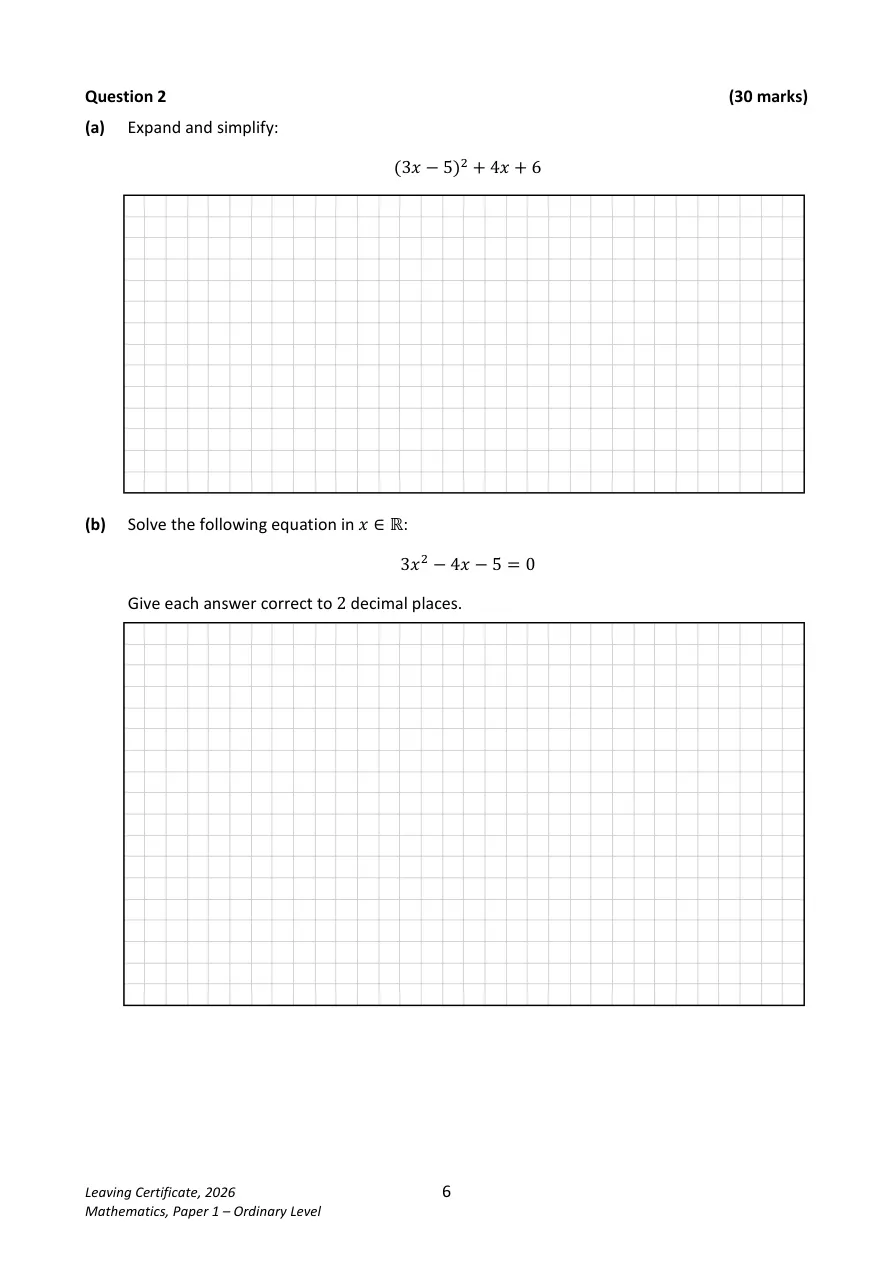
Show solutions
Follow the working below. The original question is unchanged. These 2026 maths answers are independent teacher solutions; an SEC marking scheme has not been obtained.
a) Expand
- (3x-5)^2+4x+6
The square applies to the whole bracket. Leave +4x and +6 alone for now.
- (3x-5)(3x-5)+4x+6
Squaring a bracket means multiplying it by itself.
- (3x)(3x)+(3x)(-5)+(-5)(3x)+(-5)(-5)+4x+6
Multiply each term in the first bracket by both terms in the second bracket. There are four products.
- 9x^2-15x-15x+25+4x+6
The two middle products are negative. The product of two negatives is positive.
- 9x^2-26x+31
Combine the x-terms: −15x − 15x + 4x = −26x. Then add 25 and 6.
b) Quadratic
- 3x^2-4x-5=0
The equation is already equal to zero, so we can match the coefficients.
- a=3,\quad b=-4,\quad c=-5
a multiplies x², b multiplies x, and c is the number on its own. Keep their signs.
- x=\dfrac{-b\pm\sqrt{b^2-4ac}}{2a}
This is the quadratic (minus-b) formula. Divide the whole numerator by 2a.
- x=\dfrac{-(-4)\pm\sqrt{(-4)^2-4(3)(-5)}}{2(3)}
Substitute negative values in brackets. In particular, −b = −(−4) = 4.
- x=\dfrac{4\pm\sqrt{76}}6
Inside the root, (−4)² = 16 and −4(3)(−5) = 60, so add them.
- x=\dfrac{4+\sqrt{76}}6\approx 2.12
Use the plus sign for the first answer. Round the final result to two decimal places.
- x=\dfrac{4-\sqrt{76}}6\approx -0.79
Use the minus sign for the second answer.
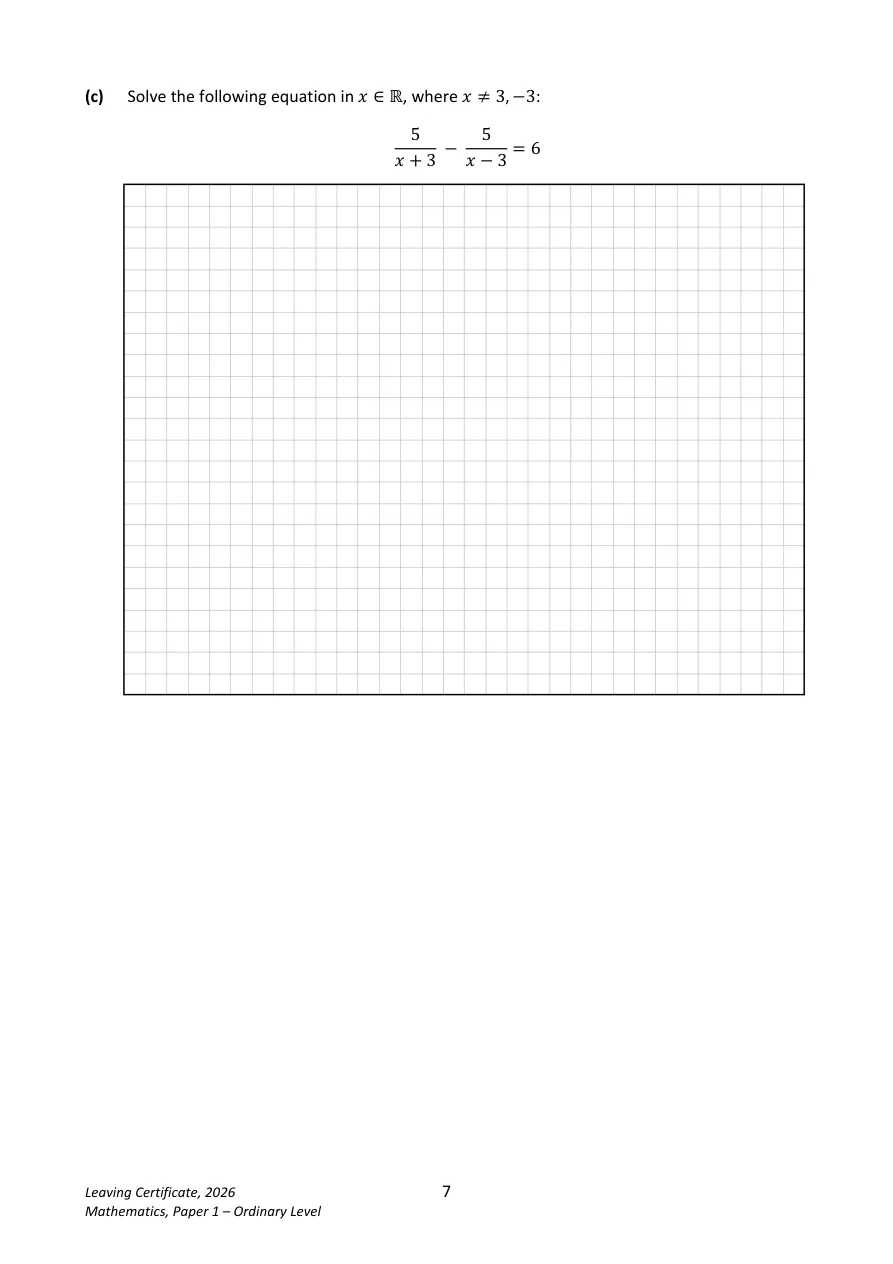
c) Rational equation
- \dfrac{5}{x+3}-\dfrac{5}{x-3}=6
The denominators cannot be zero, so x cannot be −3 or 3.
- 5(x-3)-5(x+3)=6(x+3)(x-3)
Multiply both sides by (x + 3)(x − 3). On the left, cancel x + 3 in the first term and x − 3 in the second.
- 5x-15-5x-15=6(x^2-9)
Distribute the negative sign as well: −5(x + 3) = −5x − 15.
- -30=6x^2-54
The x-terms on the left cancel. On the right, (x + 3)(x − 3) = x² − 9 because the middle terms cancel.
- 6x^2=24
Add 54 to both sides.
- x^2=4
Divide both sides by 6.
- x=2\quad\mathrm{or}\quad x=-2
Both 2 and −2 square to 4.
- Both answers satisfy the denominator restrictions and the original equation.
See working and diagrams on the original paper
Teacher sign-in and homework controls
Use your existing homework account. Questions and solutions are open to everyone.
Join a class or open your homework →