2026 · Paper 1 · Question 6 · Ordinary Level
Functions and calculus
Functions · Calculus
Mixed topics · The selected topic applies to some parts of this whole question.
Open in original paper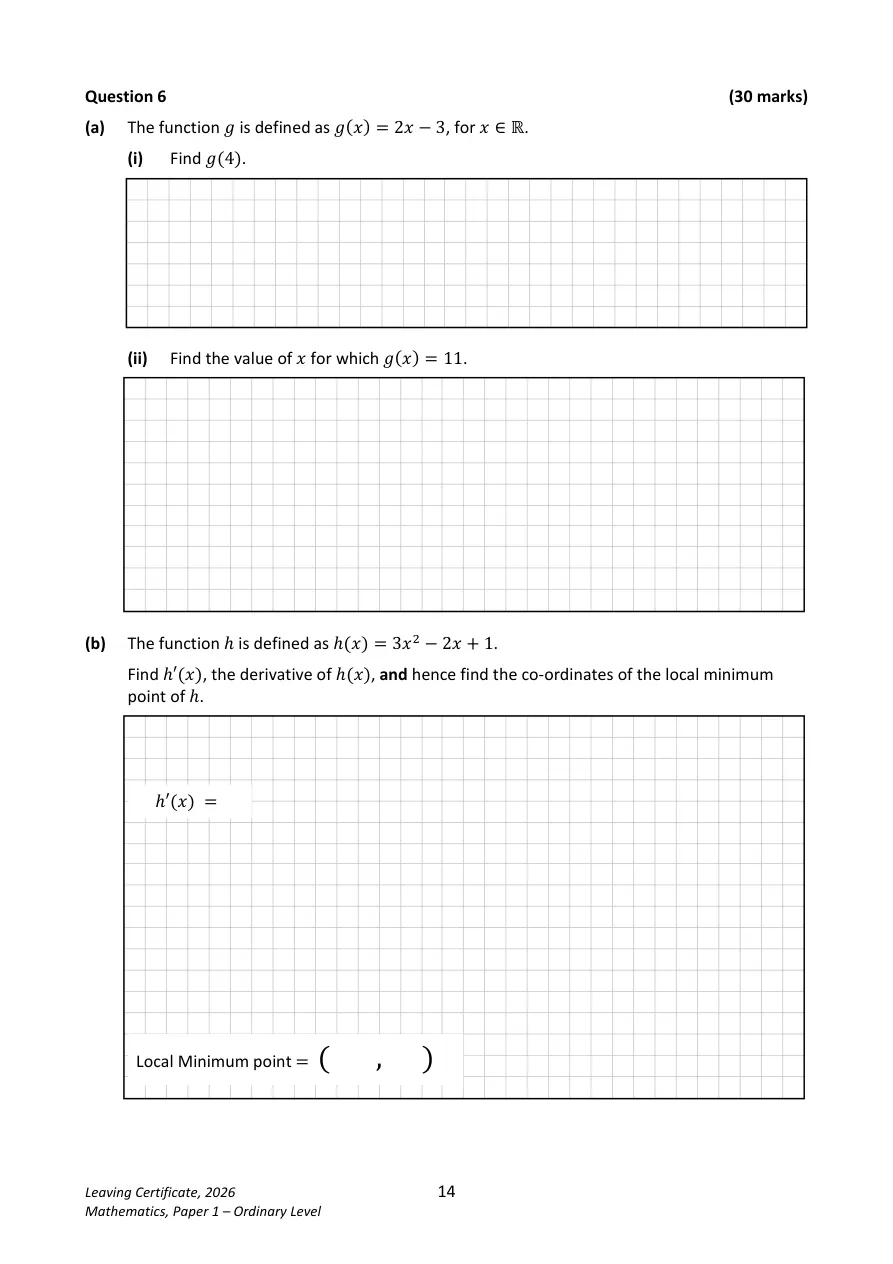
Show solutions
Follow the working below. The original question is unchanged. These 2026 maths answers are independent teacher solutions; an SEC marking scheme has not been obtained.
a)(i) Evaluate
- g(4)=2(4)-3=5
a)(ii) Solve
- 2x-3=11
- 2x=14
- x=7
b) Local minimum
- h'(x)=6x-2
- 6x-2=0
- x=\dfrac{1}{3}
- h\left(\dfrac{1}{3}\right)=3\left(\dfrac{1}{3}\right)^2-2\left(\dfrac{1}{3}\right)+1
- h\left(\dfrac{1}{3}\right)=\dfrac{2}{3}
- \left(\dfrac{1}{3},\dfrac{2}{3}\right)
h''(x)=6>0, confirming a local minimum.
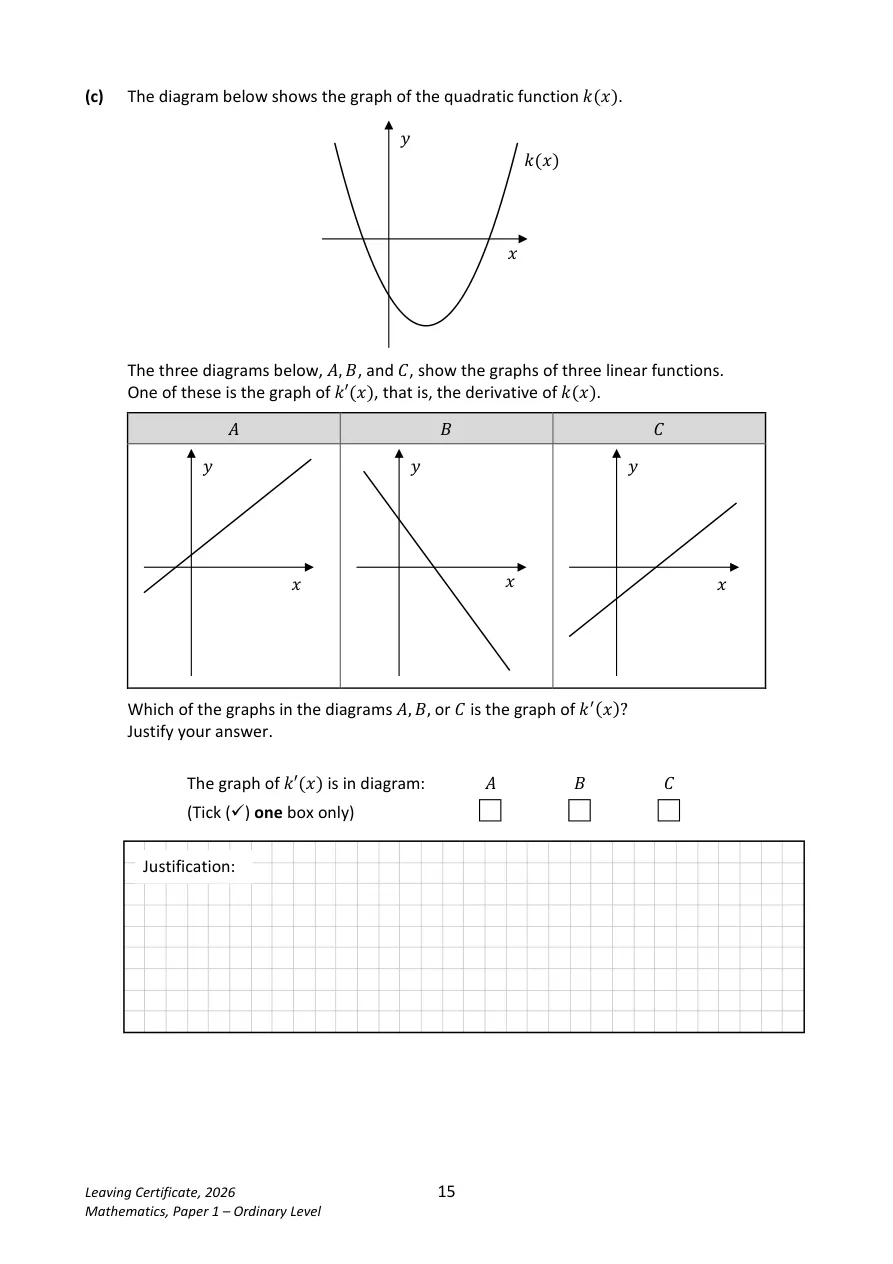
c) Derivative graph
- Choose C. The parabola opens upwards, so its derivative has positive slope. Its minimum is to the right of the y-axis, so the derivative is zero at a positive x-coordinate.
See working and diagrams on the original paper
g(4)=2(4)-3=5
2x-3=11
2x=14
x=7
h'(x)=6x-2
6x-2=0
x=\dfrac{1}{3}
h\left(\dfrac{1}{3}\right)=3\left(\dfrac{1}{3}\right)^2-2\left(\dfrac{1}{3}\right)+1
h\left(\dfrac{1}{3}\right)=\dfrac{2}{3}
\left(\dfrac{1}{3},\dfrac{2}{3}\right)
[h''(x)=6>0, confirming a local minimum.]Choose C. The parabola opens upwards, so its derivative has positive slope. Its
minimum is to the right of the y-axis, so the derivative is zero at a positive
x-coordinate.
Teacher sign-in and homework controls
Use your existing homework account. Questions and solutions are open to everyone.
Join a class or open your homework →