2026 · Paper 2 · Question 6 · Ordinary Level
Enlargement and similarity
Enlargement · Similar triangles · Circles
Mixed topics · The selected topic applies to some parts of this whole question.
Open in original paper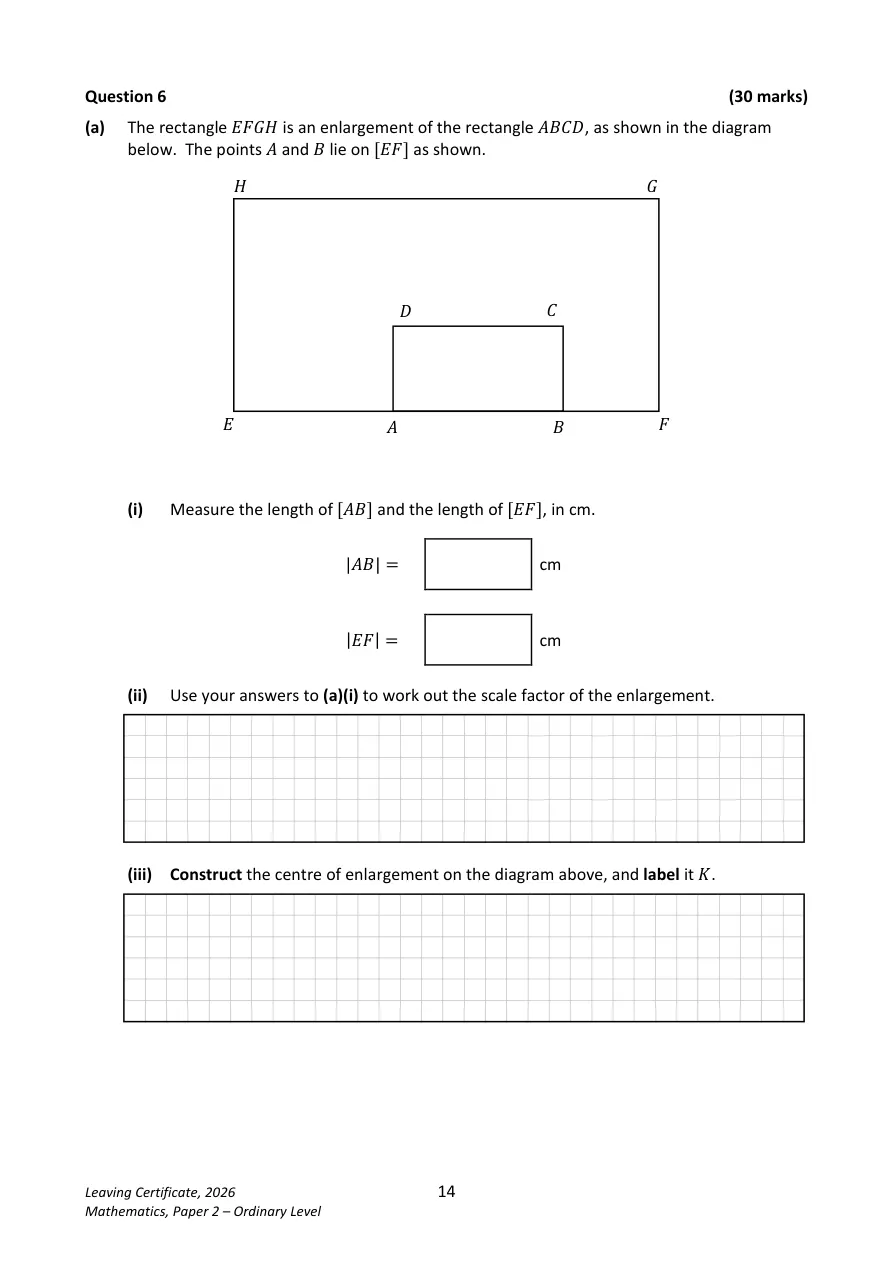
Show solutions
Follow the working below. The original question is unchanged. These 2026 maths answers are independent teacher solutions; an SEC marking scheme has not been obtained.
a)(i) Measure the original paper
- AB\approx4\ \mathrm{cm},\quad EF\approx10\ \mathrm{cm}
- Measure on the original PDF printed at 100%, not a resized browser image. Uniform resizing changes both lengths but leaves their ratio unchanged.
a)(ii) Scale factor
- k=\dfrac{10}{4}
- k=2.5
a)(iii) Centre of enlargement
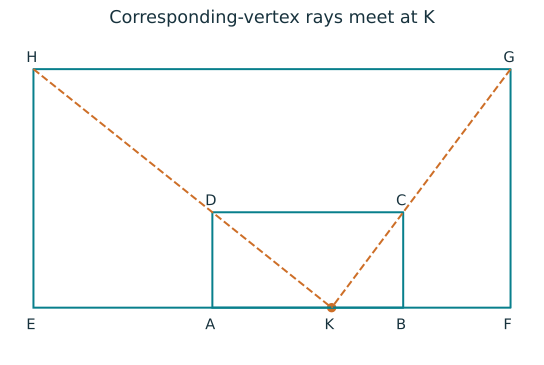
- Join corresponding vertices D to H and C to G and extend the lines. Their intersection K is the centre of enlargement on the line EF. Joining A to E or B to F provides a check.
b)(i) Equal radii
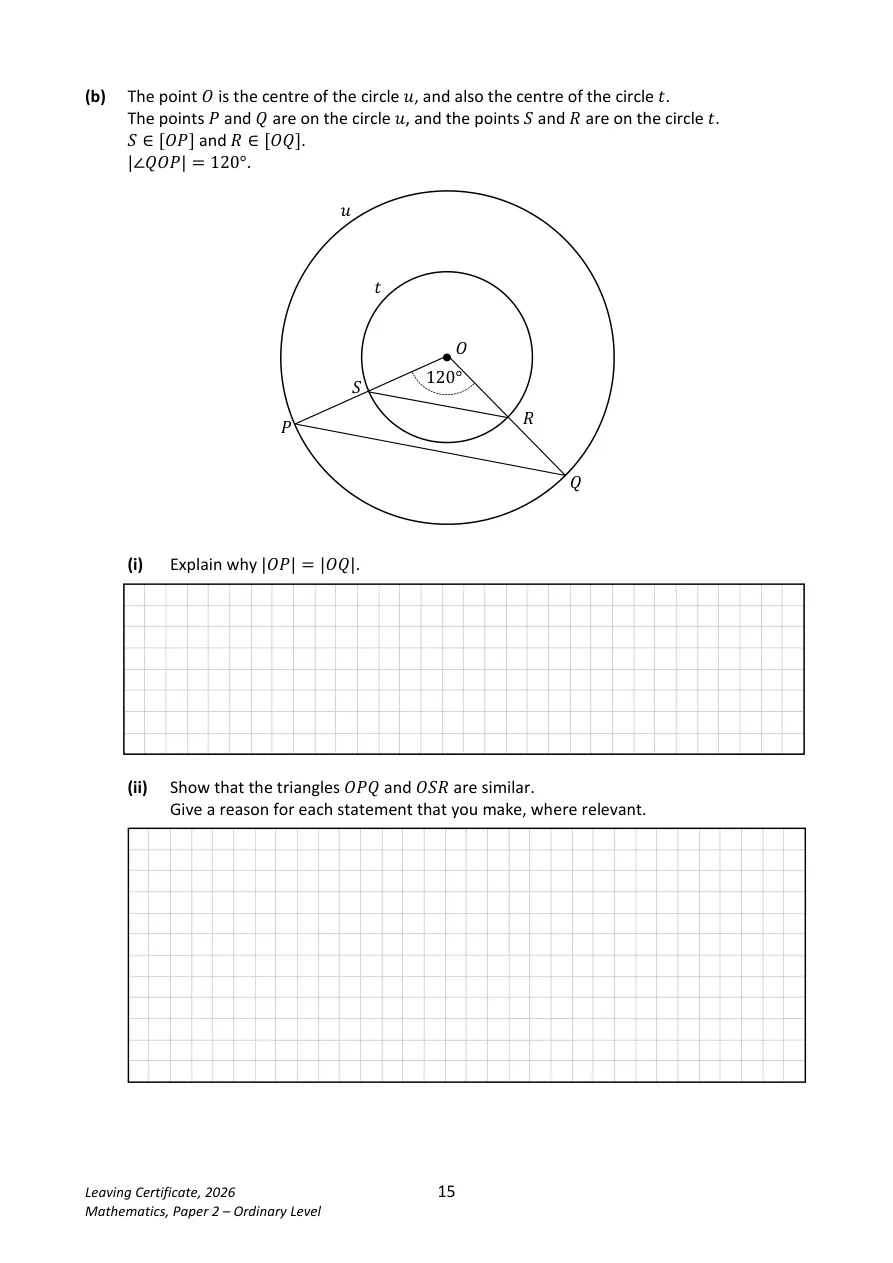
- OP=OQ
Both are radii of circle u.
b)(ii) Similarity
- \angle POQ=\angle SOR=120^{\circ}
OP and OS are collinear; OQ and OR are collinear.
- \angle OPQ=\angle OQP=30^{\circ}
Triangle OPQ is isosceles.
- \angle OSR=\angle ORS=30^{\circ}
OS and OR are radii of circle t.
- Therefore triangles OPQ and OSR are similar by AA.
See working and diagrams on the original paper
4 cm
10 cm
Measure at 100% on the original paper; resizing changes lengths, not their ratio.
k=\dfrac{10}{4}
k=2.5
Join corresponding vertices D to H and C to G and extend the lines. Their intersection K is the centre of
enlargement on the line EF. Joining A to E or B to F provides a check.
OP=OQ
[Both are radii of circle c.]\angle POQ=\angle SOR=120^{\circ}
[OP and OS are collinear; OQ and OR are collinear.]\angle OPQ=\angle OQP=30^{\circ}
[Triangle OPQ is isosceles.]\angle OSR=\angle ORS=30^{\circ}
[OS and OR are radii of circle t.]Therefore triangles OPQ and OSR are similar by AA.
Teacher sign-in and homework controls
Use your existing homework account. Questions and solutions are open to everyone.
Join a class or open your homework →