2026 · Paper 2 · Question 9 · Ordinary Level
Festival statistics and inference
Statistics · Normal distribution · Margin of error · Hypothesis tests
Mixed topics · The selected topic applies to some parts of this whole question.
Open in original paper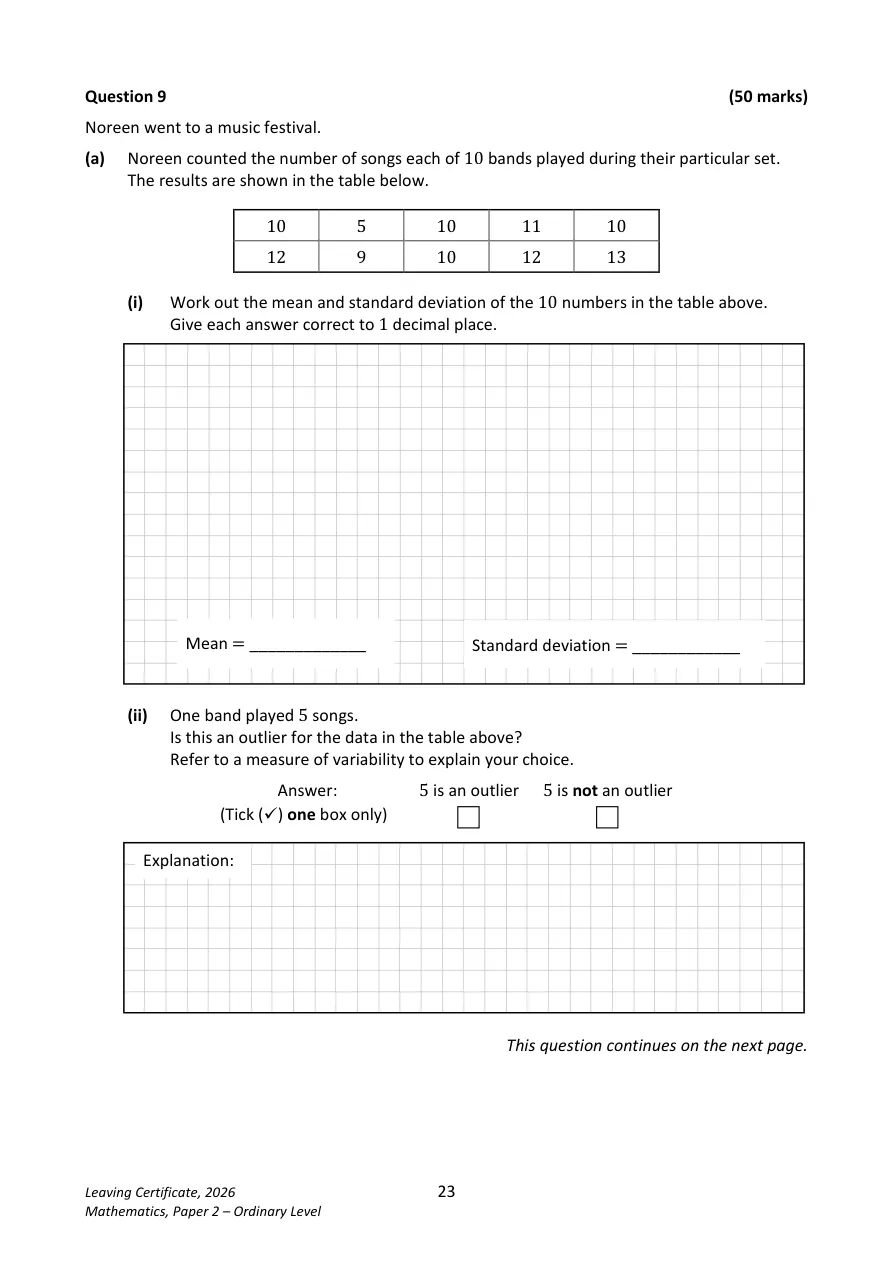
Show solutions
Follow the working below. The original question is unchanged. These 2026 maths answers are independent teacher solutions; an SEC marking scheme has not been obtained.
a)(i) Mean and standard deviation
- \bar{x}=\dfrac{102}{10}
- \bar{x}=10.2
- \sigma=\sqrt{\dfrac{\sum(x-10.2)^2}{10}}
- \sigma\approx2.1
a)(ii) Outlier
- 10.2-2(2.1)=6.0
- 5<6.0
- Yes: 5 is more than two standard deviations below the mean, using this variability criterion. An IQR-based rule also identifies it as an outlier.
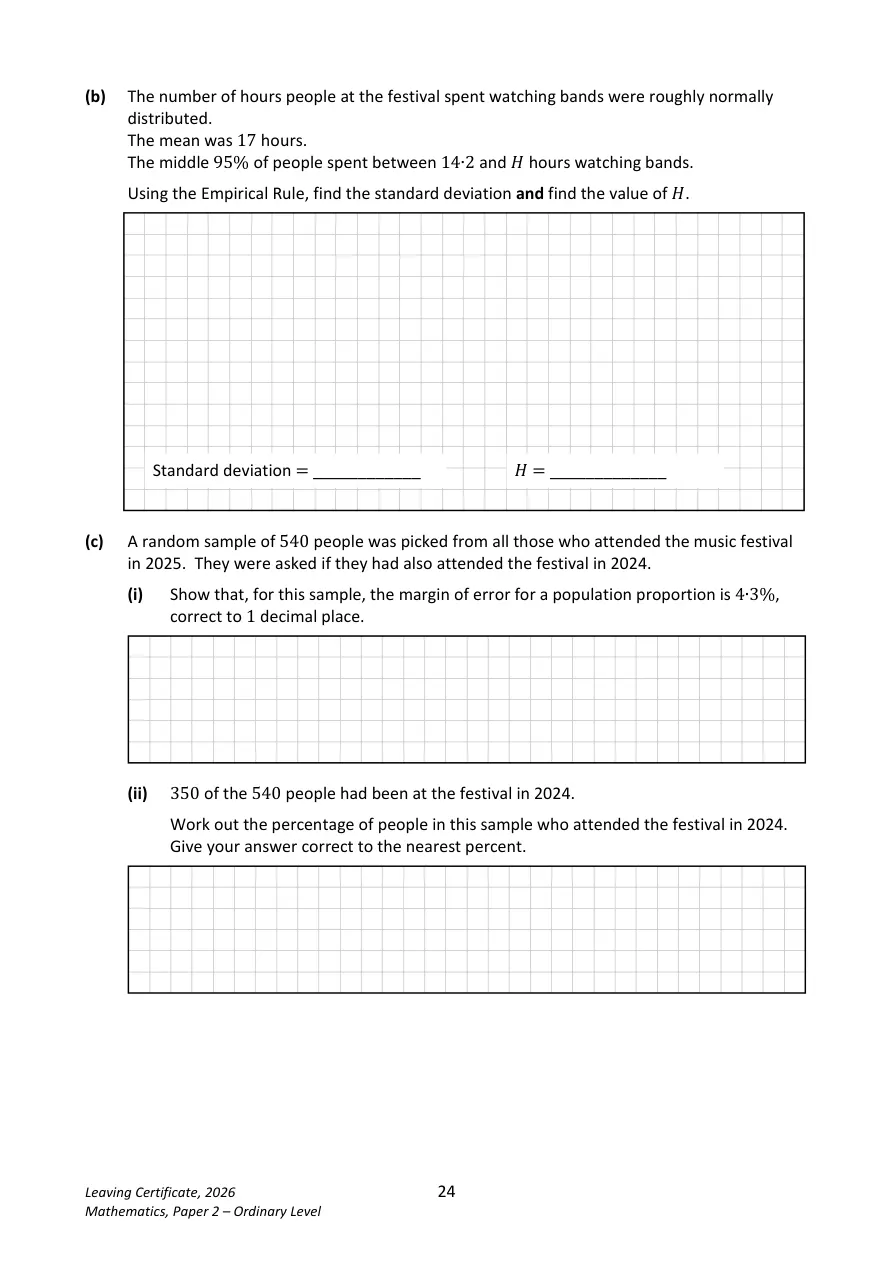
b) Empirical rule
- 2\sigma=17-14.2=2.8
- \sigma=1.4\ \mathrm{h}
- H=17+2.8=19.8\ \mathrm{h}
c)(i) Margin of error
- E=\dfrac{1}{\sqrt{540}}\times100\%
- E\approx4.3\%
c)(ii) Sample percentage
- \hat{p}=\dfrac{350}{540}\times100\%
- \hat{p}\approx65\%
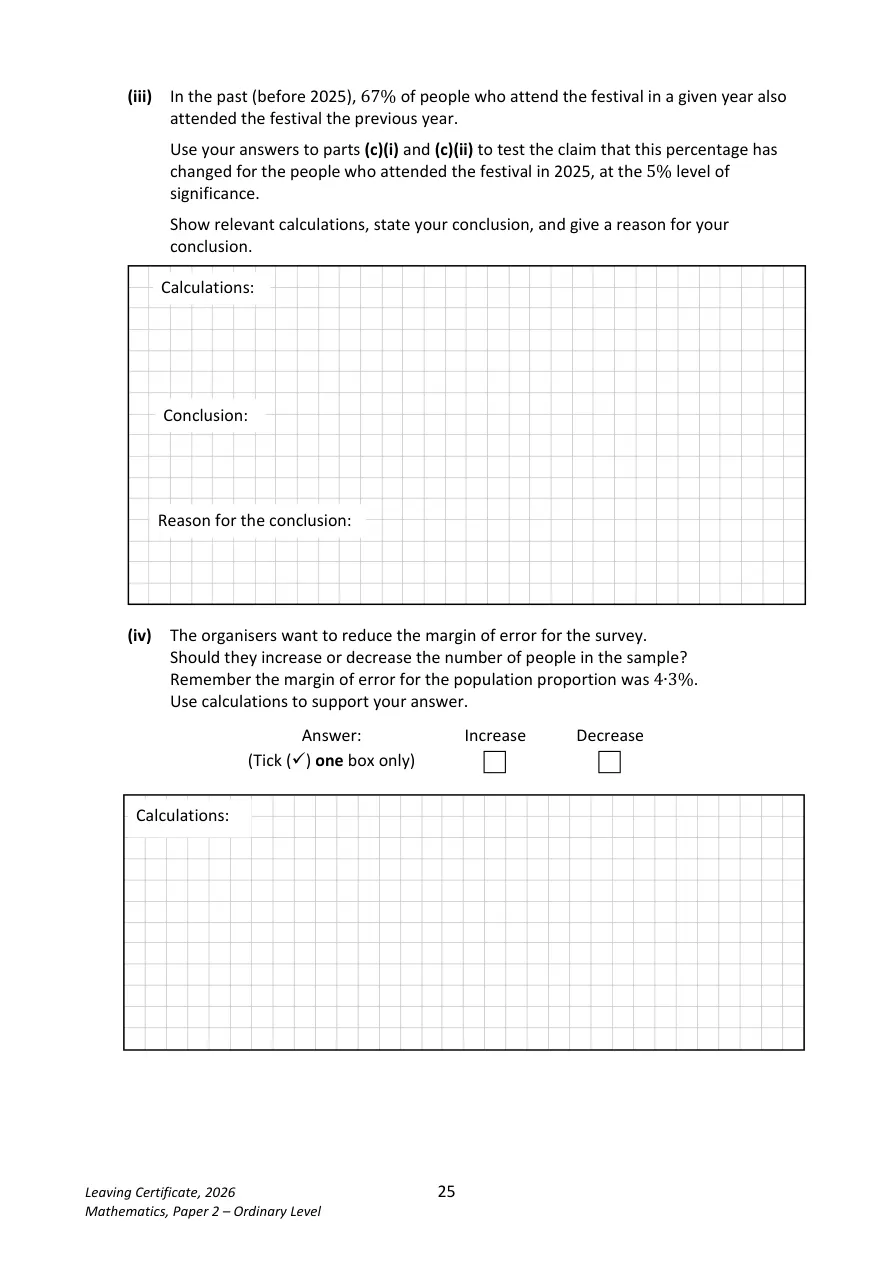
c)(iii) Test
- CI=65\%\pm4.3\%
- CI=[60.7\%,69.3\%]
- The historical 67% lies inside the approximate 95% interval. Do not reject the no-change claim: the sample does not provide sufficient evidence of a change at the 5% level. This does not prove the percentage stayed exactly the same.
c)(iv) Reduce error
- E_{1000}=\dfrac{1}{\sqrt{1000}}\times100\%
- E_{1000}\approx3.2\%<4.3\%
- Increase the sample size. The margin of error decreases as the square root of sample size increases.
See working and diagrams on the original paper
\bar{x}=\dfrac{102}{10}
\bar{x}=10.2
\sigma=\sqrt{\dfrac{\sum(x-10.2)^2}{10}}
\sigma\approx2.1
10.2-2(2.1)=6.0
5<6.0
Yes: 5 is more than two standard deviations below the mean, using this variability criterion. An
IQR-based rule also identifies it as an outlier.
2\sigma=17-14.2=2.8
\sigma=1.4\ \mathrm{h}
H=17+2.8=19.8\ \mathrm{h}
E=\dfrac{1}{\sqrt{540}}\times100\%
E\approx4.3\%
\hat{p}=\dfrac{350}{540}\times100\%
\hat{p}\approx65\%
CI=65\%\pm4.3\%
CI=[60.7\%,69.3\%]
Do not reject the no-change claim.
67% is inside the 95% interval; there is insufficient evidence of a change.
E_{1000}=\dfrac{1}{\sqrt{1000}}\times100\%
E_{1000}\approx3.2\%<4.3\%
Increase the sample size. The margin of error decreases as the square root of sample size
increases.
Teacher sign-in and homework controls
Use your existing homework account. Questions and solutions are open to everyone.
Join a class or open your homework →