2023 · Question 12 · Higher Level
Symmetry and circular arcs
Constructions · Circle geometry · Arc length
Mixed topics · The selected topic applies to some parts of this whole question.
Open in original paper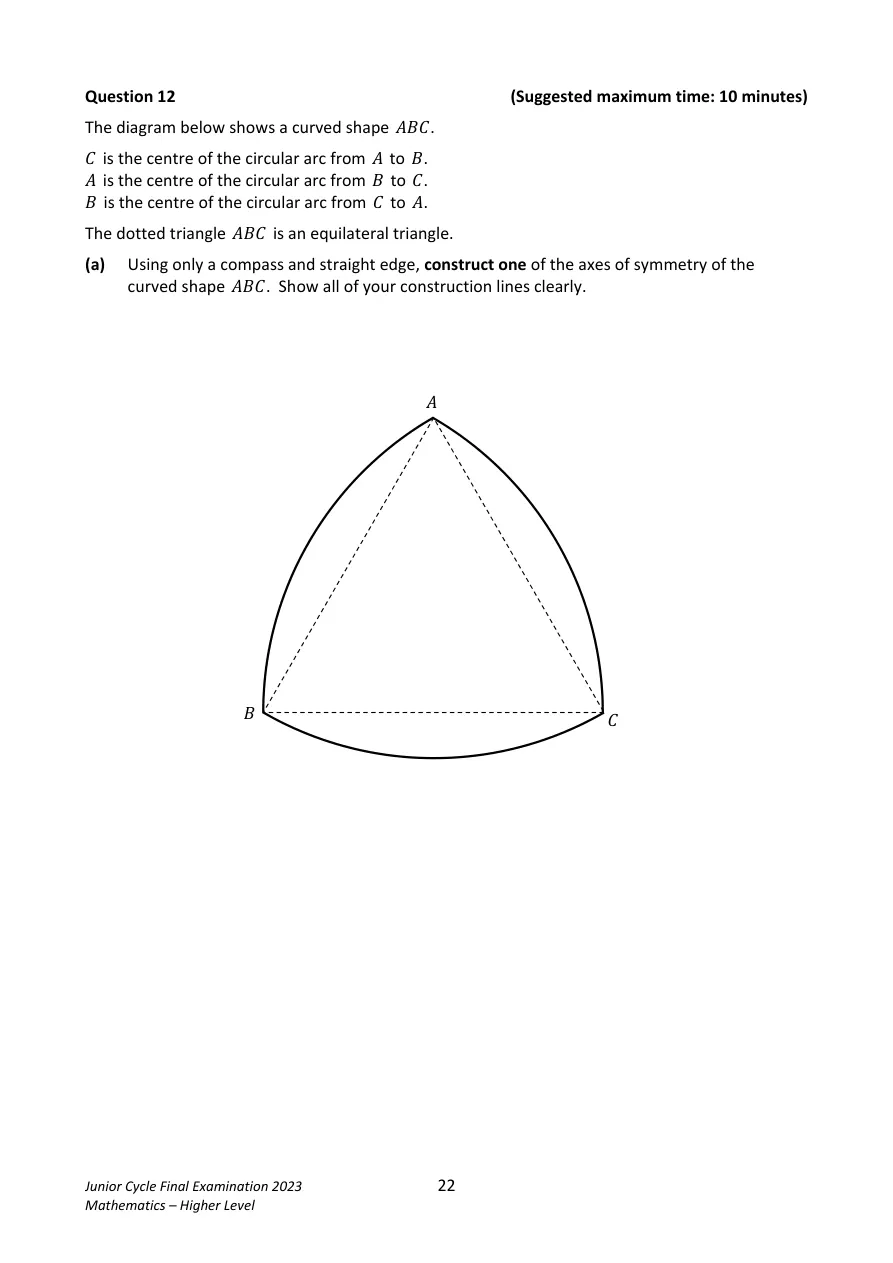
Show solutions
Follow the working below. The original question is unchanged.
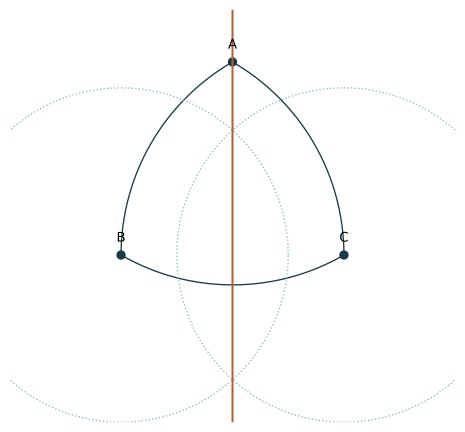
a) Construct an axis
- Set a compass to a radius greater than half BC. With centres B and C draw equal-radius arcs above and below BC. Join the two arc intersections with a straight edge, extending the perpendicular bisector through A. Keep the arcs visible. This is one of the three symmetry axes.
b)(i) Angle
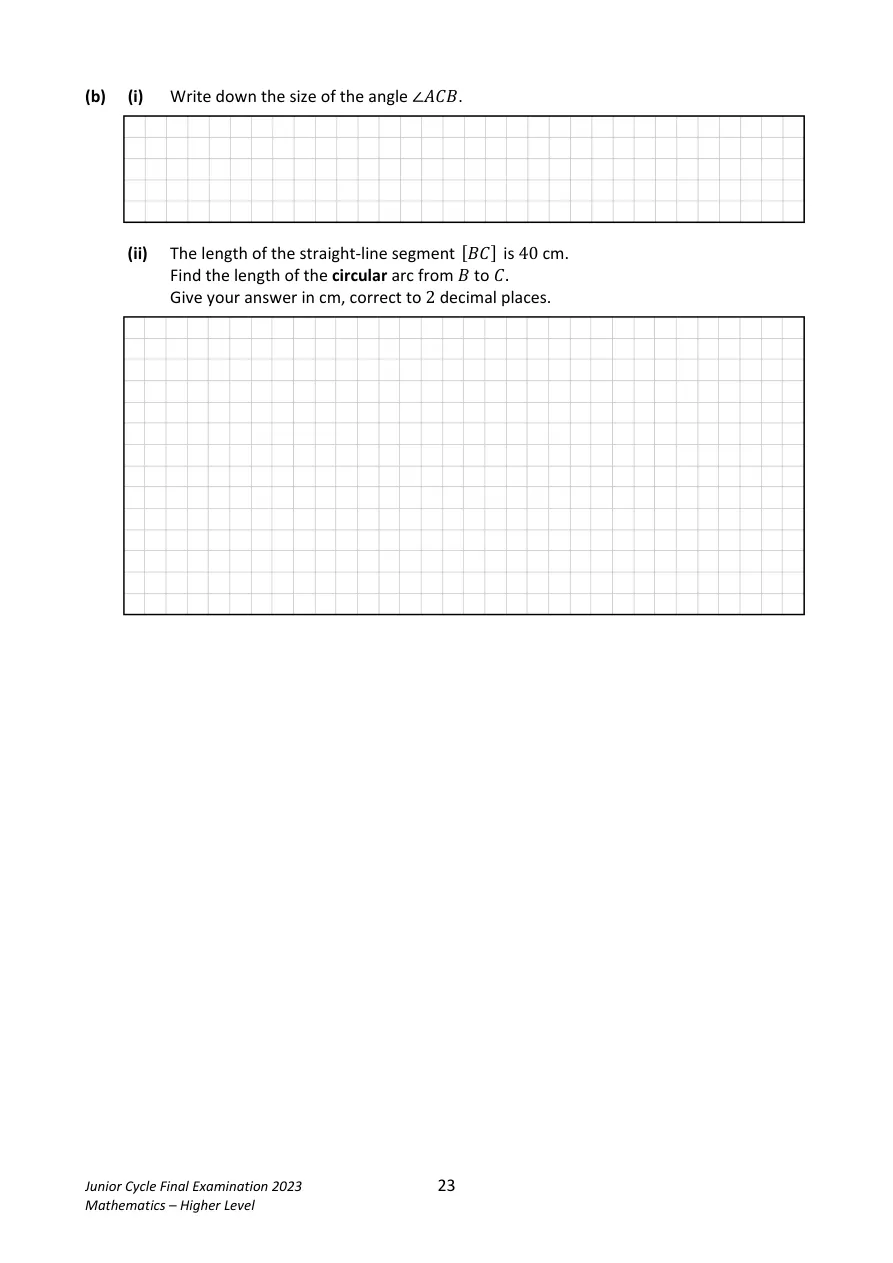
- \angle ACB=60^{\circ}
Every angle in an equilateral triangle is 60°.
b)(ii) Arc BC
- L=\dfrac{\theta}{360^{\circ}}\times2\pi r
- L=\dfrac{60}{360}\times2\pi(40)
The arc's centre is A, so its radius is 40 cm.
- L\approx41.89\ \mathrm{cm}
See working and diagrams on the original paper
Equal-radius arcs from B and C meet above and below BC. Joining their intersections gives the
perpendicular bisector through A: an axis of symmetry.
\angle ACB=60^{\circ}
[Every angle in an equilateral triangle is 60°.]L=\dfrac{\theta}{360^{\circ}}\times2\pi r
L=\dfrac{60}{360}\times2\pi(40)
[The arc's centre is A, so its radius is 40 cm.]L\approx41.89\ \mathrm{cm}
Teacher sign-in and homework controls
Questions and worked solutions are open to everyone. Use your homework account for teacher controls.
Join a class or open your homework →