2022 · Question 7 · Higher Level
Laws of indices
Indices · Algebra
Mixed topics · The selected topic applies to some parts of this whole question.
Open in original paper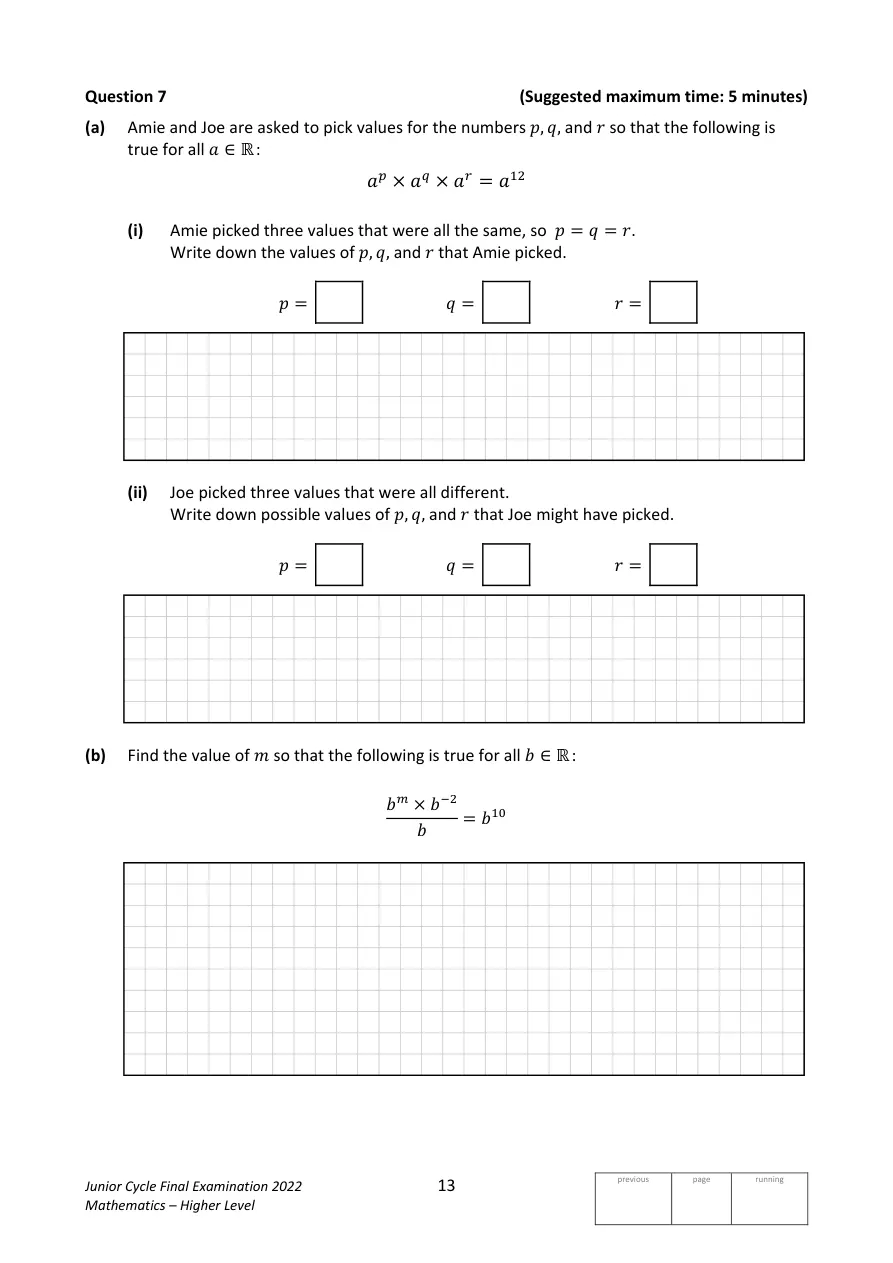
Show solutions
Follow the working below. The original question is unchanged.
a)(i) Equal exponents
- p+q+r=12
Multiplying powers of the same base adds their exponents.
- 3p=12
- p=q=r=4
a)(ii) Different exponents
- p=3,\quad q=4,\quad r=5
One valid choice: all different and their sum is 12.
b) Find m
- \dfrac{b^m b^{-2}}{b}=b^{10}
- b^{m-2-1}=b^{10}
Subtract the denominator's exponent, 1.
- m-3=10
- m=13
- The fraction in the original expression requires b ≠ 0, despite the paper's broad real-number wording.
See working and diagrams on the original paper
p+q+r=12
[Multiplying powers of the same base adds their exponents.]3p=12
p=q=r=4
p=3,\quad q=4,\quad r=5
[One valid choice: all different and their sum is 12.]\dfrac{b^m b^{-2}}{b}=b^{10}
b^{m-2-1}=b^{10}
[Subtract the denominator's exponent, 1.]m-3=10
m=13
The fraction in the original expression requires b ≠ 0, despite the paper's broad real-number wording.
Teacher sign-in and homework controls
Questions and worked solutions are open to everyone. Use your homework account for teacher controls.
Join a class or open your homework →