2022 · Question 9 · Higher Level
Algebra techniques
Algebra · Factorisation · Algebraic fractions · Quadratic equations
Mixed topics · The selected topic applies to some parts of this whole question.
Open in original paper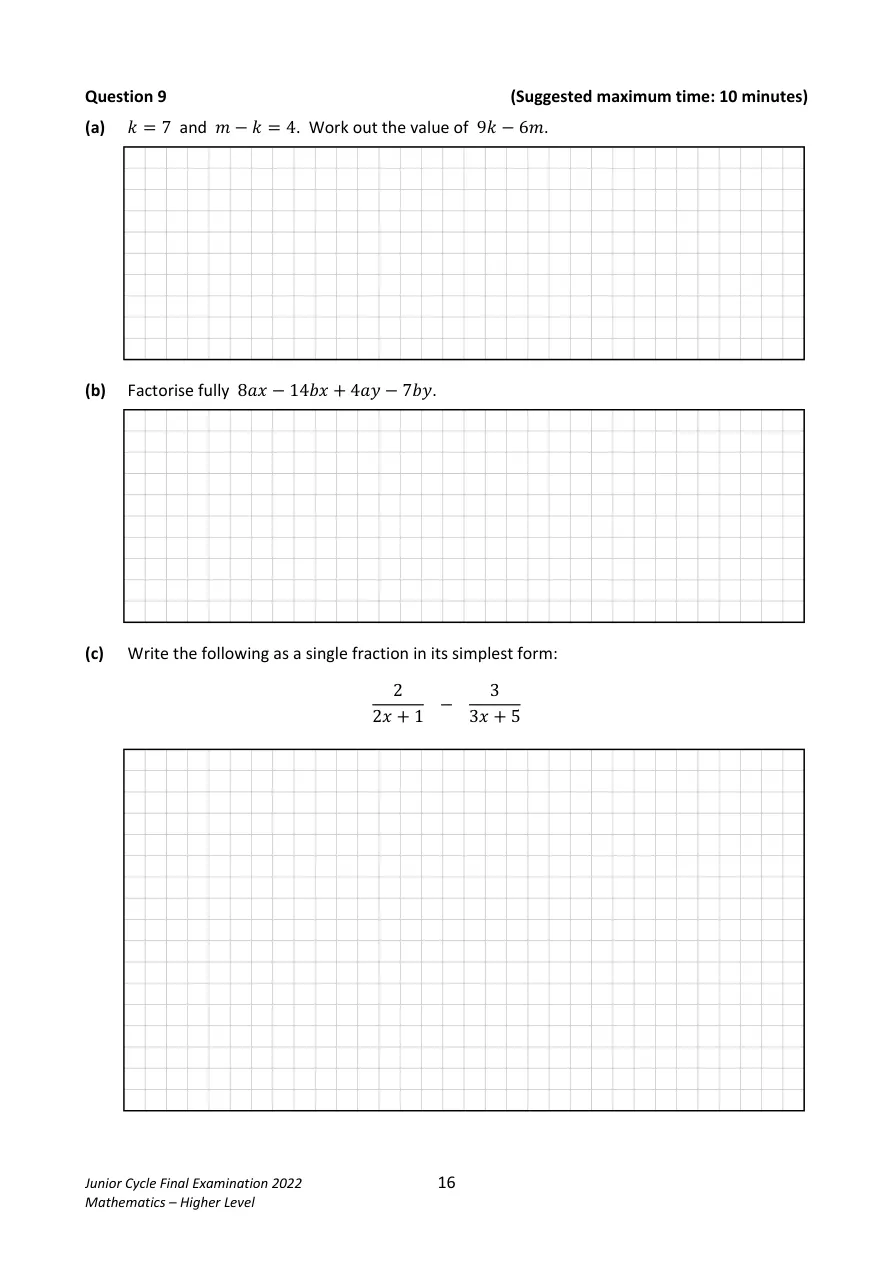
Show solutions
Follow the working below. The original question is unchanged.
a) Substitution
- m-7=4
- m=11
- 9k-6m=9(7)-6(11)
- 9k-6m=63-66
- 9k-6m=-3
b) Factorise by grouping
- 8ax-14bx+4ay-7by
- 2x(4a-7b)+y(4a-7b)
Take 2x out of the first pair and y out of the second pair. Both pairs leave the same bracket.
- (2x+y)(4a-7b)
Take the common bracket (4a − 7b) out as one factor.
c) One algebraic fraction
- \dfrac{2}{2x+1}-\dfrac{3}{3x+5}
- \dfrac{2(3x+5)-3(2x+1)}{(2x+1)(3x+5)}
Use the product of the denominators as a common denominator.
- \dfrac{6x+10-6x-3}{(2x+1)(3x+5)}
The minus sign applies to the whole second bracket.
- \dfrac{7}{(2x+1)(3x+5)}
- x\ne-\dfrac{1}{2},\quad x\ne-\dfrac{5}{3}
Original denominators cannot be zero.
d) Quadratic formula
- a=2,\quad b=-7,\quad c=-3
a is the coefficient of x², b is the coefficient of x, and c is the constant. Take the signs with the numbers.
- x=\dfrac{-b\pm\sqrt{b^2-4ac}}{2a}
Use the quadratic formula after writing the equation in the form ax² + bx + c = 0.
- x=\dfrac{7\pm\sqrt{(-7)^2-4(2)(-3)}}{2(2)}
Use brackets when substituting negative numbers, especially when squaring b.
- x=\dfrac{7\pm\sqrt{73}}{4}
- x\approx3.89\quad\mathrm{or}\quad x\approx-0.39
See working and diagrams on the original paper
Teacher sign-in and homework controls
Questions and worked solutions are open to everyone. Use your homework account for teacher controls.
Join a class or open your homework →