2024 · Question 1 · Higher Level
Coloured counters
Probability · Counting · Primes
Mixed topics · The selected topic applies to some parts of this whole question.
Open in original paper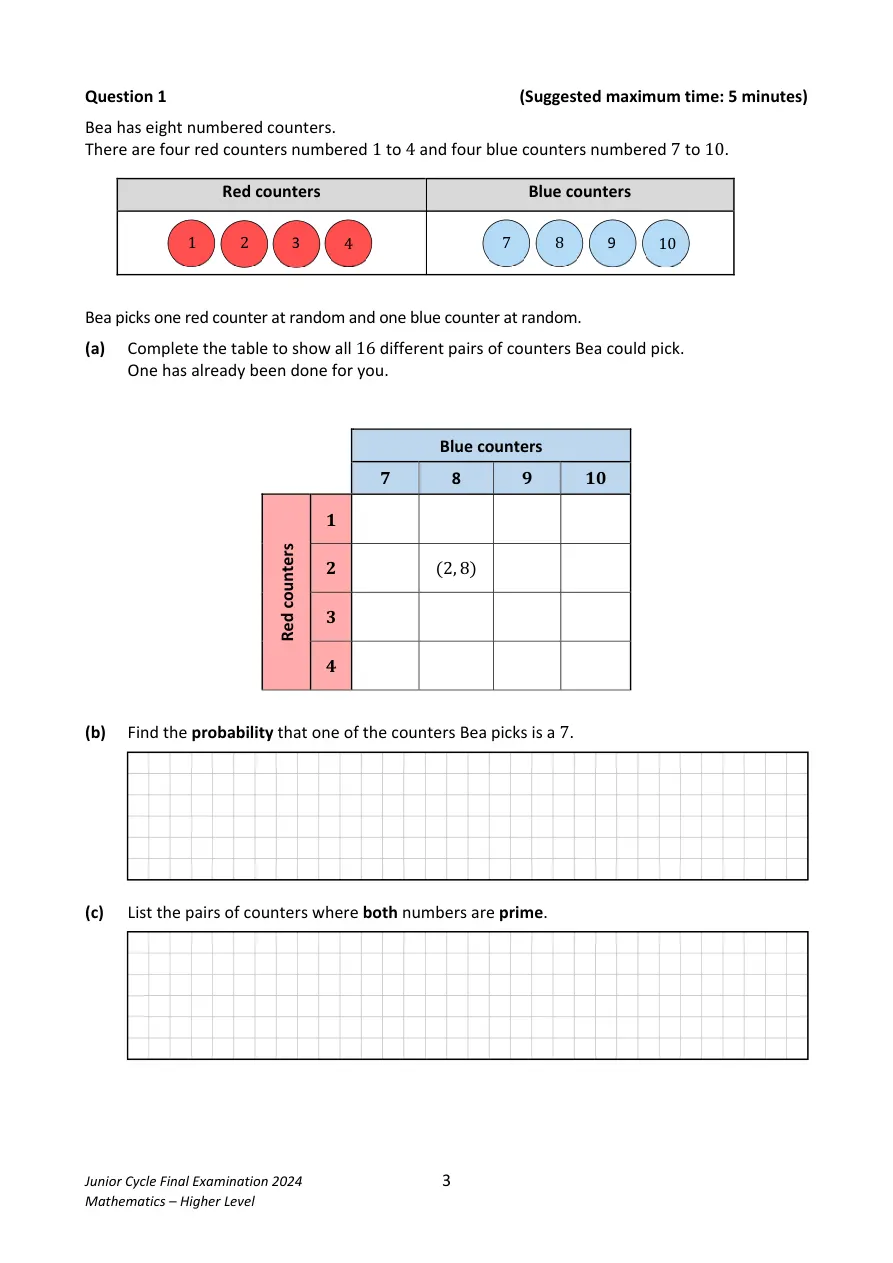
Show solutions
Follow the working below. The original question is unchanged.
a) Sample space
- Rows: (1,7), (1,8), (1,9), (1,10); (2,7), (2,8), (2,9), (2,10); (3,7), (3,8), (3,9), (3,10); (4,7), (4,8), (4,9), (4,10).
b) A 7 is selected
- P(7)=\dfrac{4}{16}
- P(7)=\dfrac{1}{4}
The blue counter must be 7; any of the four red counters can accompany it.
c) Both prime
- (2,7),\quad(3,7)
1 is not prime; 9 and 10 are not prime.
See working and diagrams on the original paper
P(7)=\dfrac{4}{16}
[Four of sixteen equally likely pairs.]P(7)=\dfrac{1}{4}
(2,7),\quad(3,7)
[1 is not prime; 9 and 10 are not prime.]Teacher sign-in and homework controls
Questions and worked solutions are open to everyone. Use your homework account for teacher controls.
Join a class or open your homework →