2024 · Question 9 · Higher Level
Central symmetry and lengths
Coordinate geometry · Transformations · Distance
Mixed topics · The selected topic applies to some parts of this whole question.
Open in original paper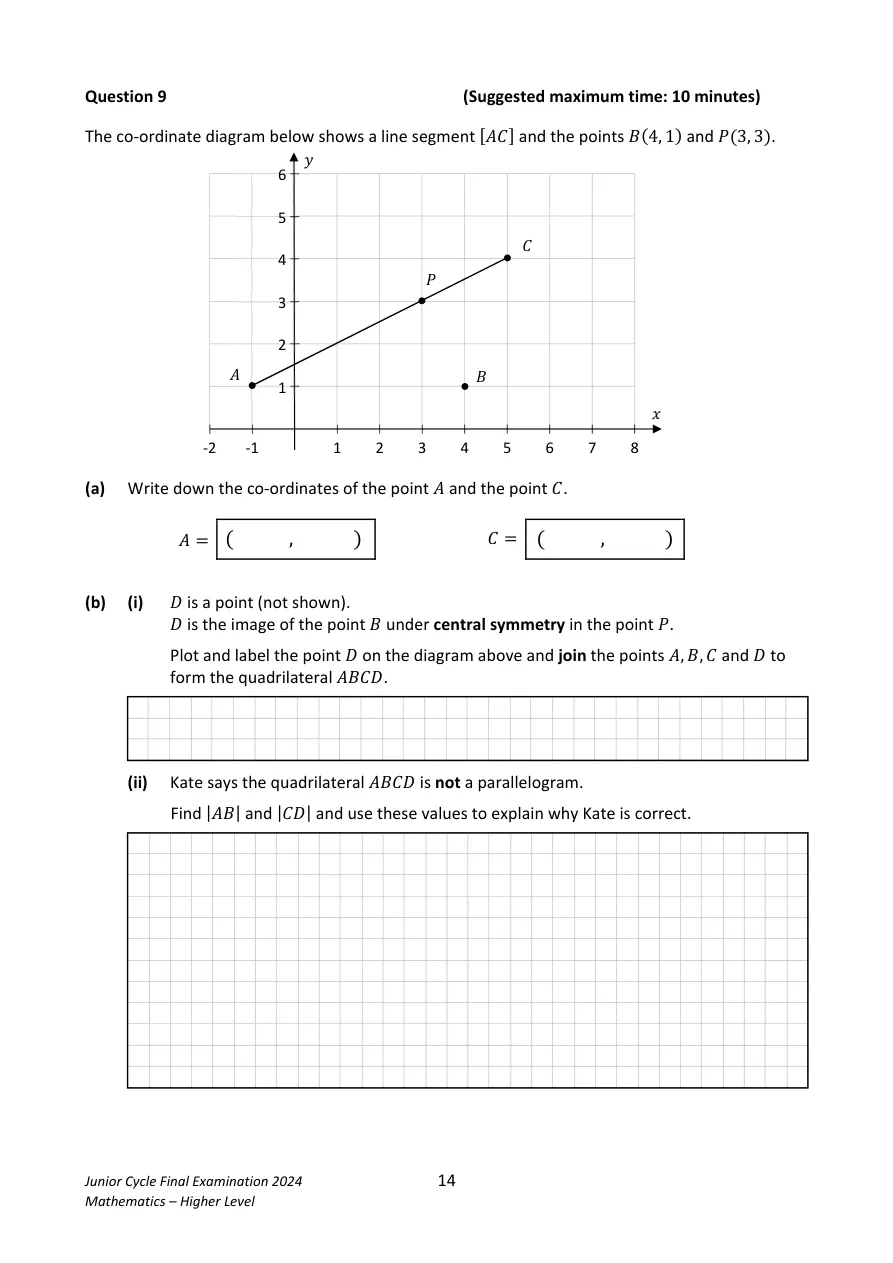
Show solutions
Follow the working below. The original question is unchanged.
a) Coordinates
- A=(-1,1),\quad C=(5,4)
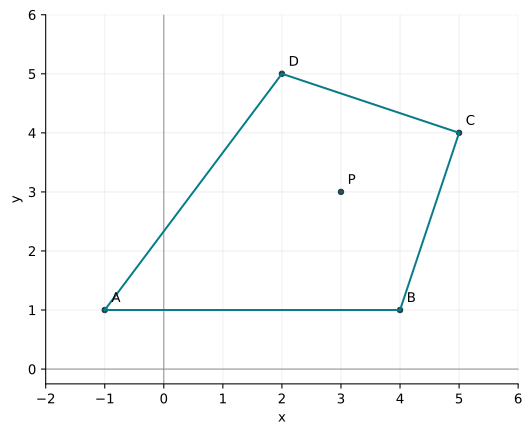
b)(i) Image of B
- D=2P-B
P is the midpoint of BD.
- D=(2(3)-4,\ 2(3)-1)
- D=(2,5)
- Plot D and join A–B–C–D–A, in that order.
b)(ii) Opposite sides
- AB=4-(-1)=5
- CD=\sqrt{(5-2)^2+(4-5)^2}
Subtract the x-coordinates and the y-coordinates separately. Square each difference, add the squares, then take the square root.
- CD=\sqrt{10}
- 5\ne\sqrt{10}
- Kate is correct: opposite sides of a parallelogram must be equal, but AB and CD are not.
See working and diagrams on the original paper
-1,1
5,4
D=2P-B
[P is the midpoint of BD.]D=(2(3)-4,\ 2(3)-1)
D=(2,5)
AB=4-(-1)=5
CD=\sqrt{(5-2)^2+(4-5)^2}
CD=\sqrt{10}
5\ne\sqrt{10}
[Opposite sides would be equal in a parallelogram.]Kate is correct: opposite sides of a parallelogram must be equal, but AB and CD are not.
Teacher sign-in and homework controls
Questions and worked solutions are open to everyone. Use your homework account for teacher controls.
Join a class or open your homework →