2024 · Question 12 · Higher Level
Square patterns
Sequences · Patterns · Quadratic equations
Mixed topics · The selected topic applies to some parts of this whole question.
Open in original paper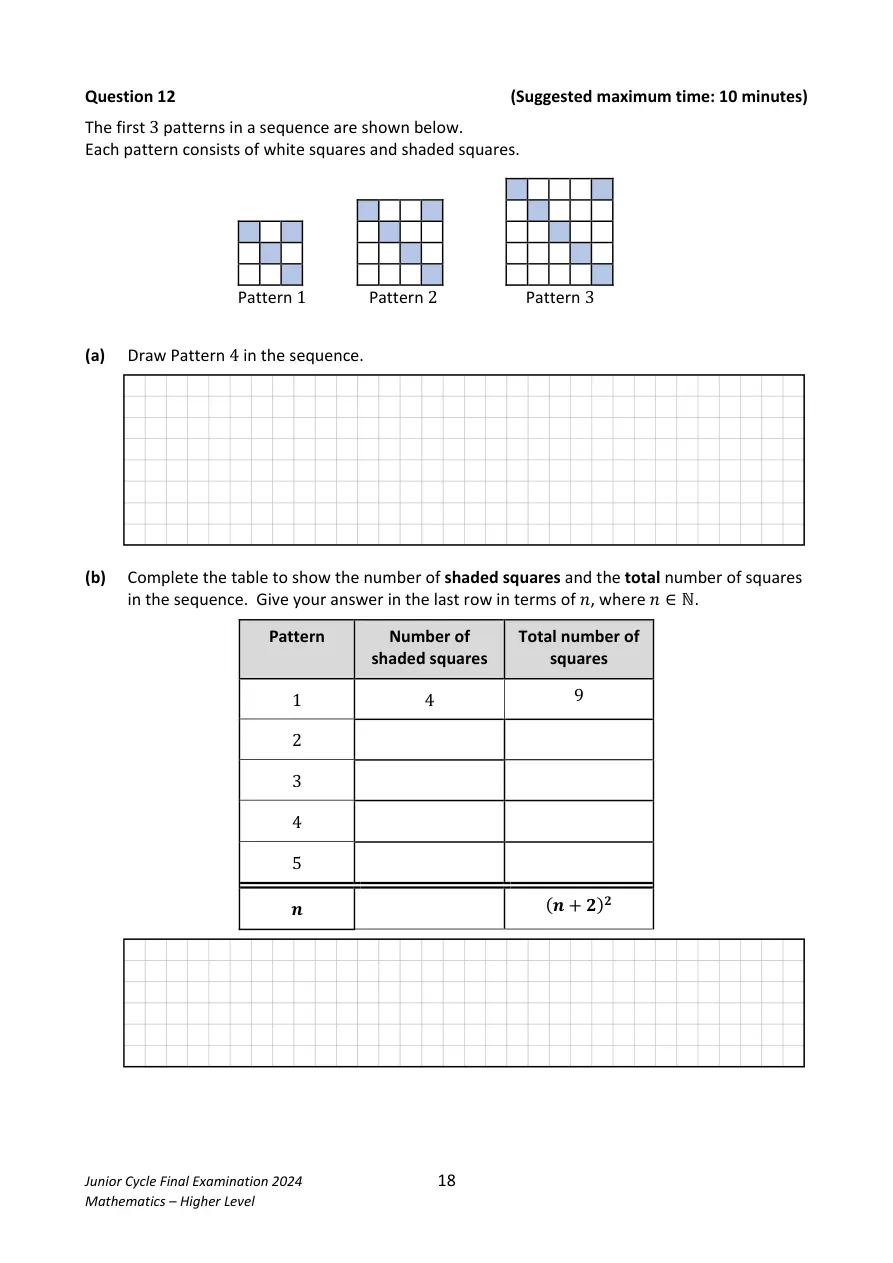
Show solutions
Follow the working below. The original question is unchanged.
a) Pattern 4
- Draw the 6 × 6 grid, continuing the main diagonal and extra upper-right square shading from the preceding patterns: 7 shaded squares in total. See the completed pattern.
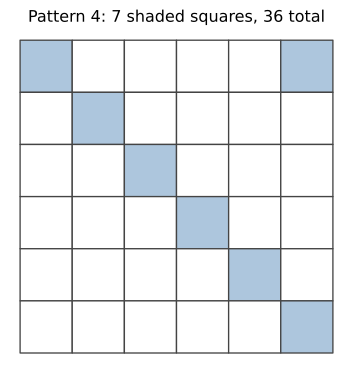
b) Table
- S_n=n+3
- T_n=(n+2)^2
- Rows (pattern, shaded, total): (1,4,9), (2,5,16), (3,6,25), (4,7,36), (5,8,49).
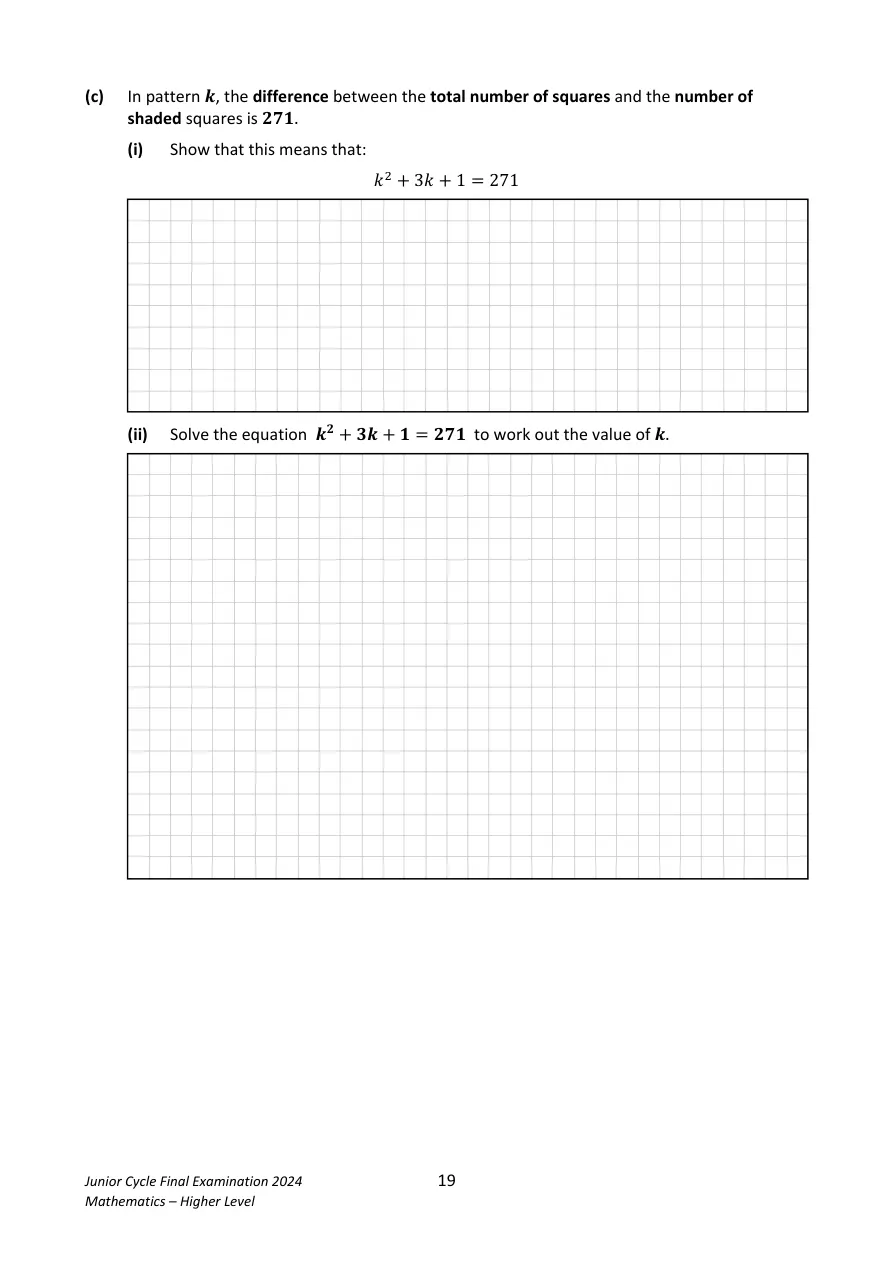
c)(i) Form the equation
- (k+2)^2-(k+3)=271
The exponent applies to the whole bracket.
- (k+2)(k+2)-(k+3)=271
Write the square as the bracket multiplied by itself.
- k^2+2k+2k+4-k-3=271
Multiply each term in the first bracket by both terms in the second, then subtract both terms of (k + 3).
- k^2+4k+4-k-3=271
- k^2+3k+1=271
c)(ii) Solve
- k^2+3k-270=0
- (k-15)(k+18)=0
The product is zero, so at least one of the factors must be zero. Set each factor equal to zero in turn.
- k=15\quad\mathrm{or}\quad k=-18
- k=15
Reject −18 because a pattern number must be positive.
See working and diagrams on the original paper
(k+2)^2-(k+3)=271
[Unshaded = total − shaded.]k^2+4k+4-k-3=271
k^2+3k+1=271
k^2+3k-270=0
(k-15)(k+18)=0
k=15\quad\mathrm{or}\quad k=-18
k=15
[Reject −18: a pattern number must be positive.]Teacher sign-in and homework controls
Questions and worked solutions are open to everyone. Use your homework account for teacher controls.
Join a class or open your homework →