2025 · Question 2 · Higher Level
Sequences and blocks
Sequences · Patterns · Probability
Mixed topics · The selected topic applies to some parts of this whole question.
Open in original paper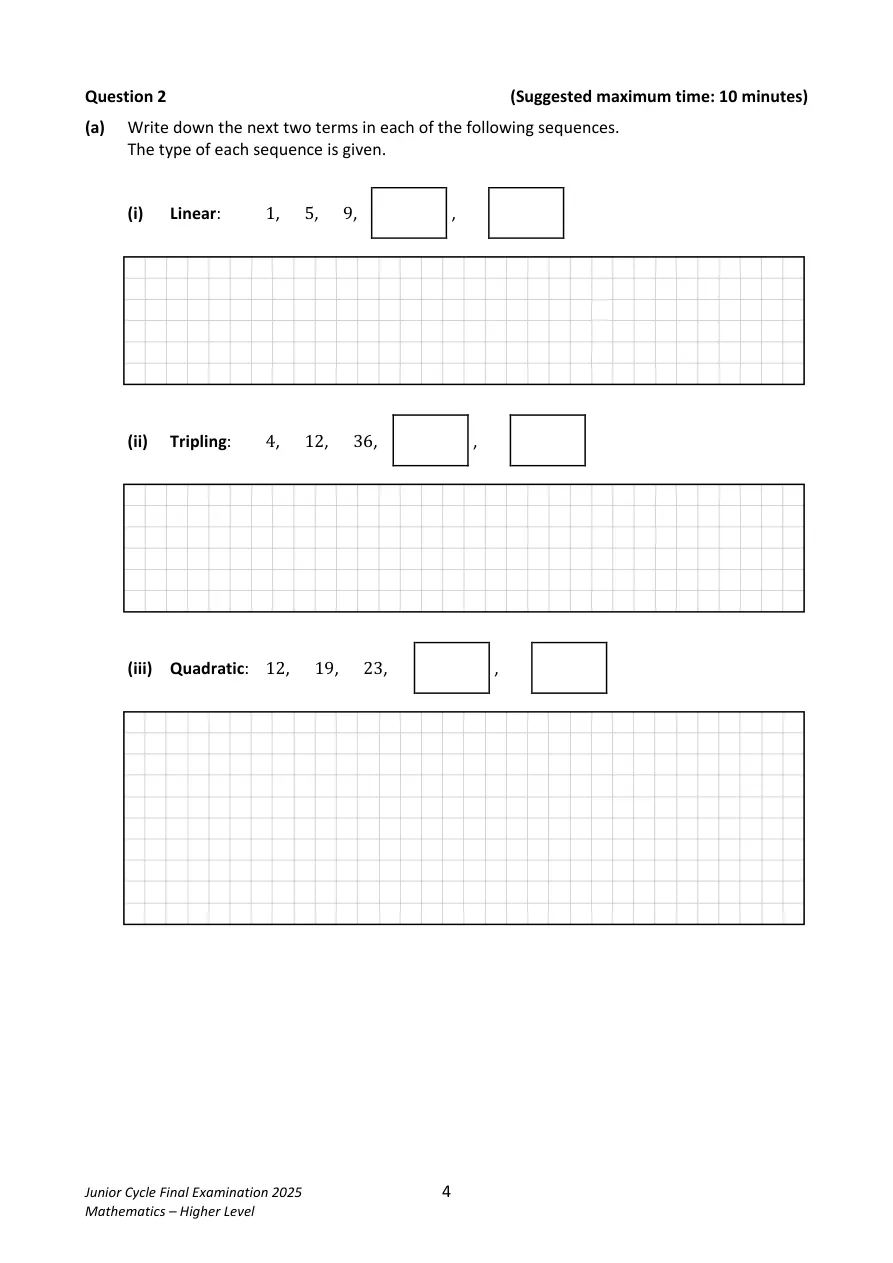
Show solutions
Follow the working below. The original question is unchanged.
a)(i) Linear
- d=5-1=4
- 13,\quad17
Add 4 each time.
a)(ii) Tripling
- 36\times3=108
- 108\times3=324
a)(iii) Quadratic
- \mathrm{First\ differences}:\quad7,\ 4,\ 1,\ -2
The second difference is −3.
- 23+1=24
- 24-2=22
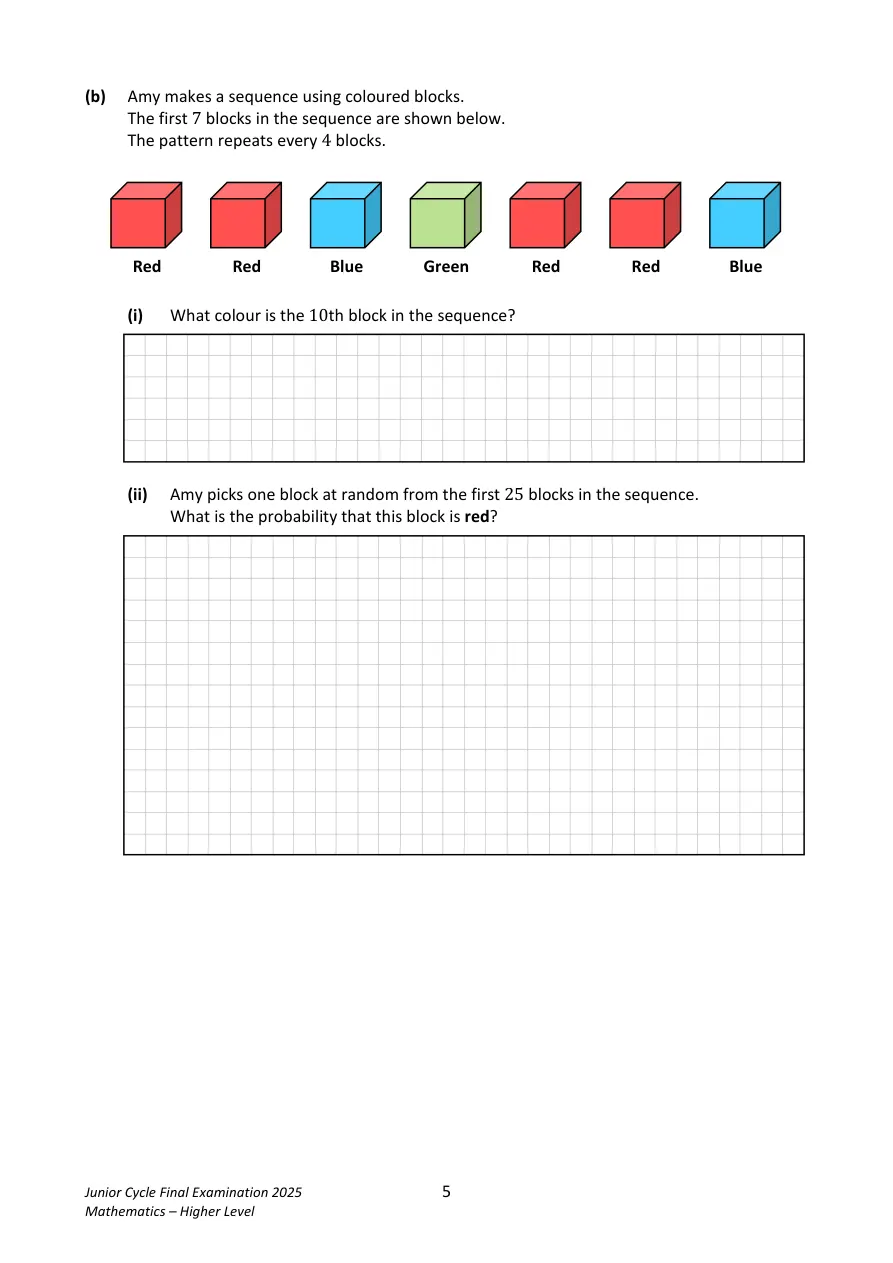
b)(i) Tenth block
- 10=2(4)+2
- The tenth block occupies position 2 in the repeating group, so it is red.
b)(ii) Red probability
- 25=6(4)+1
- N_R=6(2)+1
- N_R=13
- P(R)=\dfrac{13}{25}
See working and diagrams on the original paper
d=5-1=4
13,\quad17
[Add 4 each time.]36\times3=108
108\times3=324
\mathrm{First\ differences}:\quad7,\ 4,\ 1,\ -2
[differences decrease by 3]23+1=24
24-2=22
10=2(4)+2
The tenth block occupies position 2 in the repeating group, so it is red.
25=6(4)+1
N_R=6(2)+1
N_R=13
P(R)=\dfrac{13}{25}
Teacher sign-in and homework controls
Questions and worked solutions are open to everyone. Use your homework account for teacher controls.
Join a class or open your homework →