2025 · Question 6 · Higher Level
Trisection and similar triangles
Constructions · Angles · Similar triangles
Mixed topics · The selected topic applies to some parts of this whole question.
Open in original paper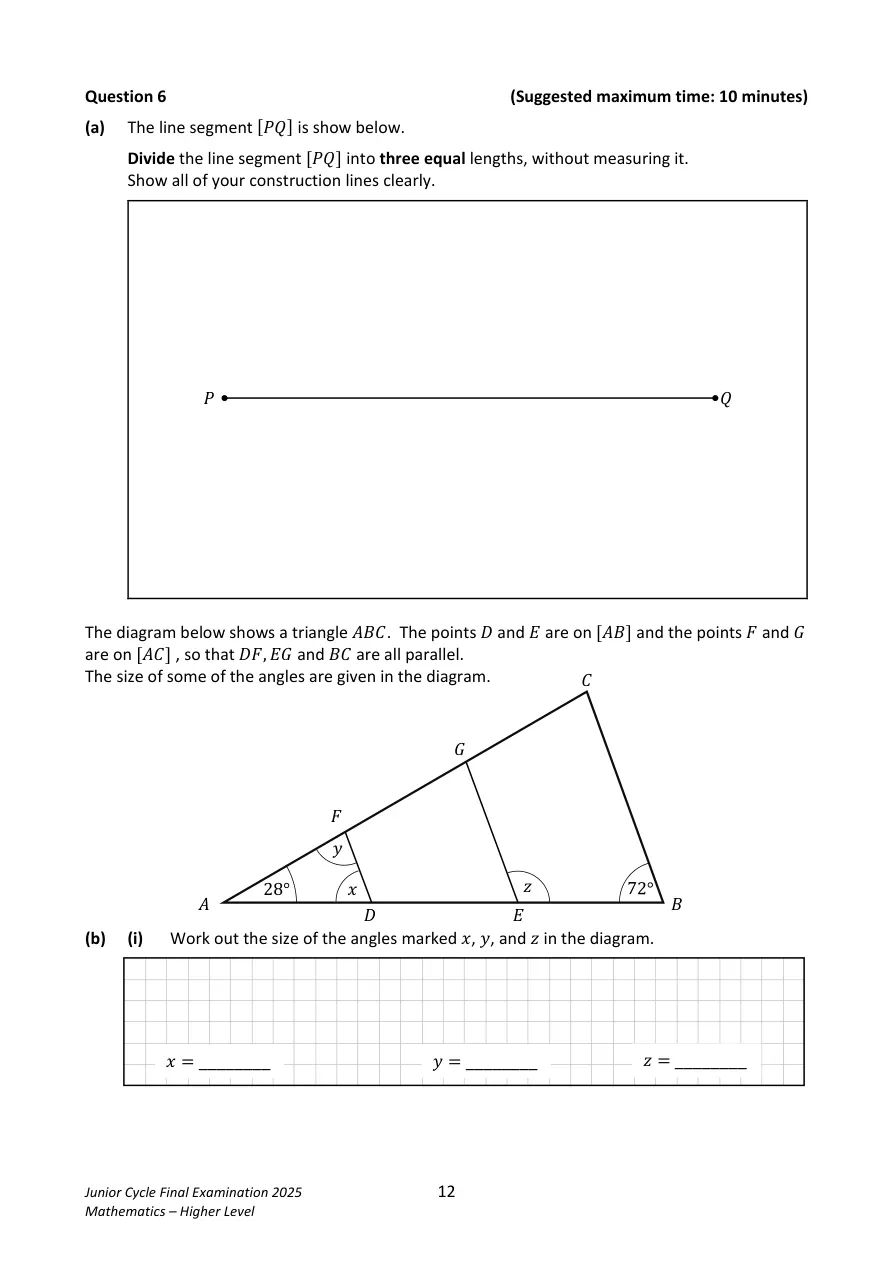
Show solutions
Follow the working below. The original question is unchanged.
a) Divide PQ into three
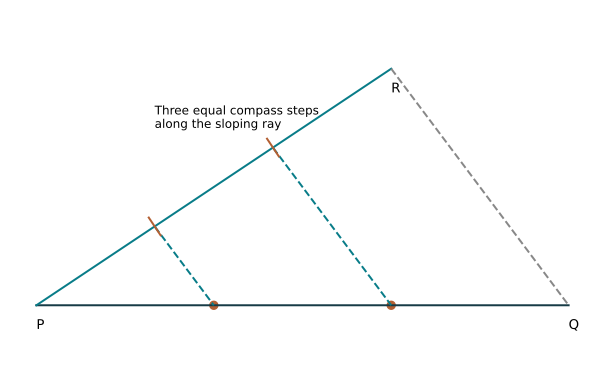
- Draw a ray from P at an angle to PQ. Mark three equal compass steps on it, ending at R. Join R to Q. Through each of the first two marks construct a line parallel to RQ, using equal-angle construction. These meet PQ at its trisection points. Keep construction lines visible; do not measure PQ.
b)(i) Angles
- x=72^{\circ}
Corresponding angles on the parallel lines are equal.
- y=180^{\circ}-28^{\circ}-72^{\circ}
- y=80^{\circ}
- z=180^{\circ}-72^{\circ}
- z=108^{\circ}
b)(ii) Similar, not congruent
- The triangles have equal corresponding angles, so they are similar by AA. Their corresponding lengths differ, so they are not congruent.
c) Length GE
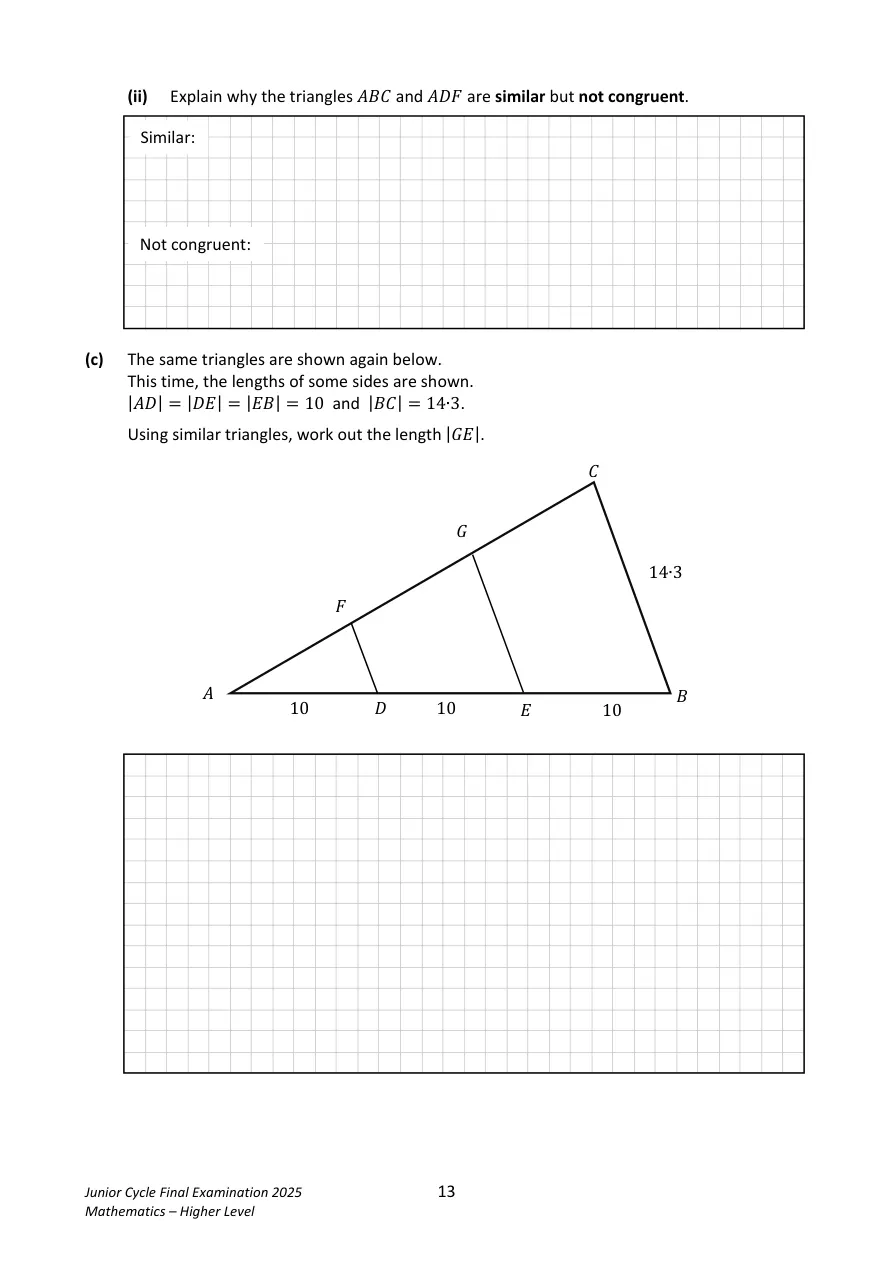
- \dfrac{GE}{14.3}=\dfrac{20}{30}
Corresponding sides have the same scale factor.
- GE=\dfrac{20(14.3)}{30}
- GE=\dfrac{143}{15}
- GE\approx9.533\ldots
Exact fraction is preferable because no rounding was requested.
See working and diagrams on the original paper
Draw a ray from P at an angle to PQ. Mark three equal compass steps on it, ending at R. Join R to Q. Through
each of the first two marks construct a line parallel to RQ, using equal-angle construction. These meet PQ at
its trisection points. Keep construction lines visible; do not measure PQ.
y=180^{\circ}-28^{\circ}-72^{\circ}
z=180^{\circ}-72^{\circ}
The triangles have equal corresponding angles, so they are similar by AA. Their
corresponding lengths differ, so they are not congruent.
\dfrac{GE}{14.3}=\dfrac{20}{30}
[corresponding sides have equal ratios]GE=\dfrac{20(14.3)}{30}
GE=\dfrac{143}{15}
GE\approx9.533\ldots
Teacher sign-in and homework controls
Questions and worked solutions are open to everyone. Use your homework account for teacher controls.
Join a class or open your homework →