2026 · Question 9 · Higher Level
Quadratics and fractions
Quadratic equations · Algebraic fractions · Functions
Mixed topics · The selected topic applies to some parts of this whole question.
Open in original paper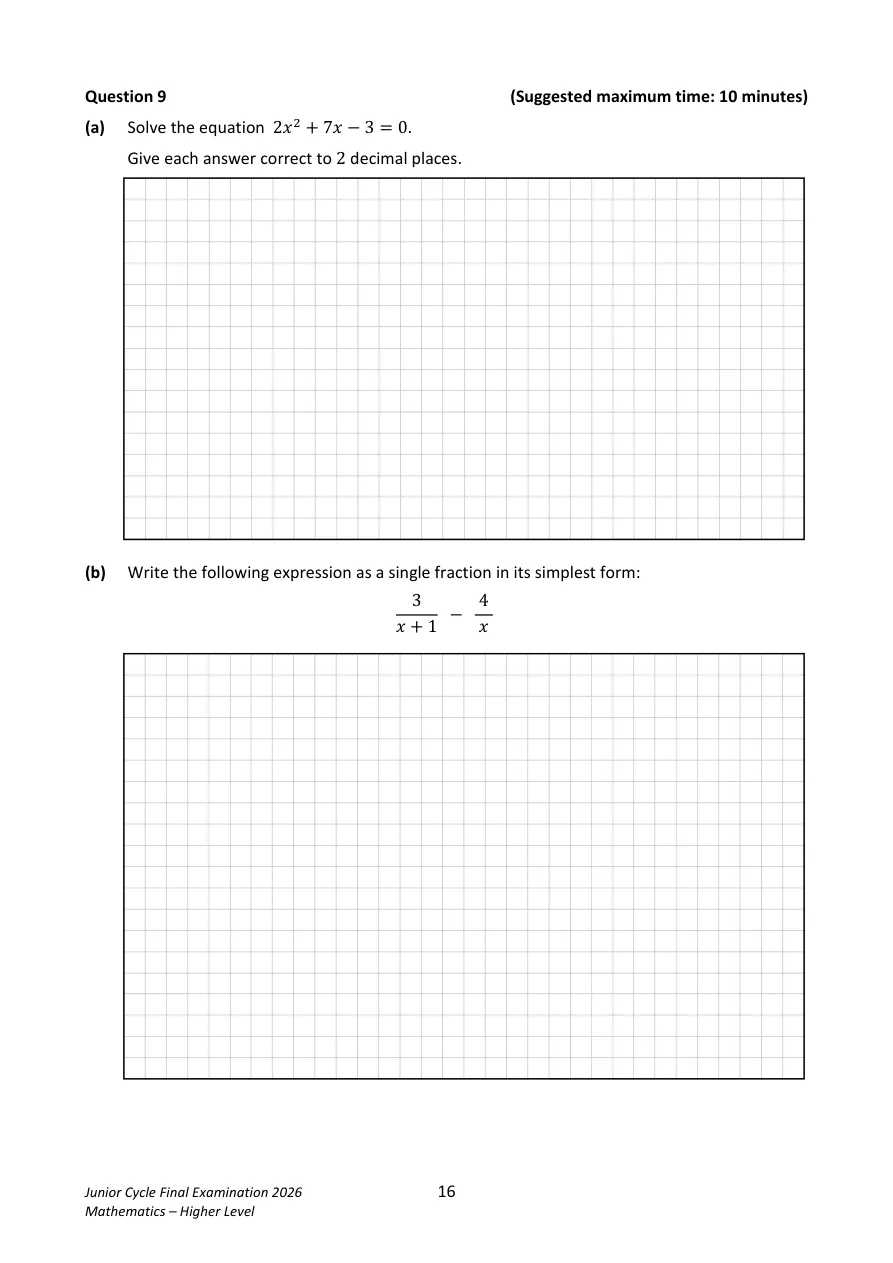
Show solutions
Follow the working below. The original question is unchanged. These 2026 maths answers are independent teacher solutions; an SEC marking scheme has not been obtained.
a) Solve the quadratic
- a=2,\quad b=7,\quad c=-3
a is the coefficient of x², b is the coefficient of x, and c is the constant. Take the signs with the numbers.
- x=\dfrac{-b\pm\sqrt{b^2-4ac}}{2a}
Use the quadratic formula after writing the equation in the form ax² + bx + c = 0.
- x=\dfrac{-7\pm\sqrt{7^2-4(2)(-3)}}{2(2)}
Use brackets when substituting negative numbers, especially when squaring b.
- x=\dfrac{-7\pm\sqrt{73}}{4}
- x\approx0.39\quad\mathrm{or}\quad x\approx-3.89
b) Single fraction
- \dfrac{3}{x+1}-\dfrac{4}{x}
- \dfrac{3x-4(x+1)}{x(x+1)}
- \dfrac{3x-4x-4}{x(x+1)}
- \dfrac{-x-4}{x(x+1)}
- x\ne0,\quad x\ne-1
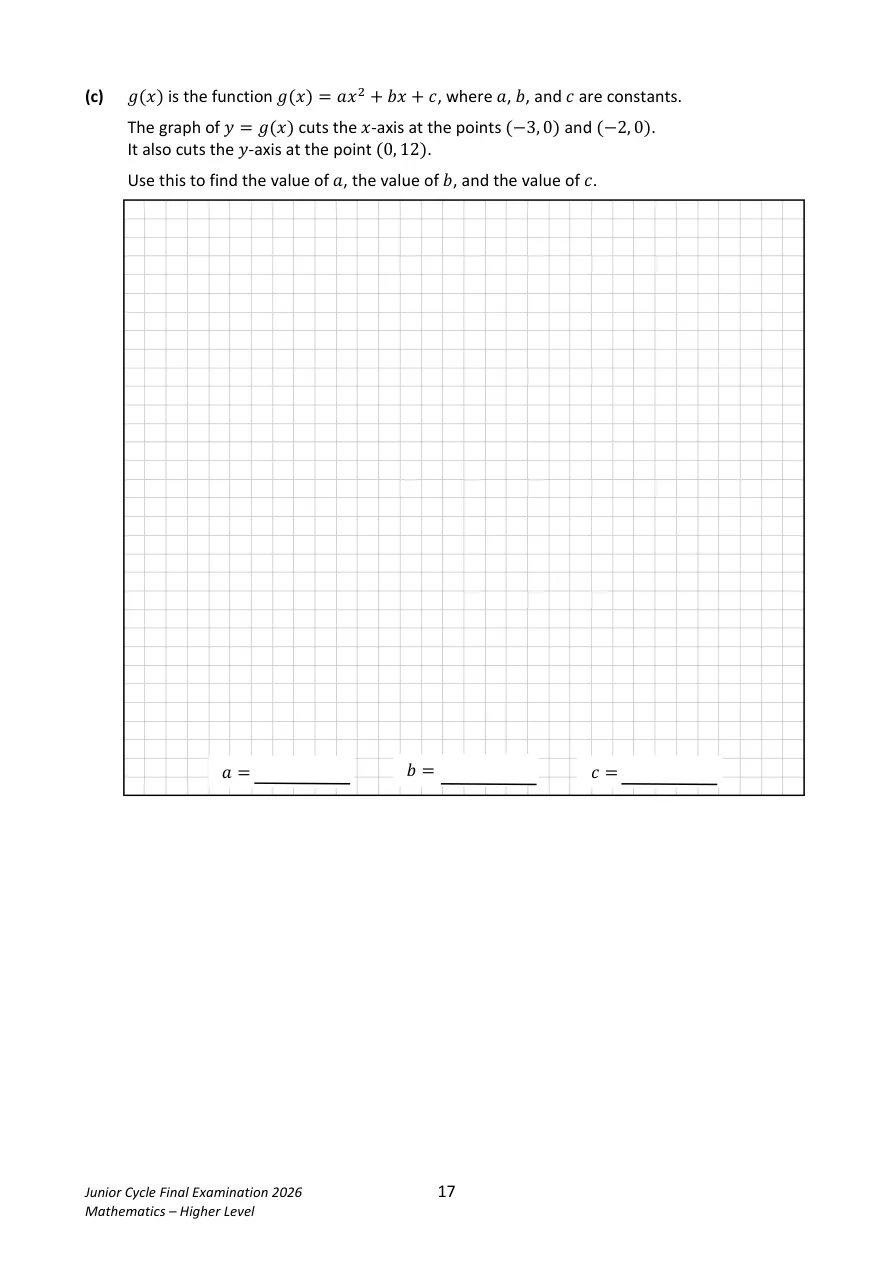
c) Find coefficients
- g(x)=a(x+3)(x+2)
Roots −3 and −2 give the factors.
- 12=a(3)(2)
Use the y-intercept (0,12).
- a=2
- g(x)=2(x+3)(x+2)
- g(x)=2(x^2+5x+6)
- g(x)=2x^2+10x+12
- a=2,\quad b=10,\quad c=12
a is the coefficient of x², b is the coefficient of x, and c is the constant. Take the signs with the numbers.
See working and diagrams on the original paper
Teacher sign-in and homework controls
Questions and worked solutions are open to everyone. Use your homework account for teacher controls.
Join a class or open your homework →